My Husband Let His Pregnant Mistress Drink My Father’s Sacred Wedding Wine — Then I Made One Phone Call

PART 1: The Bottle That Wasn’t Hers to Touch
The smell hit me before the sight did — old cork, dark fruit, and something underneath it that I can only call grief, because that bottle had outlived my father.
I knew the label from across the room. Twelve years wrapped in linen paper, stored behind smoked glass in a cellar my father had built with his own hands before he got too sick to hold a hammer. He had given it to me the night before I married, and he had said one sentence I never forgot: *open this when the marriage has survived long enough to deserve it.*
Delphine Roux was holding it over our dinner table like a prize she’d won at auction.
She wore ivory silk and my mother-in-law’s borrowed diamonds, and she smiled at me the way a woman smiles when she has already been promised your whole life.
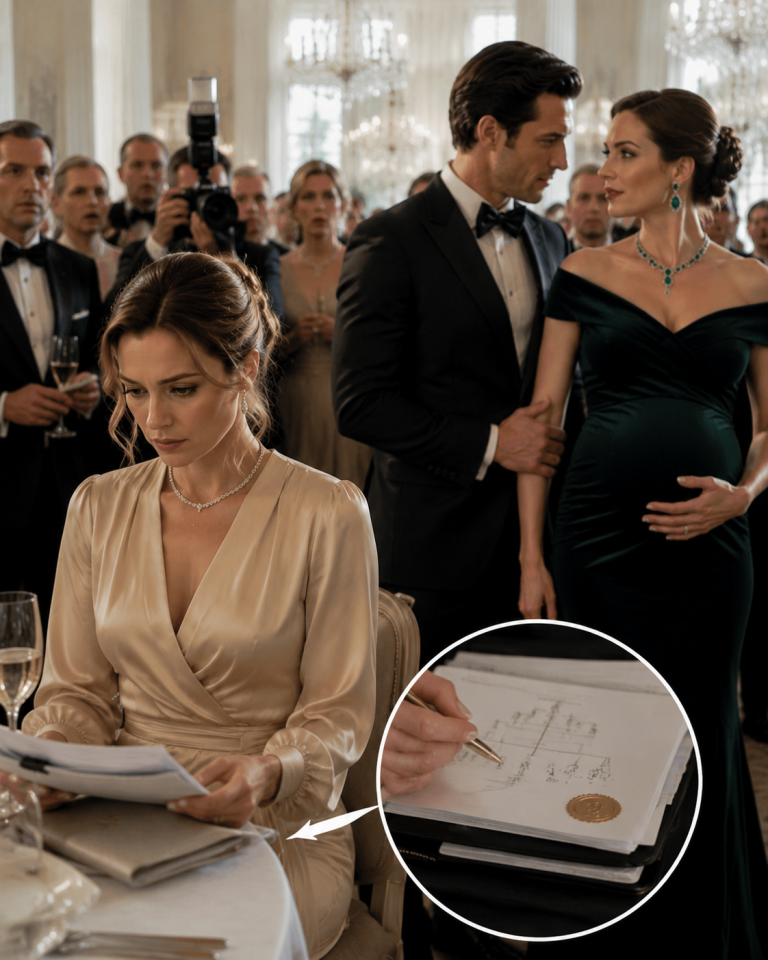
Then she popped the cork in front of forty guests, poured the first glass for my husband, and said, “He told me some promises expire.”
I did not scream. I did not cry. I picked up my phone under the table and typed four words to my lawyer.
*Freeze everything tonight.*
—
Betrayal, I have learned, rarely announces itself with noise. It sounds like a cork sliding free of glass. It sounds like a room full of powerful people deciding, all at once, that silence is safer than decency.
The dining room at Thornhaven had been built a century earlier to make ordinary people feel small. Three arched windows faced the Atlantic; the ceiling had been hand-painted by an Italian artist who died broke in a Brooklyn tenement. The table was French, the flatware English, and the loyalty of everyone seated at it, I was about to learn, was entirely negotiable.
At the head of the table sat my husband, Weston Calloway, heir to a real-estate empire old enough to have forgotten it was built on other people’s money. Beside him sat Delphine, twenty-nine years old, hired eighteen months earlier to redesign our guesthouse in Cortez Bay. I sat to Weston’s right, because a wife belongs on the correct side of a room in public. Delphine sat to his left, because a mistress always mistakes closeness for power.
I was thirty-eight, in black satin and my late mother’s emerald choker, and I had known about the affair for months — the hotel charges, the perfume on his collar, the way he came home already forgiven for something unconfessed.
What I had not known, until the moment Delphine lifted that bottle, was that Weston would let her open the one thing in our marriage that had never belonged to either of us to spend.
My father, Julian Hart, built Hartwell Capital out of a rented office and a refusal to ever be the first person in a negotiation to blink. He never trusted the Calloways, not even at my wedding, not even when Weston cried during his vows and I believed every tear was real.
The night before my wedding, in a cellar, with hands already trembling from an illness none of us named yet, he placed the bottle in my hands.
“A man who loves an audience more than the truth,” he told me, “will eventually humiliate you in front of one.”
I laughed. I told him he was wrong.
He wasn’t.
At the table, Weston’s mother, Constance Calloway, lifted her own glass of my father’s wine without a flicker of hesitation. That hurt in a way I hadn’t braced for. For eleven years I had planned her birthdays, managed her charity boards, and sat beside her hospital bed while her son negotiated real estate in Aspen. She looked at me now like a guest whose invitation had quietly been withdrawn.
“Belle,” she said softly, using the name only family used, “let’s not make a scene.”
I smiled at her. “I agree completely.”
Weston relaxed at that — his greatest mistake of the night, mistaking my calm for surrender.
Delphine set one hand lightly over her stomach, just long enough for the whole table to notice.
“I hope this isn’t awkward,” she said, sweet enough to rot teeth. “Families evolve.”
A bishop at the far end found his plate suddenly fascinating. A senator studied his cufflinks. Nobody chose decency over comfort — and I understood I’d just been handed something valuable: a witness list.
Weston set down his glass. “Belle, we can talk about this privately.”
“Can we?”
“Don’t do this here.”
I looked at the wine — my father’s last gift, meant for the anniversary we once promised to celebrate barefoot — spreading dark against crystal in another woman’s hand.
“Did he tell you where that bottle came from?” I asked her.
Her smile flickered, just once. “He said it was special.”
“It was.”
I looked at my husband, and for the first time all night I let him see exactly how still I could be.
“Weston,” I said. “Did you give her the cellar key?”
His jaw tightened. “It’s my house.”
Three words. That was the sentence that ended him — not legally, not yet, but somewhere quieter and more permanent. Everyone at that table heard the arithmetic underneath it. *My house. My cellar. My wine. My rules.*
I set my phone face-down on the tablecloth.
“Actually,” I said, “no, it isn’t.”
The room went from polite to frightened in the space of one breath.
Weston laughed, low and cruel. “You’ve had a shock and too much wine. Don’t embarrass yourself.”
“I haven’t touched a drop.”
I looked at Delphine’s glass, half-empty now, her lips still stained faintly red.
“She has.”
Delphine’s chin lifted. “Are you threatening me?”
“No,” I said, reaching for my clutch. “I’m documenting you.”
That was when the butler appeared in the doorway, and Weston’s face changed before he even understood why.
“Mrs. Calloway,” Walter said, “your guests have arrived.”
Weston blinked. “What guests?”
I rose from my chair.
“My attorneys.”
PART 2: The Trust He Never Read Twice
Three lawyers do not look dramatic walking into a dining room. They look like people who stopped feeling fear years ago.
Adrienne Voss came first, folio already open. Behind her, Marcus Lin. Last, Elias Ford — the attorney my father had trusted with a clause everyone else assumed was decorative.
Weston recognized Adrienne instantly. “What the hell is this?”
“Good evening, Mr. Calloway,” she said.
Constance went pale. Delphine looked from face to face, finally understanding that humiliation could change direction mid-sentence.
Adrienne set a single document beside the ruined bottle. “This residence belongs to the Wren Hart Legacy Trust.”
Wren. My daughter’s name. The daughter we lost at twenty-two weeks, the daughter Weston had stopped mentioning years ago because grief made investors uncomfortable at dinner.
“You never asked what happened to this house after your family defaulted on it,” I said.
*Defaulted.* The word cracked through that beautiful room like a dropped glass.
Marcus Lin slid a folder forward. “Calloway Holdings paid Roux Design Studio two-point-four million in eighteen months. Not all for pillows.”
Then Elias unfolded the page Weston had barely skimmed a decade earlier. “Any public affair inside a marital residence, combined with misuse of trust funds, triggers immediate suspension of shared financial access.”
“That’s unenforceable,” Weston said.
“Your own counsel approved it,” Elias replied.
“Promises expire,” I said, echoing Delphine’s own words back at her. “Signatures apparently don’t.”
Adrienne looked up. “As of tonight, every joint account tied to Hartwell Capital is frozen. Cortez Bay. The Aspen escrow. The aircraft.”
Constance’s hand flew to her chest.
“You can’t just cut me off,” Weston said, his voice suddenly thin.
“So do bank privileges,” I said.
Delphine shot to her feet, reaching for her clutch. Walter stepped into her path.
“Ma’am,” he said, “the earrings.”
Her hand flew to my mother’s diamonds, still fastened to her ears.
“These were a gift,” she said.
“From whom?” Adrienne asked.
Delphine looked at Weston. Weston studied the tablecloth.
Delphine unclasped the earrings with shaking hands and set them beside the ruined bottle.
Then she turned back to Weston, eyes glassy with fury, and said the six words that would end whatever fragile alliance they had left.
“I’m carrying your child, Weston.”
The room went utterly silent — and in that silence, Weston’s eyes snapped toward her with an expression I had never once seen him wear in eleven years of marriage.
Suspicion.
PART 3: The Room I Kept
“How far along?” I asked her, because someone had to.
Delphine lifted her chin, still certain motherhood was a crown she could wield against me. “Fourteen weeks.”
Weston’s head turned sharply. “You told me twelve.”
Her face drained. “I rounded.”
Adrienne wrote something in her notes without looking up. I said nothing. A woman does not need to decorate a moment like that with cruelty; the moment decorates itself.
Elias placed a sealed envelope on the table, and Weston stared at it like it might detonate.
“What’s that?”
“A filing packet,” Elias said. “For divorce.”
Weston’s mouth opened, closed, opened again. “Belle. Stop this.”
Not an apology. A command. He stepped toward me, and I did not move, because I had learned in the last hour that stillness was its own kind of armor.
“You humiliated me in my own dining room,” I said.
“You forced my hand.”
“You brought her.”
“We were already over,” he snapped. “You disappeared after Wren died. You turned this house into a museum for grief. You think a man survives on silence and memorial plaques?”
The room inhaled as one. Even Constance flinched.
I let the words land, let them sit in my chest exactly where they were aimed. Then I answered.
“Our daughter died,” I said. “You got bored.”
Something like real shame flickered across his face — the first honest thing I’d seen from him in a year — and for one unguarded second I saw the boy who had cried during his vows under the oak trees, the one who used to promise we’d open that bottle barefoot in a kitchen somewhere, old enough by then to have forgiven each other for being young. Then the shame vanished, replaced by the old practiced anger, and the boy was gone with it.
“You think the board will let you do any of this?” he said.
“That’s tomorrow’s problem,” Marcus Lin said mildly, and Constance was the first to understand what he meant. Her eyes found mine, and for once there was no performance left in them at all.
“Eleanor — Belle — what have you done?”
I picked up the empty bottle. It was lighter than it should have been. Some losses, I was learning, can only be measured by what’s left behind.
“I read what my father left me,” I said. “Finally.”
—
That night, after every guest and every lawyer had gone, I sat alone in the blue salon and let myself remember things I had spent years being too busy to remember.
I had not married Weston Calloway for his money. That was the story his family preferred, because it made everything simpler — the ambitious girl from Charlotte, the elegant nobody with good manners and a useful inheritance, rescued by a Calloway. In their version, Weston saved me. In the real version, my father saved them.
Calloway Holdings had been bleeding money the year we met — overleveraged hotels, a stalled waterfront project, lenders circling like well-dressed sharks. Weston was handsome and desperate in equal measure, and I was twenty-eight, freshly grieving my mother, and foolish enough to mistake his need for depth. He proposed in a sculpture garden. Nine months later my father quietly arranged the bridge financing that kept the company alive. Constance called it a private family matter. My father called it leverage. He never trusted love without paperwork, and I had resented him for that once. I worshipped him for it now.
The prenuptial agreement my father’s attorneys drafted ran two hundred pages. Weston barely read it; his own lawyers were too busy protecting art collections and voting shares to notice the quieter clauses — the ones concerning conduct, concerning misused funds, concerning infidelity tangled up with financial fraud. He’d mocked it over bourbon the night we signed. *Your father thinks I’m running for office,* he’d said. I told him my father simply believed people revealed themselves eventually.
For years I made myself useful in ways the world credited to Weston instead. I hosted, I remembered names, I turned scandals into non-stories and empty buildings into places people wanted to photograph. When his CFO resigned mid-crisis, I found the replacement. When his mother insulted a mayor’s wife, I sent the apology flowers before breakfast. Our best years as a company were not the years Weston became brilliant. They were the years I made his chaos look curated, and no one wrote a single magazine profile about that.
Then came Wren.
She existed for twenty-two weeks and one day before her heart simply stopped, in a hospital room where the machines turned grief into numbers on a screen. Weston cried; I do not take that away from him. For a while we slept like survivors on a raft, facing each other in the dark. Then grief became inconvenient, and so, slowly, did I. He went back to meetings and golf and Aspen. Constance suggested I “put the nursery away.” I did. He suggested we try again when things settled. We never did.
The wine had moved through every one of those years with us — Boston to Manhattan, Manhattan to Seacrest, Seacrest to Cortez Bay for winter and back again. Every time it arrived in its padded crate, I checked the seal myself and thought of my father standing in that cellar with trembling hands. He died six years into the marriage. Weston gave a beautiful eulogy, then took an investor’s call standing beside the open grave. I forgave that too. Women are trained to call self-erasure grace.
By the time Delphine Roux walked into our lives with her fresh eye for guesthouse tile, I had absorbed so many small cuts that the wound simply looked like weather.
—
The board meeting happened four days later in a glass tower over Bryant Park, in a room where I had once hosted dinners and never once appeared on the wall of magazine covers celebrating Weston as “the man reshaping American luxury.” Nine directors sat around a table while Marcus Lin walked them through eighteen months of shell invoices, hidden renovation costs, and covenant violations that could trigger lender review across four states.
But first, that morning, over tea in the blue salon, Constance had made one final attempt.
“This has gone far enough, Eleanor,” she said, using my full name the way she always did when she wanted me small. “You are hurt. I understand that. But you cannot dismantle an entire family because Weston behaved foolishly.”
“Foolishly.”
“You know men.”
“Unfortunately, yes.”
“Delphine is temporary,” Constance said. “If the child had been his, arrangements could have been made. You remain Mrs. Calloway publicly. He provides privately. She is settled elsewhere.”
I almost admired the efficiency of it — the old aristocracy distilled into a single sentence. Sin managed. Women replaced. Children arranged.
“You want me to become wallpaper,” I said.
“I want you to be realistic.”
“I am,” I said, setting down my cup. “That’s why your son’s access to every dollar of Hartwell-backed liquidity ended two nights ago.”
Her composure finally cracked. “You would destroy what generations built?”
“No,” I said. “I’m stopping your son from destroying what my father saved. I was never one of you, Constance. You’re right about that.”
“Then what gives you the right?”
I looked toward the window, where fog was pressing itself flat against the glass. “I paid retail.”
—
By the time we reached the glass tower over Bryant Park that afternoon, nine directors were already seated, and Weston had spent the whole flight down trying to rally them one by one. He told one that I was unstable. He told another I was grieving, that this was a domestic matter dressed up as a crisis. It didn’t work. Grief and instability rarely survive an ownership chart.
Marcus Lin walked the room through eighteen months of shell invoices, hidden renovation costs, and covenant violations severe enough to trigger lender review across four states. Then came the chart itself. Calloway family bloc, thirty-one percent. Independent investors, twenty-four percent. Hartwell-aligned holdings, twenty-two percent. The Wren Hart Legacy Trust, fifteen percent.
Thirty-seven percent, combined, sitting quietly in my name.
“You activated the warrants,” Weston said, staring at the number like it had betrayed him personally.
“You signed them,” I said. “Ten years ago. At midnight. After two bourbons and a promise nobody would ever let them convert.”
“This is insane. You’re my wife.”
“I was your wife,” I said, “when you toasted your mistress with my father’s wine.”
The vote to suspend him as CEO passed six to three. Constance voted no with a stare that could curdle cream. Everyone else chose survival.
The divorce became public three days after that dinner — not because I leaked it, but because Weston’s own attorneys filed a motion to regain access to the Cortez Bay property before lunch, and the docket did the rest by dinnertime. Reporters started calling me the Wine Wife, and I hated it for exactly four hours, until Talia showed me what people were actually saying online. *She opened the wine. The wife closed the vault. He toasted the mistress. She toasted the audit committee. Never betray a woman whose father loved contracts.* I laughed so hard I had to sit down on the bathroom floor of my apartment and cry into a towel, not because any of it was funny, but because a body will find any exit for grief it can.
Delphine vanished from public view for two weeks, then returned with a black-and-white photograph and a caption about choosing peace. The internet chose something closer to judgment. I never commented. Silence, Adrienne told me, reads as elegant. Talia told me it reads as algorithmic gasoline. They were both right, and it didn’t matter either way, because the numbers had already stopped needing my help.
He caught my wrist as I left the boardroom, in front of every camera and every director still gathering their coats.
“Belle. Please.”
*Please.* The word he should have used before the cork ever left that bottle. It arrived eleven years and one funeral too late.
“Call your attorney,” I told him, and walked out past the wall of magazines that had never once had room for my name.
—
The Wren’s Light gala happened anyway, three weeks later, at a hotel ballroom in Manhattan, because Talia insisted cancelling would look wounded and Adrienne insisted attending would look reasonable, and both of them were right. I wore deep green velvet and my mother’s earrings, retrieved from the safe that very morning. Weston arrived alone, thirty minutes late, his face composed and his eyes ruined. Constance came behind him in black. Delphine did not come at all — pregnancy, real or not, made a convenient excuse when consequences started wearing gowns.
He found me in the hallway afterward, beneath a painting of some forgotten man on a horse.
“You’re enjoying this,” he said.
“No,” I said. “I’m enduring it well.”
“Sloane means nothing to me.”
“She opened my wedding wine.”
“She’s carrying my child.”
“Is she?” I asked, and something in his face flickered — a doubt he hadn’t let himself say aloud yet, not even to his own attorneys. He ran a hand through his hair.
“I don’t even know anymore,” he admitted. “She said fourteen weeks that night, but the timing never — ”
“Stop,” I said, and he did, because for once I think he understood there was nothing left to gain from finishing that sentence.
“I loved you,” he said instead.
I believed that. That was the tragedy of it. Weston had loved me the way selfish people love — sincerely, but only for as long as it cost him nothing.
“I loved you too,” I said, and turned back toward the ballroom, leaving him beneath the painting of the man on the horse, alone with whatever he’d finally allowed himself to doubt.
—
Weston asked, near the end of the mediation, for a private moment. Adrienne objected. I said yes anyway, because I knew him well enough to know he had one last performance left in him, and I wanted it finished.
We stood at opposite ends of a small room with no view. He looked tired in a way that had nothing to do with performance for once.
“I’m sorry,” he said. “I know that’s not enough.”
“It isn’t.”
“I thought you’d forgive me. You always did.”
There it was — the autopsy of our marriage in five words. *Because you always did.*
“I taught you badly,” I said.
“I wanted to hurt you,” he admitted, and his voice cracked in a way I hadn’t heard since the hospital. “I wanted you to react. To admit you still cared. I didn’t know about Sloane’s — about Desmond. I wanted you to be jealous, and I used Wren’s dinner to do it, and I hate myself for it.”
“You used my father’s wine.”
“I know.”
“Is there any part of you that forgives me?” he asked.
I thought about it honestly, because I owed myself that much. “I don’t want to spend my life hating you,” I said, and watched hope flicker across his face before I let it die gently. “But I won’t spend another day married to you.”
He nodded, crying without trying to hide it now, and reached into his jacket. He set something small on the table between us — the cork, stained dark at one end, my father’s handwriting still visible along the side: *for the twentieth, if he earns it.*
“I don’t know why I kept it,” he said.
“He knew,” I whispered, grief blurring the room for one unguarded second.
“No,” I said, steadying myself. “He prepared.”
We signed the settlement three weeks later, on a clear, cold morning in late October. I kept Thornhaven, because it had never belonged to him. I kept the Wren Hart Legacy Trust, because my daughter’s name did not belong inside a divorce decree. I kept my mother’s earrings, retrieved from an evidence envelope and returned to the box where they’d always lived.
—
The paternity results had arrived that same season, in Adrienne’s office overlooking Park Avenue. Delphine’s baby was not Weston’s. It belonged to his own cousin, Desmond Calloway — a fact that surfaced through an email account she had carelessly billed to a corporate card during discovery. Men always assume women grow careless with emotion. They forget mistresses send emails too.
I did not celebrate, though people expected me to — they wanted rage from me, wanted a champagne-soaked victory lap for the cameras. Instead I told Adrienne to keep the child’s name out of every press inquiry that came in. Whatever her mother had done, whatever her father hadn’t, the baby had done nothing at all to deserve any of it.
Months later, I stood in the doorway of the old nursery at Thornhaven with my assistant, Talia, beside me. For years the door had stayed shut except when housekeepers dusted the grief inside it. The crib was gone now. The walls were pale rose. A new rocking chair sat by the window.
“You don’t have to do this today,” Talia said gently.
“I know,” I said. “That’s exactly why I can.”
We turned the room into a free suite for families with babies in the NICU at Seacrest General. The first mother arrived that June — twenty-two years old, exhausted, her son barely three pounds. She stood in my foyer clutching a diaper bag, staring up at the chandelier as though she’d wandered into the wrong building.
I took the bag from her. “You’re not a guest here,” I told her. “You’re safe.”
That night I heard her crying softly through the nursery door — not dramatic crying, the quiet kind grief makes when it thinks no one is listening. I didn’t knock. I left tea outside the door instead. Warmth doesn’t always need a witness.
—
A year after the dinner that ended my marriage, I hosted the Wren’s Light Foundation gala again at Thornhaven — same dining room, entirely transformed. Lighter now. Less afraid. No senators who’d watched my humiliation and mistaken silence for consent. Just doctors, nurses, and the families who’d slept in that reopened nursery.
Before dessert, I stood to speak, the way I did every year, and the room went quiet beneath the same chandeliers that had once watched me fold a napkin instead of screaming.
“Eleven years ago,” I began, “I married into a family known for building beautiful rooms. I learned, eventually, that rooms remember — vows, arguments, celebrations, and the names we stop saying out loud because grief makes other people uncomfortable.”
I found Weston’s absence in the crowd and let it steady me rather than hollow me out.
“This foundation carries my daughter’s name. Wren never saw this house. She never heard the ocean past that lawn. For a long time I thought honoring her meant staying quiet about her. I was wrong. To every parent who has left a hospital with empty arms — you are not an inconvenient chapter other people are allowed to skip.”
A woman in the front row wiped her cheek. I announced the matching gift, watched the number land the way large numbers always do in rooms like that, and sat back down to applause I didn’t need but was grateful for anyway.
At the center of the table that night sat no wine at all. Only white roses in low silver bowls, so that everyone could see each other clearly.
Constance sent one note in the weeks after the settlement, on heavy cream paper, the only handwriting I ever saw from her that wasn’t performing for someone. *Eleanor — I was cruel because I was afraid you were stronger than us. I was right. — C.* I read it twice and put it in a drawer. Not every apology needs a ceremony built around it.
Delphine wrote too, months later — a long email, far too long, about being young and lonely and manipulated and sorry. Some of it may have even been true. I didn’t answer. I was no longer in the business of managing other people’s exits. Desmond and Delphine’s daughter was born that December; Weston sent nothing, which told me everything I still needed to know about the limits of his remorse. I sent an anonymous donation to a neonatal fund in the baby’s name instead, quietly, the way my father would have done it.
Weston remarried the following spring, someone I’d never met, and moved west to start a boutique advisory firm with a name that sounded like a scented candle. I wished him discipline. It was the most generous thing I had left to give. Constance stayed in Boston after that and stopped speaking to me publicly, though the holiday cards kept coming, civil in the particular way old families define civil — no warmth in them, but no knives either.
I kept Thornhaven. I kept my mother’s earrings and my father’s cork, sealed now in a small silver box on the cellar’s emptiest shelf — not to worship what was gone, but to mark exactly where the vacancy sat. I kept the reading room I built where his hunting prints used to hang, and the photographs by women artists that replaced them. I kept the nursery that was no longer a shrine to what I’d lost, but a room where other people’s children were, for a few frightened weeks, safe.
Later, alone in the kitchen after the guests had gone, I opened a bottle from a small vineyard in California — not rare, not expensive, run by a widow who had started over at forty-five with three acres and one lawsuit behind her. The label read, in small gold letters, *First Light.*
I laughed out loud when I first saw it, because life is rarely subtle when it finally decides to be kind.
Talia was stealing leftover cake at the counter. Adrienne had kicked off her shoes an hour earlier. Two of the NICU doctors were arguing cheerfully with Walter about coffee. Nobody in that kitchen looked curated, and nobody looked like a magazine cover, and everyone looked, for the first time in longer than I could measure, entirely alive.
“Special occasion?” Talia asked, nodding at the bottle.
“Not an anniversary,” I said, reaching for the corkscrew.
“What, then?”
I looked around the kitchen I had once imagined opening wine in with Weston, decades from now, softened by time we never got. He was gone. That old promise was gone with him. The room itself remained. So did I.
“A beginning,” I said.
I poured one glass for myself, and two more I set beside the roses — one for my father, one for the daughter who had given this house its true name.
Then I carried my own glass past the kitchen window, where the Atlantic rolled black and steady beyond the lawn, the same ocean that had watched my wedding, my daughter’s funeral, and the night a stranger poured wine that was never hers to pour. It hadn’t changed. Neither, in the ways that mattered, had I. Betrayal hadn’t made me stronger. It had only revealed who had been spending my strength without ever once asking permission.
I lifted my glass to the empty room.
“To promises that keep themselves,” I said.
This time, the first glass was mine.
THE END.