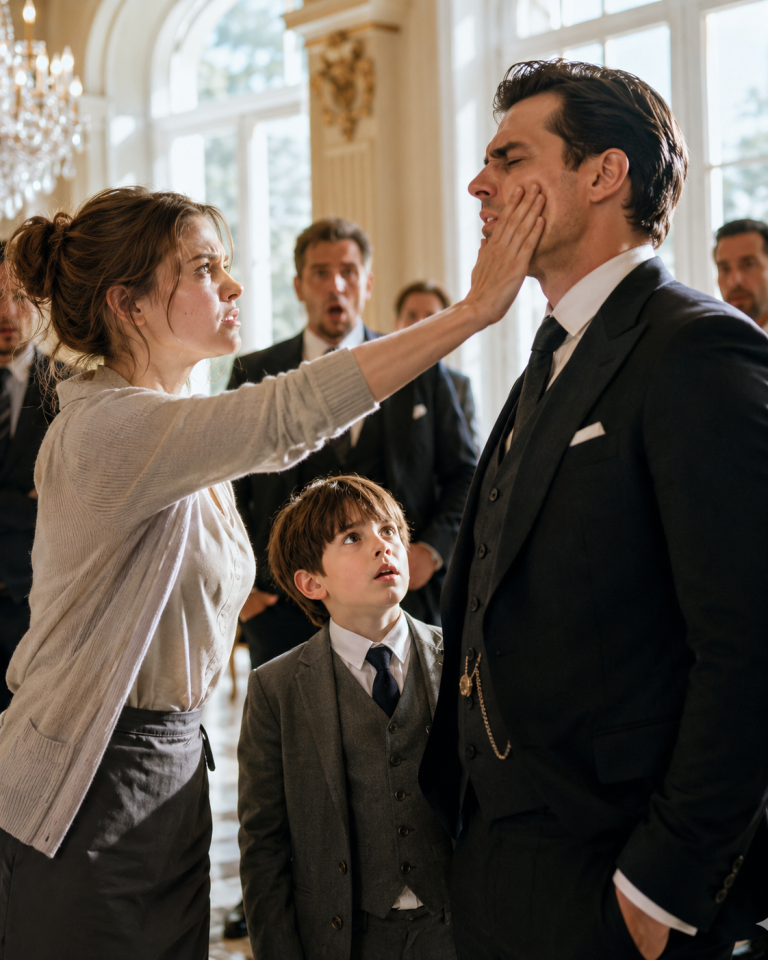
She Walked Away After Catching His Mistress in Their Home — Then the Billionaire Lost Everything He Took for Granted


—
## PART 1
Evelyn Carter had not planned to come home early. The conference in Boston had run two days short — a keynote speaker so aggressively tedious about disruption that the whole event had quietly deflated by Thursday afternoon. Her colleague caught a six o’clock flight. Evelyn sat in the hotel bar with a glass of wine she never finished, before deciding an empty hotel room in Boston was worse than her own bed in Manhattan.
She hadn’t texted Nathan. That wasn’t unusual. He had a habit of answering four hours late with one word, sometimes two, and she’d stopped expecting otherwise sometime around the third year of their marriage. *Focused. Driven. Always three chess moves ahead on whatever deal was consuming him that week.* Nine years of telling herself that had made the explanation feel almost like truth.
The apartment building on East 74th was quiet at 11:30 on a Thursday night. Pedro at the front desk waved without looking up. The elevator hummed. Evelyn leaned against the back wall, carry-on at her feet, feeling the particular low exhaustion that lived somewhere behind the sternum with no clean remedy.
She heard the music before she reached the door. Low, ambient — not Nathan’s taste, which ran toward silence or financial news radio. A woman’s voice, barely audible. Evelyn stood in the hallway a moment, key in hand, almost talking herself into a story. *Housekeeper. A client dinner. His college friend Derek, who sometimes crashed uninvited.*
She unlocked the door and stepped inside.
The living room was dim, two lamps lit, a bottle of the good Bordeaux she’d been saving on the coffee table — the one Nathan knew was hers — with two glasses, both rimmed in the same lipstick.
Her carry-on wheels made a small sound on the hardwood as she stopped walking. Something in the kitchen — a cabinet closing, water running, then off. And then the woman walked out.
Maybe twenty-six. Dark hair, olive skin, wearing the ivory silk robe with the cursive *E* near the collar, holding a mug in both hands like she was warming them. Her eyes widened slightly at the sight of Evelyn. That was all. Then she shifted her weight to one hip, tilted her head, and smiled — not nervous, not apologetic. Measured. Composed. As if she’d calculated the situation and decided confidence was still the better hand to play.
“You must be Evelyn,” she said. Three words, like she’d been briefed.
Evelyn didn’t answer. She stood in her own living room and understood, in a way that bypassed argument and went straight into her bloodstream, exactly what had been happening, and for how long it must have been happening for this woman to stand here like this, in this robe, with this posture, saying *you must be Evelyn* as if she’d been expecting the introduction eventually.
Nathan came out of the hallway a moment later — gray t-shirt, hair uncombed. He stopped the second he saw her. The color left his face all at once, like something had been switched off behind his eyes. He looked from her to the woman in the robe and back, and for a moment he just stood there, a man of fifty-one who’d spent thirty years mastering the art of controlling rooms, unable to produce a single syllable.
“Nathan,” Evelyn said. Quieter than she expected. She wasn’t screaming. Her body had decided on a different response — an eerie, preternatural calm, like the moment before a storm when the birds stop.
“Evelyn, I don’t—”
She held up one hand. Not dramatically. Just a hand. “Don’t do whatever you were about to do. I can explain.” “I know you think you can.” She looked at him for a long moment. “You’ve always believed you could explain your way through anything.”
The woman in the robe hadn’t moved. Evelyn turned to look at her again — the monogram. “That’s mine,” she said, almost conversationally.
The woman looked down at herself. “Nathan said I could—”
“I’m sure he did.” Evelyn picked up the handle of her carry-on. “Keep it.”
She walked to the bedroom without rushing. Turned on the lamp on her side of the bed, pulled her suitcase from the closet, set it open on the mattress, and worked methodically. Clothes from before the marriage. Photographs from her parents’ house. A journal she’d barely written in. Sheet music she’d carried from apartment to apartment since she was nineteen, dog-eared and annotated in pencil. Compositions untouched for years. A small wooden box her mother had given her, worth nothing and everything.
She left the jewelry — the earrings, the necklaces, the anniversary bracelet, the things from stores where the price tags weren’t the point — in a small pile on the dresser. Not arranged. Just set down, like clearing a surface she no longer needed.
Nathan appeared in the doorway. “Evelyn, please.”
She kept folding a sweater.
“You don’t have to go anywhere tonight,” he said. “She’s leaving right now.”
“I’m not angry about her leaving or staying,” Evelyn said, placing the sweater in the suitcase. “I’m not angry. Actually, I think that’s what’s strange about this.”
“Then why are you packing?”
She looked at him — really looked, the way she hadn’t in a while. Not the half-attention of someone who’s stopped expecting a conversation to surprise them. Like she was confirming something she’d suspected for much longer than tonight.
“Because I should have done this a long time ago,” she said. “And I kept not doing it. I kept thinking the next year would be different. I’ve been telling myself so many stories, Nathan. I’ve used up an enormous amount of energy on those stories.”
“Evelyn, she’s wearing the *robe.*” His voice didn’t crack. “The Milan robe. The one I never wore because I was waiting for the right occasion.” She closed the suitcase. “I can’t decide if that’s the saddest part or not. I think maybe it is.”
He stepped into the room. “I made a mistake. I know what this looks like, and I know I have no right to ask you for anything, but please don’t go tonight. Please let me—”
“I’m not leaving you,” she said, lifting the suitcase off the bed. Her face held something that wasn’t rage, wasn’t grief, wasn’t contempt. It was clarity — the expression of someone who’s finally read the last page of a book and understood the whole thing at once.
“I’m finally going home.”
She walked past him, down the hallway, into the living room where the woman in the robe was no longer standing. She left through the front door without looking back, took the elevator down, and passed Pedro, who looked up with a tired smile. “Have a good night, Mrs. Carter.”
“Thank you, Pedro,” she said. “I think I’m going to.”
She called Clare Dawson from the sidewalk, suitcase on the pavement, the city moving around her, unconcerned, continuous, magnificently indifferent to any one person’s private catastrophe.
Clare picked up on the second ring. “Evelyn, it’s almost midnight.”
“I know. I’m sorry.”
A pause — Clare had known her for twenty-three years, since their second year at Hartwell Conservatory, and could read something in three syllables. “What happened?”
“I’ll tell you when I get there. Can I stay with you a while?”
“Evelyn. Obviously. Yes.” Another pause. “I’m putting the kettle on.”
Evelyn got in the cab. She watched the city slide past the windows, sixty-eight blocks up and two avenues over, and felt something she hadn’t felt in so long she almost didn’t recognize it — the very first, tentative breath of relief.
—
## PART 2
Nathan Hail was not a man who panicked. People said this about him admiringly, in the profiles and the speeches where he was being honored — *under pressure, Nathan Hail simply recalibrates.* That night, he lost the thread completely.
Lena Cross left at half past midnight, dressing quickly, saying almost nothing, with the self-possession to look merely inconvenienced rather than chastened. At the door, she turned. “You should call your lawyer.” He didn’t respond. She left.
He sat in the living room for two hours. Poured the Bordeaux down the sink because he couldn’t look at it. Called Evelyn’s cell three times, no answer, and left no messages because he couldn’t find the words. This itself was disorienting — Nathan Hail always had words. Words had been his instrument for three decades, in boardrooms, in courtrooms, in negotiations that moved markets. Standing alone in his own living room at one in the morning, he found himself utterly without them.
He called his brother James at 2:30. James picked up already awake.
“She came home early,” Nathan said. A long silence. “How bad?” “Lena was here.” A longer silence. “Nathan, I told you—” “I know what you told me.”
James, four years younger, ran a small architecture firm, had been married to the same woman seventeen years, coached his daughter’s soccer team. He’d never wanted what Nathan had, and Nathan had spent years assuming that was a failure of ambition. He was starting to wonder if it was the opposite.
“Nathan,” James said quietly. “What do you actually want here? Not what you’re planning to do. What do you *want*?”
Nathan stood at the window, looking out at the city that had given him everything he’d ever decided to want, and tried to answer honestly. “I want her back.”
“Then whatever you’ve been doing for the last nine years,” James said, “you’re going to have to stop doing it.”
Nathan didn’t sleep. He sat in his study until the windows lightened, thinking about the way she’d looked at him before she left — not hatred, which he could have argued with, but *clarity.* The calm of someone who has finally stopped talking herself into something. He thought about the anniversary he’d sent flowers to instead of showing up. He thought about the Milan robe — ordered because a stylist said the gift should be personal, and he’d assigned “personal” to someone else to execute, then barely registered the robe existed at all. He hadn’t known she was saving it. He hadn’t known she was waiting for a moment he never gave her.
At 5:47 in the morning, he sent a text. *I’m not going to ask you to come back tonight. I just need you to know I understand what I did. Not just last night. All of it.*
She did not reply.
Clare Dawson’s Upper West Side apartment had accumulated rather than been designed — mismatched furniture, bookshelves surrendered to double-stacking, a kitchen with good light and copper pots that actually got used. Evelyn showed up at midnight with her suitcase and her sheet music and her wooden box, and Clare took one look at her and asked nothing. She simply stepped aside and held the door open.
They sat at the kitchen table with tea until nearly three. Evelyn talked not in a torrent, but the slow, methodical way of someone sorting boxes they hadn’t opened in years.
“The worst part,” Evelyn said at one point, “is that I wasn’t even shocked. I wasn’t shocked. I was *confirmed.*”
Clare, sixty-one, sharp-faced, silver-streaked, had the discipline not to say *I told you so.* “What does confirmed feel like?”
“Exhausted,” Evelyn said. “It feels like exhausted.”
She slept in Clare’s spare room that night, astonishingly well, and woke at 7:15 to Clare cheerfully making noise in the kitchen. She lay still and noticed the feeling in her chest — fragile, unaccustomed — had gotten marginally less tentative overnight.
“I put your sheet music on the bookshelf,” Clare said, sliding a mug toward her. “The Chopin’s sticking out.”
“I haven’t played in almost four years,” Evelyn said. “I don’t know if I still can.”
“You can,” Clare said, without particular emphasis, like a simple fact of geography. “The question is whether you want to.”
Evelyn looked at her tea. She thought about Hartwell, the practice rooms, the years before Nathan, when she’d spent five, six hours a day at the keyboard and never once had to be convinced it was worth the time.
“I want to,” she said.
“Good,” Clare said. “I have an upright piano in the spare room I’ve been using as a very expensive shelf. Feel free to clear it off.”
After Clare left for campus, Evelyn sat with Nathan’s five-forty-seven text for a long moment. Then she set the phone face down and went to find the piano — a Baldwin upright, buried under boxes. She moved everything to the floor, lifted the key cover, and placed her hands on the keys — not to play anything yet, just to feel the cool of the ivory under her fingers.
Nothing in the world felt quite like this.
She played a single C major scale, slowly, right hand only. The sound went into the room and settled in her sternum, something very quiet for a very long time stirring like a room being opened after years sealed shut.
—
## PART 3
She started the Chopin nocturne she’d played at nineteen. She didn’t need the music — her fingers found the opening bars with an uncertainty that was physical more than mental. She made mistakes. She stopped. She started again. By the third attempt, something let go. She played for two hours without checking the time.
When she finally stopped, her hands trembled slightly — not from weakness, but from the specific exhaustion of asking more of a thing than it had given in years.
Her phone had twelve notifications. Four from Nathan. She read them carefully, without hurry, weighing each word against the full weight of what she knew now. She felt something reading them — she was honest enough not to pretend otherwise. Nine years, however badly the end had arrived, didn’t evaporate in a night. But love and return were not the same thing. She had learned that much in two hours at a piano.
She put the phone down without answering, made herself a proper breakfast for the first time in longer than she could recall, and ate all of it.
Nathan called eleven times over the next four days. She answered twice, briefly, to confirm she was safe and had spoken to her attorney. Both conversations clarified nothing about what came next — and Nathan, whose career had been built on engineering conversations toward specific destinations, found her willingness to simply hang up disorienting in a way he couldn’t properly name.
“You need to give her time,” James told him on the third day.
“I can’t just do nothing.”
“Doing nothing *is* doing something. It’s doing the thing she’s asking for.”
“She hasn’t asked me for anything.”
“She left, Nathan. That’s a request.”
On the fourth day, the investigator Nathan had quietly retained sent a preliminary report. Lena Cross was twenty-eight, background in corporate communications, had started at a consulting firm called Voss Strategic Group eight months before she and Nathan met at an industry event. Nathan read the name — Marcus Voss — and felt an unpleasant recognition stir. Voss had been a nuisance on the shareholder side for two years, accumulating small positions, asking inconvenient questions, the kind of long-game pressure serious operators used when they couldn’t make a direct move. He flagged it for his general counsel and tried not to extrapolate. He didn’t have enough yet.
By the end of her first week at Clare’s, Evelyn had a routine — coffee before Clare stirred, an hour at the Baldwin each morning, reacquainting herself with something she’d convinced herself she no longer needed. In nine years of marriage to a man who moved at the velocity of quarterly earnings, she had forgotten mistakes were allowed to exist before being fixed.
On the ninth day, Clare asked, “Have you thought about what you’re going to do with your mornings long term?”
“You’re not kicking me out.”
“Obviously not. I’m asking what you want.” Clare leaned against the doorframe. “You gave up a lot when you married him. The teaching, the performance work. What do you actually want to do now?”
Before Nathan, Evelyn had taught piano at the Meridian Arts Center — a community organization she’d loved with a completeness that had embarrassed her slightly in Nathan’s company, where people’s passions were large and loud and denominated in market share. She’d let it go gradually, first reducing hours, then a leave that quietly became permanent, telling herself she didn’t miss it as much as expected.
She’d been lying.
“I want to teach again,” she said. “And I want to actually play. Get my hands back.”
“Call Marcus Webb. He’s still the director,” Clare said. “He’s never in his life held a four-year gap against anyone genuinely good at something.”
Marcus Webb picked up on the third ring and said her name with the warmth of someone for whom four years was a minor administrative detail. By the end of a twenty-minute call, Evelyn had agreed to come in Thursday about a part-time position — two morning classes, plus sitting in on the youth ensemble.
She did not tell Nathan. But Nathan found out where she was on day six — not through aggressive means, just the reality that Clare Dawson’s address wasn’t hard information for a man with his resources. He did not go there and did not send anything, because James had been clear and his attorney Sandra Park clearer: any contact that felt like pressure would damage whatever slim chance remained. He sat with the knowledge that he was sixty-eight blocks from his wife and could not close that distance with money or will, and found this so disorienting that he spent his evenings doing something he almost never did — simply sitting still.
On day eight, his general counsel Philip Strauss brought him a folder. “The Voss filing,” Philip said. “He’s filed for another audit — third time in six months. What’s different is that whoever’s briefing him is getting better information. Internal terminology. Things that aren’t in any public document.” A pause. “Someone’s talking to him. And the eighth name isn’t someone I’d have flagged on my own.”
Nathan looked at the folder for a long moment before opening it. The name wasn’t a stranger. It connected to a consulting introduction at an industry event roughly ten months earlier — before Evelyn had come home early, before the robe, before any of it had become what it became.
“Pull the NDA she signed,” Nathan said. “Get me the full engagement history. Every deliverable, every access level, every system she touched. Keep this very small. Four people maximum.”
At the door, Philip stopped. “Nathan — if this is what it looks like, she’s had access to a considerable amount. It’s not just a personal matter anymore.”
“I know what it is.”
What it was becoming clear it was: Lena Cross had not wandered into Nathan’s life at an industry party. She had been *placed* there. And if she’d been placed, then Evelyn — who had worked from the apartment, used the home network, been present at dinners where work came up — had been an unknowing point of entry. Not a participant. A target.
Nathan called James that evening. “I need to tell you something, and I need you to tell me honestly if what I’m about to do is wrong.” James listened. “If what you’re describing is accurate,” he said finally, “then she needs to know. Not for your sake. For hers. Because she was used, Nathan, without knowing it. She deserves to know that. And if telling her looks like you’re using it — you tell her anyway, and you live with how it looks. You lost the right to manage your image with Evelyn the night she walked out.”
Meridian Arts Center occupied the third floor of a converted warehouse — exposed ducts, good light, productive chaos Evelyn had always found more comfortable than the sterile precision Nathan preferred. Marcus Webb met her with two-handed warmth. He offered two sections of adult beginner piano and a Friday session with the youth ensemble, not as primary instructor but a second pair of hands. She took it without negotiation.
She started the following Tuesday. Within twenty minutes, she found she was good at this — not competent, *good.* She moved through problems with an ease she hadn’t expected, hearing where each person’s difficulty lived and naming it without making them feel named. By the end of the session, a retired postal worker named Gerald had played a clean G major scale and looked at his own hands with such uncomplicated delight that Evelyn had to turn away to compose herself.
She was three weeks in when the video happened.
A Friday afternoon youth ensemble session, working on a simplified Satie Gymnopédie the students had been fighting for two weeks — rhythm there, feel missing. Evelyn sat at the studio upright. “Can I show you something?” She played it through once, unsimplified, full tempo, the way she’d played it at twenty, believing completely in the importance of every note.
A sixteen-year-old named Yara, there for the violin section, had her phone out filming the afternoon light through the high windows and forgot to stop. The clip — forty-seven seconds, Evelyn at the piano, the room’s light across the keys, students with the posture of people who’d stopped fidgeting — went up without much intent, tagged Meridian Arts Center.
By the following Wednesday, it had passed a million views.
“I’ve been getting press inquiries,” Marcus told her, sounding precisely as stunned as the numbers warranted. “Someone from the Alderton Music Festival called. They want to know if you have representation.”
“I was teaching,” Evelyn said.
“I know. That’s what they’re responding to. Someone described it as watching someone remember how to be themselves in real time.”
Nathan saw the video Tuesday, forwarded by his assistant. He watched it three times, then sat very still. A woman who had spent nine years in the background of his life had produced forty-seven seconds that a million strangers found worth stopping for. He thought about the Milan robe. He thought about how long he had assumed, unchallenged, that her days were smaller than his and therefore less urgent.
Philip knocked and came in without waiting. “Confirmation,” he said, setting down a second folder. “The consulting arrangement was a setup. Voss is her primary contact. She had access to your home network for eight months through a shared device you authorized. Three strategy documents accessed from that address.”
“Evelyn didn’t know,” Nathan said. It wasn’t a question.
“No. Everything’s consistent with passive access. She was just — there.”
“She was just there,” Nathan repeated, the way you say something while the processing hasn’t finished. “Someone used her as a conduit without her knowing, and I brought that person into my house.”
He called Evelyn that evening. She answered on the fourth ring — more than he’d expected. “I need to tell you something. Not about us. About something you need to know for yourself. Could we meet? Somewhere neutral.”
A pause, faint sound of a piano in the background. “What is it, Nathan?”
“I’d rather tell you in person. This isn’t about asking you for anything.”
“Okay. Coffee somewhere public. And Nathan — you do not get to make this about us. If you agree to meet and then make it about us, I’m going to leave.”
“I understand. Thursday. Hartley’s on Amsterdam, ten o’clock.”
Hartley’s had been there long enough to stop trying — mismatched chairs, a chalkboard menu unchanged in years. Evelyn arrived four minutes early, deliberately, and ordered black coffee. She told herself she wasn’t nervous. Partially a lie — but not the pleading nervousness of a month ago, still hoping things might correct themselves. What she felt now was alertness. The attention of someone who has decided not to be managed.
Nathan arrived at exactly ten, in a gray coat she’d picked out herself years ago. He sat without touching her, without the reflexive social kiss — he seemed to understand the coordinates between them had shifted and old gestures were landmines now.
“I need to tell you something about Lena Cross,” he said, and told her — the industry event that wasn’t coincidence, the consulting arrangement that was cover, Marcus Voss’s two-year campaign, the timestamps on strategy documents accessed from their home network.
“She used me,” Evelyn said. Not a question. “She used our home.”
“You didn’t do anything, Evelyn. Our forensics team is certain the access is consistent with passive compromise. You were just there.”
“I was just there,” she repeated, not knowing he’d said the same phrase to Philip. She looked at the table, then back at him. “Does this change anything about what you did?”
“No.”
“Good. Because I want to be clear I understand you’re telling me this because I need to know it, not because it excuses you.” She paused, something in it that wasn’t grief and wasn’t anger, but was in the territory of both. “I was already disappearing in that apartment long before she was ever in it. That’s the part you have to understand. She was a specific betrayal. The other thing was nine years.”
“I know,” he said, without qualification, without the instinct to explain that she’d spent nine years watching him apply to everything. He just let it be what it was.
“What happens to her?” Evelyn asked. “Legally.”
“Our attorneys filed yesterday. Securities fraud, corporate espionage, breach of confidentiality. Voss is named as primary, Lena as co-conspirator. It’s going to be public by Monday. I wanted you to know first. Is my name in the filing?”
“No. You’re not identified.”
“All right.” She picked up her coffee. “Thank you for telling me.”
He seemed to want to say something else, the thing he was holding back. She watched him decide not to. “How are you?” he asked instead.
“Better than I expected. I’m teaching at Meridian again. You may have seen the video.”
“Yes. You were extraordinary.”
“I was teaching. Both things can be true.” She felt the pull of a different conversation — the one where they talked about what might still exist between them — and was honest enough to feel it, and clear enough to know that feeling a pull and following it were different things. “I need to go. I have a class at eleven.”
He didn’t ask to see her again. “Thank you for meeting me.”
She walked the six blocks to Meridian in the October morning and let herself feel the full weight of what he’d told her — not the legal dimensions, the personal one. She’d been used, not maliciously, just as convenient terrain in someone else’s war. The specific cruelty of it wasn’t drama. It was how mundane it was. She’d been overlooked in her marriage and overlooked in the conspiracy. In both cases, she’d been in the room and gone unseen.
She walked faster.
The filing went public Monday. By Tuesday, three financial outlets had the story — *corporate espionage, billionaire CEO, year-long infiltration.* Marcus Voss’s attorneys issued an aggressive counterstatement. Lena Cross said nothing publicly.
James came to Nathan’s office Wednesday. “How are you holding up?”
“The company’s fine. Philip thinks we have a strong case.”
“I didn’t ask about the case.” James leaned back. “I had coffee with Evelyn Thursday,” Nathan said. “She was very clear. She said what happened with Lena doesn’t change what happened between us. That she was disappearing. Her word — disappearing.”
“I knew that,” Nathan said, “not consciously. I told myself the life we had was a reasonable trade for what she’d set aside. I never actually asked.”
“No,” James said. “You didn’t.”
“What do you want, Nathan? Actually. Not the answer that sounds right.”
Nathan was quiet for longer than was comfortable. “I want her to not have been unhappy. I want to be the person who noticed. I want a second chance I haven’t earned and don’t currently deserve.”
“Those are three different things,” James said. “The first two you can’t have. The third is possibly available. But not from where you’re standing. You can’t buy your way back in, and you can’t apologize your way back in, because she’s been apologized to for nine years, Nathan. An apology from you is going to feel like more of the same unless it’s attached to something genuinely different. And you can’t do different in a meeting. You have to do different across time.”
Evelyn saw the coverage Tuesday morning at Clare’s table. “I’m angry,” she told Clare. “Which is interesting, because I wasn’t angry after the robe. I was calm after the robe. Being used without knowing it — being just terrain — that makes me angry.”
“That’s an entirely appropriate response.”
“I know. I’m just noting it. I’m not going to let it take over the week.”
She answered twenty-two emails about the video that afternoon — journalists, a music director interested in a guest performance, a recording studio called Larkspur Audio, and strangers who’d written the kind of message a forty-seven-second video does to people. *I watched this and cried and I’m not sure why. Thank you.* She answered the strangers first.
“Did you know about the recording studio email?” she asked Marcus.
“Larkspur. Yes. I want to say something. You should think about the December slot.”
“Marcus, I haven’t performed publicly in four years.”
“I watched you play for those kids on Friday. You were not playing for them. You were playing. They happened to be there. That’s not a teaching demonstration. That’s performance. You’re already doing it. The question is just whether you give it a room.”
“I don’t know yet,” she said. “Let me think about it.” She thought about it forty-five minutes, then opened her laptop and began researching what a returning musician needed to do first. She did not call Nathan. She did not need Nathan for this — the thing she kept arriving at, turning over, finding the same each time. She was not starting from nothing. She was starting from something she’d always had and simply stopped tending.
The weeks that followed moved fast on two fronts. On the legal side, the case against Voss solidified — a former Voss Strategic employee came forward with communications predating the “coincidental” meeting by four months, describing Lena’s assignment in language with a certain corporate banality: *relationship asset.* A forensic review of Lena’s own devices found eleven documents accessed over eight months, not three. Voss made the mistake of attempting an asset transfer to an offshore holding company, which Nathan’s lead attorney Carolyn Reed called an early Christmas gift.
On the personal side, Evelyn built a life. She said yes to December, choosing her own program — two original compositions and two classical pieces, no retrospective, and Theo, a sixteen-year-old student who’d been quietly wrestling a Debussy prelude for weeks, included on the bill. The Larkspur call came through with Priya Anand, a creative director who asked about the two original pieces with the kind of follow-up questions that meant she’d actually listened.
“One is about the difference between silence and quiet,” Evelyn told her. “And one is about what it costs to stop pretending you’re fine.”
“I want to hear them.”
“You’ll hear the first one at the Meridian concert in December.”
She moved into her own apartment that fall — a two-bedroom on the Upper West Side with room for a proper upright, purchased used from a musician relocating. She hung her parents’ photographs above the piano, put her mother’s wooden box on the shelf, assembled a bookcase herself with an Allen wrench and instructions that made no sense. She slept in her own bed with her own sheets, and the feeling in her chest that had begun tentative on the sidewalk of East 74th was now simply steady.
She called Nathan in late February, after his letter arrived — four handwritten pages slipped under Clare’s door, the same hand that had signed a thousand contracts writing, for the first time, without managing anything. *I have spent my entire adult life being very good at acquisition. I acquired you and treated you like an acquisition, and did not understand the difference between having someone and actually being with them. By the time I understood it, you were already gone. Not the night you left. Long before that. I just wasn’t paying attention.* He wrote about watching her play at Meridian — not the technical quality, but the moment before she began, when he’d had an unobstructed view of her face between preparation and playing. *You looked like yourself completely. I have been trying to remember the last time I saw that, and I can’t find it, and that is entirely on me.* He asked for nothing. *Consider this the accounting. The rest is yours to decide, on whatever timeline belongs to you, or not at all.*
She sat with it for weeks before calling. “I got your letter,” she said finally. “I’m not calling to tell you yes or no to anything. But I think there might be a conversation worth having — not about the past, we’ve covered the past — about whether there’s anything possible going forward that isn’t just a worse version of what we had before.” She paused. “I need you to understand my life is not available to be organized around yours again. I have a record in production. A teaching schedule I love. An apartment I’m keeping regardless of what’s decided about anything else. And I will not disappear again. Not for comfort. Not for convenience. If I ever feel myself going quiet in that particular way, I’m going to say so, and I need you to hear it. Not manage it. Hear it.”
“Yes,” he said. “I hear you right now, this moment.”
“Good. Come to Meridian next Tuesday at three. Marcus is letting me use the hall to work on the third composition. You can sit and listen. That’s all. If you can be in a room like that and actually be present — not patient, not indulgent, actually present — then maybe we have something worth talking about. And if you can’t, we’ll know that too.”
He came. He sat in the third row, not the back, and watched her work through a passage that didn’t resolve for twenty minutes, watched her change one note in the left hand and open the whole thing up. “The harmonic shift,” he said afterward. “That changed the whole feeling of it.” “You heard that?” “I don’t have the vocabulary for it. But I heard something settle.”
It was not a musician’s observation. It was a person’s — someone listening with full attention who’d found his own language for what he received. Not impressive in the way Nathan was usually impressive. Just true.
“Okay,” she said.
They began slowly, by her deliberate design the only available speed. Coffee twice in February. Dinner in March, somewhere unconnected to the marriage. He made mistakes — the old instinct toward management surfacing, arranging a conversation instead of inhabiting it — and she would simply stop responding in the way that made clear the conversation had gone somewhere she wasn’t following him. He got better. Not perfectly. Not without hard evenings. But he got better.
The record finished in April. Priya played her the final master in the studio’s listening room. “It’s good,” Evelyn said. “It’s better than good,” Priya said. “But you already know that.”
She told Nathan about it over dinner at her apartment in late April — the first time she’d had him to her own space, and both of them knew that wasn’t nothing. “Priya mentioned a venue question for the release event,” she said. “You talked to Priya?” “She called about it. I told her I’d handle it.” He caught himself. “I should have mentioned she called. I defaulted to just handling it. Old habit.” “Next time, mention it to me first.” “Yes,” he said. “You’re right.”
“Nathan,” she said, setting down her fork. “I need to tell you something and I need you to just hear it. What I actually feel is that I love you still, in spite of everything. I’m not happy about it in some abstract sense, but it’s true, and I’m not in the business of pretending things aren’t true anymore. What I also feel is that I am not the woman who left East 74th in October. I’m not going to disappear again. Any future we have has to be built on a version of us that doesn’t require me to be smaller than I am. Can you do that? Not as a promise you make tonight. As a real question about who you actually are now.”
He was quiet, thinking honestly rather than reaching for the answer she wanted. “I don’t know if I can do it perfectly,” he said. “I spent fifty-one years being a specific kind of person, and I’m in the middle of trying to become a different one. What I can tell you is that I will hear you when you say you’re disappearing. Actually hear it. Not manage it. Not explain why you shouldn’t feel it. Hear it, and change whatever needs to change.”
“That’s the right answer,” she said. “Not because it’s what I wanted. Because it’s true.”
They did not move back in together. That was Evelyn’s requirement, stated cleanly, and Nathan agreed without argument. Her apartment was hers. His was his. Whatever they were rebuilding would be rebuilt from separate foundations.
There were still hard evenings — a night in May when a business call ran late and Nathan called at 10:45 still in professional mode, and the conversation went badly, and Evelyn hung up and wrote in a journal for an hour before she trusted the evening was navigable rather than a signal. He texted at midnight: *That conversation was me being bad at transitioning. I’m sorry. Not asking for anything tonight, just saying so.* She read it, went to sleep, called him in the morning. That was that.
The record released in June, at a small downtown venue with good acoustics and no pretension. Theo played in the front row’s audience, wearing a borrowed-looking jacket. Gerald was there with his wife. Louise came with her husband. Clare and Marcus and Priya filled out a room that represented every thread of the life Evelyn had built since October.
Nathan sat in the fourth row. Not the back. He’d stopped sitting in the back.
She played the second original composition — the one about what it costs to stop pretending you’re fine — and it came out that evening with a quality it hadn’t always had. The argument in it sounded less like grief and more like the record of a decision already made, and already proven right.
Here is what nobody tells you about the life you build after the one you thought you were living falls apart: it is not a consolation prize. It is not the lesser version of what you lost. If you do the actual work of building it rather than just rearranging the rubble, it becomes something more specifically yours than anything you had when you were too busy accommodating someone else’s gravity to find your own.
Evelyn Carter was fifty-three years old that June. She had spent nine years in a marriage that asked her to be smaller than she was, and had discovered, only when she stopped complying, how much of herself had been quietly waiting. She had learned that leaving a thing is not the same as failing at it — and something harder and less convenient, too: that people can change. Not easily, not completely, not without cost, but the change Nathan Hail was in the middle of was real, born of genuine loss rather than strategic recalculation. She was not naive about it. She had eyes, and she used them, and she’d learned to trust what she saw over time rather than what she was told in a single conversation.
After the performance, once the room had released its held breath, Nathan found her near the back, waiting until the crowd thinned. “The piece resolved differently tonight,” he said.
“I know. I felt it.”
“The ending. It wasn’t unresolved the way it usually is.”
“No,” she said. “I think it resolved.”
He understood what she meant, and she let him have that — the understanding, the small and imperfect and real fact of two people who had come through something hard and were standing on the other side of it with a realistic view of what the other side actually looked like. It didn’t look like before. It wasn’t supposed to. What existed now was something they hadn’t had the first time — a clear-eyed accounting, a set of conditions she had named and he had accepted, two people who had stopped lying to each other and were finding out, slowly and without guarantee, what was possible in that honesty.
“Come have a drink with us,” she said. “Marcus is going to talk for forty-five minutes, and Clare is going to interrupt him every eight, and Louise is going to try to explain the music industry to her husband, who has no interest in the music industry.” She looked at him. “It’ll be imperfect and a little loud, and not a venue where you’ll be the most impressive person in the room.”
He almost smiled. “Is that a condition?”
“It’s a description.” She moved toward the group. “Come on.”
He followed her. Not the ending of the story — real things don’t end in the tidy sense, they just have the next moment and then the one after that. But it was something. Two people choosing, with full knowledge of what they were choosing and what it had cost to get here, to walk toward the same room.
That is, in the end, what any of us can offer another person — not a promise that we’ll always be the version of ourselves we mean to be, but the daily, unglamorous, entirely human act of trying, and the willingness to hear the truth when we fall short of it.
Evelyn Carter had learned that the hard way. She had lost herself once, inside a life that asked too much of her silence. She would not lose herself again. And she had decided, with the same clarity she brought to the left hand of a difficult composition, that all of it — the rebuilt life, the honest man, the imperfect ongoing work of two people in the same room — was worth the trying.
Not because it was perfect.
Because it was real.
**THE END**