HE TURNED AWAY TWENTY BEAUTIFUL BRIDES ON MAIN STREET — THEN A SCARRED GIANT MULE RIDER SAVED HIS DYING MOTHER

**PART 1**
The smell of trampled hay and spilled coffee clung to Main Street long before the nineteenth woman walked away in tears.
Odessa Calloway smelled it from two buildings down, her arms full of wet linen, and she already knew what kind of morning it was going to be.
Millhaven Crossing had turned a private grief into a public spectacle, and it was calling the spectacle a courtship.
Along the boardwalk in front of the Wexley Saloon, the whole town had arranged itself like an audience at a hanging — except everyone wore their Sunday clothes and pretended they’d simply stopped by. Men leaned on hitching rails, cups of coffee going cold in their hands. Women clustered beneath parasols, murmuring behind gloved fingers, leaning forward each time to catch the next humiliation. Boys balanced on rain barrels for a better view. It might have passed for a livestock auction, except the merchandise wore silk instead of saddle leather, and their mothers stood behind them polishing sharp little smiles.
At the center of it all stood Caleb Ashgrove, built like a man who split cordwood for a living and looked it. He wasn’t angry. He wasn’t embarrassed. He simply looked like he had somewhere else to be.
He was the wealthiest cattleman for three counties, and not one inch of him matched what women in Millhaven Crossing had been raised to want. A rope-scar ran from his left cheekbone to his jaw, old and pale, tugging his mouth crooked whenever he spoke. His shoulders filled a doorway. His hands were built for branding irons and birthing calves, not for holding a teacup. He’d come to this ridiculous parade in a plain work shirt and vest, as if daring anyone to mistake this for romance.
He had already said no to eighteen women.
By the nineteenth, his voice had stopped sounding tired and started sounding simply final.
Louisa Pemberton, the banker’s daughter, lifted her chin and tried her best smile anyway. “I keep a very fine house, Mr. Ashgrove.”
“Can you pull a breech calf,” he said, not really a question, “at three in the morning, with the cow down in the mud and blood in the straw and the barn stinking of it, and reach in with your bare arm and drag that calf out alive?”
Louisa’s smile cracked down the middle. Her mother gasped somewhere behind her. The crowd tittered the particular way crowds do when someone else has just been humiliated instead of them.
“Next,” Caleb said, and didn’t wait to see her flinch.
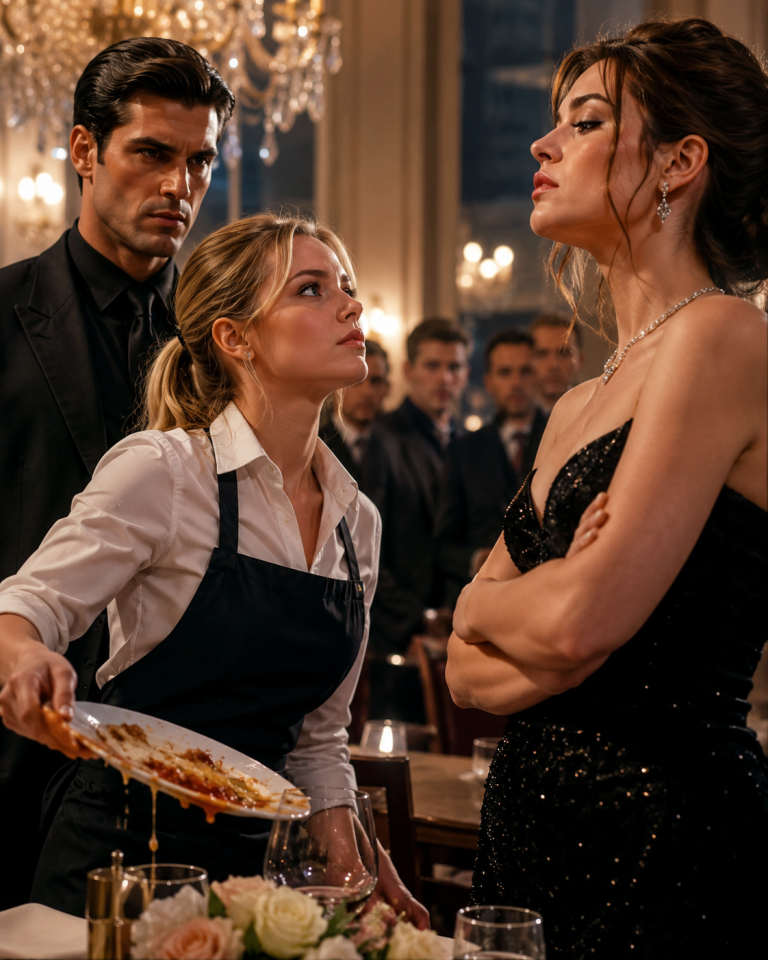
By the time Seraphina Wexley — the judge’s daughter, golden-haired, admired the way people admire a painting they’d never dream of touching — stepped up to take her turn, even the laughter had gone thin and unsure.
She placed one gloved hand flat against Caleb’s chest as if that alone could set the morning right. “Darling,” she said, soft enough that half the street leaned in to hear it, “you don’t need a farmhand. You need a wife. Stop this foolishness and take me home.”
The crowd loved that. Mothers smiled behind their fans. Order, it seemed, was about to be restored — beauty arriving to fix what practicality could not.
Caleb lifted her hand off his chest by the wrist and set it aside, gently, like returning something borrowed.
“Can you make a poultice for an infected wound, Miss Wexley?”
She blinked, then laughed. “That’s what doctors are for.”
“The finest doctor in this territory told me my mother will be blind by Christmas,” Caleb said. “So you’ll forgive me if doctors don’t carry much weight with me these days.”
The street went quiet enough to hear a dog bark two blocks over.
For one unguarded second, something real crossed Seraphina’s face. Then her pride slammed the door on it. “You’ll die alone, Caleb Ashgrove. You and that blind old woman. No one will ever want you — look at your face. You’re a monster.”
He was already turning for his horse, one hand on the saddle horn, when her last words caught up to him. He didn’t turn back.
“I’d rather be a monster than a liar,” he said. “And your father is the biggest liar in the territory.”
He mounted and rode, and the red dust closed over the sound of hooves before the street decided whether to gasp.
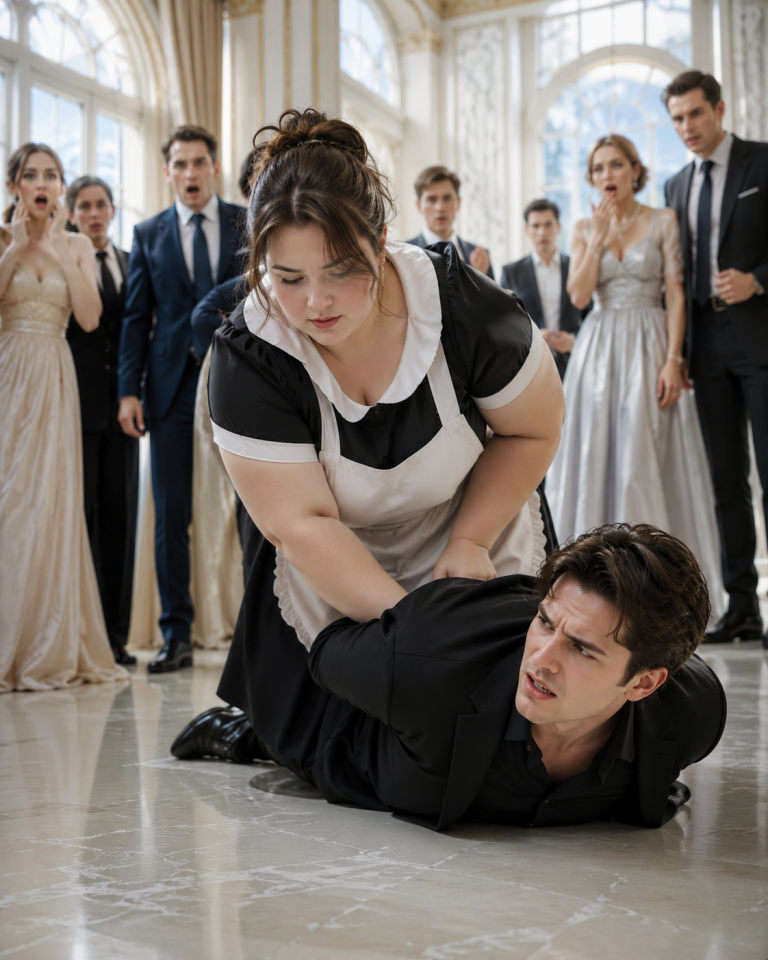
Nobody noticed Odessa at all — nobody ever did, unless it was to mock her. She stood between the saloon and the dry goods store with a basket of wet wash balanced on one hip, twenty-eight years old, broad through the shoulders, built with a strength the town’s women envied just enough to call it ugly instead. She knew what they called her when they thought she couldn’t hear. *Buffalo girl. Built like a freight wagon. Good for lifting, not for looking at.*
The words had stopped making her flinch years ago. They had never stopped landing.
Mrs. Pruitt’s voice cracked at her back the second the crowd began to scatter. “Odessa! Those sheets won’t hang themselves. Move, or I dock your pay.”
She moved. She always obeyed first and felt the sting of it later — that was how a poor woman kept a roof, even a roof as rotten as the lean-to behind her dead father’s forge. She pinned wet sheets to the line while two women by the fence lowered their voices just enough to make it plain they wanted to be overheard.
“No amount of hard work makes up for a face like that.”
“You don’t suppose she thought Ashgrove might choose her?”
“He’d need to reinforce his porch first.”
They laughed. Odessa didn’t. She worked until the light went orange, and Mrs. Pruitt paid her two bits and told her there wasn’t enough work to justify her appetite for the next two days. She walked home through the back alleys — not because they were shorter, but because they asked less of her.
The lean-to held everything she owned. A cot. A stove. A trunk. One chair. A window that never sealed right in winter.
She lit the stove, boiled water, and opened the trunk. Beneath everything else, wrapped in oilcloth, lay her mother’s journal.
Delphine Calloway had wrapped it exactly that way before the fever took her at forty-two, back when the town doctor decided a Cherokee woman’s dying didn’t rank as urgent as a rancher’s sick cattle. Odessa knew the smell of that journal before her fingers even touched the cloth — old paper, cedar, and the ghost of medicinal roots worked into the leather over decades.
The town had called her mother’s healing *backwoods hoodoo* whenever it wanted to insult her, and then sent for her in the dead of night whenever a baby burned with fever or a husband bled through his shirt or someone’s eyes swelled shut with an infection no respectable doctor could touch.
Odessa opened the journal to the page she’d read so many times the ink had gone soft under her thumb.
*Eye infections. Swelling. Nerve damage. The slow creep toward blindness. Grind goldenseal root fine. Boil white oak bark to a paste. Add raw honey, unheated. Warm compress over closed eyes, three times daily. The infection will fight. The body will burn. But the nerve remembers light — give it reason to remember.*
She pressed the journal to her chest and thought of the courthouse steps three days before, where she’d been on her knees scrubbing stone when Dr. Ambrose Colt and Judge Warren Wexley walked past close enough that their boots nearly brushed her hands. They talked over her like she was furniture, because men like that never truly saw women like her.
“The Ashgrove woman is finished,” Colt had said. “Both eyes. Three weeks, I’d guess, before she’s completely blind.”
“And once she’s blind,” Wexley answered, in the smooth, unhurried voice powerful men keep for other people’s ruin, “Ashgrove can’t run twelve hundred head of cattle and nurse a blind mother besides. He’ll sell.”
“And if he still refuses?”
“Then we make his choices worse.”
They’d walked on, laughing softly. Odessa had kept scrubbing.
But something inside her had gone very still — and in the lean-to that night, the stillness had begun, slowly, to catch fire.
**PART 2**
Odessa was almost certain she could save Ruth — no, not Ruth. Naomi Ashgrove. The infection matched exactly what her mother had once treated in Stonebridge Hollow: contamination traveling from an old wound through the blood, settling in the eyes, swelling the tissue until the nerve went dark and men who didn’t know better called it permanent.
There were plenty of reasons not to go. Stonebridge lay four hours up a mountain trail that turned dangerous after dark. She had no horse — only Samson, a mule older than patience and meaner than sin about steep ground. And Caleb Ashgrove had just shut the door on the prettiest women in three counties without so much as a backward glance. What would he do to the woman the whole town called Buffalo Girl, showing up uninvited at his gate?
She packed anyway. The journal. Goldenseal paste. White oak bark wrapped in cheesecloth. Raw honey. Clean linen. Boiled water. A wool coat, rope, matches, a knife.
Then she sat back down on the cot, because it would have been so easy not to go — so easy to let fear make the choice and call it wisdom afterward. She could stay invisible in this lean-to. Scrub more floors tomorrow. Listen to more men build their schemes over her bent back. Live thirty more years half-seen, until the world finally admitted out loud what it had always believed about her.
Then Naomi’s voice came back to her across sixteen years. Odessa had been twelve, knees skinned raw, face caked with mud from a fall in the road while boys laughed from the fence rail and women watched from their wagon seats and did nothing at all. Naomi Ashgrove had been the only one who climbed down. She’d wiped the mud from Odessa’s cheeks with her own handkerchief and said, “The tallest mountains stand strongest when the storm finally comes.”
Odessa had carried that sentence longer than she’d carried the sting of the laughing.
She stood, went out to the corral, and woke Samson. He opened one eye as if to register both his disapproval and his surrender in the same glance.
“She wiped the mud off my face,” Odessa whispered, cinching the saddle. “I owe her my life.”
They left Millhaven Crossing at midnight, and no one saw them go.
The climb was worse than she’d feared and exactly as hard as she’d braced herself for. The first hour was only steep. The second brought bone-deep cold. The third brought the washout, where a whole slice of mountainside had simply given way into blackness; she led Samson wide around it through loose scrub and rock, fell once hard enough to tear her knee open, and got back up because there was no version of this where lying still helped anyone.
By dawn her legs shook and her hands had stopped feeling like her own. Then she crested a ridge and saw the ranch below — the big house, the corrals, smoke curling from the chimney, cattle moving slow and dark across the pasture.
She tied Samson to the fence, took her satchel, and knocked on the door.
Caleb Ashgrove opened it in his shirtsleeves, coffee in one hand and suspicion in both eyes. He looked at her the way men always looked first — measuring size before intent, plainness before nerve, shape before whatever might actually be standing in front of them.
*Whatever you’re selling,* his face said, *I don’t want it.*
“Whatever you’re selling,” he said aloud, “I’m not buying.”
“I’m not selling anything,” Odessa answered. “I’m here for your mother.”
He studied her. Then he studied the mule tied to his fence. Then her again.
“You rode up here alone?”
“Yes.”
“At night?”
“Yes.”
“Why?”
“Because your mother is going blind, and I believe I can stop it.”
He laughed once — not cruel, not kind, just out of patience for people who arrived at his door with certainty in their voice and nothing behind it. “Doc Colt says the nerve’s already dying.”
Odessa didn’t flinch.
“My mother wrote different.”
**PART 3**
Neither of them moved for a long second. Morning wind carried pine and damp earth and the low smell of cattle across the porch boards between them.
Caleb had met desperate people before — traveling preachers, miracle salesmen, men who sold hope out of a wagon bed. They all arrived certain. They all left richer. This woman carried neither confidence nor greed, only exhaustion. Mud clung to her hem, her sleeve had torn open on brush somewhere in the dark, her boots were soaked through from creek crossings, and both hands were raw from a night of holding mule reins. She looked like someone who had spent everything she had simply reaching his door.
“What do you want in return?” he finally asked.
She blinked, as if the question hadn’t occurred to her. “Nothing.”
“Nobody rides four hours into the mountains for nothing.”
“She wiped the mud off my face once. I was twelve.”
Something in his jaw loosened. Without another word, he stepped back from the door.
“She’s upstairs.”
Naomi Ashgrove lay near the east window, where the morning light still reached her. Her eyelids had swollen nearly shut, the whites gone an angry crimson. She turned toward the sound of footsteps but found no faces.
“Caleb?”
“I’m here, Mama.”
“Who’s with you?”
“A healer.”
“My name’s Odessa Calloway,” she said softly.
Naomi’s mouth curved. “The blacksmith’s girl.”
Odessa’s throat closed. “You remember me?”
“I remember everyone who ever needed kindness.”
Odessa unpacked quickly before the tears could catch her — goldenseal, white oak bark, honey, clean linen — and examined the swollen skin with careful fingers. “It isn’t too late,” she said.
Dr. Colt had been treating only the eyes. Delphine’s journal had warned against exactly that mistake. The poison had started in an old shoulder wound weeks before, one Naomi had insisted had healed clean. Odessa found the truth beneath the skin: dark infection still hiding, quiet and patient, waiting.
Caleb’s jaw went tight as stone. “She told me it stopped hurting.”
“Sometimes the worst wounds go quiet right before they turn,” Odessa said. “That’s when they’re most dangerous.”
Three days passed in a blur of boiled herbs and changed compresses. Odessa barely slept. She cleaned the shoulder again and again until healthy flesh finally showed through, and Naomi endured every treatment without a single complaint.
On the fourth morning, sunlight crossed the floorboards and Naomi gasped.
“Caleb.”
He looked up from the chair by her bed.
“I can see the window,” she whispered, and started crying before she could finish the sentence. “Only a blur. Only brightness. But I can *see* it.”
By sundown she could make out her son’s outline. By the sixth day, she recognized Odessa’s face across the room.
“You look just like your mother,” Naomi said.
Odessa smiled — really smiled — for the first time in longer than she could remember.
Word of it tore through Millhaven Crossing faster than fire through dry grass. The blind woman could see again. Nobody believed it until Naomi herself rode into town seated proudly beside her son, and the whole street fell silent watching her pass. Dr. Colt turned the color of old paper. Judge Wexley’s easy smile slipped and did not come back.
Because an impossible recovery raises dangerous questions, and dangerous questions have a way of digging up buried things.
Caleb requested every medical invoice Colt had filed over the past five years. None of them matched what had actually been bought, or done, or owed. A ranch hand finally admitted the rest — that Wexley had been paying Colt handsomely every month, not to heal Naomi, but to stall her recovery just long enough that a broken man with a blind mother and twelve hundred head of cattle would have no choice left but to sell cheap.
The county hearing lasted less than two hours. Ledgers, bank receipts, and a trembling assistant’s testimony did the rest. Judge Wexley resigned before sunset. Colt lost his license before nightfall. Neither man held authority in Millhaven Crossing again.
The same people who had laughed loudest on that boardwalk suddenly remembered they’d always respected Caleb Ashgrove. He remembered it differently.
A week later, the town gathered outside the Wexley Saloon once more, half-expecting him to finally choose one of the pretty, ribboned women now suddenly eager for his attention. Instead he walked straight past every parasol, every painted smile, every ribbon in town, to where Odessa stood outside the dry goods store with a sack of flour on her hip.
She assumed he meant to walk by. He stopped instead.
“You forgot something,” he said.
“What?”
“My answer.”
“I never asked a question.”
“You rode four hours to my ranch in the dark.”
“To save your mother.”
“And you did.” He reached into his pocket — not for money, not for jewels, but for a plain silver ring that had belonged to his grandmother. “I spent years looking for the strongest woman in this territory. Turns out she rode to my door on a mule while everyone else stayed home and laughed.”
A gasp moved through the crowd like wind through wheat.
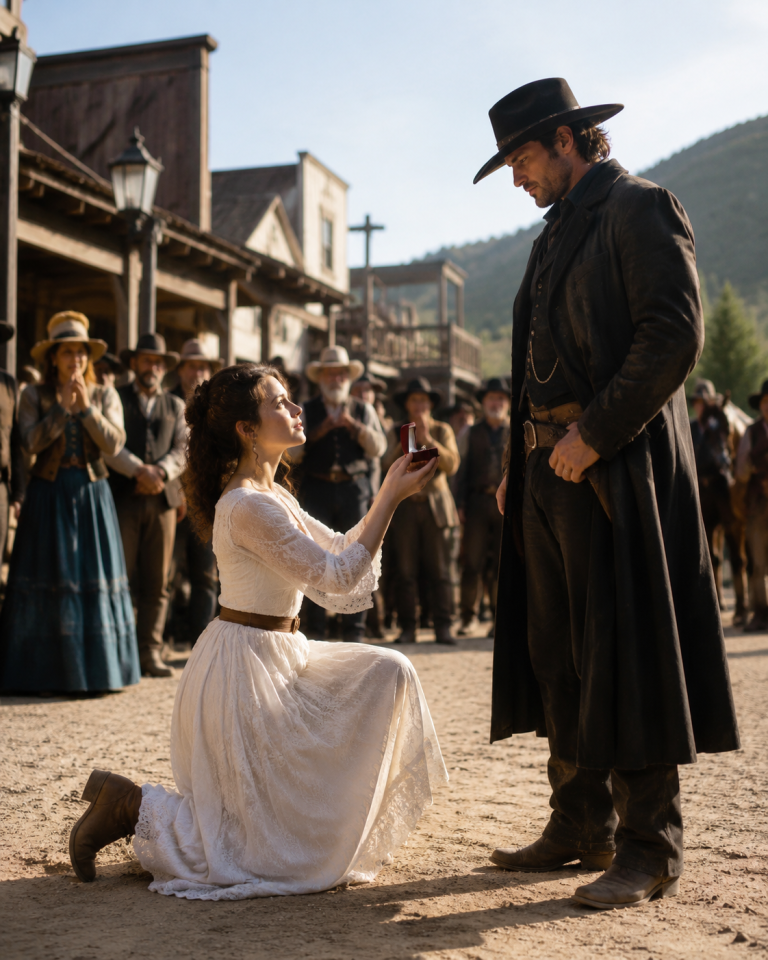
“Odessa Calloway,” he said, his scarred face gone soft in a way the town had never once seen, “would you do me the honor of becoming my wife?”
She stared at him as if she’d forgotten how to breathe.
“I—”
“You can say no.”
She laughed through sudden tears. “I’ve waited twenty-eight years for someone to ask.”
“Yes,” she said. “Yes.”
The same street that had once mocked her watched Caleb Ashgrove slide that ring onto her finger. For a moment, nobody clapped. Then Naomi began, alone at first, and one ranch hand joined her, and then another, until the whole street rang with applause that had arrived years too late to matter and somehow mattered anyway.
Odessa looked around once — not with triumph, not with revenge, only a quiet, settled peace. The people who had judged her by her body had finally been made to see what her heart had been carrying all along, and that, she thought, was worth more than every unkind word they could never take back.