Her Husband’s Pregnant Mistress Made Headlines at a Gala — Saraphina Found Out From a Stranger’s Phone

—
PART 1
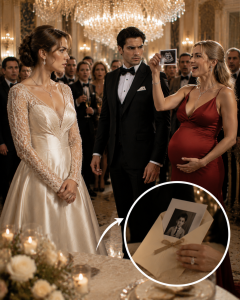
A waiter glided by with lobster canapés. A senator laughed too loudly beside a marble column. Women in diamonds leaned close together, their lips barely moving. Her husband stood across the ballroom in a black tuxedo, handsome and untouchable, laughing with men who moved markets with signatures. Alistair Rothschild was fifty-two, still broad-shouldered, still wearing confidence like it had been tailored for him in London.
For twenty-five years, Saraphina had stood beside him. She had turned cold dinners into charming evenings. She had smiled through business failures he later called lessons. She had raised their son, Julian, while Alistair crossed oceans chasing power. Tonight, he had rewarded her by turning her into a public joke.
She touched the sapphire necklace at her throat. Alistair had given it to her on their tenth anniversary, clasping it with warm fingers and whispering, “A queen deserves a stone worthy of her.” Now it felt like a collar.
“Mrs. Rothschild?” a museum board member asked gently. “Are you all right?”
Saraphina smiled — the sort of smile women learn after decades of being told not to make a scene. “Yes. Perfectly.” Then she walked away. She would not give them that pleasure.
Behind the statue of Sekhmet, hidden in the Egyptian wing, she finally took out her phone. The article was everywhere. *Isabella Ricci, rising Hollywood starlet, hints at billionaire baby bump. Sources close to the actress claim the father is one of New York’s most powerful married men.* The photograph showed Isabella outside a Los Angeles restaurant, red hair over one shoulder, one hand resting protectively against her stomach. Wounded, triumphant, and prepared.
Saraphina knew that face. Six months earlier, Alistair had invested in Isabella’s film. Called her brilliant. Brave. A bold new voice. Then came the Los Angeles trips. The new cologne. The phone turned facedown. The word *lonely*, spoken by Alistair as if loneliness were something Saraphina had done to him.
Her phone buzzed. A message from Genevieve, her oldest friend: *Do not let them see you bleed.*
Saraphina locked her phone, inhaled, and looked at her reflection in the polished black stone beneath the statue. Her lipstick was flawless. Her eyes were bright but dry. Inside, something ancient and obedient cracked. She was not going to bleed for them.
When she returned to the ballroom, Alistair saw her immediately. His smile did not change, but his eyes did. Not regret. Calculation.
“There you are,” he said, stepping toward her. “I was getting worried.”
“Were you?”
His hand brushed her elbow. “Not here.”
“No, darling. Not here.” The word *darling* cut him. Good.
The ride home in the Maybach was silent. Between them lay twenty-five years of marriage, one public scandal, and a child neither of them mentioned. When the car stopped before their limestone mansion on Fifth Avenue, Alistair finally spoke. “Saraphina.” She stepped out before the chauffeur could open her door.
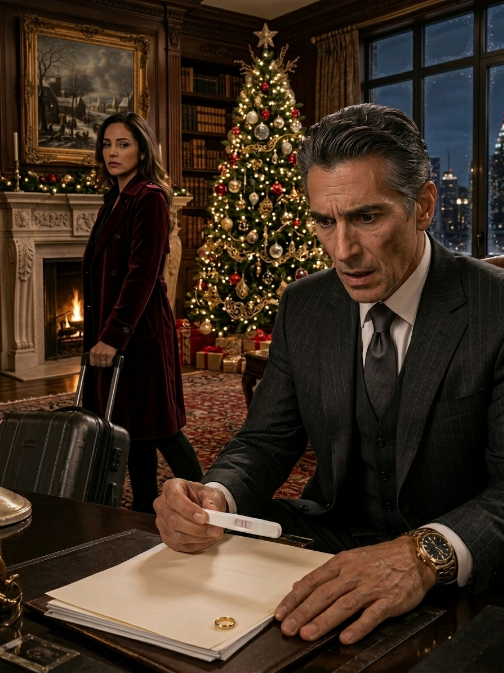
Inside, fresh white lilies stood in a crystal vase, their scent thick and funereal. Alistair followed her into the library and closed the door.
“It isn’t what it looks like,” he said.
Saraphina laughed once, and the sound surprised them both. “Which part? The mistress? The pregnancy? The headline? Or the fact that I found out with the rest of Manhattan?”
“I was going to tell you.”
“When?”
“I needed time.”
“To do what? Make the lie more beautiful?”
Alistair removed his cufflinks slowly, as if dignity could be restored through routine. “Isabella is emotional. She wanted attention. I didn’t authorize that article.”
“You think that is the wound? That you did not authorize my humiliation?” He flinched. Good again. “A mistake is signing the wrong page,” Saraphina said. “A mistake is forgetting an anniversary. You made a life outside our marriage and let me stand under chandeliers wearing your name while your mistress announced your child to the world.”
“We do not know that the child is mine.”
“Do you hope that comforts me?”
“I am asking you not to make this worse.”
There it was. The Rothschild commandment. Do not embarrass us. Do not disturb the empire. Do not let Julian suffer. At Julian’s name, her chest tightened.
“He will see it,” she said.
Alistair looked away. The first honest thing he had done all night.
“He is twenty,” Alistair said. “He will understand that adult life is complicated.”
“Our son is sensitive, not stupid.”
“I love Julian.”
“Then you should have remembered him before you gave the world a reason to pity his mother.”
Silence fell. For a moment, she saw the man she once knew — the young banker who brought her coffee at midnight, who cried when Julian was born, who danced with her barefoot because they couldn’t afford a proper anniversary dinner. Then he disappeared behind the billionaire again.
“What do you want?” he asked.
Saraphina looked at him for a long time. Then she reached behind her neck, unclasped the sapphire necklace, and placed it on his desk. The stone struck the wood with a small, final sound.
“I want a good lawyer,” she said.
—
PART 2
Eleanor Rothschild arrived the next morning without warning, wearing pearls and fury. “My dear,” she said, “we must be practical.”
“Good morning, Eleanor.”
“This is not the time for pride.”
“No,” Saraphina said. “It is the time for truth.”
“The Rothschild name cannot be dragged through divorce court because an actress wants publicity.”
“Your son dragged the name. I am only refusing to lie underneath it.”
“Think of Julian.”
“I am.”
“Think of your position.”
“That is exactly what I am doing.”
At noon, her lawyer arrived. Margaret Voss was seventy-one, silver-haired, narrow-eyed, and famous for destroying men who underestimated women over fifty. “Mrs. Rothschild,” she said. “I read the article. Unpleasant.” A pause. “Useful, though.”
Alistair stiffened. “Useful?”
“Public admissions have consequences.”
Margaret opened her briefcase. “I have reviewed the prenuptial agreement. It is strong. But not as strong as your husband believes. The morality clause is mutual. Public conduct that causes reputational damage to either spouse triggers renegotiation of several asset protections.”
Eleanor stood. “That clause was ceremonial.”
“Ceremonial clauses become less ceremonial when attached to nine figures.”
Alistair had insisted on that clause before the wedding because his father feared Saraphina might embarrass the family. Now the trap built for her had opened beneath him.
“There is more,” Margaret said. “Before I arrived, I received an anonymous packet. Financial transfers. Trust documents. Airline records. Payments routed through a production company connected to Ms. Ricci.”
“You were funding her?” Saraphina asked.
“It was an investment.”
“With marital assets?”
He looked at the floor. Answer enough.
The door opened, and Julian walked in, no one having heard him arrive. A Harvard sweatshirt, dark hair damp from rain, his face young and devastated. “Is it true?” he asked. “Is the baby yours?”
Alistair opened his mouth. Closed it.
Julian gave a small nod, as if his father’s silence had confirmed something larger than paternity. “Right,” he said, and turned to his mother. “I saw it before class.”
“I’m sorry,” Saraphina whispered.
“Why are you sorry?” Julian asked, his eyes filling.
Because mothers apologize for storms they did not make. Julian stepped forward and hugged her. Over his shoulder, she saw Alistair watching them with an expression she could not name. Regret had arrived at last. But regret, Saraphina thought, was a poor guest. It always came after the house had burned.
—
PART 3
Isabella Ricci called two days later. Saraphina did not recognize the number, but some instinct made her answer.
“Mrs. Rothschild,” the young woman said, her voice soft and practiced. “I think we should talk.”
Saraphina stood in her dressing room, looking at the empty velvet case where the sapphire necklace used to rest. “Do you?”
“I never wanted to hurt you.”
“That is a sentence people use when they want credit for failing.”
“I know you hate me.”
“I do not know you well enough to hate you.”
That seemed to disturb Isabella more than anger would have. “I love him,” she said.
There it was. The oldest weapon in the newest mouth. “Then you have my condolences.”
“He told me the marriage was over. He said you lived separate lives.”
“We slept in the same bed last week.” Silence. Then, smaller: “He said you knew.”
“I did not.”
For one brief moment, Saraphina heard not a mistress, not a rival, but a frightened woman who had been sold a story. “How far along are you?” she asked.
“Fourteen weeks.”
The number struck like a bell. Fourteen weeks meant the Hamptons weekend — the weekend Alistair said he needed space after an argument about Julian’s future. The weekend Saraphina had blamed herself for being too tired, too distracted.
“Do you know if it is his?”
“Yes.”
“Has there been a test?”
“He said it wasn’t necessary.”
Saraphina almost pitied her then. Almost. “Listen to me carefully,” she said. “Alistair Rothschild is capable of tenderness when tenderness protects him. He is capable of generosity when generosity costs less than honesty. Do not confuse either with love.”
“You’re trying to scare me.”
“No. I am trying to save you time.”
Isabella hung up.
—
That evening, Alistair came to the townhouse alone. He had moved to the Carlyle Hotel after Julian refused to speak to him. The press had camped outside the house for three days. Saraphina had not answered one call from society friends. Genevieve came every morning with coffee and outrage. Margaret Voss worked like a surgeon. Julian stayed upstairs, pretending to read, appearing at odd hours to ask questions no child should have to ask.
When Alistair entered the library, he looked older. Not ruined — men like him did not ruin easily. But cracked.
“Isabella is unstable,” he said.
“That was fast.”
“I’m serious.”
“So am I.”
He paced once, then stopped. “She gave that story to the press without warning me. Now she’s asking for a public statement, a trust for the child, a house in Malibu, and a producer credit on another film.”
“Actions have invoices,” Saraphina said.
“You think I deserve this.”
“I think you ordered it.”
“I was unhappy.”
There was the defense she had been waiting for. “Tell me,” she said. “I want to hear how my failure forced you into another woman’s bed.”
“That’s not what I mean.”
“It is exactly what men mean when they begin with unhappiness.”
He sat, suddenly exhausted. “I missed us,” he said. “I missed who I was with you. Before the business consumed everything. Before Julian left for school. Before every conversation became logistics. Isabella looked at me like I was still young.”
“And instead of grieving time, you betrayed me.”
His eyes filled. “I made a terrible mistake.”
“You made several.”
“I love you.”
Once, those words would have undone her. Now they arrived too late, carrying too much dirt. “No,” she said gently. “You love being forgiven by me. You love the version of me who absorbs pain and calls it marriage. But me? The actual woman sitting here? You stopped seeing her years ago.”
Alistair covered his face with one hand. Then his phone rang. He looked at the screen and went still.
“Answer it,” Saraphina said.
He did not. So she reached across the table and turned the phone toward herself. Isabella.
“Alistair?” the voice said quickly. “I’m outside. We need to talk now.”
“You brought her here?”
“I didn’t.”
The doorbell rang.
—
Isabella Ricci entered the Rothschild townhouse wearing a cream coat and oversized sunglasses, the expression of a woman who had expected cameras but found a funeral. She removed the glasses slowly when she saw Saraphina.
“What is she doing here?” Isabella demanded.
“I live here,” Saraphina replied.
Isabella looked younger in person — not innocent, but young in the way ambition can be young, still believing every locked door is proof of destiny. “I came to speak with Alistair.”
“Then speak.”
“No, you don’t get to hide me anymore. Not after everything you promised.” Isabella opened her purse and pulled out a folded document. “A settlement agreement. He wanted me to sign it last night. Money, a house, silence. No public statement. No acknowledgment until after the divorce.”
Alistair closed his eyes.
“After the divorce,” Saraphina repeated.
“He said you agreed.”
Saraphina laughed softly. Not a pleasant sound. “No, Miss Ricci. I did not.”
For the first time, the two women looked at each other not as wife and mistress, but as victims standing on opposite sides of the same lie.
Then Margaret Voss entered, no one having heard her, carrying a file. “Excellent. Everyone is here.”
“What is this?” Alistair demanded.
“The consequences.” Margaret placed the file on the table. “Saraphina, the anonymous packet was expanded this morning. It includes medical invoices, wire transfers, and a private investigator’s report.”
“Private investigator?” Isabella stiffened.
“Miss Ricci, did Mr. Rothschild know you before six months ago?”
“No.”
“That is not accurate.” Margaret slid a photograph across the table. It showed Isabella at eighteen, standing outside a courthouse in Queens beside a woman Saraphina recognized instantly.
“Lydia Vale,” Saraphina whispered. Alistair’s former assistant. The woman who vanished from Rothschild Holdings twenty-one years ago after rumors of embezzlement. The woman Eleanor had once called “dangerous.”
Alistair picked up the photograph. His face drained of color.
“Where did you get that?” Isabella stared.
“Miss Ricci’s legal surname at birth was Vale,” Margaret said calmly. “Isabella Ricci is a stage name.”
Alistair’s expression was no longer guilt. It was terror.
“Twenty-one years ago,” Margaret continued, “Lydia Vale filed a sealed claim against Rothschild Holdings. She alleged that Alistair’s father used her to move illegal funds through shell accounts, then framed her when regulators began asking questions.”
“My father handled that. I barely knew—”
“You signed the termination papers.”
“Did you know she was innocent?” Saraphina asked.
He did not answer.
Isabella’s eyes filled with tears, but her chin lifted. “My mother lost everything. Her job. Her reputation. Her health. She died with people calling her a thief.”
“So this was revenge,” Saraphina said.
“At first.”
“The baby?” Alistair whispered.
Isabella put both hands over her stomach, and for the first time, she looked afraid. “The baby is real.”
“Is it mine?”
Her silence became the loudest thing in the room. Alistair stumbled back as if struck.
“A paternity test was performed privately,” Margaret said. “The father is not Alistair.”
“Then why?” Saraphina asked.
Margaret opened another document. “Because Miss Ricci was not after his money. She was after a confession.”
The room went utterly still. Then Isabella pulled a small recorder from her coat pocket and placed it on the table.
“He told me things,” she said. “When he thought I loved him. When he thought I needed him. He talked about Lydia. About his father. About the accounts. About how Saraphina would never leave because she understood loyalty.”
Alistair’s face collapsed.
“You used me,” he said to Isabella.
She laughed through tears. “You used everyone.”
Julian appeared in the doorway. No one knew how long he had been standing there. His face was white. “Dad,” he said. “What did you do?”
Alistair looked at his son and finally, completely, broke. “I was young. My father said it was business. He said Lydia was threatening the family. I signed what he gave me.”
“You ruined a woman’s life,” Julian said.
“I didn’t know she would—”
“Die?” Isabella snapped. “You didn’t know poor people die when rich men erase them?”
Saraphina stepped back. Her whole marriage rearranged itself in her mind. Every polished dinner. Every charitable speech. Every lecture about loyalty. Every time Eleanor had told her the family survived because it protected itself. The Rothschild empire had not been built on strength. It had been built on silence. And she had spent twenty-five years decorating the silence with flowers.
—
The press called it the Rothschild Reckoning. Within forty-eight hours, the story of Alistair’s affair disappeared beneath a much larger scandal — financial crimes, a sealed claim, a dead assistant, a forged internal report, a recording in which Alistair admitted his father had ordered documents destroyed and that he had “signed what needed signing.” Federal investigators opened inquiries. Board members resigned. Eleanor stopped calling.
Isabella gave one interview, not as a mistress, but as Lydia Vale’s daughter. She cried only once — not when speaking about Alistair, but when speaking about her mother.
Saraphina watched the interview alone in the library. Julian entered halfway through and sat beside her. Neither spoke until the screen went dark.
“I hate him,” Julian said.
“No, you don’t.”
“I want to.”
“I know.”
“How do you do it? Not fall apart.”
Saraphina looked toward the window, where winter light lay pale across the floor. “I fall apart privately. Then I wash my face.”
Julian leaned into her like he had when he was small. “I’m sorry,” he whispered.
She kissed his hair. “Do not inherit your father’s guilt. It is not yours.”
—
Three weeks later, Alistair asked to see her. Margaret advised against it. Genevieve called him “a walking lawsuit.” Julian said nothing, which was worse. But Saraphina agreed. Not because she owed him. Because she owed herself one final conversation.
They met in the same library where she had left the sapphire necklace. Alistair looked thinner, older, human in a way wealth had once protected him from becoming. The sapphire lay on the desk between them.
“I came to return that,” he said.
“It was already yours.”
“No. That was always the problem. I thought everything was mine because I could buy it.”
He looked at her for a long time. “I have signed the divorce settlement. Everything Margaret requested. The foundation remains yours. The Albany scholarship fund will be endowed permanently in your parents’ names. Julian’s trust is untouched. I will not contest anything.”
She said nothing. His hands trembled. “I loved you badly,” he whispered.
That sentence hurt more than *I love you*. Because it was true. Saraphina looked at the man who had shattered her and saw, beneath all the damage, the boy he must have been before his father taught him that conscience was a luxury.
“I know,” she said.
“I am going to cooperate with the investigation.”
“You should.”
“I am going to tell the truth about Lydia Vale.”
“You should have done that twenty-one years ago.”
“Yes.” The word was barely sound.
He reached into his coat and removed an envelope. “This is for Julian. I won’t ask you to give it to him. Only if he wants it.”
Saraphina took the envelope. Alistair stood. At the door, he stopped. “There is one thing you should know.” She looked up. He seemed to struggle with the words. “Isabella sent the first packet to Margaret. But she didn’t send the second.”
“Who did?”
“Julian.”
The room went silent. “No,” Saraphina said.
“He found old files last summer during his internship at the company. He didn’t understand everything at first. He copied them because something felt wrong. When the headline came out, he connected Isabella’s name to Lydia Vale. He sent the documents anonymously to protect you.” Alistair’s voice broke. “He has more courage than I ever did.”
After Alistair left, Saraphina sat alone for a long time. The twist did not feel like triumph at first. It felt like grief wearing a crown.
That evening, she found Julian in the kitchen making tea badly, water spilled across the counter. He looked up, saw her face, and froze.
“You know,” he said.
She nodded.
“I didn’t want you dragged into it.”
“Why didn’t you tell me?”
“Because everyone always expects you to be strong,” he said, voice cracking. “I wanted someone to be strong for you.”
That was when Saraphina finally cried. Not politely. Not beautifully. She cried like a woman who had carried too much for too long. Julian held her, and for once, she let her son see that mothers are not stone, even when the world keeps striking them.
—
Months passed. Spring came to New York with rain shining on the sidewalks and tulips opening in Central Park. The divorce became final on a Thursday morning. Saraphina did not wear black. She wore blue. Not sapphire blue. A softer blue. The color of sky after weather.
Alistair pleaded guilty to lesser charges connected to obstruction and financial concealment. His father’s old crimes were exposed fully at last. Eleanor withdrew to the family estate in Connecticut and never again called Saraphina practical.
Isabella gave birth to a daughter in June. The father was a cinematographer from Santa Fe who had loved her quietly before revenge consumed her. Isabella named the baby Lydia. Saraphina sent flowers. No note. Just flowers.
A year later, the Metropolitan Museum hosted another gala. Saraphina almost refused the invitation. Then Julian said, “Go back.” So she did — not as Mrs. Rothschild, not as a betrayed wife, not as a headline, but as the newest chairwoman of the Saraphina Vale Foundation, after she renamed her charity in honor of women erased by powerful men.
Genevieve met her at the entrance. “You look terrifying,” she said.
“Thank you.”
Inside, the ballroom glittered as it always had. The orchids were white again. The champagne was cold. The same people whispered, because people like that always whispered. But this time, when phones turned toward her, they did not carry scandal. They carried applause.
Saraphina paused beneath the lights. For a second, she remembered the champagne glass, the headline, the humiliation that had cracked her life open. Then she remembered something else.
Cracks let the truth breathe.
Julian appeared beside her in a dark suit, taller than ever, his smile gentle and proud. “Ready?” he asked.
“Yes,” Saraphina said.
And together, mother and son walked through the room that had once watched her bleed. Only now, every person there understood.
Saraphina Rothschild had not been abandoned. She had been released.
And the man who thought money could buy forgiveness had finally learned the one thing no fortune could purchase: a woman’s dignity, once awakened, does not return to sleep.
THE END