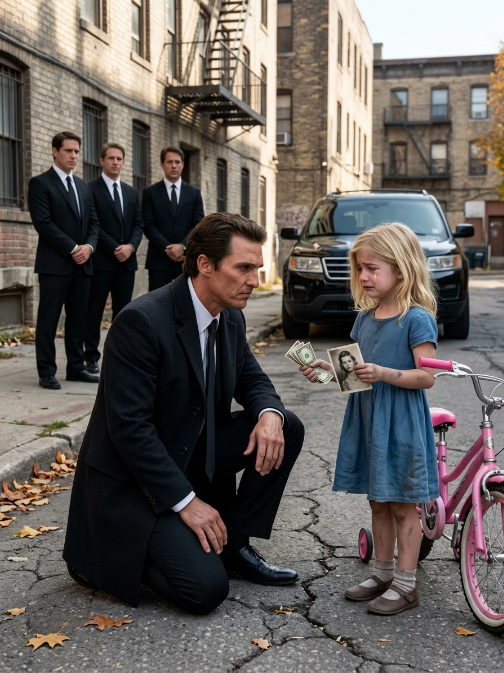
The twin girls came to his ranch starving every morning—But when the cowboy finally followed them, the hidden door beneath the barn changed everything.

Part 1
Caleb Hartwell had not wept since the morning they lowered his wife into frozen ground and left him standing beside the grave with no hand to hold.
For five years he had lived without tears, building silence around himself with the patience of a mason setting stone, one hard piece after another, until the wall stood thick enough that no neighbor, no memory, and perhaps not even God could find a crack wide enough to enter.
Then, on a brutal July morning in 1884, behind the Silver Spur Saloon in Larkin, Wyoming, Caleb saw a little girl no older than four reach both hands into a garbage pail and pull out a biscuit someone had thrown away. Beside her, her twin sister held open the pocket of her faded dress so half of it could be saved for later.
Caleb stopped where he stood.
The morning heat had already begun rising off the red dust streets, bending the air over Larkin until the mountains beyond town seemed painted onto the horizon in colors not yet dry. The alley behind the saloon smelled of old beer, kitchen grease, sun-warmed refuse, dry wood.
He should not have been there. His life had been arranged carefully to avoid places like this, hours like this, people who might ask him questions. He came into Larkin three mornings a week — Tuesdays, Thursdays, Saturdays — bought flour, coffee, nails, lamp oil, feed, whatever the place needed, collected his mail and read it only once he was home, spoke when commerce required it and not beyond, and returned to his property before Main Street filled enough to demand hat-tipping and the small condolences people still carried in their eyes even after five years.
It was a system. It had worked for fourteen months without deviation.
That Tuesday, his boot heel split on the road into town, forcing him to stop at Garvey’s Saddle Shop on the south end of Main. That small accident changed his route home. It put him behind the saloon at an hour he was never usually there.
And that was where he heard them.
Not crying. That was the first thing that struck him as wrong. Children that hungry ought to have been crying. Instead the sound was small, focused, practical — the sound of effort, of work being done quietly by someone who’d learned that noise brought no help.
He came around the back wall and saw them beside the large wooden pail where the cook threw kitchen scraps. Identical girls, dark hair, narrow shoulders, bare feet gray with dust. Their dresses had once been blue, but too many wearings and not enough washing had turned them the color of old ash. Perhaps three. Perhaps four. Too small, either way, to know hunger’s discipline as well as they clearly did.
The taller one was breaking pieces from a hard biscuit. The smaller one was chewing something Caleb couldn’t identify and didn’t want to. Then the smaller one stopped, reached into her mouth, took out part of what she’d been eating, and placed it carefully into her dress pocket.
Not because she was full. Her ribs showed faintly at the neckline. She saved it because she knew food was temporary. Because she understood, at an age when a child should have been learning songs and flowers and the names of animals, that the food in her hand might be the last food available for a stretch of time too long to calculate.
Caleb stood six feet away and felt something give in the center of his chest. Not exactly pain, though it lived near pain. More like the sound a beam makes when the weight on it finally exceeds what it was built to hold.
“Hey,” he said.
Both girls went rigid. The taller one spun so fast Caleb barely registered the motion before she stood between him and her sister — the size of a fence post, all bones and dust and fury, but set in front of the smaller girl as if she were six feet tall and armed.
Caleb raised both hands, palms out, and crouched slowly. “Easy,” he said, his voice coming out low and steady, the voice he’d once used on frightened horses. “I’m not going to hurt you. I’m not going to take anything.”
Neither child moved.
“My name’s Caleb,” he said. “What’s yours?”
The taller girl kept her eyes on him — not a child’s stare, but the attention of a creature that had learned strangers belonged to a category of danger and that survival depended on watching until the shape of the threat became clear.
“That’s all right,” Caleb said. “You don’t have to tell me. Are you hungry?”
Foolish the moment it left his mouth. He reached into his coat pocket and found a paper-wrapped piece of hard cheese he’d bought at the general store and forgotten to put into his saddlebag.
“It’s cheese,” he said. “It’s clean. It’s yours if you want it.”
The taller girl looked at the cheese, then at him, then back. Caleb could see the calculation happening in her face — risk, benefit, hunger, danger, whether the man offering had costs attached.
Then the smaller child spoke from behind her sister’s shoulder. “Ruth.”
The taller girl glanced back.
“It’s cheese,” the smaller one said, with solemn importance.
Ruth looked at Caleb for three more seconds. Then she stepped forward, snatched the cheese from his hand, retreated so fast he hardly saw the movement, broke it exactly in half, and passed one piece behind her without looking.
Caleb sat down in the dust. Sitting seemed less threatening, and he intended to remain there a while.
“Is that your sister?”
Ruth said nothing.
“Her name’s Abby,” the smaller girl said. “I’m Abby.”
“Abby,” Caleb repeated. “And Ruth.” He nodded as if they were grown women meeting him under ordinary circumstances. “I’m pleased to meet you both.”
Neither answered.
“Do you live here in town? Do you have family? Somebody looking after you?”
The silence changed — became the kind that contains information.
“Where do you sleep?” Caleb asked.
Ruth’s jaw tightened.
“Nowhere bad,” Abby said.
That was not the same as somewhere good. Caleb understood the difference. He looked at the two of them, dressed in ruined blue, barefoot and watchful, carrying exhaustion no child of four should know how to carry, and something settled in him. Not an idea yet. A decision his body had made before his mind caught up.
“Are you in town most days?” he asked.
Ruth watched him, then nodded, almost imperceptibly.
“I’ll be back tomorrow,” Caleb said. “With something better than cheese.” He stood slowly. “I’ll put it on that crate there. You can take it when you want. You don’t have to see me if you don’t want to. But I’ll be here.”
He walked home through the heat and sat at his kitchen table without eating supper. Across from him, on the shelf beside the stove, his late wife Margaret’s photograph looked out from its wooden frame. She had died of fever five years before, fast and faster, and had wanted children and never had them. If she’d been in that alley, she’d have crossed to those girls in four seconds flat, had them fed and bathed and named and possibly laughing before sundown. Margaret had been made of warmth that didn’t need permission.
Caleb had been made of something harder. He’d spent five years coming to terms with the uselessness of that.
He went back the next morning before Larkin was fully awake and left bread, salt pork, and two boiled eggs wrapped in cloth on the crate, then positioned himself behind a rain barrel where he could watch unseen. The girls came from the direction of the old tannery on the east side of town, moving through the alley like water through a channel — quick, narrow, purposeful. Ruth walked first, Abby directly behind, both hands clutching the back of Ruth’s dress.
Ruth divided everything with careful precision — bread into equal pieces, salt pork broken across the middle, one egg each — and handed Abby her portion first, waiting until Abby had it firmly before letting go.
Then Ruth looked straight at the rain barrel.
Caleb went still. Across fifteen feet of alley, she held his gaze three full seconds. Then she looked down and began to eat.
She had known he was there the whole time.
The third morning he came with a larger package and made no attempt to hide, standing fifteen feet from the crate when the girls appeared.
“Is there a place you go at night?” he asked once Ruth had divided the food. “Somewhere you sleep?”
Ruth chewed and didn’t answer.
“Old barn,” Abby said.
Ruth made a small warning sound.
“He feeds us,” Abby told her sister. “He can know about the barn.”
Ruth considered, then looked at Caleb. “Behind the tannery,” she said, voice low and rough from disuse. “The back part where the roof is still good.”
“How long have you been there?”
The sisters exchanged a fast, complete look — a language of twins Caleb could see but not understand.
“Long time,” Ruth said.
“Is there an adult with you?”
“No,” Abby answered. Ruth didn’t contradict her.
A cold clarity settled over Caleb, the kind he’d known in his years as a justice of the peace when a matter revealed itself worse than the first facts suggested. Two little girls, sleeping alone in an abandoned barn, no adult, no family, for a long time.
“Were your parents in Larkin?” he asked carefully.
Ruth put her bread on the crate and looked at him with eyes too old for her face. “They’re gone.”
“Gone how?”
She picked the bread back up. “Just gone.”
Not an answer. Not nothing either.
Part 2
That afternoon Caleb went to Hazel Doyle’s laundry at the far end of Main Street, where she worked from five in the morning until the light gave out and consequently heard everything a small town had to say.
“There are two little girls,” Caleb said. “Twins. Dark hair. About three or four. You know them.”
Hazel’s hands stopped on the washboard. “I know who you mean. Their name is Calloway. Father was Tom Calloway, worked the Brennan mine up on the ridge. Mother was Edith, came from Kansas, kept to herself.” She scrubbed harder. “They died in the spring. Mining accident, Sheriff Reese said. Tom and two other men went into shaft four, supports gave way. Sealed them in.”
“And Edith?”
“Died two weeks after her husband. Doctor Asa Webb called it grief — said her heart gave out. Closed casket. Said the body wasn’t fit for viewing.”
“And the girls?”
“Tom had no family in the territory. Edith’s people were back in Kansas. Sheriff Reese said arrangements would be made to send the twins to the county home in Cheyenne.” Hazel paused. “That was four months ago. They’re still here.”
“You leave food behind the laundry.”
“I put out bread. I won’t apologize for it.” Her expression changed. “I wanted to do more. But Reese runs this town, Caleb. He runs everything in it. If you start asking why those girls are still here four months after he said he’d handle it, why their mother’s death certificate was signed by a doctor who’s been drinking himself useless since that same spring, you may find Larkin doesn’t treat questions kindly.”
“Tell me about Reese.”
“Sheriff six years. Came up from Colorado with references important enough nobody questioned them. Never raises his voice. Always smiles. Always tips his hat.” She wrung out a shirt. “Bought six properties in this valley in two years. Every one from a family that suffered some misfortune just before selling. Mining accidents. Fires. Sudden sickness. Tom Calloway’s claim was one of the richest around. Everybody knew it. Tom knew it too — he’d been talking to a surveyor from Denver about the real value.” She looked at Caleb over her shoulder. “Tom Calloway was dead within two weeks of that surveyor’s visit.”
Caleb left with the July heat pressing down and the information pressing up. He went next to see Doctor Asa Webb, whose office stood up a steep staircase above the apothecary, the kind that discouraged casual visitors, which suited a man who’d built his life around being hard to reach.
“Calloway girls,” Caleb said, sitting without invitation. “Their mother. You signed the death certificate.”
“Heart failure. Common enough after severe grief.”
“Asa. I know you. I know what kind of doctor you were before whatever happened to you happened. Careful. Thorough. You didn’t sign what you weren’t certain of. What happened?”
For a long time Caleb thought the doctor wouldn’t answer. Then: “She came to me. Edith Calloway came three days before she died. She wasn’t sick. She was frightened. Said she knew who was responsible for Tom’s death. She had papers — documents Tom had kept. Records of payments to certain men in the county. Land transfers following deaths. A pattern.” He swallowed. “She asked me to keep them safe. I said no. Told her I was a doctor, not a lawman. Told her to take them to someone with authority.”
He stared out the window. “She was dead two days later. The morning after, Sheriff Reese came to my door and asked whether she’d said anything to me in her final days. Hat in hand. Voice calm. I said she’d said nothing of consequence. Then I signed the certificate as he asked. Heart failure.” His hands shook visibly. “The children were in the house when she died. Those two little girls. They were there.”
“The documents,” Caleb said. “What happened to them?”
Webb pulled a flat brown envelope from his bottom drawer, sweat-creased and worn, and placed it between them. “I didn’t destroy them. I told myself I would a dozen times. I couldn’t.”
Caleb picked it up. “She trusted you.”
“I know.” Webb’s voice broke. “I have thought of nothing else since May.”
Caleb stood and slipped the envelope into his coat. “Do not mention this conversation to anyone. Not yet.”
“Reese will know someone is asking.”
“Then I’ll be careful what there is to hear.”
He walked back into the heat of Main Street with Edith Calloway’s evidence against Sheriff Marcus Reese pressed against his ribs and the memory of two little girls saving garbage-pail biscuits in their dress pockets pressing against something deeper.
When he returned to the Silver Spur alley, the crate was empty. The girls were gone. But at the exact center of the crate lay a small brass button — plain, worn, the kind from a workingman’s coat. Placed there deliberately. Not dropped. Left.
Caleb picked it up, still warm from the sun. He didn’t know what it meant in whatever system Ruth and Abby had built for themselves since the world failed them. But it had meaning. Purpose was a language he understood. He put the button in his vest pocket and went home.
That night he laid out what he knew on the kitchen table — facts first, conclusions after, gaps clearly marked, the way his years on the bench had trained him. Two children alive and unsupervised for four months. A father dead in a sealed shaft. A mother dead of a stopped heart two days after bringing murder evidence to a man who turned her away. A sheriff with fine references and a trail of dead property owners behind him. Documents that might connect it all if someone had the nerve to carry them to someone with authority to act.
He looked at Margaret’s photograph. “What would you do?” he said aloud. He knew the answer already. She had never encountered injustice and decided it wasn’t her problem. He’d once called that stubbornness. She’d called it being a human being in good standing. He was beginning to think she’d held the better argument.
In the morning, he found a flat stone in the exact center of his kitchen table. A cross had been scratched into its surface. Every window was latched. The door showed no sign of entry. Caleb picked up the stone and understood with a certainty that settled into his bones that whatever decision he’d made in the dark, Ruth and Abby had already made their own. They had come into his locked house while he slept, tested him, left their message, and gone again without waking him.
Part 3
Caleb found them behind the saloon at first light. To his surprise, they hadn’t hidden after the night before. Ruth sat on the crate, feet dangling. Abby ate a piece of bread beside her.
“You were in my house last night,” Caleb said.
“We wanted to know if you were safe,” Ruth said carefully. “Some men aren’t. We had to know.”
“And?”
“You sleep with your rifle close. But you put it where you can reach it, not where you can grab it fast. Men who are scared put it where they can grab it fast. You’re not scared. You’re careful. That’s different.”
Caleb stood in the alley, staring at a four-year-old who’d just read him more accurately than most adults had in years.
“I need to ask about your mother,” he said gently. “About Edith. I’m not asking to hurt you. I think she was trying to do something important before she died, and I may be able to finish it.”
“She cried at night,” Abby said. “After Papa died. We could hear her.”
Ruth’s voice dropped into the low, careful register she used for things stored away for survival. “She told us to remember that the man with the silver badge was not a good man, even though he smiled. She said if anybody asked about Papa, don’t talk to the man with the silver badge.”
Sheriff Reese wore a silver badge polished so bright it caught light from half a block away.
“Did she say anything else? About papers? Documents she kept safe?”
The sisters exchanged their silent twin language again. “She had a box,” Abby said. “A tin box. Under the floorboard in the kitchen. She showed us where.” She hesitated. “She said if something happened, we should find a man who was safe and show him where the box was.”
“The house where you lived,” Caleb said. “Is it still standing?”
“Mostly,” Ruth said. “Kitchen floor is still there.”
“Can you take me there?”
“After dark,” Ruth said. “During the day, the man with the silver badge has men watching the road.”
Caleb didn’t ask how she knew. He’d learned by then these girls had mapped their danger better than any adult in Larkin. “After dark. I’ll meet you here at nine.”
He spent the day behaving carefully — bought salt, got a haircut he’d delayed a month, sat outside the post office reading week-old news like an untroubled man on an ordinary Tuesday. That was when Sheriff Marcus Reese walked past — tall, well-groomed, composed, moving as though the space around him already belonged to him.
“Hartwell,” Reese said warmly. “Haven’t seen much of you lately. Keeping well?”
“Well enough.”
“I hear you’ve been spending time behind the Spur. Those two little strays have been around there. Calloway girls. Sad situation. I’ve been trying to arrange placement in Cheyenne, but these things take time, as you’d know from your days on the bench.” The smile never moved. “You haven’t been feeding them, have you? I only ask because people forming attachments complicates matters.”
“I haven’t done anything that would complicate your arrangements,” Caleb said, holding the gaze with the steadiness of a man who’d spent years watching liars from a judge’s bench.
“Good man.” Reese tipped his hat and walked on.
At nine, Ruth and Abby appeared from a direction Caleb hadn’t been watching. “He had a man follow you today,” Ruth said without preamble. “Brown coat. Followed you home, stood at the end of your road twenty minutes.”
“I know,” Caleb said. He’d noticed and taken three unnecessary turns to confirm it. “Running makes it worse. Looking like you have nothing to run from is better.”
Something like approval crossed Ruth’s face. She took Abby’s hand. “This way.”
They moved along the dark edge of town, the girls leading, never crossing open ground when a tree line was available, stopping at intervals to listen, once altering their angle entirely to skirt around a barking dog before returning to the original line. These were not things a four-year-old learned by instruction. These were things learned by surviving long enough to figure them out.
The Calloway house stood a mile beyond town, part of its roof sagged in, the kitchen intact. Ruth moved through the dark knowing each board, found a seam Caleb wouldn’t have seen by daylight, pried up a floorboard with a flat piece of metal from her pocket. Underneath lay a tin box the size of a man’s boot.
Caleb lifted it out. “Your mama showed you this?”
“Yes.”
“Did she tell you what was in it?”
“Papers,” Abby said from the doorway, watching the dark outside. “She said the papers would tell the truth about Papa.”
“She was right,” Caleb said. “I’ll make sure they do.”
On the way back, Abby reached up and took his hand — not tentative, simply matter-of-fact, the way a child takes the hand of someone she’s decided belongs to her. Her hand was tiny in his. He held on with a steadiness he forced himself to maintain.
At the edge of town he crouched before them. “Stay at the barn tonight. Both of you. Don’t come to the crate tomorrow morning. I need to read what’s in this box and decide what to do. Until then, I don’t want Reese’s men seeing you near me.”
“For how long?” Ruth asked.
“A day. Maybe two.”
“We have food. Enough for two days.”
“Good.” Caleb paused. “I’m going to fix this. I don’t say things I don’t mean. I haven’t got the patience for it.”
“Our mama said that too,” Abby said. “That she didn’t say things she didn’t mean.”
“She meant everything she said,” Ruth added.
“So do I,” Caleb said.
Part 4
At home, he lit one lamp and read everything twice. Tom Calloway’s records were methodical, precise — the work of a man who understood that if something happened to him, the evidence would need to speak without him. Property transfers. Dates. Amounts. A pattern of accidents and sudden illnesses in the weeks before each sale. Names of men receiving payments from a land consortium based in Cheyenne, timed to match specific deaths. Reese’s name appeared eleven times. A lawyer named Dunmore appeared nine times. Two names from the territorial government in Cheyenne appeared four times each.
The last entry, dated two days before the shaft four accident, instructed whoever found the documents to take them to Federal Marshal Owen Bell in Cheyenne. Not the county telegraph. Not anyone in the Larkin County system. Bell, Tom had written, was the only clean hand he’d confirmed, office on Clement Street.
Caleb sat back. He knew the name by reputation — careful, thorough, a man who moved slowly because he moved correctly. Tom Calloway had identified that man while running a claim, raising twin daughters, and trying not to get killed.
By two in the morning, Caleb had both sets of documents wrapped in oilcloth and sewn into the lining of his riding coat, using a needle and thread from Margaret’s sewing kit, untouched five years and still smelling faintly of lavender.
“All right, Margaret,” he said. “I’m paying attention now.”
At six the next morning, Hazel Doyle opened her door before he knocked twice. “Figured it would be you.” She poured him coffee without asking.
“I need to get to Cheyenne without Reese knowing I’ve gone, and someone to watch the girls.”
“What’s in Cheyenne?”
“Federal Marshal Owen Bell.”
Recognition moved through her eyes. “Tom Calloway mentioned that name. Came to me in February, said if anything happened and I needed to reach someone clean, Bell was it.” She looked into her coffee. “He told me he was documenting everything. Said he was close to having enough. Two weeks later he was dead.”
“I have all of it now. Names Reese. Names men in Cheyenne. Traces money from the consortium to specific deaths. Bell can act on it.”
“How long will you be gone?”
“Three days if nothing goes wrong. Four if something does.”
“I’ll watch them. But if Reese finds out those documents are gone, his patience ends.”
“I know. That’s why I’m going today.”
Caleb was saddled and on the south road before seven, taking the creek trail screened by cottonwoods, adding forty minutes worth every one of them. Eight miles out, a rider came from a draw to the east at a purposeful angle. Caleb pulled up and waited.
“Mr. Hartwell,” the young rider said, stopping ten feet off, hands visible. “Daniel Pruitt. Correspondent for the Cheyenne Territorial Gazette. I’ve been in Larkin three weeks investigating land acquisition patterns.” He produced a card. “Hazel Doyle sent me. Said you’d take the creek road, and I should tell you the coffee’s getting cold.”
A phrase Hazel used when someone needed to move faster.
“What do you know about Reese?”
“Enough to know he’s killed at least four men in this valley in two years and called them accidents. I’ve built a parallel record — property transfers, witness accounts from families who sold under pressure, testimony from two men who worked the Brennan mine the day Tom Calloway died. Both still in Larkin. Both willing to testify if there’s a federal proceeding and protection.”
“Ride with me.”
They rode an hour together, Pruitt explaining that Tom had divided the truth deliberately among several people — Hazel knew Bell’s name, Webb had the documents, Pruitt had witnesses — so the truth would be too distributed to die with any one person. And now it was riding toward Cheyenne.
Four miles out of Larkin, Ruth stepped from the tree line directly into their path. Caleb’s horse shied.
“You were supposed to stay at the barn.”
“Men came,” Ruth said. “Two, before sunrise. We got out the back before they came in, but they know about the barn now. Abby’s in the trees. We followed your trail.”
“You tracked me four miles.”
“Papa taught us.”
“He must have had someone watching the house,” Pruitt said. “If he found the floor compartment empty, he knows the documents are gone.”
“Where are the men now?” Caleb asked Ruth.
“Stayed at the barn. But more men at the south road before you reached the creek trail. We saw them from the ridge.”
Reese had sealed the obvious exit.
“Is there another way out?” Pruitt asked.
“Two,” Caleb said. “North pass adds a day, runs through Reese’s mining operations. Or the canyon route east of the ridge — I surveyed it eight years ago. Passable if you know where to go. Wrong turn in the debris field and you’re against a wall, or in a gully forty feet down.”
“Do you know where to go?”
“I did eight years ago.”
He crouched before Ruth. “Is Abby all right?”
“Yes. Her feet hurt. We walked fast.”
“Can she ride with you on my horse?”
“I can ride,” Ruth said. Not asking. Stating a qualification.
“I know you can.”
Ruth gave a two-note whistle. Abby emerged from the cottonwoods, feet wrapped in strips torn from her dress hem. Caleb lifted her onto the horse; Ruth climbed up behind her without help. He took the reins and began walking east.
The canyon entrance lay three miles up and a thousand feet higher. By the time they reached the first rock formations, Caleb’s lungs were reminding him he was fifty-four and hadn’t climbed that slope in eight years. He ignored them.
At the mouth, he studied the passage until memory settled. “Left wall. Debris field starts fifty yards in. Follow it north. There’s a place that looks blocked — it isn’t. Go up and over the left side. Not the right. The right drops away.”
They entered. The walls narrowed, the air turned cool and strange. Ruth watched the ground with absolute attention, twice saying quietly, “Left here,” or “Not that way” — and both times Caleb checked against memory and found her right.
“How are you doing that?” Pruitt asked.
“The rocks on the safe side are smoother,” Ruth said. “Things that fall from above land on the danger side. The smooth side is what gets walked on.” As if obvious, and adults strange for needing it explained.
An hour in, they heard horses behind them — more than one, inside the canyon now. “We have time if we move,” Caleb said.
Abby made a small sound from the saddle, not a cry, only a breath escaping a child too tired and frightened to hide it completely. Ruth put her chin on top of Abby’s head. “We’re almost through.”
“How do you know?”
“The air smells different. Close to the far side of a canyon, the air smells like open.”
“You’re making that up.”
“Not now,” Ruth said.
They came out of the canyon into late afternoon light, horses still echoing in the rock behind them, too far back to matter. Ahead, the eastern plain stretched toward Cheyenne.
“We’re through,” Pruitt said.
Part 5
The Wyoming plain opened beneath a hard, bright scatter of stars as they rode through the last of the day and into the dark. Ruth fell asleep first, her grip around Abby’s waist loosening only when her body finally overruled her will. Abby stayed awake longer, shoulders set in that determined little uprightness of a child refusing to be first to give in, then her shoulders dropped too. Both girls slept leaning into one another with the unconscious trust of two people who’d been each other’s only constant so long the boundary between them had worn thin.
Caleb watched them and thought of Tom and Edith Calloway, who’d taught their daughters to divide food equally, read land carefully, trust slowly, survive absolutely. They were gone now, but the evidence of who they’d been rode in his saddle. All the love they’d put into the world remained alive in two girls who saved food in pockets, tracked men through cottonwood draws, slept holding each other beneath Wyoming stars.
They reached Cheyenne by midmorning. Federal Marshal Owen Bell’s office stood on Clement Street exactly where Tom’s note said. Caleb set the oilcloth-wrapped tin on the clerk’s desk. “Tell him it concerns Tom Calloway of Larkin, Sheriff Marcus Reese, and a land consortium operating across federal mining claims.”
Bell himself appeared — medium height, gray at the temples, careful in his movements, his eyes moving from Caleb to Pruitt to the girls, sharpening without losing their calm. “Come in.”
For the next hour Caleb spoke, Pruitt added what he knew, and the documents lay spread across Bell’s desk in careful stacks. When they finished, Bell stood very still, then reached for his hat.
“Deputy. Lock the front. No one enters without my word. Send a rider to Judge Calloway — no county office, no telegraph through Larkin. Prepare warrants for Marcus Reese, Dunmore, and anyone named in these transfers who falls under federal jurisdiction.”
Federal machinery began moving. By half past three, the door opened and Bell entered first, followed by two deputies holding Sheriff Marcus Reese between them, hat gone, hands cuffed, badge removed from his chest. Without it, he looked like exactly what he was — a man at the end of something.
“You have no idea what you’ve put in motion,” he told Caleb. “The consortium has resources your federal marshal can’t reach.”
“No,” Caleb said. “It isn’t finished. But it started. And starting is what your system counted on never happening.”
The deputies took him through to the back.
The trials took four months. Caleb stayed in Cheyenne the first two weeks at a boarding house run by Mrs. Whitfield, who put extra biscuits on the table without explanation each morning. Ruth ate three. Abby ate two and pocketed one — until the third morning, when she ate all of it before saving anything, and by the morning after that, asked for a second biscuit outright with the directness of a child discovering that asking could work. Caleb watched her eat it without storing any away and felt something in his chest he did not try to name.
By November, federal land proceedings formally restored the Calloway property. There was no one to return it to in any ordinary sense — Tom and Edith were dead, their daughters were four — but the restoration mattered because records mattered. Truth written correctly was the kind of thing Tom had understood was worth dying for.
Caleb filed guardianship papers that same month. No family to consult, no one to contest. Only two children who needed someone responsible for them in the eyes of the law, and one man who’d decided months earlier in an alley behind a saloon that he was that person. The law simply had to catch up.
“It means I’m responsible for you,” he told them at the kitchen table. “Legally and every other way. It means you have a home. Nobody can come and say otherwise.”
“Are you going back to your house?” Ruth asked.
“No. That house was built for someone trying not to be part of anything. I’m done with that. There’s a house for sale on the north side of Larkin. Three rooms, a yard, room enough for all of us. If that’s agreeable.”
“Does the yard get sun?” Ruth asked.
“South-facing. Most of the day.”
“We could put in a garden.”
“Mama grew roses,” Abby said. “She said they were hard, but worth it.”
“We could grow roses,” Caleb said.
“You don’t know how to grow roses,” Abby said, with full direct attention.
“No. But I know how to learn.”
Abby smiled — the first full, unguarded smile he’d seen from her. It landed in the center of his chest and stayed, as if it had always belonged there and simply taken a long time finding its place.
They moved into the north-side house in December. The roses didn’t take the first year. They tried again. In time, Larkin changed too — Reese’s removal opened doors locked by fear for years. The consortium prosecutions lasted longer and reached higher than anyone had believed possible. Some men went to prison. Some fled. Pruitt’s articles ran in the Gazette, naming Tom as the miner who documented the pattern, naming Edith as the woman who tried to carry the truth, naming the systems that failed them, without ever turning Ruth and Abby into spectacle. Caleb never forgot that.
The old tannery barn was torn down the next summer. Ruth watched every board fall. Abby sat in the wagon and held the brass button she’d once left on Caleb’s crate.
Years later, when people asked Caleb why he’d followed two hungry children through an alley and then into a fight with the most powerful man in the county, he never gave the answer they expected. He didn’t speak of courage. He didn’t speak of justice.
He said only that a child had put half a thrown-away biscuit into her pocket because she didn’t know when she’d eat again. He said there were moments in a man’s life when the wall he’d built around himself was revealed not as protection, but as refusal. He said Margaret had been right about being a human being in good standing.
And he said that on a July morning in 1884, two little girls had found him behind the Silver Spur Saloon — though for a while, he’d believed it was the other way around.