Eight Months Pregnant, I Went Baby Shopping—Then Saw My Ex, the Mafia Boss

## PART 1
The man near the prams had been holding the same silver rattle for eleven minutes.
She knew because she had been watching him.
Eight months of running had sharpened her this way — she noticed duration, stillness, the specific quality of someone pretending to browse without the micro-movements that genuine browsing produced. The man near the prams turned the rattle in his hands without looking at it. The woman at the cashier’s desk had her elbow at the wrong angle. The third person, stationed beside a row of folded cashmere, kept his weight shifted toward one foot in the way of someone ready to move rather than someone settled in for a purchase.
Sofia Vane counted three of them before she counted the exits.
She pressed one hand over her stomach — automatic, involuntary, the gesture she had been doing since month five — and calculated distances. Side door, forty feet. Back hallway, behind the pale oak crib she had come here to buy. Main entrance, where she could not go now.
Because Marco Conti had just walked through it.
She recognized him from the change in the boutique’s atmosphere before she turned and confirmed with her eyes. The room pressed differently around him — conversations stilled, the air thickened, the boutique staff acquired a quality of careful attention that had nothing to do with hospitality.
He had not changed.
That was the cruelest part of running from someone beautiful. They did not become less beautiful to punish you for leaving.
She had loved him. She had loved him the way women love men who make them feel chosen by something that could have chosen anything — fiercely, unwisely, in the full knowledge that the world he moved through was built on a foundation of things she could not look at directly.
She had been Sofia Conti for three years.
She was Sofia Vane now, and she had been careful.
Until today.
Until the window of a boutique on Madison Avenue had held exactly the crib she had imagined for the child she carried under her coat, and she had thought: *one hour*, and she had been wrong.
Marco was not alone.
The woman beside him was Celeste Aldene — old money, polished cruelty, the kind of beauty that required maintenance and wielded itself accordingly. Her diamonds caught the boutique’s golden light. Her hand rested against Marco’s arm with the possessive ease of someone who had decided what was hers and was simply waiting for the paperwork to confirm it.
Celeste’s eyes found Sofia first.
Then lowered to her stomach.
And her expression did something that made Sofia’s skin go cold.
Not surprise.
Relief.
As if Sofia had arrived exactly where expected.
Marco saw her a half-second later.
She watched him understand — the dates, the timing, the arithmetic of eight months — in the specific way that a man understood something his body knew before his mind had processed it. His eyes darkened.
“Sofia,” he said.
Her name in his mouth after eight months felt like a language she had been trying to forget.
“Hello, Marco.”
He took one step toward her.
And every weapon in the boutique moved simultaneously.
She heard it before she saw it — the whisper of leather, the shift of coats, the small clinical sounds of people transitioning from waiting to ready. The three she had been watching. At least two more she had missed. The cashier’s desk. The fitting room corridor.
Too many.
This had been prepared.
Not for Marco.
For her.
Marco understood it in the same second — she saw his eyes sweep the room with the cold efficiency she had watched him use a hundred times. Counting. Calculating. Arriving at the same conclusion.
The woman at the cashier’s desk raised her gun.
Marco moved.
He covered the distance between them with the precision of someone who had decided where he was going and was making the world accommodate that decision. A man behind a bassinet lunged for him. He caught the wrist, turned it, drove the man down. He absorbed it without breaking his line toward her.
The gun fired.
The sound tore through the boutique like a break in something that could not be repaired.
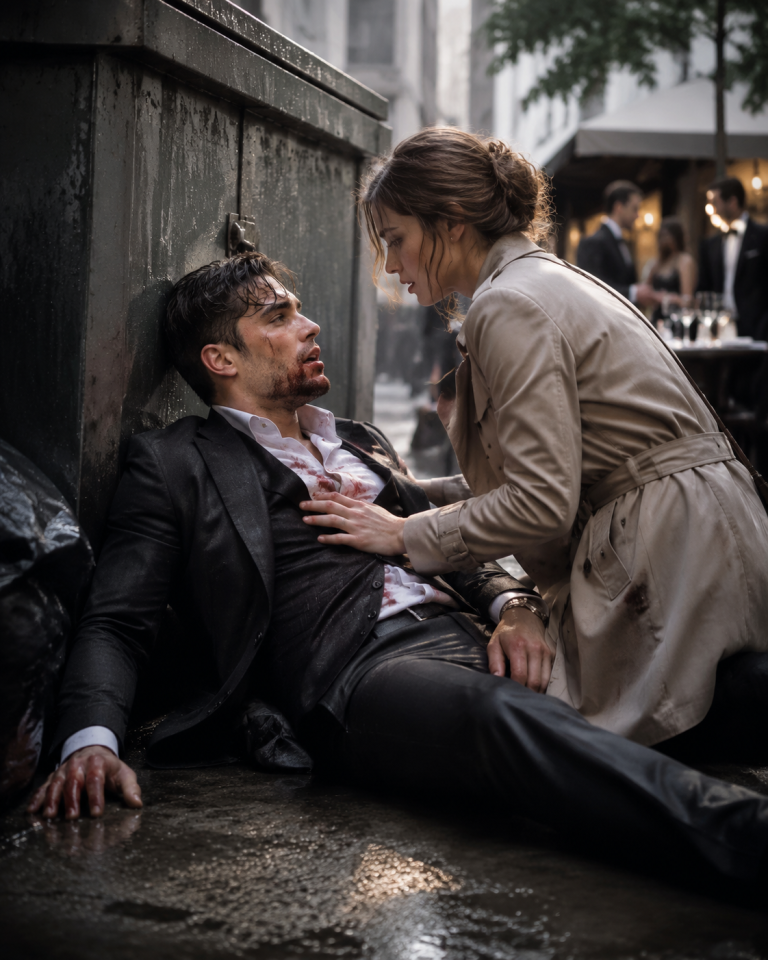
She ducked on instinct but her balance was gone — eight months had changed the geometry of her body in ways she was still adjusting to — and she caught herself against the oak crib, pain shooting through her lower back.
“Sofia!”
He stepped between her and the woman with the gun.
She saw the bullet hit him. Saw his coat jerk, saw the dark spread across his shoulder, saw the instant in which he absorbed it and kept moving.
He fired once.
The woman dropped.
“Back exit,” he said.
Then he lifted her.
She should have fought it. She had arguments prepared for exactly this — she had been rehearsing them for eight months, the speech about autonomy and choice and the specific ways that being carried by this man was not different from being imprisoned by him.
She said none of them.
Because his shoulder was bleeding through her sleeve and the boutique was still in chaos and the baby had moved sharply inside her with the particular insistence of someone who intended to survive this regardless of what the adults decided.
His men formed around them.
They moved through the narrow back hallway, through velvet curtains and consultation rooms painted in soft ivory.
The black SUV waited in the alley.
Of course it did.
Marco Conti had never gone anywhere without an escape route.
He lowered her into the back seat with a gentleness that had no relationship to the violence thirty seconds behind them. One hand braced her head.
When Celeste tried to follow, his guard stopped her.
Her face went white with fury.
“Second car,” Marco said flatly.
The door closed.
The city blurred past tinted glass.
—
## PART 2
“Is the baby mine?”
The question hit harder than the bullet had hit him.
Sofia pulled her hand back.
Outside, New York moved through its evening without any knowledge of what had just happened in the back of one black SUV — traffic lights, strangers, the city’s complete indifference.
“Take me home,” she said.
“Your apartment isn’t safe.”
“You don’t know where I live.”
“Brooklyn. Two moves in eight months. Cash payments. A doctor on Flatbush who asks nothing.” His voice lowered. “I looked until everyone in my organization was afraid to say your name.”
Her stomach tightened.
“You had no right.”
“I was your husband.”
“You were my danger. There’s a difference.”
The words cut through the car.
He looked away.
Not in anger.
Because she had hit something true.
She knew it when she saw it — the slight change in his profile, the specific quality of a man absorbing a wound that a gun had not made.
The SUV descended into the underground garage of Conti Tower, and she grabbed his sleeve before he could open the door.
“Please,” she said. “I ran from this place for a reason.”
He was quiet for a long moment.
His expression changed by something very small.
“I won’t let anyone touch you without your permission,” he said.
In his world, permission had always been decoration.
But his voice was different now.
She climbed out by herself.
—
The penthouse had not changed.
Black marble, floor-to-ceiling windows, white orchids on the side table, fresh. The grand piano she had never played. The silver sculpture by the entrance that had always made her feel like she was being appraised by the room itself.
Everything preserved.
As if she had only stepped out for the afternoon rather than eight months ago in the dark.
Her throat tightened before she could stop it.
Dr. Savini arrived within minutes — steady-handed, silver-haired, the kind of woman who had seen everything and expressed opinions about none of it. She examined Marco’s shoulder first (*passed through, you’ll live*), then turned to Sofia.
When the fetal monitor picked up the heartbeat, Sofia’s breath left her in one long shaken exhale.
Still there.
Still fighting.
Celeste was removed to a separate room after calling the pregnancy *an inconvenience* — Marco crossed the room with a speed that made her go silent before the word *inconvenience* had fully landed.
Later, Marco showed her the security footage on his tablet.
Celeste, entering through the side door twenty minutes before Marco had arrived.
Speaking to the woman who had raised the gun.
Below it: a bank transfer. Aldene Holdings. Two million dollars.
“She led you there,” Sofia said.
“Yes.”
“She knew about me.”
“She researched you. Your delivery preferences, the services you used on Madison Avenue.” He set the tablet down. “She did not want you dead.”
The words chilled her.
“She wanted you visible,” he said. “If I acknowledge the baby publicly, every enemy I have knows exactly where to aim.”
Sofia looked at her hands.
“Part of it,” Marco said.
“What’s the other part?”
His phone vibrated before he could answer.
He listened, said *send it*, ended the call.
He turned the screen toward her.
Security footage. Weeks old. Her, leaving the clinic on Flatbush, gray sweater, paper bag of prenatal vitamins.
The camera had zoomed in on her stomach.
A distorted voice: *Conti blood doesn’t stay hidden forever.*
They had known for weeks.
Before she could speak, every light in the penthouse died.
Red emergency lights flickered on.
An alarm pulsed from somewhere deep inside the building.
In the corridor: running feet, shouted orders, gunfire from below.
The baby moved sharply.
Marco was at the nightstand before she finished registering the dark, gun in hand.
The bedroom door shook.
Once.
Twice.
Then a voice came from the other side — unhurried, almost fond, carrying the specific weight of a man accustomed to rooms rearranging themselves around him.
“Open the door, Marco.”
She knew that voice.
She had heard it at their wedding. At family dinners. At her father’s funeral where it had been the steadiest sound in the room.
Marco’s face lost every trace of color.
The voice continued, almost amused.
“Don’t make this theatrical. I only came for the child.”
She knew.
Before she confirmed it, before Marco turned the handle, she knew.
Aldo Conti.
Marco’s uncle.
The man who had raised him.
The man whose funeral they had attended two years ago.
—
## PART 3
**The Arrangement**
Aldo Conti was older than his funeral photographs.
He stood in the doorway in a dark coat with a cane she had not expected, his silver hair the same and his face carrying two additional years of whatever a dead man did with his time.
He looked well.
That was the thing she could not stop noticing. He had staged his own disappearance and left his nephew to run an empire alone for two years and he looked like a man who had been sleeping adequately and eating regular meals.
His eyes found her immediately.
They were Marco’s eyes but older and less permeable — the eyes of a man who had never let things cost him the way Marco had let things cost him.
“Sofia,” he said. “You were always the clearest person in any room.”
“Don Conti.” She did not stand. Let him read the pregnancy if he wanted it. Let him underestimate her one final time. “You look well for someone we buried.”
Something that was not quite admiration moved across his face.
Marco stepped forward. “Why.”
Not a question. A reckoning.
Aldo settled himself in the chair by the window with the care of old joints. Four of his men positioned in the doorframe — weapons visible, holstered. Containing, not threatening.
“Edoardo Aldene,” Aldo said, “has been purchasing loyalties inside this organization for fourteen months. Not for himself. On behalf of a consortium of families who believe the Conti name should end with you.”
Marco’s voice went flat. “Because I have no heir.”
“Had no heir.” Aldo’s eyes moved to Sofia. “Until Celeste.”
“She told them,” Sofia said.
“She told Aldene. Aldene told the consortium.” He folded his hands over the cane. “Celeste was not working for her family. She was working for herself. She believed that positioning information about an heir would earn her standing. She is clever. She is not wise.”
“Why are you here,” Marco said. “Not the story. This room. Tonight.”
The smoothness thinned by one layer.
“Because I built this family before your father was born,” Aldo said. “And I will not watch it end because an ambitious woman and a money-minded man decided to help it along.”
“And the child.”
Aldo looked at Sofia.
“Means everything I just said to you,” he said. “I mean no harm to the child. I mean the opposite.”
“You came through a darkened building with armed men,” Sofia said.
“Through a building in crisis with men who could manage the crisis. If I intended harm, I would not be sitting here explaining myself.”
That was true.
She hated that it was true.
He reached into his coat and set a small drive on the bed.
“Everything Aldene owns inside this organization,” he said. “Every purchased loyalty. Every communication. Every promise made in my name without my knowledge. And the names of every family that wants this child erased before she becomes inconvenient to them.”
Marco stared at the drive.
Then at his uncle.
Then at Sofia.
He looked at her the way he had almost never looked at her in three years of marriage — not managing, not arranging. Waiting. Asking.
That was new.
That was something she had needed for three years and never received.
She turned to Aldo.
“You disappear before midnight,” she said. “Permanently.”
“Yes.”
“The organization, the decisions, what comes after — none of it is yours to manage.”
“Agreed.”
“I am not a piece of this exchange. Neither is this child. We are not payment.”
Aldo studied her.
Then nodded.
Once. The acknowledgment of a man who respected precision even when it cost him.
Marco turned to Gio, who had appeared in the doorway with the quiet of a man who had heard everything.
“Secure the building. His men leave through the east exit.”
Gio nodded.
“Stay,” Marco said to his uncle. “Until it’s finished.”
Aldo settled back.
“I was hoping you’d say that.”
—
**What the Drive Contained**
Marco worked for two hours.
Sofia sat against the headboard with a pillow behind her lower back while the baby pressed and shifted with the unhurried certainty of someone on her own schedule.
Dr. Savini returned twice. Blood pressure, fetal monitor. The contractions had subsided — *manageable*, she said, which Sofia understood to mean *not yet*.
The drive was methodical.
Edoardo Aldene had spent fourteen months collecting — bank transfers, recorded conversations, names. Names inside the Conti organization that Marco read with the stillness of someone cataloguing damage.
Names he had trusted.
Names he had shared dinners with.
She watched him absorb each one without expression and thought: this is the part that would have swallowed me whole. Not the guns. Not the danger. The loneliness of learning, again and again, that the people closest to you had prices.
Celeste was the final entry.
She had not merely passed information to Aldene.
She had suggested the boutique herself.
She had researched Sofia’s delivery preferences and positioned Aldene’s people inside. She had told Aldene that a public incident would force Marco to acknowledge the child, which would give the consortium a target.
She had not wanted Sofia dead.
She had wanted her visible.
In his world, those were the same thing.
Sofia sat with that and was not surprised.
She had been in rooms full of women like Celeste — women who looked at other women and saw rungs, not people. Who believed power was finite and someone else holding it diminished their portion.
Celeste had not been wrong about the math.
Only about which direction the power was moving.
Marco made three calls. After the third he sat quietly for a moment.
“Aldene’s accounts frozen by morning,” he said. “The consortium loses its funding.”
“And the men inside?”
He looked at the list.
“Handled.”
She did not ask.
He closed the laptop.
Aldo rose from his chair. “Faster than I would have done it.”
Marco looked at him. “Better information.”
“Yes,” Aldo said. “You did.”
There was two years unfinished between them. It would not be resolved tonight. But it was alive, and that was more than it had been an hour ago.
Aldo crossed to the bed.
He looked at her.
And for one moment the architecture of him — patriarch, empire-builder, the ghost who had watched from the dark — simply fell.
Just an old man, looking at a woman carrying the last of his family, after two years of absence.
“Forgive me,” he said.
“For tonight?”
“For what tonight was the consequence of.”
She met his eyes.
“Ask me in a year,” she said. “When I know whether the choice you made was worth what it cost.”
He nodded.
He reached into his coat and produced a small photograph. Black-and-white. Old paper. A young woman holding an infant.
“Marco’s mother,” he said. “The night he was born.”
The woman in the photograph had died when Marco was two. Sofia had never seen her face. But she recognized something in the line of her jaw — the way she held her child. Like she already understood the weight of what she was carrying.
Aldo left.
And then the building was only Conti men, and the crisis was contained.
Marco stood at the window.
Outside, the city was reassembling itself from whatever had disrupted it.
“You should rest,” he said.
“I’ve been resting.”
“You’ve been watching everything.”
“Those aren’t incompatible.”
He turned.
He looked at the photograph on the bed. At the bracelet box on the nightstand. At the hard chair beside the bed — he sat in that one, not the comfortable armchair.
The chair that offered nothing.
He had chosen it deliberately.
“I told you once,” he said, “that I would keep my world away from you. That protection and consumption were different things.” He turned one hand over on his knee, studying it. “I believed that. I believed that if I managed everything tightly enough, nothing bad could reach you.”
I waited.
“But when you manage everything tightly, you manage the people inside it too.” He looked up. “Including you.”
The admission sat between us.
I had waited three years to hear something close to this.
Now that it was here, it felt less like victory and more like looking at the shape of a wound.
“Yes,” I said.
“You were right to leave.”
“Yes.”
“I signed the papers without a fight because I believed you wanted freedom, and that love with a locked door was not love.”
My throat closed.
“I should have come to you,” he said. “When I suspected Aldene. When I understood you might be in danger. I should have come and told you and let you choose what to do with it.”
“Why didn’t you?”
He exhaled.
“I was afraid.”
He said it simply.
Marco Conti, who had sat across tables from men with federal authority and never blinked. Who had held an organization together at twenty-nine by being the least afraid person in every room.
Afraid.
“Of what?” I asked.
“That you would tell me you were managing without me. That the thing I had to offer was exactly what you had run from.” His voice was even. Something underneath it was not. “I was afraid that coming to you would confirm you were better without me.”
The room was very quiet.
I looked at his hands. At the bandage on his shoulder that had bled through and dried while he worked. At the photograph. At the bracelet box.
“Marco,” I said.
He looked at me.
“You are not better without me.” I held his gaze. “You are not better *for* me. Not yet. Maybe not in the way I need.” I pressed my lips together before continuing. “But you stepped in front of a bullet. And you apologized in the dark when you thought I was sleeping. And you let me climb out of that car in Brooklyn instead of arguing.”
He watched me.
“Those are not nothing,” I said.
“They are not enough,” he said.
“No.”
“But they are something.”
“Yes.”
He looked at the bracelet box on the nightstand — the tiny gold bracelet, delicate and plain, that he had shown me earlier and that had been sitting in his coat since the year after their wedding.
A future he had gotten wrong.
“The baby is mine first,” I said. “I’ve said that.”
“I know.”
“I decide where we live. The life she has.”
“Yes.”
“You don’t manage that.”
A breath. “I will try not to.”
“That’s not a promise.”
“No,” he said. “It’s more honest than one.”
I looked at him in the hard chair he had chosen for himself, with his bandaged shoulder and his careful hands, and I thought: *he is trying to become something.*
That was not nothing either.
Then the contraction hit.
—
**Lucia**
Not the practice ones.
This arrived with conviction — the specific clarity of something that had been building all evening and had decided that circumstances were irrelevant to its timeline.
I gripped the edge of the mattress.
Marco was on his feet before I finished the first sharp breath.
“Get the doctor,” I said.
He was at the door in two steps.
Dr. Savini arrived in under a minute. The nurses followed. The room reorganized itself around the fact that the night intended one more thing.
The labor lasted four hours.
What I will say about those hours is that Marco stood near the head of the bed for all of them and did not try to direct or manage or command. He held my hand when I reached for it. He was quiet when I did not reach. When I told him to stop hovering, he took one step back. When I said his name at the worst of it, he leaned in.
He was present in a way he had almost never been in three years of marriage — not arranging things around me but simply *there*, offering himself as whatever the moment required without deciding in advance what that should be.
It was what I had always wanted.
Not a man to manage the world.
A man to stand inside it with me.
She arrived at four in the morning.
The room went quiet in the specific way of rooms when something new enters them — not silence but the held-breath quality of the world making space.
Dr. Savini placed her on my chest.
Wrinkled and furious and perfect.
Dark hair. Tiny fists.
She opened her eyes and looked at me with the absolute assessment of someone who had been listening through the walls for eight months and had formed strong opinions.
My throat closed.
Everything — every cash payment, every moved apartment, every night in Brooklyn listening to the city not know my name — collapsed into the distance between me and this moment, and the moment was worth every mile.
“Hello,” I whispered.
She opened her mouth and made her views known.
I laughed and cried together in the terrible beautiful way of things that arrive after you have stopped believing they will.
Marco was very still.
I looked up.
He was looking at her with the expression I had seen only once — in a cathedral in Rome three years ago, when he turned and saw me walking toward him and for one second forgot that powerful men did not let their faces say everything.
He looked like a man who had just understood what he had been protecting.
Not an empire. Not a name. Not a succession.
*This.*
“Do you want to hold her?” I asked.
He came to the bed and took her with the careful terror of someone holding something he had no protocol for. Arms forming the right shape. Body going unnaturally still.
She looked up at him.
He looked down at her.
The assessment continued.
After a moment she appeared to conclude something.
She closed her eyes.
Marco exhaled — long, shaking, saying more than he would probably allow himself to say for months.
“What’s her name?” Dr. Savini asked.
I had known for a while.
I had not told anyone.
I looked at Marco.
“Lucia,” I said.
His eyes lifted to mine.
His grandmother’s name. The woman who had raised him before Aldo had taken over that task. The woman in the photograph who had died before anyone thought to tell the stories that might have made his world softer.
He had told me about her once. Three in the morning, in the first year, when we still told each other things.
I had been listening.
“Lucia,” he repeated.
His voice was different.
Not controlled. Not managed.
Just a man saying a name in a room where his daughter had just been born and finding it held more weight than he had.
“Yes,” I said.
—
**After**
I left Conti Tower on a Thursday morning.
Not the way I had arrived — carried through an alley with someone else’s blood on my sleeve. I walked out through the main entrance with Lucia in her carrier and a bag that Gio had packed with the specific thoroughness of someone instructed to think of everything.
Dr. Savini had cleared us both.
Marco walked us to the car.
He did not ask to come.
He did not suggest he should be the one driving.
He stood on the step and looked at the carrier and then at me with the expression of a man doing the hardest thing he had learned was necessary: allowing someone to leave.
“Thank you,” I said.
“For which part?”
I considered it honestly.
“All of it.”
He was quiet.
“I’ll send the bracelet,” I said. “When she’s big enough.”
He nodded.
“How will we—” he started.
“We’ll figure it out,” I said. “Not this week. But we will.”
“I don’t want to manage it.”
“I know.”
“I want to be—”
“I know,” I said.
He looked at Lucia, asleep in her carrier with the complete confidence of someone who had decided the world was manageable.
“She has your chin,” he said.
“She has your forehead.”
“That will cause her trouble.”
“It caused me trouble too.”
He almost smiled.
He did not touch me.
He did not ask for anything.
He stood on the step and let us go, and that was the most expensive thing I had ever watched him give.
—
Brooklyn looked the same.
Mrs. Reyes from the third floor was on the stoop with her coffee, and she looked up when the car stopped, and her face did what faces do when they see a baby.
“A girl?” she called.
“A girl,” I said.
She put a hand to her chest. “What’s her name?”
“Lucia.”
Mrs. Reyes nodded as though this confirmed something she had suspected. “Strong name.”
I carried Lucia upstairs.
The apartment was the same — paint, pigeons, one window onto the courtyard that caught morning light in a way I had started to love. I had left it looking like I might not come back.
I had come back.
I set Lucia in the bassinet and sat on the edge of the bed.
She slept.
Outside, the city continued its complete indifference.
I thought about the boutique. About gold light and cashmere and a gun. About Marco carrying me through an alley as if eight months and three years and one brutal divorce had no weight at all. About the bracelet in its velvet box. About Aldo in the chair by the window, looking at a woman he had considered incidental for years and finding out she had been paying attention all along.
About Lucia, born at four in the morning after a day that should have ended her before she began.
She was here.
Fist pressed to her cheek in the bassinet three feet away. Her father’s expression of self-contained certainty on her small new face.
She had no idea what she had come through.
She did not need to.
That was mine to carry.
Marco called that afternoon.
Not to arrange anything.
He said: “She slept.”
I said: “She slept.”
He said: “Good.”
I said: “Yes.”
We were quiet for a moment — two people on either side of something unfinished. The quiet was not empty. It was full of things not yet decided and not yet abandoned.
“Sunday,” I said. “You can come Sunday.”
A pause.
“What time?”
“Noon. Bring nothing. Just yourself.”
Another pause.
“All right,” he said.
He came Sunday.
He rang the bell from the street. He did not bring guards. He did not bring a car. He walked through Brooklyn in November with his hands in his pockets and his shoulder healing and his face doing the thing it did when he was not performing anything for anyone.
Mrs. Reyes waved from the stoop.
He waved back.
I watched from the window.
He rang again.
I buzzed him in.
He knocked on the apartment door, and when I opened it he looked at Lucia in my arms and did not try to take her and did not say the wrong thing.
He said: “Hello.”
She regarded him with the patience of someone in possession of strong opinions and excellent timing.
Then she reached toward him.
He took her.
He sat in the one decent chair in my apartment and held his daughter, and she looked at him with complete seriousness, and I made coffee in the kitchen and watched them through the doorway.
He was not a different man.
He was the same man choosing, with difficulty and imperfect success, to hold what he loved rather than arrange it.
That was not nothing.
That was not everything.
It was, for a Sunday in November with pigeons on the courtyard wall and coffee going warm on the counter and a girl called Lucia who had survived more than she would ever know just to get here —
it was enough to begin with.
**THE END**
—
—