SHE SAVED A DYING MAFIA BILLIONAIRE BEHIND A RESTAURANT — THEN DISCOVERED SHE WAS THE TARGET ALL ALONG

**PART 1**
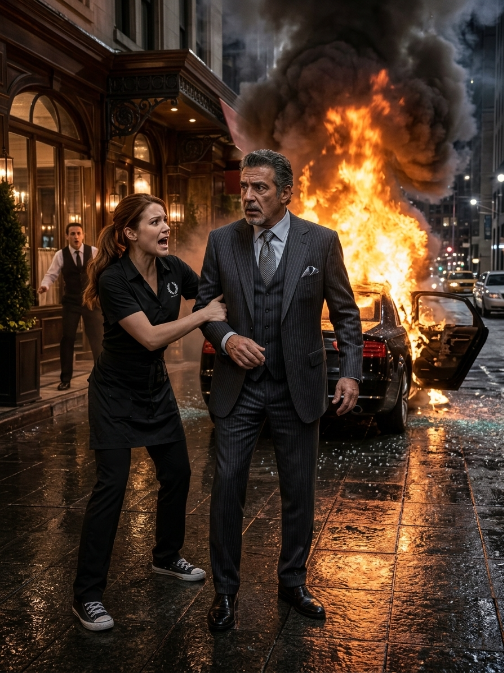
The first thing Alessandro Marchetti said to Chloe Bennett was not thank you. It was, “Don’t let them find you.” He said it with blood in his teeth and rain in his lungs, lying beside a dented dumpster behind one of downtown Chicago’s most expensive restaurants. Ten yards away, rich people were still laughing over wine while one of the most feared billionaires in the city was dying in the dark.
Chloe should have kept walking. She was twenty-five, broke, exhausted, and working two jobs just to keep debt from swallowing her whole. She’d just finished a late shift at Harlow Street Bistro, still in her fitted black server dress under a thrift-store leather coat, red lipstick fading but stubborn, auburn hair pinned back from a face too beautiful to look as tired as she felt. Chicago had taught her that poor women survived by minding their own business.
But then she heard the sound of a man choking on his own blood. She stopped beneath a broken security light and saw three men in dark coats standing over another man in the alley. One of them yanked the injured man’s face into the weak light, and Chloe went cold from her throat to her boots. It was Alessandro Marchetti.
Everyone knew his name, even people who wanted nothing to do with him. Officially, Alessandro was a billionaire logistics executive, a real estate power player, and the face of the Marchetti Family Foundation. Unofficially, people whispered that his family owned fear itself on the South Side docks. He was supposed to be untouchable, but that night he was on his knees in a puddle.
One attacker told him he should have stayed loyal. Alessandro laughed through blood and gave an answer so arrogant it sounded almost insane coming from a man who could barely breathe. The man with the scar hit him with brass knuckles, and Chloe flinched so hard her shoulder struck the brick wall. For one terrifying second, one attacker looked up, and she pressed herself into the shadows, praying he hadn’t seen her.
The men kicked Alessandro twice more, then left with terrifying calm. A black SUV pulled up, doors opened and closed, and it disappeared into traffic like nothing had happened. Chloe stood frozen, knowing this was her chance to leave and pretend she’d seen nothing. Then Alessandro made that choking sound again.
Three years earlier, Chloe had sat beside her mother’s hospital bed and listened to doctors speak in the gentle voice people use when hope has already left the room. She remembered how alone death sounded when everyone else slowly stepped away. So she looked at Alessandro Marchetti, the man Chicago called a monster, and thought one simple thing: nobody gets left to die alone. Then she ran to him.
Chloe had left nursing school two semesters short, but her hands remembered what panic tried to erase. She rolled him onto his side, eased his breathing, tore off her scarf, pressed it against the cut at his temple. Blood soaked the fabric, rain washed over his face, and his eyes opened just enough to focus on her. Not cold like she’d expected — sharp, pained, frighteningly aware.
He grabbed her wrist weakly and warned her again — not to let them find her, not to call the police, to use the phone in his inside pocket. Chloe wanted an ambulance. Alessandro insisted there could be no hospital. Then he said the words that made the alley feel suddenly full of invisible eyes: “They saw you.”
Chloe found his phone and called the only emergency contact listed. A woman named Vittoria answered with the calm of someone used to blood, secrets, and commands. Within minutes, a private medical team arrived in a black van without headlights. Chloe climbed in because she knew Alessandro’s breathing pattern, and because walking home alone suddenly felt more dangerous than staying with the mafia billionaire.
On the way, he woke long enough to say something about a ring. Simone, the young trauma nurse, froze when he said it, and Chloe knew there was a secret no one wanted to explain. By the time they reached a hidden medical facility, Alessandro was barely alive, and Chloe was covered in his blood. Then Vittoria Marchetti looked at her and said that by noon, the men who’d attacked him would know her name, her debts, her dead mother, and every place she’d ever worked.
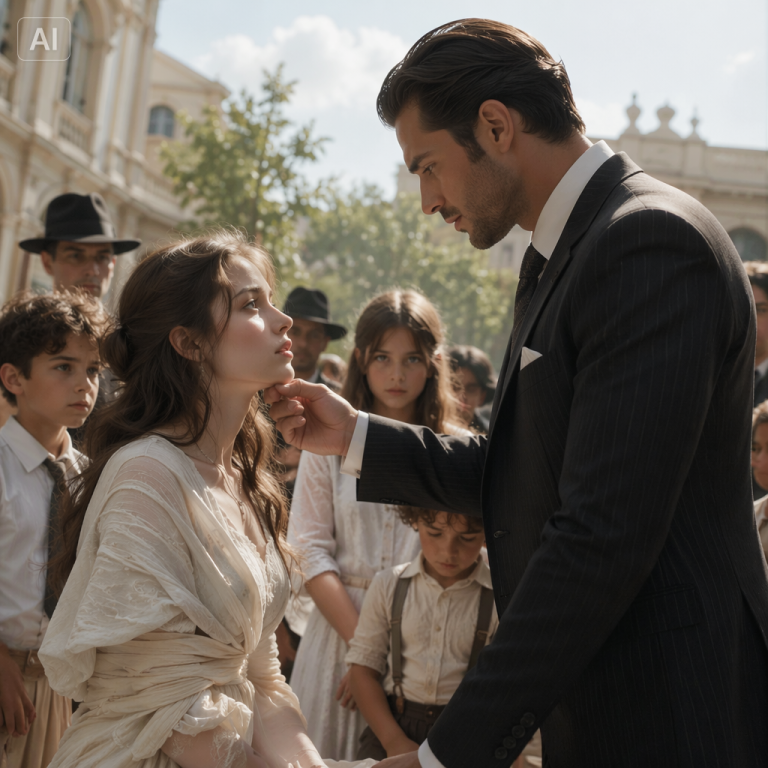
Vittoria offered her a choice. Chloe could leave as Chloe Bennett and run alone, or accept the protection of the Marchetti family. Then Vittoria opened a velvet pouch and revealed a heavy emerald ring. By dawn, if Chloe agreed, the city would be told Alessandro Marchetti had survived an attack and that the woman at his side was his secret fiancée.
**PART 2**
Chloe did not put on the ring because she believed in fairy tales. She knew a Marchetti ring could be protection, but it could also be a leash, a target, or a lie big enough to swallow her life. She demanded a lawyer, written terms, protection from coercion, and the right to leave if Alessandro woke up and rejected the arrangement. Vittoria watched her like she’d expected tears and found a fighter instead.
A lawyer named Renee Osei arrived before sunrise and made one thing clear: she represented Chloe, not the Marchetti family. Renee reviewed the agreement, warned Chloe the situation was dangerous, and confirmed the ring would not make her Alessandro’s legal wife — it would create a temporary public engagement, a shield against the men who wanted a disposable witness erased. Chloe signed only after adding that if Alessandro died, she would not become property of his family.
At 4:29 that morning, Vittoria slid the emerald ring onto Chloe’s finger. It fit perfectly, and that was the first detail Chloe could not explain. When she asked how, Vittoria avoided the answer with a smile that chilled her more than any threat. Before Chloe could push harder, Simone appeared and said Alessandro was out of surgery.
**PART 3**
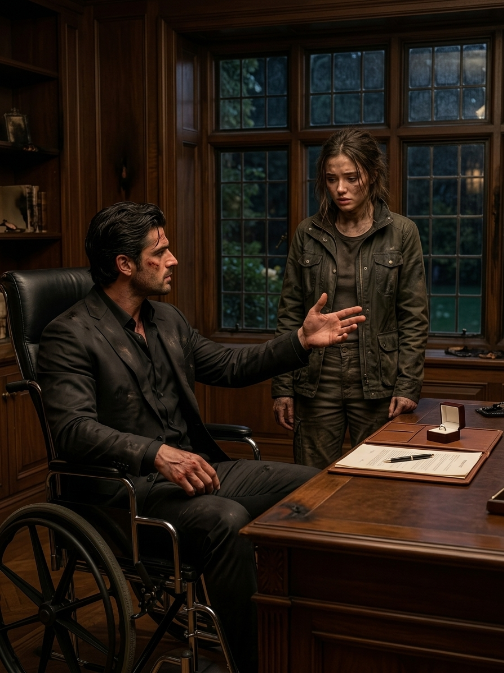
He was alive, but barely. His body was bruised, stitched, and damaged in ways that made even the doctors speak carefully. When he woke and saw Chloe wearing the ring, his entire body went still. The first word he rasped was not gratitude, but “No.”
Chloe told him she had chosen the danger because she would rather be complicated than disposable. He said she didn’t understand what his name did to people, and she answered that he should start explaining. Before he could, the hospital room door opened, and a tall blond man in an expensive suit walked in without knocking. Chloe recognized him instantly from the alley.
It was Dario Marchetti, Alessandro’s cousin. He’d stood near the attackers while Alessandro bled, and now he was smiling at Chloe’s ring like he’d found a locked drawer he wanted to open. Alessandro ordered him out, but Dario ignored him and studied Chloe’s face. When he said they hadn’t met, Chloe smiled and called him the cousin no one trusted.
By sunrise, the first headline was everywhere. Alessandro Marchetti had survived a private attack, and his secret fiancée had been revealed. But the photo attached to the article wasn’t from the hospital or the alley. It was an old picture of Chloe leaving Harlow Street Bistro three weeks earlier in a red dress, leather jacket, heels, and her mother’s emerald pendant.
Someone had been watching her before she ever saved Alessandro.
Chloe stared at the leaked photos until the room seemed to tilt. Pictures of her leaving work, buying coffee, carrying groceries, laughing under a streetlamp on a rare night off. These weren’t quick photos taken after the alley. Someone had been following her long before Alessandro was attacked.
Alessandro finally told her why. Harlow Street Bistro was secretly owned through a Marchetti shell company, and for months, money had been disappearing through payroll records and vendor accounts. An audit had flagged transfers under Chloe’s employee profile, making it look like she was receiving suspicious money from companies tied to Dario. Alessandro admitted he’d first believed she might be helping his cousin steal from him.
Chloe was furious. She’d been polishing wineglasses for sixteen dollars an hour while a billionaire had her watched like a criminal. Alessandro didn’t defend himself, which somehow made it worse and better at the same time. He said desperate people often got used, and now he knew she’d been used too. Someone had planted money in her name to make her look guilty.
The pieces connected. The ring fitting too perfectly, the headline ready by sunrise, the photos taken before the attack, Dario appearing at Alessandro’s bedside so quickly — all of it pointed to one thing. Chloe wasn’t just a witness. She was supposed to become the perfect scapegoat.
Alessandro explained the trap. If he’d died, the records would make Chloe look like the waitress who helped arrange a hit on him. The photos would prove he’d been watching her before the attack, making it seem like he’d discovered her betrayal in time. The public would see a poor, pretty, indebted waitress and believe she’d sold information for money.
But Alessandro lived, and that ruined Dario’s first plan. Now Dario needed to know whether his cousin trusted Chloe or suspected her. The fake engagement protected her, but it also pushed her into the center of a war she’d never chosen. Chloe realized she could either wait for Dario to frame her, or help find the evidence first.
Then she remembered something from the restaurant. Harlow Street Bistro used a payroll system with manager approvals, and her boss Tony was careless with saved logins. She also knew the back hallway camera was broken, but the wine cellar camera still recorded to a local drive nobody checked except after insurance inspections. If Dario’s people had altered her payroll account, that drive might show who’d entered the office.
Alessandro didn’t want her going back to the restaurant, but corrected himself when she raised one eyebrow. She changed into tight dark jeans, heeled boots, a fitted black turtleneck, and a cropped burgundy leather jacket, looking less like a rescued waitress and more like a woman returning to collect the truth. When she walked into Harlow Street Bistro, Tony’s face went white. Then the back door opened, and Dario Marchetti stepped into the kitchen corridor smiling.
“Chloe,” he said, like they were old friends. “I heard congratulations were in order.”
She kept her voice steady. “You heard right.”
“Funny thing about congratulations.” He leaned against the prep counter, unbothered, like a man who’d never once worried about consequences catching up to him. “They usually come with an investigation attached. Fraud teams love a story this clean. Poor waitress, rich benefactor, suspicious payroll transfers going back four months. I almost feel sorry for whoever they pin it on.”
“You planted those transfers.”
“Prove it.” His smile didn’t waver. “Go ahead. Ask Tony to pull up the system. Ask him who has admin access to employee accounts. I promise you, my name isn’t on anything.”
Tony wouldn’t meet her eyes, and that told Chloe everything about how this would go if she played by Dario’s rules. She glanced past him toward the door that led down to the wine cellar. Renee had told her once, in the hospital corridor, that the difference between panic and strategy was thirty seconds of thinking before you moved. Chloe gave herself those thirty seconds.
“You’re not as careful as you think you are,” she said finally.
Something flickered behind Dario’s easy smile — not much, but enough. “Excuse me?”
“You had someone watching me for weeks before the alley. Following me to coffee shops. To the grocery store. That’s not an efficient way to frame someone for a hit that hadn’t happened yet.” She kept her voice level, the way she used to steady her breathing before walking into her mother’s hospital room. “That means you were already planning to move against Alessandro before that night. The attack wasn’t a reaction to anything. It was scheduled. And people who schedule things leave records.”
Dario’s jaw tightened almost imperceptibly. “You’re guessing.”
“I’m a waitress who balances a register down to the penny every night because if I’m off by a dollar, I don’t eat that week,” Chloe said. “I notice numbers that don’t add up. And so will the auditors your uncle’s foundation is required by law to bring in every time there’s a formal fraud allegation involving a Marchetti company. You made sure of that yourself, didn’t you, when you set this whole thing up to look official.”
For the first time, Dario’s calm slipped enough that Tony took an instinctive step backward, like the temperature in the room had dropped.
“You don’t know what you’re involved in,” Dario said quietly.
“I know exactly what I’m involved in. I’m the woman who’s about to walk downstairs and pull the wine cellar footage before you think to have someone erase it.” She smiled, thin and humorless. “Unless you’d rather explain to Alessandro yourself why you were so eager to keep me out of this kitchen.”
It was a bluff about the footage being untouched — she had no way of knowing whether Dario’s people had already found the drive. But she’d learned something in three years of watching wealthy people decide who mattered and who didn’t: men like Dario Marchetti built their power on the assumption that no one beneath them would ever call their bluff back. He hesitated exactly long enough to confirm what she needed to know.
“Get out of my restaurant,” Tony said suddenly, finding his nerve at the worst possible moment for Dario and the best possible moment for Chloe. “Both of you. I don’t want any part of whatever this is.”
Dario’s eyes cut to him, cold, and Tony flinched but didn’t take it back. Chloe used the distraction to move past them both toward the cellar stairs. Dario caught her arm.
“You should have taken the ring off and run when you had the chance,” he said, low enough that only she could hear it.
“I did take the chance,” Chloe said, and pulled free. “I just didn’t take the one you wanted me to.”
Downstairs, the cellar smelled like cork and cold stone. The insurance camera sat exactly where she remembered, a small black box wedged above the racking, wired into a local drive that hadn’t been touched since the last inspection eight months earlier. Her hands shook pulling the SD card free, not from fear exactly, but from the particular adrenaline of doing something a smarter, safer person would have left to someone else.
By the time she climbed back upstairs, Dario was gone. Tony sat on an overturned crate looking like a man who’d aged five years in ten minutes.
“I didn’t know,” he said. “About the payroll thing. I swear to God, Chloe, I didn’t know.”
“I believe you,” she said, and meant it. Tony was careless, not cruel — a different kind of casualty in a war he’d never asked to be part of, same as her.
She called Renee from the sidewalk outside, the card burning a hole in her jacket pocket like it might disappear if she stopped touching it. “I have something,” she said. “I need you to meet me somewhere that isn’t a Marchetti building.”
The footage, once Renee’s forensic contact extracted it that night, showed exactly what Chloe had gambled it would. A man entering the manager’s office eleven weeks earlier, using a key Tony swore he’d never given out, sitting at the computer for exactly the length of time it would take to alter payroll routing information. The face was clear enough. Not Dario himself — he was too careful for that — but a man later identified as one of the three who’d stood over Alessandro in the alley, the one with the scar and the brass knuckles.
That single piece of footage did what months of Marchetti lawyers and Vittoria’s careful silence hadn’t managed: it connected the financial frame directly to the men who’d carried out the attack, and by extension, to whoever had sent them.
Alessandro, still healing, still moving like every step cost him something, sat across from Chloe in Vittoria’s study three days later while Renee laid the timeline out on the table between them — the altered payroll dates, the surveillance photos, the forged accounts, the footage from the cellar.
“He’s been building toward this for over a year,” Alessandro said quietly, staring at his cousin’s name written plainly across the top of Renee’s summary. “Not just the attack. The takeover after it. If I’d died that night, and Chloe had been arrested for it within the week, there would have been no one left who trusted me enough to ask hard questions. Dario would have inherited control of everything by default, wrapped in a tragedy nobody would want to reopen.”
“And if you’d lived, but distrusted me,” Chloe said, “you’d have pushed me away yourself, and he’d have gotten his scapegoat anyway, just slower.”
“Yes.” Alessandro’s voice was rough. “Either way, you were never supposed to survive this with your name intact. I’m sorry. I should have suspected him months ago. I let family be the one blind spot I never audited.”
“You’re auditing it now,” Chloe said. It wasn’t quite forgiveness. It was closer to recognition — the same thing she’d learned to offer herself in the years since her mother died, that surviving something badly handled the first time still counted as surviving it.
Dario Marchetti was arrested eleven days later, not for the attack itself — the men who’d actually swung the brass knuckles were easier targets, and two of them had already begun cooperating in exchange for reduced charges — but for a tidy, undeniable trail of wire fraud and falsified corporate records that Renee had made sure landed on a federal prosecutor’s desk instead of staying inside the family’s private machinery. Vittoria did not shed a single tear in public. Whatever she felt about her nephew, she’d spent too many decades protecting the family name to let sentiment slow down the cleanup.
The engagement, once a shield built out of necessity and an emerald ring that fit too perfectly to be coincidence, became something neither of them had planned for. Chloe kept working extra shifts for another two months out of sheer stubbornness, until Alessandro finally admitted — not as a command, but as a request Renee had helped him phrase properly — that he’d like to fund her return to nursing school, not as payment, but as investment in the woman who’d known exactly how to keep him breathing in an alley when trained security men had already assumed he was finished.
She said yes to that. The ring took longer.
“I don’t want it to mean something it isn’t yet,” she told him one evening, turning the emerald slowly in the lamplight of the study where all of this had first been laid bare across a table.
“Then we’ll wait until it does,” Alessandro said, and for a man Chicago had spent a decade calling untouchable, there was something almost unbearably ordinary in the patience of that answer.
It took the better part of a year. Not fairy-tale time, not headline time — real time, built out of hospital follow-ups and quiet dinners and Chloe finishing her final two semesters while Alessandro slowly handed off pieces of the business that had nearly gotten them both killed to people Renee had vetted twice over. There were fights. There was one terrible week when Chloe nearly gave the ring back entirely, certain she’d mistaken gratitude for love the way she’d once mistaken numbness for calm at her mother’s bedside. Alessandro let her have that week without arguing her out of it, which turned out to be exactly the thing that brought her back.
When she finally wore the ring because she chose to and not because a velvet pouch had been placed in front of her at 4:29 in the morning, no cameras were waiting outside. No headline ran by sunrise. Just Vittoria, dry-eyed as ever but unmistakably pleased, and Simone from the medical team, and Renee, who’d long since stopped billing by the hour where Chloe was concerned and started simply showing up.
Tony sent a card. Chloe kept it.
Years later, when people in Chicago told the story — and they still did, in the careful, half-admiring way the city told stories about the Marchetti family — they usually got the alley right and the ring right and left out the part that mattered most: that the woman who’d knelt in the rain beside a dying billionaire hadn’t done it because she recognized power. She’d done it because she recognized what it looked like to be left to die alone, and had decided, once, that she wouldn’t let it happen twice in one lifetime if she could help it.
Everything after that — the ring, the danger, the frame job, the year of learning whether trust could be built out of something that started as a lie for survival — had only ever been the second half of that same decision, playing itself out one difficult, unglamorous choice at a time.