Two Years After He Threw Her Out, the Mafia Boss Got a 4 AM Call: “Your Son Is Dying”

## PART 1
The thing about surviving someone is that you get very good at it.
You stop saying their name. You reroute the thoughts. You build something new out of every hour they used to occupy, and after a while the new thing fills up enough space that the absence stops bleeding every single day. You get functional. Then decent. Then something that looks, from a reasonable distance, like fine.
I had been fine for almost two years.
My name is Mara Quinn, and at 3:47 in the morning on a Tuesday in February, I was sitting outside Room 312 at Mercy Children’s Hospital in Chicago with a cup of coffee I’d forgotten to drink and the particular stillness of a person whose body had simply stopped agreeing to panic.
My son was inside.
Forty hours with a fever that wouldn’t break. Then the seizure in the kitchen while I was trying to find his shoe, and the ambulance, and the attending physician using words in a careful voice that doctors used when the truth needed wrapping.
Bacterial meningitis. Critical but stable.
Those two words did not belong in the same sentence and I kept trying to make them make sense and couldn’t.
The fourth floor was too bright at this hour. Fluorescent lights over linoleum, the smell of antiseptic and recycled air, machines beeping in gentle ongoing arguments with each other through the walls. I had been sitting in this specific plastic chair for ninety minutes because I could not go back into the room and watch the monitors and I could not go home and I could not do anything except hold my own hands and not come apart.
Then I did the thing I had promised myself I would never do.
I called Nico Varano.
Not on impulse. I want to be clear about that. I had stared at the number in my contacts for twenty minutes, my phone screen the only warm light in that cold corridor, my thumb hovering. I had argued myself out of it twice. I had made and rejected two other plans.
But my son was in the room behind me, burning from the inside, and for the last twelve hours through the fever and the confusion he had been saying one word over and over in a voice so small I could barely hear it.
Papà.
Matteo had never met Nico. Not once. There was a photograph I should have thrown away — Nico at the edge of a pier somewhere, the wind in his hair, the look on his face that had once made me believe he was capable of the ordinary kind of love — and Matteo had found it in a drawer six months ago and pointed at it with his small sticky finger and asked who that was.
I told him someone important.
That was all.
But children run their own investigations without telling you. They notice resemblances. They watch fathers in the park and ask questions sideways and construct something out of the available evidence. Matteo had Nico’s eyes — dark and still and taking everything in — and sometimes I’d look at my son across the breakfast table and lose my breath at the fact of it.
The phone rang twice.
A man answered. Not Nico. Careful, professional, accustomed to calls at unreasonable hours.
I said: “Tell him his son is dying.”
Silence. Then a different voice on the line — lower, controlled, the particular quality of quiet that had once made me feel safe and later made me understand I had never actually known what safe was.
“Which hospital,” Nico said. Not a question.
“Mercy Children’s. Please don’t—”
He had already ended the call.
He arrived in thirty-one minutes, which meant he had not stopped for traffic lights.
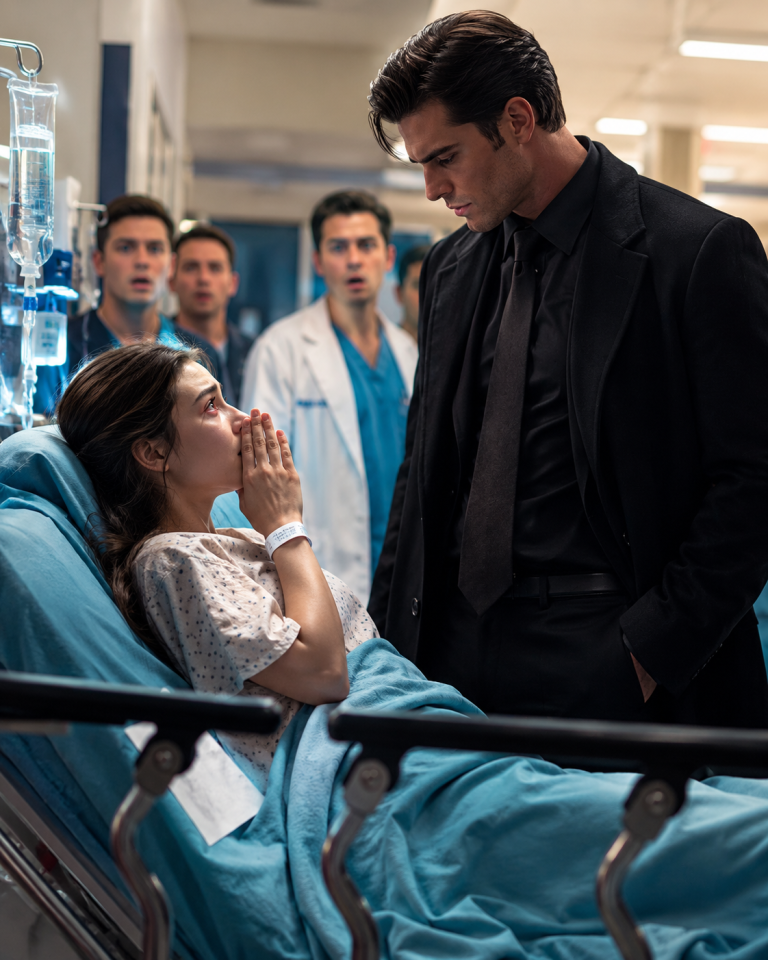
I was standing when he came through the corridor doors, because I had been unable to sit still for the last twenty minutes once I understood he was coming. My hands were pressed flat against my thighs to stop them shaking.
He had not changed.
That was the first injustice of the night.
Same dark coat. Same unhurried movement, the kind that made corridors feel like they’d been arranged for him. He was broader than I remembered, or maybe I had been telling myself a smaller version of him for two years to make the absence bearable. His face was still that particular composition of sharp angles and controlled expression, the kind of handsome that cost something to look at directly.
He stopped two feet in front of me.
“Mara.”
I had not heard my name in his voice for twenty-two months. It landed somewhere between memory and wound.
“He’s been asking for you,” I said, keeping my voice flat. “He doesn’t know who you are. But he’s been calling for you through the fever for hours, and I couldn’t—” My throat closed on the rest.
Nico’s gaze moved to the closed door of Room 312.
“What happened?”
I told him. The fever. The seizure. The words the doctor had used.
He listened without interrupting, which was not how I remembered him. He had learned stillness, or maybe I had forgotten how deep it went.
When I finished, he said, “Tell me what he looks like.”
My chest tightened. “He looks like you.”
Something moved across Nico’s face. It came and went too fast to fully read, but it was the first genuinely unguarded thing I had seen him do in years, and it nearly undid me.
“You should have told me,” he said.
The anger that had kept me functional for two years rose hard and clean.
“You told me to go,” I said. “You told me never to contact you again. I followed your instructions.”
His jaw tightened. He did not argue.
“Take me to him.”
We went in together.
Matteo was so small in the hospital bed. Dark lashes against cheeks still flushed from fever, one hand curled near his chin, a thin plastic tube at his nose, monitors drawing their quiet patient lines beside him. He looked like something that should not be in a hospital, that should be on a beach somewhere or in a garden digging for something important.
Nico stopped just inside the doorway.
I watched him look at our son and understand that the math had been real all along — the dates, the timing, the eyes, the specific quiet assessing expression that belonged entirely to his side of whatever Matteo had inherited.
Then Matteo stirred.
His eyes opened a crack, heavy and clouded, and his gaze moved slowly, slowly across the room until it reached the tall man standing in the doorway.
Something happened in his small face.
Not fear. Not confusion.
Recognition.
His fingers lifted from the blanket.
“Papà,” he breathed.
And my carefully built life came apart at the seams.
Nico’s head turned to me sharply, and in his eyes I saw every question, every accusation, every calculation happening at speed — and behind all of it, raw and undefended, something I had not been prepared to see.
Hope.
He crossed the room and sat on the edge of the bed with the careful reverence of a man approaching something sacred, and Matteo’s tiny fingers found his hand, and I had to look at the window because I could not survive watching that happen and keep standing.
What I did not know yet — what none of us knew in that terrible, tender moment — was that Matteo’s illness was not accidental.
And by morning, Nico would know whose hands had reached into our son’s world.
—
## PART 2
The infectious disease specialist came in at six.
She had the kind of face that was trained to deliver information without delivering verdict, and she folded her hands on the table in the consultation room where she had asked us both to go, and she spoke in careful complete sentences, and at the end of it Nico said the thing she hadn’t.
“Someone introduced this deliberately.”
The doctor said that was not a determination she could make medically. That the strain was unusual. That direct exposure was the most likely vector. That in a child Matteo’s age with no obvious vulnerability, the pattern was — atypical.
I told him that wasn’t possible. Children got sick. Matteo went to daycare, to the park, to the neighbors’ apartment where the radiator leaked and the windows didn’t seal. He was a child.
Nico looked at me.
“He’s my child,” he said.
The words hit me somewhere old and permanent.
By noon there were men in dark coats on the fourth floor who the nurses pretended not to notice, and Nico’s head of security, a man named Fedor who had always treated me with the thoughtful courtesy of someone who understood he was in complicated territory, appeared with coffee and a set of stuffed animals for Matteo that were significantly nicer than anything in the hospital gift shop.
“Forty minutes from Evanston,” Fedor said quietly, handing me the coffee. “He drove himself.”
I thought about what that meant and then tried not to think about it.
In the room, Matteo had Nico’s finger wrapped in his whole fist and was conducting some kind of negotiation about whether the stuffed bear could sleep in the bed with them. Nico, who had once made rooms full of dangerous men sit in silence, was listening with total attention.
My son had settled for him in less than an hour.
I had spent two years building a life defined partly by the fact that Nico Varano was not in it.
When Matteo finally slept, Nico came into the hallway.
“You’re not going back to your apartment,” he said.
I looked at him. “I didn’t ask for your opinion.”
“Someone targeted Matteo. Until I know who, you both need a controlled environment.”
“We have a home.”
“You have a ground-floor unit with one door.”
“Stop briefing me like I’m a security problem.”
“Then stop treating this like pride.”
My voice came sharp. “You don’t get to exile me and then decide where I live because you’ve decided to care again.”
A silence opened.
He absorbed it.
Then, differently: “You’re right. I don’t get to decide.”
A beat.
“I’m asking.”
That stopped me harder than any argument could have.
Nico Varano did not ask for things. He arranged. He directed. He presented the world with conclusions and expected compliance.
“Ask” was not a word in his operational vocabulary.
And then from inside Room 312, quiet and certain through the half-open door: *”Papà.”*
Matteo, talking in his sleep.
That was the end of the argument.
What I still didn’t know — what I wouldn’t know until three days into our stay at Nico’s estate, when he finally told me everything he’d learned — was that the man who had engineered my exile two years ago was the same man who had just tried to engineer my son’s death.
And he had a name.
A name I already knew.
—
## PART 3
Nico’s estate was forty minutes north of the city, past the point where Chicago gradually remembers it used to be a landscape.
Stone walls. Iron gates. The kind of property that had been built by people who wanted to be permanent and had the money to approximate it. I expected cold — the interior fortress of a man who had closed himself off from everything human. Instead I found books in rooms that got real light, a kitchen garden visible from the back windows, and a woman named Agnese who was somewhere between sixty and immortal and who looked at Matteo in my arms and said, in a voice that accepted no alternative interpretation, “That child needs a real meal and a nap without machines, and you look like you need both.”
She fed Matteo lamb broth with small pasta shapes and he ate three full bowls and fell asleep in a chair before she could move him to the guest room.
She fed me too, without asking.
I almost liked her immediately, which felt like disloyalty to my grief.
—
The days at the estate had their own logic.
Matteo recovered in increments, the way children do — suddenly better, then suddenly tired, then demanding and bored and insisting on being carried when he was perfectly capable of walking, which meant he was genuinely getting better. He followed Nico with the loyalty of a small, confident ambassador, tugging on his sleeve, handing him things for inspection, demanding opinions on matters of great importance.
Nico, who I had once watched keep a table of twelve in cold productive silence, was being instructed on the correct placement of wooden train cars with total seriousness.
He complied.
That was what I couldn’t reconcile. Not the power, not the past, not the architecture of everything that had happened between us. I could hold all of that with practiced distance.
What I could not hold at a distance was watching my son put his head on Nico’s shoulder and go to sleep like it was where he belonged.
—
“You’re going to ask me,” Nico said.
We were in the kitchen on the third night, after Matteo was asleep and Agnese had gone upstairs. He had a glass of water he wasn’t drinking. I had been standing at the window watching the gates.
“I’ve been asking for two years,” I said. “In my head. Every version of the conversation.”
He set the glass down.
“I believed you had passed information to Salvio Greco.”
I turned around.
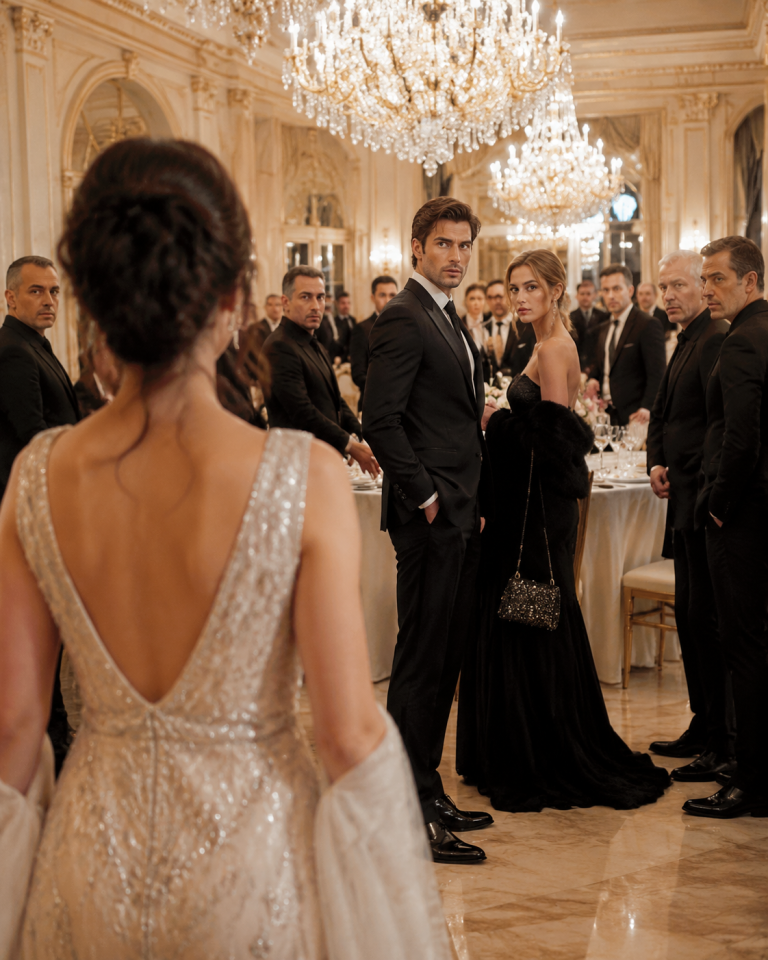
Greco was a name from the periphery of Nico’s world — a rival from the north side, methodical, patient, the kind of dangerous that never announced itself. I had met him exactly once, at an event I had not wanted to attend.
“I’ve spoken to him twice in my life,” I said. “Both times with you present.”
“I know that now.”
“You knew it then, too.”
His jaw flexed. “My father’s advisor brought me evidence. A meeting log. Communications times. A specific detail about a shipment that moved within forty-eight hours of the leak.” He paused. “The information pointed to you.”
“And you didn’t ask me.”
“I came to a conclusion.”
The honesty of that — flat, undecorated — was somehow worse than an excuse would have been.
“You came to a conclusion,” I repeated. “About me. With two years of evidence that I was someone who could be trusted, and you chose the document over the person.”
“Yes,” he said.
The word sat in the room like something put down carefully.
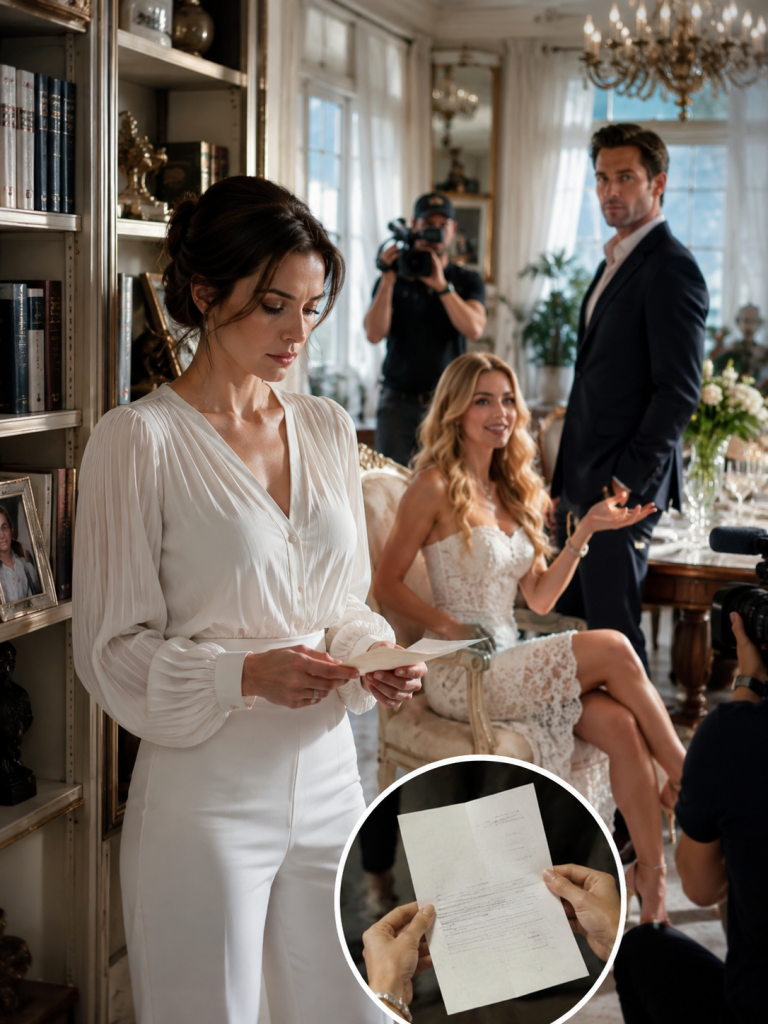
“I called you,” I said. “Six weeks after I left. I called your office and said I needed to speak to you. I was told you’d given instructions not to put me through. That if I tried again, security would remove me.”
His expression changed.
“I never gave that instruction.”
The room became very still.
We looked at each other.
“Then someone lied to both of us,” I said.
Nico went somewhere internal for a moment. When he came back, his face had the particular quality I had only seen a handful of times — not anger, which was a language he controlled absolutely, but something older and quieter. The expression of a man who has just understood the shape of what was done to him.
“Who managed your incoming calls?” I asked.
“Renato Cassel.” He said the name like it had weight. “My father’s advisor.”
I watched the realization move across his face. Not surprise. Something beyond surprise — the specific grief of discovering that the person who raised you in the architecture of loyalty was the one who dismantled everything you thought it meant.
“He arranged the evidence against me,” I said. It was not a question.
“And blocked you from reaching me after.” Nico looked at the window. “Someone in my house wanted you gone. And made sure you stayed gone.”
“Why?”
He was quiet for a long time.
“I have been asking that for three days,” he said. “I think I know the answer and I need to confirm it before I tell you.”
“Tell me anyway.”
“Not yet.” He looked at me. “But when I have it, you’ll be the first.”
That was new too. The before was a version of Nico who managed information — who decided what people needed to know and when, based on calculations that had nothing to do with what they deserved. This was different. Small, but different.
“Okay,” I said.
He nodded once.
“There’s one more thing,” I said.
He waited.
“When I called you at the hospital. 3:47 in the morning, with our son in critical care.” I kept my voice steady. “I need to know that if I had called three months after you threw me out, you would have come.”
A long silence.
“Yes,” he said.
“You would have answered the phone.”
“Yes.”
“Even believing what you believed about me.”
“He is my son.” Something in his voice roughened. “That was never conditional on what I believed about you.”
I exhaled slowly.
“Then whoever tried to keep that from happening,” I said, “knew that too. They knew that if Matteo existed in your world, you would protect him regardless. So they tried to make sure he didn’t exist in your world.”
Nico went absolutely still.
The full shape of it arriving, I could see, in real time.
“And when that failed,” he said quietly, “they tried to make sure he didn’t exist at all.”
—
The attack at dinner was the end of the careful, ordinary period.
We were at the table — Matteo in his high chair conducting experiments with pasta, Agnese arguing with me about whether I was using enough salt in the broth, Fedor having arrived twenty minutes earlier to complain about his personal life in the specific way of a man who had no personal life and knew it — when the east-facing window broke.
Not broken. *Broke.* The crack of it was different from any sound I had a reference for — sharp and immediate and followed by Nico being between me and the window before I had finished registering that it had happened.
“Interior passage,” he said.
His voice was level.
Men appeared from rooms I hadn’t known were occupied. Agnese snatched Matteo from the high chair with the competence of someone who had done this before and hoped not to do it again. I was moved through two doorways, around a corner, into a paneled hallway inside the walls of the house while my lungs worked on catching up with events.
Ten minutes later, two men were in custody and one had not survived the garden wall.
That night, after Matteo finally slept, I found Nico in his office with a cut along his forearm he was not treating.
“Sit down,” I said.
He looked like he intended to decline.
“Sit down,” I said again.
He sat.
I cleaned the cut under the lamp light while he stayed still in the particular way of people who are accustomed to pain and not accustomed to being tended. The wound was minor. The act of tending it was something else.
“You always do this,” he said quietly.
“Clean wounds?”
“Keep your hands occupied when you’re afraid.”
I pressed the tape down with slightly more force than necessary. “I bake.”
“You build things with your hands when the rest of you is terrified,” he said. “You did it the night before the evidence arrived. You made three loaves of bread and a cake nobody asked for.”
I looked up.
He was watching my face with the careful attention of someone who had been paying it for a long time and had not been given permission to say so.
“I should have asked you,” he said. “Before I did anything. Before I let a piece of paper override two years of knowing you.”
“Yes,” I said. “You should have.”
He accepted that without defense.
—
The second attack was worse because it was Rosa.
Agnese was clipped by the blast when Nico’s convoy left a pharmacy parking lot on a Thursday. She survived — concussion, broken collarbone, a deep gash on her arm that required twelve stitches — but she spent three days in hospital while Matteo asked every hour if she could still make his soup and I spent three days not sleeping and Nico spent three days dismantling everything he thought he knew about his own house.
On the evening of the third day, Fedor found me in the upstairs hallway.
“Nico says there’s a car at the north gate,” he said. His voice was different from usual — less dry, more careful. “Fueled. Clean plates. Driver with no connection to any of this. Cash. New phones. Documents if you need them.”
I stared at him.
“He’s giving me an exit?”
Fedor looked out the window.
“He said you came here because Leo needed protection, not because you chose to be here. He said the situation is getting worse before it gets better, and you should decide with that information.” He paused. “He said you always had the right to leave. He just didn’t always say so.”
I went back to the guest room.
Matteo was asleep, small and warm, breathing steadily, a stuffed bear under one arm and one sock inexplicably on the wrong foot. His dark lashes. His father’s stillness in sleep.
I sat on the edge of the bed for a long time.
The car at the north gate led back to my apartment in Wicker Park. My bakery. The morning regulars who knew my name and my son’s name and the flavor rotation of the week. A life I had built out of the rubble of loving someone dangerous, and it was real, it was mine, it was good.
It was also smaller than this.
Not in terms of money or safety or comfort.
In terms of truth.
I turned around and walked to Nico’s office.
He looked up when I came in. He had been expecting something — the departure, perhaps, or the demand for explanation. Not this.
“I’m staying,” I said.
The silence after was loaded.
“You understand what that means,” he said. Not a question.
“It means I’m tired of living inside decisions other people made. Cassel decided I was gone. Greco decided Matteo was a liability. You decided I was guilty.” I looked at him steadily. “I’m done letting other people decide.”
Something moved across his face.
“All right,” he said. “Then I tell you everything I have.”
He did.
Renato Cassel had been Nico’s father’s man for thirty years. He had been, by every measure available, loyal. The kind of loyalty that came with the furniture, that no one thought to question because questioning it would have meant questioning the foundation.
Cassel’s son had been killed six years ago in an operation that went wrong at the worst possible moment — a warehouse in Cicero, a night that was supposed to be straightforward, a boy who should not have been there and was. Nico had signed the authorization. He had not known about the boy.
Cassel had known.
He had waited.
Men like Cassel did not want apologies, Nico said. They wanted symmetry. They wanted you to understand what it was to have something taken.
So Cassel had taken me.
Fabricated the evidence. Managed my calls. Locked the door between us with careful invisible hands and then waited to see what the absence would cost.
When Matteo got sick, that had been Greco — Cassel providing the access, Greco providing the logistics. Push Nico into panic. Shake the structure until something irreplaceable fell out.
I sat with that information for a long time.
“He watched you lose your son,” I said.
“Yes.”
“For two years.”
“Yes.”
“And that was the point.”
“Yes.” Nico’s voice was level, but the level was over something very deep. “He wanted me to know what it cost. A specific cost. The one that fit the wound.”
I thought about my son in Room 312 saying *papà* through a fever. About the two years I had spent building something real out of the ruins of a betrayal that had never actually happened.
About a man grieving a son and choosing revenge so precise it was almost a form of art.
“I’m sorry about his son,” I said.
Nico looked at me.
“So am I,” he said. “That doesn’t absolve the rest.”
“No,” I agreed. “But it’s still true.”
—
Cassel was arrested four days later.
Nico did not handle it himself. That was the thing I had not expected — that a man who had been raised in a tradition where punishment was personal would pick up the phone and call the U.S. Attorney’s office instead.
He had the records Fedor had assembled. The payment documentation connecting Cassel to Greco. The phone logs showing the blocked calls. Medical records from Matteo’s case. Testimony from the nurse who had noticed the unusual presentation at St. Catherine’s and flagged it to a researcher who then flagged it to a federal health investigator.
Greco folded within seventy-two hours of Cassel’s arrest.
Neither of them saw a private room.
When Fedor told me, I said, “I thought—”
“So did I,” he said. “For about thirty seconds.”
“What made him decide?”
Fedor looked thoughtful, which on him was a rare expression. “He said Matteo doesn’t get raised watching his father become the thing that started it.”
I stayed very still with that for a moment.
Then I went to find Nico.
—
Ordinary life returned the way light returns after surgery — gradually, then all at once, then ordinary again.
My bakery reopened. My assistant Daniela, who had managed three separate crises involving event cakes and one involving a supplier who had simply stopped answering phones, hugged me in the kitchen with the particular force of someone who had been pretending to be fine for six weeks and was no longer required to.
“You look like yourself,” she said.
“I look terrible,” I said.
“That’s what I mean. You look real.”
Matteo got better. Really better, the kind that comes with appetite and opinions and the refusal to wear the coat you have already put on him. He began asking to go to “the big house” with the specificity of a child who has decided something is his.
Nico came to the bakery.
He came in the late afternoon on a Friday, dark coat, Matteo on his arm, and every woman at the window table had the same four-second reaction before returning to their drinks. He set Matteo down on the counter and Matteo pointed immediately at the pastry case.
“Papà. Cake.”
“After dinner,” Nico said, which was the correct answer and would not be honored.
He looked at me over Matteo’s head.
Matteo looked at me and then at Nico and then at me again with the assessing expression of a child who has been running calculations and is nearly ready to report his findings.
By January, Nico was spending more evenings in Wicker Park than in Lake Forest. By February, Matteo had decided that both places belonged to him and had begun leaving objects in both as territorial markers — a single green sock in one location, a drawing in the other, a wooden train car wedged behind a radiator that Agnese found in March and displayed on the kitchen windowsill like an artifact.
By March, I had stopped pretending.
One evening, after Matteo was asleep on the couch with a cartoon running quietly on the television, Nico found me in the kitchen working bread dough I did not need.
“You do this when you’re thinking,” he said from the doorway.
“I do this when I need to.”
He came to stand at the island.
He placed a small box on the counter between the flour bowl and the olive oil. Dark velvet. Worn at one corner, the way things are worn when they’ve been handled.
I looked at it.
“Nico.”
“I know.” He looked almost irritated at himself, which was its own form of tenderness. “I had a longer version. It was too careful. This is more honest.”
He opened the box.
The ring inside was old gold, a single stone, not loud. The kind of beautiful that came from being real and lasting.
“My grandmother’s,” he said. “She kept it because she said it was honest. No performance. Just the intention.”
I looked at the ring. Then at him.
“If someone tells you something about me again,” I said. “Something convenient. Something that lets you conclude instead of ask.”
“I come to you,” he said, without hesitation. “Before anything else. I come to you.”
“And Matteo?”
His expression changed in the way it always did when Matteo’s name arrived in a sentence — not softened, exactly, but rearranged around something permanent.
“Matteo is my son,” he said. “That is not a position I hold. It is who I am. Nothing changes it.”
I picked up the ring.
Slid it onto my own finger.
“Okay,” I said.
He looked at the ring on my hand and then at my face, and I watched Nico Varano — who had been composed in every room I had ever seen him occupy, who wore stillness like a second suit — lose the composure entirely for a single unguarded moment.
Then it came back, quieter.
He pulled me in and kissed me, and it was the kind of kiss that contained everything that had happened between us — the two years and the silence and the grief and the forty-minute drive at 3:47 in the morning and the small hand finding his in Room 312 — and did not try to erase any of it.
We got married in May, in a small ceremony at the courthouse with Fedor pretending he was not moved by anything, and Daniela from the bakery who cried with the committed energy of someone who had been waiting for this outcome and wanted credit, and Agnese who said the only important thing about a wedding was whether the people in it were telling the truth.
—
In the summer, a year after the hospital, I fell asleep on the bench in the estate garden.
I woke to Nico sitting beside me.
The light was long and low. Matteo was crouched near the far wall in intense communion with something in the grass, his father’s stillness in his whole small body.
“Twenty-three minutes,” Nico said.
“In the garden?”
“In the garden.” He looked at me. “You’re doing the thing.”
“What thing?”
“The thing where you sleep somewhere you didn’t plan to, in a place you feel safe enough not to notice.”
I looked at him.
“You started doing it when Matteo came home from the hospital,” he said. “The first time I saw it, I didn’t understand it. Then I did.” He paused. “You sleep in places where your body has decided, without telling you, that the danger is over.”
Across the garden, Matteo looked up and spotted us and came running with the full-commitment sprint of a child who has important news.
He reached us, slightly out of breath, and held out one hand.
A small grey stone, smooth, nothing remarkable.
He placed it very carefully in my palm.
“For you,” he said. With great gravity.
“Thank you,” I said.
He considered the transaction complete and turned to Nico.
“Papà. Cake.”
“After dinner,” Nico said.
“Now.”
“After.”
Matteo looked at me for support.
“After dinner,” I agreed.
He accepted this with the dignity of someone who has lost a vote but retains his principles, and went back to the wall.
Nico’s hand found mine on the bench. His thumb traced the ring on my finger — that small honest circle of old gold — and I let my head rest back and looked at the sky above the garden, which was the particular blue of late summer in the midwest, the kind that makes the whole city seem possible.
I thought about Room 312 at 4:03 in the morning. The paper cup of cold coffee. The corridor too bright to be kind. A man walking toward me through the worst night of my life, and my son, who had never met him, recognizing something I had spent two years trying to forget.
None of what followed had been simple. It would not become simple. There were still nights when something woke me too fast — a door, a siren, the specific quality of silence that had preceded broken glass — and there were days when the past pressed up against the present like weather and had to be walked through rather than around.
But there was also this.
A garden in summer.
A child with his father’s eyes and his mother’s stubbornness, showing stones to a stuffed bear with complete seriousness.
A man beside me who had learned, the hard way, the most important way, that love was not decision-making on another person’s behalf. That trust was not something you issued or revoked. That the right question, asked instead of the right conclusion, might have saved two years of distance that should never have existed.
He squeezed my hand once.
“Mara.”
Just my name. The same name he had said in the hospital corridor. The same name, but different now — less like memory, more like morning.
“I know,” I said.
Matteo came running back with another stone.
This one for Nico.
Equal distribution.
Nico turned it in his fingers, examined it with the solemnity it deserved, and said, “Good one.”
Matteo beamed and ran off again.
We sat in the sun and watched our son work, and somewhere inside the house Agnese was making dinner, and the gates at the edge of the estate stood solid and familiar, and the summer light kept doing what summer light does in the midwest — staying longer than you expected, turning everything it touched to gold.
*THE END*
—