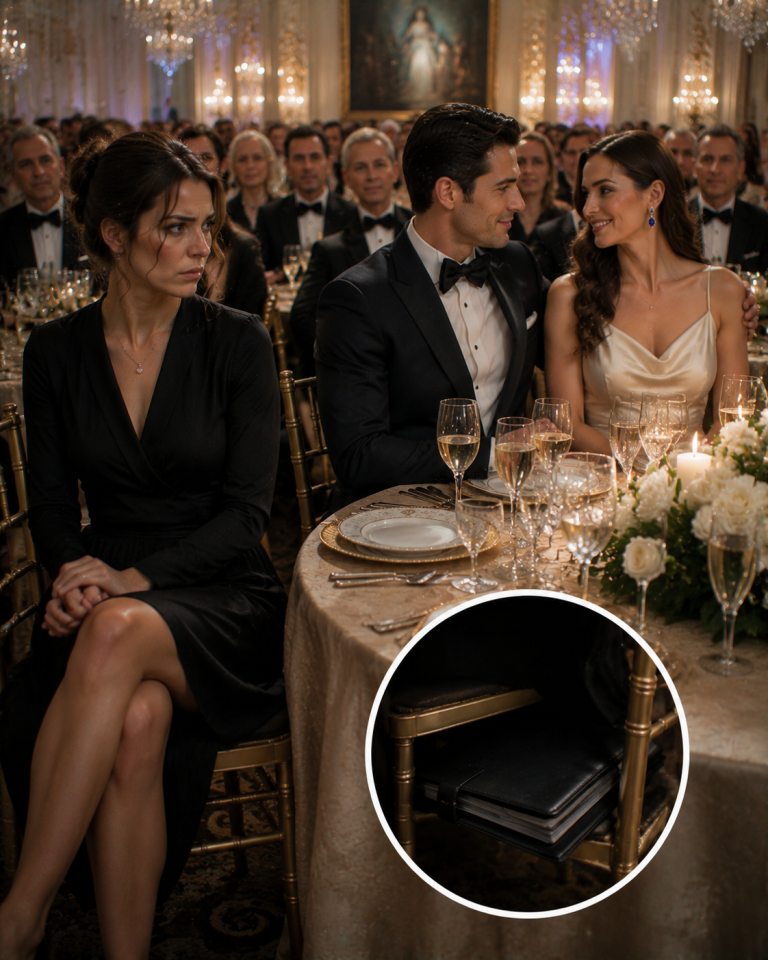
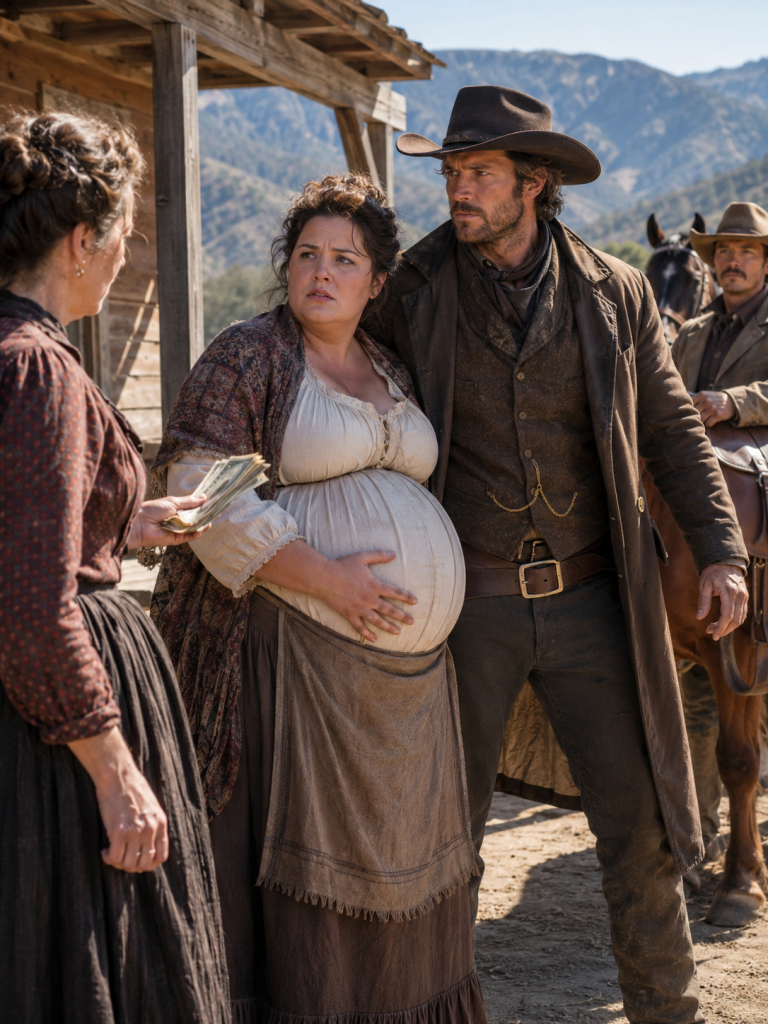
Boston Laughed When She Was Sent West Too Big to Love — But at the Train Station, a Cowboy Took Her Trembling Hand and Whispered, “I Choose You.”

PART 1
The bruise on her temple throbbed worse than her pride, and that was saying something.
Margaret Holloway pressed gloved fingers to the spot where the train window had struck her during the last violent lurch into Cheyenne, and she did not cry. She had trained herself out of crying years ago, somewhere between her fourteenth birthday and the afternoon her mother had measured her for a gown that no longer fit and wept instead of sewing.
She stood now on a splintered platform, valise in hand, wind snapping at her green traveling coat, surrounded by strangers who had already decided what to think of her.
A man near the depot nudged his companion. Neither bothered to whisper.
Margaret had heard worse in finer rooms.
Her father’s letter had arrived at the house like a verdict rather than a plan: arrangements made, a rancher in the territory willing to take a wife sight unseen, train fare enclosed, no further discussion invited. He had not asked whether she wanted a husband. He had simply run out of patience for keeping an unmarried daughter who embarrassed him at every cotillion, every charity supper, every moment she entered a room and the room’s opinion of her changed before she’d said a word.
So she had come west alone, certain of exactly one thing: this stranger would take a single look at her and regret his decision the way every Boston suitor had.
A shadow fell over her, broad-shouldered, unhurried.
“Miss Holloway.”
She turned, bracing.
The man before her was sun-weathered, somewhere past thirty, with a jaw that looked carved rather than grown and eyes the gray of a storm not yet decided whether to break. He held his hat in one hand, and he was looking directly at her face — not down, not away, not through her toward some better version of a bride he’d imagined.
“Mr. Calloway?” she managed.
“Nathaniel,” he said. “Your father wrote that you were sharp-tongued and difficult to manage.”
Margaret’s stomach dropped. Here it came.
“He wasn’t wrong,” she said, lifting her chin, daring him to flinch.
Nathaniel Calloway’s mouth moved — not into a sneer, but something closer to the beginning of a smile.
“Good,” he said. “I’ve got six hundred head of cattle and a ledger book that’s been lying to me for a year. I don’t need a decoration for the parlor. I need someone capable.”
He reached for her valise as if her size were simply not a fact worth his attention, and offered his free hand toward the wagon.
Margaret stood frozen for one full breath, waiting for the cruelty to arrive late, the way it sometimes did — a comment tossed over the shoulder once he thought she couldn’t hear.
It never came.
For the first time since she’d boarded that train, Margaret wondered if her father had not exiled her at all.
Perhaps he had, without meaning to, finally sent her somewhere she might be seen.
But riding beside this quiet stranger toward a ranch she’d never laid eyes on, she could not yet know what darker reason had made him so eager to marry a woman he’d never met — or what was waiting, hidden in his account books, that would soon put both their lives at risk.
PART 2
Nathaniel hadn’t married her out of charity. Margaret learned that within the hour.
“The books don’t balance,” he admitted as the wagon rattled toward the homestead, jaw tight. “Money leaves and I can’t trace where it goes. I needed someone who actually understands numbers — not someone who’d swoon at the sight of a ledger.”
“And you believed a stranger’s letter over meeting me first?”
“Your father called you stubborn and impossible to satisfy.” He flicked the reins. “Sounded to me like a woman who wouldn’t be cheated easily.”
That night, by lamplight, Margaret sat at his desk with the ranch’s account books stacked before her, ink staining her fingers as the household slept. She worked past midnight, then past one, tracing entries that didn’t add up — feed bills inflated, cattle marked dead that no one had buried, payments routed to a name she didn’t recognize: Hollis Webb.
By the time the lamp guttered low, she understood. This wasn’t bad bookkeeping.
Someone had been bleeding Calloway Ranch dry, quietly, for the better part of a year — and whoever it was had grown bold enough that the next missed payment could cost Nathaniel the land outright.
She found Nathaniel at dawn, exhaustion and triumph both written across her face.
“Your foreman who quit last spring,” she said. “Did he leave, or was he pushed?”
Nathaniel’s expression went cold. “Why?”
“Because his name is all over these forged receipts. And so is a man named Webb who owns half the bank in town.”
Before Nathaniel could answer, a rider thundered into the yard — and the look on the man’s face told Margaret that whatever was coming next, it had already begun.
PART 3
The rider was barely sixteen, hat askew, horse lathered with sweat. He nearly fell out of the saddle reaching for Nathaniel.
“Mr. Calloway — the bank’s calling the note. Mr. Webb says if you don’t settle by Friday, he forecloses the whole spread.”
Three days.
Margaret felt the floor tilt beneath her, though she did not let it show on her face. She had spent years learning to hold her spine straight while a room judged her; she could hold it straight now, with far more at stake than a stranger’s opinion.
“Three days isn’t enough to prove fraud through proper channels,” Nathaniel said, pacing the porch like a man counting his own coffin nails. “Webb owns the bank examiner. He probably owns the judge too.”
“Then we don’t go through proper channels first,” Margaret said. “We go through the people he’s already robbed.”
Nathaniel stopped pacing. “What people?”
“You said your old foreman vanished. A man doesn’t simply vanish from a town this size unless someone wanted him gone.” She spread the ledgers across the porch rail. “And these forged supply orders — half of them are billed through merchants in town. Real merchants. If Webb forged their names to steal from you, he’s stolen from them too. They just don’t know it yet.”
For the next two days, Margaret rode into Larkspur with Nathaniel at her side, knocking on doors that had never once opened easily for a Boston bride. She sat with the feed store owner and showed him his own signature, forged on an order he’d never filled. She sat with the widow Donnelly and showed her that the land sale she’d been pressured into the winter before had been built on falsified debt. One by one, the people of Larkspur began to see the pattern Margaret had already mapped in ink-stained pages at midnight.
By Thursday evening, six families stood ready to testify that Hollis Webb had forged their names, inflated their debts, or seized property through manufactured shortfalls.
Webb heard about it before Friday morning, the way men like him always did.
He came to the ranch himself, silver-templed and immaculate, flanked by the sheriff he’d clearly bought years ago.
“Mrs. Calloway,” he said, with a smile that belonged in a Boston drawing room and a coldness that did not. “I hear you’ve been busy.”
“I hear you’ve been thorough,” Margaret replied. “Three dead men still drawing wages. A foreman who disappeared the same week he started asking questions about your accounts. You should have been more careful with your handwriting, Mr. Webb.”
His smile thinned. “Careful women stay quiet.”
“I was never accused of being careful,” Margaret said. “Only too much.”
The sheriff stepped forward, hand near his belt, but the road behind Webb was already filling — the feed store owner, the widow Donnelly, three ranch hands, and townsfolk who had finally been given a reason to stop looking away. Nathaniel stood at Margaret’s shoulder, not in front of her, the way she’d asked him the night before. Not shielding her. Standing beside her.
“You’re outnumbered, Webb,” Nathaniel said quietly. “And out of time.”
It was the testimony of six families, not a single gunshot, that finally broke Hollis Webb. The territorial marshal arrived within the week, summoned by Margaret’s careful copies of every forged document, mailed days earlier to an address Webb didn’t know she had. The bank’s books were seized. The foreclosure died on the page it had been written on. The vanished foreman was found two counties over, alive, having fled rather than been silenced — frightened into hiding by threats Webb had made the moment the man started asking questions.
Calloway Ranch did not merely survive. By spring, it thrived — debts cleared, books finally honest, a wife at the desk whom every hand on the property now greeted with something closer to respect than curiosity.
One evening, months later, Margaret found Nathaniel by the corral fence, watching the horses move through gold evening light.
“You’ve been quiet all week,” she said.
“Your father wrote again.”
She stiffened, old instinct rising fast. “What does he want?”
“To know when you’d be sent home.” Nathaniel reached into his coat and handed her the folded letter. At the bottom, beneath her father’s familiar, clipped hand, Nathaniel had written his reply in plain block letters: She was never something to be returned. She is the reason this ranch still stands.
Margaret’s throat tightened around words she couldn’t immediately find.
“I shouldn’t have answered for you,” Nathaniel said, watching her face carefully.
“No,” she said. “You shouldn’t have.”
His expression fell, just slightly.
“But I’m glad you did.”
The wind moved warm through the pasture grass. Nathaniel reached for her hand, slow enough that she could have stepped away, and she did not.
“You told me at the station you needed someone capable,” she said. “Not someone decorative.”
“I meant it.”
“Boston never wanted me for either.”
“Boston,” Nathaniel said, “was full of fools who never once asked what you could do.”
Margaret laughed — a real laugh, unguarded, the kind she hadn’t allowed herself in years. Above them, the territory stretched wide and unembarrassed, the kind of land that had never once asked a woman to be smaller than she was.
She had been sent west as a problem to be solved.
She had become, instead, the one thing Calloway Ranch could not survive without.
THE END