She answered a stranger’s advertisement to save her father’s farm — then discovered the man she’d come to marry hadn’t written a single word of it.

PART 1
Fernhollow wasn’t a town so much as a rumor that had decided to stay put. A handful of buildings leaning into the wind off the Kaimai foothills, a church with a crooked steeple, a bank that held more of the district’s future than any of its residents cared to admit.
Charlotte Ashworth had been born within sight of that bank. It had never once done her family a kindness.
She stood outside its narrow window that November morning, watching her father through the glass. Edwin Ashworth sat with his hat in his lap, listening to Mr. Pratchett deliver the same verdict he’d delivered for six months running. Charlotte didn’t need to hear the words to read the shape of them in her father’s shoulders.
Three days. That was what was left of the Ashworth farm — twelve acres of exhausted soil and a leaking cottage that had been in the family since her grandfather cleared the first paddock by hand.
A gust sent a torn page of newspaper skittering past her boots. She caught it without thinking, ready to let it go, and then didn’t.
*Wife wanted. Established high-country runholder, Blackthorn Station, Otago district. Capable, honest woman preferred. Refinement not required. Inquire in person.*
Her breath caught oddly in her chest. Everyone in the North Island had heard of Duncan Blackthorn — a name that carried the particular weight of a man who owned more sheep than some counties held people, and a reputation that split neatly down the middle of every conversation it appeared in. Hard but fair, some said. Cold as a Southern winter, said others.
*Refinement not required.* Charlotte read that line three times. It was, she thought, either the most honest sentence she’d ever seen in print, or the cruelest kind of trap.
She folded the clipping into her coat pocket before she could talk herself out of it.
Her father emerged from the bank a few minutes later, looking every one of his fifty-four years and several more besides. “Same as always,” he said, before she could ask. “Three days, Lottie. Then Pratchett sends the surveyor.”
They walked home in silence, past paddocks gone to weed, past the fence line Charlotte’s grandfather had strung with his own two hands. That night, by the light of a stove that ate more wood than it gave back in heat, she read the clipping again and again until the words had worn smooth as river stone.
*I have character,* she thought. *Life has seen to that whether I wanted it or not.*
She did not have refinement. Her hands were split from wringing washing in cold water. Her one good dress had been let out twice and taken in once, and neither adjustment had been done well. But the advertisement hadn’t asked for refinement. It had asked for capable and honest, and those two things Charlotte Ashworth had never once been accused of lacking.
She found her father mending a gate the next morning, a task with no purpose left in it but the one that kept his hands from shaking.
“Papa. I’m going south. To Blackthorn Station.”
He read the clipping once and went very still. “Absolutely not.”
“Papa—”
“I will not have my daughter walking into a strange man’s house offering herself like a parcel to be collected.”
“I’m not offering myself like a parcel. I’m offering to work, and to be honest about why I’m there, and if it comes to more than that, it comes to more than that.” Her voice didn’t waver, though her hands, tucked into her skirts, had gone cold. “In two days we lose everything anyway, Papa. At least this way it means something.”
He argued until he had no arguments left, and then he held her at the coach station the following dawn with his hands trembling around her shoulders. “You come home if it doesn’t answer,” he said. “You hear me, Lottie.”
“I will,” she said, and they both knew it for the kind lie it was.
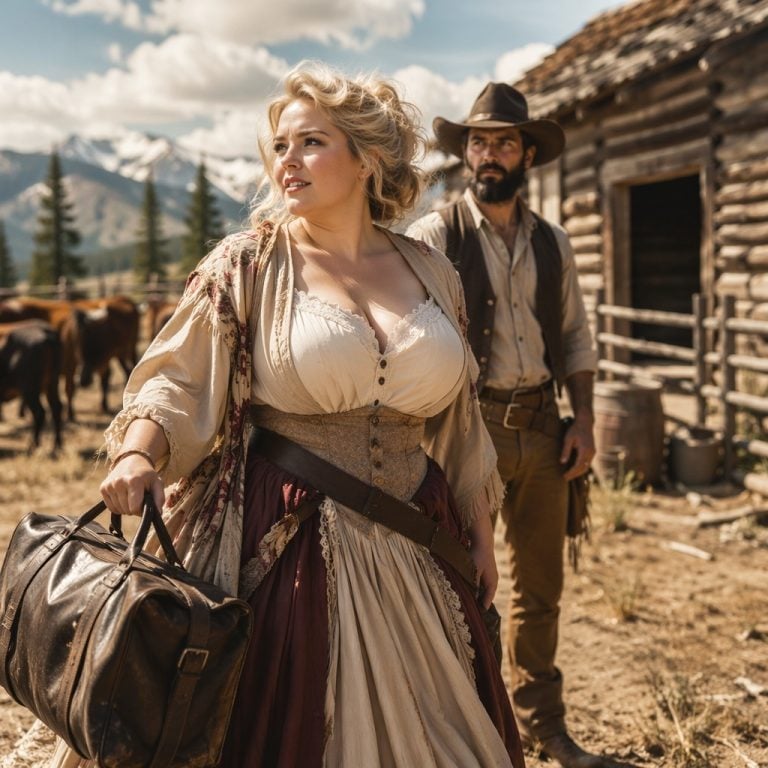
The journey south took the better part of two days — first by coach, then by a jolting mail cart along a high-country road that climbed steadily out of green farmland into something rockier, wilder, more indifferent to the people who tried to make a living from it. By the time the cart driver pointed out Blackthorn land — miles of tussock and merino sheep scattered like grey stones across the hills — Charlotte’s coin purse held exactly enough for the walk back to the nearest town, and nothing more.
The homestead itself sat on a rise above the valley, three stories of grey stone that looked as though it had grown out of the hillside rather than been built upon it. Smoke rose from four chimneys. Lamplight already glowed gold in half a dozen windows against the coming dusk.
Charlotte climbed the front steps with her heart slamming against her ribs, and knocked before her nerve could fail her entirely.
The woman who answered was perhaps fifty, iron-grey hair scraped back so tightly it looked painful, an apron over a black dress that had never once, Charlotte suspected, tolerated nonsense. Her eyes went from Charlotte’s face to her worn boots to the small bag at her feet, and hardened with every inch.
“We’re not hiring.”
“I’m not here for work, exactly. I’ve come about the advertisement.” Charlotte drew out the clipping, soft now as cloth from handling. “For a wife.”
The housekeeper’s face did something complicated — surprise, and beneath it, something that looked almost like satisfaction, quickly hidden.
“Wait here,” she said, and closed the door.
Charlotte stood on the cold stone step as the light failed around her, certain she could hear voices inside, though the words meant nothing through the heavy door. Five minutes passed. Then ten. Long enough that she had begun composing, in her head, the version of this evening she would tell her father — *I tried, Papa, and they turned me away, and now we’ll think of something else* — when the door opened again.
“Mr. Blackthorn will see you,” the housekeeper said. “Mind you don’t waste his time.”
Charlotte stepped over the threshold into a hall grander than anything she had ever stood inside, and followed the older woman down a corridor toward a half-open door, toward whatever waited for her on the other side of it — and toward a truth she could not have imagined, standing in the cold three days before, holding a torn scrap of newspaper in her frozen hands.
—
PART 2
The study was lined floor to ceiling with books, a fire crackling in a stone hearth big enough to stand in. And there, standing before it with his back half-turned, was not the hard, weathered runholder Charlotte had braced herself to meet, but a younger man, fair-haired, with ink-stained fingers and the anxious posture of someone caught doing something he oughtn’t.
“You’re here about the advertisement,” he said, before she could speak. His voice cracked slightly on the last word.
“Yes. I’m Charlotte Ashworth.”
“Right. Yes. Of course.” He glanced past her toward the doorway, toward the housekeeper still lingering there, and something passed between them — a warning, or an apology. “I should explain. My name is Robert Blackthorn. Duncan is my brother. He owns Blackthorn Station.”
Charlotte’s stomach dropped. “Then the advertisement—”
“Wasn’t his idea, no.” Robert had the grace to look ashamed. “He doesn’t know it was placed. I wrote it myself, using his name, because someone needed to and he never will. He’s been managing this station and the household besides since our mother died, and he works himself half to death rather than ask for help, and I thought — ” He stopped, dragged a hand through his hair. “I thought if the offer came from him, on paper, someone honest enough might actually come.”
“And if he finds out you’ve invited a stranger to his home under his name?”
“He’ll be furious.” Robert didn’t try to soften it. “But he’s due back from the high paddocks within the hour, and I’d rather you heard the truth from me before he walks through that door and you’re left wondering why the man in front of you doesn’t match a single word you were promised.”
Somewhere beyond the study window, a dog began barking — sharp, urgent, answered a moment later by the heavy tread of boots crossing the yard.
Robert’s face went pale. “That’ll be him now.”
Mrs. Fairweather, the housekeeper, appeared in the doorway again, her expression grim. “He’s asking who the horse in the yard belongs to,” she said. “I’d start explaining fast, Master Robert, because I am not doing it for you.”
Footsteps sounded in the hall — heavy, unhurried, the tread of a man who owned every stone under his own feet. Charlotte’s pulse hammered. She had come two days south on the strength of a stranger’s written words, and in the space of ten minutes had learned that not one of those words had come from the man now standing on the other side of the study door.
“Robert.” The voice from the hallway was low, rough with exhaustion and the particular edge of a man who already suspected he wasn’t going to like what came next. “Whose horse is that in my yard?”
Robert turned to Charlotte, something close to panic in his eyes.
“Whatever happens in the next five minutes,” he said quietly, “I am sorrier than I can say — and I still think I was right to send that advertisement.”
The door swung open.
—
PART 3
Duncan Blackthorn filled the doorway the way weather fills a valley — not loudly, but completely. Tall, broad through the shoulders, a face weathered by wind and work rather than years, though grey already threaded through his dark hair at the temples. His eyes found his brother first, then moved to Charlotte, and something in them sharpened with a speed that made her chest tighten.
“Who,” he said, very evenly, “is this?”
“Duncan—”
“I asked a question, Robert.”
Robert straightened, and to his credit, did not flinch. “Her name is Charlotte Ashworth. She’s come in answer to an advertisement I placed in the Otago Witness three weeks ago. Under your name.”
The silence that followed had weight to it, the particular density of a room about to come apart.
“You did *what*.”
“You needed help. You still do. You run yourself into the ground managing this station and this house and you have not once, in six years, let anyone close enough to share the load. I thought—”
“You thought you’d bring a stranger into my home and hand her my name like a coat off a hook.” Duncan’s voice hadn’t risen, but something underneath it had gone hard as flint. He turned to Charlotte. “I am sorry. Whatever my brother promised you, I made no such advertisement, and I have no intention of marrying a woman I’ve known for the length of one conversation.”
The humiliation landed like a physical blow — worse for how quietly he delivered it. Charlotte felt the two days of travel, the last of her father’s coin, the whole impossible gamble collapse in on itself. But underneath the shame, something else rose up to meet it. Something stubborn, that had gotten her this far and did not intend to be talked out of the door without a fight.
“Then let me correct the record for both of us,” she said. “I didn’t travel two days south for romance, Mr. Blackthorn. I came because my father’s farm is three days from the bank taking it, and your brother’s advertisement was the only door I found still open to me. I’m not asking you to marry a stranger. I’m asking for a chance to prove I’m worth the ink your brother spent on my behalf. That’s all.”
Duncan studied her for a long moment — the worn hem of her dress, the split skin on her knuckles, the way she held his gaze without flinching despite every reason she had to look away.
“You’d work for a stranger’s household on the strength of a lie you didn’t tell,” he said slowly.
“I’d work for my father’s farm on the strength of anything that’s offered to me. The lie isn’t mine to answer for. But I’m still standing here.”
Something shifted, fractionally, in the hard line of his jaw. He looked at his brother, and whatever passed between them was old and complicated and not for Charlotte to understand yet.
“Mrs. Fairweather,” Duncan said finally, not taking his eyes off Charlotte, “find Miss Ashworth a room. She’ll stay the night.” He held up a hand before Robert could speak. “Not because of the advertisement. Because it’s dark, and I won’t turn a woman out onto the road at this hour, whatever foolishness brought her here. Tomorrow she can explain herself properly, and I’ll decide what, if anything, comes next.”
It was not a yes. It was, Charlotte understood, considerably better than the no she’d braced for.
—
The trial period Duncan proposed the following morning had none of the romance Robert’s advertisement had implied and every ounce of the honesty Charlotte had asked for. Six weeks in the kitchen and household under Mrs. Fairweather’s unforgiving eye. If she lasted, if she proved capable rather than merely desperate, they would speak again about what — if anything — came next.
“I want to be clear,” Duncan told her, standing in his study with the same flat directness he seemed incapable of setting aside. “This is not a courtship. I have no interest in one. My mother ran this house until she died, and since then it has run on Mrs. Fairweather’s competence and my own exhaustion, in roughly equal measure. If you can genuinely lift some of that weight, we will discuss terms. If you cannot, I will pay your coach fare home and we need never speak of my brother’s interference again.”
“That’s fair,” Charlotte said, and meant it.
The six weeks that followed tested every muscle in her body and every assumption she’d carried south with her. Mrs. Fairweather ran the kitchen like a drill sergeant running a garrison — thirty men fed twice daily during shearing season, supplies tracked to the last pound of flour, no patience whatsoever for excuses. Charlotte scalded her hands learning to manage the copper, burned two batches of bread before she understood the temper of the range, and fell into her narrow bed each night too exhausted to do more than sleep in her clothes.
But she learned. She learned the rhythm of the household the way she’d once learned the rhythm of her father’s failing farm — through repetition, through failure, through the particular stubbornness that refused to let a mistake be the last word on the matter. Mrs. Fairweather’s corrections grew shorter, then rarer, then — astonishingly, in the fifth week — turned once, briefly, into something that might almost have been a compliment.
“You’ll do,” the older woman said, surveying a dining hall Charlotte had readied for forty shearers on eight hours’ notice. “Didn’t think you would, that first night. Glad to be wrong.”
Robert, for his part, hovered at the edges of the household with the guilty energy of a man trying to make amends for a scheme that had, against every reasonable expectation, begun to work. He sought Charlotte out in quiet moments to apologize again, to explain — his mother had died when Duncan was nineteen and Robert barely fifteen, and their father had retreated into grief and left the whole weight of Blackthorn Station on his elder son’s shoulders before Duncan was old enough to shave properly. Duncan had grown into a man who trusted work more than people, because work, at least, gave back exactly what was put into it.
“He’s not unkind,” Robert said, more than once. “He’s just forgotten how to expect kindness in return.”
Duncan himself remained a careful distance away for most of those six weeks — present at meals, present in the accounts he began, almost without announcing it, to review alongside her once her numbers proved trustworthy, but never more than that. Watching, Charlotte came to understand, the way a man watches a fence line during a storm — waiting to see whether it would hold.
It was the storm itself, in the seventh week, that changed everything.
The nor’wester came down off the high paddocks without warning, the sky going the colour of a fresh bruise within the space of an hour, wind flattening the tussock grass in long silver waves. By the time the first hail hit the homestead roof, half the station’s shepherds were still out on the high runs with three thousand ewes and their new lambs scattered across exposed country.
“We’ll lose stock,” Duncan said grimly, already pulling on his oilskin. “And men, if we’re not fast.”
Charlotte did not ask permission. She went to the kitchen instead, and to Mrs. Fairweather, and together they began the work that needed doing at the house while the men rode out into weather that had already claimed two shepherds’ fingers to frost in years past — hot broth kept ready in relays, dry blankets stacked by the door, the front room turned over entirely to whoever came back injured, exhausted, or both.
They came back in stages over the following two days, half-frozen, having lost close to two hundred lambs to the cold but not a single man. One young shepherd, a boy of perhaps seventeen named Wiremu, arrived with his hands blackened at the fingertips, and it was Charlotte who sat with him through the agony of slow rewarming, holding his arm steady while Mrs. Fairweather worked, the boy’s screams the worst sound Charlotte had heard in her life.
He kept two fingers. It could have been worse.
Duncan found her afterward in the kitchen, hands still shaking, staring at nothing.
“First time seeing that?” he asked.
“Yes.”
“Won’t be the last, if you stay.” He sat across from her, and for the first time since she’d arrived, some of the careful distance had gone out of him. “You didn’t have to help with that. Household staff aren’t expected to.”
“I wasn’t thinking about what was expected. I was thinking about the boy.”
Duncan was quiet for a long moment. “My mother used to say the same thing. That the work that mattered most was rarely the work anyone wrote down in a ledger.” He looked at her properly then, in a way he hadn’t allowed himself to before. “Robert was right about one thing, it turns out, however badly he went about it.”
“About what?”
“That this house has needed someone in it who sees the people, not just the accounts.” He stood, the moment closing as quickly as it had opened, but something had shifted, unmistakably, in the space between them. “The six weeks aren’t up yet. But I think we both already know how this ends.”
—
They married in late autumn, in the small stone church at Fernhollow, with her father standing at her side in his one good coat, weeping openly through the whole ceremony in a way that embarrassed them both and which Charlotte would treasure for the rest of her life. Duncan’s proposal, when it finally came, had been as unromantic and entirely sincere as everything else about him — delivered on the same rise above the valley where Robert had first confessed his scheme, with no ring yet in hand and no pretty words rehearsed, only the plain statement that he had watched her work herself half to death for a household that wasn’t yet hers, for people who weren’t yet her own, and that he could not, in good conscience, let her go on doing that without asking her to stay for good reason rather than obligation.
“It won’t be romance,” he warned her, the way he warned her about everything. “I’m not built for it. But it will be honest, and it will be a partnership, if you’ll have it.”
“I came here for exactly that,” Charlotte said. “I’d be a fool to leave it behind now.”
The advertisement that had started it all — Robert’s clumsy, well-meant forgery, torn from the Otago Witness and carried two days south in Charlotte’s coat pocket until the creases had worn soft as cloth — went, eventually, into a small frame that hung beside the kitchen door at Blackthorn Station, where every new hand who came through it could read the words that had, against every reasonable expectation, turned out true after all.
*Capable, honest woman preferred. Refinement not required.*
Duncan’s sister-in-law-to-be, Robert’s own eventual wife, once asked Charlotte why she kept it there instead of somewhere more private.
“Because it’s the truth of how we started,” Charlotte said. “A lie that happened to be honest about everything that mattered. I’d rather remember that than pretend we began some other, tidier way.”
The years that followed were not without their trials. There was a bitter dispute the second winter, when a wool broker in Dunedin tried to swindle the station out of a season’s shearing, and it was Charlotte’s careful bookkeeping — the same skill Mrs. Fairweather had once doubted she possessed — that caught the discrepancy before it cost them a fortune. There was a cousin of Duncan’s, a man named Alistair with expensive tastes and an emptier bank account than he cared to admit, who spent two years trying to convince the wider family that Duncan had married beneath his station and ought to reconsider his will accordingly, until a public reckoning at a district meeting — Charlotte standing, unshaking, with the station’s true accounts in her hand — put the matter to rest for good.
The confrontation with Alistair came in their fourth year, and it very nearly cost them everything they’d built.
He arrived at Blackthorn Station unannounced on a grey autumn afternoon, dressed in city tailoring that looked absurd against the tussock hills, full of the easy charm he’d always used in place of honest work. Charlotte had met him twice before, at family gatherings, and had disliked him both times without quite being able to say why. She understood the reason well enough now.
“Duncan, cousin, always a pleasure.” Alistair shook Duncan’s hand, then turned that same easy smile on Charlotte, sharper at the edges than he probably realized. “And Mrs. Blackthorn. Running the household as capably as ever, I trust?”
“We manage,” Charlotte said.
“I’m sure you do.” Something in his tone made the words sound smaller than they were. He turned back to Duncan. “I’ve come about the district council seat. Old Ferris is stepping down, and I mean to stand for it. I’d hoped for your support.”
“You’d have had it,” Duncan said, “if you hadn’t spent the last five years running your own inheritance into the ground and looking for someone else’s to prop it back up.”
Alistair’s smile didn’t waver, but something behind his eyes went cold. “That’s uncharitable.”
“It’s accurate.”
The visit ended shortly after, civil on the surface and nothing beneath it. But two weeks later, word reached Blackthorn Station that Alistair had been quietly visiting other runholders in the district, suggesting — carefully, never quite directly — that Duncan’s judgment had grown unreliable since his marriage, that he’d handed the station’s books over to a woman with no family, no formal education, and no real stake in the district’s future, and that perhaps it was time the wider Blackthorn family took a closer look at how the estate was being managed before something was lost that couldn’t be recovered.
“He’s trying to force a vote,” Robert said grimly, having ridden two hours to bring the news himself. “There’s a clause in grandfather’s original trust — if enough of the extended family petitions that the estate is being mismanaged, it goes to a formal accounting before the district land court. Alistair’s hoping to embarrass you into settling before it ever gets that far. Or worse, hoping the court finds enough irregularity to hand him a management role.”
“There is no irregularity,” Charlotte said. “I’ve kept those books myself for three years.”
“I know that. You know that. Alistair is counting on everyone else in this district not knowing it, and instead believing whatever story flatters their assumptions about a farmer’s daughter keeping a runholder’s accounts.”
The district meeting was called for the following month, held in the same hall where Robert had once, years before, made his first nervous case for placing an advertisement no one had asked him to write. This time the room filled with runholders and their wives, bank men, the very Mr. Pratchett who had once given Charlotte’s father three days to save his farm, all come to watch what promised to be the district’s most interesting gossip in a decade.
Alistair spoke first, smooth and reasonable, careful never to accuse outright, only to raise doubts shaped like questions. Was it not unusual for a runholder of Duncan’s standing to hand full financial authority to a wife with no formal training? Had anyone independently verified the station’s accounts in recent years? Was it not, at the very least, worth an outside audit, purely for the family’s peace of mind?
Murmurs of agreement rippled through the room. Charlotte felt the old, familiar heat rise in her face — the same heat she’d felt as a girl standing outside a bank window, powerless to change what men in better coats decided about her family’s future.
She stood before Duncan could.
“Mr. Blackthorn is right that I have no formal training,” she said, her voice carrying clearly across the hall. “I never attended a ladies’ academy. I never studied accounting under any tutor whose name would impress this room. What I have is four years of this station’s actual ledgers, in my own hand, which I am happy to lay in front of any auditor this district cares to appoint.” She lifted a leather case she’d brought for exactly this purpose and set it on the table at the front of the room. “Every pound spent, every pound earned, cross-checked against the bank’s own records, which Mr. Pratchett here can confirm inside the hour if he cares to walk back to his office and fetch them.”
Pratchett, startled at being addressed directly, nodded slowly. “I — yes. I could do that.”
“While he does,” Charlotte continued, “I’d like to ask my cousin-in-law a question of my own. Alistair, you mentioned peace of mind for the family. Whose peace of mind, exactly? Because in four years you have visited this station twice — once to ask for a favour, and once, two weeks before this meeting was called, to plant precisely the doubts you’re now standing here repeating back to the room as though they arrived independently.” She let that land. “I don’t say that to embarrass you. I say it because this district deserves to know whether tonight’s concern is about the health of Blackthorn Station, or about a council seat you’re hoping an inheritance dispute might make easier to win.”
The silence that followed had teeth in it. Alistair’s easy smile finally slipped.
“That’s a serious accusation.”
“It’s a question. You’re welcome to answer it, or the room is welcome to draw its own conclusion from the silence.” Charlotte held his gaze without flinching, the same way she had, four years earlier, held Duncan’s gaze across a study fire while every reasonable instinct told her to look away. “Either way, the books are open. Send whatever auditor you like. I have nothing in those pages I’m afraid to have read.”
Pratchett returned within the hour, as promised, the bank’s own ledgers under his arm, and the cross-check took less than thirty minutes to confirm what Charlotte had already known — the accounts matched, to the shilling, four years running. Whatever appetite the room had for scandal evaporated somewhere in that half hour of quiet arithmetic, replaced by the particular respect a small, practical community reserves for someone who has just proven herself, publicly and beyond argument, competent.
Alistair left the district within the year. He did not stand for the council seat. Charlotte heard, much later, that he’d taken a position managing a stranger’s estate in Christchurch, and hoped, without much malice, that whoever employed him kept a closer eye on the books than his own family ever had reason to.
—
There was, in the years that followed, a daughter and then a son, and a homestead that filled slowly with the particular noise and warmth that had been missing from it since Duncan’s mother died. Mrs. Fairweather stayed on until she was well past seventy, more grandmother than housekeeper by the end, and swore until her last winter that she’d known, that very first week, that the girl from Fernhollow would outlast every doubt anyone dared to hold about her. Robert, for his part, never quite stopped being pleased with himself for the scheme that had once nearly gotten him thrown out of his own brother’s house, and eventually married a district schoolteacher who found the whole story, once she’d heard it properly told, thoroughly romantic — a verdict Duncan disputed every single time it was raised, and Charlotte, privately, thought was closer to the truth than he liked to admit.
On the evening of their twentieth anniversary, Charlotte and Duncan climbed once more to the rise above the valley, slower now, her hand in his, and looked down over land that had tripled in size and, more importantly, had become something neither of them could any longer imagine living without.
“Any regrets?” Duncan asked. It had become their ritual, the question they put to each other at the close of every hard year and every good one alike.
“None that matter,” Charlotte said, and meant it entirely. “Your brother told one very small lie to bring me here. I’ve spent every year since grateful he did.”
Below them, lamplight came on window by window across the homestead, and somewhere in the yard a dog barked once at the coming dark, and settled. The framed clipping still hung by the kitchen door, its ink long since faded to the colour of old tea, its words no less true for all the years that had passed since a desperate girl first read them by firelight and decided, against every sensible instinct, to knock on a stranger’s door anyway.
THE END