HIS MISTRESS MAILED HER WEDDING PHOTOS WITH HER OWN FACE TAPED OVER EVERY SINGLE ONE — SO SHE RENTED THE BALLROOM SCREEN AND SHOWED THE WHOLE ROOM EXACTLY WHAT HE’D BEEN HIDING

PART 1
The humiliation had not arrived with the box.
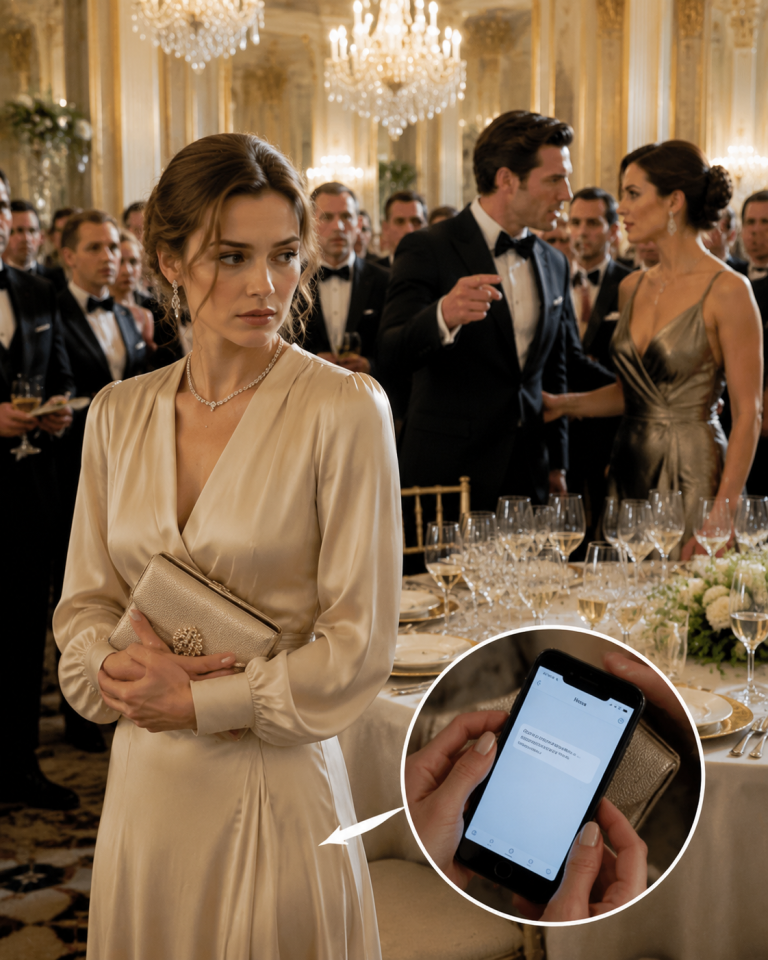
It had arrived four days earlier, at the winter gala at The Meridian.
People like to imagine that a woman knows when she is being publicly replaced. They picture thrown wine, screaming in the lobby, the dramatic exit. But real humiliation is quieter than that. It is a husband’s hand leaving the small of your back in a crowded room. It is the pause before guests decide whether to pity you or pretend not to see you bleeding. It is a mistress sitting at your table because your husband’s assistant *misread the seating chart.*
The Meridian was technically a Vale Capital property. In reality, the renovation had been financed through an Ashford trust that Vivienne’s grandmother had placed under her control at twenty-one. Carter liked to say he had built it. Vivienne had always let him.
She wore midnight-blue velvet that night, with a diamond collar her grandmother had worn to the Met in 1968. Carter had chosen the dress. He said it made her look *regal but not desperate.*
She should have recognized the warning in that.
Sloane arrived twenty minutes late.
She wore white. Not bridal white — worse. A sharp, low-cut winter white that clung to her with the confidence of a confession. Her hair was swept into a careless gold knot. Her mouth was red. At her throat: a necklace Vivienne recognized immediately, because she had admired it at a Cartier window three months earlier and Carter had told her it was *too young* for her.
He had bought it anyway.
Just not for her.
When Sloane crossed the ballroom and reached them, Carter smiled before he remembered Vivienne was standing beside him. One second. Just one second. But one second is enough to end a marriage.
*Don’t make this difficult,* he murmured, his voice smooth as a closed door.
*Make what difficult?*
His jaw tightened. *She’s here for the foundation campaign. Don’t embarrass me.*
Not: *I’m sorry.* Not: *This isn’t what it looks like.* Not even the lazy mercy of denial.
Just: Don’t embarrass me.
Sloane reached them with champagne in her hand and something in her eyes that had been practicing itself for months. *Vivienne,* she said, touching Vivienne’s arm as if they were old friends. *You look beautiful. Very classic.*
In Manhattan, *classic* meant old.
*Thank you,* Vivienne said. *You look expensive.*
Sloane’s smile faltered.
Carter cleared his throat.
At dinner, Vivienne’s place card had been moved two seats down. Sloane sat directly across from Carter, between him and Senator Bryce Lowell, in the place that Vivienne had occupied at every Meridian Foundation gala for nine years.
Carter gave the keynote after dessert. He stood under the chandelier — every inch the American prince, blond and Yale-polished, his charm so refined by inheritance that most people had stopped looking for what it was covering. The screen behind him lit up with the foundation’s newest campaign for young women in the arts.
Sloane’s face appeared.
Not Vivienne’s. Sloane’s.
Sloane in a silk blouse, laughing with students. Sloane holding a child’s painting. Sloane standing in the lobby of The Meridian beneath the words THE FUTURE HAS A NEW MUSE.
The room applauded.
Vivienne sat perfectly still.
Carter looked directly at her from the stage. *Every great institution,* he said, *needs the courage to evolve. To let go of the past. To embrace what is vibrant, modern, alive.*
A few people turned toward her.
One woman lowered her eyes. Another smiled into her wine.
Sloane pressed a hand to her heart.
Vivienne lifted her champagne and took one small, deliberate sip.
Carter believed the room had just witnessed his wife’s replacement.
What it had witnessed was her opening statement.
—
The box arrived four days after the gala.
The wedding photographs were laid out across Vivienne’s dining table by ten in the morning, arranged with the care of someone who intended them to be found in precisely this order. She looked at each one without touching them. The Newport steps. The reception tent. The first dance. The cutting of the cake. The moment her father had said something that made her close her eyes and laugh, her bouquet pressed against her chest.
All of them ruined.
In one, Sloane’s cutout face had been taped crookedly over hers, red lipstick smeared across the silk ribbon of the bouquet. In another — Carter kissing her forehead, her eyes closed, that morning in Newport when she had still believed the thing she was stepping into was real — Sloane had drawn a crown over her pasted-on head.
On the back of the final photograph, in the same precise handwriting as the return address:
*Some women are born to be remembered. Some are just placeholders.*
Vivienne read it twice.
Then she put on nitrile gloves.
Her grandmother had been married to a man who cheated in Paris and lied in London and died in Connecticut with three secret bank accounts and a girlfriend younger than his youngest daughter. She had raised Vivienne on a very specific lesson: not to be soft, but to be civilized. Civilized, she had explained, was the more dangerous of the two.
Vivienne photographed the box from every angle. She preserved the tissue paper, the ribbon, the tape, the note, and the label in separate clear sleeves, handling each piece with the methodical care of a woman who understood that confidence leaves fingerprints.
She called Nora Bell — a former NYPD detective who now charged corporate wives nine hundred dollars an hour to discover what their husbands thought was hidden.
She filed a police report.
The officer who took her statement was polite and slightly skeptical until she slid the photographs across his desk.
His expression shifted.
*Do you know the person who sent them?*
*Yes.*
*Your husband’s girlfriend?*
She looked at him.
He coughed. *Alleged girlfriend.*
*Her return address is on the box.*
He studied the photographs. *That was careless.*
*No,* Vivienne said. *That was confident.*
Carter called that evening, his voice tight with the particular strain of a man who has just learned his wife did not respond like a wife in a sad movie.
*Vivienne. What the hell are you doing?*
She stood in her dressing room while her housekeeper zipped her into a black silk dress. *Getting ready for dinner.*
*You filed a police report?*
*I reported destroyed property and harassment.*
*She’s upset.*
*That was evident.*
*She was processing her emotions.*
She looked at herself in the mirror. Her face was perfectly calm. Her lipstick was dark. Her eyes looked like her grandmother’s.
*I processed the package differently.*
A silence.
*Withdraw it,* he said.
*No.*
*Do you understand what this could do to her?*
*More importantly,* she said, taking her clutch from the maid, *she should have understood what it could do to me.*
She hung up.
Then she went to dinner at Daniel with Nora Bell and her new attorney, Julian Cross — a man who did not raise his voice, but made other people lower theirs, who wore navy suits that looked inherited rather than purchased, and who possessed the specific stillness of someone who had destroyed louder men in wood-paneled rooms.
He reviewed the photographs without flinching.
*Harassment,* he said. *Intentional infliction of emotional distress. Destruction of property. If she accessed the originals from your marital home, we add unlawful entry.* He set down the photographs. *What do you want, Mrs. Vale?*
*Not an apology. Not money.* She looked through the restaurant window at the rain shining on Park Avenue like spilled ink. *The truth. Placed somewhere expensive, where everyone can see it.*
Julian’s mouth barely curved.
*Then we should begin.*
—
PART 2
Within ten days, Nora knew more about Sloane Hart than Carter did.
Sloane was twenty-eight, from Scottsdale, though she told people she was West Coast. Her father sold luxury cars and had declared bankruptcy twice. She had reinvented herself first in Los Angeles, then in New York — art consultant, brand strategist, philanthropist — once Carter had discovered her at a private dinner in SoHo and decided she was useful.
She lived in Apartment 12B at The Aurora Residences. Rent: eighteen thousand a month. Paid through a company called Holloway Creative LLC, which had no website, no employees, and no clients except Vale Capital.
Carter was paying for her apartment through a vendor shell.
*How much?* Vivienne asked.
Nora slid the documents across Julian’s conference table without expression. *Rent, furniture, travel, jewelry, private driver, cosmetic dermatologist, and a forty-thousand-dollar monthly consulting retainer for the foundation.*
Julian’s pen stopped moving. *Foundation funds?*
*Some through the foundation. Some through Vale Capital. Some through a project account tied to the Miami development.*
Vivienne looked at the papers.
The Miami development.
The project Carter had asked her to support with her maiden name six weeks before the gala. The one built on Ashford trust leverage.
*There is more,* Julian said.
Of course there was.
Carter had begun moving assets months before the gala — not obvious assets, not the penthouse or the public stock or the art collection everyone knew about, but management fees, consulting payments, and debt obligations, shifted into a maze of entities designed to make marital assets look smaller while making Sloane’s lifestyle look like business development.
The betrayal was not romantic. It was financial.
*He was preparing to leave me contained,* Vivienne said.
Nora leaned back. *He thought you were ornamental.*
*Most men confuse restraint with decoration.*
Two days later, Carter came home before midnight for the first time in weeks, carrying the old charm that had made her love him once — the softened eyes, the lowered voice, the look that said only she could understand him — and she recognized it, finally, not as intimacy but as a tool she had been too fond of to identify.
*I made mistakes,* he said.
She waited.
*Sloane got carried away. The photos were unacceptable.*
*Unacceptable is cold soup, Carter. That was harassment.*
His mouth tightened. *You don’t need to ruin her life.*
*She mailed me my own wedding photos with her face taped over mine.*
He tried the next tactic. *You know how divorce would look. For both of us. The board hates instability. The foundation donors hate scandal. Your family name is tied to mine.*
*No,* Vivienne said softly. *Your family name is tied to mine.*
He went still.
She let the silence expand.
*Do you remember my grandmother’s wedding gift?* she asked. *The Ashford Legacy Trust?*
*The revised trust,* she added.
Carter had signed the papers the morning after their wedding, hungover and glowing, barely reading anything beyond the words *marital cooperation* and *tax advantage.*
Her grandmother had watched him sign.
She had smiled the whole time.
*What did you do?* Carter said.
*I didn’t do anything,* Vivienne replied. *I simply never changed what was already there.*
—
PART 3
The Ashford Legacy Trust owned the preferred shares in Meridian Hospitality Holdings.
The Meridian. Three boutique hotels in Charleston, Savannah, and Santa Barbara. The Miami land option Carter needed to monetize before the quarter turned.
Carter managed them. He did not own them. He had built his entire public image on her private architecture, and he had signed the document that confirmed this the morning after their wedding, beside a window overlooking Newport Harbor, because his new wife’s grandmother had offered him tea and explained something about trust continuity, and he had smiled and reached for the pen because he was twenty-nine years old and golden and certain that women who dealt in old documents were simply performing sentiment.
*You can’t touch the company,* he said.
*I don’t need to touch it,* Vivienne said. *I need to audit it.*
His phone began ringing. He looked at it, saw the name, and silenced it.
The new muse.
The future.
She almost felt sorry for Sloane. Almost. The girl had been handed access and mistaken it for power, which was the oldest mistake in the social register.
*Vivienne,* Carter said, trying the last version of his voice — the one that had, for years, recalibrated her certainty. *We can handle this quietly.*
She stood. Her dress moved like dark water. *You made quiet impossible when you let her sit at my table.*
—
The second gala was not supposed to happen.
Carter tried to cancel it, then to postpone it, then to relocate it to Palm Beach where he thought the crowd might be more manageable. But the Meridian Foundation’s winter benefit had been scheduled for a year, and donors dislike inconvenience almost as much as they dislike being associated with fraud.
So it stayed. At The Meridian. In Vivienne’s ballroom.
The legal machinery had been humming for weeks by then.
Sloane received notice of the civil claims two days before the event: harassment, destruction of property, intentional infliction of emotional distress, preservation of evidence demand, no-contact directive. Carter received something considerably longer — a divorce filing, a forensic accounting notice, a demand for records, a preservation letter covering all communications with Sloane Hart, Holloway Creative, Meridian Foundation staff, Vale Capital finance, and every entity connected to the Miami development.
Men who cheat expect tears.
They do not expect indexed exhibits.
The morning of the gala, Page Six ran a blind item so transparent that Vivienne’s phone began ringing before she had finished her coffee. A Manhattan hospitality prince. A foundation muse. A society wife with receipts. Carter called twelve times. She answered none.
Instead, she went to her grandmother’s townhouse on East 70th Street.
Eleanor Ashford was ninety-one, still wore pearls before breakfast, and possessed the particular authority of a woman who had outlasted every man who had ever underestimated her. She sat in her blue drawing room beneath a portrait of a dead Ashford who had probably ruined lives with railroads, and she looked at Vivienne with the clear, assessing eyes that had never once offered false comfort.
*You look thin,* she said.
*You always say that.*
*You always are when men disappoint you.*
Vivienne sat beside her. *You knew, didn’t you? About the girl.*
*My darling, there is always a girl. The girl is never the story.*
*What is?*
*The money.*
Vivienne laughed despite herself.
Her grandmother patted her hand with fingers that trembled only when she permitted them to. *Love is a candle. Money is the house. Never let a man burn down the house because he got bored of the candle.*
*Did you think he would do this?*
*I hoped he wouldn’t.* Her grandmother’s eyes sharpened. *I prepared in case he did.*
That was the closest Eleanor Ashford had ever come to saying *I love you.*
—
At eight that evening, Vivienne arrived at The Meridian in black velvet.
No jewelry except her wedding ring. Not sentiment — strategy. Evidence should be displayed until it is no longer needed.
The lobby went quiet when she entered. The kind of quiet that has weight, that touches the skin. Guests turned. Phones lowered. Conversations collapsed mid-sentence. She walked through the silence as if she could not hear it, which was something she had been practicing her entire adult life and had finally decided to use.
Carter stood near the grand staircase, looking flawless and exhausted. Sloane was beside him in emerald satin, a diamond bracelet glittering at her wrist.
Vivienne’s diamond bracelet. The one Carter had taken from the safe six months ago, telling her it was being inspected for insurance.
Sloane saw her notice it and smiled.
The smile said: *I am wearing your life better than you did.*
Vivienne smiled back.
Hers said: *Keep it on.*
Julian appeared at her side, immaculate in black tie. *Are you ready?*
*No,* she said. *But I’m prepared.*
*That’s better.*
The evening proceeded in the usual architecture of these events — champagne, oysters, money performing itself in the presence of more money. Carter gave interviews near the step-and-repeat. Sloane positioned herself with the practiced angles of a woman who understood that scandal was simply a kind of spotlight, and that the important thing was to be in frame.
At nine, Carter took the stage.
He always began well. The Yale confidence, the inherited charm, the voice that had been trained by generations of men who expected to be believed. He spoke about vision, resilience, women in the arts, the courage to embrace new chapters. He thanked donors and board members. Then his eyes moved to Vivienne in her usual table seat, and she saw the ghost of the boy he had been before entitlement became his personality — and then she saw him decide, one more time, not to be that boy.
He smiled.
*Every great institution,* he said, *needs the courage to embrace what is vibrant, modern, alive.*
Sloane lowered her eyes with the modesty of a woman who has practiced it.
A few people applauded too early.
The screen behind Carter changed.
Not to Sloane’s foundation video.
To a single image.
Vivienne’s wedding photograph.
The ruined one.
The ballroom inhaled as one organism.
Sloane’s magazine-cutout face stared down from the screen in glossy fragments, taped crookedly over Vivienne’s, the red lipstick marks catching the chandelier light. Carter stood beside the vandalized bride, eternally smiling at a woman who had been erased.
Carter turned.
His face emptied.
The next slide appeared. The return address in red ink. The police report number. The destroyed photographs arranged in evidence sleeves. Holloway Creative LLC. The payment schedule. Rent transfers. A Cartier purchase receipt. The insurance image of the diamond bracelet — the bracelet currently on Sloane’s wrist. A foundation payment approval bearing Carter’s electronic signature.
The ballroom had become so quiet Vivienne could hear the ice shifting in someone’s glass.
Julian stepped onto the stage.
He did not grab the microphone dramatically. He approached the podium with the authority of a man who had done this before — not in ballrooms, but in rooms that mattered more, and who understood that the ballroom’s power over outcomes was entirely dependent on whether one chose to honor it.
*Good evening,* he said. *My name is Julian Cross. I represent Mrs. Vivienne Ashford Vale.*
Carter whispered something sharp. The microphone caught it.
*Turn it off.*
No one moved.
Because the man controlling the screen was not Carter’s AV director. He was an independent contractor retained through the Ashford trust that held the ballroom’s management rights.
*Tonight’s program,* Julian continued, *has been amended due to concerns regarding donor transparency, misuse of foundation resources, harassment connected to foundation personnel, and potential breaches of fiduciary duty.*
A donor at table six rose from her seat.
Senator Lowell looked as though he wanted to dissolve into his tuxedo.
Sloane stood frozen at her table, her champagne halfway to her lips, the bracelet catching light with every small tremor of her wrist.
Carter lunged for the podium.
Julian raised one hand.
*Mr. Vale, I would advise you not to interfere with a legal disclosure being made to a board quorum regarding foundation governance.*
That sentence — the precise, airless, implacable language of it — did more damage than any confrontation could. *Board quorum. Legal disclosure. Governance.* The vocabulary of elegant destruction.
Carter stopped.
Vivienne rose from her chair.
Every head turned.
She had spent nine years being photographed beside Carter, slightly behind him, slightly angled toward him, her presence functioning as the human equivalent of good lighting — present enough to legitimize, invisible enough not to compete. She had never walked a room alone.
She walked this one alone.
Her heels sounded clear and deliberate on the marble aisle. She climbed the stage and stood beside Julian, and Carter looked at her from three feet away with an expression she had never seen on his face before.
He looked as if he didn’t recognize her.
Perhaps he didn’t.
She took the microphone.
She did not plan the words. They had been forming for weeks, perhaps longer, since the Newport morning she had watched him sign a document he hadn’t read, since the gala night his hand left the small of her back, since the Tuesday morning she had stood in the marble foyer in his shirt and opened a box wrapped in cream tissue paper.
*My husband’s mistress mailed me a box of my wedding photos with her face taped over mine.*
The room was absolute.
*Each photograph had been ruined with glossy magazine cutouts and red lipstick marks. When I asked my husband about it, he told me she was processing her emotions.*
A ripple moved through the crowd — disgust, fascination, the three true currencies of high society moving through the room like weather.
*I chose to process the package differently.*
The screen shifted.
Fingerprint analysis pending. Police report filed. Civil complaint drafted. Foundation audit initiated. Divorce petition filed. Asset preservation order requested.
She looked at Sloane.
Sloane looked smaller without the room’s collective gaze to inflate her.
She looked at Carter.
*The Meridian Foundation was created to teach young women that their voices matter.* She held his gaze until she felt him flinch. *So let mine be clear. I will not serve as the silent decoration in a life financed by my own inheritance. I will not allow charitable funds, marital assets, or donor money to be used as stage lighting for an affair. And I will not be erased from my own story.*
The first clap came from the back of the ballroom.
Vivienne looked.
Her grandmother stood in black silk and pearls, leaning on her cane, applauding with the precise, deliberate energy of a woman watching something she had prepared a decade for. Her face held an expression Vivienne had seen only once before: the morning a document was signed beside a Newport window while a confident young man smiled and reached for the pen.
The room followed Eleanor Ashford’s lead, which it always eventually did.
The applause built into something that occupied the whole space.
Carter grabbed Vivienne’s arm as she stepped back from the podium. His grip was tight enough to bruise. *Vivienne. You just destroyed us.*
Julian looked at Carter’s hand on her arm.
Carter released her.
*No,* she said. *I documented you.*
—
Real ruin is administrative.
It arrives in emails, resignations, emergency meetings, frozen accounts, legal holds, insurance calls, donor withdrawals, board votes, and the particular social disappearance of people who once kissed both your cheeks but have now performed a rapid assessment of which side of this will be more expensive to be on.
Carter resigned from the Meridian Foundation within forty-eight hours *to avoid distraction.*
Sloane was terminated from all consulting roles pending review.
Holloway Creative’s accounts were subpoenaed.
The Cartier bracelet was returned through her attorney in a velvet case with no note. Vivienne did not open it for three days. When she did, she found a single strand of blond hair caught in the clasp. She put it back in the evidence bag.
People think revenge feels like champagne.
It does not.
It feels like waking every morning with a stone in your chest and choosing, with full deliberation, not to let it become your heart.
Carter fought at first. He accused her of manipulation, cruelty, reputational sabotage. He told mutual friends she had *staged* the gala out of jealousy. He suggested the wedding photographs were distasteful but not criminal. He claimed Holloway Creative had legitimate strategic value.
Then discovery began.
The emails were not romantic. Romantic emails would have been easier. These were worse.
Carter instructing finance to categorize Sloane’s rent as *campaign housing.* Carter approving jewelry as *donor cultivation gifts.* Carter writing to his CFO that divorce would be *cleaner once VA signs Miami.* Carter writing to Sloane: *Once the trust exposure is minimized, we can stop pretending.*
VA.
Not Vivienne. Not *my wife.*
Initials in a scheme.
Sloane turned on him first, which mistresses often do when they realize they were not chosen so much as budgeted. Her attorney sent a letter claiming Carter had encouraged her to mail the photographs, told her Vivienne needed to *accept reality,* and promised the foundation would protect her because Vivienne would never risk a public scandal.
She included screenshots.
One message from Carter read: *Make it symbolic. She understands appearances.*
Vivienne stared at that line for a long time.
Then she laughed until she cried.
Not because it was funny.
Because he had been right.
She did understand appearances. That was precisely why she had survived.
—
The divorce mediation took place in a conference room thirty-seven floors above Sixth Avenue.
Carter arrived with three attorneys and the hollow, still-handsome face of a man losing sleep and leverage in equal measure.
Vivienne wore cream.
Julian sat beside her. Not too close. Never too close. But close enough that Carter noticed.
There had been rumors about Julian by then — Manhattan cannot comprehend a woman being defended by a man who is not sleeping with her, and so it invented an explanation. The truth was quieter and considerably more dangerous. Julian respected her before he wanted her. That was new enough to feel like intimacy.
During a break, Carter cornered her near the windows. Snow fell over the city in the particular soft way of expensive-looking things.
*You win,* he said.
*This was not a game.*
*You humiliated me.*
*You did that yourself,* she said. *I simply rented the screen.*
His mouth twisted. For a moment she saw the boy he might have been before entitlement had finished hardening into personality.
*I loved you once,* he said.
That one landed. Not because she doubted it, but because she had.
*I know,* she said.
He seemed surprised by her gentleness. It was, she had learned, the thing men expected least from the women they had wronged.
She gave him the truth: *But you loved what I gave you more.*
The final hour of mediation produced, on Carter’s side, a document that Carter’s lead attorney Marjorie Flint presented with the confidence of a woman who had read every sentence of the 2014 prenuptial agreement and found it airtight.
*Mrs. Vale cannot remove Mr. Vale from operational control of Meridian Hospitality without triggering a valuation dispute that could take years.*
Julian glanced at Vivienne.
She nodded.
He opened the slim leather folder he had placed on the table at the beginning of the session and had not touched until this moment.
*I believe you are referring to the 2014 prenuptial agreement,* he said.
*That is the controlling document.*
*No. It is not.*
Carter looked up.
Julian placed a second document on the table. *The controlling document is the postnuptial amendment executed on June 18th, 2015, at the Ashford estate in Newport, witnessed by Eleanor Ashford and filed with trust counsel the following week.*
Carter frowned. *What amendment?*
Vivienne remembered that morning precisely.
The ocean outside the windows. Carter in linen, tanned, impatient to get to the boat. Her grandmother pouring tea while her attorney explained something about trust continuity, fiduciary behavior, and reputational clauses. Carter signing without reading. Carter always signed what he thought women were too sentimental to weaponize.
*Under Section 9,* Julian said, *any spouse acting in a managerial capacity over Ashford-linked entities forfeits operational authority upon evidence of concealed asset transfers, misuse of charitable structures, or reputational harm tied to intentional marital misconduct.*
Marjorie Flint went very still.
Julian placed another page on the table. *Further, under Section 11, Mrs. Vale retains sole authority to appoint successor management in the event of such forfeiture.*
Carter’s voice dropped. *That can’t be real.*
Her grandmother had written those clauses after burying a man who had believed betrayal was a private hobby.
*It’s real,* Vivienne said.
He looked at her then with something more naked than anger. The expression of a man who has just understood that the transaction he thought he was managing had different terms than he had been told, and that the person across the table had been holding the actual contract the entire time.
He looked betrayed.
*You knew?* he said.
*I knew my grandmother loved me.*
Julian slid the final page across the table: a board consent for immediate signature. Carter Vale removed from all operational roles connected to Meridian Hospitality Holdings. An independent interim CEO appointed. A forensic audit to continue. The Miami development paused pending review.
The penthouse? Not marital property. It belonged to an Ashford residential trust.
Carter had thirty days to vacate.
He laughed once, but it made no sound.
*All of this over Sloane?*
*No,* Vivienne said. *All of this over you thinking I was replaceable.*
He looked at Julian with a last reflex of competitive anger. *And what is he? Your victory lap?*
Julian’s expression did not change.
Vivienne answered before he could. *No. He is my attorney.* A pause. *And the first man in years who did not ask me to become smaller so he could feel tall.*
Carter looked away.
That was the moment she stopped hating him.
Not because he deserved peace.
Because she did.
—
Spring came to New York the way it always does — shamelessly, without apology, as if winter had been a minor administrative error the city had simply corrected.
The trees along Park Avenue bloomed pink and white. Manhattan moved to its next scandal with the efficient amnesia that is one of its few genuine talents. A new affair. A new fraud. A new woman leaving a courthouse in sunglasses.
Vivienne did not forget.
But she stopped carrying it in the way she had carried it through the winter — as a weight she was managing rather than a thing she was putting down.
Carter moved downtown into a glass apartment he described as minimalist. Sloane settled the civil claim and resurfaced in Los Angeles as a wellness founder, which seemed appropriate. The Meridian Foundation continued under new board leadership and a new managing director — a woman who had run arts programs in Detroit for fifteen years and who, at her first board meeting, asked a series of questions that no one in the room had prepared for because they had not previously understood that questions were part of the job.
Nora Bell sent Vivienne photos of her dog whenever a legal filing went badly, which turned out to be more effective than any other form of support.
Julian left coffee outside conference room doors without asking whether she needed anything, because he had already noticed.
Eleanor Ashford sent soup to the Carlyle suite throughout the winter because she knew Vivienne would forget to eat, and because soup is the only gift that says *I love you* without requiring anyone to say it.
—
Months later, after everything was signed and settled and Carter was someone she thought of the way you think of weather that has passed — as real, as formative, as finished — Vivienne went back to Newport.
She brought the wedding photographs with her. All thirty-seven.
People told her to burn them, shred them, scatter them into the Atlantic, perform whatever contemporary ritual of release would allow her to say she had *moved on.* But she did not want to erase what had happened. Erasure had been Sloane’s language, and Sloane’s language was not available to her.
Documentation was hers.
She sat on the back terrace with the Atlantic wind in her hair — the same wind that had lifted her veil, once, in a life she had believed entirely in — and beside her she placed an archival box, acid-free, ivory, lined in linen. Inside: the damaged photographs, the police report, the lawsuit, the settlement, the divorce decree. And one small note from her grandmother, written on the heavy cream paper Eleanor Ashford had been using since before Vivienne was born.
*Never fear being edited, darling. Ink can be restored. Ownership is harder.*
The sun lowered over the water, taking the light off the ocean in stages.
Her phone lit up.
A message from Julian. No pressure in it, no demand, no implicit negotiation. A photograph: two coffees on a small table at a bookstore café in the West Village, the winter light coming through the windows at the angle that makes everything in New York look briefly worth the cost of living there. And one sentence.
*When you are ready for a chapter with no defendants in it.*
She laughed — a real laugh, the uncurated kind she had stopped performing for rooms years ago and had nearly forgotten the texture of.
She typed back: *Soon.*
Not because she needed a man to complete the story. Because for the first time in years she was free to choose one who understood he was not the author of it.
She set down the phone.
Around her, the Newport house held its familiar weight — the portraits, the blue sitting room, the long hall where generations of Ashfords had kept their secrets and their silver and occasionally their dignity. She had grown up believing the house was her inheritance. She understood now that the house was only a container. The inheritance was the knowledge of how to hold it.
She walked through every room.
She opened the windows.
The ocean air came through without asking permission, moving the curtains, cooling the rooms that had been closed all winter, carrying with it the particular smell of the Atlantic in April — salt, cold, the suggestion of distance, the suggestion of everything still out there beyond the horizon that the land cannot quite see.
Nothing collapsed.
No one erased her.
No one replaced her.
—
The clip from the gala appeared online the following morning.
She had not posted it. She did not know who had — someone in the room, someone who had understood what they were watching and pointed a phone at the stage rather than looking at the stage, which was perhaps the truest form of contemporary witness.
It showed her standing beneath the chandelier in black velvet, her voice clear and level, the ruined wedding photograph glowing behind her on the screen. The caption: *The mistress tried to erase the wife. The wife kept the evidence.*
By noon it had been seen by millions of people.
Women wrote to her from Kansas, Atlanta, Phoenix, Chicago, Seattle, from places where the particular social theater of the Meridian ballroom was as remote as the surface of another planet. Some were wealthy. Most were not. Some were still married to men who had concluded that silence meant surrender. Some had left. Some were leaving. Some were standing in foyers holding cups of coffee they hadn’t tasted, opening boxes they had not yet permitted themselves to understand.
She read as many as she could.
Then she recorded a short video from her grandmother’s garden. No diamonds. No dramatic staging. Just the morning light, the April wind moving through the old hedges, and her own face looking back at the camera with the expression of a woman who has stopped performing composure because she no longer requires it.
*I know everyone loves revenge,* she said. *But the real victory is not destroying someone else. It is refusing to disappear from your own life.*
She paused.
*And please, for the love of God, keep receipts.*
That was the line people quoted.
But it was not the line she remembered.
The one she came back to — in the quiet mornings at Newport, in the first real nights of sleep she had allowed herself in months, in the specific, unhurried stillness of days that belonged entirely to her — was the one she had said to a reporter who asked what she wanted people to take away.
She had thought of the box. The cream tissue paper, the black satin ribbon, the glossy cutout face pressed over her own. She had thought of Carter’s voice saying *she’s processing her emotions.* She had thought of her grandmother’s pearl-white hands writing clauses into a document on a June morning, smiling while a golden, impatient man signed without reading.
She had thought of herself, standing at a podium in a ballroom that her family’s money had built, under a chandelier that her family’s trust maintained, speaking in a voice that was finally, completely, irreversibly her own.
Then she said the truth.
*She edited the photos. I edited the lawsuit.*
In the Newport house that evening, the last of the light went off the water and the stars came out over the Atlantic the way they always had — without drama, without announcement, one by one and then all at once, the ordinary miracle of the sky doing what the sky does when the day is finished.
She sat on the terrace with her grandmother’s note in her hands and the archival box beside her, and she listened to the ocean, and she did not feel like a woman who had been through something.
She felt like a woman who had arrived somewhere.
The wind moved through the open windows of the house behind her, through every room she had walked through alone, and nothing fell and nothing broke and no one came to tell her she was too much or not enough or that the story she was living was not the one that had been arranged for her.
The house held.
It had always held.
That was the point.
—
*THE END*