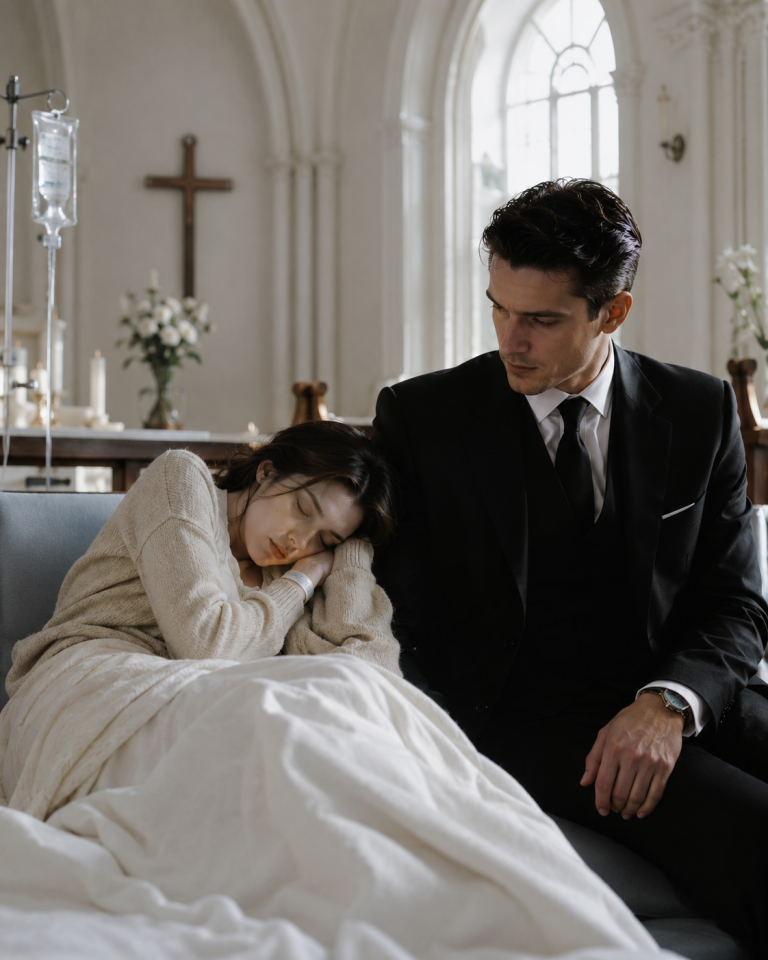
The Feared Mafia Boss’s Twins Cried Every Night—Then She Comforted Them and Changed Her Life

## PART 1
The child’s name was supposed to be on my chart.
After, I couldn’t look at the paper. I had been doing this for six years — six years of pediatric emergency, six years of learning the precise calibration between care and distance, six years of becoming exactly the kind of nurse who could hold a mother’s hand while monitoring a monitor — and still, at 11:52 on a Wednesday, I stood in a hospital break room that smelled of old coffee and cheap disinfectant and tried to remember how to make my hands stop shaking.
Mara. I had given her that name in my head. That was what I did — renamed them internally, something small and private and mine, a way of separating the chart from the child while keeping both. Mara had been seven. She had come in with a fast-deteriorating infection following what should have been a routine surgical repair, and she had been frightened in the way children that age are frightened: not dramatically, just completely, in a way that made the world look enormous and herself look very, very small.
She had held my finger.
That was the detail I couldn’t get past.
She had held my finger with both hands and gone still for about thirty seconds — the kind of still that means a child has found something solid in an unsteady world — and then the monitors had changed and then everything went fast and loud and purposeful and ultimately, finally, quiet in a way I had never managed to make peace with.
I was still standing at the sink, the water running cold over my wrists the way you do when you have run out of reasons to justify the specific motion but cannot stop, when my phone began vibrating inside my locker.
Three times.
I ignored the first two.
The third time felt like an argument.
Unknown number.
I answered.
The woman who spoke was precise in the way of someone who had learned that warmth slows down information. She identified herself as Margot. She worked for a family based outside Boston. She had been given my name, she said, by someone familiar with my work in neonatal and pediatric trauma.
I asked how she’d gotten my personal number.
She said it wasn’t the most important question right now.
I told her it was.
A pause. Then: “The most important question is whether you’re able to help two infants who have not slept more than three consecutive hours in eleven weeks.”
I sat down on the bench beside the lockers.
“How old?” I asked.
“Fourteen months. Twins. Their mother died in February from complications following a postnatal infection.”
The particular cruelty of that sentence landed in me the way medical specifics sometimes do — not softly, but precisely.
“They’ve been seen?”
“Four specialists, two pediatric psychologists, one sleep clinic consultation. No lasting improvement.”
I already understood the shape of what she was describing. Infants don’t grieve the way adults grieve — with language and memory and narrative. They grieve through the body. Sleep failure. Feeding disruption. A watchfulness in the eyes that doesn’t belong in children that young.
“What are you offering?” I asked.
“Thirty thousand dollars for the initial forty-eight-hour engagement.”
I said nothing for a moment.
She added: “The family understands this is unusual. The amount reflects urgency, not doubt about your profession.”
I thought about my mother’s second notice from the gas company. I thought about the eighteen hundred dollars I owed to a medical credit card that charged interest at a rate designed to humble people. I thought about my own apartment, which was adequate the way a waiting room is adequate: functional, temporary, never quite yours.
But none of that was what kept me on the line.
What kept me on the line was the image that had formed the second she said eleven weeks: two small bodies in a house that didn’t know how to hold them, cycling through distress and shutdown in a room that didn’t understand yet that a person could leave and not come back.
“Who is the family?” I asked.
This pause was longer.
“Nate Calloway.”
The name arrived like a word in a language I’d heard spoken nearby without having studied it myself. Not famous. Not a name that appeared in news cycles or charity galas. But the kind of name that circulates in places with controlled access — in whispers between a senior attendant and a resident after certain patients left, in the careful way security guards straightened when certain coats walked through glass doors.
“I know that name,” I said slowly. “I don’t know from where.”
“You don’t need to,” Margot said. “You only need to decide whether two children in distress are within your ability to help.”
I stared at the locker door in front of me.
A strip of paper had been taped there by someone from an earlier shift — a reminder about documentation due dates, ordinary and completely indifferent to everything happening in the world.
“Call me back in forty minutes,” I said.
She said she’d call in thirty.
She called in twenty-eight, which told me something about the state of the household.
“I’ll come,” I said.
I would like to report that the decision was principled and clean.
It was neither. It was the collision of exhaustion with purpose — the specific feeling of a person who has just spent a shift losing something and needs, with animal urgency, to find somewhere to put the part of them that is still trying to help.
I texted my mother.
**Long shift going longer. Don’t wait up.**
At six-fifteen in the morning, a dark blue car was already idling below my building.
The driver made no small talk.
The city unwound itself in stages beyond the windows — lower streets giving way to wider roads, lower buildings giving way to older trees, the entire density of urban life thinning into something more deliberate and controlled. By the time iron gates appeared at the end of a private lane, I had already understood something essential about the family I was entering.
This was the kind of wealth that had given up needing to be seen.
The gates opened.
The house inside them was white and still and arranged with an exactness that made it look less like someone’s home than like a proposition about order. No ornamentation. No sign of children’s things left at the entrance. The gardens were immaculate. Even the air through the car window smelled managed.
I thought: wherever grief is living in this house, it’s had to become invisible to survive here.
The front door opened before the driver reached it.
Margot was exactly as her voice had implied: composed, efficient, the kind of person whose value lies entirely in anticipating problems before they require description. She gave me a brief tour. She told me the children were in the east wing. She paused outside a door and turned to me.
“Before you meet them,” she said, “understand this. You are the seventh person to attempt care since February. The first six were competent. None of them stayed.”
“Why not?”
She looked at me levelly.
“Because the house made it hard to stay.”
She opened the door.
The room inside was beautiful in the way rooms are beautiful when someone has tried very hard to make them good and succeeded at everything except whatever that other quality is — the indefinable quality of rooms where children have been happy in them before.
Two small figures. A boy in the corner, seated on the rug, pressing a wooden shape repeatedly against his knee. Not exploring. Repeating. The movement of a nervous system looking for a rhythm it had lost.
A girl in a low chair by the window, eyes open but turned inward in a way that small children’s eyes shouldn’t be. Not sleeping. Somewhere else.
I set my bag down and sat on the floor without approaching them.
Not too close. Not performing warmth. Just there.
“Hi,” I said. Even. Low. The way you lower your voice in a room where the acoustics of safety are still being negotiated.
The boy — Owen, I would learn — looked up with the eyes of a child who has already been assessed by too many strangers and has developed, in self-defense, a talent for reading assessment before it arrives.
He didn’t smile.
He didn’t retreat.
He watched.
I pulled a smooth wooden cylinder from my bag — a sensory piece, plain and neutral — and rolled it between my palms. I didn’t offer it. Didn’t make it a test. Just let it exist in the space between us.
Seconds passed.
He scooted forward by perhaps four inches.
The girl — Zoe — blinked once. Her eyes refocused slightly. Her hands, which had been pressed flat against the chair arms, relaxed by a fraction.
I noticed.
I began to hum. Not a lullaby exactly. Something underneath lullaby — a rhythm more than a melody, the kind that works on the nervous system before it works on the mind.
Owen scooted forward another two inches.
Margot stood in the doorway behind me and said nothing.
That was when I understood the shape of what these children needed. Not treatment. Not protocol. Not another intervention. Just someone who would keep showing up until the body decided it was allowed to rest.
I stayed on that floor for forty minutes.
By the end of it, Owen had placed the wooden cylinder into my open palm.
Zoe had turned to face the room.
Neither had smiled.
But neither had retreated.
In trauma care, that is not a small thing.
That is the whole world, moving one inch at a time.
—
## PART 2
Margot took me to meet Nate Calloway in a room that was clearly designed for people who arrived to ask him for things and left with answers carefully calibrated to preserve his control over the situation.
He was standing at the window when I entered.
Younger than his name implied — mid-thirties, maybe. The kind of face that might have been open once, but had since been reorganized by something demanding into a landscape of precision and management. Grief does that. Power does that. When they arrive together, they leave marks in the skin around the eyes that age doesn’t fully account for.
He turned.
He looked at me once, thoroughly.
I had the sensation of being assessed the way someone assesses structural load-bearing capacity — without personal judgment, but with extremely high stakes attached to the conclusion.
“Miss Carey,” he said. My name in his mouth sounded like a decision already made.
“Eve Carey,” I confirmed.
“You spent time with the children.”
“Yes.”
“And?”
I had worked for enough attending physicians to know that some people ask questions already holding the answer they’ve decided to accept. He was not one of those. He was asking because he did not know and needed to.
“They’re not broken,” I said. “They’re waiting.”
“Waiting for what?”
“Evidence that the world has stabilized.”
He absorbed that without visibly reacting, which was its own kind of reaction.
“What would it take?” he asked.
“Consistency,” I said. “Somebody whose presence doesn’t get revised every few days. Predictable routine. Reduced stimulation. Time.”
The word landed awkwardly in the room. I suspected time was not a resource he was accustomed to working with rather than managing.
“Stay,” he said.
Not phrased as a request.
“Excuse me?”
“In the house. Frequent transitions have been disrupting progress.”
I stared at him.
“I came for forty-eight hours.”
“I know. I’m asking for longer.” He paused — a brief, controlled pause, the kind that costs something in men who prefer not to cost anything. “They slept this morning. Both of them. That hasn’t happened in eleven weeks.”
There it was.
The thing beneath the precision.
Not an employer speaking.
A man afraid of losing two more people.
I told him I needed to think.
He nodded once and turned back to the window, which was either dismissal or the closest he could get to giving me space without physically leaving the room.
I spent the rest of the afternoon working with Owen and Zoe.
That evening, I lay on the rug between their cribs from ten p.m. until Zoe woke crying at two-fifteen, and then again at three-forty, and then at five-ten when the window went pale with early light. I did not leave. I placed my hand on the crib slat and hummed and waited.
At five forty-seven, both children were asleep.
The decision about whether to stay had already made itself.
I simply hadn’t said it aloud yet.
And I noticed, when Margot brought me coffee at six a.m. and didn’t ask how the night had gone, that she already knew.
What I didn’t know yet was that the most important truth in the house had not yet been told to me. And it was already living in a filing cabinet two floors below where I stood.
—
## PART 3
The days took on rhythm the way they always do when you commit to a place.
Six-thirty: wake, garden, the particular quiet of a house before children stirred. Seven: warm the breakfast porridge, set the tray with the same objects in the same positions, because children in distress learn safety from furniture before they learn it from people. Seven-thirty: Owen and Zoe.
My brown notebook filled steadily. **Owen tracked movement across the room for twenty-two consecutive seconds — longest duration since arrival. Zoe reached for the toy independently, no prompting. Both infants accepted midday sleep in under eight minutes today.** Small entries. Large landmarks. The private cartography of a nervous system finding its way back.
I started noticing the house along with the children.
It was not unkind. That was important to say. Everything in it had been selected with care and maintained with precision. But care and precision are not the same as warmth, and the house had been arranged to function at the highest level of care without having any natural language for warmth at all. No fingerprints on the glass. No shoes left at the wrong door. No books left face-down with their spines cracked from being held too long.
I started leaving things.
Owen’s ball just slightly out of place on the shelf. Zoe’s softest blanket draped over the chair arm rather than folded. Small disarrangements that I chose deliberately, the visual language of a house that was being lived in.
Nate noticed without commenting.
That was how he operated, I learned. He noticed everything and commented on very little. He began appearing at the edges of rooms during play sessions — not intruding, not asking to be included, just present in the way someone stands near a warm place after being cold for a long time. He watched how I sat on the floor. He watched how I waited. He watched how I turned my body sideways when Owen came close so the approach was his choice and not my claim.
One afternoon, Owen crossed the entire room and handed him a wooden block.
Nate held it for a moment that lasted much longer than the moment itself.
Then he set it on the rug and rolled it gently back.
Owen’s shoulders settled by a fraction. He picked up another block and returned to his position on the rug, content. He had been testing whether his father’s presence would change the room’s safety. It had not.
That was worth everything.
Nate left things too.
A novel on my nightstand one evening — something by an author I had mentioned once in passing, which meant he had been listening more carefully than he appeared to be. Tea left warming outside my door on difficult mornings. A note tucked beneath the tea tray one night after I had spent four hours managing a fever and a screaming child through a particularly bad episode:
**Thank you for not leaving.**
No name.
None needed.
The first actual conversation happened on a Wednesday, outside, in the kind of autumn evening that arrives like an apology for having been summer too long.
I was sitting on the back steps with my hands around a mug when I heard the door and felt him sit down beside me.
He didn’t speak immediately.
Neither did I.
We watched the garden go dark together for several minutes, and the silence had that particular quality — not empty, not forced, the quality of two people who have been sharing space for long enough to have developed an intuitive grammar about when speech is required and when it isn’t.
Finally he said, “You changed the detergent.”
“Zoe was startling at the original scent. Probably associated with the period immediately after—” I stopped. “I should have asked before changing household things. I’m sorry.”
“Don’t apologize,” he said. “It was the right decision. I just noticed.”
“You notice most things.”
A pause.
“I learned to,” he said. “Earlier in my life, not noticing was more convenient.”
I turned my mug between my palms and waited to see whether he would continue.
He did.
“My family built things,” he said. “Buildings, mostly. Infrastructure. The kind of work that requires you to be very good at identifying problems and very poor at tolerating them. You train yourself not to see things you can’t immediately fix.”
“And now?”
“And now I have two children who demonstrate every day that the things you most need to see are the ones that take the longest to fix.”
I looked at the pines beyond the garden wall, the last light cutting through them in pale copper slashes.
“They’re doing better,” I said. “Owen slept six uninterrupted hours three nights ago.”
“I know. Margot showed me.”
“Are you sleeping?”
The question surprised him, I could tell.
“Poorly.”
“Grief disrupts the same systems in adults that it disrupts in children. The body doesn’t distinguish by age.”
He looked at the garden.
“No one’s asked me that in a while.”
“How you’re sleeping?”
“Whether I was struggling.”
I held the mug a little tighter against the cold.
“I’m asking,” I said simply.
He was quiet for long enough that I thought he might not answer.
Then: “I feel like I’m watching them heal from the wrong side of a window. I can see the progress. I can see what you’re doing for them. But every time I try to be close to them, I feel like I’m the reason they needed healing in the first place.”
“You’re not,” I said.
“I don’t know that.”
“Grief isn’t an accusation. Their mother’s death happened to them. It also happened to you. The feelings they’re carrying aren’t evidence of your failure.”
He looked at me then — directly, in the way he rarely did outside professional necessity.
“How do you talk about these things so easily?”
“I work in pediatric emergency,” I said. “You learn to discuss what no one else wants to name, or you stop being useful.”
“That’s not the whole answer.”
It wasn’t. But the rest of it — Mara, the sink, the shaking hands — belonged to a private vocabulary I wasn’t ready to share across the back steps on a Wednesday evening with a man I’d known three weeks.
“No,” I agreed. “But it’s the part that’s mine to give right now.”
He accepted that with the same economy he brought to everything.
Later, I understood that this was one of the things I had come to appreciate about him. He didn’t push for more than was offered. He took what was given and waited for the next opportunity rather than treating every exchange as something to be maximized.
That kind of restraint, in my experience, is rarer than it sounds.
—
I found the file on a Thursday night.
Not through snooping. Through accident, and the kind of accident that arrives precisely when you have already been given too much truth and fate decides to add the remainder.
I had come downstairs at midnight to check on a slow feed Zoe had been struggling with earlier. The kitchen light was already on. I followed it through the service corridor to see if Margot had beaten me there, and found instead a door I had not noticed before: a narrow archive room, one of those spaces in old houses that holds the institutional memory of the family in metal drawers.
The door was ajar.
A drawer pulled open.
I was about to close it when I saw a name on a file tab.
Sophie.
It was the name I had seen written on the children’s birth certificates in a corner of the nursery documentation. Their mother’s name. Sophie Calloway.
The file beneath it was medical.
I told myself I was looking only to understand the care history. That it was relevant to their treatment.
That was partly true.
What the file told me, in clinical language across four pages: Sophie had been Nate’s younger sister. Not his wife. Not a partner. His sister, who had come to stay after the breakdown of her own relationship, who had given birth to twins in this house under Nate’s roof, who had developed a postnatal infection that the attending physicians had rated as manageable until it wasn’t, who had died in February leaving behind two infants and a brother who had absorbed the responsibility and the loss simultaneously and apparently told no one the full shape of either.
Beneath the file, letters.
Handwritten. His handwriting — I had seen it on enough notes to know it. Letters addressed to Sophie. Not full letters. Fragments. Sentences that started and stopped like a man talking to someone he kept forgetting wasn’t there.
**I should have made you stay at the hospital longer. You said you felt fine. I believed you because I wanted to.**
**Owen figured out how to push himself upright today. You would have laughed at his expression.**
**I still set your mug out in the morning. Margot doesn’t mention it.**
I put the pages down exactly where I had found them.
Then I turned around.
Nate was standing in the doorway.
The light from the corridor caught the left side of his face and left everything else in shadow. He looked — not angry. Not exposed in the way of someone caught keeping a secret for control. He looked like a man who has been carrying something extremely heavy alone for so long that even being seen with it is a kind of relief, though an uncomfortable one.
“She was your sister,” I said.
“Yes.”
“Not—”
“No.” His voice was steady. “I know how it must have looked. Two infants, no mother, no explanation. I let people assume.”
“Why?”
He looked at the drawer.
“Because explaining it required telling the rest of it. That I should have pushed harder on the treatment. That I had the resources and the access and I still lost her. That the people under my care in that house are there because I failed the one person who trusted me the most.”
He spoke without self-pity.
That was worse, somehow.
“You didn’t fail her,” I said.
His gaze lifted.
“You can’t know that.”
“You wrote that you should have made her stay longer at the hospital. That tells me you were paying attention. Postpartum infection that progresses to the point of fatality is catastrophically fast and can present without the signals that would trigger intervention even in a well-monitored case.” I kept my voice level. Clinical but not cold. “That is not personal negligence. That is a medical reality that kills people whose care teams are also paying attention.”
The corridor light buzzed faintly above us.
“You needed to know,” he said finally. “About her. I should have told you when you arrived.”
“Probably. But I understand why you didn’t.”
He looked at me.
“Do you?”
“Because telling me would have required you to explain why you felt responsible. And you haven’t finished figuring out whether the responsibility is real or whether it’s the version grief builds when it needs someone to blame and the only available candidate is you.”
The archive room was very quiet.
He said nothing for a long time.
Then: “She was the only person in my family who never treated love as a liability.”
That sentence landed in me like something thrown accurately rather than carelessly.
I did not fill the silence.
“After our parents died,” he continued, “she spent years making the family of the four of us feel like it was still a family. She was the one who remembered birthdays. Who showed up. Who called when there was no occasion for calling.” He stopped. “When she came here, I thought I was protecting her. I thought having resources made me useful. I thought control could cover the gap where skill should have been.”
“And now?”
He looked at the letters.
“Now I think the most honest thing I’ve done in years is learning how to roll a wooden block back to a child.”
I crossed the room and picked up the letters and placed them back in the drawer and closed it.
Not to hide them. To put them away for tonight.
“Come upstairs,” I said. “The morning feed is in four hours. You should sleep.”
He looked at me.
“I’m not sure I’m capable of that.”
“I know. Come anyway.”
He followed me back up through the house, and I went to the nursery, and he stood in the doorway and watched Owen sleep for a long time, and Zoe shifted and settled, and at some point I looked up and saw his shoulders release by half an inch, which was the same thing I had catalogued in Owen’s chart as a landmark and meant the same thing in the body of any human regardless of age.
The fear had not gone.
But the immediacy of it had eased.
That was enough for tonight.
—
Three weeks later, Margot collapsed in the kitchen.
It happened quickly and without warning: a pitcher, a sound like a small argument between glass and tile, and then Margot on the floor with her hand pressed flat against her chest and her face carrying the startled expression of a person whose body had just broken an agreement.
I was beside her before I had consciously registered the movement.
Pulse: irregular, rapid.
Skin: cold, damp.
Respiration: shallow.
I called for emergency services, located the household medical kit, supported her upright, and kept talking to her in the particular steady register that stops a frightened person from breathing faster than their situation requires.
She gripped my wrist hard enough that I felt it for an hour afterward.
“Don’t tell him yet,” she said.
I assumed she meant don’t tell Nate until she was stabilized. I filed the request under triage and kept working.
The ambulance came.
Nate left with them without stopping for a coat, which told me more about his state of mind than anything he could have said.
The house became a different version of itself after that.
Quieter.
Not in the managed way of its ordinary quiet. In the way of a system that has lost one of its organizing principles and is trying to determine how to function without it.
I managed the children through the afternoon and put them down at their usual hour and then sat in the kitchen with cold tea and tried to organize my thoughts about Margot — her precise competence, her watchfulness, the specific way she looked at the children that I had always read as professional care but now suspected of containing something additional.
Nate came back at ten-thirty.
He sat at the kitchen table and I made him tea he did not drink and we were quiet together for a while.
“She has a cardiac condition,” he said eventually. “She’s known for two years. She didn’t tell me because she thought I’d send her somewhere quiet and safe and she was not ready to leave.”
“Why?”
He looked at his tea.
“She’s Zoe and Owen’s grandmother. Sophie’s mother. I brought her here after Sophie died because I didn’t know what else to do, and then she decided to stay because she needed to be near them.” He paused. “She never asked for the arrangement to be explained to anyone. I never offered.”
I held my mug and thought about the way Margot had watched the children — that particular quality of attention that exceeded professional interest, that had roots deeper than duty.
“She called you daughter,” he said. “In the kitchen. She thinks you don’t hear her.”
I blinked.
“She told me,” he said. “Tonight, at the hospital. She said you were the first person to come into this house and see the children as themselves instead of a problem. She said she was not afraid to leave anymore.”
Something moved through my chest at that.
Not comfortably.
“She’s not leaving,” I said.
“No. She’s not. But she’s not afraid to anymore.” He looked up. “She asked me to tell you.”
We were quiet again.
Then he said, “There’s something I need to ask you.”
“Alright.”
“I know the initial engagement has long since passed. I know this was not the arrangement you came for.” He set down his mug. “I need you to know that what I’m about to ask is not contingent on anything we’ve built here. It’s a separate question.”
I waited.
“Will you stay?”
Not permanently. Not formally. Not with promises he didn’t know how to make yet.
Just: will you stay.
I thought about my apartment, which would continue to exist without me in it. I thought about my mother, who would understand if I called and explained. I thought about the pediatric ward, which had other good nurses and would manage.
I thought about Owen handing me a wooden cylinder on a Tuesday morning on the floor of a beautiful room.
I thought about Zoe’s fingers around mine in the dark.
I thought about a man who had written letters to his dead sister and set out her mug every morning and stood in doorways learning to love people without the armor of control.
“Yes,” I said.
He nodded once.
Then, slowly, with the carefulness of someone who has been wrong about the relationship between distance and safety and is practicing something new, he covered my hand with his on the table.
Just that.
Left it there.
I turned my hand and held his.
—
What followed was not a dramatic transformation.
It was work, which is the shape real change always takes.
The children grew.
Owen started laughing — short, surprised laughs, as if his own joy were a visitor he hadn’t learned yet to expect. Zoe began pointing at things with her whole hand, demanding attention for the world around her with the comfortable authority of a child who had decided the world was safe enough to be curious about.
Nate joined breakfast three mornings a week, then five, then every morning, sitting at the table in older clothes, softer versions of himself, learning the language of ordinary mornings.
Margot recovered.
She came home from her procedure thinner and less composed than I had ever seen her and walked directly to the nursery and sat in the chair by the window for an hour without speaking, and none of us asked her to explain herself, and by dinnertime she was ordering the grocery delivery with her usual precision and calling me *daughter* at full volume rather than under her breath.
She told me, once, what she had told Nate at the hospital.
“Sophie would have liked you,” she said. “She collected people who paid attention. She said most people look but very few notice.”
I didn’t know how to answer that, so I didn’t.
She seemed to consider the silence an adequate response.
The danger that came to the house came quietly.
Not physical. Not immediate. A series of calls to Nate that changed the pattern of his evenings — tighter, shorter, more frequently ended by him walking out to the garden alone. A conversation I wasn’t part of. A change in the way the security staff moved through the property.
He told me when he was ready: a business dispute, long-standing, that had recently become more personal than professional. Someone was applying pressure in ways that included the family’s location.
Then he said, “I want you and the children to go to my place in Maine.”
I looked at him.
“Until this resolves,” he added.
“No,” I said.
He frowned. “Eve—”
“You are asking me to leave because you are afraid. I understand that. But the answer is no.”
“This could become dangerous.”
“It could. And I am an adult with full information making a decision about where I want to be during a period of risk.” I paused. “You do not protect people by removing them from their own lives. You protect people by being honest with them and letting them choose.”
He stared at me.
“You’re supposed to agree with me.”
“I’m supposed to be honest with you. Those are different things.”
The silence was long and uncomfortable and entirely worthwhile.
Finally he said, “What if something happens to you?”
“Then I’ll have been here when it happened rather than somewhere safe that I didn’t choose.”
He looked at me for a long time.
“I have built my entire life around keeping people at a distance that would protect them,” he said. “Every important person I have ever lost has been lost while I was at a distance I thought was protective.”
“I know,” I said. “And you know what that strategy has actually cost you.”
He did.
“I’m not going to Maine,” I said, more gently. “I’m staying here, with you and the children and Margot, until this passes. And if you need to do something to address the threat, do it — but do it with me knowing, not around me.”
He exhaled.
Then he reached into his jacket and removed an envelope.
Inside: a plane ticket, a key, and a note in his handwriting that read: **In case you changed your mind before I could say any of this correctly.**
I tore the ticket in half.
Kept the note.
He watched me do both.
“Alright,” he said.
That word — from him, after everything — was enormous.
“Alright,” I confirmed.
The threat resolved, as most threats from quiet powerful men do, through leverage and patience and the specific kind of institutional pressure that doesn’t make headlines.
The house returned to itself.
And then continued further — continued toward something it had not been before, something warmer and more disorganized, full of the happy accidents of children and the awkward grace of adults learning to be honest with each other.
—
One evening in late spring, when the gardens had gone fully green and the twins were asleep and Margot had retired to her rooms and the house held only us, Nate sat down beside me on the porch with two mugs.
He handed me mine.
He watched the garden.
He said, “I think I’ve been afraid since I was about twelve.”
I looked at him.
“My father left when I was twelve. My mother managed the aftermath the way she managed everything — by making it invisible. I learned very early that the most reliable protection from loss was to need fewer people.” He turned the mug. “It is an excellent short-term strategy and a catastrophic long-term one.”
“Yes,” I said.
“Sophie knew that about me. She spent years trying to show me another way. I was too stubborn to change while she was alive.” He paused. “I am changing now.”
“I know.”
“Because of you.”
I shook my head. “Because of Owen. And Zoe. And Margot. And Sophie, still.”
“And you,” he said.
I held my tea.
“And me,” I agreed. Quietly. Without performance.
He turned toward me.
“I love you,” he said.
Not dramatically.
Not as a confession.
The way you say something true that you have been practicing saying privately for long enough that finally saying it aloud is simply the next logical step.
“I know,” I said. “I love you too.”
He smiled.
Not the managed, controlled smile of a man maintaining surfaces. Something smaller and more specific — the smile of a man surprised by his own contentment.
He leaned forward and kissed my temple.
It was enough.
More than enough.
—
The ceremony, when it came, was Margot’s idea.
Small, she said. Outside, under the old oak that had been in the back garden since before the house was built. Not a legal arrangement — those would follow, in time, in their own forms. But a family arrangement. A naming.
Owen wore a shirt that immediately acquired a grass stain.
Zoe carried a bundle of herbs from the kitchen garden with such concentrated seriousness that it broke several adults in attendance.
Margot held a book and read something in Italian that she declined to translate and that made her cry halfway through.
Nate stood under the oak in shirtsleeves, without a jacket, without the architecture of formality. He looked, for the first time since I’d met him, not like a man accustomed to occupying power but like a person standing in a garden under familiar light, present.
He took my hands.
“I spent years building things intended to last,” he said. “Structures. Systems. Things that were supposed to replace the need for anything that could be lost.” He looked at my hands. “You showed me I had the tools backward. The things that last are not built to be impervious. They’re built from the acceptance of impermanence. From the decision to stay anyway.”
He reached into his pocket and produced a ring.
Simple. Old silver. A small stone the color of the pines beyond the garden wall.
“This is not a claim,” he said. “This is an acknowledgment. That you belong here. With us. That this family is yours as much as it is anyone’s.”
I let him put it on.
Owen immediately tried to pull it off my finger, which meant he had spotted it from three feet away, which meant he was paying excellent attention.
“No,” Zoe told him firmly. The first strong declarative sentence I had ever heard from her.
We all looked at her.
She looked back at us with the mild certainty of someone who considers her position self-evidently correct.
Then she turned and walked back to the herb bundle.
Margot laughed so hard she had to sit down.
Nate looked at me.
The expression on his face was simple.
Not triumphant.
Not relieved.
Home. That was all. Just home.
I stood under the oak tree with the grass softening under my feet and the children nearby and Margot wiping her eyes and this man looking at me with that particular expression, and I thought about Mara and the hospital sink and the shaking hands and the midnight phone call and the drive through the gates and every inch of this place that had been cold and managed and cleaned of all visible evidence of love.
I thought about what it had become.
I thought: you can walk into a broken thing expecting to help it and find that in the process of helping, you have been helped.
Not saved.
Not rescued.
Helped.
The way being in a room where someone finally exhales helps everyone breathe a little more freely.
That is what had happened here.
A family had been holding its breath since February.
I had come in and stayed.
And eventually, gradually, in the way that bodies learn safety through accumulation rather than declaration, they had exhaled.
So had I.
—