I FED A MAFIA BOSS’S STARVING BABY ON A PRIVATE JET — THEN HE TOLD ME I COULD NEVER LEAVE

**PART 1**
I never expected a crying baby to change my life. But somewhere over the Atlantic, aboard a private jet full of armed men and buried secrets, I made one decision that would trap me in a world I never should have entered.
My name is Mira Ashton.
Three months before that flight, my whole world had come apart. My husband, Ethan, died in what everyone called a tragic accident. My newborn twin sons died shortly after, from complications no doctor could explain or stop. I survived. Only physically. Everything else in me had gone quiet, like a house with the power cut.
I lived alone in Boston, avoiding the nursery I couldn’t make myself walk into. The cruelest part was that my body refused to accept any of it — even after both funerals, I was still producing milk. Every single day arrived as a fresh reminder of everything I’d lost.
That night I was flying home from London on a private charter, after finishing a temporary nursing consulting job overseas. I wanted nothing from the flight except sleep and the chance to forget the world existed for a few hours.
Then I heard the baby.
At first the cries carried through the luxurious cabin with startling strength. Passengers shifted, uncomfortable. Flight attendants traded worried looks. No one said a word. The cries kept coming — louder, more desperate — and then something changed.
They started to weaken.
As a former neonatal nurse, I recognized the shift instantly. This wasn’t frustration. Wasn’t exhaustion. This was hunger. Dangerous hunger.
My stomach tightened. I opened my eyes and looked toward the front of the cabin, and that’s when I saw him.
Damien Voss.
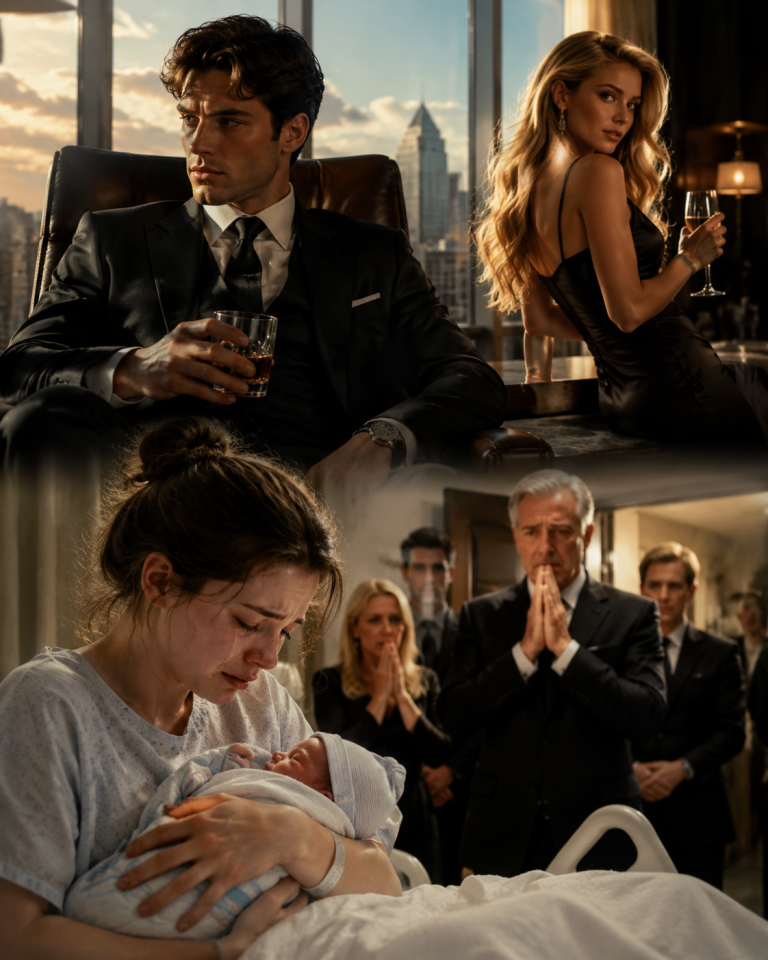
Even without knowing his name, you’d have known he was dangerous. Tall, broad-shouldered, a charcoal suit tailored close enough to look like armor, tattooed hands folded carefully around something impossibly small. Rumors tied him to organized crime up and down the East Coast. True or not, nobody on that plane seemed willing to test the question.
In his arms was a baby girl. And for the first time since I’d looked at him, I saw something on his face that didn’t belong there.
Fear. Real fear.
He offered her a bottle again. She turned away, crying weakly, refusing it outright. A flight attendant hovered nearby, useless. Three broad-shouldered men sat several rows back, pretending not to watch. Every one of them was watching.
Nobody moved. Nobody knew what to do.
Then her cries went frighteningly soft.
My body reacted before my mind caught up — pain tightened across my chest, milk leaking through the nursing pads I still wore out of habit I couldn’t break. I closed my eyes. *Not my child. Not my problem. Not safe.*
Then the baby let out one final, weak cry.
I stood.
The whole cabin noticed at once. Every head turned. Every conversation died. I walked toward Damien, and his men straightened instantly, one of them stepping forward before Damien raised a hand and stopped him cold.
I stopped beside his seat. “She’s starving,” I said quietly.
His jaw tightened. “I know.”
“She’s rejecting the bottle.”
His eyes narrowed. “You know babies?”
“I was a neonatal nurse.”
Neither of us spoke for a moment. Then I said the words I never imagined leaving my mouth. “I can help her.”
Understanding flashed across his face. Then shock. The cabin went utterly silent.
A minute later I sat behind a privacy divider, holding his daughter against my chest. The moment she latched, the crying stopped. Relief flooded her tiny body, and then mine — tears filling my eyes before I could stop them. For the first time since losing my sons, I felt needed. Alive.
When I finally handed the sleeping baby back to her father, something in the air between us had changed. Damien looked at me differently now. Not like a stranger. Not like an employee. Not even like a hero.
Like someone he’d just decided was important.
Dangerously important.
Hours later the plane landed at a private airfield outside New York. I gathered my bag, ready to leave — but before I reached the exit, a deep voice stopped me.
“Mira.”
I turned. Damien stood there holding his sleeping daughter, his expression unreadable. “You saved my child’s life tonight.”
I forced a nervous smile. “I’m glad she’s okay.”
He shook his head slowly. “No. You’re not understanding.” His eyes locked onto mine. The bodyguards moved closer. The cabin suddenly felt very small.
“You can’t go home anymore.”
**PART 2**
For several seconds I could only stare at him.
The jet hummed around us as its engines wound down. Beyond the oval windows, black vehicles waited under floodlights, men in dark coats standing beside them, motionless in the cold. Behind me, the cabin door stood open. Freedom was less than twenty feet away.
Damien stood between me and it anyway, holding his sleeping daughter like she was the only fragile thing left in a world built to withstand bullets.
“You can’t go home anymore,” he repeated.
My fingers tightened on my bag strap. “That isn’t your decision.”
“It became my decision the moment you fed her.”
The words hit harder than they should have. I looked at the baby against his chest — flushed cheeks now, slow even breathing, one tiny fist tucked beneath her chin.
“She needed help. I helped her. That’s all.”
“Nothing is ever only one thing.”
“I don’t know what that means.”
“It means people saw.”
I glanced around. The flight attendants had vanished toward the galley. The pilots stayed behind the cockpit door. Damien’s men no longer pretended not to watch — three of them, positioned like a cage made of tailored suits and calm faces.
“My daughter’s existence isn’t public knowledge,” Damien said. “The people who know about her are either loyal to me or useful to me.”
“And what am I?”
“I haven’t decided.”
A cold wave passed through me. “I’m getting off this plane.”
“No.”
“You can’t kidnap me.”
His expression stayed almost bored, but something flickered in the eyes of the man nearest the door. Damien noticed it too — he noticed everything.
“I can,” he said. “But I’d prefer you understand why first.”
“I understand enough.”
“You understand fear. Fear isn’t always the same as truth.” He tipped his head toward the stairs, and the guard blocking them stepped aside. The path was clear. For one hopeful second I thought he was letting me go.
“Walk out,” he said.
I hesitated.
“You’re free to try.”
Something in his voice stopped me before I moved. I looked through the open door — past the stairs, across the tarmac toward a chain-link fence, a row of idling black SUVs, and near a distant service building, two vehicles sitting under yellow light that might once have been police cars.
I almost went anyway.
Then headlights appeared beyond the fence. A dark sedan crawled along the perimeter road. Damien turned his head toward the window. One of his men touched his earpiece.
The sedan stopped. Its lights cut out.
“That vehicle followed us from London,” Damien said.
“That’s impossible. I only boarded hours ago.”
“And they knew you were on it.”
“No one knew my flight details.”
“Someone did.”
His daughter stirred against the tension in his body, and immediately his whole posture changed — the feared man disappeared, and only the father remained. “Three days ago,” he said, lower now, “someone tried to take her from a house outside London. Her nanny was killed. The woman who normally fed her was hurt. We left without preparing because staying would have been worse.”
I thought of the failed bottle, the weakening cries, the fear on his face when I’d first seen him. “You had no formula she’d take?”
“We had formula. We had bottles. She refused both.”
“And her mother?”
Silence moved through the cabin. His jaw hardened. “Dead.” The word carried something colder than grief. Something unfinished.
A bodyguard pulled out a tablet at Damien’s nod. Two grainy photographs appeared — me, standing beside Damien’s seat before departure, and me entering the privacy divider. Both taken through the jet’s own window in London.
“That doesn’t prove anything,” I said.
“To you, no. To men who’ve spent months hunting my daughter’s vulnerabilities, it proves enough.”
Then the guard by the door said, “Boss,” and Damien’s gaze sharpened. A second later the floodlights died. Darkness swallowed the aircraft. Someone grabbed my arm.
“Down,” a voice ordered.
Gunfire cracked outside — flatter and harder than it ever sounds in movies. The windows burst inward in a storm of glass. Damien turned his whole body over the baby. A guard drove me to the floor between the seats. Bullets tore through leather. The cabin lights flashed red, painting everyone in blood-colored shadow.
Damien shouted something in Russian. His men moved with terrifying precision — one returning fire, one dragging a metal panel over the doorway, one hauling him toward the rear. He resisted.
“Mira.” His eyes found mine through the dark. The baby began crying again, the sound cutting through everything. “Bring her.”
The guard hauled me upright. “What?”
“Move.”
“I’m not going anywhere with you.”
A bullet struck the wall inches from my head. The argument ended.
We ran. At the rear, a flight attendant opened a maintenance hatch I hadn’t noticed, cold air rushing up from below. Damien went down first, one arm around his daughter. I followed because the man behind me left me no choice. We emerged beneath the aircraft into a night full of gunfire — black SUVs swerving between hangars, men firing from behind open doors, the fake police cars nowhere to be seen anymore.
“Keep your head down,” said the guard beside me — younger than the others, pale-eyed, a scar across his chin.
“What’s your name?” I gasped.
“Kade.”
We reached an armored SUV under the jet’s wing. Damien climbed in; Kade pushed me after him. I landed hard across the leather seats. The vehicle was moving before I’d even sat up.
The baby was screaming. Damien held her close, his attention split between her and the chaos outside. One of the trailing SUVs erupted into flame, the light briefly lighting his face. He didn’t flinch. I did.
“No,” I said, when he looked at me.
“She needs you.”
“So you can keep me prisoner?”
“So she stays alive.”
The vehicle swerved hard; I struck the door; his hand caught me before I fully fell, strong enough to bruise. For one second our faces were inches apart. “Do you think I wanted this?” he asked.
“I don’t know what you want.”
“Neither do I.”
The baby let out a broken cry, and my body answered before my pride could stop it. I hated how fast instinct beat thought. “Give her to me.”
He hesitated, then passed his daughter into my arms.
“What’s she called?”
“Anya.”
I looked down at her rooting weakly against me, and something in the name went straight through me. One of my sons would have been Adrian. The other, Micah. Names matter after death — sometimes more than they ever mattered in life.
“Anya,” I whispered, and when she latched, the world briefly disappeared — the gunfire still distant, the SUV still racing, but inside that armored box there was only the small trusting weight of her against me.
“Are you hurt?” I asked Damien, noticing blood on his cuff.
“No. Not mine.”
The answer should have terrified me. It only left me numb.
“Where are you taking me?”
“My home.”
“I’m not staying there.”
“Tonight you are.”
“And tomorrow?”
“Depends whether the people who attacked us know who you are.”
“They already know my face.”
“Your name is worth more.”
“They can find my name.”
“Yes. Passenger records. Immigration. Employment history. Security footage. Your life isn’t hidden, Mira.”
“Neither was yours.”
A faint smile touched his mouth. “Mine’s built to survive being seen.”
“Then let me go to the police,” I said.
“They’ll ask why armed men attacked a private aircraft. Why you were aboard. They’ll dig into your history. Your husband’s death.”
I looked at him sharply. “What does Ethan have to do with this?”
“Perhaps nothing.”
“Then why say it?”
“Because his accident wasn’t an accident.”
The air seemed to leave the vehicle. “No,” I said.
“He died when his car crossed the centerline outside Cambridge.”
“I know how he died. Heavy rain. Loss of control.”
“That’s the report you were given.”
My arms tightened around Anya. He reached inside his coat — Kade half-turned with a raised weapon before Damien waved him off — and produced a folded inspection report. Ethan’s car. A severed power-steering line. Tool marks. *Possible deliberate interference.* Dated a week after his death. A name at the bottom, and beneath it, in red ink: *RETRACTED.*
“Where did you get this?”
“From a man who was killed yesterday.”
My hands started shaking. “Why would anyone kill Ethan?”
Something in Damien’s face shifted — not softer, but closer to recognition. Pity, maybe. That was worse.
“What did your husband do for work?” he asked.
“Accountant. Logistics company. Baltic Cargo Solutions.”
“Baltic Cargo moved money for my organization,” Damien said quietly. “Your husband found irregular accounts. He tried contacting federal investigators. He also tried contacting me.”
“Then you killed him.”
“No. If I had, I wouldn’t pretend otherwise.”
“That isn’t reassuring.”
“It’s the truth.”
“You’re a criminal.”
“Yes.”
“You have armed men.”
“Yes.”
“People are dead tonight because of you.”
“Yes.” Each answer arrived without shame, without denial, and the brutal simplicity of it unsettled me more than any lie could have. “But you should understand,” he added, “that the person who killed your husband is the same person who tried to take my daughter tonight.”
The SUV turned through iron gates topped with cameras, the drive curving into dark woods, and the estate rose ahead of us at the end of it — gray stone, tall windows, a central tower, armed men waiting in the courtyard.
Inside, a woman in a gray dress hurried down the staircase — sixties, silver hair pinned back, a Russian accent. Relief flooded her face at the sight of Anya. “Thank God.”
“Nadia, this is Mira Ashton,” Damien said.
Something crossed the older woman’s face. Surprise. Then alarm. “You brought her *here?*”
Damien caught it instantly. “You know who she is.”
“I know the name.” Nadia’s eyes wouldn’t quite settle on me.
“What does that mean?” I asked. No one answered.
“How,” Damien said, quieter now.
Nadia glanced at the armed men. “Not here.”
“Now.”
“Her husband came to this house,” Nadia said. “Six months ago.”
My heart stopped. “What?”
“He came twice. He said he had information for Mr. Voss. He wouldn’t tell the guards. Said he’d only speak to Damien directly.”
“He never reached me,” Damien said.
“You were in Moscow.”
“Someone should have told me.”
“Someone did.”
“Who?”
“Anton.”
At the name, Kade cursed under his breath. I looked between them. “Who’s Anton?”
No one answered. The silence told me everything I needed to know — someone powerful, someone dangerous, someone close.
“Seal the estate,” Damien told Kade. “No calls in or out. Find Anton.”
“He left three hours ago,” Nadia said. “He got a message.”
“From whom?”
“I don’t know.”
Damien turned back to me, calculation moving visibly behind his eyes. “You were on that flight by accident?”
“Yes.”
“Your employer arranged the charter?”
“A staffing agency. Ashwell Medical.”
Kade, checking his phone, went pale. He turned the screen toward Damien.
Ashwell Medical Staffing had been incorporated four months earlier. Dissolved that same morning. The listed address led to an empty office. The directors were false identities.
My mouth went dry. “No. I worked in a real hospital. They hired me for my neonatal experience.”
“Of course they did,” Damien said. “The best traps contain truth.”
The meaning settled slowly, painfully. “They knew I could feed her.”
The foyer went silent. Somewhere deeper in the house, a clock struck midnight.
“This was arranged,” Damien said. “The flight. The job. Your seat. All of it.”
I looked toward Anya, sleeping in Nadia’s arms. “And her hunger?”
“They knew she’d refuse formula,” Damien said. “Someone close to her told them.”
“Why arrange for me to help her?”
Damien didn’t answer. Kade did. “To make the boss take you in. They knew he wouldn’t leave her vulnerable after that. They knew he’d bring you inside.”
A chill spread through me. The attack at the airfield. The photographs. The dissolved company. Ethan’s hidden report. None of it had been random. I hadn’t wandered into Damien Voss’s world.
Someone had placed me directly in his path — and I had walked in willingly.
“What did Ethan find?” I asked.
“Names. Payments. Shipping routes.”
“Whose names?”
“We don’t know. I know someone inside my organization betrayed me.”
“And killed my husband.”
“Yes.”
“And maybe caused the complications that killed my sons.”
The room went very still. I hadn’t meant to say it — the thought had risen from somewhere beneath reason, too dark to touch, too terrible to ignore.
“Explain,” Damien said.
“My pregnancy was healthy until the final month. Then an infection no one could trace. Ethan became terrified before the twins were born. Changed the locks. Checked under the car every morning. Told me not to answer unknown numbers. I thought he was grieving before there was anything to grieve.”
“Your sons died how long after your husband?”
“Eleven days.”
Damien turned to Kade. “Get her medical records.”
“No.”
Both men looked at me.
“You’re not touching my records.”
“If someone harmed you—”
“I said no. You don’t own my body because your daughter needed it. You don’t own my history because someone manipulated us both. You don’t get to tear my life apart and call it protection.”
Something dangerous moved through his eyes — the look, maybe, of a man rarely told no by anyone still breathing. “And if your medical records reveal who killed your children?”
The word *children* hit like a blade. I looked away, hating that I had no answer.
Anya began crying again in Nadia’s arms — louder, redder-faced, hands clenched. Damien took her back; she didn’t calm. I felt the familiar pressure building in my chest.
“No,” I whispered.
He looked at me — not commanding this time. Waiting. That was worse. I held out my arms, and he gave her to me.
Nadia led me upstairs afterward, to a quiet room at the end of a long corridor — a fire already burning, fresh clothing folded on the bed. My size, exactly.
“Were these brought for me?” I asked.
Nadia’s face tightened. “I didn’t place them here.”
On the nightstand sat a silver frame, turned facedown. I reached for it. Nadia caught my wrist. “Don’t.”
I pulled free anyway. The photograph showed me outside a Boston hospital, pregnant, smiling, Ethan’s arm around my shoulders. My sons, still alive inside me.
Written across the bottom in black ink: *SHE WILL OPEN THE DOOR.*
My knees weakened. Nadia took the frame. “We must show Damien.”
A soft click sounded behind us. The bedroom door had closed.
A man stood inside the room, having entered without a sound. Tall, gray-haired, impeccably dressed. A gun in his hand.
Nadia went rigid. “Anton.”
He smiled. “So dramatic, all of you.”
Anya was still in my arms. I pulled her closer. His gaze moved to her.
“Careful,” he said. “She’s worth more alive.”
**PART 3**
Nadia stepped between us. “You betrayed him.”
“I corrected an imbalance.”
“You killed Ethan Ashton.”
Anton looked at me. “No.”
“Then who did?”
“Your husband killed himself the moment he found something beyond his understanding.”
“That isn’t an answer.”
“It’s the only one you’ll get tonight.”
Footsteps sounded in the corridor. Anton raised the gun toward the door, then looked back at me. “You were supposed to arrive quietly.”
“You arranged the plane?”
“I arranged many things.”
“The attack?”
“Necessary. People always die when Damien refuses to listen.”
“What do you want?” Nadia asked, her voice trembling.
“The child.” Nausea rolled through me; I stepped back. His expression shifted. “Not that child.” He turned the gun toward my stomach. “The other one.”
For a moment I thought he was mocking me. “My sons are dead.”
“Your sons,” he said softly, “were never both buried.”
The fire crackled. Anya’s breath was faint and even against my collarbone. Nadia was whispering something under her breath.
“That’s a lie.”
“One was.”
The room seemed to tilt. “What?”
“One of your boys died in the hospital. The other was taken. The records were altered. The death certificate duplicated. One infant was cremated under two names. Your husband discovered the exchange too late.”
A sound tore out of my throat that wasn’t quite a word.
“Where is he?” I managed.
“That,” Anton said, “is why you’re here.”
The corridor noise grew louder — Kade shouting in Russian. Anton crossed to Nadia and pressed the barrel against her ribs. “Tell Damien to enter alone.”
Nadia stared at him with pure hatred, then called out. The door opened. Damien stood there, gun already drawn, shadows moving behind him. His eyes went first to Anya, then to me, then to the photograph on the floor.
“What did he tell you?”
I couldn’t breathe. “My son.”
Damien’s expression changed — only slightly, but Anton saw it, and so did I. Not surprise. Recognition.
“You knew,” I whispered.
He said nothing.
“You *knew?*”
“Not everything,” Anton said, almost pleased. “But enough.”
“For how long?” I demanded.
Silence.
“For how long.”
“Three months,” Damien said finally. The exact length of time since the funeral.
Something broke inside me that wasn’t grief — grief had already broken everything it could reach. This was something else. A door opening onto an abyss.
“You watched me bury an empty coffin.”
“I was trying to confirm—”
“You watched me believe he was dead.”
“I did not know where he was.”
“But you knew enough to find me.”
Anton’s patience ran out. “And now the touching reunion must end.” He pressed harder against Nadia. “A trade. Mira comes with me.”
“No,” Damien said.
“You don’t have a choice.”
“I always have a choice.”
“Then choose.” Anton’s gaze dropped to Anya. “The daughter you can see, or the son you cannot.”
Damien’s face went to stone. My heart pounded so hard it hurt.
“You know where my baby is,” I said.
“I know who has him.”
“Who?”
“You’ll learn when we leave.”
“You’re not leaving,” Damien said.
Anton shifted the gun toward Nadia’s heart. “You’ve grown predictable.”
“And you’ve grown careless.”
A red dot appeared on Anton’s forehead — a laser through the window. He froze.
“Move the gun away from her,” Damien said quietly.
For the first time, real fear crossed Anton’s face.
Then the lights went out.
Anya screamed. Gunfire exploded through the dark. Glass shattered somewhere. Someone struck me from behind; I twisted as I fell so the baby landed safely against my chest. Men shouted. Nadia cried out. A weight crashed beside me.
Emergency lights flickered on — red again, always red. Anton was gone. The window stood open, curtains whipping in the cold. Nadia lay near the bed, blood spreading across her dress, Kade already crouched beside her.
Damien crossed the room in three strides and reached for Anya. I pulled back instinctively. “Don’t touch her.”
“Mira—”
“You knew.”
“We don’t have time.”
“My son is alive.”
“Maybe.”
“Don’t say maybe.”
A gunshot cracked outside. He looked toward the broken window, then back at me. “You need to come with me now.”
“No.”
“Anton will come back.”
“Then let him.”
His control finally snapped. “I stayed silent because every person who’s ever searched for that boy has ended up dead. Do you understand? Every one of them.” The room fell quiet. Even Anya’s cries weakened. He leaned close enough that only I could hear him. “Your husband found evidence of a program moving infants through private clinics and forged adoptions. He believed your son had been taken because of who Anton suspected his father to be.”
“What are you talking about?”
He didn’t answer with words. His face answered for him.
I didn’t slap him — I wanted to, but Anya was in my arms, and some instinct older than anger kept my hands still. “Say it.”
“I don’t know for certain,” Damien said. “Only that Anton believes it. That your son matters to him beyond ransom. That’s why he took him instead of simply killing him to punish me.”
It wasn’t the answer I’d braced for, and somehow that made it worse — a smaller, colder mystery instead of one dramatic revelation. “Then we find him,” I said. “Tonight.”
Kade looked up from Nadia. “She’s stable. The bullet went through, missed anything vital.” Relief moved through the room in a single exhale.
Damien’s phone buzzed. A message from an unknown number.
*Bring Mira to the old cathedral on Water Street tomorrow night. Come alone, or the boy disappears for good.*
Beneath it, a photograph: a dark-haired toddler in a blue blanket, a small silver bracelet around one wrist — the exact bracelet I had fastened onto my son’s arm myself, before the nurses carried him away and told me the wrong story about what had happened next.
I stared at the screen until the letters blurred.
“His name is Adrian,” I said. “Or it should be. Adrian Ashton.”
Damien looked at me for a long moment. “Tomorrow night,” he said, “you are not walking into that cathedral without me. Whatever Anton wants from you, he isn’t getting it alone.”
“He said come alone.”
“He also killed my nanny, shot my caretaker, and orchestrated the murder of your husband,” Damien said. “I’ve stopped taking his instructions as anything but a starting offer.”
We spent the next twenty-four hours doing the unglamorous, exhausting work that never makes it into the stories people tell about men like Damien Voss — tracing shell companies, pulling old clinic records, calling in favors from people who owed him things they’d rather forget. Kade found the clinic where the switched birth records had been filed: a private maternity annex outside Cambridge that had quietly closed eight years ago and reopened under a different name, still funneling “hard to place” infants through a network of falsified adoptions that Anton had built long before he ever worked for Damien.
“Your husband wasn’t wrong about any of it,” Damien told me, somewhere near three in the morning, both of us still awake in the estate’s kitchen, Anya finally asleep upstairs. “He just didn’t live long enough to prove it to the right people.”
“Then we prove it,” I said. “After tomorrow.”
He studied me. “You still don’t trust me.”
“No.”
“But you’re still here.”
“Because right now you’re the only person in this whole rotten machine who’s told me the truth even when it made you look terrible.”
Something almost like a smile crossed his face. “That’s a low bar.”
“It’s the only one that’s mattered tonight.”
The cathedral stood empty and half-lit when we arrived the next evening, stained glass throwing broken color across the aisle, Anton waiting alone near the altar with my son in his arms and two men flanking the side doors. Damien’s people were already in position outside — I didn’t ask how many, and he didn’t tell me.
“You brought company,” Anton said, unsurprised.
“You brought my son,” Damien answered. “We’re both breaking rules tonight.”
Anton looked at me instead, and for the first time all the theater dropped out of his voice. “I never wanted the boy dead. I wanted him raised somewhere Voss could never reach — insurance, in case Damien ever decided loyalty mattered less than convenience. It’s happened to better men than me.”
“You could have told me that instead of staging a war,” Damien said.
“You’d have laughed at me. You always did.”
“I’m not laughing now.”
For a long moment nobody moved. Then Adrian — my son, small and solemn in a stranger’s arms, with Ethan’s same serious mouth — turned his head toward the sound of my voice when I said his name, the way infants do before they understand anything except that a sound belongs to someone safe.
That was what broke Anton, in the end. Not the guns outside, not the calculations Damien had clearly already made about how this could go. It was watching a baby who barely knew her turn toward the sound of his mother’s voice like it was the only fact in the world he trusted completely.
He handed him over without another word.
I don’t remember crossing the aisle. I remember the weight of my son against my chest for the first time in three months, and the sound I made that wasn’t quite crying and wasn’t quite anything else either, and Damien’s hand steady at my back the entire time, not holding me in place — just there, in case my legs gave out, which they nearly did.
Anton didn’t run. Whatever he’d been building toward for years, it seemed to end there, in the quiet of a half-lit church, more resignation in his face than fear. Federal investigators — the same ones Ethan had originally tried to reach before Anton’s people intercepted him — were waiting outside within the hour, alerted by evidence Damien had spent the past six months quietly assembling behind the scenes, the same evidence that would eventually unravel the whole falsified-adoption network from the inside out.
What followed took months, not one dramatic night — sealed hearings, frozen accounts, revoked licenses, careful testimony instead of headlines. Families who’d spent years wondering where their children had gone finally started getting real answers. Not every answer brought peace. But the uncertainty stopped belonging entirely to the powerful.
Damien testified against parts of his own organization to keep his cooperation agreement intact. It cost him money, allies, and men who’d never really been friends to begin with. He didn’t complain about the cost, not once, not to me.
I moved out of the estate eventually — not far, and not permanently gone from it either, because Anya had grown to expect me in the mornings, and some bonds don’t care what’s convenient. I went back to nursing, first informally, then through a small family-support program I helped start for parents navigating infant loss and complicated births. Adrian grew steady and curious and loud in all the ways a toddler is supposed to be loud, and slowly, the nursery I’d once been unable to walk into stopped being a room full of ghosts and started being a room he actually lived in.
Damien and I didn’t rush anything. We’d both learned, the hard way, what happens when love gets confused with control, when protection turns into a cage built out of good intentions. What grew between us instead took the better part of two years — slow dinners, honest arguments, the ordinary unglamorous work of trust built through choices instead of crisis.
One evening, almost exactly two years after a crying baby had first pulled me out of my seat on a plane I never should have boarded, Damien found me in the garden behind the house, Adrian asleep against my shoulder, Anya chasing fireflies barefoot across the grass.
“I can’t promise you a life without fear,” he said.
“No one can.”
“I can’t promise my past stays in the past.”
“It already hasn’t.”
“But I can promise,” he said, “that no door in this house will ever be locked to keep you inside it.”
I looked at him for a long moment — at the man who’d once told me I could never leave, and had since spent two years proving, in a hundred small ordinary ways, that he’d meant something entirely different by it than either of us understood that first night.
“Ask me properly,” I said.
He almost laughed. Then he didn’t. “Will you stay? Not because I need you to. Because I want you to choose it, every single day, the way you chose to stand up on that plane.”
Adrian stirred against my shoulder. Anya shouted something delighted at a firefly across the lawn. Somewhere behind us, the house that had once felt like a cage stood lit up and warm against the dark.
“Yes,” I said.
Not because I’d been trapped there.
Because, for the first time since I’d lost everything, I was finally choosing to stay.