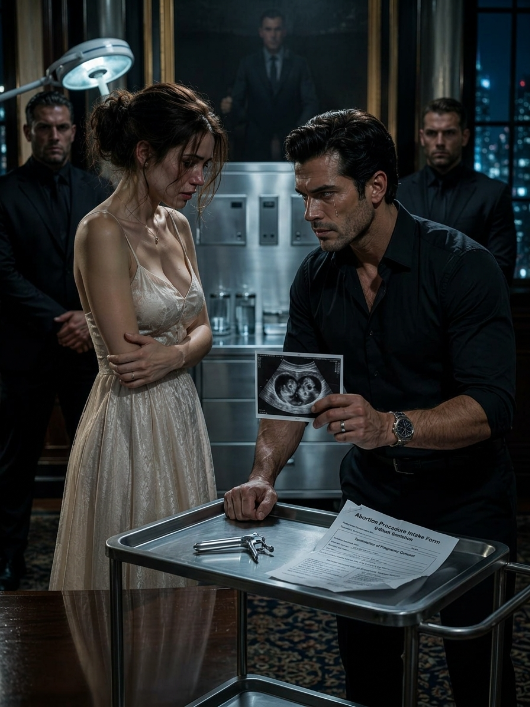
Mafia Boss Signs Divorce—Then Discovers His “Runaway” Wife is Expecting Twins

PART 1
The ink was still wet on the signature when everything changed.
Cole Harrington had signed his name on fifteen thousand documents across twenty years of building an empire. He had never once felt his hand hesitate. Not on acquisitions. Not on termination orders. Not on the testimony he had given before a Senate infrastructure subcommittee at thirty-one, cool and unhurried while the entire financial press waited for him to blink.
He hesitated on this one.
Victor Holt, his attorney of eleven years, slid the final page forward across the conference table and said, “Clean. No contest. She has chosen silence, Cole. At a certain point, silence is an answer.” The rain outside the San Francisco office turned the bay into gray static. Victor was a man built from patience and clauses, silver at the temples and comfortable with other people’s grief, provided it remained billable.
Cole picked up the pen.
Nora Caldwell Harrington had been gone for eight months.
She had not screamed when she left. No accusations fired across a marble foyer, no public scene at a charity dinner for the papers to feast on. She had simply stopped being there — one rainy November morning, one suitcase, one camel coat. And on his dresser, beside a coffee mug she had washed and dried before walking out, she had placed her wedding ring.
That detail had broken something in him that negotiations couldn’t reach.
She had cleaned the mug. She had not wanted him to come home to a mess.
Cole signed.
Victor reached for the folder with both hands.
Then Cole’s private phone rang.
He had four people with that number. His assistant. His head of security. His consigliere. And Margaret, the woman who had raised Nora’s younger sister and was the closest thing Nora still had to family since her father died and her mother became someone who called only when kindness was convenient.
The number on the screen was none of these.
It was a 414 area code. Milwaukee.
He answered.
“Mr. Harrington?” A woman’s voice, professional but careful. “This is St. Catherine’s Medical Center. Your wife has been admitted in active labor. Thirty-four weeks. Twins.”
The room tilted.
Cole’s pen hit the floor. He did not reach for it.
“Say that again,” he said.
“Your wife. Nora Harrington. She was admitted under a different surname, but you’re listed as emergency contact on an older insurance record. Sir, there are complications. The attending physician asked us to reach next of kin because—”
“What complications?”
“Blood pressure elevation, and the second baby is showing cardiac deceleration. They may need to act quickly.”
Across the table, Victor had gone still, folder half-open.
Cole stood.
“I’m on my way.”
“Sir, we need to confirm whether—”
He ended the call.
For three seconds the conference room existed outside of time. The folder on the table. The signature. The rain. Victor’s hand hovering above the folder like he’d been paused mid-motion.
“Cole.” Victor’s voice was careful. “Before you react, consider the legal geometry here. A pregnancy claim at this stage would complicate every aspect of the filing — asset division, custody, the merger timeline—”
“Don’t file those papers.”
Victor blinked. “You just signed.”
“Then find a reason they can’t be filed today.”
“That is not how law—”
“Victor.” Cole’s voice dropped to the register that had once convinced a sitting senator to reverse a regulatory position in forty minutes. “If my wife is in a hospital room alone with my children and you say the word merger one more time, I will leave this building and take eleven years of retainer with me.”
Victor’s hand left the folder.
Cole was already moving.
The drive to Milwaukee took sixty-three minutes. His driver pushed every limit available. Cole spent the time on the phone, issuing instructions to people trained to receive them without asking why. His assistant cleared his day. His security chief confirmed the hospital. The attending physician’s office confirmed Nora had been in prenatal care there for months under the name Nora Vale.
Months.
The word lodged in his chest like a splinter.
Months meant she had known since at least December. Months meant appointments alone, ultrasounds alone, vitamins on a bathroom counter he had never seen, decisions made in small rooms while Cole sat in their Pacific Heights house reading her grocery lists like a man clutching evidence that someone had once lived there.
He had imagined her in a hundred versions during those eight months. Relieved. Furious. Somewhere coastal, spending the settlement he had wired and she had never touched. Staying with a college friend in Portland. Starting over with a lightness she had never been allowed inside their marriage.
He had not imagined this.
Nora, alone, thirty-four weeks along, under a false name in a city where none of his world knew to look.
The sleet started as they crossed into Wisconsin, turning the freeway into something uncertain and gray. When St. Catherine’s appeared through the windshield — amber light glowing against the dark afternoon, automatic doors breathing open and shut — Cole walked through them with the controlled speed of a man arriving late to a life he had not been paying attention to.
The maternity desk nurse recognized him immediately. Everyone recognized him, which Cole had always accepted as a feature of wealth. Now it felt obscene, like being applauded for the wrong thing.
“I’m here for Nora Harrington,” he said. “She may be registered as Vale.”
The nurse’s expression moved from recognition to judgment in under a second.
“You’re the husband?”
“Yes.”
“She said she didn’t have one.”
The sentence hit him cleanly, because it was not even legally true yet — and because he had earned it.
“Please,” he said, “just tell the doctor I’m here.”
She studied him for a moment that felt longer than it was, then picked up the phone.
A doctor appeared through double doors within minutes — fifties, sharp-eyed, with the particular calm of someone who had witnessed too many crises to perform emotion about them.
“Mr. Harrington. I’m Dr. Chambers.”
“How is she?”
“In pain, frightened, and very unhappy that we called you.”
“That’s Nora.”
The doctor’s expression shifted, barely. “It is.”
“The babies?”
“Baby A is tolerating labor well. Baby B has had decelerations — we’re watching closely. I need to be direct: your presence may raise her stress. If she refuses to see you, you will wait.”
“Understood. Can you tell her I’m here?”
Dr. Chambers looked at him the way doctors look at people who have used money to protect themselves from consequence. “She knows.”
“And?”
“She said to tell you congratulations. She said you managed to get the divorce before the babies arrived.”
Cole closed his eyes.
He had heard contracts dissolve. He had heard men beg in boardrooms. He had heard the specific silence of a marriage failing slowly across rooms that cost more than most people earned in a decade.
None of it had sounded like that sentence.
“I didn’t file,” he said. “I signed it this morning. The hospital called before Victor submitted it. I stopped the filing.”
Dr. Chambers said nothing.
“I stopped it,” Cole said again.
“That may matter to you,” the doctor said quietly. “Right now, it may not matter to her.”
Then she walked back through the doors to ask.
Cole stood in the corridor, rain still drying on his coat, and did something he had not done since he was nineteen and his father’s company collapsed in a week: he bargained with silence. Not beautifully. Not with words. Just the raw transaction of a man asking any force willing to receive the call to keep two heartbeats and one woman alive long enough for him to earn his way back into the room.
After four minutes, Dr. Chambers returned.
“Two minutes,” she said. “You don’t argue. You don’t ask questions that can wait. If I say leave, you leave.”
“Yes,” Cole said.
And he meant it.
PART 2
The room was dim. Nora lay against white pillows with her hair loose and her face stripped of everything except exhaustion, pain, and the gray-green eyes Cole had spent eight months trying not to picture.
Her stomach rose in a curve he had not known to expect. Two lives, hidden inside the woman he had let believe he chose silence over her.
He could not move for a moment.
“You came fast,” she said.
“I would have come sooner.”
Her mouth curved without warmth. “That’s the line you’re opening with?”
“It’s the truth.”
“Truth from Cole Harrington. Someone should mark the date.”
He deserved worse. He knew it.
“I didn’t know,” he said.
“You signed the papers this morning.”
“I stopped the filing.”
“You still signed.”
“Yes.”
Her eyes filled, but she did not let it happen. Nora rarely cried where anyone could use it against her — she had told him that once, in a rare unguarded moment, and he had heard the sentence without understanding the weight of it.
“You should go,” she said.
A contraction hit before he could answer. Her body tightened, her face turned away. Cole stepped forward, but Dr. Chambers’ voice stopped him at the bed rail.
When it passed, Nora looked back at him.
“If something happens to me,” she said quietly, “don’t let Diana near them.”
Cole went still.
Diana Harrington. His mother.
“What does my mother have to do with this?”
Nora closed her eyes. “Of course she didn’t tell you.”
The monitor changed before he could ask anything further. Dr. Chambers moved immediately, checking readings, issuing instructions. The room filled with efficient motion. As the nurses prepared to wheel Nora toward the OR, she turned her head toward him one last time.
“Don’t make this about you,” she said.
Then she was gone.
Cole stood in the empty room with those words and the other ones pressing down on him.
Don’t let Diana near them.
He pulled out his phone and called his mother.
Diana answered on the third ring, light and practiced. “Cole, darling, I’m just arriving at the museum luncheon—”
“Did you know Nora was pregnant?”
The silence that followed was one second too short to be innocent.
“What an extraordinary question,” Diana said.
“Answer it.”
“Your wife left you eight months ago. I don’t track rumors she may be circulating.”
“She is in surgery right now delivering my twins.”
A longer silence. Then: “Where are you?”
“No.”
“Cole, if she’s claiming those children are yours without documentation, you need proper counsel before you acknowledge—”
He hung up.
The word acknowledge sat in his stomach like something rotten.
He called Victor next.
“Did Nora ever try to contact me?” Cole asked. “Not through lawyers. Directly. Calls, messages, anything. In the last eight months.”
Victor’s pause was almost nothing.
Almost.
“We sent all required notices to verified addresses,” Victor said. “No legally valid response was received.”
“That is not what I asked.”
“Cole, you’re in an emotional—”
“Yes or no. Did she try to reach me directly?”
A beat.
“There was one message. Vague. Unsigned. Through an attorney I didn’t recognize. I considered it a potential delay tactic given she was evading service.”
“When?”
“Several months ago.”
“How many months?”
“Five.”
Five months ago, Cole had been eating dinner alone at 10 p.m. because the table without Nora felt like a held breath. Five months ago he had found one of her handwritten notes tucked inside a cookbook — You have a call with Denver at nine. Please eat something that isn’t black coffee — and had read it so many times the paper had gone soft at the fold.
“What did the message say?” Cole asked.
“That there was a personal matter requiring your attention.”
“And you didn’t tell me.”
“At the time—”
“Victor.” Cole’s voice had gone somewhere very quiet. “You’re fired. Effective right now. Not tomorrow. Not pending review. Now.”
A beat. “Cole, I have managed your—”
“Find someone else to manage.”
He ended the call, texted his chief of staff Ava with three lines: Pull every communication from Nora or anyone using the name Vale. Last eight months. Personal, corporate, all channels. Not Victor. Not Diana.
Her reply came in seconds. On it. And breathe.
A nurse emerged from the OR corridor forty minutes later.
“Mr. Harrington?”
He stood.
“Your daughter was born at 6:04. Your son at 6:07. Both alive.”
Both alive.
He gripped the back of the chair with both hands.
“Nora?”
“Stable. Dr. Chambers will update you.” The nurse paused, and then her professionalism softened by the smallest margin. “Would you like to see them from the nursery window?”
His daughter was impossibly small under a cap too large for her head. His son lay beneath a warming shield, smaller still, with a furrowed brow that looked furious at the indignity of being premature.
Cole pressed one hand flat against the glass. Not touching them. Not close. But closer than he had been at noon, when he had signed away the woman who carried them.
“Names?” the nurse beside him asked.
Cole shook his head. “I don’t know if she chose them.”
“She did.”
“What are they?”
The nurse checked the chart. “Clara Rose Vale. Eli James Vale.”
Vale. Not Harrington. A name that belonged to neither his inheritance nor his mother’s expectations. A name that sounded like something that could grow in difficult soil.
Cole’s throat tightened past the point of managing it.
The nurse did not look away. She had seen this before — powerful men undone by something small enough to fit in two hands.
“You can go in when she permits it,” she said.
“I’ll wait,” Cole said.
And he meant that too.
PART 3
Ava arrived at the hospital before dawn wearing yesterday’s clothes and carrying a laptop, two paper cups of coffee, and the expression of a woman who had discovered something ugly enough to require context before delivery.
They sat in a family consultation room off the maternity corridor. Through the wall, Cole could hear the distant, persistent sounds of new lives insisting on themselves.
“Tell me in order,” he said.
Ava opened the laptop. “Five months ago, a lawyer named Jonathan Rhee contacted Victor’s office on behalf of a client who needed to disclose an urgent personal and medical matter. Victor replied once, directing all communication through his office, then declined Rhee’s request for a direct meeting with you.”
Cole’s jaw worked.
“Two days after that,” Ava continued, “Diana’s driver logged a trip to Milwaukee. The address corresponds to Nora’s apartment under the Vale name. No official record of the meeting.”
“She told me Diana came.”
Ava nodded. “Then you know more than I found.”
“She received a settlement proposal. Confidentiality clause. It included language about future children.”
Ava’s expression went flat. “That document isn’t in any system I can access.”
“Meaning it was created off-book.”
“Meaning either Victor drafted it independently or someone else did.” She paused. “Someone who would have needed access to our legal templates.”
“Marcus,” Cole said.
Ava didn’t answer. Which was answer enough.
Marcus Harrington — Cole’s half brother, chief financial officer of Harrington Group, installed by Diana because she believed family should remain near money. Marcus, who had said at a board dinner that Nora was “too idealistic for this world.” Marcus, who had quietly opposed the governance restructuring that would concentrate voting control in Cole’s hands upon the birth of a direct heir.
If Cole had children, Marcus’s path to influence closed permanently.
“What did he do?” Cole asked.
“He accessed the internal media archive four times in November. Long-form recordings from your product keynotes and investor presentations. The access note said investor-relations editing.” Ava took a breath. “Two days after that, an audio file was generated on a private sandbox server tied to an authentication research project. The file was deleted. But the metadata survived.”
Cole stared at the wall.
“Someone used our own voice-authentication infrastructure,” he said. Not a question.
“I’ve retained Marisol from external forensics. Private contract. She’ll have preliminary results within forty-eight hours.”
“Good.”
“Cole.”
He looked at her.
“There’s more.” Ava closed the laptop halfway, the way she did when the news stopped being professional. “Nora called your personal line four times. The one you told her was only for people you’d always pick up.”
Cole went completely still.
“When?”
“November through January. The calls show in your carrier records as received, then forwarded. Victor’s office received those forwards. They were logged as caller unknown and never escalated.”
“She thought I was ignoring her.”
“Yes.”
“And then she got a voicemail.”
Ava reached into her bag and placed a phone on the table between them. Not Cole’s phone. A cracked-case device he had never seen.
“She left it at the nurses’ station for you.”
Cole unlocked it with the code Nora had once used for everything — her father’s birthday, a detail she had told him once and he had kept the way you keep things you know matter — and opened the saved messages.
His own voice filled the room.
“Nora. Whatever you think changes with a pregnancy claim — it doesn’t. Send everything through Victor. Do not contact me directly again.”
Cole listened to it twice.
The voice was his. Not approximately his. His cadence, his low particular impatience, the clipped edge he hated in recorded interviews. Every syllable assembled from thousands of hours of public audio by someone with access to systems Cole had built to protect infrastructure across seven cities.
“That is not me,” he said.
Ava looked at him steadily. “I know.”
“She believed it.”
“She had four unanswered calls preceding it. In her position—”
“She believed it.” He set the phone down. “And she spent the rest of her pregnancy believing I had chosen paperwork over her.”
A silence expanded between them.
“Marcus used our own product against her,” Cole said.
“Against both of you,” Ava said. “That’s what I think he didn’t calculate. He was trying to remove her from your life. He may not have considered that he was also removing you from hers.”
Cole stood. “Get Marisol everything she needs. And find me a family attorney who has never met Victor or Diana.”
“Already scheduled for nine.”
“What would I do without you.”
“Pay someone considerably less effective.” She picked up her coffee. “Cole. Before you see her. What are you going to say?”
He thought for a moment.
“The truth,” he said. “Which means I’m going to say it badly and probably too much.”
Ava nodded. “That’s actually the correct answer.”
When Nora allowed him into her room that afternoon, she was upright against the pillows with Clara in the crook of her arm, exhausted in the particular way of someone who has been running alone for a long time and has finally been permitted to stop.
She looked at Cole the way she had always looked at him when she was deciding something important: quietly, without hurry, as if she had learned not to waste assessment on people who might not deserve it.
“You saw them?” she asked.
“Through the glass. Eli looks offended by everything.”
A ghost of a smile. “He gets that from you.”
Cole sat in the chair beside the bed without asking. “She told me you’d called.”
Nora looked at Clara’s face. “Diana.”
“What exactly did she say to you?”
Nora stroked the baby’s cheek once. “She came to my apartment three weeks after I left. She said you had authorized Victor to manage all communication. She said you wanted the divorce clean because of the merger. I told her I needed to speak to you. She said I could say whatever I wanted through counsel.” A pause. “I asked if you knew I was pregnant. She looked at me and said, ‘Cole knows enough.'”
Cole’s hands were very still in his lap.
“She gave me a settlement document,” Nora continued. “Very generous. It included a clause about not disclosing any future children.”
“I never authorized that document.”
“I didn’t sign it.” Her voice hardened at the memory. “I left it on the passenger seat and was sick in a parking garage, then drove back here and changed doctors.”
“Why didn’t you call me directly?”
She turned to look at him, and the steadiness in her eyes was the steadiness of someone who has answered this question for themselves many times already and is now only deciding whether he deserves to hear the answer.
“I did,” she said.
Cole looked at the phone on the side table.
“Four times,” she said. “Then I got a voicemail I believed was from you. The one telling me not to contact you again.”
“That voice is not me.”
She nodded slowly. “I know that now. After the fourth call, I watched your infrastructure summit on television. You said directly exactly the same way. And something felt wrong. I played the message until I understood it was too clean. No ambient sound. No breath.” She looked at the window. “Someone built it from recordings.”
“My brother,” Cole said.
Nora closed her eyes briefly.
“The voice authentication system,” she said. “The one you presented at the Smart Cities conference in September.” A pause. “I watched that conference on a laptop in this apartment at six months pregnant.”
Cole looked at his hands. “I’m sorry.”
“I know.”
“I’m sorry for more than the fake voicemail. I’m sorry for making a marriage where you had no reason to believe I would choose your word over a system. Where being protected felt like being managed.” He looked at her. “You asked me once if I knew what it felt like to live inside a life I had built around you. I said yes. I didn’t. I knew what it looked like from the outside.”
Nora was quiet for a long time.
Then she said, “There’s a morning feeding at two. If you’re staying, it’s yours.”
It was not forgiveness. It was not reunion. It was a door left unlocked for the first time in eight months, and Cole understood exactly what it was.
“I’ll be here,” he said.
The forensic report landed six days later.
Marisol had recovered enough metadata to place Marcus in proximity to the sandbox server on the dates in question, and payments through a private investigator had been traced to follow Nora in Milwaukee under the justification of service verification for legal proceedings. Victor’s eleven-year management of Cole’s personal affairs had included, it emerged, at least two instances of withholding communications from Nora’s attorney that fell outside what even the most aggressive interpretation of his mandate could justify.
Cole called a board session.
He stood at the head of the table where he had won a hundred negotiations and admitted the one that mattered most.
“My wife attempted to contact me during her pregnancy,” he said. “Those communications were intercepted by individuals acting without my authority. A synthetic voice message was generated using my voice and sent to her through our own research infrastructure. Victor Holt is terminated and referred for professional review. Marcus Harrington is suspended effective immediately, pending the forensic findings.” He placed Marisol’s preliminary report on the table. “Diana Harrington has been removed from all advisory roles connected to my family office and the Harrington Foundation. She will have no access to my children unless their mother and I agree.”
He then played the voicemail.
Hearing his own voice, assembled from keynote recordings and product demos into something designed to abandon a pregnant woman, produced a particular silence in the boardroom — the silence of people recalibrating who they thought they were working for.
Marcus tried to speak. He did it badly.
When it was over, the board voted unanimously to refer the matter to outside counsel. Marcus left the building before the session closed.
Diana did not come to the hospital.
She sent a letter instead, three weeks later, to Nora directly. Not an apology. Diana did not know how to kneel with language. But near the end, she had written: I believed Cole could survive losing you more cleanly than he could survive being changed by loving you. I see now that what I called protection was fear.
Nora read it twice, folded it, and put it in a drawer.
“Unfinished,” she told Cole.
“Okay,” he said.
She looked at him. “You’re not going to tell me forgiveness is healing?”
“No.”
“Good. Forgiveness is expensive. People who recommend it casually aren’t the ones paying.”
Cole looked at her with the specific admiration he had spent two years failing to express. “What do you want to do with it?”
“Leave it alone until I decide.”
“That’s reasonable.”
“Most things I do are reasonable. You just weren’t watching closely enough to see it.”
He didn’t argue. She was right.
The courthouse hearing was supposed to be procedural.
Cole and Nora had agreed on temporary custody terms, parental decision-making, and financial support that Nora had fought to keep from becoming an acquisition. Their attorneys had reviewed everything. The family court judge — a woman with steady eyes and no visible patience for wealthy people performing victimhood — was expected to approve the arrangement in under an hour.
Then Victor appeared.
He had filed a motion on behalf of vaguely described family interests challenging Nora’s fitness: the months under an alternate surname implied financial manipulation; the choice to avoid Harrington resources during a high-risk pregnancy demonstrated poor judgment; the isolation of the children from their father’s extended family was a concerning pattern.
It was desperate. It was also calculated cruelty dressed in legal language.
Nora read the filing in the courthouse hallway and went very still.
Cole recognized that stillness. It was not fragility. It was the gathering of force before something precise.
Her attorney muttered under her breath. “The judge will see through it.”
Nora said nothing.
Cole started toward Victor, who stood at the far end of the corridor in a navy suit, speaking to a junior attorney with the relaxed authority of a man who had never believed consequences would reach him personally.
Nora caught Cole’s sleeve.
“Don’t.”
“I’m not going to touch him.”
“That’s not what worries me.” Her eyes met his. “He wants the story to be Cole Harrington destroys another man in a courthouse. He wants me standing behind you like a woman who needed rescuing.”
Cole breathed in once, out once.
“You’re right.”
“I know.” She straightened Clara’s blanket — the baby was sleeping in a sling against her chest, blissfully unaware of the proceedings around her. “Let me speak.”
When the judge asked for preliminary matters, Nora stood.
“Your Honor, I’d like to address the implication that I concealed my children for financial advantage.”
The courtroom went quiet.
Her attorney started to object, then looked at Cole, who shook his head.
Nora’s voice was level. Unhurried.
“I left my husband before I knew I was pregnant. I left because our marriage had become a place where silence did the work of cruelty, even when neither of us intended it. When I learned I was pregnant, I attempted to contact him. Those attempts were intercepted by members of his family and his legal team who believed my pregnancy was a threat to a corporate structure.” She paused. “I received a message I believed came from him telling me not to contact him directly again. I have since learned that message was artificially assembled from his public recordings without his knowledge or consent.”
Victor’s face was performing stillness.
Nora continued.
“I used another name because I was being followed and pressured, and because every door to my husband had been constructed to look locked from the outside. I made decisions I won’t pretend were perfect. But I did not hide from Cole. I hid from the machinery built to keep us separated.” She turned slightly, not toward him but near him. “He’s here now. He was late. That matters. But since the day he arrived, he has shown up without making our children into a legal strategy. I’m not asking this court to reward him for that. I’m asking it not to allow the people who lied to both of us to rewrite fear as manipulation.”
The room was very quiet.
Then Cole stood.
“Your Honor, may I address the motion briefly?”
The judge glanced between them. “Very briefly, Mr. Harrington.”
“The motion was filed by a former attorney whose conduct is under independent investigation and whose failures directly contributed to the circumstances it now critiques. Documentation is available under seal.” He looked at Victor. “More importantly: Nora did not prevent me from being a father. Other people did. And before them — I did. By building a life where she had reason to believe I would trust a system before I trusted her.” He returned to the judge. “I support the temporary agreement as drafted. I support her full authority as their mother. And I ask that the motion be denied.”
The judge looked at Victor over the top of her glasses.
“Counselor,” she said, “I strongly suggest you determine whether further arguments would benefit your afternoon.”
The motion was dismissed in eight minutes.
Outside the courthouse, cameras waited. Cole stepped beside Nora — not in front of her — before questions could take shape.
“My children are not a negotiation,” he said. “Their mother acted with courage in circumstances my family helped create. Any further attempts to harass her will be answered fully and publicly.”
A reporter called out: “Are you and Mrs. Harrington reconciling?”
Cole glanced at Nora.
For the first time in the years of their marriage, he did not speak for both of them.
Nora adjusted Clara’s blanket against the May air.
“We’re parenting,” she said. “That’s the only story our children need.”
She walked to the car, and Cole followed one step behind — which was, he was beginning to understand, exactly the right distance.
Summer arrived in the brownstone on Lincoln Park — not the Lake Forest estate Cole had sold without asking, the one with the east parlor that looked like grief arranged as furniture and Diana’s portrait over the staircase, but a narrow brick building with uneven floors and a garden that got afternoon light and a kitchen too small to disappear inside.
Nora had visited once, cautiously, in April when a pediatric appointment and a sudden storm made the drive back to Milwaukee unreasonable. She had walked through it with Eli in Cole’s arms and Clara against her chest, and run one hand along the kitchen counter and looked out at the bare garden in the rain.
“No portraits,” she observed.
“No portraits.”
“You chose this yourself?”
“With help. The woman at the tile shop had strong opinions.”
“Did you lose every argument?”
“Decisively.”
Nora’s expression changed in the small way it changed when something surprised her into softening. “Good.”
They stayed that night in separate rooms. Cole took the 3 a.m. feeding and was found at dawn asleep in the nursery chair with Eli on his chest and Clara in the bassinet beside him, one small fist raised like a tiny revolutionary.
Nora stood in the doorway long enough to feel the change in herself.
The divorce papers resurfaced in September during a filing cabinet clean-out at the Pacific Heights house Cole was preparing to close permanently. His assistant found them and sent them over. Cole left them on the kitchen counter without explanation.
Nora found them on a Tuesday morning while Cole was trying to convince Eli that oatmeal was not a conspiracy.
She picked them up. Looked at the signature on the final page — sharp and black, pressed hard, the way Cole always signed when he was trying not to feel what he was doing.
She carried them to the stove.
Cole looked up. “That seems like symbolism.”
“You married a woman who uses it.”
“I remember.”
She turned on the burner and held the edge of the papers to the flame. The fire caught slowly. His signature went first, which felt correct. They watched it blacken over the sink, curling into ash in a stainless-steel bowl while Clara clapped from her high chair because she found destruction delightful, and Eli watched with the philosophical expression that had apparently settled into his permanent face.
When the ash was cool, Nora ran water over it.
Cole slipped his hand into hers.
Not a proposal. Not a declaration. Just the fact of his hand and hers, and both of them choosing not to pull away.
That evening, the twins asleep, Nora stood in the kitchen making chamomile tea at midnight. Cole came in and made a second cup without asking.
She looked at him.
“That’s our spy phrase,” she said.
“I know.”
“You’re being sentimental again.”
“I’m becoming very advanced.”
She handed him his cup and leaned against the counter.
They stood side by side in the quiet kitchen, rain beginning again outside the window, the brownstone warm and imperfect and full of evidence — burp cloths on the counter, tiny socks on the drying rack, a drawing Nora had made of the garden taped to the refrigerator.
It was not the life Cole had built.
It was the life Cole had arrived late to and was learning how to stay inside.
Love, he was discovering, was not the grand acquisition he had always treated it as. It was smaller than that. It was handing someone chamomile tea at midnight and meaning it. It was learning to read the room you were in instead of the room you assumed you’d find. It was his daughter’s fist raised in her sleep and his son’s furious, hungry cry and the woman beside him who had cleaned a coffee mug before she walked away, because even leaving, she had not wanted him to come home to a mess.
He had come home to it anyway.
And she had let him stay.
THE END