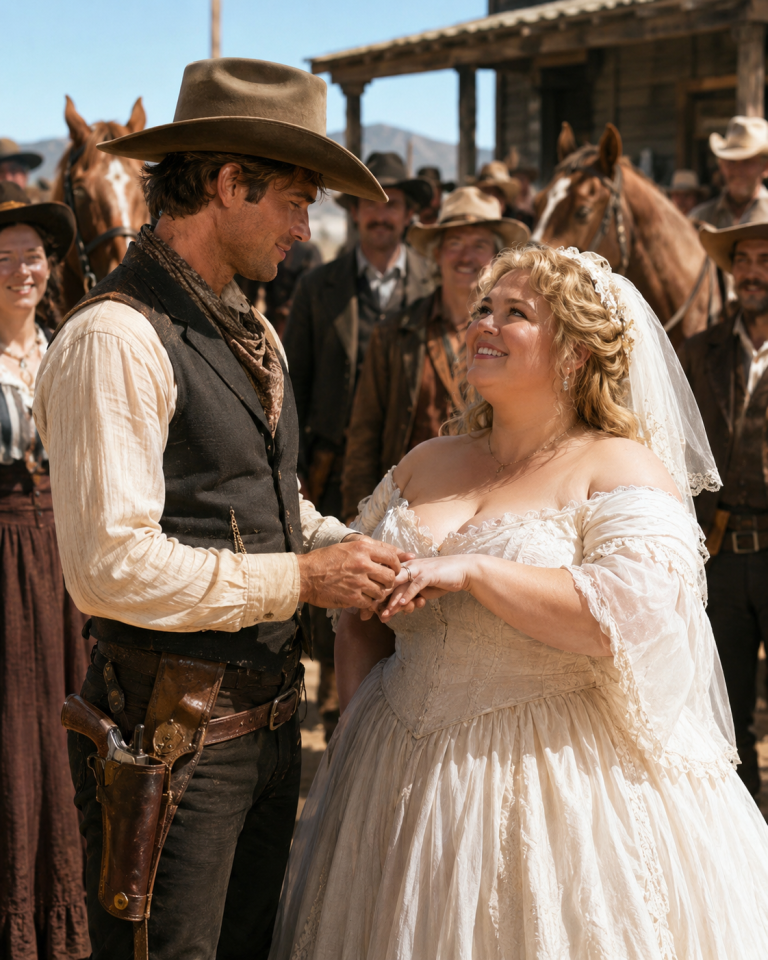
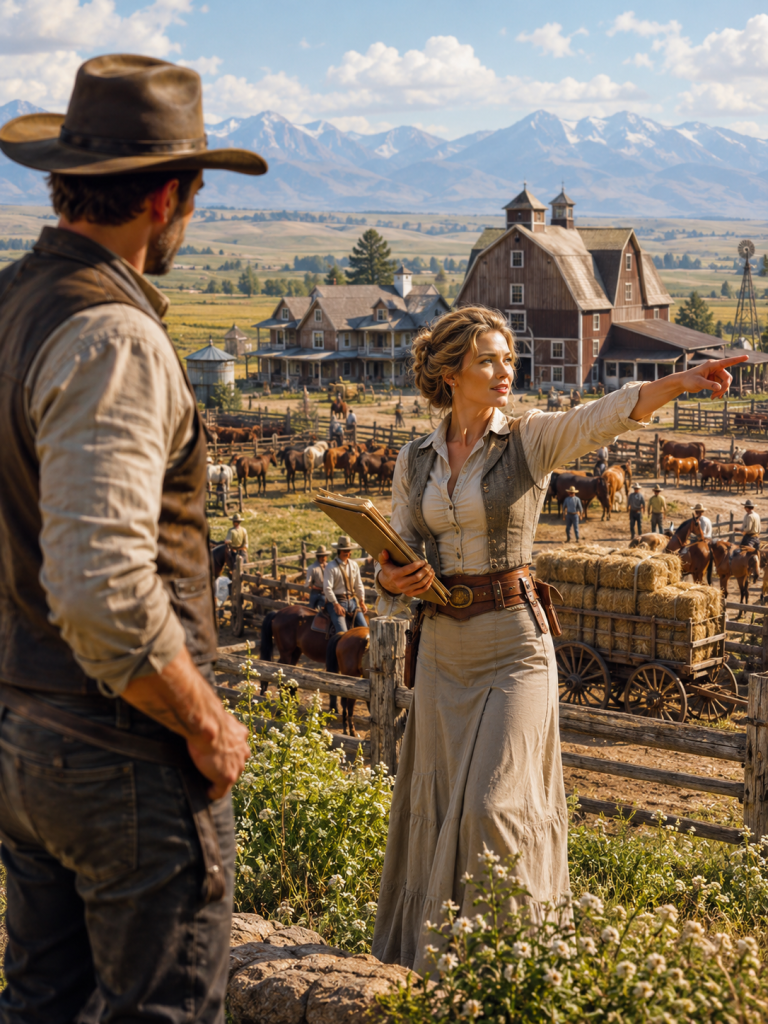
THE PREACHER HUNG HER FROM A SALOON BEAM AS A WARNING — THEN ONE STRANGER SAID “ENOUGH”

**PART 1**
The saloon was full, but the silence inside it felt wrong.
It didn’t sound like peace. It sounded like surrender.
Glasses sat untouched in broad hands. Dice lay forgotten on a table near the wall. A card game had collapsed mid-round without anyone bothering to end it properly. Even the piano in the corner, battered and permanently out of tune, had gone quiet, as if the old instrument understood there were moments when music would only make cruelty look festive.
In the middle of the room, a young woman hung from a rope.
Her wrists were bound high above her head, the line thrown over a ceiling beam and knotted tight enough to pull her body into a painful arch. Her boots barely grazed the floorboards. Every time her knees buckled and her weight sagged, the rope bit deeper into the flesh above her hands. Dust caked her skin. Sweat tracked down her face and throat and arms, dripping onto the rough planks in a slow, steady rhythm that sounded louder than it should have in all that silence.
No one moved. No one spoke.
On the wall behind her hung a black cross — stark, charred at the edges, mounted with the kind of deliberate severity meant to make a point rather than inspire worship. Beneath it, burned straight into the wood, two words: *ABSALOM KANE.*
That was enough. The man himself didn’t need to be in the room for his power to fill it. Out in that dry strip of land, where life depended on who could claim a well, a riverbed, or the promise of rain, law had slipped long ago from the sheriff’s hand and settled somewhere else entirely. Not into pistols. Not even into money alone. It had settled into a system built from fear, thirst, and submission, and Absalom Kane stood at the center of it like a preacher who’d traded grace for control and called the whole arrangement righteous.
People in Dustwell obeyed because water obeyed him first.
And because they obeyed, the woman in the center of the saloon hung there while a room full of men stared at their drinks and their cards and the floorboards and did nothing at all.
Then the batwing doors opened.
The sound was small. In that room, it landed like a gunshot.
A man stepped in, and the air changed before anyone said a word.
Dalton Marsh had the kind of face weather gives a man who’s spent too much of his life outdoors for vanity to keep hold of. Sun had browned him. Wind had cut fine lines around his eyes. Dust and solitude had worn his clothes and his patience into the same plain toughness. He wasn’t flashy. Wasn’t trying to look dangerous. That was exactly what made him dangerous — men who could actually handle trouble rarely bothered decorating themselves with it.
He stopped just inside the door, eyes sweeping the room once — the crowd, the stillness, the guns not yet drawn, the black cross, the girl hanging beneath it.
Then his gaze stopped on her.
For a second the whole saloon seemed to hold its breath, waiting to see whether he’d turn away like everyone else, nod once at the visible order of things, and go find a drink at the bar.
Instead he lifted his head and said one word.
“Enough.”
Low, dry, final. It didn’t need to ring out. It cut through the silence because it carried no performance in it at all.
Every face turned toward him. A man near the bar laughed once under his breath, with nothing like real amusement in it.
“Don’t take another step, Marsh.”
Another, posted farther back with a hand already near his revolver, said, “You know what that mark means, don’t you? She belongs to the preacher. Stay out of it.”
Dalton didn’t answer right away. He took one step forward.
That was enough. Two guns came up at once, both leveled at his chest.
“Stop.”
The command came sharp and hard, but Dalton kept his eyes on the rope. He saw what the rest of them saw and had already decided not to explain himself to it. Each time her strength failed and her body sagged, the loop above her wrists tightened further. She’d been left there long enough that her arms trembled with involuntary spasms. Her head dipped, then rose again on will that had nearly run dry.
He let out a slow breath. “Put the guns down.”
That earned a few strained laughs — the kind men make when fear and disbelief collide and they need noise to pick a side.
“Who do you think you’re giving orders to?”
Nobody answered. Nobody wanted the real answer.
He moved again. The guns didn’t fire in time.
There was only the crack of a single shot, sudden and perfect — not aimed at a man, not at a bottle, not to scare. The bullet took the rope clean. It snapped with a whipping sound, and the woman dropped.
Dalton was already there. He crossed the room in the same beat the rope gave way, caught her before she hit the floor, and steadied her against him with one arm while his other hand kept the gun low and ready. The room went so still it stopped sounding like a saloon at all — sounded instead like a church after someone spoke the wrong truth in front of the wrong congregation.
Her head fell against his shoulder. Not fully unconscious, but close enough that her legs wouldn’t trust the floor. Dalton said nothing more. Didn’t wait for permission or reaction. He simply turned, carrying her weight, and walked straight through the crowd.
No one stepped into his way. Not because they wanted to let him pass — because they no longer knew how to stop him without crossing a line they weren’t entirely sure still stood where it had five minutes earlier.
The batwing doors opened. Sunlight poured in, hard and blinding after the dimness inside. Dalton carried the woman out of the saloon and into it, leaving behind a room full of men who had done nothing but watch.
The doors slammed shut.
Only then did the room find its voice again, and even that came back warped. A glass trembled against the bar hard enough to chatter. Someone exhaled a curse held too long in his teeth. An old man near the stove shook his head once and said, in a whisper that carried anyway, “He just signed his own death warrant.”
No one contradicted him. They all knew what would follow.
Outside, the desert wind had begun to rise, dragging dust and heat across the open land despite the falling light, scraping skin and filling mouths with grit. Dalton moved quickly but without panic — he wasn’t a man given to hurrying for the sake of appearances. The woman in his arms felt lighter than she should have, which told him something ugly about how long thirst and fear had been doing the work of starvation on her body.
His cabin sat alone beyond the edge of town, where the land flattened into cracked distance and the only privacy left came from sheer remoteness. No one’s idea of comfort — rough timber walls, a sun-warped porch, a well bucket hanging dry because the well beneath it had yielded nothing but mud for two seasons running. Still, it had a roof and a door that shut. Out there, sometimes that counted as wealth.
He kicked the door open and carried her inside. The cabin smelled of old wood, coffee grounds, dust, leather, and the faint iron scent that follows men who clean their own guns rather than trust the job to anyone else. He laid her carefully on the bed against the wall and cut the remaining rope from her wrists. Deep bruises had already bloomed where the line had bitten in, dark purple against skin gone pale with strain.
He brought water — not much, he couldn’t afford much — and sat beside her, dribbling it against her cracked lips in small, measured sips. Most of it spilled at first. Then some found its way in. Her throat moved weakly. That was enough to tell him thirst hadn’t pulled her too far to come back from.
He stayed longer than he needed to. Not for thanks, not for any plan beyond keeping a woman from dying in his own bed the same day he’d cut her down from a rope. He stayed because the whole town had watched and done nothing, and something in him wouldn’t let her wake into an empty room after that.
Outside, hoofbeats moved somewhere far off on the road — not many, just one rider leaving town without haste, because there was no need for haste when the news itself would do the running.
Inside, the woman didn’t wake until well after dark. The fire had burned low, throwing long, shifting shadows against the walls, lending the small room the uneasy intimacy of a place too poor to afford secrets. Dalton sat in a chair near the bed, half in shadow, hat tipped back, hands loose, eyes open. When her breathing changed, he noticed at once.
Her eyes opened without panic. That struck him first. Most people dragged back from fear or pain wake thrashing or disoriented. She woke still. Her gaze moved once around the room — the door, the stove, the chair, the man in it — and settled on him with a clarity too sharp for someone barely conscious an hour before.
“You cut the rope,” she said. Her voice came hoarse, fragile in sound but not in structure.
Dalton gave a slight nod and held out the water bowl again. “Drink.”
She looked at it a long moment, and he understood that what sat between them was more than thirst. Water out there was never just water. It was permission, leverage, debt, favor, hierarchy, punishment. Men built whole systems on the fact that every sip could be turned into obedience if the right hand controlled the well.
She drank in careful little pulls, then lowered the bowl. “You shouldn’t have interfered.”
“You shouldn’t have been hanging there.”
A brief silence — then something else rose outside.
Hoofbeats. More than one this time. Not close yet. Coming.
She heard them a second after he did and pushed herself upright with a wince sharp enough that he could see the pain travel through her arms.
“They’re here,” she said.
Dalton was already on his feet. He didn’t waste time asking who — in places like Dustwell, names mattered less than intention, and the intention had been plain from the moment he’d walked her out of that saloon.
The hoofbeats stopped outside.
Then the cabin door exploded inward. Wood splintered. Hinges screamed. The broken door struck the wall hard enough to send ash whispering out of the stove.
Three men stepped in.
Deputy Colton Reeves came first, broad-shouldered and deliberate, wearing his badge like a man who’d long since forgotten it was meant to mean law instead of allegiance. Whitcomb followed, dressed too well for the country, carrying himself with the bored entitlement of a man used to profiting from arrangements he never had to dirty his hands maintaining. Last came a man in black, white collar crisp against the dark fabric, his face composed in the way certain church men cultivate when they want cruelty to sound pastoral.
Reeves’s eyes went to the bed, to the woman, then to Dalton. “You’ve caused a lot of trouble, Marsh.”
Dalton didn’t shift. “She needed water.”
Whitcomb laughed once, short and joyless. “Everyone needs water. Not everyone gets it.”
The man in black stepped forward, his voice quiet enough to sound colder for it. “You don’t understand. The problem isn’t the girl. The problem is you touched something that doesn’t belong to you.”
Dalton didn’t answer — not with words. The room had already made itself plain. This wasn’t a rescue that ended at the rope. Wasn’t even a disagreement between men. It was a system speaking through its representatives — ownership, access, permission, punishment, and right in the middle of it, the fact that water had become currency more absolute than gold, because every living thing in that valley eventually bent toward thirst.
Reeves peeled off his gloves one finger at a time, the gesture deliberate enough to pass for theater. “Let me make this plain. No water means no crops. No water means no one survives. And in this land, there’s only one man who decides who gets to drink.”
He didn’t need to say Absalom Kane’s name. Everyone in the room already knew it.
Dalton glanced once at the woman on the bed. For the first time since carrying her from the saloon, he fully understood what he’d stepped into — not an isolated cruelty, not a public punishment meant to scare one person into line, but a whole arrangement, a machine built from drought and fear, oiled by habit, held together because too many people had learned it was safer to bow than to ask whether the man rationing life had ever really owned the source of it.
No one drew a gun. No one had to. Waiting could do what bullets could, and men like Reeves knew thirst was slower, cheaper, and far more useful as an example.
Reeves stepped further into the cabin. “We didn’t come to kill you. Death comes too fast. Wouldn’t be near as fun.”
“Then what do you want?” Dalton’s voice came flat.
Whitcomb pointed a polished boot at the floorboards. “Not us. Water.” The church man moved beside him. “Tomorrow you won’t be able to buy it. Day after, no one’ll sell it to you. By the fifth day, you’ll be on your knees begging.”
The woman on the bed, sitting straighter through the whole exchange, tightened her grip on the blanket. “You think he owns the water?”
Reeves turned to her. “No. He owns the people who need it.”
The whole system, in one sentence, stripped clean of sermon language and civic manners.
No one raised a voice after that. They didn’t need to. They’d delivered the judgment. Out here, it was enough to tell a man the next five days belonged to thirst — after that, his own body would finish the persuasion.
Whitcomb turned toward the shattered doorway. Reeves followed. The man in black lingered long enough to let the silence turn the knife one last time.
“We’ll be back,” he said. “Not to ask questions. To see how long you can stay standing.”
Then they were gone. Hoofbeats sounded again in the yard, then faded into the night.
Inside the cabin, the silence they left behind felt heavier than the threat itself. Dalton stood in the splintered doorway a few seconds, looking into the dark, then turned back to the woman.
No more explanation was needed. He’d stepped into a fight he could no longer leave simply by changing his mind.
**PART 2**
The night stretched on without mercy.
Wind moved around the cabin in long, dry gusts, dragging dust across the porch, making the broken hinges whisper every time the air shifted against the half-hung door. Inside, the fire burned low, the room holding the sour, metallic smell of split wood, old heat, and tension that hadn’t yet decided what it wanted from the hours ahead.
Dalton stood on the porch a long while after the riders left, eyes on the horizon though there was nothing to see but darkness and the vague suggestion of land against a sky heavy with stars. He’d lived out there long enough to know what a system felt like when it turned toward you fully. It didn’t arrive only as men at the door. It arrived as absence — silence at the well, a hand that didn’t return your greeting in town, grain that could no longer be bought, water that could no longer be carried home, and the slow accumulating knowledge that everyone around you had decided your suffering was survivable so long as it happened to someone else first.
Behind him, the woman on the bed moved. He didn’t turn right away. When he finally did, she’d pushed herself upright again — weak still, but no longer collapsing inward. Whatever had hung in that saloon hadn’t broken her. It had only thinned her down to something sharper.
“You can still turn me in,” she said.
“No.”
She was quiet a moment, then rose, ignoring the tremor in her legs, and came to stand beside him on the porch. Wind caught her hair and pulled it across her face. Up close now, outside the saloon’s dirt and shadow, he could see she was younger than the room beneath that black cross had made her seem. Not a child. But too young to already carry that kind of contained endurance.
“You think he’s powerful because of guns?” she asked, not waiting for an answer. “No. He’s powerful because people need water.”
Dalton kept watching the horizon. That, more than anything the three riders had said, felt true. Not guns — guns only enforce what people already fear. Not sermons either, though sermons make convenient rope when tied to an empty well. What gave Absalom Kane his power was the simple fact that every family in that valley eventually needed what he claimed to control.
She drew a slow breath. “But there’s one thing he never tells anyone. There’s another water source. Bigger. Deeper. Beneath the eastern rock fields. The place he forbids anyone from going.”
Now she had all of his attention.
Beyond the cabin, the eastern lands rose broken and barren, jagged shelves of red stone and dry gulch, a place the town had been taught to fear so thoroughly that even now people stepped onto it like trespassers on cursed ground. Men disappear out there, they said. Step on that soil and bad things follow. There were always stories. Out west, a lie survives best when it sounds a little like old bad luck and a little like the hand of God.
“Out there,” she went on, “anyone who finds it disappears. Or ends up hanging.”
The words settled between them. For a while only the wind spoke. Then she looked at him with an expression no longer defensive, no longer merely grateful — something closer to appraisal, as if she were still working out what kind of man cut a rope in a room full of cowards and then carried the consequences home without flinching.
“You didn’t save me because of who I am,” she said. “You saved me because you don’t know how to turn away.”
Dalton could have denied it. Could have made it about temper, or disgust, or some hard-edged frontier principle that sounded more practical and less vulnerable. That wouldn’t have been the truth. He’d seen her hanging in that room and recognized something unbearable in the fact that everyone else had already decided to stand still. Sometimes that was all it took. Not heroism. Not certainty. Just the inability to keep your own body in place once too many others had already chosen to do so.
“If that spring keeps them alive like this,” he said, looking east, “then it deserves to be broken loose.”
She watched him in silence. The danger in her face changed — not fear, recognition. Not of him, but of what he represented. A man who, once he understood a line, didn’t seem especially interested in retreating from it. In hard places, that kind of person is either a gift or a catastrophe. Often both.
Far off on the black horizon, little points of fire appeared. One. Then another. Then more.
She saw them too. “They’re coming back.”
Dalton stayed where he was. He didn’t reach for his rifle right away, didn’t stack furniture against the broken door, didn’t start planning cover angles. He already understood the shape of what was coming. This wouldn’t be an ordinary raid — not men in a rush, not chaos. It would be theater again. Kane liked witnesses. Systems like his always did.
The lights grew closer. By the time the hoofbeats turned distinct, there were dozens of them. They stopped around the cabin in a tightening ring. The riders dismounted without shouting, no motion wasted — the organization of it made the whole thing more chilling than disorder would have. Disorder at least contains uncertainty. This had ritual in it. These men already believed the ending belonged to them. All they’d come to do was administer it.
Reeves stepped forward first again. Whitcomb followed. The church man came with them, black clothing immaculate despite the dust. Around the cabin, riders waited with rifles and the blank expressions of people who hadn’t yet decided whether this was punishment, lesson, or spectacle.
Dalton stood in front of the cabin. The woman — Marisol, though he still hadn’t heard the name from her own mouth — came out behind him. Wind whipped between them and the ring of riders, dragging dust like something invisible being drawn and measured.
Reeves looked at Dalton a long moment. “We gave you a chance.”
“You call that a chance?”
Whitcomb’s mouth twitched. “We call it mercy.”
No one moved. It was the kind of stillness that sometimes comes before a gunfight, and sometimes replaces one when the real battle sits somewhere else entirely. Dalton felt Marisol at his back, not touching him, but close enough that he could feel every shift of her weight. He knew she could run if she wanted. Knew she wasn’t going to.
The church man stepped forward. “Bring out the girl.” He said it without heat, without much interest at all — as if instructing the return of borrowed property after a misunderstanding.
Marisol’s hands clenched at her sides.
Dalton did something then that none of them expected.
**PART 3**
He lowered his gun.
Not dropped it. Not surrendered it. Just lowered it enough to crack the logic of the moment.
A ripple passed visibly through the ring of riders. Reeves narrowed his eyes. Dalton didn’t look at him — looked past him, at the second rank and the third, at faces that belonged not to power but to dependence. Hollow-cheeked ranch hands. Farmers with dust on their collars. Riders who’d likely spent years hauling barrels from Kane’s guarded supply and calling the humiliation normal because the alternative felt too dangerous to imagine.
“You don’t need him,” Dalton said.
No one answered.
Marisol stepped forward beside him, weak but upright, and he turned slightly, pointing toward the eastern dark. “The water isn’t in Absalom Kane’s hands,” he said. “Not really.”
That landed. Not loudly — nothing so simple. It moved instead like a crack running through old plaster, invisible for half a second until suddenly the whole wall admits it was never as solid as it had been pretending.
Whitcomb frowned. “What the hell are you talking about?”
Marisol answered. “There’s another water source.” Her voice wasn’t strong, but it carried clear enough to survive the wind. “Deep under the eastern rock fields. Bigger than anything he lets the town see. He’s been hiding it.”
Several heads turned at once. Reeves saw it happen and reacted faster than the others. “Enough,” he snapped. “Don’t listen.”
Too late. The danger had changed shape. Before, the riders had come united by obedience. Now doubt had entered the circle, and doubt is more disruptive to authority than open rebellion, because it starts in the private places where orders turn back into choices.
Dalton raised his voice just enough to carry. “How long have you lived under the shadow of a lie?”
The ring shifted. Not much. Enough. A man toward the back, gaunt-faced, sunburned nearly gray, spoke before he seemed to fully realize he was doing it. “What if he’s telling the truth?”
Reeves swung toward him. “Be quiet.”
The man didn’t answer. He didn’t look down either.
Dalton saw it. So did Marisol. Power wasn’t breaking because of a gun. It was breaking because someone had finally placed a question where silence used to live.
He took another small step forward, gun still low. “You can shoot me.” That made several men tense. Then he finished it. “But you can’t shoot the truth.”
The wind rose harder, dragging dust through the space between them, until the whole world seemed made of red grit and held breath and one impossible decision balanced on whether enough men believed their own thirst more than they believed Kane’s version of God.
Then one rider lowered his rifle. Another followed.
Reeves saw it, and for the first time something uncertain entered his face. He’d likely spent years enforcing Kane’s will through routine rather than conviction, and routine survives only while the crowd participates in it. Once men begin wondering whether the well behind the sermons is real, the sermon loses its teeth.
Whitcomb cursed under his breath. The church man said nothing at all — which, perhaps, was the clearest sign the night no longer belonged entirely to them.
No shots were fired. No dramatic surrender followed either. The riders simply stopped advancing, looking at one another, at the east, at Marisol, at Dalton, at the possibility that their whole lives had been built on artificial scarcity, enforced by a man who needed them frightened in order to remain important.
One by one, the ring loosened. The standoff didn’t end so much as fail.
By dawn, the town was walking east. No orders. No official gathering. No proclamation. People simply came — men with shovels, women with wrapped cloth against the wind, old laborers who moved slower but wouldn’t stay behind, boys carrying tools too large for them because curiosity and hunger make children braver than their parents like to admit. The crowd that had once stood in a saloon and watched a woman hang had changed shape overnight. Same people. Now they had momentum, and momentum is often the first form courage takes.
Dalton walked at the front. Marisol beside him. The eastern rock fields rose around them in dry broken shelves, ground the town had been taught to fear so thoroughly that even now some people stepped onto it with the caution of trespassers on cursed soil. But fear built by prohibition dies fast once enough boots stand on the same forbidden ground at once.
They stopped where Marisol told them to stop. She knelt and placed her hand against the earth. “Here.” That was all. No speech, no grand claim. Just certainty.
One man drove his shovel into the ground. The sound was hard and ugly. Another joined him. Then another. Soon a dozen people were digging, trading off when arms tired, scraping through dry-packed crust and harder clay beneath. The morning grew hotter. Sweat ran down faces, chests, backs. Hands blistered, then split. Still they kept going.
Nobody cheered. Nobody talked much. The work had moved past excitement into need.
Dalton stood nearby but didn’t take the lead — handed out tools, shifted dirt, watched the edges of the crowd in case Kane’s men regrouped under a steadier nerve. Marisol stayed close to the opening in the ground, eyes fixed, whole body tuned to something beneath the visible world.
Time dragged. Doubt flickered across faces here and there. Maybe the ground would stay dry forever. Maybe Kane’s power had always rested on a truth too ugly to change. Maybe they were all fools after all.
Then the sound changed. Subtle at first — a duller strike, not the brittle crack of dry earth but something heavier beneath. The man digging stopped, dropped to his knees, scooped with both hands. The next layer came up darker. Damp.
Nobody spoke. He dug faster. The dampness spread.
Then water appeared. Not a flood at first — just a glisten, a seep, a bright thread moving through brown earth like something almost too miraculous to trust on sight. Then more, gathering, rising, pushing up under pressure held back too long. Clear. Alive. Real.
Still no one shouted. The silence that followed was larger than noise would have been. One old man fell to his knees beside the opening and touched the water with both hands like he was touching the face of someone returned from the dead. A woman began crying without seeming to notice she was doing it. Another simply stood with her shovel hanging loose, staring, as if years of obedience were draining out of her through her own boots.
Far up on a ridge overlooking the fields, a figure in black stood motionless.
Absalom Kane. He hadn’t come racing in fury, hadn’t arrived shouting scripture or judgment. He simply stood and watched as the thing beneath his whole life rose into the light and stopped belonging to him.
That was the real ruin. Not death. Irrelevance.
Dalton saw him. So did Marisol. Neither moved toward him. There was no point. A man like Kane had never truly owned the water. He’d only owned the story around it, and the story was dying right there in front of half the town, drop by drop, choice by choice.
One of the townsmen turned toward Dalton, looking like he wanted to say something worthy of the moment. Thanks, maybe. Or apology. Or the awkward beginnings of respect after cowardice. Nothing came out. After a second he only nodded once.
Dalton answered with the smallest incline of his head. He hadn’t done this for gratitude. That was the thing people rarely understood about certain acts — they assume intervention must secretly want recognition in return, because they themselves have so often withheld help unless applause waited on the other side of it. But sometimes a man acts simply because he can no longer stand what doing nothing requires of him.
The new water kept rising, its sound growing steadier, not loud but constant enough to begin replacing the old silence of fear with something else entirely. Movement. Flow. The valley had lived so long beneath the authority of scarcity that the ordinary sound of unowned water felt almost revolutionary.
Marisol stood beside the opening, her face no longer the face of someone who’d hung under a cross while a room chose stillness. Something in her had changed too — or maybe it had only come back into visibility once the rope was gone and enough eyes finally looked at her without first deciding what she was worth.
Dalton turned away before the crowd fully remembered he existed. He didn’t stay for the celebration that would eventually come once disbelief gave way to relief. Didn’t wait for Kane to speak, surrender, or flee. The man on the ridge would do what men like that always did once the structure beneath them cracked — call it heresy, disorder, theft, rebellion, sin. None of it would matter much now, with water risen in front of too many witnesses to ever be hidden again.
Dalton began walking. Slowly, quietly, the same way he’d come. The town behind him no longer stood still — people moving toward the spring, toward one another, toward the first practical questions that follow freedom. Buckets. Channels. Guard shifts. Distribution. Labor. Once fear breaks, the work begins. Harder than fear, maybe. But honest.
The sound of water followed him. So, for a few steps, did Marisol’s gaze — he felt it even without turning. There are people who arrive in a life not as companions meant to stay, but as the necessary force at the hinge between one shape of the world and another. Maybe that was what they’d been for each other. She’d shown him where to dig. He’d refused to look away. Sometimes whole systems fall because two strangers choose, at exactly the right moment, not to hand the truth back over to silence.
He kept walking. Behind him, the water ran clearer. The town that had once bowed beneath a lie now had proof under its own hands. No sermon could erase that. No deputy could scare it back into the ground. No black cross hung in a saloon would ever again carry quite the weight it once had before that dawn.
What changed the valley wasn’t a miracle. It was a decision. First his. Then hers. Then everyone else’s.
The desert had never been barren only for lack of water. It had been barren because fear trained people to live as though nothing beneath the surface could be reached without permission from the man standing on top of it. Once enough of them believed otherwise, the land answered — and the answer had been there all along, waiting beneath rock, silence, and the long habit of obedience.
Dalton Marsh didn’t think of himself as a hero. Marisol Vega was no saint. They had simply refused the simplest, most common corruption of hard places — the corruption of turning away because everyone else already had. That refusal, on its own, is often small. One step. One shot. One word spoken when a whole room wants silence instead. But systems built on dependence are more fragile than they look. Sometimes they need only one person to break the stillness, and another to point at what was always buried underneath.
Then the rest becomes possible.
The sound of water rose behind him until it drowned out the old quiet completely.