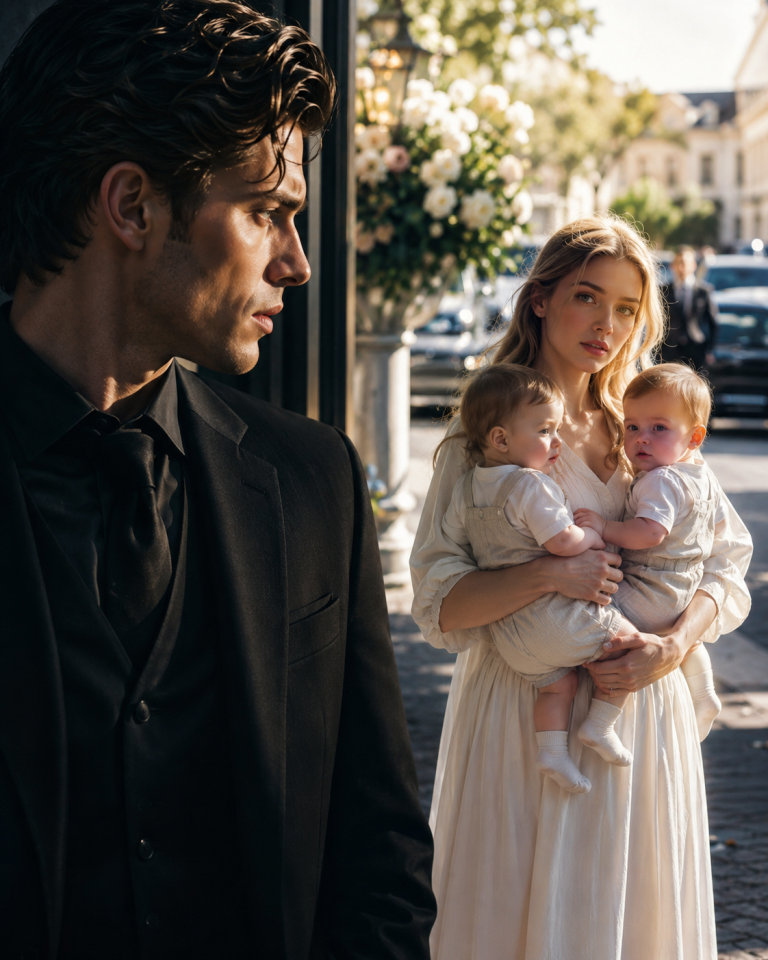
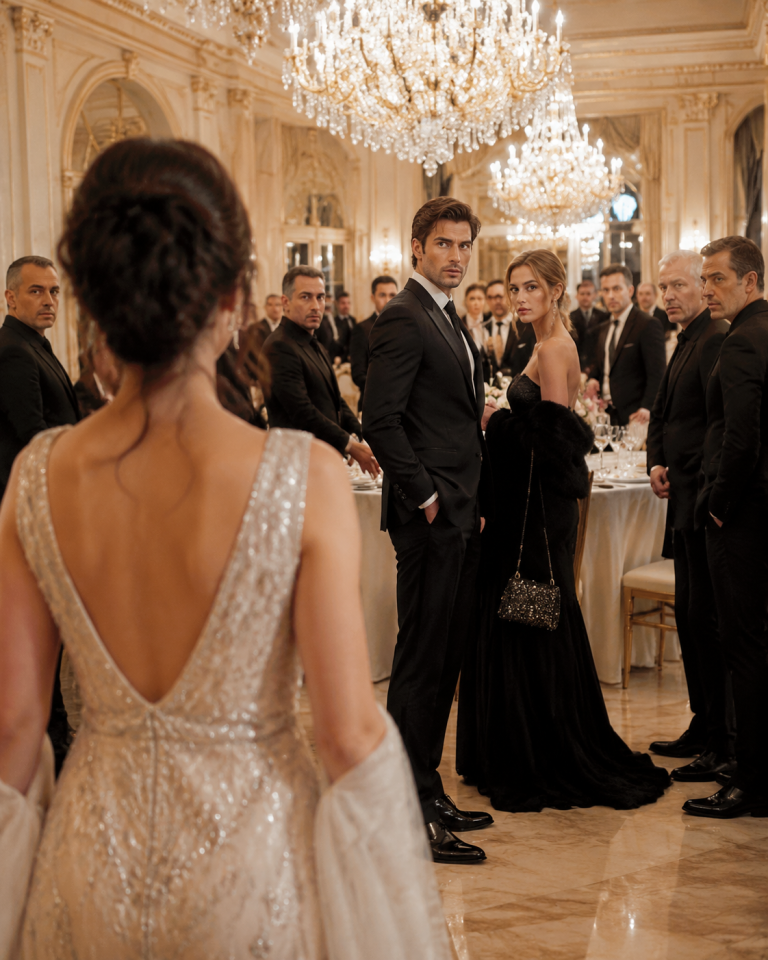
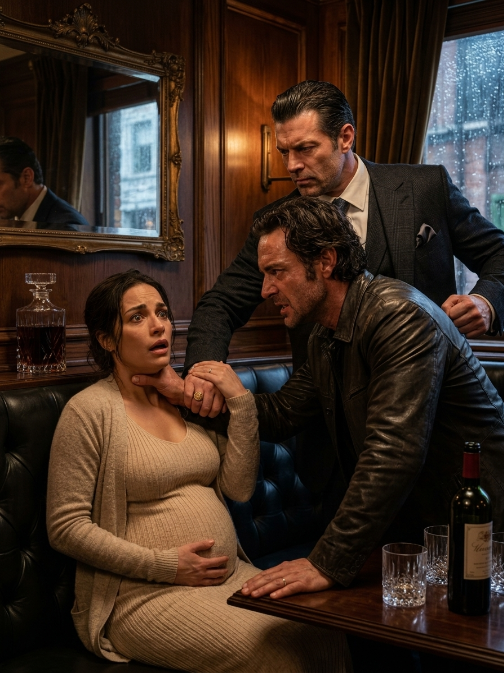
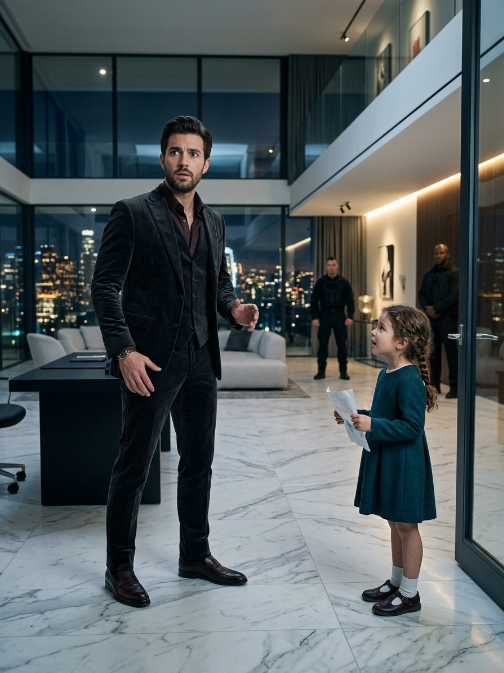
The Mafia Boss Was Kneeling in Tears for His Missing Daughter—Then a Homeless Boy Whispered, “She’s in the Dump”

## PART 1
The night they took Rosalie, the most feared man in Chicago forgot how to breathe.
Not because of the forty-seven years he had spent building an empire from nothing. Not because of the hundred and twelve men dead at his order over two decades. Not even because the estate he had spent eight years fortifying was sitting now with its front gates hanging open like a broken jaw, its marble floors scarred by gunfire, its security staff reduced to body counts his men were still tallying.
Because the crib upstairs was empty.
Dominic Corsa had stood in that doorway for a long time before anyone dared approach him. He stood there looking at the white crib with its yellow duck mobile, at the small dent in the mattress where a body had been, at the one brown shoe on the floor — Rosalie always pulled off one shoe and kept the other, it had been a habit since before she could walk — and he did not make a sound.
Later, in the rain, he fell.
Not attacked. Not shot. Just fell.
His knee hit the wet asphalt of his own driveway and his hands pressed flat into a puddle of rainwater that had collected near the edge of the path, and the sound that came out of him was not grief as it appeared in movies. It was smaller than that. It was the sound of something that had never had a name because no man in his position had been expected to need a name for it.
His second-in-command, a man named Vic Ferraro who had been at Dominic’s side for nineteen years, stood nearby and turned away.
Not out of disrespect.
Out of the specific kind of witnessing that required privacy for both parties.
“How long?” Dominic asked.
“We think they moved sometime between one and two,” Vic said, still facing the trees. “Security footage is wiped. The cameras on the northwest perimeter were cut from inside.”
“Inside.”
“Yes.”
Dominic already knew what that meant. He had known the moment he saw the north gate’s access panel. The code to bypass it was only known by four people. He had already looked at three of them. He was not ready to look at the fourth.
“Who has the manifest on tonight’s guard rotation?” he asked.
“Bruno.”
“Get Bruno.”
Bruno arrived and gave him the names on the night shift. Dominic went through them twice. All loyal men — or men he had believed were loyal. He found nothing in that list to take apart tonight. He needed the other kind of intelligence.
He needed someone who had watched his estate from outside it.
The problem with being the most feared man in a city was that the city arranged itself around your fear. Nobody stood outside your gates uninvited. Nobody loitered in the trees near your property after midnight. Nobody watched you unless they were paid to or forced to or desperate enough to need the warmth of a light in someone else’s window.
Only one category of person did that without agenda.
The kind no one saw.
The kind the city itself had made invisible.
Dominic raised his head.
His eyes scanned the treeline at the far edge of the estate property, where his land gave way to a strip of city park that ended at a chain-link fence backing onto an access road.
He had driven that access road a thousand times.
He had never once looked at what was behind the fence.
“Light it up,” he said. “The park. The access road. All of it.”
His men moved.
Floodlights swept the treeline.
And out of the shadows of a cluster of elms near the fence, in the specific still manner of a small animal that has learned motionlessness as protection, a boy stood.
Every weapon in the perimeter came up simultaneously.
“Down,” Dominic said.
He stood.
He walked across the wet asphalt toward the fence.
The boy did not run.
Dominic had learned to read absence of fear as a specific condition rather than a specific quality. This boy was not unafraid. He was simply standing past the point where running helped. He was wearing a jacket three sizes too large, his sneakers bound with duct tape at the toe, and he was shaking — not from cold alone. He had the particular thinness of a child whose body had been rationing itself for a long time.
He was watching Dominic the way people watched things they did not know how to categorize.
“You saw something,” Dominic said.
The boy’s jaw moved.
“Yes, sir.”
“Tell me.”
The boy’s name was Marcus. He had been sleeping near the old processing facility by the rail yard, a place nobody went after midnight except people who also did not want to be found. He had seen the black cars moving too fast at two in the morning. He had been close enough to the road to see what was being loaded.
He swallowed.
“There was a little girl,” he said. “She was crying. She only had one shoe.”
Dominic’s vision went white for half a second.
“Where were they taking her?”
“I heard one of them say the Pullman facility. The one near the old compactor plant.”
“The Reno facility.”
“I don’t know the name.”
Dominic knew the name. Everyone in his world knew the name. Reno Industrial was a chop facility on the south side that had been cycling through shell company ownership for twelve years. It was one of four properties connected to a rival family that Dominic had been preparing documentation against. A place where things were made to disappear permanently. A place with industrial compactors that ran every Monday at four a.m.
He checked his watch.
3:12.
He looked at the boy.
“You had every reason not to come here,” he said. “Why did you?”
Marcus looked at the one shoe in Dominic’s hand — which Dominic had not noticed he was holding until this moment.
“She was little,” the boy said. “And she was scared.”
That was the whole answer.
Dominic turned.
“Get the cars,” he said. “Now.”
He turned back.
“Marcus.”
The boy looked at him.
“Get in.”
—
## PART 2
The convoy moved through the south side in the dark, running six vehicles wide, the kind of movement that made traffic cops on overnight shifts suddenly develop urgent business elsewhere. Marcus sat in the lead car’s back seat holding a bottle of water someone had pressed into his hands, watching the city pass outside the window with the focused attention of someone who had spent years learning which streets were safe and which ones were not.
Dominic was on the phone.
“It came from inside,” he said to someone on the other end. “The north gate code. Who besides you and Ferraro had access to the emergency override sequence?”
He listened.
His face did not change.
“When was the last time you gave Benetti access to the gate system?”
He listened again.
His hand tightened around the phone until the knuckles went pale.
Benetti.
Sergio Benetti had been his operations manager for seven years. He oversaw logistics, scheduling, and physical security protocols. He was efficient and quiet and completely invisible in the specific way of men who made themselves useful by never standing in the way of anyone else’s importance.
He was not answering his phone tonight.
“Find Benetti,” Dominic said.
He put the phone down.
Marcus was watching him.
“The men who took her,” the boy said. “They had a crest on their jackets. Like a coat of arms.”
Dominic looked at him.
“What did it look like?”
Marcus described it: a circular emblem with a crown at the top and a river running through the center.
Dominic knew that crest.
The Sorrento family. Based out of the near south side, recently expanded toward the lakefront, currently in a quiet dispute with Dominic over two docking permits. Sal Sorrento’s people. Not direct rivals — the Sorrentos were not bold enough for that. They were the kind of family that made moves by attaching themselves to someone bolder.
Someone was using the Sorrentos as an instrument.
“They said something else,” Marcus said.
“Tell me.”
“When they were loading the car. One of them said ‘Bertelli’s going to want proof.'”
The name landed like something physical.
Marco Bertelli.
East Coast. Connected to the national commission. A man Dominic had crossed six years ago over a shipping arrangement that had cost Bertelli’s family a significant piece of the Atlantic freight corridor. A man who had smiled and shaken hands and said the matter was resolved.
Dominic had believed him.
He had been wrong.
Marcus was quiet for a moment, then: “Is she going to be there when we arrive?”
“Yes,” Dominic said.
“How do you know?”
“Because if she weren’t,” he said, “this would be a different kind of drive.”
Marcus absorbed this.
Then: “What happens to the men who took her?”
Dominic looked at the boy beside him. Thin. Eleven, maybe twelve. Eyes that had watched the city from its underside for long enough to be clear about how things worked.
“Nothing good,” Dominic said.
Marcus nodded once.
“Good,” he said.
They reached the Reno facility at 3:47.
The gate was padlocked.
Dominic did not stop moving.
“Ram it.”
The second vehicle drove forward and the gate screamed off its hinges and the convoy poured through onto a property of stacked refuse and industrial equipment and the specific smell of compressed waste that lingered in the cold air like something burned.
“Marcus,” Dominic said.
The boy was already out of the car before anyone could stop him. He stood in the beam of the headlights and pointed.
“South bins. The ones near the belt.”
Dominic was running.
—
## PART 3
He heard her before he saw her.
Not crying. Something quieter. The small rhythmic impact of a child kicking against metal — not a tantrum, not fear, but the sustained patient effort of a four-year-old who had decided that making noise was the only form of agency she had left.
Rosalie.
Three years old and already refusing to accept impossible situations.
Her mother’s quality, in the one characteristic way Elena had always shown up in their daughter: that particular stubbornness, applied to problems too large for its size.
Dominic climbed the dumpster rungs with his hands and aimed a light into the dark interior. Fourteen feet down, under torn plastic sheeting, he saw the shape of a small body.
He went over the edge.
He did not think about the drop. He did not think about the cold wet refuse beneath his feet or the twisted ankle that announced itself when he landed or the absolute impossibility of explaining this to anyone later. He tore through the plastic sheeting with his hands and found her at the bottom, dressed in the pale blue pajamas she had been wearing when he put her to bed at eight o’clock.
She was cold.
Her lips had that faint blue tint he had learned to fear in the months after she was born early, the color of a body that has been working harder than its size should require.
She opened her eyes.
“Daddy,” she said.
He did not speak.
He pressed her against his chest and wrapped his jacket around her and held her the way he had only held her once before — three years ago, in a hospital in Oak Park, when a doctor had placed her in his hands for the first time and told him she was going to be fine, just needed time, which had turned out to be the most important thing anyone had ever said to him.
His men lowered a tow cable.
He wrapped it around his waist and held her with both arms while they raised them out.
Back on solid ground, he checked her over with his hands. Head wound, small and already clotting. Cold, but responsive. He held up two fingers and she said two without hesitation, then held up three of her own fingers and said three, unprompted, as if correcting him.
He almost laughed.
He did not.
Because when he turned, one of his men was holding something.
A lighter. Silver. Found in Rosalie’s closed fist, placed there apparently by someone who wanted it found.
Engraved on the case was a monogram.
S.B.
Sergio Benetti.
The operations manager.
The man whose phone had been going to voicemail.
Dominic stood in the compound with his daughter wrapped in his jacket and looked at the lighter. Then he looked at the men around him. Then he looked at Vic Ferraro, whose face was showing the specific expression of a man who has understood something and is waiting to see what his employer does with it.
“Find Benetti,” Dominic said.
Then he looked at Marcus, who was standing three feet away with his hands in the too-large jacket’s pockets, watching everything with those specific eyes.
“Come here,” Dominic said.
Marcus crossed to him.
Dominic looked at him for a moment.
“You slept outside every night this winter,” he said. “You saw something dangerous happen. You had every reason to stay invisible.” He paused. “Why didn’t you?”
Marcus looked at Rosalie, who had fallen asleep against Dominic’s shoulder.
“She only had one shoe,” he said again.
It was still the whole answer.
—
Benetti broke in forty minutes.
He had not known what he was facilitating. That was his story, and under the specific kind of pressure Dominic’s men applied to the question, it held up — he had genuinely believed he was providing security override codes for a leverage play, not a kidnapping. Bertelli’s people had approached him through the Sorrentos and told him the target was Dominic’s dock schedule. The little girl was never supposed to be touched.
“You gave them my home’s security codes,” Dominic said. “What did you think they wanted them for?”
Benetti had no answer that worked.
Dominic’s eyes moved to Vic.
“Keep him,” he said. “We’ll need him for what comes next.”
What came next was longer than one night.
Bertelli had been careful. He had built his operation to avoid exactly the kind of direct exposure that would invite retaliation — using the Sorrentos as a layer, Benetti as a penetration point, the Reno facility as a place with deniability. The commission stood behind him as long as he stayed deniable.
Dominic spent six weeks removing that deniability piece by piece.
He had always been better at the strategic end of this work than people credited him for. The part that required patience. The documentation assembled through channels that did not involve violence, the conversations conducted through intermediaries, the slow erosion of protection.
He also contacted a woman named Celeste Damiano.
Celeste was an intelligence professional who operated in the space between organized crime and the kind of institutional power that regulated it — not law enforcement, exactly, not criminal either, but the kind of person who moved freely on both sides because both sides understood her value. She and Dominic had a history that had resolved into something more sustainable than romance and more complicated than pure business.
She met him in a private room at a restaurant he owned in River North.
“Bertelli,” she said. “You want the commission’s rationale for sanctioning this.”
“I want everything they used to justify it,” he said.
She looked at him.
“You understand what you’re asking for is not something I can undo once it’s in circulation.”
“That’s why I’m asking for it.”
She poured wine. Didn’t drink it.
“There’s a piece you don’t know,” she said. “It’s not just the freight corridor from six years ago.”
“Tell me.”
“Your wife,” she said.
The restaurant went quiet.
“Elena’s clinic on the west side,” Celeste said carefully. “The land it sits on. There’s a development deal worth somewhere between one and two billion dollars. The land holder is blocking it. The developer is a man named Carl Whitmore.”
Dominic had heard that name.
“Whitmore sits on two commission advisory boards,” Celeste said. “Has for eleven years. When Elena refused to sell, Whitmore went to the commission. Told them she was a destabilizing influence — that you were going to walk away from Chicago operations to protect her clinic. That the pipeline was at risk.”
Dominic looked at the table.
“Elena died in a car accident three years ago,” he said.
“It was not an accident,” Celeste said.
The room reduced itself to a very specific stillness.
“The bomb was Sorrento work, commissioned by Whitmore,” she said. “The commission facilitated the introduction and looked the other way.”
Three years.
Three years in which Dominic had told himself that the men responsible for the explosion had been found and handled. Three years in which he had grieved and hardened and raised their daughter and built a wall around his own grief by making it practical.
He had buried the wrong men.
He looked up.
“Whitmore,” he said.
“He’s not a mobster,” Celeste said. “He’s not reachable the way you usually reach people. He has security, lawyers, political connections. He gave money to three governors.”
“Everyone is reachable,” Dominic said. “You know that.”
“Yes,” she said. “I do.”
She reached into the bag beside her chair.
“You’ll want this,” she said. She placed a folder on the table between them. “Commission meeting minutes from three years ago. Internal correspondence. And a financial audit of Whitmore’s charitable foundation that documents the payment structure.”
Dominic looked at the folder.
“What do you want for this?”
“I want the Sorrento family’s West Side loan book,” she said. “And I want them to understand that the arrangement under which they currently operate is entirely dependent on my continued goodwill.”
“Done.”
“And Dominic.”
He looked at her.
“Rosalie is healthy,” she said. It was not a question. She had been keeping track.
“She is.”
“And the boy?”
He paused.
“Still with us,” he said.
—
Marcus had been staying in a room in the estate’s east wing.
The first night, he had slept on top of the covers, still wearing the duct-taped shoes, and one of the household staff had found him like that in the morning and had the presence of mind not to disturb him. By the third night, he was sleeping normally, though he had a specific arrangement of small items near the door — a heavy book, a lamp, and the flashlight Dominic’s head of security had pressed into his hands after taking away the pocketknife he’d been carrying — that suggested he had developed his own system for monitoring exits.
By the end of the first week, Rosalie had decided Marcus belonged to her.
She followed him around the estate with the absolute certainty of a four-year-old who had made a determination and saw no reason to revisit it. She brought him things: a crayon drawing of what she called the park where we found her but which depicted a brightly colored square with stick figures surrounding a small central shape, which Marcus had studied for a long time and then folded carefully and put in his pocket.
Dominic watched this from a distance.
He had seen men form attachments in his world. He had seen the specific quality that made someone loyal — not because they were paid or because they were afraid, but because they had been seen and received it as an organizing fact. He recognized that quality in Marcus the way you recognized a language you had spoken in a different version of yourself.
“Can you read?” Dominic asked him one morning.
“Yes,” Marcus said. “I taught myself at the library.”
“How long did that take?”
“A while.” He paused. “I couldn’t go every day.”
“Why not?”
Marcus looked at him with the patience of someone who understood that some questions revealed what the asker didn’t understand about the world.
“I had other things to manage,” he said.
“What things?”
“Finding food,” Marcus said. “Finding somewhere to sleep where people wouldn’t take my things. Finding a place to get warm when it was cold.” He paused. “The library was Thursday afternoons, mostly. When the woman at the desk changed shifts and the new one didn’t ask questions.”
Dominic looked at him for a moment.
“What did you want to be?” he asked.
Marcus looked at the wall.
“An engineer,” he said. “Buildings. I thought I’d figure out how they stayed up, and then I could figure out how to stay somewhere myself.”
Dominic nodded.
“I’ll hire a tutor this week,” he said.
Marcus looked at him.
“I’m not charity,” he said.
“I know you’re not,” Dominic said. “You saved my daughter’s life. This is a transaction, not charity.”
Marcus considered this.
“Okay,” he said.
“But I want you to understand something else.”
The boy waited.
“You can leave whenever you want,” Dominic said. “You are not here because I own you or because you owe me anything. You are here because you chose to come, and you can make a different choice whenever you want.”
Marcus was quiet for a long time.
“I know what I can do,” he said finally. “About Rosalie.”
“What do you mean?”
“She’s going to need someone,” he said. “While you’re doing whatever you’re doing.” He paused. “I can do that.”
Dominic looked at him.
“I know,” he said. “That’s why I asked you to get in the car.”
—
Whitmore was handled the way men of Whitmore’s type were always eventually handled: from the inside, with paper.
Celeste’s documentation was sufficient for a federal investigation that Dominic facilitated through a contact in the U.S. Attorney’s office who had been in his debt for three years over an unrelated matter. The investigation moved slowly and then quickly, as investigations did. Whitmore’s charitable foundation collapsed under scrutiny. The commission’s advisory boards became complications rather than protections.
The Sorrentos were reorganized. The Bertelli connection was severed at its root — not through violence, which would have required weeks of attrition, but through the exposure of the internal commission correspondence Celeste had provided, which made Bertelli’s position untenable and his protection evaporate.
Dominic was not present for any of these outcomes directly.
He was in Chicago, at the estate, being a father.
He had spent three years believing that those two things were incompatible — that the man he had to be in order to keep Rosalie safe was not the same man who could sit beside her at dinner and let her show him the drawings she made in school. The kidnapping had clarified something he had not wanted to look at: the wall he had built between those two selves was not protection. It was distance. And distance was the thing he could not afford.
On a Saturday morning in April, Rosalie sat at the kitchen table drawing with the intense focus that small children brought to tasks that mattered to them, and Marcus sat across from her with a geometry textbook he had worked through in three weeks and was now past the end of, and Dominic sat beside the window with coffee and looked at both of them.
His phone buzzed.
Celeste.
*Whitmore indicted this morning. Thirty-one counts.*
He put the phone face-down.
Outside, the garden had started coming back from winter. Small things. Not dramatic. The kind of return that required patience and was easy to miss if you were looking for something larger.
Marcus looked up from the textbook.
“She’s drawing the dump again,” he said.
Dominic looked.
Rosalie was producing, with great concentration, a landscape of tall shapes. She had given them colors — yellow and orange and red.
“Those are supposed to be metal bins,” Marcus said. “She told me.”
“She keeps drawing it?”
“She says it’s where I found her.”
Dominic looked at his daughter, who was adding a small figure at the bottom of the picture, painstakingly, with blue crayon.
“That’s you,” Marcus said quietly.
The figure had no face but it was clearly running.
Rosalie looked up and saw them both looking at her.
“I’m almost done,” she said. “It’s for Marcus’s room.”
Marcus looked at Dominic.
Dominic looked at Marcus.
“Tell her it’s a good drawing,” Dominic said.
“It’s a good drawing,” Marcus said.
Rosalie considered this and turned back to her work.
“I know,” she said.
—
The adoption papers were completed on a Tuesday in June, in a conference room in the Loop. Dominic had handled the legal requirements with the same systematic patience he brought to anything that required documentation. His attorney had prepared everything twice.
Marcus sat across the table looking at the papers.
He had asked, when Dominic first raised the subject, what adoption meant in practical terms. Dominic had explained: legally a member of the family. His name would change if he wanted it to, and if he didn’t want it to, that was also fine. Whatever he needed.
Marcus had thought about it for four days.
Then he had come to find Dominic in the office and said he had one condition.
“The name stays mine,” he said. “Not the family name. Just my first name.”
“Marcus,” Dominic said.
“My mother gave it to me before she died,” he said. “I don’t want to change it.”
“It stays yours,” Dominic said.
Marcus nodded.
“Then yes,” he said.
Now, sitting with the papers, he read through them with the focused careful attention he brought to everything he read, and Dominic waited, and Rosalie sat in the corner of the conference room with her drawings, which she had brought to the meeting uninvited but had been allowed to keep because the attorney was a father himself and understood some things were non-negotiable.
Marcus signed.
Rosalie looked up.
“Is Marcus our family now?” she asked.
“Yes,” Dominic said.
“Good,” she said. She turned back to her drawing. “He already was.”
Marcus looked at the papers.
Then at Dominic.
Something moved in the boy’s face that was not a child’s expression — it was older than that, worn through by experience into something that understood its own value without needing to perform it.
“My mother would have liked this,” he said.
“Tell me about her,” Dominic said.
Marcus looked at the window.
“She was a nurse,” he said. “She worked at a clinic on the west side. She liked growing things. We had a window box with tomatoes.” He paused. “She died when I was eight. I stayed in foster care for two years and then I left because it wasn’t working.”
Dominic nodded.
“What was her name?”
“Elena,” Marcus said.
The room was quiet.
Dominic sat with that name for a moment — the specific coincidence of it, or the specific non-coincidence, depending on how you understood the way certain things moved through the world.
He thought about Rosalie’s mother, who had died running a clinic on the west side.
He thought about the boy who had been sleeping near that side of the city, who had seen his daughter being carried in the dark, who had come through the treeline with duct-taped shoes and chosen not to be invisible.
He did not say any of this out loud.
Some things were better understood than spoken.
“Elena,” he said.
“Yes,” Marcus said.
Dominic looked at the window.
Outside, Chicago was being its ordinary summer self — warm, complicated, loud, full of the specific ongoing life of a city that had not stopped for any of this.
“She would have liked you,” Dominic said.
Marcus looked at him.
“Which one?” he asked.
Dominic thought about it.
“Both,” he said.
Marcus nodded, and turned back to the papers, and Rosalie added another figure to her drawing, and outside the window the city moved on in the way cities always moved on, indifferent and enormous, containing within itself — as it always had, as it always would — the small specific stories of people who had chosen, in the darkest available moment, to do the one thing that cost them nothing and meant everything.
There is no protection more powerful than a father with nothing left to lose.
And there is nothing rarer, or more necessary, than a child who had every reason to stay silent and chose instead to speak.
—
**THE END**