She Found His Grandmother’s Ring in Her Martini—Then the Mafia Boss Explained Why He Disappeared for Eight Years

## PART 1
The note had been eleven words.
*Layla — I have to go. Please don’t try to find me.*
Eleven words in Marco Vitelli’s handwriting on a page torn from the back of the AP Chemistry notebook she had let him borrow, tucked under her windshield wiper in the school parking lot on a Thursday morning in April when she was eighteen years old and thought she understood what the worst day of her life felt like.
She had been wrong.
The worst day had arrived three days later, when she understood he was genuinely gone and not coming back.
Then the days that followed, which were worse than the worst day in the way that ordinary grief was: not dramatic, not cinematic, just long. Just the slow work of rebuilding a person around an absence.
She had done it.
She had gone to school in Philadelphia and learned how to be someone who did not check her phone waiting for a message that would not come. She had come back to New York because New York was hers, not his, and she was not going to lose the city too. She had a job she was good at — curatorial work at a contemporary photography gallery in Chelsea — and an apartment with too many bookshelves and a best friend named Paula who thought Marco Vitelli was the worst person alive and had told her so approximately twice a year for eight years.
Layla had argued, sometimes.
She had also, sometimes, agreed.
Tonight was a Thursday in April.
Not the same April. A different one.
Eight years later.
The envelope had arrived at her building on Monday — cream paper, no return address, her name in handwriting she had recognized before she’d finished opening it.
*Layla. Come to Trattoria Scarlatti on Thursday at eight. I need you to hear something. I know I have no right to ask. I’m asking anyway.*
*— M.*
Paula had held the envelope between two fingers and said, “This is a terrible idea.”
Layla had said, “I know.”
“He’s going to make you feel things and it’s going to be awful.”
“Probably.”
“You could just not go.”
“I could.”
“But you’re going.”
“I’m going.”
Paula had looked at her for a long moment.
“Wear the black blazer,” she finally said. “It makes you look like someone who does not currently have feelings.”
She wore the black blazer.
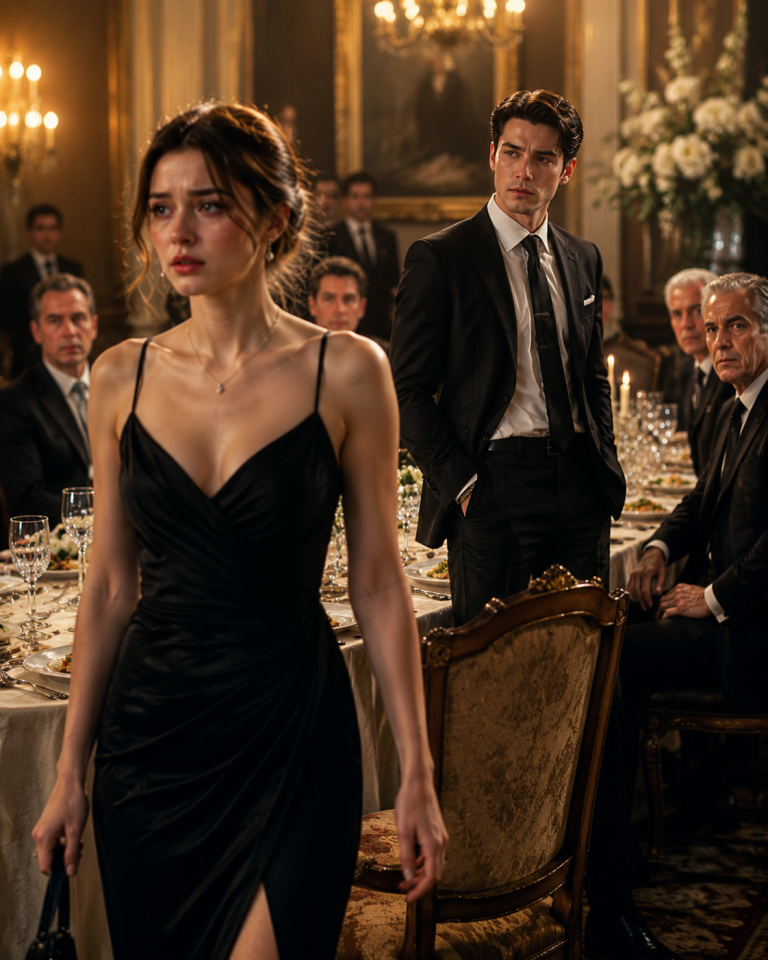
She sat at the table in Trattoria Scarlatti’s private dining room — the room someone had reserved under a name she didn’t recognize, the room where the candlelight was amber and the windows overlooked a rain-dark courtyard — and she waited for the boy she had buried to walk through the door.
He was three minutes late.
She was counting.
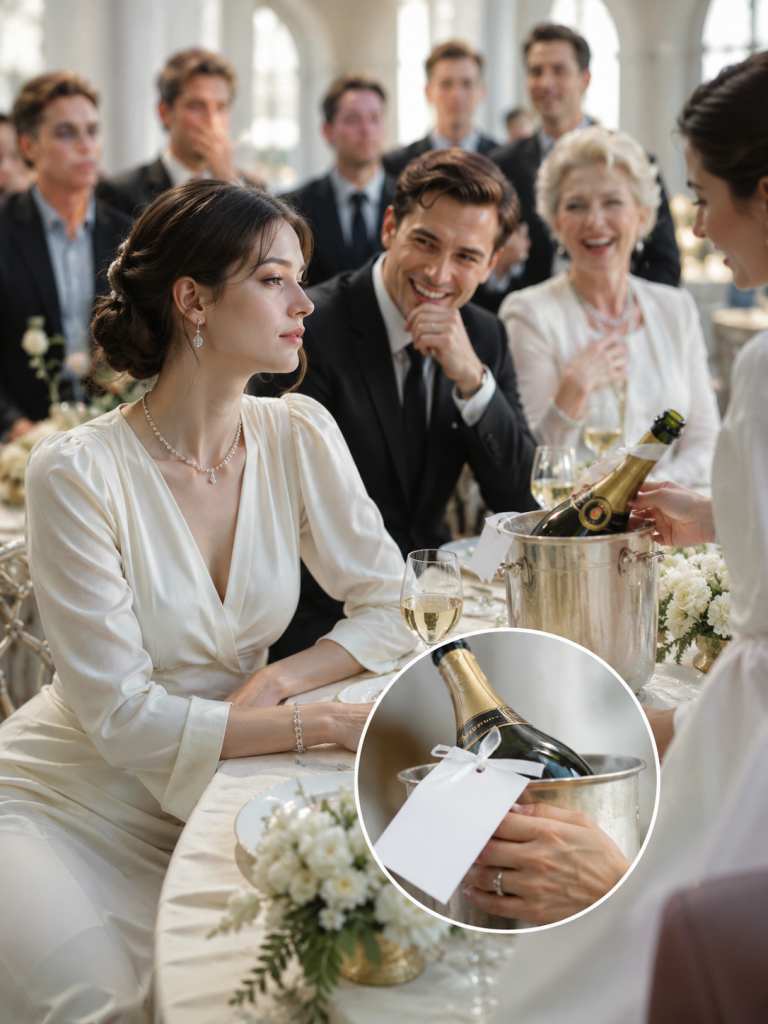
She was looking at the wine she had ordered and not drinking, and she was thinking that she should have brought Paula as backup, when something caught in the glass — a refraction, a glint — and she looked down.
At the bottom of her wine.
A ring.
Not a piece of jewelry she recognized.
No — that was wrong. She did recognize it. Not because she had worn it, but because she had seen it once, eight years ago, when Marco had been showing her a photograph of his grandmother on his phone and there had been a brief, easy moment where he had said *that ring goes to whoever I end up with* and she had looked at the tiny antique gold band on the screen and felt something warm and unguarded move through her before she had put it carefully away.
She had put a lot of things carefully away since then.
The ring sat in the wine like it had always been there.
Like it had been waiting.
She was still staring at it when the door opened.
The first thing she felt was the quality of the room changing — the specific pressure shift of Marco Vitelli occupying space, which was something she had not thought about in years but recognized immediately.
The second thing she felt was anger, clean and immediate, which was better than the alternative.
“You put a ring in my wine,” she said, before he sat down.
“Yes.”
His voice was older. Lower. Still his.
He stood at the edge of the room in a dark suit that did not look like something a boy wore. He was broader than she remembered. A scar ran along the outer edge of his right hand that had not been there before. His eyes were the same color they had always been — the dark brown that looked almost black in low light.
She looked at those eyes and felt everything she had been efficiently managing for eight years shift out of place at once.
“Sit down,” she said. “Or leave. Don’t stand there.”
He sat.
“The ring,” she said. “You have three minutes to explain it before I take it back to the kitchen and ask the chef to pour it down the drain.”
Something moved across his face — a flinch, almost, that he covered quickly.
“My grandmother left it to me,” he said. “She said to give it to whoever I wanted to spend my life with. I’ve been carrying it for eight years.”
“Carrying it.”
“Yes.”
“While being entirely absent.”
“Yes.”
Layla looked at the ring.
Then at him.
“You have two minutes.”
He told her.
She listened.
At the end of it she was not any less angry. But she was — she recognized this, noted it, filed it away — different.
Because the reason he had left was not what she had spent eight years believing.
And the reason he had come back was not guilt.
It was something she was not ready to name yet, but she recognized its shape.
“Eight years,” she said.
“Yes.”
“In all of that time, you did not think there was a moment when you could have—”
“Every moment,” he said. “I thought about it every day.”
“And yet.”
“And yet I thought silence kept you safe.”
She looked at the wine.
At the ring.
At the man across the table who had grown up into someone she did not know but could feel the outline of the way you could feel the shape of a room in the dark.
“I have not said yes,” she said.
“I know.”
“I have not said anything.”
“I know.”
“What I am saying is that you have some explaining to do before I make any decisions.”
Marco’s mouth moved.
Not quite a smile.
The ghost of the boy she remembered.
“I have been waiting eight years to explain,” he said. “I have a great deal of material.”
Layla looked at her wine.
She reached in and removed the ring.
Set it on the table between them, where it caught the candlelight the way things caught light when they had been waiting patiently for a long time.
“Start,” she said.
And Marco Vitelli told her the truth.
The whole truth.
Every part he had kept silent for eight years.
By the time he finished, the wine had gone warm and the courtyard beyond the windows was still raining and Layla understood, for the first time since she was eighteen, the exact shape of what had been taken from her.
Not by him.
By a world he had been born into and had been trying, since before she’d met him, to find a way out of.
She was not forgiving him.
Not yet.
But she was listening.
And the ring sat on the table between them like evidence of everything they had not had the chance to become.
—
## PART 2
The first threatening call came four days later.
Layla was at the gallery, rehinging a large-format photograph of coastal erosion that had arrived with a bent corner, when her phone rang from an unknown number.
She answered because gallery work occasionally involved unknown numbers.
“Miss Moretti,” said the voice on the other end.
“That’s not my name.”
“It may become relevant.” A pause, smooth and practiced. “You had dinner with Marco Vitelli Thursday evening. You were seen leaving together.”
“We had dinner,” Layla said. “That’s not a crime.”
“Not yet. I am calling to clarify that association with the Vitelli family carries consequences. We thought you should understand that before you made any decisions.”
The line went dead.
Layla stood with the phone for a long moment.
Then she called Marco.
He answered on the first ring.
“I know,” he said, before she could speak. “Sal just told me. Someone intercepted your number. That means they’ve been running surveillance on the restaurant.”
“Who is ‘they’?”
“A competing organization. Vanzetti. They have been watching me since my father’s health declined. If they think I am establishing a new relationship, they will try to use it.”
Layla set the photograph gently against the wall.
“Your father is ill.”
“Yes. He had a stroke two months ago. He cannot—” Marco stopped. “He cannot run things the way he used to. Which means the question of who runs them is being actively contested.”
“By the Vanzetti family.”
“Yes.”
“Who now have my number and know where I work.”
“Yes.”
She looked at the photograph of eroding coastline. The particular way water wore stone away over time, until the stone that had seemed permanent was simply gone.
“How long has this been coming?” she said.
“The tension? Years. The active threat? Since my father’s stroke. Approximately two months.”
“Which is when you sent the letter.”
A silence.
“Yes,” Marco said.
“I need to understand that,” she said. “I need to understand whether you came to me because you love me or because you needed something.”
The silence that followed was not evasive.
It was honest in the way of a person deciding not to make their answer easier than it should be.
“Both are true,” he said. “I came to you because I have loved you since I was eighteen years old and have never stopped. I also came to you because my father is dying and the world I was born into is about to change in ways that require me to decide what I am willing to protect and what I am willing to lose.” He paused. “I should have told you about my father on Thursday. I should have told you about the threat. I didn’t because I was afraid of your answer.”
“You thought if I knew the full situation I wouldn’t come.”
“Yes.”
“You were probably right.”
“Yes.”
Layla looked at the eroding coast.
“There’s someone in your organization feeding information to the Vanzetti family,” she said. “Someone who knew we had dinner before the surveillance could have picked it up.”
Silence.
“Why do you say that?”
“Because the call came four days after Thursday. Surveillance that fast, for a dinner at a private table, requires someone already positioned on the inside.” She paused. “You have a leak.”
A longer silence.
“Layla,” he said.
“I’m right.”
“Yes,” he said. “I think you are.”
“Then you have two problems. The external threat and the internal one.”
“Yes.”
“And I am currently standing in my gallery having been made part of both without my consent.”
“Yes.”
“We are going to have a very long conversation about that.”
“I know.”
“But first,” she said, “you need to find the leak before they find out you know about it.”
She hung up.
She stood in the gallery for another moment.
Then she called Paula.
Paula’s response took approximately fifteen seconds to progress from concern to outrage to the particular resigned pragmatism of a person who had been Layla’s best friend for twelve years and understood that arguing was sometimes less useful than helping.
“Okay,” Paula said. “Tell me everything.”
—
## PART 3
The safe apartment was in Brooklyn Heights.
Layla had gone home first — to her apartment, her bookshelves, the blue mug she’d been using since college — and stood in the center of the living room looking at the accumulated evidence of the life she had built.
She had built it carefully.
She had built it after Marco, around the absence of him, in the way you built things after something collapsed: choosing each piece deliberately, making sure everything load-bearing was her own.
The gallery job she had gone after because it was hard and she wanted hard things that required her to be good. The apartment she had paid for with her own money for three years until the rent stopped feeling precarious. The friendships she had maintained with people who did not need her to be more than she was.
All of it hers.
And now someone had her number and knew where she worked, and the reason was that she had gone to dinner with a man she hadn’t seen since she was eighteen, and the ring was sitting on her kitchen counter where she’d put it because she hadn’t known what else to do with it.
She packed a bag.
She called Paula.
She did not call Marco.
Marco arrived anyway, because he had apparently told his security to watch her building from Thursday onward, which she intended to address at length and in detail once the immediate situation was resolved.
The argument happened in the stairwell of her building.
“You had surveillance on me.”
“Protection.”
“That word,” she said, “does not mean what you keep using it to mean.”
“Layla—”
“I understand that you have been worried about my safety. I understand that the threat is real. I also understand that you made a decision to put eyes on my building without telling me, which is the same thing you did eight years ago — making decisions about my life without my participation.”
He was quiet.
“That pattern ends now,” she said. “Not because I am asking nicely. Because it is the condition of any version of this that I agree to.”
A long silence in the stairwell.
“Agreed,” he said.
“Every decision that involves my safety, my work, my movements — you tell me first. I decide whether I accept it.”
“Even if I think—”
“Especially if you think you know better.” She looked at him. “You may be right, sometimes. You know things about your world that I don’t. But I know my own life better than anyone. Those two things have to work together.”
He looked at her with the expression of a man who had grown up in systems where information was power and sharing information was vulnerability.
“That is difficult for me,” he said.
“I know. Do it anyway.”
He nodded.
“Start with the leak,” she said. “Tell me everything you know.”
He told her.
The Vanzetti family had been in contact with someone inside Marco’s organization for approximately six weeks — long enough to have positioned themselves before his father’s stroke made everything urgent. The leak was providing movement intelligence, not strategy, which suggested someone peripheral rather than inner circle.
“Who has access to your calendar and location data?” Layla asked.
“At least a dozen people.”
“Narrow it by who knew about Thursday specifically.”
He listed names.
She listened.
“The reservation,” she said. “Who made it?”
“Sal handled it. But he went through the restaurant’s events coordinator, which means—”
“The restaurant has a contact,” Layla said. “Someone who manages private dining reservations for clients like you. That contact could have been turned weeks ago. They wouldn’t have needed anyone inside your organization.”
Marco stared at her.
“It’s not a leak,” she said. “It’s a planted access point. Someone they placed at the restaurant specifically to watch private clients.”
He pulled out his phone.
Sal confirmed it within the hour.
The restaurant’s events coordinator had taken the position eight months ago. Her references, when carefully checked, had connections to a Vanzetti-adjacent business in Queens.
“She didn’t know anything sensitive,” Marco said, when he told Layla. “Just the reservation. But that was enough.”
“The call to me came too quickly for anything else,” Layla said. “Which means your actual organization is clean. The leak isn’t internal.”
The relief on his face was visible.
“You did that in about forty minutes,” he said.
“I curate photography,” she said. “Half of my job is looking at things other people have looked at and finding what they missed.”
—
The threat from Vanzetti came to a head six weeks later, not with violence but with an attempted leverage operation: documents implicating Marco’s father in a decade-old financial irregularity, positioned to go public in a way that would invite federal scrutiny and destabilize everything during the transition of power.
The documents were real.
Layla read them at Marco’s kitchen table at eleven at night and said, “These are real.”
“Yes.”
“Your father knew.”
“I know.”
“You didn’t.”
“No.” He looked at the documents. “Not the specific transactions. I knew there were things in the past I hadn’t been told. My father was—” He stopped. “He protected me from the ugliest parts. He thought that was a gift.”
“It left you without the information you needed.”
“Yes.”
She looked at the documents.
“The same information,” she said, “is in these files twice. The same set of transactions, documented two different ways. One version is the version Vanzetti is threatening to release. The other version—” She turned the pages. “The other version has been through a legitimate accounting reconciliation. Someone has already done the remediation work.”
Marco looked at the pages.
“My father’s lawyer,” he said slowly. “She brought a financial forensics team in two years ago. I thought it was estate planning.”
“She was cleaning this,” Layla said. “In case it ever came up. Which means the version Vanzetti has is the old version, and the version on record is the clean one, and if they release what they have, a comparison will show that it’s already been addressed.”
Marco was very still.
“They don’t know that.”
“No. They think they have leverage. What they actually have is outdated information.”
“If I let them release it—”
“It looks like a failed smear campaign using historical documents that have already been resolved,” Layla said. “Which damages their credibility more than yours.”
He looked at her.
“You see this very quickly,” he said.
“I’ve been doing this for forty minutes.”
“How?”
“I told you. I look at things other people have looked at and find what they missed.” She set the papers down. “Also, I worked at a gallery for three years where one of our major donors turned out to be running a provenance fraud scheme. I got very good at reading financial documentation.”
He laughed.
Not the small, careful sound she had heard occasionally over the past weeks.
A real laugh.
It was, she realized, the first time she had heard it.
The crisis resolved without drama.
The Vanzetti family released the documents.
Marco’s lawyer issued a statement the following morning, calmly referencing the subsequent remediation, attaching the audit trail, and pointing out that using outdated financial records as a leverage tool was, legally speaking, an interesting choice.
It landed badly for the Vanzetti side.
Internally, the question of succession became calmer without the manufactured urgency.
Marco’s father, who was recovering more slowly than the doctors had initially hoped, was told about the resolution from his hospital bed by Marco and, separately, by Layla, who had visited once and had sat with the old man for forty-five minutes talking about the gallery, which was, she felt, probably not what anyone had expected.
He had asked good questions about the photography.
She had liked him, which complicated her feelings about what he was and what he had done.
She told Marco that, directly.
“I liked him,” she said. “I also know what’s in those documents.”
“Yes.”
“Both of those things are true at the same time.”
“Yes.”
“I’m going to hold both of them,” she said. “I’m not going to resolve them into something simpler.”
He looked at her.
“Is that what you’re doing with me too?”
She considered.
“Yes,” she said. “That’s exactly what I’m doing with you.”
—
Bella Notte was closed on Monday nights.
Marco had bought the restaurant eight years ago, three months after he left. He had told her why: a place he used to walk past when he was seventeen, imagining taking her there. He had bought it as a kind of practice — holding onto something that was connected to the future he had chosen to give up.
She had sat with that for a long time.
She had also told him it was a strange thing to do and she meant that sincerely.
He agreed it was a strange thing to do.
They had, in the weeks since everything had calmed, built something that did not yet have a name but had a texture — dinners, conversations, arguments about decisions he still occasionally tried to make without telling her first, the particular honesty of two people who had lost eight years to a misunderstanding that was not entirely a misunderstanding and were trying to account for that accurately.
On a Monday night in October, the restaurant was empty and lit only by the courtyard lights and the candles Marco had put on the table by the window.
He had cooked.
He was, it turned out, a reasonable cook. He had learned, he said, because he had spent years eating alone in restaurants he owned and eventually found it depressing.
She had said that was the saddest thing she had heard recently.
He had agreed.
After dinner, he placed the ring box on the table between them.
Not in her wine.
Not as a manipulation.
Just on the table.
“I want to do this correctly,” he said. “Not the way I did it at the beginning, which was a terrible plan I thought was romantic.”
“It was terrible,” she said.
“I know. I regret it.”
“The ring is still beautiful.”
“Yes.” He looked at it. “My grandmother bought it for herself, actually. She was married twice and both times she picked her own ring because she said men had terrible taste. She left it to me specifically because she thought I would need it to convince someone.”
“She sounds like she knew you well.”
“She said I had good judgment about people and terrible judgment about everything else.”
Layla looked at the ring.
Then at Marco.
Not the boy he had been.
Not only.
Also the man — the one who had made choices she disagreed with and choices she understood and choices she was still in the process of evaluating, and who had spent six weeks learning, imperfectly but consistently, to tell her things before he did them.
“I’m not forgiving you yet,” she said. “For the eight years.”
“I know.”
“That’s going to be ongoing.”
“I know.”
“And if you make decisions about my life without telling me—”
“I know,” he said. “You’ve been very clear.”
“I’m going to be clear again, periodically.”
“I anticipate that.”
She picked up the ring.
Turned it in the candlelight.
The same antique gold she had seen in a photograph when she was seventeen, on the hand of a woman Marco’s grandmother had kept a photograph of her whole life, in a wallet worn soft from use.
“Ask me,” she said.
Marco stood.
Not dramatically.
Not with a speech prepared.
He just stood and looked at her and said, very quietly: “Layla. Will you marry me.”
Not a question, quite.
More like a statement that was also a question.
The statement was: *I have loved you since I was seventeen and I will spend the rest of my life learning what that means in practice.*
The question was: *will you.*
She looked at the rain against the courtyard windows.
At the candle.
At the ring in her hand.
At the eight years between them, which had not made them who they were — they had done that themselves — but had shaped the specific way they carried it.
“Yes,” she said.
He sat back down.
She put the ring on her own finger, which felt right.
He looked at her.
She looked at him.
“You put a ring in my wine,” she said.
“My worst idea.”
“It was deeply strange.”
“Deeply.”
“Paula said it was either a scam or a murder plot.”
“She was not wrong to consider both.”
Outside, the rain continued.
Inside, the courtyard candles moved in whatever small draft reached the windows.
Trattoria Scarlatti glowed amber and quiet, and Marco Vitelli had spent eight years buying a restaurant he used to walk past, and Layla Moretti had spent eight years building a life around an absence, and neither of those things was a story that resolved cleanly.
But they were, she thought, honest.
And honesty was what they had.
It was enough.
It was, in fact, more than enough.
It was everything they had not had at seventeen, and everything they had learned since, and the ring was on her finger and the wine was warm and Marco Vitelli was across the table from her looking like a man who had not been sure, until this moment, that the future he had been carrying for eight years was real.
She had told him that forgiveness was ongoing.
She had meant it.
She had also meant yes.
Both things were true.
She was, she had told him, going to hold them both without resolving them into something simpler.
That was the plan.
—