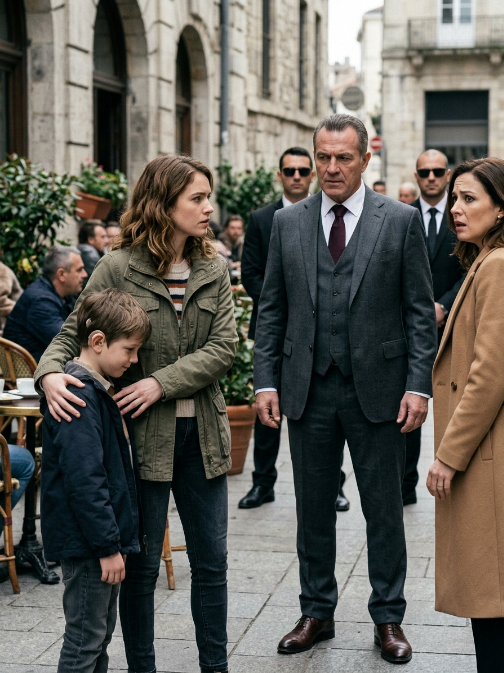
The Mafia Boss Disguised as a Poor Mechanic—Only One Woman Saw the Man Behind the Mask

**PART 1**
The night he decided to disappear, Ethan Cole was sitting in the back of his car outside a benefit dinner, watching himself on a laptop screen.
The footage was from a charity event eight months earlier — security footage, actually, acquired by a journalist who never published the story because of a conversation Ethan’s lawyer had initiated. In it, a woman was speaking to him across a dinner table. Leaning slightly forward. Laughing at the right moments. Saying, over candlelight in a restaurant that seated fourteen, *I feel like I’m seeing the real you.*
He remembered that evening. He remembered thinking he might be in love.
He also remembered finding the recording device three days later, sewn into the lining of her evening bag, serviced by a federal contact she’d been running for most of the year they were together.
The car idled outside the benefit dinner. His consigliere, Marsh, sat across from him in the dark, delivering a summary of three pending situations that required Ethan’s attention before morning. Ethan was not listening. He was watching his own face on a small screen, watching himself believe something that wasn’t real.
“There’s a good woman you should meet,” Marsh said, the way he said it every four to six weeks, with the patient persistence of a man who understood that the organization required continuity and continuity required heirs and heirs required a wife. “The Brannigan family. Their youngest is twenty-six. Georgetown, speaks three languages—”
“No.”
Marsh exhaled through his nose.
“Ethan.”
“I said no.”
Ethan closed the laptop. He looked at the entrance to the benefit dinner — the valets, the guests in their event clothes, the particular performance of people who had dressed to be seen. He had done this a thousand times. He would do it a thousand more.
Unless.
The thought had been building for months. An idea he kept returning to late at night in the penthouse that he had never quite made into a home. He had two hundred million dollars in legitimate holdings and approximately twice that in operations that didn’t appear in annual reports. He had properties in four countries. He had a name that made tax attorneys nervous and city officials return calls within the hour.
And he had been lied to by every woman who had ever claimed to love him. Not because they were bad people — some of them were not bad people — but because the category he occupied came with distortions. He was a symbol before he was a person. A resource before he was a man. And everyone, always, adjusted their vision to what they wanted the symbol to mean.
He needed to know if it was possible to be seen.
Not Jackson Harrove the name. Not the empire behind it. Just whatever was left when you took all of that away and stood in a room as no one.
“I need three months,” he said.
Marsh looked at him.
“Off the grid. No access to accounts, no car, no contact except emergencies. A cover identity. Something unremarkable.”
“You want to go undercover.”
“I want to go invisible.”
Marsh sat with this for a long time.
“That’s not an experiment,” he finally said. “That’s a punishment.”
“Maybe,” Ethan said. “Find me an apartment.”
—
The identity took two weeks to construct.
He became Cal Merritt, thirty-four, recently separated from a warehouse job in logistics, relocated to Millhaven in South Jersey for reasons that didn’t need to be interesting. The apartment was a third-floor walkup with a bathroom window that didn’t close all the way and a kitchen that smelled of the previous tenant’s cooking. He bought clothes from a donation bin outside a church. He stopped shaving on a regular schedule. He locked his watch — a Vacheron, custom case, one of eight made — in a box that went into a storage unit in Manhattan.
He replaced it with a digital watch from a pharmacy checkout. It cost eleven dollars.
Marsh called once to confirm the setup, looked at the apartment, and said: “You’re going to last four days.”
He lasted ninety-three.
He got a job at a grocery store called PrimeFoods on the edge of town. Night stocking, ten to six, minimum wage plus a small shift differential. The manager, a man named Garrett who sweated under fluorescent lights and used the word *buddy* the way some people used punctuation, assigned him to the frozen foods aisle.
Cal Merritt learned to take the bus.
He learned what it cost to eat on the money that remained after rent. He learned the specific invisible quality of being a man without resources in a system organized for people with them — the way tellers spoke to you differently at the check-cashing place, the way service counters adjusted their tone, the way the world moved around you at a slightly faster speed, as though accommodation required a minimum investment you hadn’t made.
He tried the dating apps. Free tier, no premium features, a photo of himself in front of the walkup building.
A woman named Amber matched with him and asked what he did within the first five messages. When he told her — retail associate, night shift — the responses slowed, then stopped. A woman named Jordan met him for coffee and left early for something she had apparently forgotten until he paid for his own drink with counted change. A woman named Priya was direct: she needed someone with more stability, she said. Something that looked like a plan.
He didn’t blame them. He understood the economics. He simply noted, with the cold precision that had made him very successful in a very difficult business, that the women who had found him when he was Ethan Cole had been performing interest in exactly the same direction, just with more resources available to sustain the performance.
He had been in Millhaven for twenty-six days when he saw her.
He was sitting on a bench outside a Laundromat on Clement Avenue, waiting for his clothes to dry because the dryer in his building had been broken for three weeks and the landlord’s communication about it consisted of two unreturned calls. He was eating a sandwich from the gas station convenience store — turkey, slightly stale, acceptable — and watching the street do the ordinary things streets did at dusk.
A woman came out of the community building across the road carrying two large cardboard boxes, stacked one on top of the other, her arms spread wide around the load, unable to see clearly over the top. She was navigating the cracked sidewalk carefully, her steps deliberate, and she was wearing a grey sweater that had been washed too many times and sneakers that had earned their wear.
She stumbled.
Not badly. Her foot caught a raised seam in the concrete, and she caught herself — a quick, practiced adjustment, the kind of compensation you developed when your body had given you sufficient practice. A man walking past, earbuds in, suit jacket, didn’t slow. Two people on the other side of the street didn’t look.
Ethan was off the bench before he had decided to be.
“Hey,” he said, crossing the road. “Can I take one of those?”
She looked at him over the top box. Her eyes were dark brown and measuring — not suspicious exactly, but assessing, doing the specific calculation of a woman determining whether unsolicited help had attached strings she hadn’t agreed to.
“I’ve got it,” she said.
“Your arms are going to give out in about twenty seconds.”
She looked at him again. At the worn jacket, the untrimmed beard, the sneakers with the cracked right sole. Something in her assessment was different from the women on the app. They had looked at him and seen what he lacked. This woman was deciding something else — whether he was safe. Whether the offer came without a bill attached.
“The top one,” she said. “It’s lighter.”
He took the top box. Children’s books — soft-spined, dog-eared, handled to the point of love — a collection that smelled like libraries and other people’s childhoods. He walked beside her to a white hatchback with a dent in the rear panel, held the box while she opened the trunk, and they loaded both inside.
“Thank you,” she said, and pushed her hair back behind one ear.
“What are the books for?”
“A reading program.” She paused. The pause of someone deciding how much context a stranger required. “For kids who need it.”
“That’s good work.”
“It doesn’t pay,” she said. Flatly, without bitterness, the way you would state the weather.
“I’m Cal,” he said.
“Nora.”
She got in her car. She didn’t linger, didn’t offer her number, didn’t do any of the things that people did when they were trying to extend an interaction. The hatchback pulled away from the curb and the tail lights dissolved down Clement Avenue.
Cal Merritt stood on the sidewalk in the November evening and realized something he hadn’t been prepared for.
That was the first conversation he’d had in almost a month where the other person wasn’t performing anything at all.
**PART 2**
He didn’t seek her out.
The experiment had rules. He wasn’t supposed to choose someone. He was supposed to let someone choose him, or not, and observe what happened without arranging the result. But Millhaven was small in the way of towns that were technically part of a metropolitan area but felt provincial anyway, and the community building where she worked was two blocks from the Laundromat and three blocks from his bus stop.
He saw her again.
And again.
He saw her unlocking the front door at seven in the morning, coffee in one hand, keys in her teeth. He saw her chasing a five-year-old down the sidewalk while the kid shrieked and she shouted, *Marcus, if you get to the curb I will personally tell your grandmother.* He saw her on the steps one evening eating a sandwich and reading a paperback with the spine cracked so far the book was nearly in two pieces.
He watched, from the cereal aisle at PrimeFoods on a Wednesday evening, as two women in exercise clothes — the specific casualness of people who had never been on the wrong side of other people’s casual cruelty — spoke quietly to each other while Nora reached for a box of pasta. He was too far away to hear the words but close enough to see Nora’s hand pause on the shelf. Just for a moment. A half second. Then she put the pasta in her cart and moved on.
He had seen people respond to humiliation many ways in his life. He had never seen someone absorb it with that particular quality — not acceptance, not defeat, but a kind of practiced refusal to give the moment more weight than it deserved. She had decided some time ago that her time was not available for other people’s small cruelties, and she moved on.
He found himself watching for her.
Their second real conversation happened because of rain and a dying engine.
He was leaving PrimeFoods at six in the morning, overnight shift over, carrying the particular exhaustion of a man who had been stacking frozen goods in a cold aisle for eight hours, and the sky opened up in that specific October way — not a gentle rain, an assault, sheets of water that turned the parking lot into a running lake within thirty seconds.
He stood under the store’s awning and saw the white hatchback in the parking lot with its hood up. Nora was in the driver’s seat with the door open, looking at the engine with the expression of someone who has been having an ongoing argument with an object and has finally lost.
She was already wet. Her jacket — canvas, practical, not waterproof — was soaked dark across the shoulders.
“That’s not a great sign,” he said, walking over.
She looked up. Recognition, and something more: *oh, it’s the safe one.*
“Radiator hose,” she said. “Cracked. My car has decided to pursue other opportunities.”
“You need a tow.”
“I called one. That was ninety minutes ago.” She held up her phone. “They said thirty to forty-five minutes, which apparently meant nothing.”
He sat down on the wet curb next to her car. She looked at him.
“You don’t have to do that,” she said.
“I know. Bus doesn’t come for another fifteen minutes anyway.”
She studied him. Then she sat on the wet curb beside him, which was the moment he understood something important about her character, though he couldn’t have articulated it immediately. She had decided he was worth sitting in the rain for.
“Tell me about the reading program,” he said.
She told him.
Her name for it was Bridgelight. She’d started it three years ago after leaving a position at an insurance company that had paid adequately and cost her, she said, the ability to care about anything. The community building gave her the space for free in exchange for running their after-school activities, which meant she was technically running two programs for the salary of zero.
She had twenty-eight children enrolled. Ages five to twelve. Most from families where books were a financial calculation rather than a given. She drove to library sales and estate sales and donation bins across three counties to find books. She wrote grant applications on weekends and had been declined sixteen times.
“Sixteen,” he said.
“Seventeen. I forgot the Halloran Foundation. They sent me a rejection letter that was so carefully worded I printed it out. They said my program demonstrated community commitment but did not align with their current strategic emphasis.” She paused. “Which I believe means they gave the money to an organization with a better logo.”
“That’s criminal.”
“That’s grants.” She almost smiled. “The interesting part is the seventeenth one I haven’t applied to yet. I keep finding reasons not to.”
“Why?”
She was quiet for a moment.
“Because the wait after you apply is the part where it still might be yes,” she said.
The tow truck arrived forty minutes late. The driver looked at the hatchback with the expression of a man who had been asked to help and resented the imposition. He said something about the car being barely worth the fee.
Nora looked at him with the steady, unhurried patience of someone who had been dealt this kind of interaction before and had developed a response that cost nothing and achieved everything.
“It’s worth it to me,” she said. “Can you take it to Martinez Auto on Clement?”
The driver loaded the car. When he was gone, Nora turned to Cal and said, “Thank you for sitting here. You didn’t have to.”
“I know.”
“People don’t usually.” She said it simply. Not as complaint, not as observation. Just as fact. *People don’t usually stay.*
The words went into him somewhere specific.
He rode the bus home and stared at the seat ahead of him and thought: she just told me the most important thing about her life in four words, and she said it like it was weather.
After that, the seeing-around became deliberate on both sides. He started stopping by Bridgelight on his way to the bus stop. She was always there — painting something with a group of kids, reorganizing bookshelves, having a patient telephone argument with someone about a heating system that had been broken since September. She’d look up when he appeared in the doorway. Her face would do something complicated: pleasure, and a kind of pre-emptive guard, the brace of someone who had learned that good things came with expiration dates already stamped on them.
He brought her coffee one morning. Gas station coffee — the dark roast, the one that was actually decent — because that was what Cal Merritt could afford.
She took it with both hands and said, “You didn’t have to do that.”
“It’s seventy-nine cents.”
“It’s not about the price.”
She was right. It wasn’t.
They fell into a rhythm over the following weeks. He’d help her carry supplies. She’d save him the spot on the front steps. They talked — real talk, the kind that moved without agenda through whatever needed to be said. She told him about growing up in the kind of family where being thin was the metric by which women were measured, and she had failed the metric, and had spent years inside that failure before deciding, three years ago, that the metric was wrong.
“I stopped trying to earn the right to be treated like a person,” she said one evening on the steps. The November air was sharp, and their breath was visible. “I just decided I was going to be one.”
“How’s that going?”
“Some days it’s the bravest thing I’ve ever done. Some days it just means I’m tired of pretending the obvious isn’t happening.” She pulled her sweater tighter. “There’s a difference.”
He told her truths wrapped in lies. He told her he’d grown up in a complicated situation. He told her his father had been difficult. He told her he’d spent most of his adult life in a world he hadn’t exactly chosen. He told her he was broke, and she looked at him and said *welcome to the majority*, and he laughed for the first time in months — a real laugh, the kind that started somewhere in the chest and surprised him.
He was falling in love with her. He understood this the way you understood that weather was changing before you could say exactly how you knew.
Then the man named Garver arrived.
—
His name was Dale Garver. He managed the properties on the block where the community building stood. He was a man in the specific mold of people who had been given a small authority over people with no recourse, and who had mistaken this arrangement for a natural order.
He’d been incrementally raising Nora’s rent for two years. Small enough each time to be arguable, consistent enough to be intentional. Nora had told Cal about it on the steps in a voice that was trying to be matter-of-fact.
“He says the market rate has adjusted. He’s technically not wrong. But the adjustments are always exactly at the edge of what I can absorb.”
“Have you tried negotiating?”
“He doesn’t negotiate. He tells me I’m welcome to find another space and then smiles like I should be grateful he hasn’t kicked me out already.”
She paused.
“He also makes comments. About me. About the kind of comments you make when you want someone to know they’re not welcome but you’re not quite willing to say it plainly.”
The heat in Ethan’s chest was immediate and clean, the way it was when something required a response and the only question was which kind.
Cal Merritt had no power here. Cal Merritt could only sit on a cold step and listen.
He hated this more than he had expected to.
Three weeks later, Garver came to the Bridgelight holiday celebration — a small event, potluck, the kids reading from books they’d chosen themselves, parents who worked too many jobs having found the time anyway. Cal was there, had been helping Nora set up since two in the afternoon, had learned all twenty-eight names.
Garver walked in with two men in suits.
He said it loudly, across the room, cutting through a seven-year-old named Rosie who was mid-sentence reading from a book about a girl who can talk to animals. Rosie trailed off and looked up, uncertain.
Garver told Nora her lease was not being renewed. December 31st. New tenant as of January 1st.
The room went the kind of quiet that meant the oxygen had changed.
Nora said, “You told me I had until March.”
Garver said plans changed.
A parent in nursing scrubs who’d come straight from a twelve-hour shift stood up and said something. Garver dismissed it.
And then he looked at the potluck table, then at Nora, and something moved across his face that was too small and too deliberate to be accidental, and he said, without finishing the sentence, that maybe if the budget had gone toward rent instead of refreshments—
He didn’t need to finish it.
The implication settled over the room like smoke.
Cal watched Nora’s face change. Watched the thing she had built — the refusal, the armor, the decision three years ago to be a person regardless — watched it crack open for just a moment, just enough for the hurt underneath to show.
Something in him detonated.
He stood.
“Get out,” he said.
The room went quiet in a different way.
Garver looked at him. Looked at the cracked-sole boots and the Goodwill jacket and the face of a man who stocked shelves at a grocery store overnight. He prepared an expression of dismissal.
Then something happened in Garver’s eyes.
A signal he couldn’t name. Some evolutionary warning that this was not the man he thought it was. The eyes. The way he stood. The quality of the stillness.
“I delivered the message,” Cal said quietly. “Now leave. Before this conversation becomes something you’ll have to think about for a long time afterward.”
Garver left.
The room breathed.
Rosie, still at the front, looked at Nora. “Can I keep reading?”
Nora looked at her. She built a smile from pure will and put it on her face for the child.
“Of course you can, sweetheart.”
Rosie kept reading.
And Cal watched Nora stand in her community center with her paper garlands and her folding chairs and the twenty-eight kids who thought she hung the world, and he understood with complete clarity that he loved this woman and that he had been lying to her since the day they met.
Both things could not continue to be true at the same time.
**PART 3**
After the event, after the parents left and the chairs were folded, Nora sat on the front steps and cried.
Not the kind of crying you managed. The kind that had been waiting a long time for permission.
Cal sat beside her. He didn’t try to fix anything. He didn’t offer the words that powerful people reached for instinctively — the *I’ll handle it*, the *don’t worry*, the promise that his resources would solve the problem before morning. He simply sat close enough that their shoulders touched, and he let her feel what she was feeling without interruption.
When the crying slowed she said, “I don’t know what I’m going to do. There isn’t another space. Not that I can afford. Not that the kids can reach.”
“We’ll figure it out.”
She looked at him. “Cal. You stock shelves. You pay for coffee with the exact change.” Her voice was gentle, not dismissive. “I believe that you want to help. But there’s no version of this where you can.”
He wanted to tell her. The words were there, stacked and ready. He had four hundred million dollars and a company with legal experts who could dismantle Dale Garver’s lease history by Tuesday morning.
But if he said those words, everything they’d built on these steps — every real conversation, every gas station coffee held in both hands, every moment of sitting on a wet curb because the bus didn’t come for fifteen minutes — would retroactively become something else. She would look back and see not a man who had chosen to stay, but an observer who had been taking notes.
“Let me make some calls,” he said.
“Calls to who?”
He didn’t answer.
He called Marsh from the payphone around the corner.
—
Garver’s file took eleven hours. When it arrived in the dead drop at a storage unit off the highway, it was comprehensive in the way that only thorough people could make comprehensive feel threatening. Financial fraud across three properties, maintenance costs inflated over six years. Building code violations in two of the buildings, including one structural issue in a stairwell that an engineer had flagged and Garver had buried. Two harassment complaints settled with NDAs that a tenant’s rights attorney would find unenforceable.
Garver was a house of cards in a landlord’s clothes.
Ethan sat with the file for a long time.
He could make one call. The kind of call that people in his position made when they needed things handled quickly and without process. Garver would have a very different conversation by morning.
He didn’t make that call.
He contacted a journalist instead — direct, no intermediaries, a woman named Delia Marsh at a county paper who covered local housing and who, when Ethan described what he had, said, *If this holds up, this man is done.* He gave her the documents anonymously.
Then he called a legal aid attorney named Vashti Okonkwo who specialized in tenant rights and had, according to her own website, won four cases in the past year against property managers in similar situations. Vashti, when she read the NDAs, said, “These were signed under financial duress. They’re not enforceable.” The two women who had signed them agreed to talk.
The story ran on a Monday.
By Wednesday, the county had opened an investigation.
By Friday, Garver’s building license was under review.
Ethan, in the process of dismantling Dale Garver through proper channels, had not been careful enough about the channels themselves. He had called the payphone from a location that a security camera had caught. He had accessed the dead drop in a way that was consistent with someone who knew how dead drops worked. And the journalist — a good journalist, which was why he had called her — had noticed that the documents showed a level of forensic organization that didn’t match the anonymous civilian she’d been told to expect.
She called Nora.
—
Nora told him about the call on a Thursday evening.
The raw voice — not flat, not controlled. The voice of someone who had been holding a structure in place and had felt it shift.
“She asked me about you,” Nora said. “About Cal Merritt. She said the documents that took Garver down came from someone matching your description. She said when she tried to trace Cal Merritt, there was no record before two months ago. No work history. No trail.”
She looked at him.
“She asked me if I knew who you really were.”
The silence between them was the loudest thing in the street.
“Do you?” she asked.
He could have constructed one more lie. The machinery was there — the story, the deflection, the plausible alternative. He was very good at this.
He told her the truth instead.
All of it.
His name. The money. The empire. The women who had come before her — the girlfriend who disappeared when the financial ceiling showed, the one whose devotion was precisely calibrated to the monthly deposit, the one who had looked at him across a candlelit table in Italy and said *I see the man behind all of this*, and had been feeding information to a federal contact for nine months.
He told her about the experiment. The fake identity. The months of living on minimum wage to see if anyone could love what was left when you stripped everything away.
He told her about the dating app and the women who had left when the check came or the job description arrived. He told her about sitting on a bench outside a Laundromat and watching a woman carry two boxes of children’s books and stumble on a cracked sidewalk and keep going.
“I love you,” he said. “And I know that doesn’t mean what it should mean right now, because what I built between us was built on a lie, and you have every right to—”
“Stop,” she said.
He stopped.
She stood up. Her arms crossed. She was looking at him with an expression he had never seen on anyone’s face — a terrible arithmetic, everything they’d shared being recalculated for the variable she hadn’t known was present.
“You tested me,” she said. “You built a fake identity and you tested women like we were subjects in a study.”
“I—”
“And I passed.” The bitterness in her voice was concentrated and specific. “The fat woman who can’t get a date was kind to the fake broke guy. What a moving outcome. Is that the story? Because from where I’m standing, this sounds like a man with more money than God decided to go observe how the other half lived, and he happened to find a woman who was grateful enough for basic decency that he confused it for love.”
“That’s not—”
“You lied to me every day. Every conversation. Every time I told you something real.” Her voice cracked. “I told you about being eight years old and the first time someone called me—” She stopped. Pressed her hand to her mouth. “I told you about people not staying. And the whole time, you were someone else. A man with four hundred million dollars playing a part.”
She was crying now — not the way she’d cried on the steps after the Garver event, but quieter. The slow leak of something punctured.
“I need you to leave,” she said.
He left.
He walked back to the walkup apartment that he didn’t need, through streets that had become, over three months, familiar in the particular way of places where you had walked when you were trying to become a different person. He sat on the mattress on the floor and stared at the wall.
He had all the power in the world and the only person who mattered was done with him.
He didn’t call her. The impulse was physical — his hand moved toward his phone constantly in the first hour. But Nora had asked him to leave, and respecting that was the first honest thing he had left to offer.
He went home.
—
The penthouse was enormous in the way of a space designed to communicate wealth and had, as a consequence, never quite managed to communicate anything else. He stood in the foyer looking at the view of the city sixty floors below and felt precisely nothing. He recognized the art on the walls. He recognized the furniture. None of it recognized him back.
Marsh was there, discreet and unsurprised.
“I need something handled,” Ethan said.
“Name it.”
“The community building on Clement Avenue in Millhaven. I want it purchased through a clean nonprofit entity — nothing connected to me or the organization, nothing that can be traced. Fair market value, no lowballing.”
Marsh wrote it down.
“A perpetual trust to fund the Bridgelight program. Enough to cover rent, supplies, two additional staff, and transportation assistance for kids who can’t walk. The trust is independently managed. The director of the program has no access to donor information.”
“And Garver?”
“The county investigation handles Garver.” Ethan paused. “I went to see him.”
Marsh looked up.
“In person. As myself. I told him to cooperate fully and relocate. He will.”
“You told him to relocate.”
“Yes.”
“And that was sufficient.”
“I believe I made the nature of the alternative clear.”
Marsh looked at him for a moment. “You’ve changed,” he said.
“I’ve started,” Ethan said. “That’s different.”
—
The building purchase took three weeks. The trust was established and funded in ten days. Nora received a letter from a law firm informing her that the Clement Avenue property had new ownership and her organization’s rent had been adjusted to one dollar per year, and that a five-year operating grant had been approved.
She called the number on the letter.
She was told the donor wished to remain anonymous.
She asked again.
She was told again.
She hung up.
And she knew.
—
He didn’t contact her for four weeks. Christmas passed in the penthouse with maritime law he wasn’t reading and the view of the city that had never quite felt like his.
On a Tuesday evening in early January, Marsh called from the lobby desk.
“There’s a woman here. Nora Vega. She says she doesn’t have an appointment.”
Ethan didn’t say anything for three seconds.
“Send her up.”
She came out of the elevator looking exactly like herself. The canvas jacket, the sneakers with the worn treads, the dark hair behind her ears. She looked around the penthouse with the careful, analytical expression of a woman who was not impressed and was also doing her best not to show that the scale of it startled her.
“So this is what it looks like,” she said.
“Some of it.”
“It’s very—” She searched. “Empty.”
She didn’t sit. She stood in his living room with her arms folded and her chin level, and she said: “I know it was you. The building. The trust. Don’t deny it.”
“I wasn’t going to.”
“Good.” She took a breath. “I came here to say two things. The first is that what you did for those kids was the most significant thing anyone has ever done for me or for Bridgelight, and I needed you to know that I know, and that I’m grateful.”
She paused.
“You said two things.”
“The second is that I’m still furious with you.”
Her voice broke on that word and the break revealed what was underneath — not anger alone, but the particular grief of someone who wanted badly to forgive and couldn’t find the path that didn’t cost her something.
“You lied to me every day,” she said. “You had all the power the entire time. You set the terms. You chose when to reveal them. And I didn’t know the game was being played.” She pressed her lips together. “I told you things I don’t tell people. And you were watching. Evaluating.”
“You’re right,” he said.
She blinked.
“Every word of that is right.” He held her gaze. “I told myself I was being brave. I was doing the opposite. I was controlling the conditions so I couldn’t be hurt. I set the terms, held the secret, and convinced myself that made me the honest one. It didn’t.”
She was watching him.
“You want to know what I actually learned?” He continued before she could stop him. “I didn’t learn that you were real. I knew that on the first night. I knew it when you said people don’t usually stay and you said it like you were just noting the weather. I knew it when you sat on a wet curb in the rain beside a man you’d known for two hours because you’d decided he was worth the trouble.”
He stopped.
“What I learned is that I was the one who wasn’t real. I’d been hiding from the possibility that someone would see me clearly and still choose to leave. And you did exactly that. You saw everything — the lie, the test, all of it — and you chose to leave. And that was the most honest thing anyone had ever done to me.”
The room was very quiet.
“So I’m not asking for anything,” he said. “I’m just telling you the truth. Because that’s what I owe you.”
Nora looked at the floor. Then at the window. Then at him.
“The coffee you brought me,” she said. “The gas station coffee. Was that part of it?”
“No.”
“The tow truck in the rain. Waiting with me.”
“No.”
“When Garver came to the kids’ event and you stood up—”
“That was the realest thing I’ve felt in ten years.”
She pressed her lips together. Her eyes were bright.
“I can’t just fall into this,” she said. “I can’t walk into your world and pretend it’s mine. My world is community centers and grant rejections and parking tickets and trying to figure out if we can afford a second hand projector for the kids’ presentations.” She looked around the penthouse. “I’m not going to become a symbol for you. A story. The real woman who saw through the empire.” Her voice was careful and direct. “I’m just a person. If you want me, you want the person.”
“That’s who I want.”
“Prove it. And not with money.”
“How?”
“I don’t know yet. But I’m telling you what the terms are this time.” She met his eyes. “So you know them.”
He looked at her for a moment.
“Come by Bridgelight sometime,” she said. “As yourself. Bring decent coffee. And be prepared to sit on the floor and read about animals that can talk.”
“When?”
“When you’re ready to just be a person.”
She took the elevator down.
He was on the steps at seven-fifteen the next morning, with two cups from a roaster on Newark Avenue that ground their own beans.
She came out at seven-thirty, keys in hand, stack of papers under one arm, and stopped when she saw him.
“You’re early,” she said.
“I’ve been waiting a long time to do this right.”
She sat down beside him. She took the coffee. She drank it and raised one eyebrow.
“This is significantly better.”
“Everything is going to be significantly better.”
“That remains to be seen.” But she was almost smiling. “Don’t make promises you can’t keep.”
“I’m not making a promise,” he said. “I’m making a choice.”
She looked at him. The expression she wore was careful and clear-eyed, the expression of a woman who had been told things before and had learned to evaluate them, and who was choosing, with full knowledge of the risk, to believe this particular thing.
“Okay,” she said.
He earned it slowly. The way real things are built — in daily increments, through showing up and staying, through learning twenty-eight names and sitting cross-legged on a linoleum floor while a five-year-old explained, in significant detail, why the animal in the book was not actually a real kind of deer.
He started going to therapy. Nora had suggested it with the directness she brought to most things: *You invented a fake identity to test women because you were afraid of being loved under false pretenses, but you don’t think that’s its own false pretense, and that’s a level of self-contradiction that I am not qualified to untangle.*
He went. The therapist was a woman in her fifties who specialized, as she put it, in *people who have built elaborate systems to avoid being known.* She had two hundred and forty hours of Ethan’s material to work with.
He began the slow, careful process of dismantling the parts of his empire that required methods he no longer wanted to use. This took longer than three months and was not clean or simple and involved several conversations that he approached as differently as he could from the conversations he used to have.
He introduced Nora to his brother, Declan, who was charming and immediately terrified by her. Declan called Ethan afterward and said, “She looked at me like she was deciding whether to trust me. Nobody has looked at me like that since my seventh-grade teacher.”
“Is that a problem?”
“God, no. She’s going to be good for all of us. Marry her.”
He took Nora to the foundation his accountants had established for tax purposes and that Nora, within six weeks, had restructured into something that actually functioned as a grant-making organization. She declined the salary. She declined the car. She accepted the funding for Bridgelight, because it was for the kids and the distinction mattered.
He didn’t ask her to change anything.
She changed everything.
She made him eat dinner at a table. She made him call Declan on holidays. She made him sit still long enough to notice that the thing he’d spent his life calling ambition was actually a specific kind of fear — the fear that if he stopped moving, someone would catch up and find out what was underneath.
She looked underneath. She found something.
Not a perfect man. Not a redeemed one, not fully, not yet. A man in the process of choosing to tell the truth about things that were difficult, which is a choice you made daily and sometimes several times a day and which got easier but never became effortless.
One evening in early spring — the particular spring evening when the light was back and the air smelled of earth and something beginning — they were on the Bridgelight steps after the building had closed, watching the street come on under the streetlights.
“Cal,” she said. She still called him that sometimes. It was the name she’d learned him under and she wasn’t ready to let it go entirely.
“Yeah.”
“Thank you for sitting on a wet curb in the rain when you didn’t have to.”
He looked at her. The canvas jacket. The sneakers. The dark eyes that had evaluated him on a Millhaven sidewalk eight months ago and decided he was probably safe, and had been revising that assessment ever since.
“That was the easiest thing I’ve ever done,” he said.
She leaned her head against his shoulder. He put his arm around her. Down the block, a kid on a bicycle navigated around something with serious concentration. The streetlights were on one by one.
Inside the building behind them, on shelves he had helped build and she had filled with everything she could find, twenty-eight kids’ worth of books waited for morning.
This was what it looked like. Not a grand gesture. Not a fleet of cars or a penthouse or the leveraged power of a name that made restaurants sweat.
A curb. A cup of coffee. A choice to stay.
And the slow, imperfect, daily work of letting someone see you clearly — not the name, not the symbol, not the empire — and discovering that what they found there was enough.
Not perfect. Not safe. Not guaranteed.
Just true.
And for the first time in Ethan Cole’s deeply, elaborately, carefully constructed life, true was the only thing that mattered.