HIS MISTRESS ANNOUNCED HER PREGNANCY FROM MY OFFICE CHAIR ON A COMPANY LIVESTREAM — SHE HAD NO IDEA I STILL HAD ADMIN ACCESS

**PART 1**
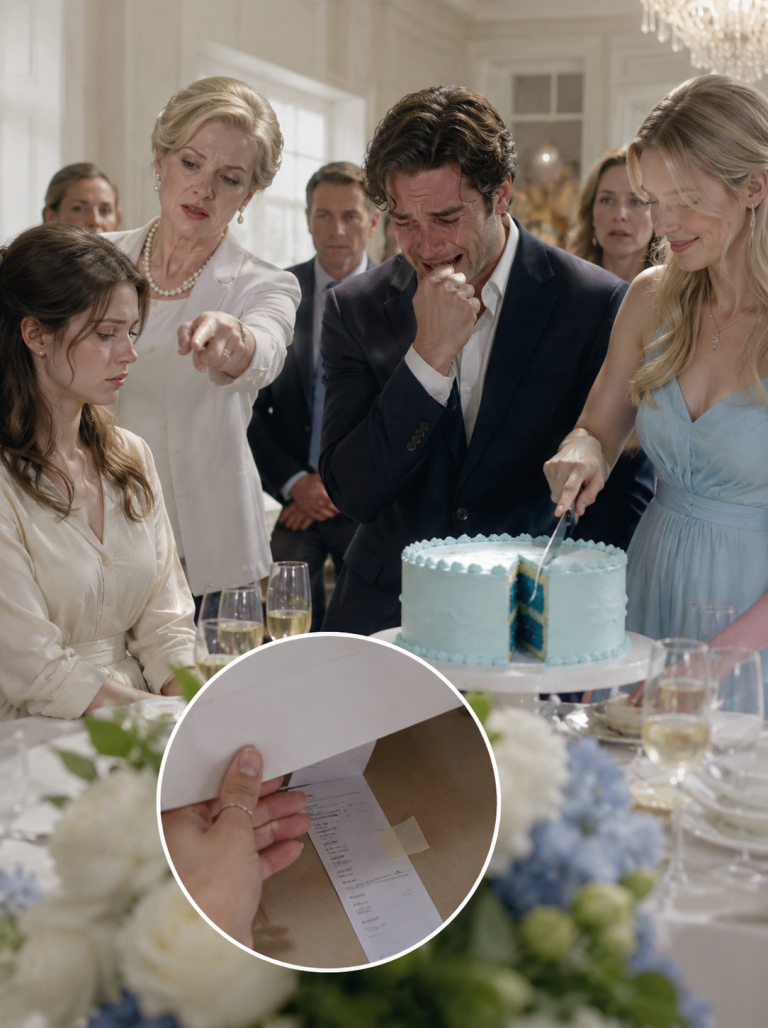
His mistress announced her pregnancy from my office chair on a company livestream. Not a gossip page. Not a blurry restaurant photo. Not a cowardly text sent at midnight. A company livestream. My bookshelves were behind her. My awards framed her shoulders. My nameplate sat inches from her left elbow, turned slightly toward the camera like even brass could be humiliated.
My husband stood beside her in a navy suit I had bought him for our tenth anniversary. He was crying. Not because he had destroyed our marriage, not because he had lied to me for almost a year, not because half of Manhattan’s private equity world was watching him burn his wife in public. He cried because she placed one hand over her flat stomach and whispered, “We’re having a baby.”
The comments froze for exactly two seconds. Then my phone began to shake across the marble counter of my kitchen. Employee messages. Board member calls. A text from my mother-in-law that said, *Adrienne, please don’t make this ugly.* A message from our CFO that said, *I am so sorry. I didn’t know this was happening.*
But I kept watching. I watched Marlowe Quinn smile from my chair before she had the right to use my last name. I watched my husband, Sebastian, lift her hand to his mouth. I watched two hundred and fourteen employees realize, in real time, that their CEO had turned an investor update into a public confession.
The stream continued. My coffee cooled beside a silver vase of white tulips. And I did not cry.
I opened my laptop. I logged into the company system with the credentials nobody remembered I still had. Then I joined the livestream and removed his admin access.
The first thing people always noticed about my office was the view — forty-six floors above Bryant Park, glass on three sides, Manhattan spread beneath it like a diamond-studded threat. But the view was never my favorite part. My favorite part was the chair. Italian leather, warm ivory, custom-built in Florence after I signed our first eight-figure acquisition. Sebastian used to joke it looked like a throne. “Careful, Addy,” he’d say, leaning in the doorway with that boyish grin that once made older women forgive his arrogance. “Sit there too long and you’ll start ordering executions.” I used to laugh. I had been young enough then to think a man could admire your power without needing to steal some of it.
The chair had become famous in our company. People took photos in it after promotions. A trade magazine once called it “the quietest seat of power in American boutique finance.” It was mine — not because I liked leather, not because I liked symbols, but because I had built Marsh Calloway Capital out of a rented conference room, one skeptical investor at a time. Sebastian’s name came first because his family already had one. Calloway was mine. Marsh was his. His father had money. My father had medical debt, a failing hardware store in Ohio, and a daughter who’d learned at thirteen that survival was not a mood.
I met Sebastian Marsh at a charity auction in Boston, where he bid fifty thousand dollars on a weekend in Aspen and then admitted he hated skiing. I was twenty-eight. He was thirty-two. He had charm, old money manners, and the restless insecurity of men who inherit doors but not discipline. I had a black dress from a consignment shop and a portfolio that made two men twice my age ask who had prepared it for me. “I did,” I told them. Sebastian laughed from behind me — not mockingly, admiringly. That was how it started. Not love at first sight. Recognition. He saw that I was dangerous. I saw that he wanted to be.
For years we worked well together. He handled rooms; I handled numbers. His family introduced us to legacy clients; I structured deals clean enough to survive divorce, death, and tax audits. By the time we married at Grace Church, the society pages called us “the new American power couple.” Nobody photographed the prenup. That was a mistake. Sebastian’s mother, Genevieve, had insisted on it through three attorneys and one lunch at a bistro uptown. “Adrienne, darling,” she’d said, slicing her sole like it had personally offended her, “you understand this is not personal. When families have assets, they protect them.” I smiled. “Of course.” She believed she was insulting me. She did not understand that poor girls read contracts more carefully than rich women read invitations.
Their prenup protected the Marsh family trusts. Mine protected everything I would ever build. It also contained a fidelity clause Sebastian had laughed at the night before our wedding. “You think I’m going to cheat on you?” “No,” I said. “I think contracts are written for the day people stop acting like themselves.” “You are terrifying.” “You love that.” “I do.”
For a long time, I believed him.
Then, at forty-one, Sebastian began staying late. A delayed flight from Chicago. A board dinner in Dallas. A “quick call” taken in the garden during my birthday party. His shirts started smelling different — not perfume, something colder, a hotel lobby candle, white tea, expensive vanilla, the kind of scent chosen by a woman who wanted to seem soft while doing hard things. I did not confront him. Confrontation is for people who need answers from liars. I needed evidence.
Marlowe Quinn was twenty-nine, blonde in the way luxury hotels are blonde, joined the company as Director of Brand Strategy. Sebastian hired her himself. “She’s sharp,” he told me. “Hungry. Reminds me of you when we started.” That was the first cruelty — not the affair, the comparison. Marlowe didn’t remind him of me. She reminded him of a version of himself he wanted to believe still existed, untouched by age, unburdened by consequence.
For eight months I collected pieces. A restaurant receipt from a boutique hotel for two tasting menus on a night Sebastian claimed to be in Boston. A security log showing Marlowe entering the executive floor after midnight. A deleted calendar invite restored by IT. A private bank transfer disguised as a consulting bonus. A photograph from a Palm Beach weekend where his hand rested too low on her back. I also had recordings — clean ones, legal ones. Our executive conference rooms had recorded automatically for compliance since a regulatory scare years earlier, a policy Sebastian himself had approved and then forgotten.
In one recording, Marlowe asked, “What happens to her when this comes out?” Sebastian laughed softly. “Eleanor lands on her feet. She always does.” “That’s not what I asked.” A pause. “She’ll be humiliated. For a while. Then she’ll negotiate.”
That sentence stayed with me. *She’ll negotiate.* As if my heart were a term sheet.
I did not tell him I knew. Instead, I made appointments — with my attorney, with the trustee of my private holding company, with the independent director Sebastian always called “your boring insurance policy.” I reviewed deeds, share classes, voting rights, employment agreements, server permissions, media access, key man clauses. Especially the prenup. Genevieve Marsh had wanted iron. I had given her a cathedral made of it.
The company, legally, was not owned the way people assumed. Sebastian held the title of CEO. I held controlling voting interest through Calloway Holdings, a private entity created before our marriage and amended twice afterward. Sebastian never paid attention to amendments. He called them “your legal origami.” He liked the stage. I owned the theater.
**PART 2**
At 10:58 a.m. on the morning of the livestream, I sat at my kitchen island in a cream cashmere sweater. Carmen, our housekeeper of eleven years, placed coffee beside me and touched my shoulder. “Señora, do you want me close?” “Not yet,” I said. She nodded and disappeared.
At exactly eleven, the stream opened. Marsh Calloway logo, white on black. Then the camera cut to my office. My stomach did not drop — that surprised me. My body simply went still. Marlowe was sitting in my chair. Not beside it. Sitting, legs crossed, hair smooth, a pale pink dress fitted just tightly enough. Sebastian stood beside her, hand on the back of the chair. My chair.
“Vale Sterling has always been more than a company,” Sebastian told the camera. “It is a family. It is a legacy. And today, Marlowe and I want to share something deeply personal.” My phone lit up — our COO, Priya Anand. *Are you watching?* I didn’t answer. On-screen, Marlowe placed her hand over her stomach. Sebastian’s voice broke. “We’re having a baby.” Then the tears came. His. Not hers.
“Eleanor and I have lived separate lives for some time,” he said. New. Bold. We had hosted Thanksgiving together six weeks earlier. “Our marriage has been privately ending. We ask for compassion as we move forward.” Marlowe nodded with moist eyes. “I have so much respect for Adrienne.” I laughed once, quietly, startled by the sound. Respect is what women like Marlowe say when they’re standing on the body but don’t want blood on the shoes.
“Marlowe will be stepping into a broader public role with the company,” Sebastian said. “We believe this family moment reflects the next chapter.”
The next chapter. I opened the company portal. My login still worked — I’d designed the founder access hierarchy in year two after a consultant tried to call “spousal founders” redundant. Sebastian had joked about it then. “Addy needs a kill switch.” Yes. Addy did.
I clicked into the livestream dashboard. Active host: Sebastian Marsh. Admin access: full. Secondary access: Marlowe Quinn, temporary presenter. Executive floor camera source: my office. I opened the permissions panel. My hand did not shake. That’s the part people never believe. They want betrayed wives to tremble, to break champagne flutes, to scream in foyers. But rage is most useful when it’s quiet enough to hear a lock turn.
I clicked “Revoke Administrative Access.” *Are you sure you want to remove executive media permissions for Sebastian Marsh?* Yes. The livestream flickered. I clicked “Remove Signature Authority Pending Review.” Yes. I clicked “Disable Internal Communications Admin.” Yes. Then I found a button labeled “Join as Principal Owner.” Nobody had used it in four years. I did.
The screen split. Sebastian and Marlowe froze. My face appeared beside theirs — a woman drinking coffee in her own kitchen, because I was. The comments exploded so fast they blurred.
“Adrienne—” Sebastian began. I muted him. *Muted by Principal Owner.* Marlowe reached for the laptop. I removed her access too. *Muted by Principal Owner.*
Then I looked into the camera. “Good morning. My apologies for the interruption. As many of you now understand, this livestream was used without board approval, without communications approval, and without my authorization. Mr. Marsh’s administrative privileges have been suspended pending review. Ms. Quinn’s access has been terminated effective immediately. Human Resources will send formal guidance within the hour. No employee is required to engage with personal disclosures made through unauthorized corporate channels. The quarterly investor update will be rescheduled under proper governance.”
Sebastian grabbed his phone. Mine began ringing. Genevieve. I ignored it. Then I said the sentence that ended my marriage more cleanly than any judge could.
“Sebastian, please leave my office.” His face changed — not anger, fear. Because he’d heard the word *my.* So had Marlowe. So had every employee. “Security is on the way.” Then I ended the stream. For three seconds my kitchen was silent. Then every phone in the house rang at once. I picked up my coffee. It was cold. I drank it anyway.
**PART 3**
By noon the board had convened an emergency call. By 12:18, Genevieve Marsh arrived at my townhouse uninvited, entering like a woman who had never learned that locks applied to her. In the library, she removed her gloves finger by finger — how Marsh women prepared for battle.
“I assume you are emotional,” she said.
“I assume you are embarrassed.”
Her mouth tightened. “Sebastian handled this poorly.”
“Yes.” That was the first honest sentence anyone in his family had said all day.
“But there is a child involved now.”
“There is a claim of a child.”
“Do not be vulgar.” “Biology is not vulgar.” “Fraud sometimes is.” She stepped closer. “You will not drag this family through court. You will not damage the company. You will not punish a baby for adult mistakes.”
I walked to the safe behind the bookcase and took out an ivory folder. “The Marsh name is not the problem. The Marsh signatures are.” I opened it. “Our agreement includes a fidelity clause, a public-disparagement clause, and a corporate conduct clause. Your attorneys insisted on all three.” Her face lost color slowly, like cream poured into black coffee.
“In the event of adultery resulting in reputational harm to Calloway Holdings or any entity under its control, Sebastian forfeits spousal claims to founder distributions, marital appreciation tied to my premarital holdings, and any executive bonus pending at the time of disclosure.” I turned a page. “In the event of misuse of company channels for personal benefit or reputation manipulation, termination for cause may be triggered by majority voting control.”
“You would fire your husband?”
“No. He fired himself on camera.”
“She is pregnant,” Genevieve tried.
“Then I hope she is healthy.”
“That child is a Marsh.”
“Perhaps.”
“You will not suggest otherwise.”
“I will request confirmation.”
“A paternity test? That is humiliating.”
“So was watching a mistress announce her pregnancy from my office chair.”
I slid a second folder across. Recordings. Receipts. Security logs. Proof of bonus misuse. Proof Sebastian moved company resources to support Marlowe’s personal brand consulting. Proof he’d planned the announcement to pressure the board before I could act. “He would not be that stupid,” Genevieve said. “No. He was that arrogant.”
“What do you want?” she finally asked.
“I want him out of my company. I want him out of my house. I want the divorce clean. I want Marlowe subject to the same investigation any employee would face after misusing corporate channels. And I want your family to stop pretending I married up.”
“You were welcomed into this family.”
“I was audited by this family. I passed because I was profitable.”
That afternoon the board placed Sebastian on administrative leave. By evening, every finance blog had the story. *CEO Announces Affair Baby on Company Livestream, Wife Cuts Feed.* A freeze-frame of Marlowe in my chair circulated with the caption: *When you steal the husband but not the login.* I saved it.
At 9:43 that night, Sebastian came home — not to apologize, men like him don’t apologize until they know what something costs. I was in the dining room signing documents beneath a chandelier we’d bought in Paris. “Ellie.” “Only your family calls me Adrienne. You call me that when you want forgiveness. You should not be here.” “This is my home.” “No. The deed is held by Calloway Holdings. You live here by agreement.” “You’re serious.” “I became serious around the time your mistress sat in my office chair.”
“That wasn’t supposed to happen like that.” “What a fascinating beginning.” “She wanted honesty. She felt hidden.” “She was.” “You don’t have to be cruel.” I looked at him a long moment. There are sentences that reveal a man’s entire architecture. *You don’t have to be cruel,* he said to the woman he’d publicly humiliated. “I suppose I could have cried on camera instead.”
“I made mistakes,” he tried. “No. A mistake is sending champagne to the wrong table. You built a second life. You funded it with my company. You filmed it in my office. Then you asked my employees to applaud.” “Our employees.” “My company.” He laughed once, sharp and ugly. “There it is. That’s what this is really about. Control.” I stood. “Yes, Sebastian. It is about control. Because when I trusted you with love, you turned it into theater. When I trusted you with power, you handed the microphone to your mistress. So now I will use the only language you still respect.”
“She’s pregnant,” he said softly. “I heard.” “It’s my child.” “Then you will have no objection to legal confirmation.” A flicker crossed his face — fast, almost nothing, but I’d spent fifteen years reading men across negotiation tables. Fear. Not fatherly fear. The kind that appears when someone realizes the lie has another witness. Security arrived five minutes later. He didn’t yell. He packed one bag while I stood in the foyer. At the door he turned. “This isn’t over.” I looked past him at the falling snow. “No. It is just finally honest.”
The next week moved like a trial before the trial. Everything had witnesses — every email, transfer, keycard swipe, hotel folio, every message Sebastian thought was deleted because rich men believe technology works like loyalty. Marlowe hired a lawyer named Simone Delacroix, glossy and reputed for turning tears into settlements. Sebastian hired three. Genevieve hired a crisis firm before she hired compassion.
At the board meeting that Friday, Sebastian arrived seven minutes late with Marlowe beside him, in winter white, one hand resting on a barely-visible stomach. Our independent director, Walter Finch, said flatly, “Ms. Quinn is not currently employed by the company and has not been invited to this closed session.” “She is central to the matter,” Sebastian said. “She is subject to investigation in the matter,” Priya replied.
The compliance report was devastating in the dullest possible way — unauthorized livestream access, misclassification of expenses, improper bonus authorization, failure to disclose a relationship with a direct report, breach of fiduciary duty. Then came the recordings. Marlowe’s voice: *”If we do it from her office, people will understand it’s real. They’ll know you chose me.”* Sebastian: *”It’ll look aggressive.”* Marlowe: *”It’ll look final. Eleanor won’t make a scene. She’ll go cold. That’s what makes people believe she doesn’t hurt.”*
The room went very still. A second clip: Sebastian, *”The board can’t remove me if employees already see Marlowe as part of the future. Optics matter.”* Marlowe: *”And the baby?”* Sebastian: *”The baby makes it untouchable.”* A third: *”What about the funding?”* *”I’ll code it through brand expansion. Nobody checks those buckets except Adrienne, and she’s been distracted with the fertility foundation.”*
There it was. The knife beneath the ribs. After five failed rounds of IVF and one pregnancy that ended with no nursery to go home to, I had built a foundation funding fertility preservation for women undergoing cancer treatment. Sebastian had stood beside me at the launch, crying there too. My grief had given him room in the budget.
My attorney, Odile Fontaine, slid a request for legally supervised paternity confirmation across the table, given the public use of the pregnancy as a reputational shield. Marlowe’s face changed — not offended, terrified. Sebastian saw it. That was the moment the affair ended — not legally, not physically, but spiritually. He looked at her and understood he was no longer the man choosing between two women. He was the mark.
The board voted before lunch. Sebastian Marsh, terminated for cause. His board seat suspended. Marlowe Quinn, under investigation.
**PART 4**
Two months later, the fertility foundation hosted its annual winter gala. I almost canceled — grief makes invitations feel absurd — but Carmen answered that for me while steaming my black gown. “You go because the women coming did not betray you.” So I went, in black velvet, high-necked, severe enough to keep sympathy at a distance.
Three weeks after the board meeting, Marlowe’s story had begun unraveling publicly, not through anything I leaked. A former boyfriend came forward through counsel. A doctor’s appointment date contradicted Sebastian’s travel records. A hotel security image placed her with someone else the night she’d claimed conception occurred. The legally supervised paternity test confirmed it: Sebastian was not the father. The father was a married venture capitalist from Austin with three children and a lake house. Marlowe hadn’t loved Sebastian. She’d selected him — rich, visible, guilty, flattered, useful. She thought a baby would secure a last name and a boardroom chair she’d mistaken for a symbol instead of a warning. The result became public only after the Austin wife filed for divorce and named her in the complaint.
Sebastian found me near a quiet gallery at the gala. “Can we speak somewhere private?” “No.” He swallowed. “I deserve that.” “You deserve several things. Privacy is not currently one of them.” His face broke. “I’m sorry. For the affair. The livestream. Marlowe. Using the company. The foundation. All of it.”
“Why did you do it?” I asked.
“I was tired of being your husband. Everyone knew you were the reason we worked — the board, the investors, my own mother. They looked at me like I was lucky. And I was. But after a while, lucky started feeling like small. Marlowe made me feel chosen. Not useful. Chosen. And I thought if the world saw her first, you wouldn’t be able to control the story.”
“Sebastian, the story was never controlled by who spoke first. It was controlled by who had the truth.”
“I know that now.” “That is the tragedy of men like you. You learn respect only after it becomes useless.” He flinched. I did not regret it. “I don’t expect forgiveness,” he said. “Good.” “But is there any world where we are not enemies?” “We are not enemies,” I said. “We are consequences.”
He left before dessert. Genevieve stayed, and found me near the staircase afterward with a small white envelope. “I made a donation. Anonymous.” “That is wiser.” A tired smile. “You have become difficult to dislike.” “I was always difficult to dislike.” “You were committed.” She took a breath. “I treated you like an intruder because you arrived without needing us. That made you dangerous. I mistook danger for disrespect.” “That is almost an apology.” “It is the closest I have given in years.” “Then I accept the effort.”
She handed me the envelope — a signed letter. Sebastian would not contest the divorce terms. No claim to the townhouse, no founder distributions, no contest to the termination triggers, no challenge to the prenup. Clean. Late, but clean.
“You won,” Genevieve said, looking toward the room where donors mingled — a young cancer survivor touching her husband’s hand, a mother showing photos of twin girls born after treatment. “No,” I said. “I survived loudly enough that other women heard it.”
That night I went back to the office. The chair sat behind my desk, cleaned, conditioned, restored. After the livestream I’d considered replacing it — burning it felt dramatic, selling it felt petty, keeping it felt impossible. Then Harper, a junior analyst, had left a note on my desk: *Don’t let her be the last woman who sat there.* So I kept it. I sat down. The leather was cool beneath my hands. Manhattan glittered outside like nothing had happened.
**PART 5**
Six months later, the divorce was finalized in a courtroom that smelled like polished wood and expensive restraint. Sebastian wore charcoal. I wore ivory — not bridal, sharper, a reminder that white isn’t only for beginnings. Sometimes it’s for evidence. No trial. No spectacle. Just signatures.
Outside, reporters waited behind barricades. Odile asked, “Side exit?” I looked at the front doors. For months people had watched me through screens and stolen clips, replaying my humiliation and calling it strength because the ending made them feel better. But strength isn’t the absence of pain. Strength is walking through the front door while carrying it. “No. We go out this way.”
“Adrienne, how do you feel today?” “Do you consider this justice?” “What would you say to women watching your story?”
I stopped at the bottom step. “I believe in contracts,” I said. “I believe in evidence. I believe in women knowing what they own before someone tries to convince them they’re only lucky to be there.” The reporters shouted again. “And yes — I still believe in love. But not the kind that asks a woman to become smaller so a man can feel tall.”
The clip went viral before dinner. Letters began arriving from women in Texas, Ohio, California, Georgia — women who’d found hidden credit cards, signed bad prenups, built businesses in husbands’ names, been told making a scene was worse than being betrayed. One came with no return address: *I checked the deed. Thank you.* I framed that one, privately, in my bedroom.
The townhouse became mine in every way that mattered. I repainted the dining room deep blue, moved the Paris chandelier to the foundation office, turned Sebastian’s cigar room into a reading room with green velvet chairs. On Sundays, Carmen and I drank coffee in the kitchen and judged the neighbors’ floral arrangements. Healing did not arrive like a movie ending. It came in small, almost insulting pieces — a morning without checking my phone, a song that didn’t hurt, a mirror that stopped looking like a witness.
Marlowe left New York before spring; the Austin wife’s lawsuit took care of the rest. I heard she rebranded herself as a wellness consultant somewhere out west. I hoped she learned that softness was not the same as safety. Sebastian moved downtown, tried consulting, then teaching, then eventually silence. Once, nearly a year later, I saw him across the lobby of Lincoln Center. He nodded. I nodded back. That was all. Some endings don’t need fire. Some just need the absence of keys.
Marsh Calloway Capital became Calloway House within the year — no hyphen, no inherited name, no ghost in the logo. At the launch event, Harper stood at the podium announcing our new mentorship fund for women entering finance without family connections. Priya became CEO. I became Chairwoman.
At the end of that night, after the champagne, after the last investor shook my hand and said, “You turned a scandal into a legacy,” I returned to my office. The chair waited beneath the city lights. For a moment I saw Marlowe there again — pink dress, soft smile, one hand on a future she hadn’t earned. Then the image vanished. Memory does that once it realizes it no longer has power.
I opened the top drawer. Inside was the old brass nameplate: ADRIENNE CALLOWAY MARSH. I had kept it not from sentiment but as a record — women are often told to erase the parts that hurt; I prefer archives. Beside it lay the new one: ADRIENNE CALLOWAY. Nothing added. Nothing borrowed. Nothing attached.
I placed it on the desk, straightened it, and leaned back in the chair that had survived ambition, betrayal, a pregnancy announcement, board votes, divorce papers, and one very expensive cleaning. Outside, the city kept glittering. Inside, everything was finally quiet. Not empty. Quiet. There is a difference.
His mistress had used my office to announce her pregnancy. My husband had used my company to sanctify his betrayal. His family had used my silence to measure how much damage I would accept. They all forgot the same thing.
I was not the woman standing outside the story, begging to be chosen.
I owned the room. I owned the system. I owned the ending.
And when the camera turned on, I did not break.
I logged in.