“Bring That Girl to Me,” the Mafia Boss Ordered—She Was the First Woman to Captivate Him in Three Years

## PART 1
The sentence that changed everything was not particularly beautiful.
I had written better ones. I knew that. Eleven months of drafting an unfinished romance in every stolen hour had produced lines I was genuinely proud of — moments of dialogue that crackled, descriptions that earned their adjectives, the specific kind of emotional precision that made my college workshop instructor say, back when I still attended workshops, *this one has something*.
The sentence he read was not like that.
It was not crafted for effect. It had come out at two in the morning on a Tuesday, when I was sitting on the floor of my apartment because my desk chair had finally collapsed, editing on a cracked phone screen while my roommate slept eight feet away. It was the kind of sentence that arrived already whole, the kind you recognized as true rather than constructed.
*She had built her whole life around being useful before anyone had the chance to find her insufficient.*
I did not think about it again for three weeks. Then I spilled wine on a man at the Trentham Foundation gala, and my phone slid from my jacket pocket, and he looked down before I could get to it.
His eyes stopped.
That was the part I could not explain. Not that he looked — everyone looked at things on the floor. But he looked at the screen the way people looked at things they were not expecting to recognize, and when I snatched the phone up and mumbled an apology and walked away faster than the situation strictly required, I spent the entire rest of the evening thinking about one question.
What did he see?
My name is Wren Calloway. I am twenty-seven. I have a novel that is almost finished in the way that a building is almost finished when the frame is complete but there is no plumbing, no insulation, and no glass in the windows. I have a café job and a catering job and a third job on weekends transcribing legal depositions, and none of them pay enough because nothing pays enough, and underneath all of it there is a book that I am trying to write my way out of the life I am currently living.
That Tuesday evening I was catering the Trentham Foundation’s annual gala at the Portland Meridian Hotel. Third floor ballroom. Seven hundred guests. The kind of event where the catering company issued three rules: do not speak unless addressed, do not make eye contact with donors, and do not spill anything.
I had kept the first two.
The third rule died when another server turned too fast with a champagne tray and knocked my elbow, sending a full glass of red wine in a clean arc directly onto the cuff of the man nearest to me.
I was already pressing a cloth against his sleeve before I looked up.
He was watching me with the patient attention of a man who had decided not to react until he understood the situation better. Somewhere in his late thirties. Dark hair, the kind of jaw that suggested architectural intent. He was wearing a charcoal suit over a white shirt, and the wine had soaked through to the elbow in a widening stain.
Then I registered his eyes. Light gray, pale, the color of winter sky before dawn breaks, and absolutely still in a way that read less like calm and more like something calm had been chosen over.
I had written characters with eyes like that when I needed to show someone who had gone very quiet inside.
“I’m so sorry,” I said.
He looked at the cloth in my hand, then at the wine, then at my face, in that sequence.
“It’s fine,” he said.
His voice had the quality of someone who did not waste things, including volume.
“I can press directly on the fabric—”
He took the cloth from my hand. Not unkindly. Simply. The way people take things they have decided to manage themselves.
That was when my phone slid from my pocket.
It hit the marble face-up, screen bright, my novel open on the current chapter. One sentence visible. He looked down.
I reached for the phone at the same time he read.
His eyes stopped moving.
I picked it up. Screen down. Walked away without finishing the apology.
—
Three hours later I was loading dishes into the catering van with aching feet and the specific exhaustion of a person who has been invisible for an entire evening, and I was not thinking about his eyes. I was thinking about the sentence he had read, and whether it was good, and what it meant that a stranger’s reaction to one line of my unpublished novel was more interesting to me than anything else that had happened all night.
I did not think about him at all.
I thought about him the entire drive home.
His name was Declan Voss.
I found that out nine days later when my catering manager called to say that a guest from the Trentham gala had left a message asking whether any staff member had dropped a personal item.
“Did you lose anything?” my manager asked.
“My phone. I picked it up.”
“He said the screen had an app open. Something about a book.”
“It was my phone. I picked it up.”
My manager paused. “He left a contact. Said if the person was interested in a conversation, he could be reached. Name is Declan Voss.”
I looked up the name during my lunch break with the focused attention of someone who already suspected they were not going to find anything reassuring.
Declan Voss. Forty-two. Founder and primary partner of Voss Capital, a private investment firm that had operated out of Portland and San Francisco for the last twelve years. On paper: impeccably legitimate, selectively public, the kind of person whose name appeared in foundation donor lists and architectural preservation grants rather than headlines.
Off paper: two investigative pieces from four years ago, both from the same journalist, both describing a man who acquired struggling companies with a patience that made the acquisitions look like rescues and the outcomes look like something else. Nine hundred people, across four companies, displaced over eighteen months. The inquiries had concluded. The journalist no longer wrote about business.
I put my phone away.
I was not going to call.
I called five days later.
His assistant answered. There was a transfer, a pause, and then his voice — the same contained quality I remembered from the ballroom, but closer now, without ambient noise.
“The sentence,” he said.
Not hello. Not his name.
“What about it?” I said.
“I’d like to know what comes after it.”
Something moved in my chest — the specific, unwanted feeling of being taken seriously by the wrong person.
“It’s not finished.”
“Things worth reading usually aren’t.”
“You can’t read an unfinished manuscript.”
“I’m not asking to read it,” he said. “I’m asking to meet the person who wrote that sentence.”
I should have said no. I said, “Why?”
His pause was the kind that contained something real.
“Because for the last four years,” he said, “I have been interested in nothing. Then I read one sentence written by a woman who was trying very hard not to be noticed.”
I looked out the café window at the rain on the street.
“That’s not an answer,” I said.
“It’s the only honest one I have.”
I agreed to meet him the following Tuesday. West Burnside Library, reading room, four o’clock. My choice of location, which felt important even if I was not sure why.
I told my roommate Petra that evening.
She looked at the search results on my phone.
“Wren,” she said.
“I know.”
“This man dissolved a paper mill that had been operating for sixty years.”
“I know.”
“The whole town lost their jobs.”
“I read that part.”
“And you’re meeting him at a library.”
“It’s public.”
“So is a parking garage. That doesn’t make it safe.”
I stacked the printed pages of my first chapter — twenty-three pages, revised until two that morning, the best version I could produce — and looked at them.
“I’m going because he stopped,” I said.
“Stopped what?”
“Reading. He stopped, Petra. At that line. He didn’t skim it and look up. He stopped.”
She was quiet for a moment.
“Send me your location,” she said finally.
“I will.”
“And don’t get in a car.”
I arrived twenty minutes early. Ordered nothing. Sat with the pages face-down on the table in front of me and watched the door.
He arrived at exactly four.
He did not look like he belonged in the West Burnside Library, with its split vinyl chairs and the retired man sleeping near the periodicals rack. He looked like someone who had decided where he was going and arrived there with complete conviction regardless of context. Dark coat, dark suit, no tie. His presence moved through the room before he did.
The librarian at the desk looked up. Then deliberately looked down.
Declan saw me and crossed the room without detour.
“Wren,” he said.
Not *Ms. Calloway*. Not a question.
My name in his mouth was a different thing than my name anywhere else.
He sat across from me.
I pushed the pages toward him.
“First chapter,” I said. “One hour.”
He took the pages without comment and began to read.
I had expected questions. Commentary. The specific condescension of powerful men encountering things they did not normally encounter and performing appreciation. I had not expected silence. He read like the room had been excused, like every word was receiving the same quality of attention he had given the single sentence on my phone screen. On page four, his thumb stilled. On page nine, he went back and reread something. On page sixteen, the line of his jaw tightened.
I watched him and told myself I was not watching him.
When he finished, forty-one minutes had passed.
He set the pages down.
“Well?” I asked.
“It’s good.”
“That’s insufficient.”
His eyes came up to mine.
“Your heroine is afraid of her own capability,” he said. “Your hero is afraid of wanting something he can’t acquire. That’s the actual tension. But you keep softening it.”
I blinked. “I’m writing romance. Softness is the point.”
“Softness is the arrival. You’re giving it before the journey earns it.”
“You’ve read one chapter.”
“I’ve read enough to know you’re protecting them from what they are.”
Heat moved up my face. “That’s an arrogant—”
“Yes,” he said.
No qualification. No reversal.
I looked at him across the library table.
“Why do you care?” I asked.
He was quiet for a moment that carried real weight.
Then he said, “My wife died two years ago.”
The words rearranged the air.
“I’m sorry.”
“I don’t want that.” Not harshly. Just accurately. “I want to tell you that since then, I haven’t been interested in anything unfinished. Everything I looked at had already ended. Your chapter is — it’s alive in the middle. I don’t encounter that.”
I looked at the pages between us.
“What are you proposing?” I asked.
“Three months,” he said. “Quit the café. Stop the catering. I cover your expenses. You finish the book.”
The room seemed to contract.
“No.”
“You haven’t heard the terms.”
“I don’t need to.”
“No creative control. No ownership claim. No royalties.”
“Then I don’t understand what you want.”
He looked at me with the pale, still eyes.
“I want to see what you write when you stop surviving long enough to write.”
No one had ever named it like that before.
Surviving.
The word that fit the thing I had been doing.
He placed a card on the table. “Send the contract to someone you trust. I’ll pay for independent review.”
I stood. Gathered the pages.
“Declan.”
He looked up.
“Why me?” I asked. “Specifically.”
For the first time since I had met him, his face moved in a way that wasn’t controlled.
“Because nothing about you is performing,” he said.
I left without taking the card.
I went back and picked it up from the table on my way out.
—
## PART 2
The eviction notice arrived on a Thursday.
Not a warning. Not a gentle letter from the building management asking us to discuss a payment plan. A formal notice, the kind with specific legal language and a timeline, taped to the door at eye level so we would see it immediately.
Petra found it first. She held it out when I came home from a double shift still in my work clothes, and her face had the expression of someone who has used up all their elasticity on a problem and arrived at a place past surprise.
“How bad?” I asked.
“Bad enough,” she said.
We sat at the kitchen table with the notice between us and went through the arithmetic we had already gone through three times that month. Numbers that did not resolve regardless of how we arranged them.
At midnight, after Petra had gone to bed, I took Declan’s card from my coat pocket.
The card was cream-colored, heavy stock. His name embossed, not printed. An email address.
I opened my laptop.
The fan started its familiar complaint.
I typed: *Send the contract.*
His reply arrived eleven minutes later.
*You’ll have it by morning.*
No enthusiasm. No relief. Just confirmation.
The contract arrived via a law firm I did not recognize. By afternoon, a separate attorney — one specifically retained for me, demonstrably unconnected to Declan’s firm — had called to walk me through it.
“This is unusual,” she said.
“That seems to be his default.”
“It is also, structurally, very clean. He receives nothing from the work. You’re required to complete a manuscript draft within ninety days and meet with him weekly. There’s a confidentiality clause regarding the meetings.”
“What kind?”
“Don’t publicly discuss his involvement. Don’t sell the details. Don’t share specifics of your conversations.” She paused. “You’ll be fine if you’re not planning to monetize the association.”
“I’m planning to write a novel.”
“Then sign it.”
I signed.
The first payment arrived within the hour.
I quit the café with shaking hands the next morning.
The eviction notice was resolved by end of day.
Petra stood in the kitchen looking at me with an expression I recognized as gratitude wrapped in worry.
“Who is he?” she asked.
“I don’t entirely know yet.”
“Should you know before taking his money?”
“Probably.”
She thought about this.
“Send me your location,” she said. “Every week. Every meeting.”
“I will.”
“And if something feels wrong—”
“I’ll leave.”
She nodded. Then, more quietly: “Go write your book, Wren.”
—
## PART 3
The first week of freedom ruined me.
I woke at five-thirty from habit, sat at my desk with coffee going cold beside me, and stared at a document that suddenly felt enormous. Without the scaffolding of exhaustion — without the ten-minute lunch breaks and the midnight sessions against a deadline of my own fatigue — the novel expanded to fill every room in the apartment. It became the air. I wrote three sentences, deleted them, wrote them again, deleted them again, and by noon had produced less than I typically wrote on a Tuesday morning between orders.
The second week was slightly better.
The third was when I found a rhythm.
Morning drafting. Afternoon revision. Evening walks along the waterfront that were ostensibly for clearing my head and were actually for thinking about the next chapter without the pressure of a blank screen.
And every Friday at three, Declan.
He always arrived before me, which I attributed less to eagerness and more to the way someone organized their time when they had stopped believing in wasted moments. We met in a private study room at the library — the same one each week, frosted glass walls and a table that had absorbed decades of initials and coffee rings. He would read whatever I had brought that week, make notes in the margins with a fountain pen, and then we would talk about the work.
His notes were infuriating and almost always correct.
*She already knows this. Why does she pretend not?*
*The reader needs to feel his control as a survival mechanism, not a character flaw.*
*You’re writing around the fear again. Write into it.*
Week four, I pushed the pages across the table and watched him read and thought about the fact that I was being paid by a man who had acquired companies the way other men collected things, who had been the subject of federal inquiries that concluded without charges, and who read fiction the way a forensic analyst read evidence.
“You’re staring,” he said without looking up.
“I’m thinking.”
“About the chapter?”
“About you.”
He finished the page before responding.
“What specifically?”
“The journalists who wrote about your acquisitions. The one who stopped writing about business afterward.”
He set the pen down.
“Her name is Rachel Osei. She moved to documentary work. Her choice, not mine.”
“You didn’t threaten her.”
“No.”
“But she stopped.”
“Sometimes people decide that the story they’re capable of telling isn’t the story that exists.” He looked at me steadily. “She knew what she had, and she knew what she didn’t have. She stopped because she was accurate about the difference.”
“Is that what happened? Or is that the version you’ve decided to live with?”
His jaw tightened.
“Both,” he said. “Probably.”
That was the quality I kept encountering in him — the willingness to let an uncomfortable answer stay uncomfortable rather than resolving it into something cleaner.
The weeks accumulated.
The novel changed. My heroine stopped deferring in ways that cost her the story. My hero stopped being managed into legibility — his control revealed as the architecture of someone who had learned very young that wanting something was the fastest route to losing it. The tension between them stopped being neat.
Something else accumulated too, which I refused to name for as long as possible.
Week seven, I arrived at the library early and heard him through the study room door before I opened it.
“Tell him the Portland account moves Sunday,” he said. “If he touches the Harmon line before then, he loses the whole arrangement.”
I stood with my hand on the door.
He heard the pause, finished the call, and opened the door himself.
He looked at me.
“Business,” he said.
“Which kind?”
He stepped back to let me in.
“Sit down, Wren.”
“I don’t want to sit down.”
He sat across from me.
“My father built things that were not entirely legitimate,” he said. “When he died, I inherited them alongside the legitimate parts. I’ve spent twelve years trying to separate those layers.”
“And the acquisitions? The nine hundred people?”
“Three of those companies were being used as transit infrastructure for things I needed to dismantle. The people lost jobs because I dismantled the infrastructure. I tried to mitigate that. I failed at some of it.”
I looked at him.
“Is that the full story?”
“That is the honest version of the partial story I’m able to tell you.”
“What’s in the part you’re not telling me?”
He held my gaze.
“My sister.”
The word landed differently from everything else he had said.
“Where is she?”
“I’ve been trying to find that out for three years.”
I set my pages on the table.
“Tell me.”
He told me.
Her name was Nadia. Younger than him by five years. She had spent the better part of a decade documenting the layers he described — the legitimate surface, the inherited infrastructure beneath, the men who had operated in both spaces simultaneously. She had built files, followed money, mapped routes that appeared in charitable foundations and transportation contracts and private club memberships.
Three years ago, she had disappeared before she could do anything with what she had collected.
The man she had been building a case against was named Brennan Fosse.
Declan’s father’s oldest partner.
“He has her,” I said.
“Yes.”
“How do you know she’s alive?”
“Because he sends me proof on the anniversary of her disappearance. Every year.” His voice stayed level. “He wants me to know I have something to lose. He wants me to know he’s been patient.”
The room felt very small.
“What does he want?”
“He wants the files she collected. He wants confirmation that they’ve been destroyed. And he wants me to give him access to two specific financial structures that would effectively make certain movements untraceable.”
“You haven’t done it.”
“No.”
“Because?”
“Because even if I gave him everything he asked for, he would not return Nadia. That is not how people like Brennan Fosse operate. He would have what he wanted and two handles instead of one.”
I absorbed this.
“Why are you telling me this?”
Declan looked at me for a long moment.
“Because last week I read your new chapter,” he said. “The scene where your heroine stops letting the hero manage the story. Where she decides to be in the room instead of adjacent to it.”
“That’s a novel.”
“It came from somewhere real.”
I looked at my hands.
“You wrote something true,” he said quietly, “and then you watched me read it. That’s not a writer who wants to be protected from difficult things.”
I said nothing.
“Brennan will make contact soon,” Declan said. “He has a pattern. The annual proof of life, then three months of silence, then a request. The third anniversary is in ten days.”
“And you’re telling me because?”
“Because Nadia’s files are still out there,” he said. “She hid them somewhere I haven’t found. And she left something for me — a message, encrypted, that I’ve had three years to partially decode. It references a book.”
I looked at him.
“Not yours,” he said quickly. “A real one. A specific edition of a specific novel, which I believe contained the key to her file locations.”
“Why are you telling *me* this?”
He was quiet for a long moment.
“Because the book she referenced was a romance,” he said. “And the line she used in the encryption was the same line you wrote on your phone that night.”
The room went completely still.
“That’s not possible,” I said.
“She quoted it two weeks before you ever wrote it.”
I stared at him.
“Declan.”
“I know.”
“That is not—”
“I know how it sounds.”
“How?”
He reached into his jacket and placed a photograph on the table.
A woman. My age, roughly. Dark hair, lighter eyes. Standing in front of a library — a different library, a different city, sometime in what looked like late autumn. She was holding a book.
The book’s title was partially visible.
A romance novel.
One I had read in college.
One I had underlined in several places, including one line in the second chapter that I had thought about for years without knowing why, and that had surfaced, three years later, in my own manuscript as if it had always belonged to me.
*She had built her whole life around being useful before anyone had the chance to find her insufficient.*
“Nadia wrote that line,” Declan said.
“In that book.”
“In the margin of that specific edition.” He looked at me steadily. “Which I lost track of three years ago, before she disappeared.”
I pressed my hand flat on the table.
“Where is the book now?”
“That,” he said, “is what I need your help to find.”
—
The photograph of Nadia had been taken outside the Powell’s City of Books on West Burnside, which was four blocks from where I was sitting.
I pointed this out.
Declan nodded once.
“I’ve had someone checking Powell’s inventory for two years. There are three copies of the edition she had. None of them have her handwriting.”
“She donated it,” I said.
“Or sold it.”
“Or gave it to someone.”
“Or hid it somewhere in the store.”
I stood up.
Declan stood at the same time.
“Wren—”
“Powell’s closes at eleven,” I said. “It’s five-thirty.”
We went.
Powell’s City of Books was the kind of place that required a map and rewarded getting lost. Five floors, nine color-coded rooms, a system that had evolved over decades into something that made sense only to people who had surrendered to it. The romance section occupied part of the Rose Room on the second floor.
I went straight to the shelf.
The edition was a mid-nineties paperback with a specific cover — a woman in profile against a grey sky, the title in raised lettering that had mostly worn away on older copies.
There were three copies of the relevant edition.
The first two were clean.
The third had a small pencil mark inside the front cover. Not words. A symbol. And beneath it, in handwriting that Declan went completely still looking at, three numbers.
A storage unit. A facility near the waterfront. A locker number.
He looked at the handwriting for a long time.
“That’s hers,” he said.
I put the book under my arm and carried it to the register.
“I’m buying it,” I said.
“Wren—”
“She put it here for someone to find. That someone bought it.”
He did not argue.
—
The storage facility was a low concrete building near the Willamette, the kind that had no personality and no distinguishing features, designed to hold things without drawing attention to the fact that it was holding them.
Declan had called someone during the drive. Two men were already at the facility entrance when we arrived, standing with the particular stillness of people who had learned to be invisible at speed.
“Stay close,” Declan said.
“I’m not staying outside.”
“That wasn’t what I meant.”
The locker was in a back corridor, under low fluorescent lights that hummed at a frequency that felt slightly wrong. Declan had the code from the numbers in the book.
The locker opened.
Inside were three sealed boxes.
Declan crouched in front of them.
His hands were not entirely steady.
He opened the first box.
Files. Printed documents. Photographs. Bank statements with routing numbers annotated in Nadia’s handwriting. A USB drive. A small notebook.
He lifted the notebook.
On the inside cover, in the same handwriting as the storage locker numbers, was a note.
*Declan. If you’re reading this, you found the right person to help you look. Don’t make the mistake of protecting her from what you are. She already knows.*
He turned the page.
The next page was a letter to him.
I stepped back.
“I’ll wait outside,” I said.
“No.” He looked up at me. “Stay.”
I stayed.
He read the letter standing, and I watched the contained quality of his attention do something I had not seen it do before — absorb something that cost it, and not manage the cost away.
When he finished, he held the letter with both hands for a moment.
Then he looked at me.
“She’s in Portland,” he said.
I went still.
“She was moved six weeks ago. Brennan moved her when the anniversary approached — he always moves her before contact, in case I’ve found the location.” His voice was controlled but his face was not. “She left this here eight months ago because she believed I would eventually find it, and she wanted me to have the information before the next contact.”
“Does she say where in Portland?”
“She doesn’t know exactly. She knows the building structure, the general area, the number of people guarding her.” He folded the letter carefully. “She left me enough to find her.”
“Then we find her.”
“Wren—”
“Declan.” I looked at him directly. “She put a sentence in a book. The same sentence I wrote without knowing I was writing it. Whether that is coincidence or not, I am in this now. Don’t manage me out of it.”
The fluorescent light buzzed.
He looked at me for a long moment.
“All right,” he said.
—
What followed was not a story I can tell fully here.
Some of it belongs to the people who were inside it. Some of it involves specifics that attorneys advised me, very firmly, to leave in their current legal ambiguity. What I can tell you is that Nadia was found, and that she was alive, and that the process of finding her took eleven days and involved information she had spent three years collecting.
Brennan Fosse was arrested on a Tuesday morning, thirty-seven miles south of Portland, at a property that appeared in three different corporate registrations under three different names. He was accompanied by two men who had, it turned out, been employed through a foundation that Nadia had documented in the second box in that storage locker.
The documentation that made the case was Nadia’s.
The corroboration that made the documentation admissible came from sources that had taken Declan twelve years to develop in his effort to separate the inherited layers of his father’s life from the ones he had built himself.
Nadia came home in January.
She was thin and she moved carefully for the first few weeks and she had opinions about everything with the specific ferocity of someone who had been silent for too long and was making up for it.
The first evening she was home, Declan made dinner and neither of them said very much and Nadia kept looking around the kitchen the way people looked at things they had been afraid of not seeing again.
I was there. He had asked me to be.
“You’re the one who found the book,” Nadia said.
“He found the photograph.”
“He’s been staring at that photograph for three years. He needed someone who didn’t know what they were looking for.”
I looked at her.
“You wrote that sentence,” I said.
“In a margin.”
“I wrote it in a manuscript.”
She tilted her head.
“Where do you think sentences come from?”
I did not have an answer for that.
She smiled. It was a slightly exhausted smile, but it was real.
“Finish the book,” she said.
—
I finished it in March.
Ninety-one days from signature to completed draft. One day over the contract deadline, which Declan had waived in writing before I even asked him about it.
The night I typed the last chapter, I sat for a long time in the dark with my laptop open on the closing paragraph, not ready to close the file.
Petra came out of her room at midnight, found me there, and wordlessly made tea and sat across from me.
“Done?” she said.
“Done.”
She looked at my face.
“How does it feel?”
I thought about it.
“Like finishing is not the end of anything,” I said.
She nodded, the way she nodded at things that made sense without requiring explanation.
Declan came to collect the manuscript the next afternoon.
Not digitally. In person. He knocked and I handed him the printed pages in a rubber-banded stack, and he held them with both hands the way he had held the pages I’d brought to the library weeks ago.
“The title,” he said.
*The Invisible Architecture*, I had called it, which was a title I had been circling for months and had finally committed to on the last night of drafting when I understood that it was about the structures people built to survive being seen, and what happened when those structures became less necessary.
“Yes,” I said.
He looked at the cover page.
He looked at me.
“I want to tell you something,” he said.
“All right.”
“When you said you would finish this, I believed you. But I did not expect—” He stopped. “I did not expect it to matter this much.”
I leaned against the doorframe.
“The book or the finishing?”
“Both.”
“Declan.”
He looked up.
“You’re not going to tell me this is where the arrangement ends.”
Something in his expression moved.
“The contract ends,” he said carefully.
“That’s not what I asked.”
He was quiet for a moment.
“I don’t know how to do this without it becoming something I own,” he said. “I don’t know how to want something and not turn it into an acquisition.”
“I know,” I said.
“That should worry you.”
“It does.”
“Then—”
“I’ve spent eleven months writing a novel about exactly this problem,” I said. “I understand the architecture of it from the inside. Don’t tell me what should worry me.”
He stood in my doorway holding my manuscript.
“What are you saying?”
“I’m saying that whatever you inherited from your father is not the same as what you built,” I said. “And I’m saying that I wrote a book about a man who confused possession with protection, and the revision process taught me the difference.” I held his gaze. “Don’t be the version of yourself that acquired things. Be the version that found a sentence in a library and stopped.”
He was quiet for a very long time.
“I stopped because it was true,” he said.
“I know.”
“Because it was the truest thing I had read in years.”
“I know.”
He set the manuscript carefully on the table inside my door.
“There’s something I want to show you,” he said.
He reached into his jacket and produced a document.
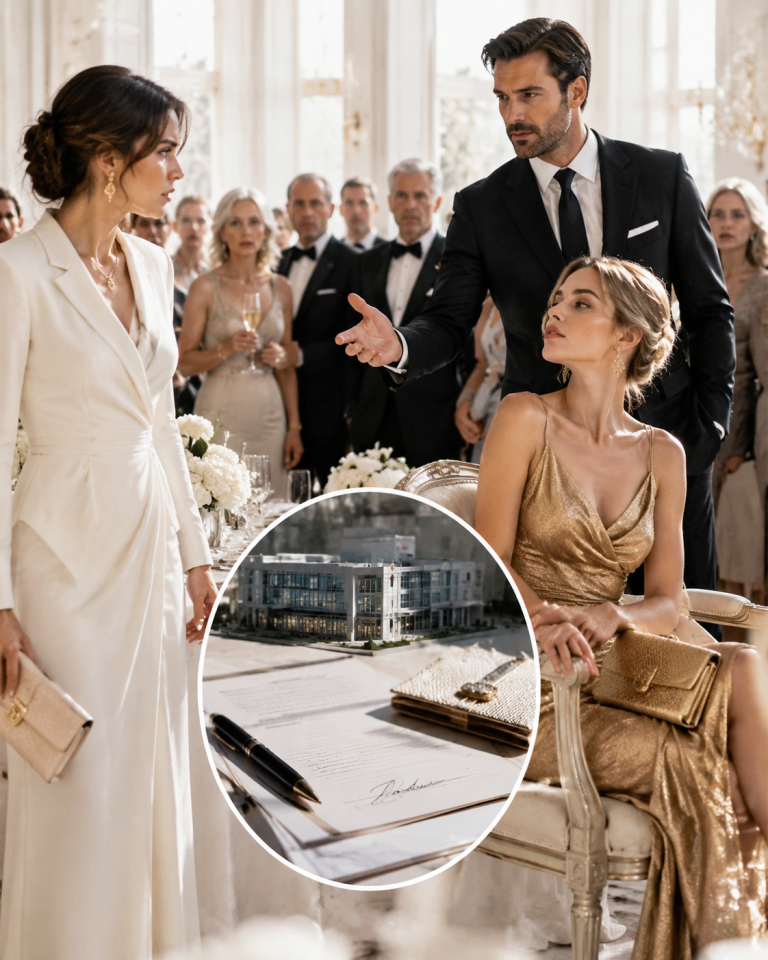
Property deed. A building near the Pearl District. An old performance space that had been closed for renovation.
“Nadia wants to use part of it for the documentation center she’s building — an archive for whistleblowers and investigative journalists. She has significant opinions about how that should work.” He paused. “I thought the rest might become a writing center. Workshops. Residencies. A place for people who have something to say and need time and space to say it.”
I looked at the deed.
“That’s a very large gift.”
“It is.”
“Why?”
“Because a writer’s center named for a woman who spent three years in a storage locker seemed like the right kind of ending.”
I looked at him.
“Nadia isn’t ending,” I said.
“No.” He smiled. Very slightly. “Neither are you.”
I took the deed.
It was warm from his jacket pocket.
“This is still impractical,” I said.
“I hired practical people.”
“You always do.”
Outside, Portland was doing what Portland did in March — not raining, exactly, but thinking about it, the air carrying the particular weight of weather not yet committed. The kind of day I usually spent inside writing.
I was going to spend a lot more days inside writing.
I looked at the man in my doorway who had read one sentence and stopped, who had spent twelve years trying to separate inherited darkness from built light, who had asked me to write freely and then had the grace to mean it.
“One condition,” I said.
“Name it.”
“Don’t call them acquisitions. Call them what they are.”
He considered this.
“And what are they?”
“Things you chose,” I said. “There’s a difference.”
He held my gaze for a moment.
Then he said, quietly, “Yes.”
—
The novel was published eight months later.
The Invisible Architecture. By Wren Calloway.
The dedication page read: *For the sentence that found me before I wrote it. And for the people who understood why that mattered.*
At the launch event, held in the renovated building near the Pearl District — half documentation archive, half writing center, fully Nadia’s domain — I stood at a microphone in front of more people than I had ever spoken to and read from the first chapter.
When I looked up from the page, Declan was standing near the back wall.
He did not need to be at the center of things to be in them.
I had learned that about him.
After the reading, in the small crowd outside in the not-quite-rain of a Portland evening, Nadia appeared at my elbow with a glass of wine and the expression of someone who had strong opinions about how the evening was going.
“You forgot the acknowledgments,” she said.
“I didn’t forget anything.”
“You thanked your roommate and your former catering manager and some woman named Rachel Osei, which I respect, but you did not thank the person who found you.”
“He found a photograph,” I said. “I found the book.”
“You found each other,” she said, which was embarrassingly accurate and which she clearly knew.
Declan appeared beside me a moment later with two glasses and the expression of a man who had been quietly waiting for the right moment in the way he waited for most things.
“Good reading,” he said.
“You’ve heard it before.”
“I read the draft four times.”
“That’s obsessive.”
“Yes.”
I took the glass.
We stood together in the not-quite-rain while Portland moved around us and the building behind us housed the kind of stories that needed to be told and the kind of archive that made sure they survived.
I had spent eleven months writing my way out of the life I was living.
I had not expected to write my way into a different one.
But that was the thing about sentences — you did not always know where they were going when you started them.
You wrote the first word.
You wrote the next.
And somewhere in the middle, if you were honest enough and the light was right, the sentence told you what it was.
—
**THE END**