A TOWN CAGED HER AND CHARGED STRANGERS TO TOUCH THE “MONSTER” — THEN ONE RIDER THREW GOLD ON THE TABLE AND ASKED HER NAME

PART 1
*The Widow. The Beast in the Square. The Monster That Should Have Been Hanged.*
A rough sign nailed to the bars dared anyone with money to come closer. Crooked black letters, shouting from the boardwalk for all of Willow Creek to see: **$10 TO TOUCH THE GIANT WIDOW.**
The cage sat dead center of the dusty main street, where ranchers used to tie their horses. Now it was the only show in town. Children rode their fathers’ shoulders to get a better look. Women clutched their shawls and whispered behind gloved hands. Young men laughed too loud, shoving each other toward the bars to prove they weren’t afraid.
Beside the cage, the sheriff sat at a small table, happily stacking coins into neat little piles.
Inside the bars sat Martha Cain.
She was as tall as most men, broad through the shoulders, years of hard work built into thick muscle along her arms and back. Her blonde hair hung loose and dull around a face that had once held softer lines — every angle sharpened now by strain and weather. She sat on a plain bench, hands locked together in her lap, eyes fixed on a worn patch of dirt near her boots.
She did not pace. She did not shout. She did not rattle the bars.
She just sat there, still as stone.
On a hot afternoon with dust hanging thick in the air, a lone rider came over the rise and into town. His name was Jake Morrison. Trail dust coated his hat, his coat, his boots. His jaw carried several days of stubble, and his gray eyes held the heavy, buried look of a man who had already lost too much.
He’d only meant to buy supplies and ride on. But the tight ring of bodies in the square, and the sight of an iron cage at its center, made him slow his horse.
He guided the animal closer until he could see the woman inside. The noise of laughter and shouting washed past him, but his attention locked on the still figure on the bench. He noticed Martha before he even noticed the sign. Even locked up, she kept her back straight, her shoulders squared. Her eyes — pale blue, like winter sky — stayed fixed on that same patch of ground, as if it were the only safe place left in the world.
She looked like a woman who had decided, a long time ago, that feeling nothing hurt less than feeling everything.
A skinny boy near the front bent down, grabbed a rock, and flung it at the cage. It slammed the bars with a sharp clang that made several women gasp. The crowd roared and pushed the boy forward like a hero.
Martha did not blink. Her hands did not move. She gave them nothing.
Somehow that made their cruelty worse.
Jake’s teeth pressed together. His hands tightened on the saddle horn. He knew exactly what it felt like to have people poke at your pain for sport.
Two years earlier, he’d buried his wife Sarah, and the baby she carried, both taken by fever in one long night that left him standing over two fresh graves with nothing left inside his chest. Since then he’d ridden from job to job, drinking too much, picking fights he half-hoped he’d lose.
When he looked at Martha Cain, he saw the same hollow ache behind her eyes. She had lost everything, and then been punished for surviving it. In that moment she stopped being a wild story he’d heard in some saloon. She became someone whose pain matched his own.
The sheriff, thick-bellied, badge crooked on a stained vest, lifted his hands for order and gave the crowd the same speech he gave every day. The town council had spared Martha from the rope and locked her in the cage instead. Every ticket, he reminded them, bought boards and nails for the new schoolhouse. A dollar to look. Ten dollars to touch. All for the good of Willow Creek.
People cheered like they were doing charity instead of cruelty.
Jake swung down from his horse. He stepped onto the wooden platform wrapped around the cage, boards creaking under his boots. Up close, he could see faint scars along Martha’s knuckles, purple shadows beneath her eyes, her shoulders trembling just slightly, as if holding herself together cost more strength than any fistfight.
For a long moment she didn’t look at him.
Then, slowly, her gaze lifted from the dirt and found his. The roar of the crowd faded to a dull hum. All Jake felt was that stare — anger in it, and fear, and a fierce will that refused to break. And underneath all of it, a grief that matched his own.
Something inside him, dead and cold for two years, shifted for the first time.
Without planning it, Jake turned toward the sheriff.
“How much,” he said.
The sheriff called back that it cost ten dollars to touch the giant widow.
Jake shook his head. His voice, when it came, was calm enough to carry across the whole square.
“How much to buy the woman in the cage.”
Silence dropped over the town so fast it felt like the air had gone thin. People stopped talking mid-sentence. Even the flies over the horse trough seemed to pause.
Martha’s eyes widened, just a little.
PART 2
The sheriff gave a short, shaky laugh. Said she wasn’t for sale — said she was serving her sentence.
“Everything in this world has a price,” Jake said, and reached into his coat.
He pulled out a leather pouch and poured gold onto the sheriff’s table. The coins flashed in the sun — more money than most families in Willow Creek would see in a lifetime. Jake asked again, quiet but firm. “How much.”
The sheriff stared at the pile. Jake could almost see the numbers turning behind the man’s small eyes — the schoolhouse, his own pockets, the trouble of keeping a woman like Martha locked up much longer. At last he named a figure that made the crowd gasp.
“Five hundred dollars.”
Jake didn’t haggle. He counted the coins with steady hands and pushed them across the table. Five hundred dollars could buy land, or clear old debts. Jake was handing it to a stranger in chains.
When the last coin dropped, the sheriff snatched the pouch and declared the deal done, fumbling the ring of keys at his belt.
Jake went back to the cage and knelt so his face was level with hers. The crowd pressed in again, hungry for the next twist. Martha watched him with confusion and defiance — a cornered animal with no reason left to trust anyone.
“Your name,” he said, soft.
It came out rough and low, like she hadn’t used it in a long while. “Martha.” A pause. “Cain.”
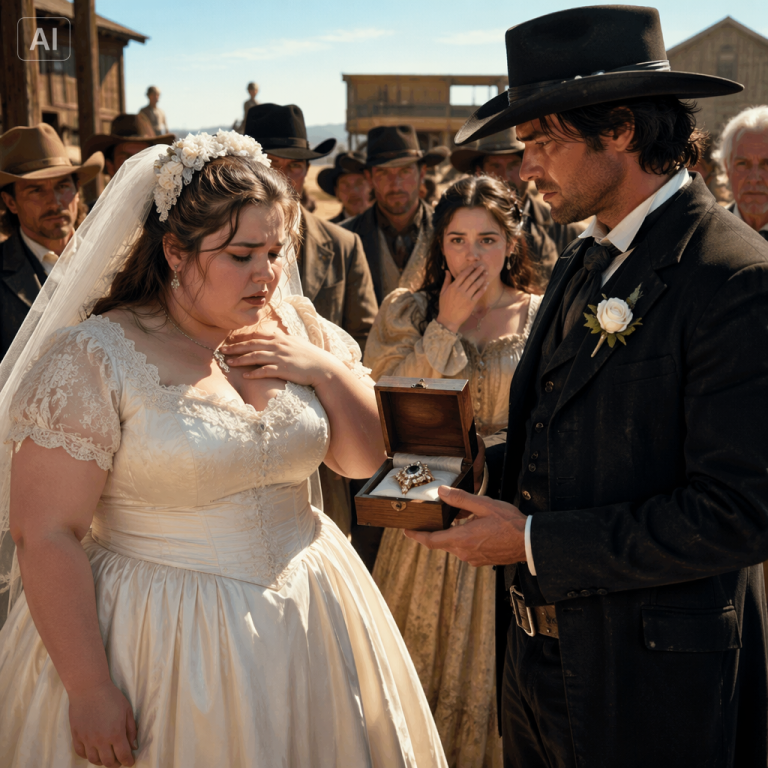
He told her his own name. Then he reached into his vest and drew out a simple gold band, old but carefully polished — his grandmother’s ring, carried in his pocket since Sarah died, waiting for a future that never came. He opened his palm so Martha could see it. So the whole town could see it gleam.
There, on his knees before the cage, with all of Willow Creek watching, Jake Morrison asked Martha Cain to be his wife.
For one heartbeat, nobody moved.
Then the square exploded. Women screamed. Men cursed and laughed. Children started crying. The whole crowd surged toward the cage like a wave, and in the middle of all that noise, Martha’s lips moved around one cracked word, her throat barely remembering how to make it.
“Why?”
Jake stayed on one knee in the dust. He didn’t smile. Didn’t play to the crowd.
“I don’t believe any human being should be locked up like an animal,” he said. “I know what it feels like to wish you could disappear from the world.”
Martha studied his face, searching for the trick. Men had laughed at her before. Made sport of her tears, her strength. All she saw now was a worn cowboy with tired gray eyes — a man who had buried someone he loved and never truly climbed back out of the ground behind them.
Then the blacksmith shoved forward through the crowd, leather apron streaked with soot, face burning red, a finger jabbed at Martha’s chest.
“She murdered my brother!” he shouted. “She deserves a rope, not a husband!”
And the crowd roared its agreement, hungry for more punishment.
PART 3
Martha lifted her head.
For two long years she had sat inside that cage and listened to other people tell her story for her. Now her voice cut through the noise — rough, but steady.
“Three drunk men backed a grieving widow into a dark alley behind the saloon,” she said. “Ask them what they said about my dead husband. Ask them what they planned to do to his widow, since no one else in this town seemed inclined to protect her.”
The blacksmith shouted that she was lying.
Martha didn’t blink. “Ask Doc Wilson what he saw when the sheriff dragged me into his office,” she said. “Ask about the bruises at my throat. The torn dress. The blood on it that wasn’t mine.”
For a moment, eyes slid away from her — ashamed, however briefly, to meet the truth.
“Enough,” the sheriff snapped, glancing nervously at the crowd, five hundred dollars now safely tucked in his pocket. He didn’t want anyone thinking too hard about it. He jabbed the key into the lock. The heavy click rang out across the platform.
Martha had heard that sound a hundred times. It had always meant more days of hard stares and crueler jokes.
This time it meant something else.
Slowly, she rose from the bench, unfolding to her full height until she filled the space of the cage. The nearest onlooker stepped back without meaning to. The sheriff yanked the door open and hurried off before anyone could change their mind.
Martha stepped out onto the platform. Up close, she stood nearly as tall as Jake, broad-shouldered, strong — but there was a careful grace in the way she moved, like a woman used to carrying her own power and having no one to share the weight of it with. Parents yanked their children back. A man muttered “beast” under his breath.
Martha didn’t look at any of them. Her eyes stayed on the man who had bought her freedom.
Jake stood without backing away, and simply held out his hand — the same way he’d offer it to a lady stepping down from a wagon. The quiet respect of that small gesture shook her more than all the shouting combined. No one had offered her a gentle hand since before Robert died.
After a long breath, she put her palm in his. Rough. Strong. Trembling, just slightly.
He helped her down until they stood side by side in the dust, the empty cage behind them, half the town staring like they were watching a hanging instead of a wedding proposal.
“I don’t understand why you’d want a woman like me,” she said, low and broken. “I’m a killer. A freak. The monster of Willow Creek.” Each word tasted like rust and shame in her mouth.
“I see a woman who fought back when three men tried to break her,” Jake said, just as quiet. “I see someone punished for being stronger than the cowards who attacked her. I see a human being under the hurt.” He paused. “Not a beast.”
That last word struck her harder than any insult ever had.
In a voice meant only for him, she told him about Robert Cain — a gentle man who had never once mocked her height or her big hands, who’d called her his tall warrior and made her feel like her strength was something beautiful instead of something to fear. Then the fever came. She nursed him until it took him. No one helped. She dug his grave herself on a small hill, and walked back into a town suddenly, finally free to show her exactly how much they’d always been afraid of her.
Then the alley. Three drunk men. Rough hands. Foul talk about what they intended to do to a widow nobody would protect. Something inside her had snapped — the same strength Robert used to praise, turned loose all at once. When it ended, three bodies lay still in the dirt, and the sheriff called it murder, and the town called her a monster, and built her a cage.
Shouts rose around them again. A cloud of dirt burst near her boots. Someone yelled that Jake ought to be locked up too, for taking her side.
Jake felt her fingers tighten in his — the grip of a person bracing to bolt. He knew that feeling. After Sarah died he’d wanted to ride until the world forgot his name.
He leaned closer, so only she could hear.
“This isn’t pity,” he said. “It’s one broken soul reaching for another. I think two people carrying scars might stand a better chance together than either of us does alone.”
“You don’t know me,” she warned. “I could hurt you.”
He pulled his coat back just enough to show her the worn grip of the gun at his hip, the knife at his belt.
“I’ve killed men too,” he said, rough and honest. “In the war. In bad years after, doing things I’m not proud of. I’m tired of living alone with ghosts and whiskey for company.” The plain truth of it slipped past every defense she had left. “I don’t want a woman to worship me. I want a partner who knows what it costs to hurt and still get up every morning.”
Warmth moved through her chest — strange, after two years of cold numbness.
“What happens if I say yes?” she asked. “Where do we even go? No respectable town welcomes a murderer and the fool who married her.”
He told her about his grandfather’s ranch in the Colorado territory. Old fences. Empty fields. Clear water. High sky. A place worn down but quiet, far from town gossip and ticket tables.
“No cages there,” he said. “Except the ones a person carries inside their own head.”
Martha closed her eyes and pictured it — a rough house with no bars. Land where her strength might be called a blessing again instead of a curse. Hard work instead of hard stares. Nights with nothing but wind in the grass instead of coins clinking on a sheriff’s table.
When she opened her eyes, Jake was still there. Still holding her hand. The ring still waiting in his palm. Behind him, the cage door hung open, useless. Around them, the crowd pressed closer, faces twisted between fear and fury, the sheriff’s hand hovering near his gun.
For two years, Martha Cain had lived without a single real choice. Now, one sat directly in front of her.
She looked at Jake. At the ring. At the cage that had defined her for so long.
She lifted her chin.
“Yes.”
The word rolled across the square like thunder. For one stunned heartbeat, nobody moved. Then the noise crashed back — men cursing, women clutching their shawls, someone shouting that the stranger had lost his mind. Jake barely heard any of it. All his attention stayed on the woman beside him. She still held herself stiff, braced for a blow. But something had changed behind her pale eyes. The flat, dead look was gone. In its place, a small, shaking spark — a coal that refused to die no matter how much dirt the world kept throwing on it.
“We need to leave,” she said, close to his ear, steady despite the tremor in her hand. “Before this town changes its mind.”
He nodded once and walked her through the thinning crowd toward his horse. Someone spat near her feet. A voice yelled she’d cut his throat before morning. Jake didn’t answer. He’d spent enough nights in rough saloons to know when words only fed a fire.
At the horse, he set his hands at her waist and lifted her into the saddle as gently as he knew how. For an instant her whole body locked hard under his fingers — muscle memory of the alley, of grabbing hands and hot breath at her ear. But his grip stayed steady. Respectful. He didn’t shove, didn’t drag.
He mounted in front of her. There was no room for distance, so Martha wrapped her arms around his middle. The contact felt strange and sharp — for two years, every touch had meant chains or pain or rough hands pushing her toward the cage. Now she was holding on to a man who had offered her his name instead of another insult.
They rode out of Willow Creek past the saloon, the little white church, the row of crooked storefronts, the iron cage sitting open and empty behind them in the dust. People watched from porches and windows as the giant widow and the stranger rode out on the same horse. No one stepped in their way. The town had sold its monster and seemed glad to see her go.
—
Once the buildings fell behind them, Jake eased the horse into a steady lope. Dry grass rolled toward low hills and faint blue ridges. Wind tugged loose strands of Martha’s hair and brought tears to her eyes she blamed on the dust. She pressed her cheek to the back of his coat and breathed in leather and sweat and old campfire smoke. To her, it smelled like motion. Like distance. Like the first breath of freedom she’d taken in two years.
“There’s a preacher in a little town called Pine Ridge,” Jake said eventually, his voice low against the wind. “Not far ahead. If you still want this, we can reach it by sundown and be married tonight.” A pause. “If you change your mind, I’ll still see you set free. You don’t owe me anything.”
*Free.* The word made her throat tight. In the cage she’d pictured freedom a thousand times — always alone, walking into empty land, never hearing her own name spoken again. Now, with her arms around his ribs and his steady weight in front of her, the thought of climbing down and walking off alone brought a different fear. Smaller. Sharper.
“Why did you really do it?” she asked, close enough to feel the heat of his skin through his shirt. “You could have paid for one look and ridden on. Instead you threw five hundred dollars on a table and tied your life to a woman half the territory calls a monster. I need to know what you expect in return.”
He was quiet several breaths. Then he told her about Sarah — small and quick, a laugh that filled every corner of their cabin, carrying their first child when the fever swept through the valley and took them both in one long night. He told her he hadn’t much cared, after, whether he lived or died. Admitted the drinking, the fights, the jobs taken only because standing still hurt too much. The ache had never faded. It had just sunk deeper, until it felt like part of what he was made of.
“When I saw you in that cage,” he said, “I recognized the same hollow look. Someone who lost everything and got punished for surviving it.” He paused. “I knew if I turned my horse around, I’d hear that cage door clanging in my sleep for the rest of my life.”
Martha listened with her face against his back. His words slid into the cracks inside her the way rain works into hard, dry ground. She heard her own story folded inside his — the graves, the long nights, the way grief could twist a person into something the world no longer recognized.
“Is this just your way of feeling like a hero?” she asked. “Rescuing the beast everyone was afraid of?”
“I’m no hero,” he said. “I’m tired of talking to ghosts and waking up alone. I don’t want to be worshipped. I want a partner who understands what it costs to hurt and still get up every morning.” A beat. “I think you might want the same thing. Even if it’s hard to say out loud.”
The sun slid lower as the land lifted into soft foothills. Pines appeared, then thickened along the slopes. Ahead, thin lines of smoke and the point of a small steeple marked Pine Ridge, quiet and plain and wonderfully ordinary, waiting in its shallow valley.
This time, Martha made her choice without a crowd screaming for blood. The first yes had been flung like a weapon into the faces of people who wanted her dead. This one rose from somewhere deeper and quieter.
“If you still want me,” she said, “I’ll stand with you before the preacher. I can’t promise my heart yet — it’s too bruised and tired for that. But I can promise to work. To try. To walk beside you on whatever hard road comes, instead of walking it alone.”
Neither of them spoke for a moment. Just hooves on hard ground, and faintly, the soft ringing of the church bell ahead. Something eased in her chest, like an iron band had finally loosened enough to let real air in. She felt the tightness go out of Jake’s shoulders under her hands. For the first time since the platform, a quiet warmth moved through him — not wild joy, but something steadier.
He guided the horse toward the small white church just as the bell finished its evening call, and the sky turned gold and purple overhead.
—
Inside, the church smelled of beeswax and old wood. A gray-haired preacher looked up from a stack of hymnals. Jake told him plainly they wished to be married — no family to call, no reason to wait. The preacher studied their tired faces, the way they stood close without clinging, and nodded, calling his wife to witness.
They stood before a small wooden table while he read the vows — sickness and health, richer and poorer, joy and sorrow. Martha listened with her hands clasped. When it was time, Jake took her hands and promised, in a steady voice, to share the work and the weight, to see her strength as a gift, and to remember she was human even on her worst days.
Then Martha spoke, her voice shaking before it found its footing. She promised to stand with him through lean years and hard memories, to guard his back as fiercely as she’d once guarded her own, and to keep walking beside him whenever old shadows tried to drag either of them under.
“Will you take Martha as your wife?”
“I will.”
“Will you take Jake as your husband?”
For a heartbeat she saw the cage. The sign. The stones thrown at the bars. Robert’s grave on the hill. Then she saw Jake pouring gold onto a table because he refused to leave her in chains.
She lifted her chin. “I will.”
Jake slid his grandmother’s ring onto her finger, snug over her strong knuckle, and added a plain band from the preacher’s wife. When he was pronounced her husband, he cupped her face and kissed her gently — no force in it, only care. Something tight inside her finally, fully loosened.
That night, in a small room above the general store, Martha stood at the window with Jake’s coat around her shoulders, looking down at a quiet street where no one shouted *beast.* Jake sat on the edge of the bed and told her they could take things slow — that they had time to learn each other’s ways and wounds.
No one had ever given Martha time before.
She crossed the room and sat beside him. “Thank you,” she said, low and rough, “for seeing me as more than the monster of Willow Creek.”
“By saying yes,” he told her, “you pulled me out of the empty place I’d been living in since Sarah died. Gave me a reason to look toward tomorrow.”
—
At first light they rode for Colorado. The trail wound through pine and rock. They shared coffee over small fires and split the chores without many words. Some nights Jake woke with fever-sounds still ringing in his ears. Some nights Martha woke certain she’d heard a cage lock click shut. On those nights, one of them would murmur a few plain words, reminding the other that the graves and the iron were behind them now, and open sky stood overhead.
When they crested a rise and saw the ranch, Martha drew in a breath. Weathered buildings leaning near a thin strip of creek. Sagging fences. A roof that needed work. But the land rolled out wide and open, held by distant blue mountains. No bars. No signs. No watching crowd — only grass moving under the wind, and a hawk circling high above it.
They fell into a steady rhythm. Martha hauled posts and feed sacks with the same strength that had once frightened an entire town; here, it simply meant the chores went faster. Jake mended gates and fences and coaxed life back into tired fields. On a small hill behind the house, they raised two plain wooden markers. Martha carved Robert’s name. Jake carved Sarah’s, and beneath it, the word *daughter*, for the child who never got the chance to be born. They stood with their heads bowed while the wind tugged at their clothes, and this time the tears that came were tears of release, not rage. Here, far from the cage and the graveyard both, they were finally allowed to say goodbye.
The seasons turned. Snow came and went on the high peaks. Fields greened. There were still hard days — anger flaring fast sometimes, one of them going quiet under the weight of an old memory. But each time, the other reached out, and the dark never felt quite so deep after that.
Back in Willow Creek, the story of the giant widow in the cage slowly faded, crowded out by newer gossip. Out on the trail, riders around campfires sometimes spoke of a tall woman and a quiet cowboy up in the Colorado hills — two people who worked hard, kept to themselves, and watched out for each other with a fierce, unshakable loyalty.
Martha slowly began to believe she was more than her worst day.
Jake slowly began to believe that love didn’t have to end at a grave.
On cool evenings, they sat on the porch and watched the sun drop behind the mountains, their hands resting close together on the rail. Their scars were still there. They simply weren’t the whole story anymore.
What saved them wasn’t luck, or legend.
It was a choice. Jake chose to see a woman where the rest of the world saw a monster. Martha chose to trust a stranger when every scar she carried told her to stay alone.
Together, they chose to build a life in a quiet corner of the West — proof that even the most broken hearts can still find their way back into the light.
THE END.