Sold To A Grieving Rancher To Pay Her Father’s Debts — Then She Exposed The Town’s Darkest Secret

PART 1
The dress didn’t fit.
Lydia could feel it gaping at the back where Mrs. Henshaw’s hurried stitches had tried and failed to gather enough fabric. The lace collar scratched against her collarbone. The hem dragged in the dust. Everything about this moment felt borrowed, ill-fitting, wrong.
She stood in the small room behind the church, staring at herself in a cracked mirror. The woman looking back was a stranger. Pale. Hollow-eyed. Her dark hair pulled back so tightly it made her temples ache.
“You look lovely, dear.” Mrs. Henshaw’s voice came from the doorway, bright and false.
Lydia didn’t turn around. “I look like exactly what I am.”
The older woman’s face tightened. “That’s a terrible way to think about marriage.”
“Is there a better way to think about marrying a complete stranger for money?”
Silence filled the small room. Outside, the murmur of voices drifted through the wood. The whole town had turned out. Not for joy. They’d come to watch the Cross family’s final humiliation play out in real time.
“Mr. Boon is a good man,” Mrs. Henshaw offered, her tone dripping with forced pity. “Respected. Wealthy.”
“Mr. Boon offered to buy a wife,” Lydia cut in. “Let’s not dress it up as charity.”
Before the older woman could respond, the door opened wider. Lydia’s father stood in the frame. Thomas Cross had always been a big man, loud-voiced and broad-shouldered. But debt and shame had whittled him down to something bent and gray.
“It’s time,” he said quietly.
Mrs. Henshaw slipped past him with a disapproving sniff.
Lydia and her father stood alone. The weight of everything unsaid pressed down between them.
“Lydia, don’t—”
“Don’t apologize. Don’t explain.” She still hadn’t turned from the mirror. “I know you didn’t want this. But here we are anyway.”
He took a step forward, then stopped. His hands hung useless at his sides. “If there was any other way—”
“There isn’t.” Lydia finally turned to face him. “So let’s just get through this.”
He looked at her with such naked grief that she had to glance away. “You look so much like your mother.”
“Don’t.” The word came out sharp enough to cut. “Mother’s lying in bed with a fever that won’t break because we can’t afford a doctor. Don’t tell me what she would have wanted.”
Her father flinched. Lydia felt a mean, small satisfaction at causing him pain, and immediately hated herself for it. This wasn’t his fault. Not really. He’d made bad investments, trusted the wrong people. It was stupidity, not malice. But stupidity and malice often led to the same place.
A borrowed dress. A stranger waiting at the altar.
“Let’s go,” she said, moving toward the door.
The church was packed. Every pew was full. Faces turned toward her, some curious, some gleaming with the quiet satisfaction of witnessing someone else’s downfall.
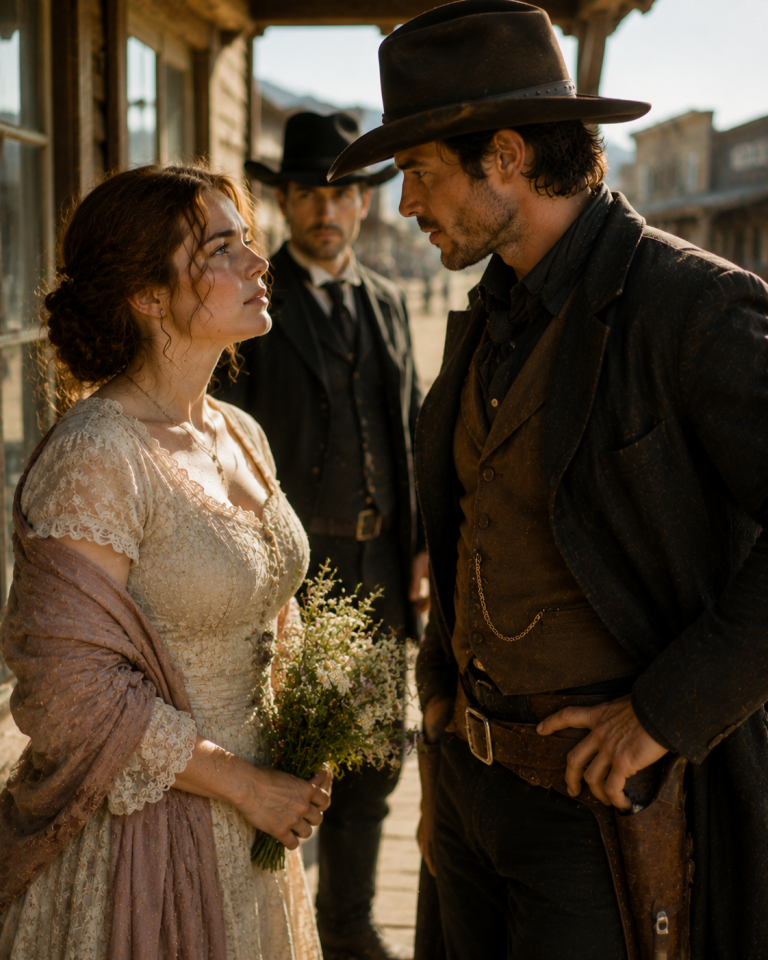
At the end of the aisle, a man waited. Caleb Boon.
He was tall. Broader through the shoulders than her father. Dark hair that curled slightly at the collar. He’d made an effort to dress up, but there was something fundamentally untamed about him. Like trying to put a wolf in a gentleman’s clothing.
His eyes weren’t cruel. She’d been bracing for the look of a man who’d just purchased something he owned. But Caleb Boon looked at her with something closer to resignation. Like he was standing at his own funeral.
Her father released her arm and stepped back. Lydia was suddenly alone.
Reverend Matthews opened his Bible. The words washed over her. Duty. Honor. Obedience.
“Do you, Caleb Boon, take this woman?”
He was staring straight ahead. A muscle jumped in his cheek.
“I will,” Caleb said.
Not *I do*. *I will*. The phrasing was strange enough that Lydia’s attention sharpened. It wasn’t a promise. It was a statement of intent. Or a warning.
“And do you, Lydia Cross, take this man?”
The words sat on her tongue like poison.
“I do.” It came out as a whisper. A surrender.
“Then I pronounce you man and wife.”
No one applauded. The silence stretched, awkward and thick. Caleb turned to her slowly. For a moment, she thought he might kiss her. But he just gave a single nod, then turned and walked down the aisle.
Outside, a plain wooden wagon waited. Caleb was already climbing into the driver’s seat. He didn’t offer to help her up. Lydia grabbed the side and hauled herself onto the bench. The borrowed dress caught on a splinter. She heard fabric tear and didn’t care.
Her father appeared at the wagon’s side, slightly out of breath. “Lydia, I—”
“Goodbye, Father.”
Caleb picked up the reins. The horses started forward.
“I’m sorry,” her father’s voice cracked. “Lydia, I’m so sorry.”
She didn’t turn around. She just sat rigid as stone as the wagon carried her away from the only life she’d ever known.
The ranch came into view gradually. A large main house, a barn, several outbuildings. Everything looked prosperous. Of course it did. Caleb Boon could afford a wife.
He set the brake and climbed down. This time, he came around to her side and offered his hand.
Lydia looked at it like it might bite. “I can manage.”
She climbed down on her own. Her foot caught on the last step and she stumbled. Caleb’s hand shot out to steady her. She jerked away so violently she nearly fell.
“I’m not going to hurt you,” he said quietly.
“You already have.”
He absorbed the blow. His hand dropped to his side. “Your room is upstairs. Second door on the right. It has a lock on the inside. I won’t bother you. You have my word.”
“Your word?” The words tasted bitter. “I’m supposed to trust the word of a man who just bought a wife.”
Something flickered across his face. Anger, maybe. Or pain.
“I didn’t buy a wife.”
“No? What would you call it?”
He didn’t answer. He just turned and walked toward the barn.
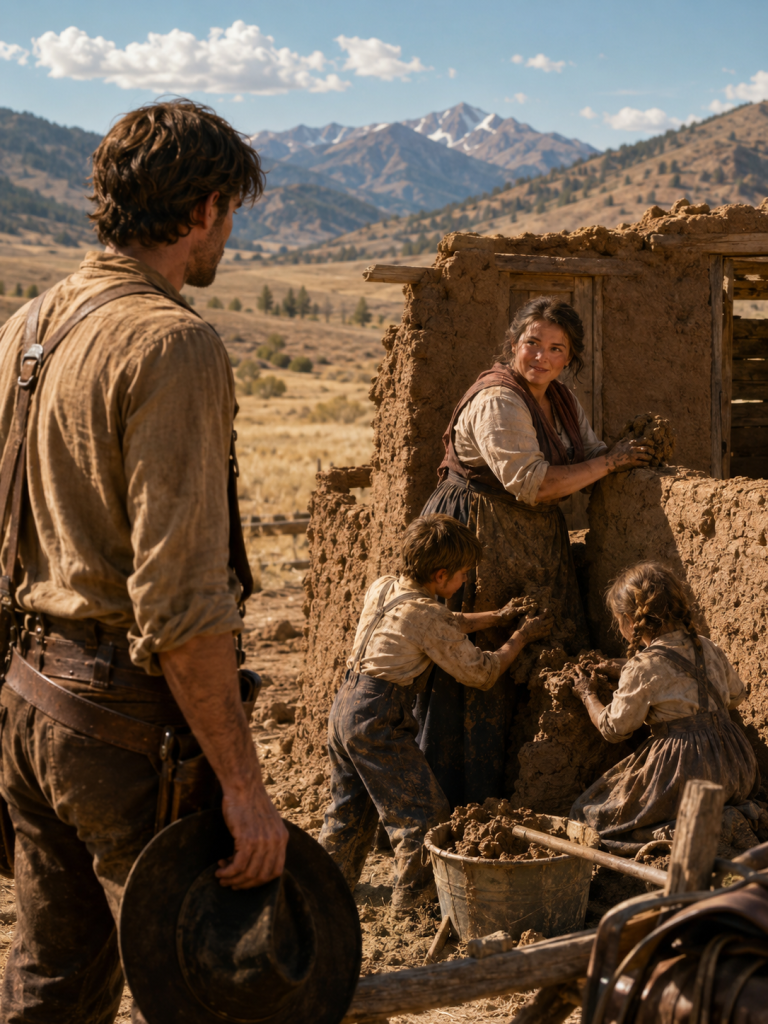
Lydia went inside. The house was dim and blessedly cool. Clean. Orderly. Almost militarily precise. It looked like a place where someone lived, but didn’t really feel at home.
She climbed the stairs. The second door on the right opened easily. A bed. A dresser. A window overlooking endless land.
And on the inside of the door, a heavy iron bolt lock.
Lydia stared at it. He had been telling the truth. She could lock him out.
She sat on the edge of the bed and put her head in her hands. Married. She was married to a stranger who gave her a lock to keep him out.
Hours passed. The sun set. Stars began to appear.
Another knock. “I made supper. I’ll leave a plate outside.”
Footsteps retreated.
Lydia waited until she was certain he was gone, then opened the door a crack. A plate sat on the floor. Bread, beans, meat. Steam still rising.
She took the plate inside, locked the door again, and ate sitting on the bed. The food was plain but good. She hated that she was grateful for it.
The next morning, she woke to the smell of coffee. A cup and a covered basket sat outside her door.
She dressed, unlocked the door, and went downstairs. The kitchen was empty. Through the window, she could see Caleb working near the barn.
Around noon, he came in for water. He stopped short when he saw her.
“Good morning,” he said.
“Is it?”
He filled a glass from the pump. “I need to ride fence line this afternoon.”
“All right.”
He turned to go.
“Mr. Boon,” she called out.
He stopped.
“Why did you do this? Why marry someone you didn’t know?”
Caleb was silent for a long moment. When he finally spoke, he didn’t turn around.
“Same reason you did. Because I didn’t have a choice.”
The days fell into a rhythm that felt less like living and more like waiting. Lydia cooked, cleaned, kept the house in order. Caleb came in for meals. They ate across from each other, the table a no-man’s-land between them.
On the eighth day, she broke a plate.
It was an accident. Her hand slipped while washing dishes, and the ceramic shattered against the floor.
Lydia stared down at the pieces, and something in her chest cracked open. She sank to the floor and started laughing. It came out harsh and a little wild. She pressed her hand over her mouth, trying to stop, but the laughter kept bubbling up, edged with something that might have been tears.
“Are you hurt?” Caleb’s voice cut through the noise.
He stood in the doorway, still wearing his work gloves. He crossed the kitchen in three strides and dropped into a crouch beside her. He took her wrist gently, turning her hand to examine a thin line of red where a shard had cut her.
“It’s not deep,” he said.
He pulled her up, led her to the pump, and held her hand under the cold water.
“I’m sorry about the plate,” she said.
“It’s just a plate.”
“Do you ever break things? Make mistakes? Or are you always this controlled?”
He finished wrapping her hand with a bandage, then stepped back. “I make mistakes.”
“Like what?”
“Like this.” He gestured vaguely at the space between them. “Like thinking a business arrangement was the same as a solution.”
Lydia blinked. It was the most personal thing he’d said since their wedding day.
“Why did you do it?” she asked. “Really. Not the careful answer. The truth.”
He turned and started sweeping up the broken plate. “The town expected it. I’ve been out here alone for five years. Every Sunday, someone has a daughter they want to introduce. Every social gathering, I’m cornered by women trying to fix me.” He dumped the shards into the waste bin. “I got tired of the expectations. So when your father’s situation became known, I saw an escape.”
“You saw a way to stop the matchmaking,” Lydia finished. “To have the appearance of propriety without the intimacy.”
“Without actually having to let someone in.” Caleb met her eyes.
The honesty of it was infuriating. “So, you bought yourself freedom by taking mine.”
“I paid your father’s debts. Kept your family from losing everything.”
“You thought money made up for choice?” Heat flooded through her. “Don’t pretend you did this for me. You did this for yourself.”
They stared at each other across the kitchen. Eight days of careful politeness cracking apart.
“You’re right,” Caleb said finally. His voice was rough. “I didn’t think about you. I thought about what I needed. And men like me don’t ask. We just take what we can afford.”
“So what now?”
“I don’t know.”
“You’re lonely,” she said suddenly.
Caleb’s expression shuddered.
“That’s why you’re out here. You don’t actually want to be around people. The marriage wasn’t to get the matchmakers off your back. It was to have an excuse to keep everyone at arm’s length. A wife means you’re settled. No one can question why you never come to town.”
“Stop.”
“I’m right, aren’t I?” Lydia sat down across from him. “You bought yourself a shield.”
“I had a family once,” Caleb said into the dimness. His voice was flat, drained of emotion. “A wife. A daughter. Three years old, with curls that caught the light.”
Lydia’s breath stopped.
“Fever took them both within a week of each other. That was five years ago. And yes, you’re right. I don’t want their pity. I wanted to be left alone.”
Lydia sat very still. It explained the empty house. The lack of personal touches. The way he moved through space like a ghost.
“I’m sorry,” she said quietly.
“Don’t pity me.”
“I’m not. I’m saying I’m sorry you lost them. But that doesn’t excuse using me as a wall to hide behind.”
PART 2
The weeks that followed were a slow, painful thaw. The careful silence was replaced by short sentences that gradually grew longer. They ate meals together. They spoke of the weather, the ranch, the chores. Never of the past. Never of the future.
Then the invitation arrived.
Heavy paper. Sealed with wax. The ladies of Red Hollow cordially invited Mrs. Caleb Boon to join them for fellowship following services.
“You don’t have to go,” Caleb said, his expression carefully blank.
“If I don’t go, they’ll talk. Hiding out here just makes me look ashamed.”
Sunday came too quickly. Lydia dressed with care, pinning her hair up, studying her pale reflection. She looked like someone bracing for battle.
Caleb waited by the wagon. “Let me go in first,” she said. “Alone. If you come with me, they’ll think I need protection.”
“I don’t like this.”
“You don’t have to like it.”
Inside the church, the conversations died. Heads turned. Whispers rippled. At the center of it all stood Margaret Sullivan, the wealthiest woman in Red Hollow, holding court like a queen.
“Mrs. Boon. How lovely of you to join us.” Margaret’s smile was all teeth. “We’ve been so curious about how you’re settling into married life.”
“It’s an adjustment,” Lydia agreed, keeping her voice neutral.
“Going from your father’s house to Mr. Boon’s ranch,” Mrs. Cartwright leaned in, her eyes bright with malice. “Such a change in circumstances.”
“We heard your father was quite desperate,” Margaret purred. “Debts, wasn’t it? And Mr. Boon was kind enough to help. For a price. How much did he pay? What’s the going rate for a wife these days?”
The women laughed. Polite, tinkling laughs that cut like glass.
Lydia felt something crack inside her. The careful control she’d been maintaining shattered. Heat flooded through her. Not embarrassment. Pure, white-hot rage.
“You’re right,” she said, her voice cutting through the laughter. “It was a transaction.”
The women stopped laughing.
“My father owed money. Mr. Boon offered a solution. I agreed to marry him in exchange for my family’s debts being cleared.” Lydia looked at each of them in turn. “You want to judge me for that? Fine. But at least I’m honest about what happened.”
Margaret’s smile faltered. “My dear, there’s no need to be defensive.”
“I’m not being defensive. I’m being truthful.” Lydia took a step forward. “You want to know about flexibility of morals, Mrs. Sullivan? Let’s talk about the bank your husband owned. The one that foreclosed on the Mitchells when they were two weeks late, even though they’d been loyal customers for twenty years.”
Margaret’s face went white with fury.
“Or you, Mrs. Henderson. Should we discuss how your husband bought up half the farmland in this county by waiting for people to default, then offering pennies on the dollar?”
“You insolent little—”
Lydia’s voice was ice. “You’re all so comfortable in your judgment. But the truth is, you profit from other people’s suffering. You build your lives on the backs of people who are desperate, and then you have the nerve to look down on someone who did what she had to do to survive.”
She turned toward the door. “I came here because I thought I needed to prove I wasn’t ashamed. But I realize now I’m not the one who should be ashamed. You are.”
Lydia walked out of the church with her head high. Behind her, the eruption of voices rang out.
Outside, Caleb was leaning against the wagon. He straightened when he saw her.
“We need to leave,” she said, her hands shaking. “Now.”
They were at the edge of town when Lydia started laughing. It came out high and slightly unhinged. “I think I just destroyed any chance of ever being accepted in this town.”
“What did you do?”
“I told them the truth. All of it. I think I called Mrs. Sullivan’s dead husband a thief.”
Caleb was quiet for a long moment. Then, to Lydia’s shock, he started laughing, too. A real laugh, deep and genuine.
“You called Edmund Sullivan a thief to his widow’s face.”
“I didn’t plan to. It just came out.”
PART 3
They rode in silence for a while, the ranch coming into view on the horizon. Lydia’s adrenaline was fading, leaving her exhausted and slightly sick. The enormity of what she’d done was starting to sink in.
“I can’t go back there,” she said quietly. “To town. Not after this.”
“Then don’t,” Caleb said. He pulled the wagon to a stop in front of the house. “Sometimes those are the same thing. Freeing yourself from caring what they think.”
Inside, she sat at the kitchen table and put her head in her hands. Caleb moved around the kitchen and set a cup of coffee in front of her.
“I don’t know what came over me,” she whispered. “I just couldn’t stand there and let them tear me apart.”
“So, you tore them apart first.” Caleb sat down across from her. “What did they say to you?”
“They called me a replacement for your wife. They said I was bought like livestock. They wanted to know how much you paid for me.” She saw Caleb’s jaw tighten. “They made it sound dirty. Shameful.”
“Because survival isn’t shameful,” Caleb’s voice was firm. “What’s shameful is a system that puts people in positions where they have to make those choices. What’s shameful is the people who profit from that desperation and then judge the people they’ve exploited.”
It was the longest speech she had heard from him. And the most passionate.
“The town doesn’t see it that way,” she said.
“The town can go to hell.” Caleb leaned forward. “Lydia, you stood in that church and told the truth. You called out their hypocrisy. That takes more courage than smiling and nodding while they tear you apart.”
That night, Lydia didn’t lock her door again. It was becoming a pattern. The slow erosion of the walls they’d built between themselves.
The next few days passed quietly. They ate meals together and spoke in short sentences that were gradually getting longer. It wasn’t intimacy exactly, but it wasn’t the hostile silence of those first weeks either.
On Thursday evening, there was a knock at the door.
Lydia answered it to find a woman she didn’t recognize. Young, maybe seventeen, with red-rimmed eyes and a nervous expression.
“Mrs. Boon? I’m sorry to bother you. I’m Emma Clark. I heard about what you said to Mrs. Sullivan.”
Lydia’s stomach dropped. Here it was. The backlash.
“I just wanted to say,” Emma took a breath. “Thank you for saying what everyone else was too afraid to say. My father lost his farm to the bank two years ago. Mr. Sullivan’s bank. We had one bad harvest and couldn’t make the payment, and he foreclosed even though we’d been paying on time for fifteen years.”
Emma’s voice shook. “You’re just the only one brave enough to admit it.”
She reached into her pocket and pulled out a folded piece of paper. “Other people feel the same way, but they’re too afraid to say it.” She pressed the paper into Lydia’s hand and hurried back to her horse.
Inside, Lydia unfolded the paper. It was a list of names. At least a dozen of them. People she recognized from town. And next to each name, a short note.
*Thank you for speaking up.*
*The Sullivans ruined my family, too.*
*You said what we couldn’t.*
Lydia stared at the paper, her throat tight. She’d thought she was alone in her anger. But apparently, there were others who’d been waiting for someone to crack the facade of polite society.
She showed the paper to Caleb over dinner. He read it slowly, his expression thoughtful.
“You’ve started something,” he said.
“I didn’t mean to start anything. I just lost my temper.”
“Sometimes that’s how things start.” He handed the paper back. “People have been afraid to speak out against the families who run this town. You broke that silence.”
Over the next week, more visitors came. People who’d heard what happened at the church social. Some brought food. Others just wanted to share their own stories of being exploited by the families who ran Red Hollow.
“This is bigger than me,” she told Caleb one evening after the latest visitor had left. “What they’re describing, it’s not just my father’s debts or my marriage. It’s systematic.”
“It is.”
“So, what do I do about it?”
Caleb was quiet for a long moment. “That’s not my decision to make.”
“I’m asking your opinion.”
“I think you’ve already done more than most people would. But,” he paused. “Or you could keep going. Use this. Turn your anger into something that actually changes things.”
“How?”
“You’re smart. You’re angry. And people are listening to you. That’s more power than you think.”
The answer came three days later in the form of her sister Mary.
Lydia was in the kitchen when she heard the horse. She looked out the window and saw Mary sliding off a borrowed mare. Her face flushed with exertion and anger.
“Mary? What’s wrong?”
Inside, Lydia poured water while Mary paced the kitchen like a caged animal.
“You happened,” Mary stopped pacing. “You and your scene at the church. Everyone’s talking about what you said to Mrs. Sullivan. Do you know how long people have been wanting someone to do that? How many families have been crushed by those people and their banks?”
“Mary, I just lost my temper.”
“You did what needed to be done. And now,” Mary took a breath. “Now people are organizing. Families who’ve been hurt by the bank. They want to do something about it. Fight back somehow. And they want you to help lead it.”
Lydia sat down heavily. “That’s insane. Why?”
“You’re the one who started it. You said the truth, and now people want to take it further.” Mary grabbed Lydia’s hand. “Lydia, this could actually change things for all of us.”
“I don’t know how to lead a movement. I’m just a girl who survived being sold off.”
“You’re exactly who should be doing this,” Mary squeezed her hand. “Don’t think too long. People are ready to act. They just need someone to show them how.”
After Mary left, Lydia sat at the kitchen table with her head in her hands.
Caleb found her there an hour later. “Mary came by. What did she want?”
“They want me to lead them. The families who’ve been hurt by the bank. They want to organize some kind of resistance.” She finally looked at Caleb. “What do you think I should do?”
“What do you want to do?”
“I don’t know. Part of me wants to say no. To stay out here and avoid the whole mess.” She paused. “But another part of me, I keep thinking about Emma Clark and all those families who lost everything. The Sullivans and Hendersons will just keep doing it unless someone stops them.”
“Then stop them.”
“Just like that?”
“Just like that.” Caleb moved into the kitchen and sat down across from her. “Lydia, you’ve spent your whole life taking care of other people. Maybe it’s time you took care of yourself by fighting for something you believe in.”
“What if I fail?”
“Then you fail. But at least you’ll have tried.”
The next morning, Lydia made her decision.
“I’m going to do it,” she told Caleb over breakfast. “Help them. Whatever it is they’re trying to organize.”
He looked up from his coffee. “All right.”
“That’s it? Just all right? Maybe warn me about the consequences.”
“You already know the consequences and you’re going to do it anyway.” He took a sip of coffee. “So, yes. All right.”
The simplicity of his response steadied her.
“I need to go to town,” she said. “Talk to Mary and whoever else is involved.”
“I’ll take you.”
“You don’t have to.”
“I’m taking you. You want to walk into Red Hollow alone after what happened at the church? That’s asking for trouble.”
They left after breakfast. Mary had given her an address, a small house on the edge of town that belonged to the Mitchells.
When Caleb pulled the wagon to a stop, Lydia could see curtains twitching in nearby windows.
“You want me to come in?” Caleb asked.
Lydia considered it. Having him there would be comforting, but it would change the dynamic. Make it about Caleb Boon’s wife instead of Lydia Cross.
“No. I need to do this myself.”
The house was small and shabby. Lydia knocked and the door opened immediately. Mary stood there, her face breaking into a relieved smile.
Inside, a group of people sat in the small front room. Emma Clark was there along with her father. A thin woman with work-worn hands. John Mitchell, an older man with a farmer’s calluses.
“This is everyone,” Mary said.
“I’m not sure what you think I can do,” Lydia said honestly. “I don’t have money or influence.”
“You have a voice,” the thin woman interrupted. “And people listened when you used it.”
“Mrs. Sullivan and her friends have been running this town for too long,” Emma’s father added. “They foreclose on properties, buy them up cheap, rent them back at prices people can barely afford. It’s a system designed to keep us desperate and them comfortable.”
“So, we change the narrative,” Lydia stood, starting to pace. “Right now, they operate in the open because no one questions it. If we make noise, if we force people to see what’s really happening, public pressure—”
“Make it shameful to participate in the foreclosures,” Mary finished.
“Exactly. And not just shameful. Risky. If enough people band together to support families facing foreclosure, it becomes harder to execute them.”
John Mitchell leaned forward. “How do we prove it? The bank’s records aren’t public.”
“No, but the sales are. The town keeps records of all property transfers. If we could show a pattern that the same families keep buying up foreclosed properties, that the prices are suspiciously low, that the timing is coordinated, people would see it’s not about bad luck.”
“It’s about systematic exploitation,” Mary said.
Over the next hour, they hammered out a plan. Emma’s father would start collecting data on foreclosures. John Mitchell would organize a list of families currently at risk. Helen, the thin woman, would spread the word quietly. And Lydia would be the voice.
When she finally left the Mitchell house, the sun was high overhead. Caleb was still waiting by the wagon.
“How did it go?” he asked.
“I think I just joined a rebellion.”
His mouth quirked. “How very like you.”
On the ride back to the ranch, Lydia filled him in on the plan. He listened without interruption.
“It’s risky,” he said when she finished. “The Sullivans won’t take this lying down.”
“I know.”
Caleb was quiet for a moment. Then he said something that surprised her. “I want to help.”
Lydia turned to look at him. “What?”
“The plan. I want to help. I have resources. Land, money, influence, such as it is. If you’re going to take on the most powerful families in the county, you’ll need backing.”
“Caleb, I can’t ask you to—”
“You’re not asking. I’m offering.” He glanced at her. “Besides, you’re my wife. What affects you affects me. And I’ve never liked the way the Sullivans and Hendersons operate anyway.”
Something warm spread through Lydia’s chest. “Thank you,” she said quietly.
Over the next two weeks, the rebellion took shape. Emma’s father presented them with records showing that over the past five years, seventy percent of foreclosed properties had been purchased by just three families. The prices paid were consistently thirty to forty percent below market value.
“We need to make this public,” Lydia said at their third meeting. “Put it somewhere everyone can see it.”
“Print it,” Caleb spoke up from the back of the room. “There’s a printing press in Cottonwood. Print the information as a pamphlet. Distribute it throughout Red Hollow and the surrounding county. They can tear down one posting, but they can’t stop hundreds of pamphlets.”
“That would cost money,” John Mitchell said.
“I’ll pay for it,” Caleb cut in.
Three days later, Lydia and Caleb rode to Cottonwood with the manuscript. The printer, a grizzled man named Harris, asked no questions.
“Five hundred,” Lydia said when he asked how many copies.
Harris whistled low. “That’ll cause a stir.”
“That’s the idea.”
The pamphlets arrived exactly one week later. The title was simple: *The Truth About Red Hollow’s Foreclosures.* Below it, in clear, precise language, was everything they discovered. Names, dates, properties, prices.
They distributed the pamphlets that night under cover of darkness. By morning, the town would be papered with the truth.
By noon the next day, all hell had broken loose.
Helen came to the ranch in a state of barely contained excitement. “The whole town is talking. The Sullivans tried to claim it was all lies, but too many people recognize the names. They can’t deny it.”
“What about the families facing foreclosure?” Lydia asked.
“That’s the best part. The Hendersons were supposed to evict the Martins this morning, but when the sheriff showed up, there were thirty people blocking the door. Just standing there, refusing to move. The sheriff didn’t know what to do. He left without executing the eviction.”
Lydia felt her heart jump. “It’s working.”
“But Lydia, Margaret Sullivan is looking for you. She’s furious.”
“Let her look.”
The confrontation came two days later.
Lydia was in town meeting with John Mitchell when Margaret Sullivan’s carriage pulled up outside. The older woman descended like a queen.
“Lydia Cross,” Margaret said, ignoring the Boon surname entirely. “We need to talk.”
“I don’t think we do.”
“Oh, but we do. You’ve caused quite a disturbance with your little pamphlets.”
“The accusations aren’t wild. They’re documented.”
“Documented by whom? Some disgruntled farmers who failed to manage their own affairs?”
“Documented by the town’s own records,” Lydia said clearly, making sure her voice carried to the small crowd gathering. “Property sales are public information, Mrs. Sullivan.”
“What you call a pattern is simply good business,” Margaret sneered.
“And when those properties are only undervalued because your husband’s bank foreclosed on families at the first sign of trouble? When you buy them for pennies on the dollar and rent them back at prices people can barely afford, what do you call that?”
Margaret’s face flushed red. “I call it the natural order of things. Some people are meant to succeed and others aren’t.”
“No,” Lydia said. “That’s cruelty. Dressed up as economics.”
“You’ve overstepped, girl. I can destroy you. Your family. Everyone who helped you with this ridiculous crusade. One word from me—”
“And what? You’ll foreclose on more properties? Evict more families? You were already doing that. The only difference now is that everyone can see what you’re doing.”
Lydia looked around at the gathered crowd. “You have power because we gave it to you. Because we stayed quiet when you exploited us. But that’s over now. We see you for what you are. And we’re not going to be silent anymore.”
Margaret climbed back into her carriage and rode away.
John Mitchell appeared at Lydia’s elbow. “That was either very brave or very stupid.”
“Probably both.”
That evening, Lydia told Caleb about the confrontation. He listened with a deepening frown.
“Margaret Sullivan doesn’t make idle threats. She could come after the ranch.”
“I know that, too.” Caleb was quiet for a long moment. Then he stood and left the room.
When he came back down, he was carrying a thick folder.
“Insurance,” he said, setting it on the table. “The deed to the ranch, property records, financial documents. Everything that proves this land is mine, free and clear.”
Lydia stared at the folder. “Why are you showing me this?”
“Because I want you to know whatever Margaret Sullivan tries, she can’t touch this place. The ranch is paid for. No debts. No mortgages.” He paused. “And I want you to know something else.”
He pulled out a single document from the folder.
Lydia’s eyes widened as she read it. It was a property deed for two hundred acres of the Boon Ranch. And the name on it wasn’t Caleb Boon. It was Lydia Boon.
“What is this?”
“Half the ranch in your name. Water rights, grazing rights, everything.” Caleb’s voice was steady. “I had the papers drawn up last week.”
“I don’t understand.”
“You’re not my property, Lydia. You never were. This marriage started as a transaction, but that’s not what it has to stay. You deserve to own something. To have security that doesn’t depend on me or anyone else.”
Lydia looked down at the deed, her hands trembling. Two hundred acres. Independence. Freedom.
“Why?” she whispered.
“Because you earned it. Because you’re fighting for other people’s rights while giving up your own. Because you deserve a choice in everything, including this marriage. I’m not asking you to stay. I’m giving you the means to leave if you want to. Or to stay because you choose to.”
Lydia felt tears prickling at her eyes. Not tears of sadness. But of overwhelming recognition that someone finally saw her as more than a problem to solve.
That night, Lydia didn’t sleep. She sat at the kitchen table with the deed in front of her.
She stood and walked upstairs. Caleb’s door was closed, but not locked. She knocked softly.
“Come in.”
He was sitting at the small desk by his window. He looked up, surprised.
“I’ve been thinking,” Lydia said. “About choices. About what I want.” She took a deep breath. “And I want to stay.”
Caleb went very still.
“I decided weeks ago. I just didn’t know it until tonight. This thing we’re doing, standing up to the Sullivans, fighting for the people Red Hollow has forgotten. I can’t do it alone. And I don’t want to.”
“Lydia, I’m not saying I love you—”
“I know,” she interrupted. “I don’t know if I’m there yet. But I know I don’t want to leave. I know that when Margaret Sullivan threatened to destroy me, my first thought was that I needed to tell you. I know that this place feels more like home than anywhere I’ve ever been.”
She held up the deed. “Thank you for this. For seeing me as more than what everyone else does. But I don’t need to own land to stay. I just need to know that you see me as a partner. As someone with a voice.”
Caleb stood slowly. “I do see you that way.”
“Then that’s enough for now.”
They stood there in the dim light. Caleb reached out slowly, giving her time to pull away. When she didn’t, he took her hand.
“We’re going to face hell for this,” he said quietly. “Margaret Sullivan won’t stop.”
“Neither will I.”
His hand tightened on hers. “Then we fight together.”
Margaret Sullivan’s retaliation came swiftly. Vicious rumors began circulating. She was unstable, the whispers said. A bitter woman taking out her resentment.
“We need to do something bigger,” Mary said one evening. “Something she can’t spin or deny. The Hendersons are still trying to evict the Martins. What if we didn’t just block the door this time? What if we made it an event? Invited everyone in town to witness what actually happens during a foreclosure.”
“That’s dangerous,” Caleb said. “The sheriff could arrest everyone involved.”
“Let him try. Arresting thirty people for peacefully observing a legal proceeding would prove our point better than any pamphlet.”
Tuesday morning dawned clear and cold. The Martin house came into view, and Lydia’s breath caught. There were people everywhere. At least fifty of them, standing in quiet clusters around the property. Not blocking access. Just standing there. Bearing witness.
Richard Henderson stepped out of his carriage, his face flushed with anger. He took one look at the assembled crowd and rounded on the sheriff.
“Clear these people out immediately!”
“On what grounds?” Lydia called out loud enough for everyone to hear. “We’re not breaking any laws.”
“You’re trespassing on private property.”
“We’re on the public road,” she gestured at the crowd. “Every single person here is standing on public land. You want to evict the Martins? Go ahead. We’re just here to watch.”
Henderson’s face went from red to purple. “This is harassment. Sheriff, arrest them!”
“For what crime?” The sheriff looked deeply unhappy. “They’re not doing anything illegal.”
From inside the house, Mrs. Martin was crying. The children looked terrified.
“Mr. Henderson,” Lydia said, pitching her voice to carry. “Why don’t you explain to everyone here why the Martins are being evicted?”
“They failed to make their mortgage payments.”
“How many payments did they miss?”
“That’s private banking business.”
“One,” Mrs. Martin called from the doorway. Her voice shook, but it was audible. “We missed one payment after my husband broke his leg and couldn’t work the harvest.”
A murmur rippled through the crowd.
“One payment,” Lydia repeated. “And rather than work out a payment plan, the bank chose to foreclose. Is that right?”
“The contract is clear,” Henderson spat.
“And what happens to this property after the Martins are evicted?” She didn’t wait for him to answer. “It’ll be sold at auction, probably to someone connected to your family for less than half its value. Then you’ll rent it back to farmers at rates they can barely afford.”
She turned to address the crowd. “How many of you have lost property to the bank?”
Hands went up. A wave of them across the crowd.
“And how many of those properties were bought by the Hendersons, Sullivans, or Cartwrights?”
Nearly every hand stayed up.
Henderson’s face contorted with rage. “This is slander!”
“Sue me if you want, Mr. Henderson,” Lydia said, a strange calm settling over her. “But first explain to all these people why I’m wrong. Show us the evidence that proves the bank isn’t systematically profiting from people’s desperation.”
He couldn’t. They both knew it.
The sheriff stepped forward. “Mr. Henderson, perhaps this eviction should be postponed until tempers cool down.”
“Postponed? Absolutely not.”
“You do have every legal right,” the sheriff agreed. “But I’m not sure it’s wise to proceed right now. Not with this many witnesses. Give it a week. Let things settle.”
Henderson looked around at the crowd. Dozens of faces staring back at him with expressions ranging from hostility to simple curiosity. For the first time, Lydia saw uncertainty flicker across his features.
“Fine,” he spat. “One week. But this doesn’t change anything.”
He climbed back into his carriage and left. The crowd erupted in cheers.
They’d won. Not permanently. But they’d forced one of Red Hollow’s most powerful men to back down in public.
The final confrontation came on a Sunday, eight months after Lydia’s outburst at the church social.
The reverend had announced that Caleb and Lydia would be speaking after services. The church was packed. Margaret Sullivan sat in the front pew, her face carefully neutral.
Lydia stood with Caleb at her side and faced the congregation. For a moment, she was back in that borrowed wedding dress, standing in the same spot, saying *I do* like a surrender. But she wasn’t that girl anymore.
“Most of you know my story,” she began, her voice carrying clearly. “I was sold in a marriage arrangement to pay my father’s debts. I stood right here and said vows to a stranger while the whole town watched.”
A ripple of discomfort moved through the pews.
“I’m not here to apologize for what I said about that. It was the truth then, and it’s the truth now.” She paused. “But I’m here to talk about what happened next.”
She looked at Caleb, who gave her an encouraging nod.
“When I arrived at the Boon Ranch, I expected to be treated as property. Instead, I found someone who gave me a choice. Who saw me as a person, not a transaction.”
She pulled out the deed from her pocket and held it up.
“This is ownership of two hundred acres of the Boon Ranch. Water rights, grazing rights, everything. My husband gave it to me freely with no conditions because he believed I deserve to own something. To have security that didn’t depend on anyone else.”
Gasps rippled through the congregation. Margaret Sullivan’s face went rigid.
“I’m showing you this because I want everyone here to understand something. Power isn’t just money or land or social position. Power is the ability to make choices. To control your own life.”
She looked directly at Margaret. “For too long, a few families in this town have had all the power. They’ve made decisions that affected everyone else without input or accountability. They’ve profited from other people’s struggles and called it business. And we accepted it because we thought that’s just how things were.”
Her voice strengthened. “But it doesn’t have to be that way. We can organize. Support each other. Hold the powerful accountable. We can demand fair treatment and refuse to be silent when we don’t get it.”
She turned to Caleb, who stepped forward.
“I’m making this deed public,” he said, his voice quieter than Lydia’s, but no less firm. “So everyone understands what I’m about to say. My wife is not my property. She never was. She is my partner.”
He looked out at the congregation. “And I want all of you to witness this. Lydia Boon owns half of everything I have. She has equal say in all decisions affecting our land, our home, our future. Not because I’m being generous. Because it’s right. Because marriages should be partnerships, not ownership.”
The church was absolutely silent.
“If that makes us strange or improper in the eyes of this town,” Caleb continued. “So be it. We’d rather be honest than acceptable.”
Lydia stepped forward again. “I came to this marriage with nothing. No money, no options, no control over my own life. But I’m not leaving it that way.”
She met the eyes of the families who’d stood with her over the months.
“None of us have to accept powerlessness. We can fight for something better. We can build something new.”
She looked at Margaret Sullivan one final time. “That’s not an apology. It’s a promise. We’re not backing down. We’re not going away. We’re here. We’re organized. And we’re going to keep pushing for change until Red Hollow becomes a place where everyone has a fair chance, not just the wealthy.”
She sat down. Caleb sat beside her.
The silence stretched for a long, painful moment. Then someone in the back started clapping.
John Mitchell was on his feet, applauding. Helen joined him. Then Emma and her father. The Martins. One by one, families stood and applauded until more than half the church was on its feet.
Margaret Sullivan sat rigid in her pew, her face a mask of fury and defeat.
Outside, people surrounded Lydia and Caleb, shaking hands, offering support. Mary pushed through the crowd and threw her arms around Lydia.
“That was incredible,” she said, her voice thick with emotion.
“We were incredible,” Lydia corrected. “All of us.”
As the crowd gradually dispersed, Lydia and Caleb walked back to their wagon. The sun was bright, the air crisp with the promise of autumn.
“Think we’ve finally burned all our bridges?” Caleb asked.
“Probably,” Lydia laughed. “But I don’t care. Do you?”
“Not even a little.”
They climbed onto the wagon and headed home. Toward the ranch that was now half hers. Toward a future they’d built from the ruins of a forced marriage.
The girl who’d whispered *I do* like a surrender had learned to speak with a voice that couldn’t be silenced. She’d been sold, but she’d bought herself back. And in doing so, she’d shown others how to do the same.
That was the real victory. Not the deed. Not the confrontation. But the understanding that spread through Red Hollow and beyond. That ordinary people, when they stood together and refused to be silent, could change the world.
One choice at a time. One voice at a time. One person at a time, deciding they deserved better and being brave enough to fight for it.
THE END