She Wore My Name Like a Costume — Then I Stood Up and Told the Room Who Actually Owned the House

**PART 1**
Six months earlier, Charlotte had learned her marriage was over because of a hospital receipt.
Not lipstick. Not a phone call at midnight. A folded slip of paper in the pocket of Julian’s charcoal coat — a deposit for the private maternity suite at Presbyterian Memorial. The name on it wasn’t hers.
*Delphine Marsh.*
She remembered standing in the marble foyer of the Ashworth townhouse while snow fell outside, the house smelling of cedar and old money that had learned to pretend it had no smell at all. Julian had told her he was in Denver. He’d kissed her forehead on his way out and said, *don’t wait up, darling.*
She didn’t confront him. That’s the part people never believe — they want screaming, wine on silk walls, a wife weeping barefoot in the snow. She put the receipt back exactly where she found it and walked upstairs to the nursery they’d never had the heart to redecorate.
Their son, Wyatt, had lived sixteen days. Sixteen days of machines and hushed prayers and nurses who touched her shoulder like she might shatter. Julian had visited when the photographers were outside. That was the first betrayal. Delphine was the second. What he did with Wyatt’s name afterward was the third.
Three weeks after the receipt, Charlotte’s foundation accountant called, her voice too careful, asking her to review reimbursements tied to the Ashworth Children’s Heart Initiative — the charity Charlotte had built herself, funded quietly through the Bellamy Trust, her late grandmother’s estate. Julian liked people to believe Ashworth money paid for everything. She’d let him, once, thinking it made them look united. She understood now that her silence had simply been useful architecture.
The reimbursements were for florists, a private prenatal consultation, and a diamond bracelet charged to an account labeled “donor relations.”
Delphine’s bracelet. The one glittering on her wrist tonight.
Charlotte called her lawyer that same evening — not the family’s lawyer. Hers. Walter Pierce had represented the Bellamy Trust since her grandmother was alive: white hair, unhurried voice, the calm of a man who’d ruined people gently for four decades. She told him everything. He didn’t say he was sorry. Good lawyers know sorry is sometimes too small to be useful.
“Do you want punishment,” he asked, “or freedom?”
“I want control,” she said.
He nodded once. “Then we begin quietly.”
Quietly was her specialty. Julian mistook it for weakness, because he’d never had to survive anything that didn’t applaud him. He’d been raised inside applause — his father, Edmund, had built Ashworth Holdings out of hotels and hospital real estate; his mother, Genevieve, had spent thirty years polishing the family into a myth for magazines. *An Ashworth wife never embarrasses the family,* Genevieve had told her once. Charlotte had been twenty-seven and had mistaken it for wisdom about dignity. It meant obedience.
For eight years she’d been excellent at it — ribbon cuttings, seating charts, senators’ handshakes, the particular smile you gave surgeons and reporters. Julian called her his calm center. He meant his shield.
She’d met Delphine at a gallery preview in Chelsea two years ago — twenty-eight, polished, a smile like a blade wrapped in perfume. *I’ve heard so much about you,* Delphine had said, holding her hand a beat too long. After that, Charlotte began seeing everything: Delphine leaving restaurants twenty minutes ahead of Julian, an apartment lease routed through an Ashworth Holdings shell vendor, a job title for Delphine’s mother at a nonprofit that didn’t employ her.
Betrayal isn’t one wound, Charlotte had learned. It’s a hundred paper cuts, each too small to scream about, that quietly bleed you out.
She and Walter built the file for months — bank records, hotel footage from properties financed under her own trust, voice memos Julian had synced without thinking to an old iPad. *She still thinks this is her family,* Delphine’s voice said in one, bright and bored. *Stop letting Charlotte sit at the center of everything.* Julian laughed. *She sits where I put her.*
Charlotte listened to that sentence exactly once. “Use it,” she told Walter.
Then came the surprise even Julian didn’t know about. Her prenuptial agreement — the one Genevieve had watched her sign years ago with the satisfied look of a woman closing a door from the inside — carried a morality clause her grandmother had quietly added. If either spouse used charitable or trust funds to support an affair, the wronged spouse could trigger immediate asset separation and forfeiture of disputed marital claims.
Buried in a private annex was something larger still: years ago, when Ashworth Holdings needed emergency liquidity to save three hotel properties, no bank would touch Edmund at the rate he wanted. Josephine Bellamy — Charlotte’s grandmother — had, through her trust. Quietly. The price, if Julian ever caused a reputational or financial breach through infidelity or charitable fraud, was that voting rights on thirty-eight percent of Ashworth Holdings would revert to the Bellamy Trust.
Hers.
For years she’d sat at board dinners believing herself decoration. She had, in fact, been collateral all along.Two weeks before the gala, Genevieve invited her to lunch at a restaurant with white tablecloths and a view of nothing. An Ashworth woman never delivered a threat in an office; she delivered it over Dover sole.
“Delphine is expecting,” Genevieve said, setting the words down like a loaded gun.
“Is she,” Charlotte said, and folded her hands.
It was the wrong response. Genevieve had expected tears.
“You will not shame this family publicly,” Genevieve said, and slid an envelope across the table — a settlement, cooperation, silence, and Charlotte’s resignation from the very foundation she’d built in her son’s name.
They didn’t just want the wife gone.
They wanted the grief she’d turned into an institution.
Charlotte slid the envelope back.
“No.”
“You misunderstand your position,” Genevieve said.
Charlotte leaned forward, letting her mother-in-law see, for the first time in eight years, that her softness had always been a choice and never a debt.
“No, Genevieve. You do.”
**PART 2**
Two nights before the gala, Julian came home at midnight to find Charlotte still awake in the library, a book open and unread in her lap.
“Long night,” he said, loosening his tie. Delphine had posted a photo from the same restaurant twelve minutes earlier — just a hand around a martini glass, the bracelet visible. Charlotte’s bracelet, technically.
“Is Delphine coming to the gala?” she asked.
He looked away. One second. Enough.
“She’s my guest.”
There it was, finally unwrapped. Charlotte crossed to the bar cart and poured water, not wine — she wanted every memory of this clear.
“Are you asking me to sit at a table with your pregnant mistress?”
“I’m asking you not to make a scene.”
“You’re asking me to absorb one.”
Julian’s jaw tightened. “I’ve tolerated your grief long enough.”
The room went cold in a way that had nothing to do with the weather. She thought of hospital chairs, of holding their son’s foot in her palm while Julian stepped into the hallway to take a call.
“You loved Wyatt when people were watching,” she said quietly. “I loved him when no one was.”
“Don’t weaponize our son.”
“No, Julian. You don’t get to anymore.”
He straightened, arrogance sliding back over his face like a mask resettling. “Wear the navy,” he said on his way out. “It photographs well.” Then he left her alone with the fire and the portrait of her grandmother, who had never once confused romance with safety.
She wore black instead — a column gown with no sparkle, no softness, like a verdict — and her grandmother’s emerald earrings, bought the day Josephine divorced her first husband. When a jeweler once asked what occasion they were for, Josephine had said: *clear vision.*
At the Kensington, cameras flashed as they arrived. *Beautiful couple,* the photographers called. America loves a beautiful couple, especially when the wife is bleeding quietly behind diamonds.
Inside, the auction host, Renata Cole, kissed Charlotte’s cheek and asked, low enough for only her to hear, “All set?”
“All set.”
Across the room, Delphine entered in white, one hand resting with theatrical care on the faint curve of her stomach. The room noticed. The room always notices white worn by the wrong woman.
Julian crossed to her immediately, leaving Charlotte’s side without apology.
Charlotte moved through the ballroom exactly as she’d been trained — thanking donors, complimenting gowns, absorbing kisses from women who’d already texted three friends about the mistress in white. *Poor Charlotte. Did you see her? How awful.*
Then the lights dimmed for dinner, and she walked toward the table at the center of the room, the one that always sat closest to the stage.
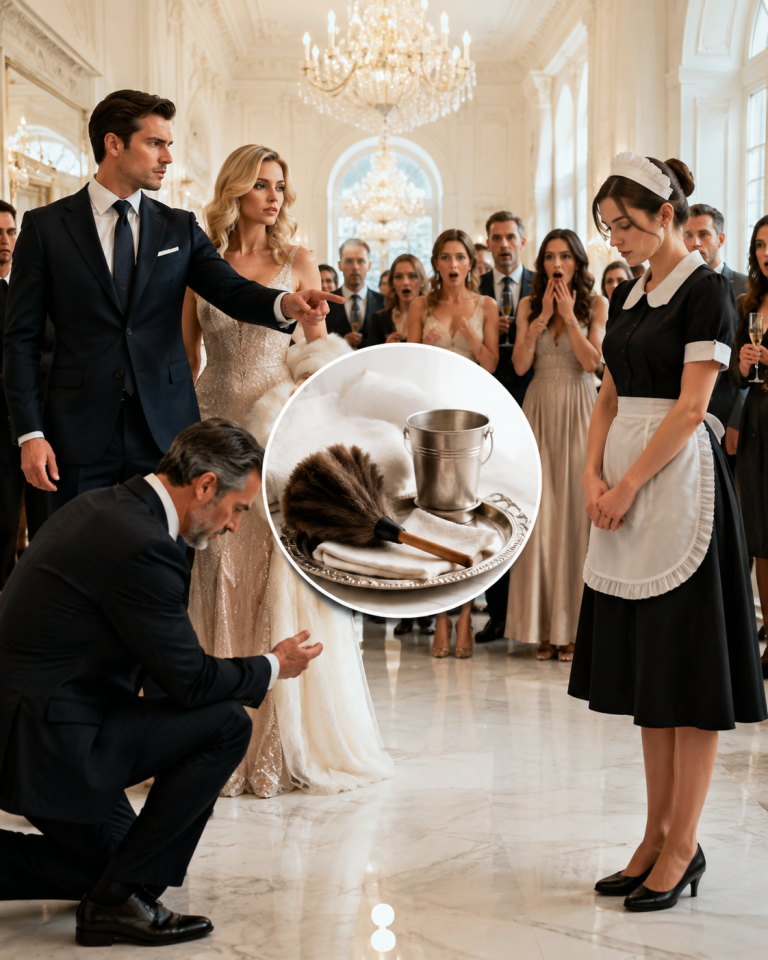
That was when she saw Delphine sitting in her chair.
**PART 3**
The seating chart was a social contract, and everyone at that table understood exactly what had been rewritten. The wife sits to the husband’s right. The mistress sits nowhere near center — unless someone is declaring war.
Delphine’s clutch rested over Charlotte’s name card, one gold corner still showing beneath it.
“There are other chairs,” Julian said, his hand tight on the seat back.
The senator’s wife looked down. A board member found his bread plate suddenly fascinating. Public humiliation has a temperature — hot in the face, cold in the hands, silent in the lungs. Charlotte had rehearsed this moment for months, not in this room but in every quiet hour spent reading bank statements and folding a blanket that would never be used.
So she didn’t reach for the clutch. She didn’t ask Delphine to move. Those questions were for women still hoping there was a man left inside the husband. Hers had already shown her the vacancy.
“Is this what you want?” she asked Julian, once, giving him a last door.
He said nothing. That silence answered more loudly than any sentence could have.
She turned instead to Renata, standing near the stage, and said it clean and clear.
“Announce the lead donor. Let’s see who the room follows.”
Renata’s eyes lit with something close to delight. She lifted the microphone.
“Before tonight’s auction begins,” she said, “we have a correction to make. For months, public materials have credited Ashworth Holdings as lead sponsor of the twenty-five-million-dollar commitment to Mercy Children’s Cardiac Wing. That language was incomplete.” She turned one page. “The full gift is being made by the Bellamy Trust, under the sole direction of Mrs. Charlotte Bellamy Ashworth, in memory of her son, Wyatt Bellamy Ashworth.”
The room turned — not toward Julian, but toward her. That is the thing about rooms that follow money. They pivot fast.
“The new cardiac wing,” Renata continued, “will be named the Wyatt Bellamy Pediatric Heart Center.”
Genevieve stood. “You cannot do that.”
“I did,” Charlotte said.
The hospital chairman rose and began to clap. The senator’s wife joined. Then the room. Applause is weather in rooms like this — it tells everyone exactly where to stand.
Charlotte walked back to the table, lifted her own name card from beneath Delphine’s clutch, and set it down two seats away instead. She sat there — not because she’d been moved, but because she was choosing her angle.
Julian leaned down, furious. “What are you doing?”
“Bidding,” she said, and raised her paddle on the first lot, a private estate week in Vail, all the way to seven hundred fifty thousand dollars. The room gasped. *Sold to Mrs. Ashworth.*
His phone buzzed. Then buzzed again. His face went pale — the board packet had just landed in every Ashworth Holdings inbox at once. *Notice of Breach and Voting Rights Reversion.* She’d scheduled it for exactly that hour.
Julian stood so fast his chair scraped the floor and disappeared toward the side corridor with his mother close behind. Delphine, left alone at the table, finally understood she wasn’t included in the conversation that actually mattered.
She came to Charlotte’s side minutes later, one hand cradling her stomach.
“You can’t ruin him,” she said.
“I’m not,” Charlotte said. “I’m removing my assets from his reach.”
“You can’t keep his child from this family.”
Charlotte studied her — not cruel, just clear. “Is it his child?”
The blood left Delphine’s face. A crack, tiny but deep.
“Do not invoke my son’s foundation again,” Charlotte said quietly. “And take off that bracelet before the deposition.”
When Julian returned, his tuxedo no longer sat the same way on him. Genevieve trailed behind, face like carved ice, and demanded to know what Charlotte had done.
“Protected my son’s name,” Charlotte said.
“You vindictive girl,” Genevieve snapped, loud enough for the table to hear.
“I’m thirty-five, Genevieve. You didn’t welcome me into this family. You installed me.” She turned to Julian. “I have thirty-eight percent voting control of Ashworth Holdings. The Bellamy Trust financed your father’s rescue years ago. You never read the annex.”
“You?” Julian’s voice cracked. “But Josephine—”
“Died three years ago. I run it now.”
Walter Pierce arrived from the back of the ballroom, unhurried, and handed Julian a formal notice. “Separate copies have gone to the board, the lenders, the hospital trustees, and your insurers.”
That was when Delphine’s voice rose, thin and frightened. “Tell them, Julian. Tell them about the baby.”
Walter cleared his throat. “I’d advise against public paternity claims until court-ordered testing concludes.”
The room went silent enough to hear ice settle in glasses. A month earlier, Delphine’s former fiancé had come forward with an affidavit — dates, messages, a prenatal paternity screening she’d tried to suppress. She had known there was a real question and let Genevieve call the child an Ashworth heir anyway.
Julian looked at her like a stranger. “You said there was no question.”
“There isn’t,” Delphine said, too fast.
Genevieve gripped the back of an empty chair, and for the first time since Charlotte had known her, she looked less like a woman carved from marble and more like one made of something that could actually crack.
“You knew about the annex,” Julian said to his mother, low and disbelieving. “You let me walk into this room tonight without telling me.”
“Your father handled those documents,” Genevieve said.
“That’s not an answer.”
“I told you to be discreet,” she snapped, and the sentence landed with a strange, ugly clarity — not because it shocked anyone at the table, but because it confirmed, finally and completely, exactly what kind of family Charlotte had spent eight years trying to belong to. Discretion, not fidelity. Optics, not honesty. A door you were allowed to walk through, as long as no one photographed you doing it.
Julian looked at his mother the way a man looks at a map that has just been proven wrong.
By the time Renata called the final pledge round, the golden number on the screen read twenty-five million — then climbed as donor after donor added their own, the figures rising in silence broken only by soft applause. Not for Julian. Not for the Ashworth crest stitched into the tablecloths. For the mission. For a boy’s name projected eight feet tall above a stage full of people who had never met him.
The gala raised thirty-eight million dollars that night. Applause doesn’t erase a wound, Charlotte thought, standing for the ovation. It only changes the lighting.
Near the exit, Julian caught her sleeve — not hard, just enough to remind her he still believed he could.
“You could have warned me,” he said.
“I did. For eight years.”
“You were never really my wife after Wyatt,” he said, reaching for the one accusation guaranteed to hurt.
“My body was still healing when you started sleeping with her,” Charlotte answered. “How long?”
“Three months after,” he admitted finally, and something in her went quiet. Not broken.
Finished.
“Thank you,” she said, “for making the divorce feel clean.” Then she walked past him into a car that wasn’t the Ashworth car, on a route that wasn’t the Ashworth route, toward a house that, within thirty days, would no longer belong to any of them.
The video hit social media at 7:12 the next morning — someone’s phone catching the chair, the clutch, Julian’s *there are other chairs.* By evening it had eight million views and its own morality play: the betrayed wife in black, the mistress in white, the mother-in-law who’d called her vindictive. Women commented about chairs they’d been told to give up their whole lives. Charlotte read exactly one comment that stayed with her: *She didn’t fight for the chair. She proved she owned the building.*
Within a month, Julian was removed as interim chair of the foundation pending investigation. The hospital reissued all donor language under the Bellamy name. Ashworth Holdings’ lenders called for emergency review. A gossip account posted grainy screenshots of the foundation audit summary within the week; Walter said leaks were like mice in old houses — you never knew exactly where they’d come in, and there was no point hunting for the hole once the damage was already done. Genevieve’s attorney asked, delicately, about “family mediation.” Walter’s answer was two sentences long: *Mrs. Ashworth is unavailable for emotional laundering. Direct future requests through counsel.* Charlotte sent him flowers for that one.
Julian showed up at the townhouse one Friday morning with the navy dress he’d asked her to wear months earlier, unshaven, a garment bag over his arm like an offering nobody had requested. He spoke to the security camera because she wouldn’t open the door. *I was angry. I was lost. I made terrible mistakes. I love you.* He pressed his palm flat against the wood as if the house itself might let him back in on sympathy alone. *I don’t know how to do any of this without you.*
That, at least, was true. Not love. Need. He didn’t know how to be powerful without her steadiness underneath him — her planning, her patience, her grief quietly refined into philanthropy that made his family look generous instead of merely rich. He didn’t miss his wife. He missed the architecture she’d built around him for eight years without once putting her own name on the blueprints.
She saved the recording for Walter and turned off her phone.
The divorce filing went public two weeks later, written by Walter in language too clean for melodrama: infidelity, misappropriation of charitable funds, breach of marital agreement, separation of assets. There was no custody dispute, because there were no living children to dispute. Charlotte read that clause three times before she could close the folder.
Delphine gave one regrettable interview, no bracelet, saying she’d also been a victim. The internet was not kind, and Charlotte found she took no pleasure in that either — some freedoms aren’t built on another woman’s collapse. The paternity filings surfaced through the court record not long after. The baby wasn’t Julian’s. Walter told her gently, as if it might wound her.
It didn’t. Not the way he feared. The child was innocent. The adults had never been.
Julian called once more, from an unknown number, his voice raw. “Did you know?”
“Yes.”
“For how long?”
“Long enough.”
“She lied to me,” he said. “She used me.”
“So did you,” Charlotte said, and for the first time all night, he had no answer ready. Then, quieter, he said, “I miss him.” Grief stepped into the silence between them like a third person in the room, and for one moment he sounded less like a cornered man and more like a father with nothing left to perform. “I didn’t know how to be in that hospital room,” he admitted. “You were so still. I felt useless.”
“So you left.”
“I couldn’t watch.”
“I had to.”
There was a version of her, once, that would have said yes to talking further — that believed confession was the same thing as repair. It wasn’t. Apology without accountability is just a man asking to be forgiven more quietly.
“I hope you grieve him honestly, someday,” she told him, and hung up.
The settlement took nine months to finalize. The settlement took nine months to finalize. In the sixth month, Julian requested a single mediated conversation — no lawyers in the room, just the two of them and a mediator named Dr. Osei who kept a box of tissues on the table between them like a small, patient referee. Charlotte almost didn’t go. She went anyway, because closure, she’d decided, was worth showing up for even when it wasn’t owed.
Julian looked older across that table than he had at the gala. Not broken — just unpolished, the way a man looks when there’s no photographer left to perform for.
“I keep thinking about the nursery,” he said. “I never went back in, after.”
“I know,” Charlotte said. “I was the one who dusted it.”
He flinched at that, visibly, and for a moment neither of them spoke. Dr. Osei let the silence sit, the way good mediators do.
“I’m not asking you to take me back,” Julian finally said. “I know that door’s closed. I just wanted to say it to your face instead of a screen. I failed him. I failed you before I ever met Delphine, and she just gave me somewhere convenient to go instead of fixing it.”
It was the most honest sentence he’d said to her in two years, and it changed nothing, and Charlotte found she was at peace with both of those facts at once.
“Thank you for saying that here, instead of at a gala,” she said, and meant it without warmth and without cruelty — simply a closing of a ledger that had been open too long.
Julian kept a reduced stake in Ashworth Holdings but lost voting control for five years. Genevieve lost the townhouse. The Kensington quietly ended its partnership with the family name. Three board members resigned within the same week, each citing “personal reasons” in letters Walter’s office had, notably, helped draft. The Wyatt Bellamy Pediatric Heart Center broke ground that October — no press, no gala photographers, just doctors, nurses, a few families, and Charlotte in a plain coat under a clear sky. She’d expected the day to feel triumphant. Instead it felt quiet, almost private, the way real milestones usually do once the audience for them has finally gone home.
The nurse who’d sat with her through Wyatt’s last hour — a soft-spoken woman named Diane who still worked the cardiac ward — found her near the ceremonial shovels and hugged her without asking permission first. “You did good, mama,” Diane whispered, and that undid Charlotte more completely than anything Julian or Delphine had managed all year. She cried behind a construction barrier, not prettily, not for cameras. Just honestly, for the first time in months, while Renata stood beside her and handed over a handkerchief without a word, because some kindnesses don’t need commentary attached to them.
A little boy waiting for his own surgery, missing his front teeth and wearing tiny blue sneakers, wandered over from his mother’s side and handed Charlotte a sticker shaped like a dinosaur.
“This is for your hospital,” he said solemnly, like a man conducting business.
“Thank you,” Charlotte said, crouching to his level.
“My mom said your baby helped build it.” His mother, mortified, started to apologize, but Charlotte only shook her head. Children tell the truth without meaning to wound you with it.
“He did,” she told the boy. His name, she’d learn later, was Owen.
“Then he was a good baby,” Owen said, with the total certainty of someone who has never once doubted a simple fact, and Charlotte’s throat closed around the truest sentence anyone had offered her all year.
That night she moved into a new apartment on the Upper West Side — wide windows, floors she’d chosen herself, no orchids, no cedar, no borrowed silver waiting in a cabinet she hadn’t picked out. The boxes sat everywhere, smelling of fresh paint and packing tape, and she ate takeout on the floor in a silk blouse simply because there was no one left to tell her that wasn’t how an Ashworth wife behaved.
A delivery arrived from Renata that same week: a small restored rocking chair, with a note that read, *for the room that comes next.* Charlotte stood in the entryway holding it for a long time before she decided where it belonged. Not in a nursery. Not in a shrine. She set it by the living room window instead, where the afternoon light would actually reach it, where grief could exist in the house without owning every room of it.
Julian’s final note arrived with the last of the paperwork, handwritten in a script she hadn’t seen since the early years of their marriage. *I’m sorry for the chair. I’m sorry for everything before it. You deserved better than being asked to disappear. Wyatt deserved better from me.* She read it once and filed it in a folder marked *Completed.*
Not forgiven.
Completed. There’s a difference, and she’d learned, finally, exactly what it was — the difference between a wound you keep reopening for someone else’s comfort, and one you’ve simply, quietly, closed for your own.
The following summer, Renata invited her back to the Kensington gala. Charlotte almost said no — until the hospital sent photographs of the first finished recovery room, the plaque outside reading *Wyatt Bellamy Pediatric Heart Center.* No Ashworth. Just her grandmother’s name, and her son’s.
She went. She wore ivory this time — not bridal, not innocent, just light. The reserved chair at the center table read *Mrs. Charlotte Bellamy, Lead Donor.* No borrowed name, no hidden card. She moved it herself, one seat to the left, and told Renata, smiling, “I prefer the view.”
The little boy from the groundbreaking — Owen, two teeth grown back in now — found her near the dessert table at that second gala, wearing a bow tie printed with tiny sharks. He handed her another sticker without a word of preamble, as if their business relationship had simply resumed where it left off.
“For your chair,” he said.
“Which chair?”
He looked around the ballroom like the answer should have been obvious to anyone paying attention. “The one nobody can take.”
His mother laughed and apologized again for his bluntness, and Charlotte told her, honestly, not to. Some of the clearest sentences she’d heard all year had come out of a seven-year-old’s mouth, delivered with more precision than every lawyer, donor, and mother-in-law combined.
People still ask Charlotte about that night at the Kensington. They ask if she planned the exact moment, if she knew Delphine would sit there, if Julian ever really begged for her back once the cameras were gone. The truth is less glamorous than the story people want. Revenge didn’t heal her. Power didn’t hold her while she cried behind a construction barrier. But control gave her room to heal. Silence gave her time to gather proof. Proof gave her freedom. And freedom, eventually, gave her a door — one she walked through slowly, on her own schedule, without anyone standing behind her telling her the room had moved on without her.
The chair was never just a chair. It was every room she’d funded and not been credited for, every table where her grief was tolerated only if it stayed beautiful, every moment a woman is expected to shrink because a man found someone easier to lie to. It was every meeting where she’d been introduced as someone’s wife instead of by her own name, every board dinner where her opinion was politely noted and then quietly overruled.
Delphine took her reserved seat. Julian offered her another. Genevieve told her rooms follow power.
They were all a little right, in their own small, ugly ways.
But they forgot the one thing that mattered: sometimes the woman standing quietly at the edge of the ballroom already owns the trust, the deed, the recording, and the name on the plaque — and she doesn’t need to raise her voice at all. She only needs to know, long before anyone else in the room does, exactly what she is worth and exactly what she refuses to trade it for.
She only needs to look at the person holding the microphone and tell the truth.
*Announce the lead donor. Let’s see who the room follows.*
And when it turns, she doesn’t chase it.
She simply sits where she chooses — not because someone saved her a chair, but because she finally understands that no one gets to reserve her worth but her. Not a husband. Not a mother-in-law. Not a room full of people deciding, in real time, which version of her story was worth applauding.
THE END