The Silent Maid Took Three Bullets to Save the Billionaire Mafia Boss’s Heir—Then His Father Gave Her a Life No One Expected

## PART 1
She almost didn’t go to the party.
That was the thought Anna Voss kept returning to, later, in the hospital — the small hinge on which everything turned. If she had called in sick. If she had told Mrs. Crane her ankle was worse than it was. If she had just been less conscientious, less determined to be the kind of employee nobody noticed leaving a gap.
But Anna had spent two years being the kind of employee nobody noticed at all, and she was not about to ruin that now.
So she dressed in the borrowed black uniform, took the tray assigned to her, and walked into the Harrow Hall ballroom at 7:45 PM with a fear she had learned, through long practice, to carry so quietly it had become invisible even to herself.
The ballroom was everything a criminal empire looked like when it remembered to put on formal wear. Crystal chandeliers. White roses banked along every wall. Tables spread with linen the color of fresh snow, carrying the weight of enough crystal and silver to fund a small municipal budget. The guests moved through it all with the practiced ease of people who understood that wealth, displayed correctly, was indistinguishable from virtue.
Anna moved through them like furniture.
She had been doing this for two years — not just at Harrow Hall but in the years before it, in cities she no longer named even to herself, under names that changed with the circumstances. She had learned that the best disguise was not a wig or a new hair color. It was usefulness. Specific, unremarkable, replaceable usefulness. The kind that made you part of the background of a room rather than an element of it.
She did not look at the guests.
She refilled glasses. Collected empties. Moved when she was in someone’s way and stopped when she wasn’t.
Eli Ashford found her anyway.
He always did.
At seven years old, Eli had an instinct for locating the only person in the room who was genuinely happy to see him as a person rather than a symbol of his father’s legacy or his mother’s tragic absence. He appeared at Anna’s elbow near the dessert table with a cookie in one hand and the careful dignity of a child who had been dressed by someone else for an event he hadn’t been consulted about.
“You came,” he said.
“I work here,” she reminded him.
“You could have not come.”
“Then who would tell you the cookies are going to be gone in twenty minutes and you should get two now while the opportunity exists?”
Eli considered this seriously. Got a second cookie. Pressed one into her hand before she could refuse.
Anna took it.
That was the last ordinary moment.
She registered it later as the exact point before — the before that every after needed to define itself against. Eli’s fingers passing the cookie to hers. The music still playing. The chandeliers still burning. The room still performing the particular theater of legitimate wealth.
Then she saw the man by the east entrance.
He was dressed like the catering staff. His jacket was pressed. His bearing was correct enough to pass at a distance. But his eyes were wrong — not the distracted eyes of someone doing a job, not the careful eyes of someone managing a room, but the fixed, targeted eyes of a person who had already decided what they were going to do and was only now selecting the moment.
And those eyes were on Eli.
Anna’s body understood before her mind did.
She was already moving when the first shot shattered the chandelier above them.
The room exploded into noise — screaming, glass, the percussion of running, the crash of overturned tables. The white roses scattered. Someone grabbed someone else. A woman near the door went down. The music stopped so abruptly that its absence was its own kind of violence.
The second shot hit the wall three feet from where Eli stood.
He was frozen. Both feet planted on the marble floor, the cookie still in his hand, his small mouth open and perfectly silent in the specific way children went silent when fear had outpaced their understanding of it.
The third shot was coming.
Anna knew it the way she knew a lot of things — not through reasoning but through the body’s older intelligence, the part that had been paying attention to danger for so long it had gotten faster than thought.
She threw herself over him.
The impact was not like anything she had language for. Not pain, exactly — not in the first second. More like percussion. Like being hit by a wave that came from the wrong direction. One struck her shoulder and turned the whole arm electric. Another tore across the left side of her ribs with a heat that arrived before the sensation, in that strange order that the body chose when it was trying to protect you from knowing all of it at once.
The third buried itself somewhere deeper.
The world went white.
Then gray.
Under her body, Eli made a sound that was not quite a word. His hands grabbed the fabric of her uniform with the grip of someone who had already learned, too young, that the people who held onto you sometimes didn’t stay.
*Don’t look*, she tried to say.
She wasn’t sure if it came out.
The marble was very cold against the side of her face. The chandeliers glittered above her in fragments. Somewhere in the room a man was shouting a name that she recognized as a command — the specific register of a voice that was not used to being desperate and was therefore more frightening for it.
*Eli.* Then: *Eli —*
Rowan Ashford.
She recognized his voice the way she recognized a sound she had spent two years carefully not listening for.
The most feared man on the East Coast, dropping to his knees on a ballroom floor, and for the first time in the two years Anna had worked inside his house, the terror had nothing to do with his power and everything to do with the smallness of what he was afraid of losing.
She felt him lift her. Felt the weight shift as he moved Eli out from under her with hands that shook — *shook*, which she filed away in some distant part of her mind as something she would think about later, when later was available.
“Stay with me.” His voice was close. Right beside her. Not commanding, not performing. Just there, rough and stripped of everything it usually hid behind. “You hear me? You don’t get to leave after what you just did.”
She wanted to tell him Eli was safe. That was all she had needed to do.
But the gray had become something denser, and the cold marble had become something she could no longer feel, and somewhere in the distance a name drifted through the ballroom that reached her even at the far edge of consciousness.
Not Voss.
Not the name on her papers.
Her *real* name.
Spoken quietly, by someone who was supposed to be a guest, standing among the shattered crystal and the scattered roses, watching her bleed with an expression she couldn’t read from here and would not be able to forget.
—
## PART 2
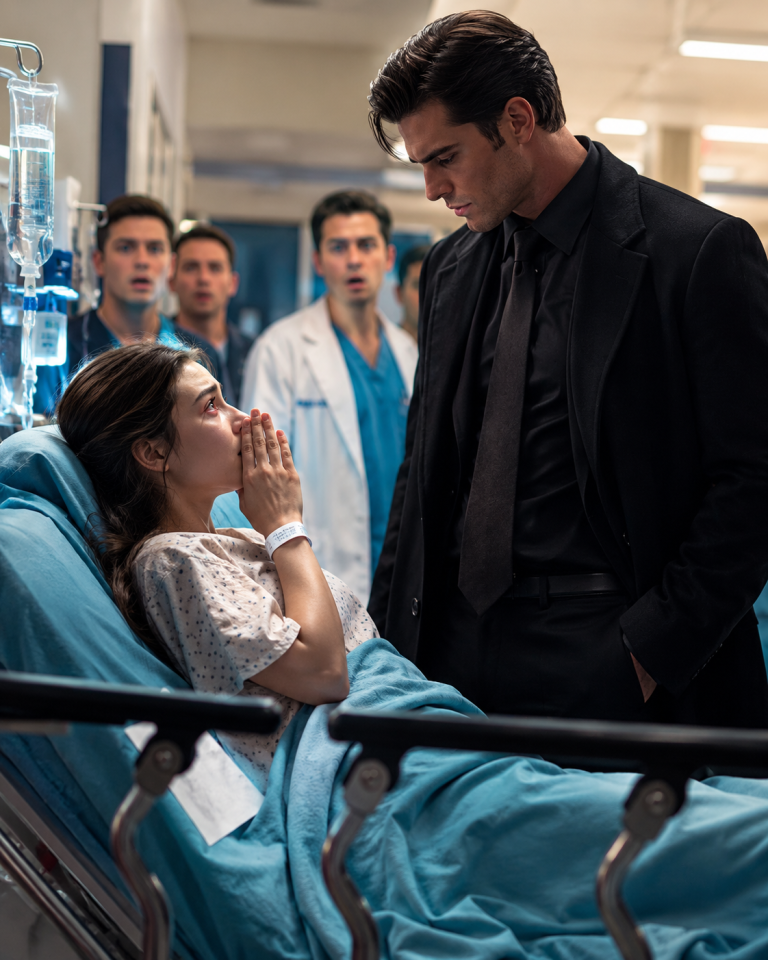
She woke to white ceilings and the specific silence of a place that had been paid to be quiet.
Private. Expensive. The kind of hospital floor where the equipment was current and the nurses had been told not to disturb unless disturbed.
Her shoulder was bandaged to immobility. Her left side was wrapped tight enough that breathing required a decision each time. The third wound — the one she had not fully registered in the ballroom — had been the most serious, and she understood from the IV line and the careful way the nurses moved around her that it had required a surgeon and several hours she had not been awake for.
She turned her head.
Eli was asleep in the chair beside her bed.
He had been placed there — arranged, really, with a blanket over his legs and a stuffed animal she didn’t recognize tucked under his arm — by someone who understood that the child had needed to be close to her badly enough that moving him was not worth the cost.
She looked at him for a while.
His face in sleep was completely unguarded, which was something she had noticed from the beginning: Eli guarded himself constantly during waking hours, with the particular vigilance of a child who had learned that emotions, displayed at the wrong moment, would be categorized as inconvenient by the adults around him. But sleeping, he was just a seven-year-old boy with dark hair and his mother’s jawline, taking up his chair with complete confidence.
The door opened.
Rowan Ashford stepped inside, and the room changed the way rooms changed around him — not dramatically, nothing as obvious as a drop in temperature, but a reorganization of the air’s attention. He wore a dark suit with the jacket gone, his collar open, and the specific dishevelment of a man who had been in the same clothes for twenty hours and had not thought about it once.
He looked at Eli first, then at Anna.
“You’re awake,” he said.
“Yes.”
He crossed to the chair on the other side of the bed — the one someone had placed there, she suspected, for him — and sat down. He did not perform ease. He simply sat, elbows on his knees, and looked at her with an expression that had been stripped of the careful architecture he usually maintained over his face.
“I need to ask you something,” he said.
Anna waited.
“There was a man at the event,” Rowan said. “Not one of mine. Not one of the guests we vetted. He was standing near the east corridor when —” He stopped. “When you were on the ground. One of my security team registered him speaking. They didn’t catch what he said. But one of the serving staff did.”
Anna’s pulse did something she controlled by not moving.
“What did they hear?” she asked.
Rowan looked at her steadily. “A name. Not the name on your employment contract.” He paused. “Who are you, Anna?”
The question sat in the room like the moment before a verdict.
Eli breathed softly in his chair.
Anna looked at the ceiling for a moment, then back at the man who had the resources to find out the answer whether she gave it or not, and whose son was asleep three feet away wearing her name on his face like proof of something she hadn’t meant to become.
“I’ll tell you,” she said. “But not here. Not in front of him.”
Rowan looked at Eli.
“When he wakes up,” Anna said, “can you take him for breakfast? Then come back.”
Rowan was quiet for a moment.
“He hasn’t left this room since they brought you in,” he said.
That landed somewhere it hadn’t expected to.
“I know,” Anna said. “Tell him I’ll be here when he gets back.”
—
## PART 3
Rowan took Eli for breakfast at seven thirty.
She heard them leave — the soft argument about which elevator to take, Eli’s voice insisting on the one with the numbers that lit up blue, Rowan’s brief silence followed by capitulation in the way of a man who had not yet worked out that with Eli, small battles were always negotiable and large ones were simply not worth starting.
Then the room was quiet.
Anna used the quiet to think.
She had been thinking, in the broken way of someone moving in and out of sleep, since she first opened her eyes. The man in the catering jacket — she had known him, or known *of* him, which was worse. He was connected to the person she had been running from before she became Anna Voss, before the forged references and the borrowed uniform and the two careful years of being unremarkable inside a house that was the last place anyone would think to look for her.
His being there was not coincidence.
The shooting had not been aimed at Eli.
Or rather — Eli might have been the target *claimed*, the thing that would have made the chaos useful to multiple parties at once. But the man in the catering jacket, standing at the east corridor’s edge, speaking her real name into the air while she bled on the marble floor, had been sending a message that had nothing to do with the Ashford syndicate.
*I found you.*
Rowan came back alone at eight fifty.
He sat in the same chair. He had coffee this time — two cups, one of which he set on the table beside her bed without asking. She found she was grateful for it.
“Eli?” she said.
“Downstairs. With Marcus and a stack of pancakes and what will probably be an unsustainable amount of syrup.” He looked at her. “He made me promise you’d still be here.”
“I’ll still be here.”
“I know.” He picked up his cup. “Start wherever you want.”
Anna started with her real name.
She had not said it aloud in two years. It felt strange in her mouth — not foreign, but like a room she had locked and was now opening while someone else was present.
Caitlin Reeves. Twenty-nine years old. From a city she didn’t name but would if asked. Graduate student, two and a half years ago, in a university program she had left when the situation made leaving necessary.
The situation.
It had a more specific name, but she had been careful about how she used it, because the specific name was connected to a specific man who had specific resources and who had, apparently, found her despite two years and a new identity and a criminal fortress she had chosen as her hiding place precisely because it kept better secrets than anywhere else she could think of.
“His name is Callum Reeves,” she said. “My brother.”
Rowan’s expression didn’t change, which meant he was listening carefully.
“He’s not — he’s not a good person, which I understand sounds like an inadequate description. He runs money for people in ways that require the people he works for to believe he’s trustworthy, and the way he maintains that trust is to make sure anyone who has reason to question it doesn’t have the opportunity to do so.” She looked at her hands on the blanket. “I found something I wasn’t supposed to find, two and a half years ago. Accounting records. Names. A ledger he kept in a format he thought was unreadable, which it was, until I worked out the cipher.” She paused. “I was going to take it to someone. I hadn’t decided who yet. He found out before I could decide.”
“And you ran,” Rowan said.
“I ran.” She looked at him. “I chose Harrow Hall because I thought — a house like this, a man like you, the security, the absence of official records — I thought if I were invisible enough here, he would eventually conclude he’d lost me.” She paused. “I was wrong about the timeline.”
“The man at the ballroom.”
“Is one of his. Which means he knows where I am. Which means —” She stopped.
“Which means the shooting may not have been aimed at Eli,” Rowan said.
“I don’t know. I don’t know if it was cover or if they were genuinely targeting him and my brother’s man was simply there to confirm my location. Both are possible.” She looked at Rowan. “I’m sorry. I chose this house because I believed it was impenetrable. I didn’t consider that I might bring something in with me.”
Rowan was quiet for a long moment.
He set his coffee down.
“Tell me everything you remember about the ledger.”
She looked at him. “Why?”
“Because ‘Callum Reeves’ is a name I recognize,” he said. “Not well. But I know what he’s adjacent to. And if the records you described are what I think they are, the people they protect are not going to stop sending men until either you’re gone or the records are unusable.”
“I made copies,” Anna said. “Encrypted. In a location that isn’t connected to any name I’ve ever used.”
Something shifted in Rowan’s expression. Not surprise exactly. More like a man arriving at a specific conclusion about a person he had underestimated.
“How long have you been carrying this?” he asked.
“Two and a half years.”
“Alone.”
“Yes.”
He looked at her for a moment.
“You walked into a room and threw your body over my son,” he said. “Without hesitation. Without knowing what was going to happen to you.” His voice was even, but the evenness was deliberate — the voice of a man maintaining control over something that was trying to be otherwise. “I’ve had people claim loyalty to me for fifteen years. I’ve built an organization on the idea that loyalty meant something. And not one of them has ever done what you did.”
“I didn’t do it because of loyalty,” Anna said.
“I know,” he said. “That’s the part I’m still working out.”
She looked at him.
“Eli is —” She stopped, started again. “He’s the first person in two years who asked my name like they actually wanted to know it. Not the name on my papers. Just — who I was. What made me laugh. What I thought about things.” She looked toward the window. “I wasn’t trying to love him. It wasn’t a plan. He just kept showing up.”
Rowan looked at his son’s empty chair for a moment.
“He does that,” he said quietly.
The silence between them was different from the earlier silence. Not the silence of a man interrogating a woman who had kept things from him. Something more like two people who had arrived, from very different directions, at the same complicated piece of ground.
“I need to tell you something,” Rowan said.
Anna waited.
“Isolde — Eli’s mother — died because someone sent a man after me and she was in the car instead.” He said it without expression, which was not the same as without feeling. “I spent four years making sure no one I cared about was close enough to be used as a target. I told myself that was protection.” He paused. “What it actually was, was a room with a locked door and a boy inside it who needed something I had decided was too dangerous to give him.”
Anna thought about Eli behind the velvet curtain.
*Everybody knows.*
Not arrogance. Fatigue.
“He knew,” she said.
“Children always know.” Rowan looked at his hands. “He found you instead. Which tells me something about what I’ve been giving him and what he needed that I wasn’t.”
“He needed someone to give him the second cookie,” Anna said.
Rowan looked at her.
“That’s all he needed, at first,” she said. “Someone who noticed what he actually wanted, not just what they thought was appropriate to give him.”
“And now?”
She thought about it. “Now he needs to know that the people he loves don’t always leave.”
Something moved across Rowan’s face that he did not try to suppress, which told her how much it had cost him.
“I’m going to find your brother,” he said. “And the man who was in my ballroom. And the people behind the records you’re carrying. This is not me offering charity or protection or an exchange.” His voice was direct. “This is me telling you that what happened in that ballroom changed the information I’m operating on, and I don’t know how to pretend otherwise.”
“You don’t have to pretend,” Anna said. “But I need you to understand what I want from it.”
“Tell me.”
“I want the threat removed well enough that I stop needing to disappear. That’s all. I don’t want to be owned or managed or kept.” She held his gaze. “If I stay at Harrow Hall, I stay as myself. Not as a shadow. Not as something to be protected from behind a closed door.”
Rowan studied her for a long moment.
“Caitlin,” he said. Her real name, in his voice, for the first time.
She held still.
“I haven’t kept anything behind a closed door successfully since a seven-year-old found a way through my security to sit under a curtain and cry about rain,” he said. “I’m not going to start now.”
—
The investigation took eleven weeks.
Anna knew this because she counted them from the hospital, then from the room at Harrow Hall that had been hers before and was now hers differently — meaning that Mrs. Crane no longer handed her a cleaning schedule on Monday mornings and no one referred to her as staff in Rowan’s presence, and Eli had informed his tutor at the start of the third week that Caitlin was going to be at dinner from now on and the tutor could adjust the lesson schedule accordingly.
The tutor had adjusted the lesson schedule.
Rowan’s people moved with the specific efficiency of an organization that had survived a long time by being better-prepared than its opponents. The man from the ballroom — Reeves’s operative, a careful professional named Stroud who had made the mistake of being recognizable to one of Rowan’s security team when he surfaced in Connecticut three weeks later — was taken into a situation that Anna did not ask for specific details about, except to ask that he remain alive long enough to be useful as evidence.
He remained alive.
The encrypted records Anna had been carrying for two and a half years were accessed through a process that involved two of Rowan’s attorneys, a federal contact that Rowan declined to describe in detail, and a meeting in a building in lower Manhattan that Anna attended herself, with Rowan beside her, because she had asked to and he had said yes without hesitation.
The records were sufficient.
Callum Reeves was arrested on a Thursday in February, in a city that was not the one Anna had run from, on charges that would take eighteen months to fully prosecute and that his attorneys would spend three years trying to reduce to something manageable. They would not succeed as fully as they hoped. The ledger cipher, once decoded by people who knew how to decode it, turned out to be comprehensive in ways that Callum had not anticipated when he designed it — comprehensive enough that the people he worked for, who had resources and lawyers and the habit of surviving things, found themselves in a situation where surviving this particular thing required sacrificing him.
They sacrificed him.
On the day the arrest was confirmed, Rowan found Anna in the winter garden.
She was sitting on the stone bench near the dormant roses, her coat wrapped around her, looking at the Hudson through the bare branches. The river was silver in the February light, cold and still and entirely indifferent to the size of the things happening along its banks.
She heard him before she saw him. His footsteps on the stone path had a specific rhythm she had learned over the past eleven weeks in the same way you learned anything that mattered — incrementally, without planning it.
He sat beside her.
“It’s done,” he said.
She let out a breath.
Not a dramatic one. Not the kind that came with tears or collapse. Just the breath of a body releasing something it had been holding for so long the holding had become indistinguishable from breathing.
“How’s Eli?” she said.
“Annoyed that you’re not at breakfast.”
“I’ll go in a minute.”
Rowan looked at the river.
“I want to ask you something,” he said. “And I want you to answer as yourself. Not as the person who was trying to disappear. Not as the person who was trying to earn the right to stay.”
Anna looked at him.
“Ask,” she said.
“Do you want to stay?”
She thought about the question the way she thought about everything since the ballroom — not managing it, not performing her way through it, just actually sitting with it and finding out what was true.
She thought about Eli in the chair beside her hospital bed. About the way he had said *you came* like the fact of her presence was a small miracle he had not taken for granted. About the morning she had walked out of the hospital and he had taken her hand on the front steps with the complete confidence of a child who has decided on something.
She thought about Rowan at three in the morning, when she couldn’t sleep from the rib pain, appearing in the doorway of the library where she had gone to sit in the dark, and simply sitting down in the chair across from her and not asking questions or filling the silence with reassurance, just being there until she fell asleep in the armchair and woke to find a blanket that had not been there before.
She thought about her real name in his voice.
She thought about the river.
“Yes,” she said.
Rowan turned to look at her.
“Then stay,” he said. “Not as anything with a title or a contract or a category. Just — here.”
“That’s not a very specific offer,” she said.
“No,” he said. “It isn’t.”
She looked at him for a moment. “I want to go back to my program. Finish what I was doing before all of this. Not full-time, not right away, but eventually.”
“I know someone at the institution.”
“I’m sure you do.”
“I won’t call them unless you ask.”
“I’m aware,” she said. “That’s why I mentioned it.”
He made a sound that was not quite a laugh. Close enough.
She stood. “I’m going in for breakfast.”
“I’ll come.”
They walked back along the stone path through the winter garden, past the dormant roses and the frozen fountain and the iron gates that had seemed, when she first arrived two years ago, like the walls of a trap she was choosing for herself.
They did not look like that anymore.
They looked like what they were: the edges of a house where a boy with his mother’s jaw had found her under a curtain on a rainy afternoon and decided, with the unassailable conviction of the very young, that she was someone worth finding.
Eli met them at the back door.
He had syrup on his collar and the expression of someone who had been patient for approximately as long as he considered reasonable.
“You took forever,” he told them.
“We were talking,” Anna said.
“About what?”
“About staying,” Rowan said.
Eli looked between them.
“Obviously she’s staying,” he said, with the brisk confidence of a child for whom this had never been in question. “Can we have the rest of breakfast now?”
He went inside without waiting for an answer.
Anna looked at Rowan.
Rowan looked back at her.
“Seven years old,” he said, “and he’s already better at this than I am.”
“Most people are better at it than you are,” Anna said. “He just comes to it naturally.”
Rowan’s mouth moved.
She walked in after Eli.
After a beat, Rowan followed.
The kitchen smelled of coffee and toast and the specific domestic warmth of a morning that had been made by people who had stopped performing ease and started actually inhabiting it. Eli was back in his chair, reorganizing the syrup situation with the focused authority of a person who had a system. Mrs. Crane was somewhere toward the back with the dignified displeasure of a woman who had been asked to accommodate a great deal of change in the past three months and had done so without complaint, which she considered an act of professional generosity that she would mention to no one and expect no acknowledgment of.
Anna sat down.
Rowan sat across from her.
Eli poured her coffee with the exaggerated care of a child who had been practicing this and was not going to waste the moment by doing it casually.
“Thank you,” Anna said.
“You’re welcome,” he said. Then, without looking up from righting the cup: “I’m glad you didn’t die.”
“Me too,” Anna said.
“Papa was really scared.”
“Eli,” Rowan said.
“You were,” Eli said, with the implacable accuracy of a child reporting observable fact. “I saw your face.”
Rowan said nothing.
Anna looked at her coffee.
“It’s okay to be scared,” she said, to both of them, to the room. “As long as it doesn’t make you stop.”
Eli considered this seriously.
“Did it make you stop?” he asked. “When you were scared?”
Anna thought about two years of careful disappearing. About the forged papers and the borrowed name and the long discipline of making herself invisible enough to survive. About the moment in the ballroom when fear had arrived and she had moved *through* it rather than away from it, because Eli’s small fingers were in hers and the body’s oldest intelligence had made the calculation before she had a chance to be afraid of it.
“No,” she said.
Eli nodded. Apparently satisfied.
“Good,” he said, and reached for the toast.
Outside, the Hudson moved past in its gray February light, cold and wide and entirely indifferent to the small specific warmth being assembled at a kitchen table inside a house that had been a fortress and was becoming, incrementally, room by room and morning by morning, something else.
Something that required a different word.
One that fit better.
One that felt, for the first time in two and a half years, like something Anna Voss — Caitlin Reeves — whoever she was and was still becoming — was allowed to use without taking it back.