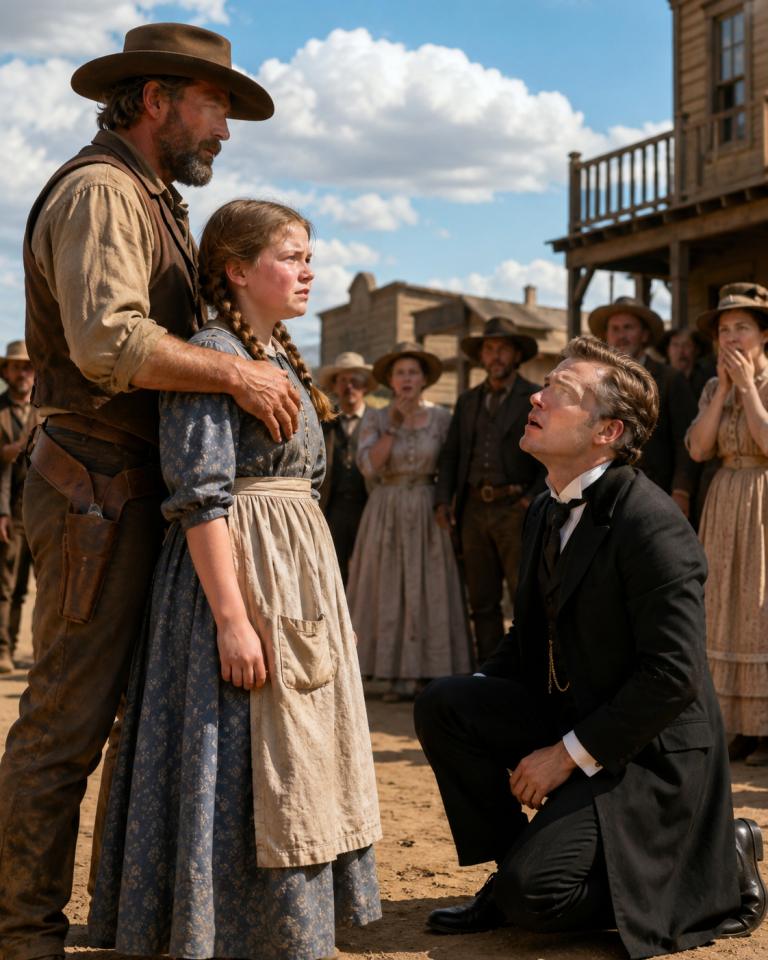
At the Town’s Cruelest Widow Auction, Everyone Laughed at the Forgotten Girl — But When the Cowboy Chose Her, the Mark on Her Hand Revealed the Secret That Could Save His Dying Ranch

## PART 1
Samuel Calhoun could feel the noose tightening around his family’s legacy.
The Calhoun ranch had belonged to his family for forty years. His father had built it through stubbornness and sweat, and Samuel had inherited both the land and the weight of maintaining it. But maintaining required money, and money was something the territory had decided Samuel no longer deserved.
Banker Augustus Dalton had held his father’s original notes—old agreements that predated the banker’s arrival in Millstone Crossing. Two years ago, Dalton had claimed Samuel owed back payments on debts his father had supposedly taken out before his death.
Samuel had checked his father’s papers.
The debts did not exist.
But Dalton produced ledgers showing them, and he smiled the way men smile when they know the law has been written by people who look like them and think like them.
“Your father’s signature is right here,” Dalton had said, pointing to documents Samuel knew his father had never signed. “Looks authentic to me.”
By autumn, Dalton was threatening foreclosure. By winter, Samuel would lose everything—the house, the pastures, the graveyard where his parents’ bones rested in soil they had broken.
That was why the Mayor had organized the dance. Not out of kindness, but out of the practical understanding that a man with a name, a ranch, and broad shoulders was worth more married than destroyed.
“Pick any widow in town,” the Mayor had joked as the band tuned their instruments. “Pick one before your ranch dies with you.”
The men laughed.
Samuel did not.
The barn was bright with lanterns that evening, the space transformed into something that resembled hope for people desperate to believe hope was still possible. Fiddle music filled the air. Silk skirts brushed against the dusty floor. And every widow in Millstone Crossing seemed to have arrived convinced that this was the night their financial security would be guaranteed.
There was widow Clemmons with her late husband’s cattle fortune. There was widow Hayes with her inherited town property. There was widow Morrison with her investment accounts and her practiced smile.
They circled like birds understanding they were being hunted.
“Don’t be a fool,” one of the ranchers said to Samuel. “Choose one with property. Choose one who can help.”
Samuel looked past the silk. Past the perfume that had cost money. Past every woman who had arrived certain she would be selected based on her dowry’s size.
In the darkest corner of the barn sat Rebecca Morgan.
She was not a widow. She was a store clerk, perhaps thirty years old, dressed in a faded fabric that had been mended more times than original stitches remained. Her gloves were worn through at the fingertips. Her hair was pinned without ornament. She had arrived because the mayor had insisted every unmarried woman attend, but she had clearly understood that attendance did not confer expectation of welcome.
She kept her eyes lowered because the town had taught her that poor girls should occupy space apologetically.
Someone snickered.
“Not her, Wade,” a man said. “She does not even own a proper hat for Sunday services.”
Rebecca heard it. Her face flushed red, but she did not cry. She only folded her hands tighter in her lap, and Samuel caught sight of something—a small paper, creased and worn, hidden beneath her glove.
Samuel crossed the barn floor.
The music faltered mid-phrase.
Every eye in the space turned toward him, and when he stopped in front of Rebecca, the silence became so complete that breathing seemed audible.
“Miss Morgan,” he said, “would you dance with me?”
Rebecca looked at his hand. Then her gaze traveled across the barn, landing on Banker Augustus Dalton.
Dalton’s smile had vanished.
In its place was an expression that suggested Samuel had just moved a piece on a board game that had been fixed since the beginning.
Rebecca’s voice was barely a whisper. “If I dance with you, Mr. Calhoun, he will know I showed you.”
Samuel lowered his voice to match hers. “Showed me what?”
Her fingers trembled as she slipped the folded paper from beneath her glove.
It was old. Creased from constant handling. Sealed with faded red wax that had begun to crack at the edges.
Samuel opened it.
Inside was a release of debt, dated two years earlier, signed by Banker Augustus Dalton and bearing his father’s genuine signature.
The document stated that William Calhoun had paid off every note owed to Dalton’s bank. That the ranch was free of encumbrance. That Dalton had received full payment and released all claims.
Samuel’s hands shook so badly the paper nearly fell.
“My mother,” Rebecca whispered, “worked for Mr. Dalton as his record keeper. She found forged documents in his ledger. She found records showing your father’s name attached to debts he never took out. She found evidence that Mr. Dalton had been systematically creating fictional obligations and then demanding payment from people who did not owe him anything.”
Samuel looked at the paper in his hands, then at Dalton across the barn.
The banker’s face had gone from pale to gray.
Then Dalton stood and pointed at Rebecca with a trembling hand.
“That girl’s mother was a thief,” he shouted. “She stole documents. She lied. Everything she claimed is a fabrication designed to destroy my reputation because I would not rehire her when her work became unreliable.”
Rebecca flinched as though the accusation had been thrown at her a hundred times already—the familiar weight of defending a dead mother against a powerful man’s lies.
Samuel stepped in front of her.
“Say that again,” he said quietly. His voice carried the kind of threat that made the barn’s noise halt completely.
Dalton’s jaw clenched.
Then Rebecca reached into her other glove and withdrew another paper. Then another. And another.
Not just the Calhoun ranch.
Widow Clemmons’s allegedly mortgaged property.
Widow Hayes’s supposedly encumbered inheritance.
Five farmers whose lands Dalton claimed were subject to unpaid notes.
A war veteran whose pension Dalton had claimed was insufficient to prevent foreclosure.
Dozens of documents, all forged in the same hand, all bearing the same pattern—a man creating debts from nothing and collecting payment from people too frightened or too powerless to challenge him.
“My mother documented everything,” Rebecca said, her voice gaining strength with each word. “Before she died, she sent copies to the territorial authority. She said that if anything happened to her, they would need the evidence to prove what had been happening.”
The barn doors swung open.
Two territorial marshals stood silhouetted against the night, having ridden hard through darkness to reach Millstone Crossing in time for this confrontation.
—
## PART 2
“Augustus Dalton,” the lead marshal said, his voice carrying the weight of federal authority, “you’re under arrest for fraud, conspiracy, and systematic theft through document forgery.”
Dalton tried to run.
He made it three steps before the second marshal caught him and placed him in restraints that must have felt like prophecy finally arriving.
The evidence Rebecca had been guarding—documents her mother had carefully collected before her death—painted a picture of systematic criminality that had operated in plain sight for more than a decade.
Dalton had arrived in Millstone Crossing fifteen years earlier, establishing himself as a banker through documents that were themselves forged. He had set up what appeared to be a legitimate lending operation, but it had been a harvest machine from the beginning—designed to separate desperate people from their property through manufactured debt.
Fifty-seven victims.
That was the final count after the territorial investigation concluded.
Fifty-seven people who had been forced to sell property, sign away inheritance, or surrender their businesses because Banker Augustus Dalton had created obligations they had never incurred.
Some of them had fought. Most had simply accepted the banker’s authority as truth because in the frontier, banks answered to no one and desperate people were assumed to be lying.
Rebecca’s mother, Helena Morgan, had been employed by Dalton as a record keeper. She had noticed the discrepancies early—debts being created without corresponding loan agreements, signatures that did not match, amounts that shifted in the ledger without explanation.
When she had confronted him, he had destroyed her reputation, spread rumors that she was mentally unstable, and ensured she would never work again.
But Helena had not been broken by this.
Instead, she had spent the final years of her life documenting Dalton’s crimes with the precision of someone who understood that evidence was the only weapon the powerless possessed against systematic fraud.
She had died of illness, but not before arranging for her daughter to carry the evidence and for the territorial marshal’s office to receive copies.
Rebecca, guarding those documents through fear and isolation, had become the repository of her mother’s final act of resistance.
“Why didn’t you show anyone before now?” Samuel asked her, the morning after Dalton’s arrest.
“Because I was afraid,” Rebecca said simply. “My mother showed her evidence to people, and they did not believe her. They believed the banker instead. I thought—” her voice wavered, “—I thought if I showed the documents, Dalton would destroy them. And then my mother’s work would be for nothing.”
“So you waited.”
“I waited,” Rebecca confirmed. “I waited for someone Dalton could not dismiss. Someone with a name that mattered. Someone the town would listen to if he said the banker had lied.”
Samuel understood then that Rebecca had not been hiding in shame. She had been waiting for the right moment to expose systematic criminality. She had been protecting evidence through patient observation, understanding that timing mattered as much as truth.
By spring, the investigation had expanded across three territories.
Dalton’s operations reached far beyond Millstone Crossing. He had replicated his fraud method in multiple towns, creating layers of false documentation and collecting payment through coercion and reputation destruction.
He was convicted on fifty-seven counts of fraud and conspiracy. The sentence was life imprisonment.
The victims—the fifty-seven people he had systematically robbed—began the long process of reclaiming what had been stolen.
Samuel Calhoun’s ranch was returned to him, free of any claim.
Widow Clemmons regained her property.
Widow Hayes’s inheritance was restored.
The war veteran whose pension had been questioned received full compensation for the years of lost income.
—
## PART 3
But the most profound transformation involved Rebecca Morgan.
After the trial concluded, after Dalton had been transported to the territorial prison, after Millstone Crossing had begun to understand the scope of what had been happening in their midst, Samuel approached Rebecca with a proposition.
“Marry me,” he said. “Not because your mother’s evidence saved my ranch. But because when everyone else was looking at widows with money, you were the only person in that barn I actually saw.”
Rebecca did not answer immediately. She asked him to wait while she made a decision that belonged to her alone—not pressured by gratitude, not influenced by the town’s expectation that she should be grateful to be chosen.
Two months later, she said yes.
They married quietly, with only a few witnesses, and they moved to the Calhoun ranch where Rebecca established a lending library—a repository of free books and educational materials for people who could not afford them. It became a gathering place for the vulnerable, a space where people could access information without fear of exploitation.
The territorial authorities, following up on the investigation into Dalton’s operations, discovered that he had maintained detailed records of every fraud. These records became evidence in subsequent cases against other corrupt officials and businessmen who had colluded with Dalton’s schemes.
Helena Morgan’s documentation, combined with Dalton’s own ledgers, created a paper trail so complete that corruption in three territories was exposed and prosecuted.
Widow Clemmons, whose property had been threatened by Dalton’s fraud, established a legal defense fund for people facing similar situations. She worked with territorial authorities to create standards for documentation that made it harder for officials to create false records.
Widow Hayes became an advocate for financial transparency, ensuring that banks were required to maintain legitimate ledgers open to public inspection.
The war veteran, his income restored and his reputation cleared, became a mentor to young men entering military service, teaching them to understand their rights and to recognize coercion when it appeared in official guise.
Millstone Crossing transformed from a town where corruption had flourished in plain sight to a place known for its resistance to fraud and its protection of vulnerable people.
Years later, when people asked Rebecca how she had found the courage to carry evidence of such systematic criminality without revealing it, she told them the truth.
“My mother taught me that patience is sometimes an act of resistance,” Rebecca said. “She could not fight Dalton directly—he was too powerful, and no one would listen to her. But she could document his crimes. She could preserve the evidence. And she could trust that eventually, someone with authority would arrive who would listen.”
She touched a small locket she wore around her neck, containing a portrait of her mother. “She did not live to see justice. But she made sure justice was possible. And I made sure her work was not forgotten.”
Samuel, listening to her speak, understood that he had not married Rebecca because she was overlooked or because she had saved his ranch. He had married her because she possessed the kind of integrity that made her willing to risk everything for truth, just as her mother had.
Their children grew up understanding that sometimes the most important work happened in silence—that documentation mattered, that patience could be strength, that speaking truth late was still better than never speaking it at all.
When Rebecca’s lending library expanded to neighboring towns, it became known as the Morgan Memorial—a tribute to Helena Morgan’s refusal to accept corruption as inevitable.
The wooden desk where Helena had documented Dalton’s crimes remained in the library’s center. Visitors were told the story—not of how Helena’s work had been vindicated (though it had been), but of how standing against systematic fraud required patience, courage, and the willingness to work quietly for justice that might not arrive within your own lifetime.
Rebecca lived on the Calhoun ranch for fifty years, and when she died, she left behind not just a library, but a legacy of resistance. She left documentation of her own—records of other people’s frauds she had uncovered, patterns of corruption she had noticed, evidence that helped the territorial authorities prevent future schemes.
Samuel, who had chosen to dance with the overlooked girl when the town expected him to choose wealth, had found something far more valuable than money.
He had found a partner who understood that some victories took generations to achieve, and that the work of building them was its own reward.
The Calhoun ranch, saved from foreclosure through Rebecca’s mother’s courage and Rebecca’s patience, became a place where vulnerable people could seek help without fear of exploitation. It became a sanctuary for people recovering from fraud, people rebuilding after loss, people learning to trust again.
And in the barn where Samuel had made the choice to dance with Rebecca instead of the widows in silk, stories were told—not about the moment itself, but about what that moment had meant. A choice to see people rather than their wealth. A choice to recognize value in someone the town had dismissed. A choice that had cascading effects across three territories and changed the course of justice.
Rebecca Morgan kept her mother’s documents—the papers she had carried in her gloves, the evidence she had protected through fear and isolation—in a place of honor. They were not hidden anymore. They were displayed openly, a testament to a woman who had fought corruption even when no one believed her, and to a daughter who had waited for the right moment to finish her mother’s fight.
The wooden sparrow from another family’s story had symbolized survival.
These documents symbolized something different: the power of those without power to reshape the world through patience, documentation, and the willingness to trust that truth, preserved carefully enough, would eventually find its audience.
—