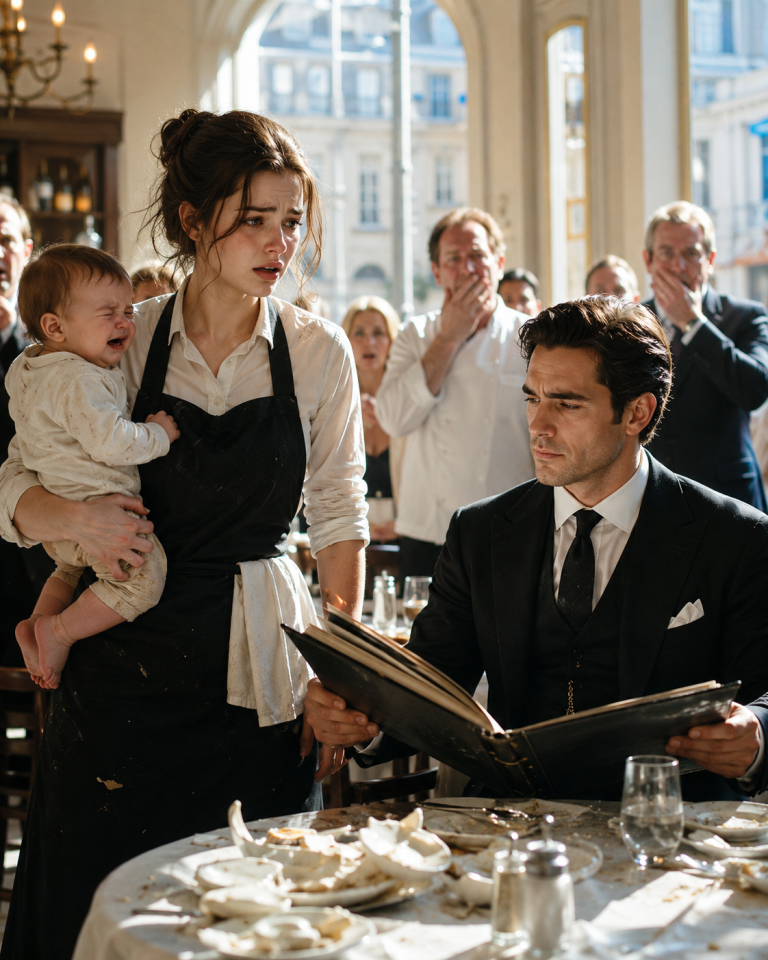
Gunfire erupted around the Mafia Boss just as betrayal closed in — cornered and seconds from death, he froze when the shy waitress leaned close and whispered, “Keep still”… because what she saw behind him changed everything.

PART 1
She was good at disappearing into rooms.
Not hiding — disappearing was different. Hiding implied intention, implied that someone was looking. Disappearing meant becoming part of the furniture, the way a lamp becomes part of a room the moment you stop noticing it. Nora Hale had been disappearing into rooms since she was eleven years old, learning to move around her father’s hospital bed without disturbing his sleep, to cry in bathrooms with the faucet running, to swallow the questions that sickness never left room to answer.
After her father died, disappearing stopped being a survival habit.
It became a career.
She had worked the floor at Marea for nine months. Long enough to know which tables required a specific pour angle for the wine, which regulars needed a bread basket pre-positioned before they sat down, which men’s eyes followed her across the room and which ones never registered her existence — the latter being the ones she preferred.
“Table nine,” said Monica, pressing a menu into her hand. “Corner booth. You’re up.”
Nora looked.
The corner booth at Marea had a particular quality to it — not the best view of the dining room, which was the table in the center where people went to be seen, but a different kind of advantage. Sightlines to both exits. The wall behind you. The room’s traffic in front. A table chosen by someone who preferred to see who was coming.
“That’s Ciro Ballan,” Monica said quietly, close enough that Nora could feel the words more than hear them.
Everyone in the city knew that name.
Ciro Ballan ran the eastern port operations, which everyone understood meant he ran considerably more than shipping logistics. He had the quality of powerful men who did not need to perform power — they simply existed in the room at a different density than everyone else, and the room reorganized around them without being asked.
“Why me?” Nora said.
“Because you don’t talk,” Monica said. “And tonight, he doesn’t want to be talked to.”
Nora could do that.
She tucked the menu under her arm and walked toward table nine.
Three men. The two on the outside had the particular stillness of people paid to be alert — not tense, just present in a way that registered without processing conversation. The man in the center was younger than she had expected from the weight of the name, somewhere in his mid-thirties, dark suit, white shirt open at the collar. He was watching the room the way she watched rooms — cataloguing.
His eyes found her when she was still four tables away.
That was unusual. Most people noticed a server when the server arrived. He noticed her in transit, which meant he was already tracking the room’s variables.
“Water for the table,” he said, when she reached them.
“Of course. Would you like to hear—”
“No. Bring the ’92 Barbaresco. Whatever the kitchen recommends tonight.”
“Yes, sir.”
She turned.
“Your name,” he said.
She turned back. “Nora.”
He said it back to her, once, as though testing how it sounded. Not a question.
She went to the kitchen and stood against the cold stainless of the prep counter and regulated her breathing, which was something she had learned to do in the months after her father died when the grief would arrive without warning in the middle of ordinary things.
He was a customer.
A dangerous customer, but a customer. She would serve him, stay invisible, and go back to the narrow, manageable life she had rebuilt — the rent, the groceries, the medical bills that were still arriving in her father’s name, the quiet of an apartment that no longer had his voice in it.
She carried the wine back.
His guards had migrated to a nearby table.
He was alone now, and beside his hand sat a small box, open. The ring inside caught the chandelier light and held it.
“Opinion?” he said, when she set down the glass.
She looked at the ring. Then at him.
“Whoever she is,” Nora said carefully, “she’ll need to decide whether she wants to wear something that expensive or display it under glass.”
He looked at her.
“That’s not a compliment,” he said.
“It wasn’t meant as one.” She picked up the corkscrew. “It’s a beautiful ring. But beautiful and comfortable aren’t the same category.”
Ciro Ballan looked at the ring for a moment.
Then at her.
“I’ll consider that.”
She poured the wine with steady hands. The room around table nine had the particular ambient quality of Monday evening — unhurried, the tables occupied by regulars who were here for the food rather than the performance, the service staff in their comfortable groove. The kitchen was running clean. The sommelier was handling the wine list at table four. Everything was exactly as it should be.
Then the kitchen doors opened.
A server she knew — Theo, who handled the back stations on Mondays, who had complained about pulling a second shift tonight and whose name was not on the floor schedule she had checked at six — came through the doors carrying appetizers.
He was moving wrong.
Not in a way most people would notice. His walk was correct, the tray was correctly balanced, his expression was professionally neutral. But his eyes were not on the room the way servers’ eyes were on the room. They were on Ciro Ballan specifically, with the focused quality of someone approaching a specific destination rather than performing a routine task.
And his right hand, under the tray, had a particular tension to it.
The tension of something held.
Nora’s body understood before her mind finished the sentence.
She stepped close to the table, close enough that the motion wouldn’t read from a distance as anything other than a server adjusting a setting. She leaned.
“Don’t move,” she said, just loud enough to reach him.
Under the table, her hand found his and pressed down.
He went completely still.
Not startled still. Immediately, entirely, deliberately still — the stillness of a man who had been in enough rooms to understand when the instruction came from someone who had seen something.
Theo reached the table.
“Compliments of the kitchen,” he said.
Nora’s free hand caught the water glass and tipped it — hard, deliberate, into Ciro’s lap.
The guards were moving before the water finished falling. The closer one had Theo’s right hand out from under the tray and against the table edge in less than two seconds. The tray crashed. Something small and glass-barreled bounced against the floor.
A syringe.
The dining room noise collapsed into a different kind of noise.
Theo went white.
Ciro stood. He was very calm. He looked at Theo with an expression that had no heat in it, which was somehow the thing that made several nearby diners stand and begin moving toward the exits without anyone telling them to.
His hand settled at the small of Nora’s back.
“We’re leaving,” he said.
“I have three more tables,” she said.
“Your manager will cover them.”
“You don’t know—”
“Nora.” His voice was quiet. “The man on the floor saw your face. He knows you warned me.”
She looked at Theo, who was zip-tied to his own chair now with his own wrists.
Then at the door.
The car was already in front.
She walked out of Marea into the November air with her apron still on, and the city that she had been invisible in for nine months rearranged itself entirely around the fact of her.
—
PART 2
The car was dark and fast and smelled like leather and the particular faint residue of cigarettes smoked long ago.
Nora sat against the door with her arms crossed.
Ciro sat across from her, jacket off, one hand pressing a handkerchief to a cut on his forearm from the tray’s edge when it fell. He watched her the way he had watched the room — actively.
“You noticed something,” he said.
“He was moving wrong.”
“Explain wrong.”
“His eyes were on you before he cleared the kitchen. Servers don’t do that. We watch the path, then the table. He watched you the whole time he was moving.” She paused. “And his hand was carrying weight that wasn’t on the tray.”
Ciro was quiet for a moment.
“You’ve been watching people for a long time,” he said.
“I’ve been invisible in rooms for a long time,” she said. “Same thing, different direction.”
He looked at her.
“Your name is Nora Hale,” he said.
Her stomach tightened.
“Yes.”
“Your father was Peter Hale. He worked night shifts at Saint Clement’s. He died fourteen months ago.”
She looked at her hands. “Don’t.”
“Pancreatic,” he said. “Fourteen months. I know because I was informed.”
She looked up. “Informed by who?”
Ciro reached inside his jacket.
An envelope. The paper had been handled often — soft at the edges, a slight warp from being carried close to a warm body for a long time. Her name on the front in her father’s handwriting.
The *N* he’d always written too large.
“Your father sent this,” Ciro said. “He sent it through a contact of mine with instructions to hold it until something happened that made it relevant.” He paused. “Tonight is relevant.”
Nora looked at the envelope.
“Why would my father have a contact of yours.”
“Because seven years ago,” Ciro said, “your father saved my life.”
The car kept moving. The city strobed past the windows.
“He was a nurse,” she said.
“Yes.”
“He hated everything you represent.”
“Yes.”
“He wouldn’t—”
“He didn’t save me because he approved of me,” Ciro said. “He saved me because I was bleeding out on a gurney and he was the only one in that ward who didn’t walk away.” He looked at the envelope in her hands. “He told me he didn’t treat deserving patients. He treated patients.”
Nora’s eyes burned.
That was his voice. That was exactly his voice — the particular flat pragmatism he deployed when he was doing something emotionally enormous and needed to make it sound clinical.
“He saved you,” she said.
“Six hours. Three bullets. He stayed the whole night.”
“He never told me.”
“He didn’t want you to know. He wanted you safe from the association.”
She looked at the envelope.
She wanted to not open it. She wanted to hold it closed a little longer, because she knew that what was inside would be the last new thing her father ever said to her, and once she read it she would have read it, and that would be final.
She opened it.
*Nora—*
*I don’t have much time to write this properly. You know I never did things properly when the shorter version would do.*
*Seven years ago I made a choice I didn’t tell you about. I treated a man I was not supposed to treat, and I did it because walking away from a patient isn’t medicine. The man recovered. He left. I went back to work.*
*But I learned things during those six hours that I shouldn’t know. About a person inside his organization. About what that person was planning and who he intended to use.*
*I reported nothing because reporting creates records and records create danger for people attached to the recorder. I kept it to myself and I watched and I waited to see if I was wrong.*
*I don’t think I was wrong.*
*If this letter found you, then something happened that made it relevant. That means the person I was afraid of found out what I knew. I am sorry that my knowing put anything near you.*
*The information is in the lockbox under the floorboard in my office closet. Third plank from the right. You’ve been in that closet a thousand times.*
*The man you’re with — and if this letter found you, you’re with him — I don’t know what he is to you or what he’ll become. But I know what he was in my ward at three in the morning when he thought he might not make it. He was the kind of frightened that honest men get.*
*That’s enough for me. I hope it’s enough for you.*
*All my love, Dad.*
She read it twice.
Then the car stopped.
Not slowing — stopped, hard, brakes and rubber and the particular sound of something immovable ahead.
“Boss,” said the driver.
The first shot came through the windshield.
—
PART 3
Nora had been in one car accident before, at nineteen, which had happened slowly enough that she’d had time to think *this is happening* before the impact. This was not like that. This was glass and noise and Ciro moving across the backseat in the same second the shot sounded, his body coming between her and the windshield, and she registered that he had done it before she registered anything else.
“Down,” he said.
She was already down, pressed against the door, his weight partially over her. Return fire from the front — the driver and the guard in the passenger seat. Shouting outside. The sound of the second car, which she hadn’t known was there until she heard it accelerating from the right.
Then the second salvo.
Two shots, different angle.
“The left side is compromised,” the driver said.
“I know,” Ciro said. “Move to the right.”
He shifted his weight, keeping himself between her and the door that was taking the fire, and she felt the warmth of him — and then the different warmth, which was the warmth of something wet.
She pressed her hand against his side.
He didn’t make a sound.
“You’re hit,” she said.
“I know that too.”
“Ciro—”
“Stay still.”
She stayed still. She listened to the firefight with her cheek against the leather seat, counting shots and directions the way she had learned to count things in hospital rooms — not because the counting helped, but because it was something her mind could do that kept it from the other thing, the white noise of pure fear.
It lasted four minutes.
She counted.
Then quiet.
Not the peaceful quiet of a room at rest. The tactical quiet of a space that has been cleared.
A figure approached the car through the rain.
He moved the way someone moved when they weren’t worried about what they were walking toward — unhurried, collar up against the rain, the particular ease of someone who had planned the night and was arriving at the part that had always been inevitable.
Theo.
Zip ties, evidently, had not held.
Or someone had cut them.
He stopped a few feet from the car and looked in through the ruined windshield and smiled in the way that people smiled when they had been holding the smile back for a long time and could finally let it out.
“Ballan,” he said.
Ciro’s voice came out even. “I’m listening.”
“Your father’s nurse,” Theo said. He wasn’t looking at Ciro. He was looking at Nora. “He found something he shouldn’t have. He heard a conversation in that ward that night that I would have given a great deal for him not to hear.” He tilted his head. “I visited him, after. Very politely. He had nothing to say to me.” His expression shifted slightly. “I waited. I was very patient.”
Nora heard her own heartbeat.
“He didn’t die of cancer,” she said.
“He died of cancer,” Theo said. “I just didn’t make it easier. Fear is hard on the body. Stress accelerates things. I visited him six times over two years and asked him, each time, whether he was ready to tell me where he’d put what he’d found.” He paused. “He never was.”
The rain.
The ruined car.
Her father, alone in that hospital room, saying nothing.
She thought about the floorboard in his office closet. The third plank from the right. A thousand times in that closet and she had never thought to look.
He had been protecting her from even knowing there was something to look for.
Something in Nora went very quiet.
Not numb. The opposite — clear and sharp and focused the way things focused when there was only one thing left to calculate.
“There’s a lockbox,” she said.
Theo looked at her.
“With everything he found. I know where it is.” She held his gaze. “Let him get medical attention and I’ll tell you where it is.”
“Nora,” Ciro said.
“I’m negotiating,” she said.
“You don’t need to—”
“Let me finish.” She looked at Theo. “That’s the offer.”
Theo smiled. “You’re not in a position to negotiate.”
“I’m the only person who knows where it is. My father’s handwriting in a letter I just read. You have no other lead.” She kept her voice level. “Those are the terms.”
Theo considered her for a moment.
Then he raised the gun.
“Or,” he said, “I take you somewhere quiet and we have the conversation differently.”
Ciro moved.
She hadn’t anticipated it and apparently neither had Theo — Ciro came out of the damaged car door with his shoulder, the door swinging wide and catching Theo across the wrist, the gun going sideways. He had been shot. He was moving like he hadn’t been shot, which Nora thought, from her angle, was either adrenaline or will or some third thing she didn’t have a word for.
She came out of the car behind him.
She had the envelope in her hand, still, from before. She was not sure why she hadn’t let go of it. She looked at what was available — which was the car’s door, the ground, the rain, and Theo trying to recover his balance while Ciro held his gun hand — and she picked up the door mirror, which had been sheared off in the collision, and she hit Theo across the back of the knee with it.
He went down.
Ciro finished it.
She looked away.
She had looked away from the footage in her apartment, weeks earlier, when she had watched Reyes from the kitchen. She did not think this was weakness — she thought it was honesty about what she could see and what she didn’t need to.
When she looked back, Theo was not a problem anymore.
Ciro was standing in the rain with one hand pressed against his side and looking at her.
“The door mirror,” he said.
“It was available.”
“You negotiated.”
“It bought thirty seconds.”
“It also told him there was a lockbox.”
“He was going to find out anyway. My father’s been dead for fourteen months and he still hadn’t found it, which means he already knew it existed and couldn’t locate it. I confirmed it existed. That was a small loss.” She looked at his hand, pressed against his side. “Come here.”
She had carried a first aid kit in her bag since her father got sick — the habit had outlasted the need for it by fourteen months and she had never bothered to remove it. She took off her apron, which she was still wearing, and she pressed it against the wound and held it there with both hands.
“Hospital,” she said.
“Private clinic,” he said. “Forty minutes.”
“You have forty minutes.”
“I’ve lasted on less.”
She kept pressure on the wound. His hand came over hers — not pulling it away, just resting there, covering hers.
The sirens were coming. She could hear them, still distant, moving through the wet city toward this intersection.
“The lockbox,” she said.
“Yes.”
“I’ll get it. Tomorrow, when it’s light. Whatever’s in it—” she paused. “I don’t know what’s in it. My father didn’t tell me. But he said it was what he found in your ward that night, which means it belongs to your situation, not mine.”
“It will name people in my organization.”
“I know.”
“Handling that will not be clean.”
“I know what handling it means,” she said. “I grew up knowing my father saved someone dangerous. I understood the implications even when I didn’t know the specifics.” She looked at him. “I’m not confused about what you do.”
He looked at her.
The rain came down steady. Somewhere, the sirens.
“Then what are you?” he said.
She thought about her father’s letter.
*He was the kind of frightened that honest men get.*
She thought about the corridor in the restaurant — the moment her body had understood before her mind finished the sentence, the moment she had made the calculation and leaned and whispered and it had worked.
“Someone who pays attention,” she said. “That’s what my father made me. He spent twenty years treating people that frightened him because he’d decided that doing the right thing didn’t require the absence of fear. Just the willingness to move through it.” She paused. “I got that from him.”
Ciro was quiet.
“He told me in the letter,” she said, “that when he was in your ward that night, you were frightened the way honest men are frightened. He said that was enough for him.”
Ciro looked at the rain.
“I was,” he said. “I don’t let people see it.”
“He saw it.”
“He was looking for different things than most people.”
“Yes,” she said. “He was.”
—
The lockbox contained thirty-seven pages.
Her father’s handwriting, compact and precise — the same hand that had written her grocery lists and birthday cards and, finally, the letter she had read in a moving car in the rain. Dates, names, amounts, connections. A record that had apparently required six hours of proximity during a life-threatening situation to overhear, built from the conversations that happened around a medical team because the people having them had forgotten, or never noticed, that nurses were in the room.
She delivered it herself.
Not because she was asked to — Ciro had sent someone to collect it and she had sent that person back empty-handed and driven to the address herself. She was not sure exactly why, except that it had been her father’s last act of consequence and handing it off through an intermediary felt like a delegation that wasn’t hers to make.
Ciro met her in the front room of a building she did not ask the address of.
He was moving carefully — the clinic had done what it could, but his left side held a new stiffness that would be there for a while. He took the box from her and set it on the table and opened it and looked at the pages without touching them.
“He documented it over months,” Ciro said.
“He was careful.”
“He could have destroyed it.”
“He could have,” she said. “He chose not to.”
Ciro looked at the pages.
“This will create significant instability in my organization,” he said.
“I know.”
“Several people named here are people I’ve known for years.”
“I know.”
“You understand what happens to people named in a document like this.”
She looked at him.
“I understand what kind of man Theo was,” she said. “I understand that he visited my father six times in two years and tried to frighten a dying man into giving up something that would protect him. I understand that my father said nothing, each of those six times, because he was protecting me from even knowing there was something to protect.” Her voice stayed level. “I have no confusion about what justice looks like in your world. I just want to know that it’s going to happen.”
Ciro looked at her.
“It’s going to happen,” he said.
She looked at the pages.
At her father’s handwriting.
She thought about the night in the ward — her father, at three in the morning, making the decision that honest people make when the alternative is walking away. Not because the person deserved saving. Because abandonment wasn’t medicine.
He had kept the consequence of that decision from her for seven years.
She was here now because of it, which meant she was living inside the consequence whether she knew about it or not. Knowing was just honest.
“I want something,” she said.
Ciro looked at her.
“My father’s medical bills. They’re still arriving. He had supplemental insurance that didn’t cover the last six months of treatment and the estate doesn’t have enough to clear it.” She held his gaze. “I’m not asking because I did you a favor. I’m asking because he did, fourteen months ago, and he refused payment, and I think there’s a debt there that predates anything that happened this week.”
Ciro was quiet for a moment.
“Yes,” he said.
“That’s all I want.”
“All right.”
She picked up her bag.
“I’m going back to Marea tomorrow,” she said. “I need the income and I’m good at the work and you didn’t compromise the restaurant, you compromised Theo. So there’s no reason I can’t go back.”
“They’ll know your face.”
“Not most of them. The people who matter to you won’t be coming for me once you’ve used what’s in that box.” She paused. “And if I’m wrong, I’ll handle it.”
He looked at her.
“With a door mirror,” he said.
“With whatever’s available.”
The corner of his mouth moved.
She went to the door.
“Nora,” he said.
She turned.
He said: “Your father saw something in me that no one else did. I have been trying, for seven years, to be worth what he spent on me.” He paused. “I’m not there. I may not get there. But I’m trying.”
She thought about the letter.
*Judge him by how he treats those weaker than himself.*
She thought about the backseat of the car, his weight between her and the window, the shot she hadn’t taken because he had already moved.
“I know,” she said.
“That doesn’t worry you.”
“It’s honest.” She looked at him. “Honesty is something I can work with.”
She walked out into the morning.
—
The bills cleared four days later.
She found out from the collections agency, which called to inform her that the outstanding balance had been settled and the account was closed. She stood in her kitchen in her uniform before the morning shift and held the phone after the call ended and breathed.
She thought about her father in that ward. Six hours. Three bullets. *I don’t treat deserving patients.*
She thought about the envelope she had been carrying in her bag since that night, tucked into the inner pocket where she could feel it without taking it out.
She knew what it said. She had read it four times now. She was not done reading it — she thought she might keep reading it for years, the way you returned to things that had become load-bearing in your understanding of yourself.
She put the phone in her pocket and finished getting ready for work.
She was good at her job. She noticed things. She paid attention to what rooms required and what they were hiding and the distance between the two, which was where most of the important information lived. She had learned that from her father, who had spent his career in the space between what patients presented and what was actually happening, reading the room with the particular skill of someone who understood that the room was always telling you something if you knew how to be quiet enough to hear it.
She went to work.
She carried wine through rooms where people performed versions of themselves and never looked at the server.
She disappeared into the furniture.
And she thought, more than she expected to, about a man sitting across from her in a dark car in the rain, telling her without drama that he was trying to be worth something, which was the most honest thing she had heard from anyone in fourteen months of managing loss.
She thought: her father had left her something after all.
Not money, not the lockbox, not even the letter — though all of those.
He had left her the practice of looking at people past what they cost you, past what they were supposed to be, into what they were doing with what they had.
She was her father’s daughter.
She could work with that.