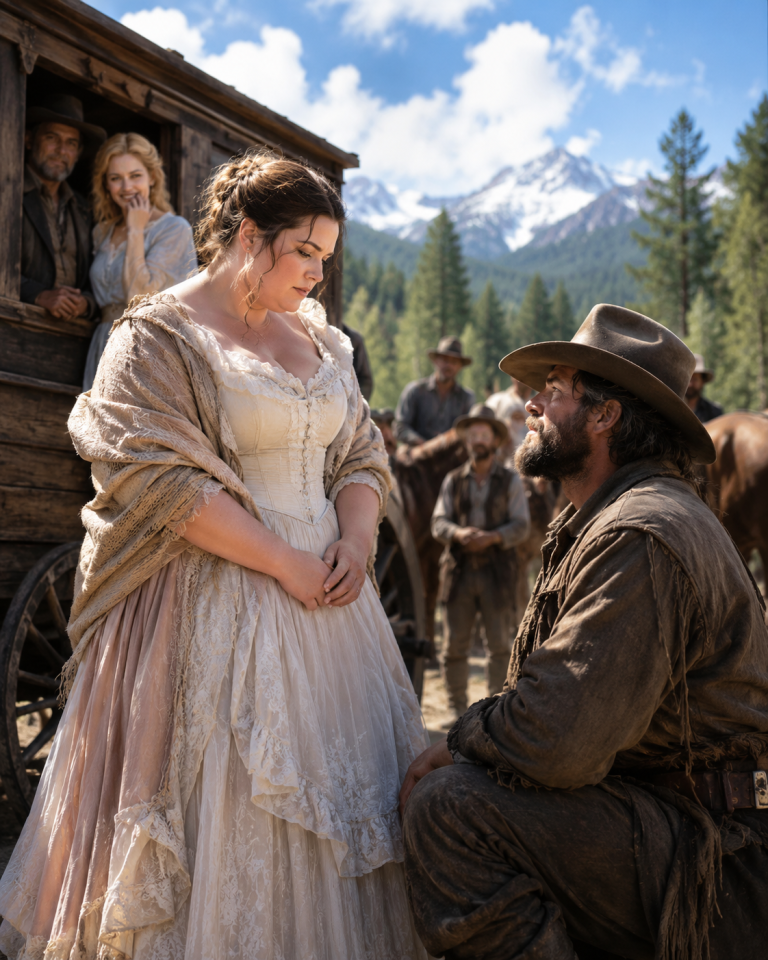
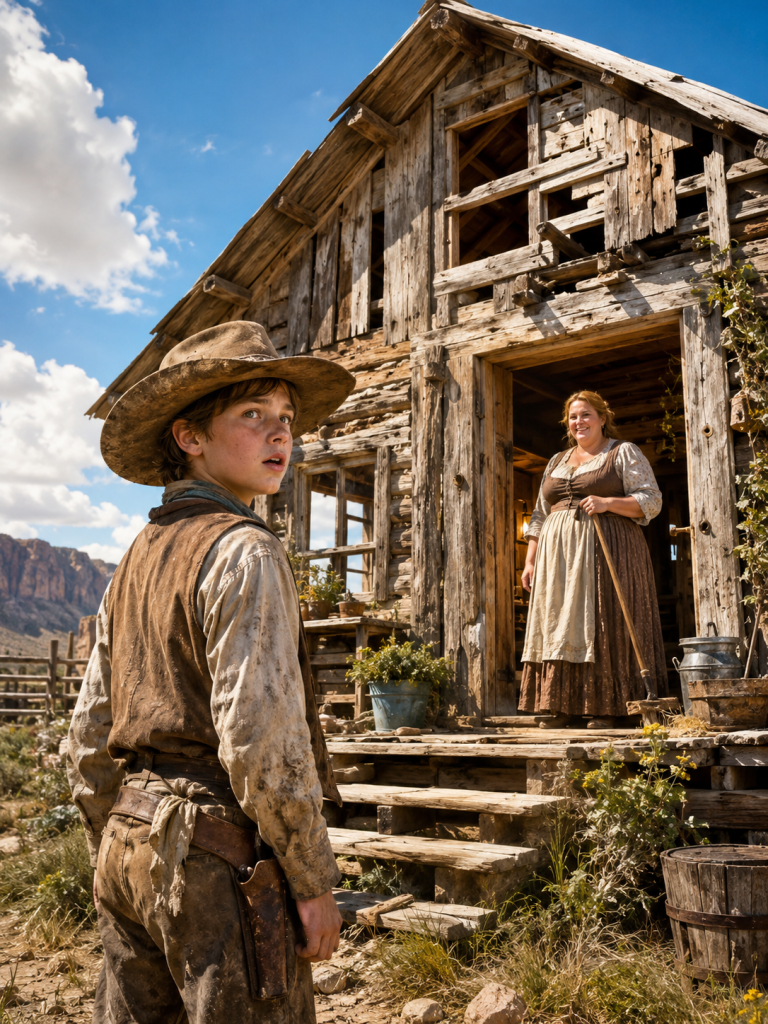
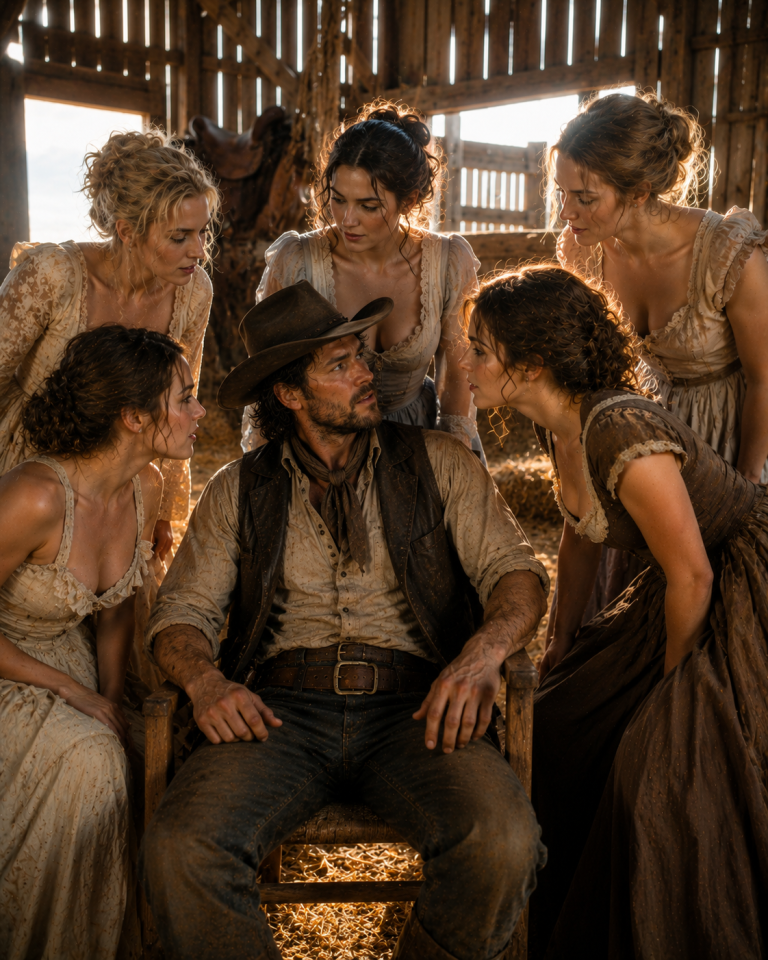
I found a crying baby beneath a dead horse in the tall grass. The sun was burning, the trail was empty, and I thought saving the child was the worst thing that would happen that morning. Then I saw the silver charm tied around the baby’s wrist, and my hands went cold.

## PART 1
The horse had been dead since before sunrise.
I found her at the north end of my fence line, on her side in the tall grass, legs already stiff, flies working at the corners of one half-open eye. She had been a good animal once — a bay with clean legs and careful feet, the kind someone had paid real money for. The smell reached me before I was fully off my horse. Blood, hot hide, and something sweeter underneath it that made my gelding sidestep hard and blow through his nose.
I almost turned back.
Then I heard the cry.
Thin. Ragged. Coming from the strip of shade under the bay’s belly.
I left my horse with his reins over his neck and pushed through the grass. The blanket bundled against the mare’s underside looked like nothing from three steps out. Then it moved. I dropped to one knee, waved flies from my face, and pulled back the top fold.
A baby girl blinked up at me through a face swollen red and wet with crying. Her lips had gone dry and cracked. Dust had tracked itself along the tear paths on her cheeks. When the light hit her eyes, she pinched them shut, and one tiny fist opened and trembled in the heat before falling back against her chest.
I pressed one finger near her mouth without thinking about it.
She turned and latched on with the grip of something that had decided not to die.
I lifted her out.
The blanket was heavy wool, too hot for the morning, but it had kept the direct sun off her. Her cheek burned against the inside of my wrist. As I stood, I looked across the wash and the stretch of range beyond it for anything that made sense of this — a wagon, a camp ring, a rider, smoke from somewhere. Nothing. No tracks in the visible ground but the mare’s, mine, and a second set already blurred by overnight wind.
I went back to the mare.
The reins had been cut clean. One stirrup dragged. There was a dark dried entry wound on the left side of her neck, just above the shoulder, that no branch or rock had made.
Someone had shot the horse while it was being ridden.
I searched the blanket while the baby made weak sounds against my chest. My hand caught on the corner where it was thicker than it should have been. Embroidery. Faded blue thread, carefully worked into the fabric.
*Mary Langford.*
The morning tilted.
I was nineteen again. A flat white August sky. The Langford place burning in the distance with enough smoke to stand up like a column. I had ridden out with my father to see what the county was already saying, and my father had stood in the road with his hat brim low and said: *Ride on, Thomas. This isn’t ours to fix.*
I had.
I was thirty-one now. I held Mary Langford’s blanket around a baby that had been hidden under a shot horse on my fence line, and my father’s voice sounded different than it had for twelve years.
I turned the blanket over and checked the seam.
Something hard had been sewn into the wool near the corner. I worked it out with my thumbnail.
A brass key, old and heavy, with a small tin tag wired to the ring. Scratched deep into the tag:
*BOX 214*
On the back, almost worn through: *$2,800.*
The same number people had whispered about the Langford debt. The debt that had caused the fire. The debt that had killed the family.
Except standing there in the morning heat with that number in my hand, I understood for the first time that I had never once actually seen the debt itself. Only been told about it by people who had not seen it either.
I wrapped the key in my bandana and put it in my shirt pocket.
“Hold on,” I told the baby, and tied her to my chest with my belt and the blanket. Her head settled under my chin. She smelled of sour milk and dust and that particular sweetness babies kept even when the world had been trying to take it from them.
I rode south toward home.
—
My place sat where Mesquite Creek came down through a shallow limestone cut — two rooms, a lean-to, a well that had never failed, and a dog named Rust who was too old to chase cattle and too stubborn to admit it. Not much to look at, but it stayed dry and kept my business mine.
By the time I got there, the sun had climbed high enough to make the yard white.
Rust met me at the porch with one sharp bark and then went quiet when he heard the baby. He looked at the bundle, then at me, then at the bundle again with the expression of a dog doing careful math.
“I know,” I said.
Inside, I laid the baby on the kitchen table, found a clean cloth, and touched water to her lips drop by drop from the cap of my canteen. She took it. She coughed once, and then her eyes came fully open.
Dark eyes. Alert even through exhaustion.
Not Arthur Langford’s pale blue. Not Vera Langford’s brown.
The eyes that looked up at me from that table were Mary Langford’s eyes exactly as I remembered them from childhood, when she was twelve years old and quiet and always standing slightly apart from whatever group she was meant to be part of, watching things most people didn’t notice.
My hand tightened on the canteen.
The story in Harlan County was that Mary Langford had died in the fire eight years ago. Along with her parents. All of them.
But I had not seen bodies. I had seen smoke.
I warmed milk on the stove and fed the baby with a twisted cloth, the way my mother had once fed weak lambs. The child latched on with the furious intent of something that had decided it had more to do.
“Good,” I said quietly. “Angry is better than quiet.”
I was cleaning the dust from her neck when I found the bruise near her collarbone. The shape of a thumb. Someone had grabbed her hard enough to leave a mark.
The door opened without a knock.
—
Agnes Croft had been the first woman I knew in Harlan County, the first I had feared, and remained the first I trusted. She was close to sixty, broad-hipped and narrow-eyed, and she ran the only house in the county where you could get a poultice, a piece of real advice, or a meal without anyone looking at you like they were keeping score. She had delivered me, delivered half the county after me, and buried a portion of the rest. She knocked when she chose to and walked in when she didn’t.
She stopped two steps inside.
“That was not a cat,” she said.
Then she saw the blanket.
The color left her face the way color left a cut stone in shadow — fast and absolute.
“Where did you get that?”
“North pasture,” I said. “Under a dead horse.”
“Under?”
“Shot horse. Cut rein. No camp. Name sewn in the blanket says Mary Langford.”
Agnes set both hands flat on the table. She looked at the baby the way you looked at something you had believed was safely gone and were now being asked to receive back.
Outside, Rust moved on the porch. The creek made its shallow sound over rock.
“Three men rode through town yesterday afternoon,” she said. “One of them gave Lloyd Pena two dollars for word of a dark-haired woman carrying an infant.”
My chair scraped the floor. “What did he look like?”
“Tall. Brown coat in this heat. One gold tooth at the front. When Lloyd told him he hadn’t seen anyone matching that, the man smiled and said something Lloyd couldn’t repeat at supper.” She paused. “He said ash wives ought to stay ash.”
The baby shifted on the table.
Agnes lifted her, settled her with the practiced ease of someone who had been settling infants since before I was one, and looked at me over the child’s head. “What else?”
I showed her the key.
When she read the tag, she closed her eyes for a full breath.
“So it held,” she murmured.
“What held?”
She looked toward the window, which showed only the yard and the creek bank and the empty county road beyond.
“Stoke the stove,” she said. “And load your rifle.”
I was reaching for the Winchester when Rust stood up off the porch without making a sound.
Hoofbeats followed. Slow and measured, the kind that meant the man in the saddle had done this enough times to understand that steady approached better than hurried.
The horse stopped outside.
Leather moved. A boot hit the porch.
Three knocks. Even spacing. The kind that didn’t need to hurry.
I put the rifle behind the door before I opened it.
The man in the brown coat stood close enough for me to see the trail dust on his hem and the exact quality of his smile, which was the kind that functioned without reaching his eyes. He held half a torn wool blanket wrapped around one fist. The other half was on the baby in Agnes’s arms.
His gaze cleared the room in one sweep.
“There she is,” he said.
“What do you want?” I said.
“The child’s name is Josie,” he said. “And you’re holding something that belongs to other people.”
Only Mary Langford would know her daughter’s name.
Or someone close enough to Mary Langford to have heard her use it while running for her life.
I kept my hand on the door edge. “Most men ask about the dead horse before the baby.”
His eyes sharpened. “The key, rancher. Hand it over and I’ll be on my way.”
I heard Agnes shift weight behind me.
“You don’t know what you’re sitting on,” the man said.
“I know enough,” I said.
“Tired of explaining things to people today.”
He stepped forward without being invited.
The door caught his wrist before his pistol cleared leather.
The gun went off anyway, punching a hole in the lintel above my head.
Rust hit him from behind — low and hard, teeth into the calf — and the man stumbled sideways onto the porch. Agnes appeared at my shoulder with the cast-iron skillet from the stove hook and connected with the side of his head with a sound like a green branch splitting.
He went down.
I was on him before he finished going, knee in his back, his own pistol in my hand.
By the time Josie started crying in earnest, the man was tied to my kitchen chair with my saddle rope and Agnes was bouncing the baby against her shoulder with hands that shook only once before she made them stop.
The man’s name, when I asked, was Cord Vause.
He gave it the way he gave everything — with the smile of someone who thought his own position was better than the evidence suggested.
Agnes went still at the name in a way she had not gone still for anything else.
“He rode for Silas Brant,” she said.
I knew the name Silas Brant the way everybody in three counties knew it — as weather. He owned freight contracts, cattle routes, grain warehouses, and enough credit paper to make a man feel in debt just by reading the county record. He shook hands at every funeral and donated to every church roof and had never been called anything but respectable by anyone whose opinion had value in the county, partly because Brant was the one assigning value to opinions.
Cord Vause leaned back as far as the rope allowed. “You should ask the midwife here about the Langfords,” he said. “She knows more than she taught this town.”
Agnes’s jaw set.
The baby had quieted against her shoulder, one small fist tangled in the collar of her dress.
“At four o’clock yesterday evening,” Agnes said, “Mary Langford came to me.”
—
## PART 2
My breath caught.
“She was riding hard. Horse had been run past safe. The baby had fever. Mary had blood on her left arm and the blanket torn in two where someone had grabbed her in the dark.” Agnes looked at the baby, not at me. “I cleaned the baby. Mary wouldn’t let me keep her — said she had business at the county bank before noon today and that if she didn’t make it, the key needed to be somewhere Brant’s men couldn’t find it.” She paused. “I sewed it back into the blanket while Mary was in the other room.”
Cord Vause shifted in the rope. “And you hid it in a field,” he said, with a tone that suggested he found this admirable.
Agnes ignored him. “Arthur Langford did not die in that fire eight years ago owing Silas Brant a dollar. What Arthur owed was Brant’s permanent inconvenience.”
The room narrowed around that sentence.
“Mary’s mother was still alive three years ago,” Agnes continued. “Vera Langford. She’d been living outside Albuquerque under a different name since the night the house burned. She took sick last winter — her lungs — and Mary came home from New Mexico to sit with her through it. When Vera died, she told Mary that Arthur had not been trying to pay a debt when he hid that key. He had been trying to preserve evidence.”
“Evidence of what?” I asked.
“Of how the debt was made.” Agnes shifted the baby. “Brant used false instruments. Clean-looking notes backed by willing witnesses and pliable county clerks. He built debts out of nothing, applied them to land he wanted, and when men balked, their luck turned bad in the way that looked like accident from a distance. Arthur figured out the method. He deposited original records in the bank box and got Vera and Mary out through the root cellar the night men came for him.”
She looked at me.
“Your father was there,” she said.
The stove ticked in the silence.
“What?” I said.
Agnes’s voice didn’t change. “Arthur asked him to. Ben Hale was the one man Arthur trusted enough to be a second witness. Your father rode to the Langford place the night before the fire. He came to me after midnight with soot on his shirt and a split knuckle and asked for bandages and laudanum, wouldn’t say for who, and the next morning he stood on the county road and told his son it wasn’t their business.”
I stared at her.
“I’ve always known he was there,” Agnes said. “I chose not to know what it meant.”
Cord Vause’s mouth opened. I didn’t give him the room to use it.
“Where is Mary now?” I said.
He smiled.
I looked at the rope, the chair, and the cast-iron skillet still in Agnes’s free hand, and I set the butt of his own pistol against the chair slat near his knee in a way that communicated more than I needed to say aloud.
“Dry creek bed past the mesquites,” he said, when he had finished deciding. “Old irrigation culvert. She went under after I took the shot. Maybe still in there.”
I was already moving.
Agnes caught my sleeve. “Take Dolly. She handles broken ground better than that lanky gelding.”
“What about him?”
She looked at Cord Vause with the expression of a woman who had learned patience in rooms worse than this one. “Go find Mary. I’ve managed worse things than a tied man.”
—
## PART 3
The culvert was forty minutes south at a run and I made it in thirty.
Every pale shape in the mesquite looked wrong from a distance. Every shadow under a rock ledge made me slow the horse. Heat came up from the cracked ground in waves you could read the way you read water, and once I almost stopped for a dark bundle in the brush that turned out to be a crow lifting off a dead limb.
I reached the dry creek bed and pulled Dolly to a stop.
Blood had dried in the cracked mud outside the concrete culvert’s mouth. Dark and recent.
“Mary!”
Nothing.
I went off the horse and crawled in on hands and knees.
She had pressed herself against the far curve of the culvert with her back to the wall and her injured arm braced across her knees and a short-barreled revolver pointed at the opening, and she did not lower it when she heard me until I said my name, and then she said, “I know who you are. I grew up near your fence line.”
She had changed and she had not. Her hair was down and stuck to one side of her face. Dust on her cheek, blood dried from a wound high on her left shoulder all the way to the wrist, one boot torn open at the ankle. But the way she looked at me was the same way she had always looked at things — like she was measuring the distance and the weight and the most likely outcome before she committed to anything.
“Josie,” she said.
“Alive. Fed and angry. Agnes Croft has her.”
She let her head rest back against the concrete. One breath, not quite a sob, more like a body deciding it could wait another hour.
“Vause?” she asked.
“Tied to my kitchen chair.”
The corner of her mouth moved.
When I put my arm behind her shoulders, she tensed once and then let me take the weight. The sleeve of her dress had glued itself to my hand.
“My husband was a railroad clerk,” she said as I eased her toward the light. “Thomas Reed. He kept books the way my father kept records — everything in order, everything noted. Two months ago he found freight ledgers in his office with Silas Brant’s company seal beside claims that didn’t match any cargo he had processed. He started cross-referencing them against my mother’s notes. They lined up.”
“And Thomas?” I said.
She was quiet for a beat. “His wagon went over in Cibola Arroyo eleven days ago.”
I didn’t say anything. There wasn’t anything to say to that that would be enough.
“He kept telling me daylight was safer,” Mary said, when we cleared the culvert. “He kept saying honest records always won in daylight.”
The cottonwoods scattered along the creek bank moved in the little wind there was. She squinted in the light. I lifted her to the saddle and swung up behind.
“What’s in the box?” I asked as we started back.
“Everything my father found. Everything Thomas found. Names, amounts, ledger notations, the bonds Brant used as payment for the land transfers. Eight years of it.” She paused. “Enough to ruin Silas Brant if it reaches the right hands before the wrong ones get there first.”
“Noon,” I said.
“Noon,” she agreed.
—
Agnes had cleaned the shoulder wound and put Mary in the spare bed with Josie tucked in the crook of her arm by the time we got back. The baby was asleep. Mary’s eyes were open, and she drank the broth Agnes put in front of her with the focused attention of someone refueling a machine that still had work to do.
Cord Vause had been moved to a corner with an additional length of rope through the chair frame and the stove leg. He had stopped smiling quite so often.
“Before I came back here,” Mary said, “I sent a wire from the Las Vegas station to a Ranger I had located through Thomas’s railway contacts. A man named Elias Pruett who Thomas said had been trying to find legitimate grounds to open an inquiry into Brant’s county connections for two years. I told him noon today and Box 214.” She looked at me. “I didn’t know I was going to get shot off my horse before I made it to town.”
“He’s coming?” I asked.
“He said he’d be here.” She glanced at the window. “He may not be in time.”
“Then we don’t wait,” I said.
Agnes was already looking at me with the expression she used when she had decided a thing and was waiting to see if anyone else would catch up.
“My niece Ruth is acting deputy,” Agnes said. “Sheriff Garland is Brant’s man. Ruth knows it and works around it.”
“Ruth Bell?”
“She’s been trying to get Pruett’s attention for a year. She’ll ride with us.”
I looked at the window. The sun had moved.
Cord Vause said, from his chair: “You’re going to walk a shot woman and a baby into the county bank.”
“We’re going to walk a woman with a key into the county bank,” I said. “The rest follows.”
“Brant has three men in town.”
“Then they’ll get to watch.”
Vause shook his head slowly. “You don’t know how many times people have tried—”
“I know how many times it worked,” I said. “Not once. Because nobody ever had what’s in that box.”
—
The ride into Harlan was eleven miles and we made it in under two hours, the five of us — me, Mary with Josie in a sling Agnes had fashioned from a feed sack, Agnes on her gray, Ruth Bell with her deputy star on her coat and her jaw set like she’d been saving this for a long time, and behind us two ranchers from the east end of the county who had been in Agnes’s yard when we prepared to leave and had heard enough to follow without being asked.
We brought Cord Vause too, wrists bound, on a lead rope.
Some things are better presented with evidence.
The First County Bank of Harlan sat on the corner of Main and Cattle with limestone columns and ceiling fans turning slow in the lobby lobby and a manager named Drummond who wore his suits one size too small for the man he believed himself to be. When we came through the doors, the conversation in the lobby thinned the way conversation thinned when something walked in that changed the room’s arithmetic.
Silas Brant was already there.
He stood near the manager’s desk with a polished cane he carried for show rather than support and a cream-colored summer suit and the particular composure of a man who had spent forty years making himself into something the county called respectable. His eyes found Mary first.
“Mary Reed,” he said, pleasantly, as if she were late to a meeting. “You’ve made this considerably more complicated than it needed to be.”
Mary looked at him and said nothing.
Ruth laid the copy of her wire to Ranger Pruett on the manager’s desk where everyone in the lobby could read the header.
“Open Box 214,” she said.
Brant smiled. “Deputy Bell. Banking privacy is—”
“Open the box,” Ruth said, “before privacy becomes something I have to put in a report.”
Drummond looked from the wire to Mary to Cord Vause and chose the path available to men who suddenly discover they’d been standing in the wrong place. He fetched his gate key.
Box 214 was three rows down in the vault corridor, its brass face dull from years of existing without being opened. Mary stepped forward when Drummond stood aside. Her hand trembled once on the key — I saw it — and then she fitted it in and turned it on the second try.
Inside the box were four envelopes and a cloth pouch.
The first envelope held Arthur Langford’s affidavit, witnessed and notarized by a land inspector from Santa Fe. Attached to it were freight ledgers — Brant’s company seal, payment amounts, land transfer dates, false debt claims, the names of county clerks, a deputy, and a judge. Against four separate property seizures, including the Langford land, the same figure repeated: *$2,800.*
The cloth pouch held government bonds in exactly that amount, serial numbers matching the ledger entries.
Not a debt Arthur had owed.
A payment Brant had made.
The price of what had been done to a family.
Brant’s expression held for another moment. Then he said: “Circumstantial.”
He said it too fast.
“Not finished,” Mary said.
The second envelope held deeds — originals, to the Langford land and three adjoining parcels folded into Brant’s holdings afterward. On the back of one, in her father’s pencil: *He steals with paper because fire draws attention.*
The third envelope held Thomas Reed’s ledger copies and a summary of the freight discrepancies he had documented in the last weeks of his life. Every page was initialed and dated. Thomas Reed had known what careful meant.
The fourth envelope had my father’s name on the front.
*Ben Hale.*
Underneath, in Arthur Langford’s hand: *If Ben fails, give this to his son.*
My hands were not entirely steady. Ruth took the envelope and looked at me, and then handed it over anyway.
Inside was a sworn statement. My father had written it himself, in his own particular cramped hand that I had spent my whole life trying to read in fence line records and feed invoices and the occasional letter.
He had ridden to the Langford place the night before the fire because Arthur asked him to witness copies of records Arthur believed were sufficient to force a federal inquiry into Brant’s county dealings. Arthur intended to travel east with the documents at dawn. Brant found out he was moving.
Men came before midnight.
My father helped Arthur carry the packet to the barn. He helped Vera and Mary out through the root cellar. He heard the first shot.
Arthur forced the packet into his hands and told him to get the women to safety and then go to the bank and add this statement to the box under Arthur’s existing key, because Arthur did not believe he was going to survive the morning.
My father did the first part. He got Vera and Mary to the westbound road and a family of field workers who asked no questions.
Then he came back for Arthur.
Too late.
He came back to Brant’s men in the yard and a fire already eating the house from the inside.
They gave him a choice: sign a witness statement saying Arthur Langford had been ruined by his own debt and died in an accident, or face what had already been done to Arthur, applied to a wife and a son.
My father signed.
He lived with it. He kept his son quiet on the county road the next morning.
He went to the bank three days later and added his own statement to the box, under Agnes’s instruction, and left it there. He added four words to the bottom that were not legal language and did not try to be.
*Thomas — you’re better than this.*
I could not speak for a moment.
All those years I had made him one simple thing. A man who chose silence. A man who told his son to ride on. I had built a version of myself out of being the opposite, and the version was not wrong, but it was not the whole truth, and the truth was harder and less clean and more human than I had allowed either of us to be.
Ruth read the statement over my shoulder and did not say anything.
Silas Brant said: “A dead man’s conscience is not a legal document.”
He had said it before I fully registered the voice from the lobby.
Texas Ranger Elias Pruett had come through the front doors with his sleeves rolled to the elbow and his badge visible and a deputy marshal two steps behind him. He swept the room in one practiced look — the open box, the envelopes, Mary with Josie in her arms, Ruth with her deputy star, Brant standing too straight by the manager’s desk, Cord Vause tied and present.
“Noon,” Pruett said. “Glad everyone waited.”
From behind him came a voice I recognized — Henderson Garland, the county sheriff, who had apparently arrived with Pruett and now stood at the back of his own room looking like a man who had made a very long series of small decisions that had arrived at an extremely inconvenient large one.
Pruett didn’t look at him. “Careful, Garland. I came from your office before I came here.”
That finished Garland. Whatever had been behind his eyes folded inward.
Brant’s composure was still functional, but it was working harder now. Around him, men in the lobby were doing the arithmetic — that repeating figure, those specific amounts, names on the ledger they recognized — and the calculations were landing different than they had for forty years of Brant’s careful arrangement.
A rancher from the east end of the county said: “Two thousand eight hundred dollars. That’s what they claimed my brother-in-law owed when they took his grazing lease.”
Another man, near the door, looked at the ledger page Ruth had placed on the counter. “That’s the same amount they named on Ed Cortes’s place.”
Then another voice.
Then two more.
That was when Silas Brant lost the room.
Not in a dramatic way. Not with shouting. Just the steady arithmetic of a crowd doing math on its own debts and coming up with the same number too many times, which is the specific kind of discovery that doesn’t need dramatic presentation.
Pruett stepped forward and took the cane from Brant’s hand. A small mechanism inside the handle clicked. A two-shot derringer slid out of the hidden grip and hit the tile.
That drew a sound from the lobby.
Pruett handed the weapon to his deputy. “Silas Brant. You are under arrest for conspiracy, fraud, bribery, arson, and murder pending formal charges from the state land office and federal freight commission.”
Brant looked to Garland.
Garland was studying the floor.
Cord Vause, from where he stood with his wrists bound, said: “He told you paper scared him.”
Nobody answered.
—
By evening the telegraph office had sent Arthur Langford’s name farther than the smoke had carried the morning his house burned.
Garland resigned before supper in a room he could no longer manage. The county clerk who had processed the false instruments was escorted to Pruett’s custody the following morning. By the third day, surveyors were at the county records office opening boxes that had not been opened since Brant’s men put them there.
And the repeating number — $2,800 — started showing up in conversations the way old evidence always showed up once the lid was off: everywhere it had always been, waiting to be named.
Ruth Bell was offered the county sheriff’s position on a temporary basis. She accepted it with the expression of a woman who had been measuring this barn for two years and was finally allowed to start cleaning it.
Mary Reed stayed.
She filed her father’s deed. She answered questions from Pruett’s office and the land commission and every lawyer who came through the county that fall with polished boots and soft hands. Some people apologized to her. Most did not know how. Shame is rarely articulate.
I helped where I could, which was less than she needed and more than nothing. I found that a specific combination — knowing how to read a fence line and knowing how to keep my mouth shut when it wasn’t useful — made me useful in a different way than I was used to being.
My father’s statement remained in the court record. It was not a comfortable document to have associated with the family name, and it was not supposed to be. Agnes told me once that she thought Ben Hale had left it there specifically because he knew it would be uncomfortable. That a man who had made a terrible choice and then spent twelve years watching his son judge him for a lesser version of it had eventually decided to leave something true behind, even if it arrived too late.
I did not forgive him immediately. Forgiveness required understanding, and understanding required time, and I did not pretend either came faster than they did. But I held what Agnes had told me — *fear can look so much like duty that a man can mistake one for the other for half his life* — and I turned it over, and eventually it stopped feeling like an excuse and started feeling like a description. Both things could be true. He had been afraid. He had also, in the end, written it down.
—
Six weeks after the arrest, Mary and I rode out to the old Langford place together.
The evening light was the color of old copper and the grass was still dry from summer. What remained of the house was less than ruins deserved — a dark rectangle of ground, scattered stone, a hinge half buried in the weeds. It was small in the way that places where large things happened were always smaller than you expected.
Josie slept in the sling against Mary’s chest. We did not bring anyone else.
Mary knelt where the doorway had been.
She took the brass key from her coat pocket and laid it on the stone near the hinge. Then she unfolded the blanket — the one Agnes had restitched at the tear so carefully you had to look hard to find the seam — and spread it on the ground beside the key.
The evening wind lifted one corner so the wool rose and fell.
For a while neither of us said anything.
“My mother used to say that surviving was not the same as living,” Mary said, without looking up. “I spent a long time not understanding what she meant. I thought if I kept Josie safe that would be enough.” She paused. “Then Thomas died. Then I came back here and found out that justice doesn’t raise the dead, and that wasn’t a small thing to learn.”
“No,” I agreed.
She looked at me. “That’s not as bleak as it sounds, coming from me.”
“I know.”
She touched the stitched seam in the blanket with two fingers. “Your father saved us and failed us. Both. I’ve been trying to figure out what to do with that.”
The crickets had started in the grass. Far off, something called. The sky was turning the way it turned in late summer, going red at the horizon and dark blue overhead with the particular violence of colors that had nowhere else to go.
“What have you decided?” I asked.
“That people are sometimes smaller than the moment asks them to be,” she said. “And sometimes, if they have enough time left, they try again.”
Josie made a small sound against her chest without waking.
I looked out over the field where smoke had once stood and where silence had once been the same thing as consent.
“I’m trying again now,” I said.
It was not a grand statement. It was just a true one.
Mary’s eyes met mine, and in them was the particular quality of a person receiving something that had not been dressed up before being offered. Not rescue. Not apology. Not even the careful performance of a man explaining himself.
Just a man saying where he was.
Something eased in her face.
The wind picked up. The blanket lifted and settled. The key caught the last sun and flashed once like a signal meant for a distance the eye couldn’t reach.
Josie woke up, looked at the sky with the expression babies used for large things they found interesting, and made a sound that was not quite a word but was headed in that direction.
Mary laughed — a short, real sound, the kind that came from something that had been held under and decided to surface.
I thought about what she’d said. About surviving and living. About the difference being not the degree of safety but the degree of choice. About how a baby hidden under a dead horse in the early morning heat had started a sequence of things that none of us had designed and all of us had been part of, and how that was the way most of the things that mattered actually happened — not clean, not planned, not arriving at the right time, but arriving anyway.
Behind us, the future lay in warm sleeping weight and a woman’s laugh at dusk and the specific quality of a place where truth had finally been said out loud after a very long silence.
It was not a gentle future.
It was an honest one.
That was, I was beginning to understand, considerably more valuable.
*THE END*