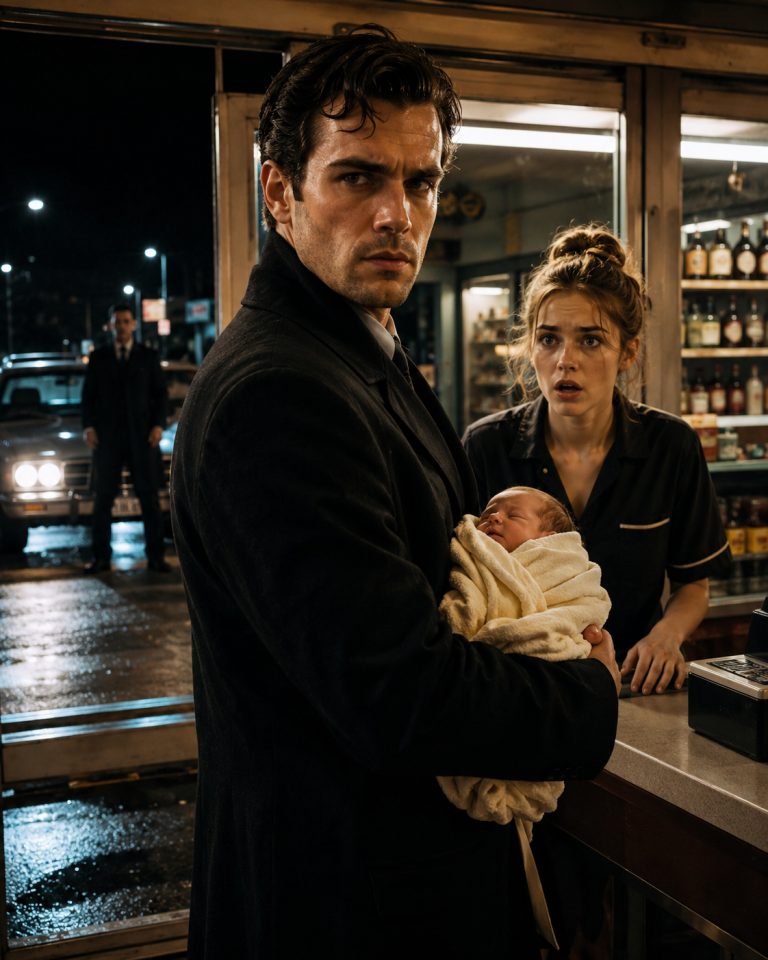
“I Came to Return My Mom’s Ring”—Then the Mafia Boss Burned Everything He Built

## PART 1
She was five years old the first time I imagined what she might look like walking through a door.
Not that door. Not that building. Not with rain in her hair and one shoe with a loose strap that made a soft sound on marble. I had imagined something warmer, some doorway in a future where things had gone differently. But the future I had imagined did not exist, and the door she walked through on that November afternoon was the revolving entrance of the Aldren Group’s main tower on Park Avenue.
I was not there when she arrived.
I was on the forty-third floor in a meeting about a merger that did not matter, which I was not realizing yet because I did not yet know that the thing that mattered was stepping out of a taxi on the street below, pulling a gray coat tighter around a body too small for it, and looking up at a building she had found on a map.
Her name was Clara.
She was five years old and she had come to return something.
—
The guard at the front desk leaned forward when she approached.
“Sweetheart,” he said. “Are you looking for someone?”
Clara looked up at him with the specific patience of a person who has rehearsed for a situation and finds the reality slightly slower than anticipated.
“I’m here to see Mr. Julian Aldren,” she said.
The guard started to redirect her. Clara said it again, the same words, the same tone, with the air of someone who understands that repetition is more reliable than volume.
Near the elevator bank, a woman paused.
Ruth Berwick had been the household manager for the Aldren family for twenty-eight years. She had seen the family through several kinds of upheaval, and she had developed, over those years, a very accurate sense of when something was routine and when it was not.
She looked at the child’s face.
She went still.
Those eyes.
Green, with a ring of brown near the center, the specific combination she had seen in photographs on a desk on the forty-third floor. In the face of a young woman who had come to the Aldren estate three years ago with a letter she couldn’t quite bring herself to hand over. In the mirror, Ruth supposed, though she would not presume to say that part aloud.
She was still deciding what to do when the private elevator opened and Julian Aldren walked into the lobby.
He was thirty-eight. He ran the kind of company that attracted the kind of attention that made the covers of magazines he would never read himself. He was in the middle of a sentence directed at the man behind him, and his attention was on the phone in his hand, and he had not yet looked at the desk.
Then he did.
He stopped walking.
The child had turned. She was looking at him with the direct, evaluating attention of someone who had been shown a photograph and was confirming a match.
“You’re Julian Aldren,” she said.
Not a question.
Julian lowered the phone. “I am.”
She reached into her coat pocket. Small fingers, red at the tips from the cold outside, but careful. When she opened her palm, a ring sat at the center of it. Gold. Simple. Worn smooth at the inside edge where it had been held rather than worn for the last several years.
“My mom asked me to give this back,” she said. “She says it belongs to you.”
The lobby went quiet with the particular quality of a room that has just recognized something significant.
Julian crossed the distance between them. Ruth pressed her hand to her throat. The guards watched with the still expressions of people who have correctly identified that they are witnessing something outside their jurisdiction.
Julian crouched in front of the child.
He took the ring from her palm.
Warm. She had been holding it the whole way here.
He turned it toward the light.
The inscription on the inside was small and worn nearly smooth: *J.A. always.*
He had stood in a jewelry shop in the West Village seven years ago and watched a young woman with green eyes spell those words out to a man behind a glass counter, and he had thought, standing there, that it was the most honest thing he had ever been given. He had not understood yet that it would also be the thing he spent seven years not knowing what to do with.
“Sophie,” he said.
The name came out wrong. Came out like a door opening into a room he had tried to stop thinking about.
Heels on marble.
“Julian, your mother is waiting — the Belton contracts have been sitting for an hour—”
Cordelia Ashworth stopped mid-sentence.
She was beautiful in the way of someone who had spent a long time being looked at and had learned to perform it. Her coat was ivory. Her earrings were understated in the manner that required money to achieve. Her eyes went immediately to the ring in Julian’s hand.
She went pale so completely and so fast that Ruth, watching, thought of a structure losing its interior support.
Then the smile arrived.
Correct. Positioned. Warm on the outside.
“What is that?” Cordelia said.
Julian stood.
He looked at her face.
At the smile.
At the child — still standing on the marble floor, damp from the rain, one loose shoe, coat two sizes too large — watching the two adults with the focused attention of a small person who has been reading adult behavior for context since before she understood what she was doing.
“Where is your mom now?” Julian asked the girl.
She looked at him with the directness she had maintained since she walked through the door.
“She’s sick,” she said. “She told me to come before she ran out of time.”
He held the ring.
Cordelia said his name.
“Before she ran out of time,” he repeated.
The girl nodded once.
He looked at the ring. At the inscription. At the warmth the child’s hand had left in the metal.
For seven years he had believed Sophie had chosen to leave. That the silence was her decision. That the ring, returned through Cordelia weeks after Sophie disappeared, was her answer.
He looked at Cordelia’s face.
At the smile that had no warmth behind it.
“How long,” he said, “have you known.”
The lobby was very quiet.
Cordelia looked at the guards. At Ruth. At the two men who had come down in the elevator with Julian.
“Julian,” she said, with the measured patience of someone managing a room. “This is not the place.”
“No,” he said. “It isn’t.”
He looked at the girl.
“What’s your name?”
“Clara,” she said.
“Clara.” He said it with the weight names gathered when they arrived unexpectedly from directions you weren’t facing. “How did you get here today?”
“The subway,” she said. “Mom practiced the route with me last week.”
He stood in the lobby of his own building, holding a ring that had been given back to him with his mother’s love in it, looking at a five-year-old who had taken the subway alone through November rain on a route her sick mother had practiced with her on a map, and the full shape of what had been done to him — to all three of them — arrived at once.
“Ruth,” he said.
“Yes,” Ruth said. She had been waiting for her name.
“Take Clara somewhere warm. Get her something to eat and something warm to drink.”
He looked at Cordelia.
“You and I,” he said, “are going to finish this conversation. Not here. Not now. But we are going to finish it.”
He was already walking to the elevator.
Behind him, Clara took Ruth’s hand.
The ring was in his pocket.
And the life he had been running inside the Aldren tower for seven years had just begun its process of coming apart at the seams.
—
## PART 2
The elevator was his alone on the way up.
Julian stood in it with the ring in his hand and assembled what he knew: Sophie had not chosen to leave. A five-year-old had carried a ring across the city to return it, sent by a woman who was sick and who had said *before she ran out of time.* And Cordelia had gone pale before she rearranged her face.
The story was wrong.
The elevator opened on forty-three.
His mother was in the adjacent sitting room — Eleanor Aldren, sixty-nine, small, composed, with the particular stillness of a woman who had survived enough to have earned her quiet.
She looked at his face when he came in.
She set down her tea.
“Where is Cordelia,” she said.
“Coming up,” he said. “We need to talk first.”
He put the ring on the table between them.
She looked at it.
She looked at it for a long time.
And he saw it: not confusion. Not surprise.
Recognition.
“Mama,” he said.
She was quiet.
“Did you know Sophie was pregnant when she left.”
One second.
“Yes,” she said.
He let that sit.
“Cordelia came to me first,” his mother said, her voice level and ashamed in the same breath — the specific quality of a woman who has made peace with a wrong thing without pretending the wrong thing was smaller. “Six weeks before your engagement. She said she had found out about Sophie and the pregnancy. She said she was concerned you would make a decision with your heart that your head would regret.”
“And you agreed,” he said.
“I was afraid,” she said. “Your father had just died. The company was under scrutiny. Cordelia said Sophie was a complication — that was the word — and I told myself it was for you.”
He looked at the ring.
“Sophie didn’t return this to you,” he said. “Did she.”
His mother looked at her hands.
“Cordelia said she had been approached. That she had been told the family’s position. That the ring came back of its own accord.”
“The ring,” he said quietly, “has been in a five-year-old’s coat pocket until an hour ago.”
His mother closed her eyes.
“What was done to her,” he said.
“Cordelia went to her directly,” his mother said. “I don’t know everything that was said. I know she was told you needed protection. That the family would not support the relationship. That she would be provided for if she handled it quietly.”
“She didn’t take money.”
“No.”
“She just disappeared.”
“Yes.”
Julian stood with seven years of manufactured certainty in pieces and the specific, focused calm of a person who has identified what needs to be done and is working backward from that to now.
“Where is she,” he said.
“I don’t know. I didn’t look.”
“I need to find her,” he said.
“Clara,” his mother said.
“I need to find Sophie,” he said. “But first I need to get more information from her daughter. Tell Cordelia to wait. Tell her I’ll come back.”
He was already at the door.
—
## PART 3
### What Clara Knew
Ruth’s office was warm in the specific way of rooms that had been made comfortable by someone who understood comfort as a practical matter rather than an aesthetic one. Clara was halfway through a grilled cheese sandwich when Julian came in.
She looked up.
She studied him with the same evaluating steadiness she had used in the lobby — the expression of a child who had been reading adult faces for information her whole life and had become quite good at it.
“Your apartment,” he said. “Do you know the address?”
“220 West Seventy-Third Street,” she said. “Apartment 3B.”
He wrote it down.
“Your mom’s name — what does she go by now?”
“Sophie Crane,” she said. “She went back to her own name. I’m Clara Crane too. She said names were hers to choose.”
He held that.
“She didn’t use my name,” he said.
“No,” Clara said. “But she kept your ring.”
He looked at this child — at her direct green eyes, at the self-possession she had maintained through a very long and unusual day, at the way she ate her sandwich with the focused appreciation of someone who had been cold and wet and had not complained about either.
“Clara,” he said.
“Yes.”
“Thank you,” he said. “For coming here today.”
She considered this.
“Mom said you’d want to know,” she said. “She said she should have found a way to tell you a long time ago. She said—” A pause. “She said some things were taken from her that weren’t meant to be taken. And she wanted to put back the one thing she could put back.”
He waited.
“She has cancer,” Clara said. The way she said it was careful rather than flat — the careful of a child who had been given a true and heavy thing to carry and had decided the only way to carry it was carefully. “In her chest. She found out in the summer. She said she has time, but she said time felt different now.”
Julian looked at the table.
“Does she know you came today,” he said.
“She sent me,” Clara said, with the patient precision of someone who had already explained this once. “She showed me the subway map herself. She said you might want to see her. She said she didn’t know if you would. But she said she was tired—” A small pause. “She said she was tired of you not knowing I was here.”
The sentence arrived completely.
She was tired of you not knowing I was here.
Not Sophie’s want for herself.
Her want for Clara.
Five years of a child whose father did not know she existed — not because he had chosen it, but because it had been arranged.
“Margaret,” he said.
Ruth appeared in the doorway.
“Cancel the rest of today,” he said. “Tell Cordelia she can wait or she can leave. I’ll deal with that later tonight.”
He looked at Clara.
“I’m going to take you home now,” he said. “To your mom. All right?”
Clara looked at him with those eyes.
“Yes,” she said.
—
### West Seventy-Third
220 West Seventy-Third was a five-story building with window boxes emptied for winter and a fire escape that had been painted at some point in the recent past, which told him something small and true about the building’s management.
Julian sat in the car for a moment.
His driver, Thomas — twelve years, the wisdom of someone who understood which silences to leave alone — said nothing.
Clara had fallen asleep in the back seat somewhere around Sixty-Eighth Street.
She had been awake since before six that morning. She had taken two trains and walked four blocks in the rain and maintained the composure of a diplomat through several hours of adult complexity she had not been warned to expect.
He looked at her.
He tried to construct Sophie from the pieces Clara had given him — a woman who had been told the family would not accept her, who had kept her child, who had gone back to her own name, who had built a life in an apartment on the Upper West Side and had not once in five years tried to reach him. Who had been sick for months and was tired of a specific kind of wrong.
He understood the not reaching out.
He had thought about this on the drive uptown.
If someone had told Sophie that the Aldren family would not accept her, that she was a complication, that the path forward was for her to disappear — and if he had not come after her, had not appeared, had not in any way shown her that what she had been told was wrong — then from where she stood, his silence was its own answer.
She had believed it.
Because he had given her reason to.
He was not going to reconstruct those seven years into something he could feel good about. That was not the work.
The work was what happened now.
He got out of the car.
He carried Clara inside.
She woke partially when he lifted her — looked at his face, made a decision, tucked her face against his shoulder.
He stood on the sidewalk holding his daughter in November rain and had to stay with that for a moment.
Thomas held the lobby door.
They went upstairs.
He knocked.
A pause. Then the door opened.
Sophie Crane stood in the doorway in a gray sweater with her hair down, and she looked at him with the eyes he had seen in his daughter all day — the original version, thirty-three now instead of twenty-six, tired in a way that went past this specific day — and she went completely still.
Then she saw Clara asleep against his shoulder.
“She fell asleep on the way,” he said.
“She was up at five-thirty,” Sophie said.
“I know. Clara told me.”
She looked at him.
Something in her face was making decisions he couldn’t read yet.
“Come in,” she said.
—
### The Apartment
The apartment was small and had been organized by someone who had limited space and precise intentions. Books arranged by the method of someone who had thought about this rather than defaulted to alphabetical. A drawing on the refrigerator: two figures, labeled in careful child-printing, *me and mom.* A plant on the windowsill that was being tended to.
He put Clara on the couch.
She settled without waking.
He stood in Sophie’s kitchen.
She stood across from him with her arms wrapped around herself — not defensively, he thought. The posture of someone holding themselves at a manageable temperature.
“You haven’t changed much,” she said.
“Seven years,” he said.
“I know how long it’s been.”
He looked at her.
“Sophie,” he said. “I didn’t know. About any of it. Not the pregnancy. Not what was said to you. Not—” He stopped. “I need you to know that first.”
She was quiet.
“I do know that,” she said. “That’s not—” She paused. “I’ve had a long time to think about it. I’m not angry at you. I was, for a while. But I’m thirty-three and I have a five-year-old and I’m fighting something serious, and I don’t have the energy to hold onto anger that isn’t useful anymore.”
“What was said to you,” he said. “Tell me specifically.”
She looked at the window.
“Cordelia came to the hospital where I was working,” she said. “To the break room. I was on hour eleven of a twelve-hour shift.” She said this without self-pity, just as location. “She told me the family had become aware of me and of the pregnancy. She said there were concerns about the company at that time — that was true, your father had just died, things were difficult — and that a complication of this kind would be damaging.”
“To me specifically,” he said.
“She said you needed to be protected from a decision you’d make emotionally rather than rationally.” A pause. “She offered money. I didn’t take it. I left the city for three months.” She met his eyes. “When I came back, Clara had arrived and I decided what my life was going to be. I decided I wasn’t going to reach out because I had been told very clearly what the answer was, and you hadn’t—”
“I didn’t come after you,” he said.
“No,” she said. “So I assumed that confirmed it.”
He looked at the table.
“I was told you returned the ring voluntarily,” he said. “Through Cordelia. I was told you had decided you didn’t want the relationship.”
Sophie looked at him.
“I didn’t give the ring to Cordelia,” she said. “I kept it for five years. In a box on my bookshelf, then later in my bedside drawer.” She pressed her lips together. “When I got sick I started thinking about what I wanted Clara to have and what I wanted her to know. I thought about you not knowing she existed and I thought about all the time she’d already spent not knowing you, and I thought—” She stopped. “I thought enough.”
“Enough,” he said.
“Enough letting the story stand as it was built to stand,” she said. “Not to change anything. Not to ask for—I wasn’t asking for anything. I just needed you to know she was here.”
She looked at Clara.
He looked at her too.
“She’s been asking about you since she was three,” Sophie said. “She asks careful questions. I told her the truth — that it was complicated, that you didn’t know about her, that she could know you if she wanted to.” A pause. “She wanted.”
“She’s brave,” he said.
Sophie looked at him.
“She got it from somewhere,” she said.
He held her gaze.
“Tell me about the illness,” he said. “What’s the actual picture.”
She looked at her hands.
“Diagnosed in August,” she said. “Non-small cell lung cancer. Stage three A. I’m on treatment — the response has been—the doctors are cautiously—” She stopped. “It’s real and I’m fighting it and the odds are not straightforward.” She met his eyes. “I needed Clara to have someone, if it went the wrong way. I wasn’t trying to make demands. I just needed to know she wouldn’t be alone.”
He sat with that.
The specific kind of courage it took to put your sick self aside and think about what your child would need and then send her on the subway alone with a ring and a name.
“She’s not going to be alone,” he said.
Sophie looked at him.
“Without conditions,” he said. “Not contingent on anything between us. Clara has a father and that means she has someone. That part is settled.”
She pressed her lips together.
She looked at the window.
“I don’t know what comes next,” she said. “Between us. I’m in the middle of a fight for my life and I have a five-year-old who rode the subway alone today and I’m—” She stopped. “I’m not in a position to sort out everything at once.”
“I know,” he said.
“I’m not saying no to—”
“Sophie.” He held her gaze. “I’m not asking for everything at once. I’m asking for today. To be here today. To actually meet my daughter.” He paused. “Everything else has time.”
She looked at him.
“You’re different from what I remembered,” she said.
“Seven years,” he said again.
“That’s not what I mean.” She looked at him carefully. “I mean you seem like someone who has been doing something difficult for a long time and has gotten quieter because of it.”
He thought about that.
“Converting the company,” he said. “Taking it from what it was to something that could exist in daylight. It took five years and most of what I had.”
She nodded slowly.
“The ring,” he said.
He set it on the table between them.
She looked at it.
“I’m not returning it to you as a claim,” he said. “Not as a promise of anything specific. As—” He looked for the word. “As acknowledgment. That it was real. That it was something.” He met her eyes. “Whatever comes next is its own process. But that part is true.”
She looked at the ring for a long time.
Then she picked it up. She did not put it on. She closed it in her fist, carefully, the same way Clara had carried it.
“Okay,” she said.
—
### The Bird Book
Clara woke at seven.
She found Julian sitting on the floor next to the couch, which was where he had moved when Sophie went to rest — the treatment made her tired at the same hours each day, Sophie had explained, and she had stopped fighting the pattern.
Clara looked at him.
“You’re still here,” she said.
“Yes.”
She pulled her knees to her chest.
“Mom’s resting?”
“She said she does this most evenings.”
“Yeah.” Clara looked at the window. “She’s better in the mornings. Evenings are harder.”
“I’ll remember that,” he said.
She studied him.
“You’re going to come back,” she said.
“Yes.”
“Often?”
“As much as you want,” he said.
She was quiet for a moment, working through something in her head.
“I have a book,” she said. “About birds. Mom and I read it together but there’s a section about migratory patterns that has a lot of words I don’t know.”
“I could help with that,” he said.
She assessed him.
“Do you know about birds?”
“Some. I can learn more.”
She seemed to find this an acceptable answer.
She reached to the side table and retrieved a book with a blue cover and a photograph of a heron on the front. She opened it to a page marked with a folded receipt.
“This one,” she said, pointing.
He looked.
*Sanderling.*
He told her how to say it.
She practiced it.
She got it right on the second try and looked pleased in the way of someone who does not announce when they’re pleased but expects you to notice.
“It travels fourteen thousand miles a year,” she said, reading from the page. “Both directions.”
“That’s a long way,” he said.
“Mom says some things travel that far just to get back to where they started.”
He looked at this child.
She looked back at him with her mother’s eyes.
“She talks about you sometimes,” Clara said, with the matter-of-fact quality of stating a known fact. “Not always. But sometimes she says things and I know she’s thinking about you because she gets a certain kind of quiet.”
He looked at the bird book.
“I missed a lot,” he said.
“Yes,” Clara said, simply and without cruelty. “But you’re here now.”
She turned back to the page.
“This one,” she said. “I definitely can’t say this one.”
She pointed to *Phainopepla.*
He looked at it.
“Neither can I,” he said honestly. “Let’s figure it out together.”
She shifted slightly so they could both see the page.
Outside, the November rain had stopped, and the city was doing what the city did — enormous and indifferent, moving through its evening — and in a small apartment on West Seventy-Third Street a man who had spent seven years living in a story someone else had written was beginning to find out what his own looked like.
—
### What He Did About Cordelia
He dealt with Cordelia that night.
Not through the mechanisms the Aldren name had historically employed when things needed ending. He had spent seven years converting the company precisely because he did not want to use those mechanisms.
He dealt with it through what he had: documentation, legal architecture, and the comprehensive understanding of a man who had spent five years turning over every stone in a company his father had built and had found quite a few things he had kept very careful records of.
Cordelia Ashworth had made certain decisions in the context of an Aldren company that still operated the old way.
The company no longer operated that way.
His attorney called at ten p.m.
By nine the following morning, the anticipated merger discussions with the Ashworth Group had been formally withdrawn, and Cordelia’s access to the various Aldren advisory boards she had held for the past several years had been quietly and permanently ended.
Any attempt to contest this would result in a thorough review of decisions she had been confident were buried.
They were not buried.
His mother called at ten-thirty.
“Julian.”
“Yes.”
A pause.
“The little girl,” his mother said. “Is she all right?”
“She’s extraordinary,” he said. “She reads about birds.”
His mother was quiet for a moment.
“I would like to meet her,” she said. “If Sophie would allow it.”
“That will be Sophie’s decision,” he said. “When she’s ready. If she is.”
“Julian—”
“We’ll talk about your part in this,” he said. “Not tonight.”
She accepted that.
He sat in his study with the ring on the desk and thought about what the last seven years had actually contained: the grief for something he hadn’t properly understood he was grieving, the work of converting the company, the years with Cordelia that he understood now had been another arrangement someone else had designed.
He had been living in rooms other people had furnished for him.
Emma — Sophie — had said something like that when they first met, in the break room at the hospital at two in the morning when he had brought her terrible vending machine coffee because she was on hour twelve of a fourteen-hour shift and it was the most useful thing he could think of.
She had said, *I think most people are living in rooms someone else decorated and they don’t notice until the furniture stops fitting.*
He had thought about it on and off for seven years.
He understood it now from the inside.
He put the ring in the desk drawer. Not to put it away. To put it somewhere he could find it.
Tomorrow he would go back to West Seventy-Third.
He would bring a book about migratory birds with a better index.
He would sit on the floor next to the couch and learn to say *Phainopepla* correctly, and he would listen to Sophie rest in the next room, and he would be present for what was happening instead of managing from a distance what he had been told was happening.
He turned off the desk lamp.
He went to find out what his life looked like now that it had started being his.
—
### Six Months Later
The sanderling, Clara told him on a Saturday in April, travels from the Arctic to Argentina and back again. Both ways. Every year. And it arrives in exactly the same place each time.
“How does it know?” he asked.
“Magnetic fields,” she said. “And memory. And the fact that it went once before, so it knows it can.”
They were in Sophie’s apartment — still her apartment, though he had taken to spending Tuesday and Thursday evenings there and most of Saturday when Sophie was strong enough, and sometimes Sunday morning when Clara had a question about the bird book that couldn’t wait.
Sophie was on the couch with her second cup of tea, listening to them talk. The treatment had been working — not perfectly, not without cost, but working in the direction that the doctors had started allowing themselves to use the word *responding* about. The Tuesday visits to the oncology clinic were still Tuesday visits, but they had begun to carry a different quality of uncertainty.
A lighter one.
“Magnetic fields and memory,” Julian said.
“And once before,” Clara said. “That’s the important one.”
Sophie caught his eye over Clara’s head.
He had been learning, over these months, to read her expressions in the way you learned to read a new language — slowly at first, by context, then faster, then in a way that had become so natural he sometimes couldn’t reconstruct how he hadn’t been able to do it before.
What she was saying now, with a look while their daughter explained bird navigation, was something close to: *I know. I see it too.*
He looked back at her with something that had been building for six months and had not yet been spoken aloud because neither of them had been ready to say it while so many other things were still in process.
He was getting close to ready.
“You know what a sanderling does at the end,” Clara said.
“What?” he said.
“It just stops,” she said. “It arrives where it’s going and it stops running. And then it eats and rests and starts over.” She said this with the tone of someone reporting a reasonable plan. “I think that’s the smart part. Knowing when you’ve arrived.”
Sophie laughed — a real one, the kind he had been collecting like evidence since October. He had a growing catalog of them: the surprised ones, the quiet ones, the ones that appeared when Clara said something exactly right, the ones she tried to suppress when he made a terrible joke. He was building a case.
“I think she’s talking about us,” Sophie said.
“I know she is,” he said.
Clara looked between them.
“I’m talking about birds,” she said.
“You’re always talking about birds,” Julian said.
“Someone has to,” Clara said, and returned to her book with the conclusive air of someone who has made a valid point and sees no reason to continue making it.
Julian looked at Sophie.
Sophie looked at him.
Outside, April was doing what April did in New York — uncertain, occasionally bright, full of starts.
He reached across the table and covered her hand with his.
She turned her palm up.
Not the ring. Just hands.
It was a beginning that had already begun, and the only direction was forward, and the sanderling had been right: knowing when you’ve arrived was the smart part.
He stayed for dinner.
He stayed until Clara fell asleep over the bird book and Sophie fell asleep on the couch and the apartment was quiet.
He sat at the kitchen table and looked at the two of them and thought about a revolving door in November rain and a small girl with her palm held out.
*She was tired of you not knowing I was here.*
He knew now.
He intended to keep knowing.
He turned off the kitchen light and closed the door gently behind him and walked out into the April night thinking about magnetic fields and memory and the important part — *it went once before, so it knows it can* — and about how some things traveled very far in order to arrive somewhere they had always been trying to get to.
He flagged a cab.
He was going to come back Tuesday.
**THE END.**
—
—