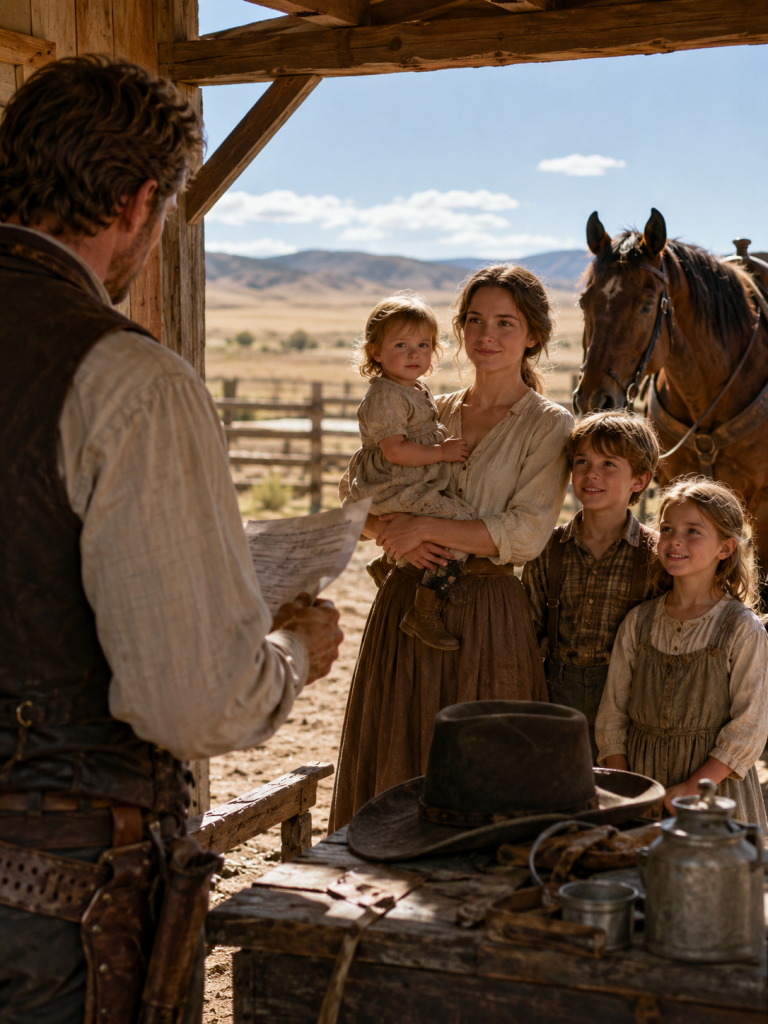
LEAVE. NOBODY’S COMING FOR YOU — THE NIGHT A FROZEN PLATFORM BECAME THE FIRST HONEST GROUND ROSE CALLAHAN HAD EVER STOOD ON

PART 1
“Leave.” The station master threw open the waiting room door and pointed into the blizzard. “He’s not coming. Nobody’s coming for you. Move along.”
Rose Callahan stood up. She picked up her bag. She walked back out onto that platform, into wind that cut straight through her coat and snow already past her ankles, and she stood there, because sitting down would mean admitting it was over, and she wasn’t ready to admit that.
She had sold her mother’s locket for this ticket. She had believed every word in those letters. She had been a fool. And now she was going to freeze proving it.
The storm had been building since noon over Larkspur, Colorado, and by the time Nathaniel Boone rode into town that evening, it had turned mean — the patient, settling kind of cold that means business. He’d come for a crate of transfer papers for his stage and freight line, expecting his station manager Dale waiting with bad coffee. Instead Dale met him at the door, hat in his hands, expression Nathaniel didn’t like at all.
“There’s a problem,” Dale said. Not the horses. Something else.
Past him, near the far wall, the station agent — a heavyset man named Ord who’d worked the Larkspur stop for eleven years — stood with his arms crossed and his jaw set. Between Ord’s cold indifference and the door that led back into the storm sat a woman. Spine straight, not from confidence but from refusal to fold. Her coat was too thin for a Colorado winter. Her carpet bag had split along one seam. Her hands were wrapped around a folded letter pressed flat against her sternum. When her eyes lifted to meet his, they were the darkest, most fiercely controlled eyes he’d seen on a woman clearly on the edge of collapse.
“Who is she?” Nathaniel asked Ord.
“Mail order. Came in on the afternoon stage. Man named Silas Vane sent for her out of St. Louis. Vane was supposed to meet her here. Vane sold his claim two weeks ago and moved to Nevada.” Ord shrugged. “Nobody told her.”
Nathaniel felt something tighten in his chest. “Nobody told her,” he repeated slowly.
“Not my job to track a man’s personal business,” Ord said. “She has no ticket back. No family she’s named. Won’t leave the bench. I’ve asked her three times. Station closes in an hour and I’m not responsible for whatever happens after that.”
Nathaniel crouched to the woman’s level. “Ma’am. My name is Nathaniel Boone. I run the freight line out of Larkspur. I’m not going to pretend I didn’t just hear that, because it’d insult both of us. Can you tell me your name?”
A long silence. Then, quietly: “Rose Callahan.”
“How long have you been sitting here?”
“Since the two-thirty stage.” It was nearly seven in the evening. He didn’t let the calculation show on his face. “Are you hurt?”
“No.” Too fast, too flat. He looked at her hands — knuckles white, not from the letter but from cold that had worked into her joints.
“You’re frostbitten.”
“I’m fine.”
“You’re not.” He stood. “Dale, bring the wagon. We’ll load Miss Callahan with the mail sacks.”
Ord stepped forward. “Now wait a minute, Boone, you can’t just—”
“I can,” Nathaniel said, the way a man says something when he isn’t angry, just certain. “This woman loses feeling in her hands by morning if she stays here. You’re closing the station. So yes, I can.”
Rose stood before Dale could reach her, on legs clearly not cooperating, and met Nathaniel’s eyes with an expression half gratitude, half suspicion.
“Mr. Boone, I don’t know you.”
“No. And I don’t accept charity.”
“I know.” He waited. Didn’t fill the silence with reassurance.
“Is there a hotel in this town?”
“There is.”
“Can I reach it on foot?” His hesitation told her everything — the snow already past the platform’s first step, her thin-soled shoes darkened with wet.
“My housekeeper, Mrs. Doyle, is at the depot house,” he said. “You’d have a room with a lock and a fire in the hearth. In the morning, when the storm breaks, we talk about what comes next. That’s all I’m offering.”
She looked at the letter in her hands, then at Ord, already counting the minutes until he could lock up and go home. Then at Nathaniel.
“All right,” she said. “One night.”
She nearly went down getting off the platform, ice under her step, her leg buckling. Nathaniel caught her arm without ceremony — the automatic response of a man who saw someone falling and moved. She grabbed his sleeve, steadied, released it. “Thank you,” she said stiffly.
“Watch your step,” he said, and left it at that.
—
PART 2
The ride to the depot house was four miles of silence and wind. Mrs. Doyle met them at the door, took one look at Rose, said “Lord have mercy” under her breath, and had her by the kitchen fire before Nathaniel finished unhitching the horses.
When he came in, he sat a small tin box on the table between them. “There’s forty dollars in there,” he said. “I’m not giving it to you. I’m telling you it exists, so you know what your options look like by morning. Stage back east runs at ten, or you stay and figure out a next step. The forty’s not part of the conversation either way.”
Rose looked at the box. Didn’t touch it. “Why help me at all? You don’t know me. You have no obligation.”
“Because Ord was going to lock that door and sleep fine, and you’d have been dead by morning. I don’t think that’s right.” He met her eyes. “I believe you,” he added, of the letter she still clutched. Four words. Something cracked open in her chest that she had to press very hard against.
By morning she had made her decision. Not the ten o’clock stage. She could keep accounts — three years for a dry goods merchant in St. Louis, double-entry ledgers, payroll, inventory — and Nathaniel’s freight line books hadn’t reconciled in four months.
She reconciled them in eleven days. Found three hundred dollars in unrecorded feed purchases. Corrected a payroll error. Earned sixteen dollars a month, a bookkeeper’s wage, not a housekeeper’s — the distinction that let her stop holding quite so tightly to the idea of leaving.
Town gossip arrived by Wednesday. A banker’s wife came to the door with judgment loaded into two words — *Miss Callahan* — and left with nothing to use, because Rose gave her references instead of tears. Nathaniel’s niece Josephine, nine and sharp, decided within an hour that Rose was good people and no complication whatsoever. Nathaniel’s neighbor Frank got told, flatly, that Rose’s honesty and hard work were reason enough, and left without returning the fence tool he’d come to borrow as an excuse.
On the twenty-eighth night, rereading the letter that had brought her west, Rose understood it differently than she had on the platform. Not a marriage arrangement gone wrong. Something planned. A postscript about *a colleague in the territory who will ensure your situation is comfortable* that she’d once read as formality and now read as something else entirely — the specific language of a man selling, not marrying.
She went to Nathaniel in the barn at dawn. “I need to tell you something about why I came west. The actual reason.”
He set down what he was holding. “I’m listening.”
—
PART 3
He listened without interrupting as she laid it out — Vane’s letters, the odd phrasing, the twice-repeated question about whether anyone would come looking for her. When she finished, he was quiet a moment.
“You think Vane was selling women,” he said. Not a question. “Labor contracts. To the mining camps.”
“I don’t have proof.”
“Keep the letter. Don’t tell anyone else yet.” He looked at her steadily. “If there’s a man in this territory involved and he knows you’re here, the last thing we want is for him to know you’re figuring it out.” He said *we* without appearing to notice.
He was right to be careful. A letter had already reached the Larkspur land office — addressed not to Rose or Nathaniel, but to a clerk named Porter, from a man in Kansas City named Silas Vane’s silent partner: Victor Renner. Renner did not act quickly. He was patient, the way a man plans a hunt rather than a fight, and he had already begun rebuilding his plan around the wreckage of the first one.
Rose didn’t know any of this yet. What she knew, by the twenty-second day, was work she could trust, a wage she’d earned, and a man who never crowded her, never stood too close, always knocked before entering the office that was legally his.
The winter charity ball came on the fifteenth of December, Larkspur’s largest social event, and Nathaniel asked her to come — not romantically, he insisted, but so people could see she wasn’t a story, she was a person. She wore his late mother’s green wool dress and walked in on his arm, and the first hour went better than she’d hoped, until the room’s whole temperature shifted at once, conversations near the door lowering, the fiddle slowing.
Victor Renner stood in the doorway, well-dressed, composed, smiling at the room like he already owned it. His eyes found her in three seconds.
He crossed toward her with practiced warmth. “Rose. I am so relieved to find you well. I’ve been worried sick.”
“There’s nothing to explain, Mr. Renner,” she said, her voice flatter and steadier than she had any right to expect.
He turned the moment into a performance for the room — an aggrieved businessman, a runaway arrangement, a woman who’d disappeared from a Kansas City station he’d paid for. The crowd tilted, the way crowds do before a single word is verified.
“He’s lying,” Rose said clearly into the silence. “Silas Vane wrote to me in St. Louis. That’s the name he used in the letters. Not his.” She looked at the room, not begging, just stating. “Vane never intended for me to arrive at a house. He intended for me to arrive with no family, no money, no way back — to be handed to someone who needed women exactly like that.”
“These are serious accusations,” Renner said, warmth thinning.
“What exactly is her situation, Mr. Renner?” cut in the schoolteacher, Miss Barrow, who’d moved closer unnoticed. “Because what I heard is a man sent for a woman, didn’t show up, and she survived a snowstorm alone. Sounds like her situation is better than yours.”
Renner pivoted to Nathaniel, the social mask sliding off. “You have no idea what you’ve gotten into. She came with a legal obligation. I have documentation.”
“Show it,” Nathaniel said. “Right now, to every person in this room.” Renner said nothing. “You want to make a claim against this woman, make it with paper in front of witnesses. Otherwise you’ve said what you came to say and it didn’t land, and you have about a minute before this stops being polite.”
Renner’s hand moved toward his jacket. Rose saw it a half-second before anyone else. Nathaniel stepped between them in one motion — not slow, not dramatic, just final. “Don’t,” he said, voice carrying to every corner of the silent hall. “You’re going to take your hand out of that jacket slowly, put back whatever you’re reaching for, and leave this hall. There are eleven men in this room who’ve been listening for ten minutes, and not one of them will side with a man who reaches for something in a room full of families.”
Renner left. But that night, before he rode out of Larkspur, he let himself into Porter’s office with a key Porter had given him in a favor traded years back, and wrote a letter to a judge in Denver who owed him a debt, and sent a wire to two men forty miles east — men Porter would later describe, terrified, as being told Rose *needed to be collected and transported.*
Dale rode for the county sheriff at dawn with Porter’s confession and copies of everything. A deputy named Sheridan arrived by nightfall with enough documentation to make a clean arrest. Two hired men were caught trying to cross Nathaniel’s land on foot, cold, turned around, and gave up without a fight when the snow beat them before the deputy did.
Renner himself was located three days later trying to board a northbound train in Wyoming. He was convicted on four counts — fraud, conspiracy in labor trafficking, criminal misrepresentation, and attempted coercion — and sentenced to twelve years at the territorial prison. Vane, extradited from Nevada, received nine. The judge’s written statement cited Rose’s documented account as the clearest testimony the investigation had received. The trafficking scheme, once fully unearthed, involved at least nine women over three years.
—
That January, Rose brought Nathaniel a cost estimate for an unused depot bunkhouse on the edge of the freight yard, repaired with a wood stove and a modest budget, to house women exactly like she had been — arriving alone, with nowhere to go. Not charity. Working accommodation, clear terms, six weeks maximum, then wages and a plan.
“This is yours,” Nathaniel told her, reading it twice. “The idea, the operation, the decisions. I’ll fund it and give the space. You run it.”
The first woman arrived in March. Rose drove the wagon herself, found her on the same bench where she’d once sat clutching a broken bag, and said the words that had once been said to her: *You are not ruined. You are not stupid. You are not alone.*
By summer the town had begun, quietly and without declaring it, to take a different measure of itself. Caroline the banker’s wife brought blankets. The schoolteacher taught letters two afternoons a week. Nathaniel watched all of it — watched Rose build something real and completely her own out of the ledger she’d once used to save herself — and fell in love with her the way a man falls when he isn’t trying to stop it: in the accumulation of a thousand small things.
He found her at the old station one July evening, the platform where it had all begun. “I’ve been trying to find the right moment for four months,” he said.
“I noticed. I decided not to say anything.”
“You’re the most direct woman I’ve ever met.”
“I prefer not to waste time.” She could feel the smile she was trying to suppress.
He crossed to sit beside her, not across from her. “Rose Callahan. You didn’t need saving when I found you on this platform. You needed time and work and someone to stand out of your way while you rebuilt. Watching you do that has been—” He stopped, started again. “I want to spend the rest of my life watching what you build next. Will you marry me?”
“Yes,” she said. Plainly, the way she did everything that mattered. “Yes,” she said again, wanting to hear it twice.
They married the first Saturday of August in the freight yard, no borrowed ceremony, just words that were true and a witness she trusted. Caroline came with a jar of preserved peaches and an honest apology for December. Dale played fiddle badly with genuine commitment. Josephine ate three pieces of cake and claimed it was two.
Years passed the way years do when you’re building something real. The bunkhouse became known formally, painted onto a sign the town voted for unanimously: **Harbor House**. Rose kept a drawer — then two drawers, then a shelf — of letters from women who’d passed through and gone on to lives measurably better than what they’d had. A fourteen-year-old named Della who’d wanted only to read properly and keep her own money wrote every year from Denver, running her own boarding house by twenty, with three of her own hires drawn from the Harbor House network.
On an ordinary Tuesday in October years later, silver-haired now, her hands stiffened by the frostbite she’d never quite lost, Rose stood at the platform when the afternoon stage came in, the way she had made a habit of doing — not anxiously, just present, the presence she’d once wished for herself. A girl stepped down on the third step, bag too light, coat wrong for the season, the same specific dignity of someone who had decided she would not be found collapsed.
Rose walked over, unhurried, a blanket over one arm.
“My name is Rose Boone,” she said. “I run Harbor House here in Larkspur.” She held out the blanket. “You look cold, and you look like you weren’t sure anyone would be here. There’s no catch. Warm room. Honest work. Nobody asking you to be grateful.” She paused. “Someone once said those exact words to me, on a platform very much like this one, in worse weather than this. It turned out to be the truest thing anyone had ever told me.”
The girl took the blanket, wrapped it around her shoulders, and exhaled the way a body exhales when it has been held tight for a long time and finally, cautiously, decides it might be safe to let go.
“What’s your name?” Rose asked.
“May,” the girl said. Then, with the small added weight of someone reclaiming something: “May Ellison.”
“Welcome to Larkspur,” Rose said, and walked her to the wagon — the same wagon, more or less, that had once carried a frozen, furious young woman four miles through a blizzard toward the first honest ground she had ever stood on.
**THE END**