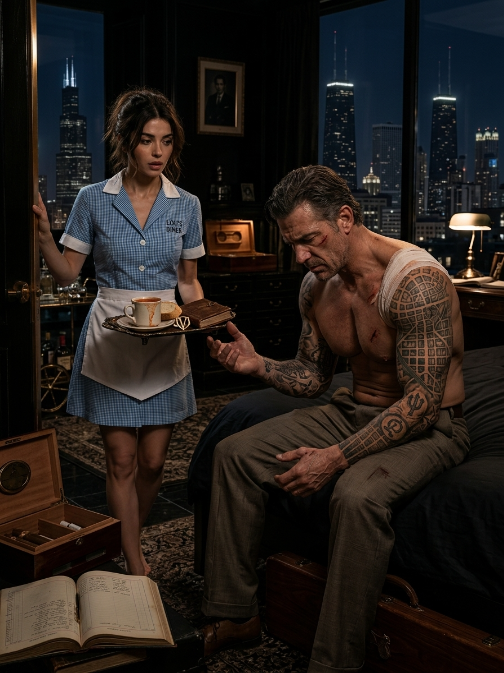
They Sentenced the Widow to Marry a Deaf Mountain Man for a Bet — What She Pulled From His Ear Changed Everything

**PART 1**
Naomi Reed had learned, long before that courtroom morning, that grief has a way of settling into the body like a stone dropped into still water — it never really surfaces again, it just changes the shape of everything underneath. She had carried that particular stone since September, since the night Mary Doyle bled out on her own bed while her husband paced the hallway with a whiskey bottle instead of a lamp. Naomi had done everything her hands knew how to do. It hadn’t been enough. Some nights she still woke certain she could hear the baby’s silence.
She was thinking of that silence when Judge Walter Dane called her name in the Stone Hollow courthouse three weeks later.
The room smelled of pipe tobacco and damp wool, the kind of smell that clung to territorial law offices everywhere west of anywhere that mattered. Naomi sat straight-backed on the front bench, hands folded, twenty-eight years old and two hundred and sixty pounds of a body the whole valley had spent years treating as evidence of some private failing. She had learned not to slouch under the weight of other people’s opinions. Slouching read as shame, and Naomi Reed had done nothing worth being ashamed of.
“Mrs. Reed,” the judge said, “this court has reviewed the petition filed against you by Mr. Ezra Doyle concerning the death of his wife.”
Naomi didn’t move. She had watched Reverend Elias Thorn plant the seeds of this petition weeks ago, whispering to anyone in Stone Hollow who’d listen that a woman built like Naomi had no business calling herself a healer, that her size itself was proof of some deeper, unnamed disorder. In a town like Stone Hollow, a man like Thorn never needed to shout. A concerned murmur in the right ear did all his work for him.
“Given the lack of definitive evidence of negligence,” Judge Dane continued, “this court is prepared to offer an alternative to the commitment Mr. Doyle has requested — commitment to the territorial asylum in Helena.”
The word landed harder than any accusation had, harder even than Ezra Doyle’s grief-soaked fury on the courthouse steps still waiting for her outside.
The asylum was where the valley sent its inconvenient women — the ones who grieved too loud, drank too much, or simply embarrassed families eager, for reasons of their own, to be rid of them entirely. Naomi had heard what happened to women built like her inside those walls. Starvation rations disguised as treatment, hard labor disguised as cure.
“You have seventy-two hours to enter into a legal marriage,” the judge said. “Should a husband agree to assume responsibility for your welfare, this court will close the matter entirely.”
Marriage. To whom. Her first husband had married her for inherited land and died of pneumonia without once looking at her like she was more than an arrangement of acreage. A second proposal had never seemed remotely likely, even before scandal had attached itself to her name.
“The court has already identified a candidate,” Judge Dane said. “Mr. Caleb Ashworth has agreed to the terms.”
A murmur rolled through the courtroom.
Naomi turned. She knew the name the way everyone in Stone Hollow knew it — spoken carefully, almost superstitiously. Caleb Ashworth lived fifteen miles outside town in a cabin nobody visited without cause, a deaf widower whose wife had died in childbirth three years before, a man Reverend Thorn had privately and publicly called cursed. She had seen him only from a distance before now — tall, hard-jawed, moving through town like a man enduring it rather than belonging to it. His dark eyes met hers for one unreadable second, then slid away.
“Do you accept these terms, Mrs. Reed?” the judge asked again, when she failed to answer at once.
The asylum or the mountain. Erasure, or the unknown.
She looked once at Reverend Thorn, whose satisfaction was thin as watered whiskey and just as visible. Then at Caleb Ashworth, silent and still, waiting.
“I accept.”
The ceremony happened that same afternoon — no flowers, no gathered family, only required witnesses and a judge reciting legal language like a man anxious to be done with an unpleasant chore. Caleb said nothing through the whole of it, only nodded when prompted, his jaw set like carved stone. When the judge told him he could kiss his bride, he hesitated so long Naomi thought he might refuse outright. Then he bent and brushed his mouth briefly against her cheek — a signature, not a promise.
Outside on the courthouse steps, Ezra Doyle waited, red-faced with drink and fury. “This isn’t over,” he told her. “You killed my wife. You’ll answer for it.”
Caleb stepped between them without a word. His stillness spoke a language Ezra understood well enough to retreat from.
The wagon ride to the cabin took four hours through falling snow, Naomi watching her new husband’s scarred hands correct the horse’s stride before she’d even sensed the ice beneath them, watching his jaw clench in some private rhythm she couldn’t yet read. When they finally arrived, the cabin surprised her — good logs, real glass windows, a barn and corral, and beyond them nothing but pine, mountain, and sky. No neighboring smoke anywhere in sight.
Inside, he wrote on a slate: *You can have the west room. I will sleep out here.* Naomi almost argued. Then, unexpectedly, she found herself relieved instead.
The west room held a narrow bed, a cracked mirror, and on the bedside table, three books she hadn’t expected to find in a mountain recluse’s guest room. She picked one up and stared at the spine.
*Gray’s Anatomy.* Well-worn. Expensive.
She was still turning that thought over in her mind, the weight of an expensive medical text sitting strange and unexplained in her lap, hours later when a heavy impact from the next room tore her out of sleep.
**PART 2**
Not quite a sound. More the sense of something substantial hitting the floor, followed by a groan too raw to be anything but pain. Naomi was up and moving before she’d fully woken, lamp in one hand, robe clutched shut with the other.
Caleb lay convulsing near the hearth, one hand clawing at his skull, sweat slicking his face, one pupil blown wider than the other. Naomi’s training swallowed her fear whole. Pulse too fast, too thin. She tilted the lamp toward his temple and saw it — blood tracking from his ear, and deeper inside the swollen canal, a darkness that didn’t belong there.
She built the fire hot, boiled her tweezers, warmed oil in a shallow bowl. By the time she returned, Caleb had dragged himself to the table, gray with pain but lucid enough to read the slate she pushed toward him.
*What happened? How long?*
His hand shook as he wrote back. *Eighteen years. Mine explosion. Doctors said the damage was permanent.*
*Did anyone ever look inside?* she wrote.
Naomi looked into the inflamed canal and felt her stomach drop. This wasn’t nerve damage. Something sat inside him, deep and patient.
She warmed oil, tilted his head, felt him go rigid beneath her hand. “Trust me,” she said, and though he couldn’t hear it, he read it on her mouth and gave the smallest nod.
Warm oil dripped into the canal. His body jerked, splitting the wood grain beneath his grip. Naomi leaned closer with the lamp.
Something moved. Alive, deep in a canal that had been sealed shut for eighteen years while doctors called the damage permanent and closed the file.
She reached for sterilized tweezers, hands steady through pure will, went in slow, felt resistance, adjusted, pulled — until, with a wet give, the thing came free and dropped into the metal tray with a sound neither of them would ever fully describe again.
Silence swallowed the cabin whole.
Then Caleb’s head snapped toward the fireplace, toward a sound he hadn’t heard in eighteen years, and his lips parted around a word broken and raw from two decades of disuse.
“…Fire.”
**PART 3**
Naomi froze with the tray still in her hands.
Caleb touched his own throat like it belonged to a stranger. Terror and wonder chased each other across his face in equal measure. He swallowed hard, tried again.
“I… hear.”
Tears blurred Naomi’s vision before she understood she was crying. The crackle of the fire. The tick of the cooling kettle. His own broken, disused voice, dragged back from eighteen years of silence by a piece of sterilized metal and a stubborn woman who refused to believe permanent meant forever.
Caleb looked at her the way a drowning man looks at the hand that pulled him out of the river.
“Your voice,” he said, the words cracking down the middle, “is beautiful.”
Then he broke entirely — bent forward at the table, shoulders shaking, not from the pain of the extraction but from something far larger and far older, eighteen years of grief and isolation finally finding an exit. Naomi wrapped both arms around him and held on while the man the whole valley called cursed wept into her shoulder until the sky outside the window turned gray with dawn.
Morning arrived and rearranged everything.
Caleb heard birds for the first time since he was nineteen. He heard wind moving through the pines, boots on the porch boards, the particular scrape of a kitchen chair against pine flooring. He kept freezing mid-motion, stunned by sounds other people had long since stopped noticing. Naomi pretended not to watch him marvel at a boiling kettle. She watched anyway, and each time wonder broke across his weathered face, something warm bloomed low in her chest that she didn’t yet have a name for.
He’d insisted, over her objections, on walking the length of the porch just to hear his own boots against the wood, stopping every few steps as though testing whether the sound would still be there the next time he lifted his foot. He’d stood in the yard at first light and simply listened to the horses in the corral, tears running freely down a face that hadn’t allowed itself that particular weakness in eighteen years. When Naomi called his name from the doorway, uncertain, he turned so fast he nearly stumbled, as though he still didn’t quite trust the sound of her voice to keep arriving.
“Say it again,” he told her, crossing the yard.
“Caleb.”
“Again.”
“Caleb Ashworth.” She laughed despite herself. “You’re going to wear my voice out asking.”
“I have eighteen years to make up for,” he said, and something in the way he said it made her chest go tight and warm at once. “I intend to hear every word you say for the rest of them.”
He asked her, haltingly, about the creature itself, wanting to understand what exactly had lived inside him for so long, and Naomi found herself explaining infection and pressure and the slow creep of untreated damage the way she once explained arithmetic to schoolchildren, patient and thorough, watching him absorb every word like a man determined never again to accept that something was permanent without asking why first. He asked about her training too — where a woman built like her had learned to hold tweezers steady enough to save a life — and she told him about her own mother, a midwife in her own right, and about medical texts she’d borrowed and copied out by hand because no school in the territory would admit a woman of her size to formal study, whatever her aptitude.
“They were fools,” Caleb said simply.
“Most people usually are, given the chance,” Naomi answered, and for the first time since the courtroom, she meant it as something closer to amusement than grief.
By afternoon, word had reached town. By sunset, Stone Hollow had arrived at their door in a slow, curious procession — neighbors first, then ranchers, then Judge Dane, and finally, last of all and least welcome, Reverend Elias Thorn.
The reverend stared at Caleb, at Naomi, at the impossible fact of a cured man standing upright in his own doorway.
“This is… remarkable,” Thorn said.
Naomi crossed her arms. “You called him cursed.”
“I said many things,” Thorn replied smoothly, “out of concern for the community.”
Caleb stepped forward, and now that he had a voice again, every word he spoke landed with the force of eighteen stored-up years behind it.
“No,” he said. “You lied.”
The porch went silent.
“I read lips,” Caleb continued, eyes locked on the reverend. “For years I watched people talk because they forgot a deaf man could still understand a face.” He turned to Naomi first, gently, before the iron came back into his voice and he faced Thorn again. “You told Ezra Doyle that Mary died because Naomi was incompetent. You also told him not to mention the bruises.”
Naomi’s breath stopped in her chest.
“Bruises,” she repeated.
“On Mary’s arms,” Caleb said. “On her ribs. Bruises her husband put there.”
The gathered crowd broke into a wave of whispers. Judge Dane went rigid. Naomi’s mind reeled backward through that terrible September night — she had seen those bruises. Mary had told her she’d fallen carrying wood. Naomi had believed her, because midwives believed the women in front of them, and because the alternative had been too monstrous to consider at the time.
“You have no proof,” Thorn snapped, color draining from his face.
“I watched you tell him,” Caleb said. “You thought a deaf man was harmless. You thought I couldn’t testify to what I understood perfectly well just by watching your mouth move.”
Judge Dane’s voice cut through the crowd like a blade. “Sheriff.”
Ezra Doyle and Reverend Elias Thorn were both in custody before the sun fully set. Within three days, the rest of the valley’s silence broke open. Neighbors who had swallowed their suspicions for years finally spoke them aloud. Women who had seen Mary Doyle flinch at her own husband’s raised hand came forward one by one, first hesitant, then in a flood no one in Stone Hollow could any longer pretend not to hear.
Judge Dane convened a formal hearing the following week, and Naomi sat once more on the same hard bench where she’d once heard her own fate decided, this time as a witness rather than the accused. She testified about the bruises she’d seen and the explanation she’d been given, about the labor that had gone wrong in ways no amount of skill could have prevented once the damage beneath the skin was already done. Caleb testified too, describing in plain, unhurried language exactly what he had read on Reverend Thorn’s lips in the weeks before the petition was filed — the careful coaching of Ezra Doyle’s grief into a story that pointed everywhere except at the man responsible.
“I want it understood,” Caleb told the court, his restored voice steady despite its roughness, “that I said nothing sooner because I had no voice to say it with. Not because I hadn’t seen it.”
The story that emerged over those three days was uglier than anyone in Stone Hollow wanted to admit their own town had been harboring for so long without ever once looking closely enough to notice. Mary Doyle hadn’t simply died in a difficult labor. She had been beaten for months beforehand, her bruises explained away as clumsiness by a husband skilled at controlling the story told about his own house, and a reverend who claimed to shepherd the valley’s conscience had helped bury the truth rather than risk his own standing by speaking it aloud. Ezra Doyle was bound over for trial on charges the territory hadn’t often bothered prosecuting before that autumn. Reverend Thorn left Stone Hollow entirely before the following spring, his congregation dissolved, his sermons about disorder and excess remembered by exactly no one with anything like the reverence he’d once commanded.
Naomi’s name, which had carried the weight of suspicion and scandal for three long weeks, began, slowly, to carry something else instead.
But the truth that unraveled Reverend Thorn wasn’t the only truth waiting in Stone Hollow that week.
Three drunk ranchers, loosened by whiskey and the general upheaval in town, let slip an uglier story of their own at the saloon a few nights later — one that eventually found its way back to Naomi through a neighbor too well-meaning to keep it to herself. Caleb hadn’t simply agreed to the court’s arrangement out of duty or convenience. Weeks before the trial, three men had dared him over cards, half-joking, certain he’d refuse. *Marry the widow everyone laughs at, and we’ll forgive what you owe us at the mill.* They’d expected him to walk away. Instead, Caleb had said yes.
Naomi heard only that much of the story before her chest went cold.
A bet. She had been a bet.
That night, she packed. She was folding her second dress into the trunk when Caleb found her in the doorway of the west room, his face going pale the way it hadn’t even during the extraction.
“What are you doing?”
“Leaving,” she said, voice shaking despite every effort to keep it steady.
“No.”
“I heard about the wager, Caleb. Three men at the saloon, and a debt at the mill, and you saying yes to spare yourself money you owed them.” Tears blurred her vision again, for entirely different reasons this time. “Was I a joke to you? Pity? Convenience?”
“No,” he said, each word landing hard. “No. No.”
“Then what?” Her voice cracked wide open. “Tell me what I was, if not that.”
He froze in the doorway, and Naomi watched something cross his face that frightened him far more openly than a mine explosion or a swollen ear ever had. Words. Feeling. The truth, finally, with nowhere left to hide it.
“I loved you,” he said. “Before the court. Before the wedding. Before you ever learned my name.”
Naomi went still.
“I used to watch you from the edge of town,” he went on, voice rough with everything he’d never had reason to say aloud in eighteen silent years. “I watched you tend to children nobody else in the valley wanted to touch. I watched you stand straight-backed while men laughed at the size of you, like straightness itself was an act of defiance. Everyone in Stone Hollow saw your body and decided that was the whole of you. I saw what was underneath it, and I couldn’t stop watching.” His hands trembled at his sides. “When those men dared me to marry you, I said yes because it gave me an excuse to do the one thing I’d wanted for over a year and never had the courage — or the voice — to ask for properly.”
“An excuse,” Naomi whispered.
“To say yes,” he said. “Not to the bet. To you.”
She broke then, fully, a sob tearing loose from somewhere she’d kept it locked for years. Caleb crossed the room in two strides and pulled her against him — certain this time, none of the formal hesitation of that first brushed kiss in the courtroom.
“You are the most beautiful woman I have ever seen,” he said against her hair.
“Liar,” she managed, half laughing through the tears.
“No.” He drew back enough to look at her properly, and smiled — a real smile, the first she’d seen on him since the night the fire first spoke to his ears again. “You pulled something monstrous out of my head. You gave me back birdsong and rain and my own voice. And somewhere in the middle of all that, you gave me back a reason to want to keep living out here instead of just enduring it.” His forehead came to rest against hers. “For eighteen years people treated me like something broken. For years before that, people treated you like something to be ashamed of. Let them talk, Naomi. Let the whole valley talk. They won’t be laughing for long.”
She pulled back just far enough to search his face, needing to be certain. “You could have told me about the wager the moment we married. You had a slate. You had all the time in the world before your hearing came back.”
“I know.” His jaw tightened, some old shame surfacing. “I was a coward about it. I told myself it didn’t matter how it started, only how I meant to finish it. But I should have written it down that first night and let you decide for yourself whether it changed anything, instead of letting you find out secondhand from a saloon full of drunk men who never once understood what they’d actually done.”
“And if I’d left that first night, knowing?”
“Then I’d have deserved it,” he said simply, no defense in his voice at all. “And I’d have spent the rest of my life regretting that I hadn’t found the courage to ask you properly instead.”
It was the honesty in that, more than anything else he’d said, that finally loosened the last of the fear knotted in Naomi’s chest. She had spent two years being married to a man who never looked at her with anything but calculation, and three weeks being judged by an entire valley for the size and shape of a body she’d stopped apologizing for years ago. She had not expected, at twenty-eight, to be looked at like this — like something worth choosing on purpose, wager or no wager, by a man who’d clearly spent a year working up the nerve before circumstance finally handed him an excuse.
“Ask me properly, then,” she said. “Now that you have the words for it.”
Caleb didn’t hesitate. “Stay, Naomi. Not because a judge ordered it, and not because of anything three drunk men said over cards in a saloon neither of us ever once set foot inside together. Stay because I love you, and because I intend to spend however many years I have left proving it, one ordinary sound at a time, for as long as you’ll have me.”
They weren’t.
Within a year, Naomi Ashworth had become the most sought-after healer in three counties, no longer merely tolerated but genuinely respected, her clinic — built by Caleb’s own hands beside their cabin — filled most mornings with women who’d once crossed the street rather than acknowledge her. Caleb became her fiercest advocate, standing at her shoulder in town the way he’d once stood between her and Ezra Doyle’s fury, and men learned quickly that insulting Mrs. Ashworth within his hearing — his newly restored, keenly attentive hearing — was a mistake made only once.
Three years after the wedding no one had wanted to attend, Naomi went into labor on a spring night loud with thunder, and Caleb paced the cabin so relentlessly she finally screamed at him from the bed to sit down before she divorced him on the spot. He sat, immediately, and four hours later a daughter arrived screaming loud enough to make her father weep before he’d even properly seen her face.
“What do we name her?” Naomi whispered, exhausted, watching Caleb hold their daughter like something too precious to trust to his own scarred hands.
He looked at his wife — at the woman the whole valley had once dismissed, who had pulled him back from eighteen years of silence and given him, in return, an entire second life.
“Grace,” he said.
Grace Ashworth grew up hearing the story told every winter by the cabin fire, the way most children in that house grew up learning to read a slate before they learned their letters properly, because their father still preferred writing down the things that mattered most. She grew up watching her mother’s clinic fill with women who traveled two days by wagon just to be examined by a doctor who understood, better than any physician trained back east, what it meant to be underestimated and to endure it anyway. She grew up watching her father listen to every sound in that valley like a man who never once took hearing for granted again, not the wind, not the birds, not his wife’s voice calling him in for supper.
Grace Ashworth grew up hearing the story told every winter by the cabin fire, the way most children in that house grew up learning to read a slate before they learned their letters properly, because their father still preferred writing down the things that mattered most, a habit eighteen years of silence never fully let go of even after his hearing returned. She grew up watching her mother’s clinic fill with women who traveled two days by wagon just to be examined by a doctor who understood, better than any physician trained back east, what it meant to be underestimated and to endure it anyway. She grew up watching her father listen to every sound in that valley like a man who never once took hearing for granted again, not the wind, not the birds, not his wife’s voice calling him in for supper, not even the ordinary, unremarkable creak of the porch boards beneath his own boots each evening.
Two more children followed Grace in the years after — a son named Silas, after no one Caleb would ever fully explain, though Naomi suspected it honored some old friend lost in the same mine explosion that had cost him his hearing, and a second daughter, Mercy, born the same spring Naomi finally handed the busiest half of her practice over to a young doctor from Helena who’d apprenticed under her for three years and still called her, respectfully, the finest diagnostician he’d ever trained beside. The cabin that had once stood silent and isolated at the edge of the pines grew loud with all of it — children’s boots on the stairs, Caleb’s booming, still-marveling laugh at ordinary jokes, Naomi’s low, steady voice reading aloud from the same worn copy of Gray’s Anatomy that had once sat on a guest room nightstand as the only clue to a stranger’s hidden decency.
Stone Hollow itself changed slowly around them. The asylum in Helena closed its doors within a decade, its worst practices exposed by a territorial investigation that Naomi herself was twice called to testify before, describing in plain clinical language exactly what happened to women whose only crime had been grief, or excess flesh, or simply outliving a husband’s patience. The courthouse where she’d once been sentenced to marry a stranger or disappear entirely eventually hung a small brass plaque near the front bench, commissioned by grateful mothers she’d delivered over four decades of practice, reading simply: *In gratitude to Dr. Naomi Ashworth, who never once believed a body’s size determined the size of its courage.*
When Grace herself married, decades later, to a young doctor who’d apprenticed under her mother, half of Stone Hollow told the old story again at the wedding supper — the deaf mountain man, the widow they’d sentenced to marry him as a joke, the parasite pulled from a ruined ear by lamplight, the bet that was never really about a debt at all. By then the story had softened at its edges the way old stories do, but the truth underneath it had never changed. Caleb lived to see six grandchildren climb into his lap and grab for his beard exactly as Grace had done the night she was born, his hearing never once failing him again in all the decades after, as though the valley itself understood he had waited long enough for it and wasn’t owed another silence.
Naomi kept practicing medicine into her seventies, delivering babies for women whose own mothers she had once delivered before them, her hands as steady at sixty as they’d been the night she first reached into a stranger’s ruined ear by lamplight and refused to accept that permanent meant forever. Every evening for the whole of their life together, Caleb sat across the table from her and simply listened — to her voice, to her laughter, to the ordinary sound of a life he’d once been told he’d never get to keep. He never stopped calling it a miracle. She never let him forget it had also been, plainly and stubbornly, a choice — his, made in a saloon over a dare that he’d turned, quietly and on purpose, into something else entirely and far more lasting; and hers, made in a courtroom with nothing left to lose; and both of them, in the end, choosing each other again every single day that followed, long after anyone in Stone Hollow remembered there had ever been anything to laugh about at all.
Stone Hollow still tells the story, when it gets told at all — not as a joke about a fat widow and a cursed mountain man, the way three drunk ranchers once meant it, but as proof that the people a town is quickest to mock are often the ones with the steadiest hands and the truest hearts, and that sometimes the whole of a happy ending turns on nothing grander than one person deciding to look closer, and finding something worth saving. Grace used to tell her own children, on the same porch her father once paced through a spring thunderstorm, that the only difference between a curse and a miracle was usually just who was telling the story, and whether they’d bothered to look past the surface long enough to notice the truth underneath it. Her mother, listening from the kitchen doorway with silver in her hair and the same steady hands that had once pulled a monster from a stranger’s ear, would only smile and say nothing at all, because by then there was nothing left to prove to anyone in Stone Hollow — least of all to the one man who had seen her clearly from the very first distant glance, long before either of them had a single word to say to the other.