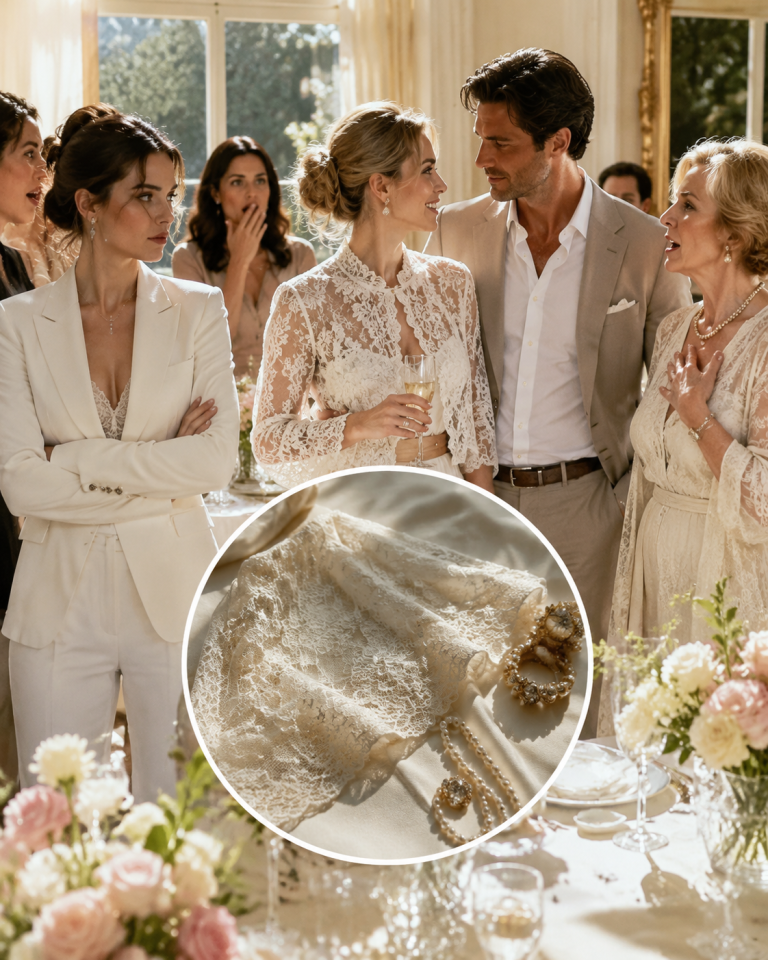
HE SAVED $48,000 ALL YEAR FOR HIS MISTRESS’S BIRTHDAY — AND TOLD HIS WIFE THEY COULDN’T AFFORD HER OWN

—
PART 1
On the morning of her thirty-third birthday, Claire Whitmore lay beneath four thousand dollars of Egyptian cotton and watched the chandelier throw pale light across the ceiling of a Buckhead townhouse that looked expensive enough to admire and cold enough never to be touched. That was Preston’s taste. Polished marble. Cream sofas nobody sat on. A dining table long enough for a board meeting and empty enough to echo when she set down a single coffee mug.
She used to think luxury meant safety. She’d since learned it could be a cage with excellent lighting.
Preston rolled out of bed already reaching for his phone, adjusting his expression in the mirror before he adjusted his tie. She’d learned to read that habit years ago. A man in love checks on his wife first. A man in love with himself checks the mirror.
“You have the Harrington call at ten,” she said.
He paused, surprised she’d remembered. “That’s why I married you, Claire. You remember the boring things.”
She waited — some small, foolish, loyal part of her waiting for him to turn, laugh, say *I’m kidding, happy birthday, beautiful.* Instead he sprayed cologne on his neck and walked into the closet.
Her father had died six years ago, but his voice still lived in her bones. *Never beg for a seat at a table you can buy. Never announce your power to people who’d only love you for it.* She had followed those rules so carefully, for five years, that she’d nearly disappeared inside them — let Preston believe her family’s money was tangled in old trusts, smiled when he introduced her as *my wife, Claire, she does a little charity work,* listened to men explain business over cocktails whose careers her silent investments had built.
At first she’d told herself it was love. Later she understood it was training. Preston had trained her to be smaller so he could feel taller.
“I’ll be late tonight,” he said, coming down for coffee.
“It’s my birthday.”
For half a second, something flickered across his face. Not guilt. Panic — the kind a man feels when he realizes he’s forgotten to perform kindness on cue. Then he recovered, both hands on her shoulders. “Babe, I know. I’ve just been buried. This year’s tight. I thought we agreed not to do gifts.”
“We never agreed to that.”
His mouth tightened — the small punishment, the look that said she was becoming inconvenient. “You know we can’t afford anything extravagant right now.”
She looked around the kitchen. Italian marble. A German espresso machine. Platinum cufflinks on the counter. “I didn’t ask for extravagant,” she said. “I asked if you remembered.”
His phone lit up. He glanced at it too fast. A name flashed and vanished as he turned it face-down.
*Sloane.*
No last name needed. Sloane Mercer — long blonde hair, a Pilates body, a social media account full of champagne towers and captions about healing, hired three months ago as a “branding consultant” for Preston’s firm. Since then her husband had developed a taste for late meetings and smiling at his phone like it had whispered something private.
“Work?” she asked.
“Client.” He pocketed the phone.
That evening he took her to a steakhouse with no reservation, made her wait forty minutes at the bar, ordered for both of them without asking, and told the server they were “just surviving the week” when asked if they were celebrating. Halfway through dinner, his mother called on speaker and informed Claire, in a bored voice, that *a woman should be careful about needing too much fuss — men get tired.*
“Mom,” Preston said, “Claire understands.”
“No,” Claire said. “Claire doesn’t.”
“Don’t do this here,” he said quietly — and that sentence told her everything. Not *I’m sorry.* Not *you deserved better.* The room mattered more than her heart.
Outside under a cold drizzle, Preston stepped beneath the valet awning without offering her his coat. Then came the laughter — bright, polished — and Sloane Mercer stepped out of a white Mercedes wrapped in cream wool, her hair shining like she’d brought her own lighting.
“Preston,” she said, too warmly.
“This is Sloane,” Preston said quickly. “She’s helping with the Harrington campaign.”
Sloane’s eyes slid over Claire — not curious, not nervous. Victorious. “Oh,” she said. “The wife.”
Not Claire. The wife.
“No birthday diamonds?” Sloane asked lightly, brushing hair from her cheek — and two diamond earrings caught the light beneath the awning. Oval cut. White gold. A delicate halo.
Claire knew those earrings. Three weeks earlier she’d stood in front of the Hart & Vale window and said, *they’re beautiful,* and Preston had said, *you have enough jewelry.*
Now they hung from another woman’s ears, and her husband looked at the sidewalk.
That was the moment Claire’s heart stopped breaking and started taking notes.
—
PART 2
She didn’t confront him in the car. That would have been too easy — men like Preston came pre-loaded with scripts for confrontation. *You’re imagining things. She’s just a colleague. You’re embarrassing yourself.*
Instead she sat with the rain on the glass until he finally said, “That was awkward.”
“Was it?”
“Sloane can be dramatic.”
“She’s wearing the earrings I liked.”
“Claire.” Just her name. Not a denial. A warning.
At home, Preston went straight upstairs, citing an early call, citing exhaustion — all the things men say when they want a conversation to die without admitting they killed it. Claire waited until she heard the shower running. Then she opened his laptop. His password was still their wedding date, which somehow hurt more than if he’d changed it.
Inside a folder labeled *Personal,* inside another labeled *Q3,* inside another labeled *Misc,* sat a spreadsheet named **SURPRISE.**
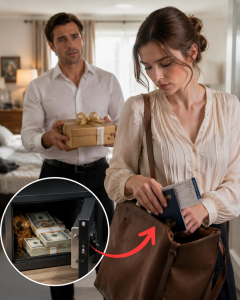
A savings account. Monthly transfers, climbing steadily since January, until by November the balance read $48,730.16. Line items beside each withdrawal — *Everly House Spa, full day package. Hart & Vale, earrings. Le Jardin, private terrace dinner. Fleur & Finch, white orchids. Calligraphy by Mae, handwritten card.*
She opened the receipt for the card. Elegant black script — proof that cruelty sometimes has beautiful handwriting.
*To Sloane. You make ordinary life feel cinematic. This is only the beginning. — P.*
There was a hotel reservation too — The Aurelia, the dark-glass tower overlooking the Chattahoochee, famous for its rooftop pool and its private membership floors where celebrities went to disappear.
Preston had no idea her father had built it. No idea that before she was Claire Whitmore, quiet wife, she had been Claire Ashford, only daughter of Everett Ashford, founder of Ashford Hospitality Group. No idea that the “anonymous trust” quietly keeping Whitmore Capital alive carried her initials.
*C. Ashford Trust.*
He thought his own brilliance had saved his firm. It had been her, all along, in the shadows he’d trained her to stand in.
She called Nora Bell — best friend, and the most feared divorce attorney in Georgia — and read the facts out loud like testimony, without drama, without tears.
“Do not confront him tonight,” Nora said. “Screenshot everything. Download everything. Preserve half of that account immediately, and document it properly. Marital asset preservation. Not revenge.”
Claire moved $24,365.08 into a new account under her own name, memo line exactly as instructed, and felt something inside her quietly unlock.
What Nora told her next, two days later over documents spread across a table at the St. Regis, was worse than the affair itself. Preston wasn’t just cheating. He was preparing an exit — a lease inquiry on a condo, a message to Sloane that read *once the Harrington deal closes, everything changes* — and he intended to argue, when the divorce came, that Claire had contributed little to their marriage.
Claire laughed at that. Sharply.
Because sitting in the folder beside it were the real numbers. A $2.8 million initial investment in Whitmore Capital. $1.1 million in emergency liquidity. A $750,000 bridge loan that had kept his firm’s payroll alive one winter — all of it quietly approved by her over five years, because she’d believed her husband’s dream was their shared one.
“Preston Whitmore is alive in business,” Nora said, “because his wife kept him breathing. He doesn’t know that yet.”
“No,” Claire said, looking out at the city. “But he’s about to.”
And there was one more thing coming that neither Preston nor Sloane Mercer had any way of seeing: a foundation gala at The Aurelia the following Saturday night, a birthday cake with Sloane’s name on it, a stage, a microphone — and an announcement about a trust, a hotel, and a woman named Claire Ashford that was about to make the entire ballroom turn its head at once.
—
PART 3
The week before Sloane Mercer’s birthday, Preston Whitmore became generous. Not to Claire — never to Claire — but generous with performance. Grocery-store roses on Monday, the price sticker still attached. *My girl,* whispered in front of the housekeeper on Tuesday, a phrase he hadn’t used in two years. An invitation to the Delta Rose Children’s Foundation gala on Wednesday, delivered with the studied casualness of a man who needed his wife in the room to complete the picture.
The gala was held every year at The Aurelia — old money pretending to care about new philanthropy, new money paying six figures for tables to look old. Preston needed that room. The Harrington Group would be there. Two senators. Half the people who decided which men in Atlanta got called visionary.
“I thought spouses were mandatory,” Claire said.
“They are. I just wasn’t sure you’d want to go.”
“Because of my age? Or because I need too much fuss?”
“Are you going to punish me forever because my mother made one comment?”
“No, Preston,” Claire said. “I’m not going to punish you forever.”
That was true. Forever was unnecessary. Saturday would do.
On Thursday, Nora Bell laid out what she’d found across a private table at the St. Regis, and it landed harder than the affair itself had. Preston wasn’t drifting toward Sloane. He was preparing a transition — a condo lease inquiry in West Midtown, a message that read *once the Harrington deal closes, everything changes* — and he intended to build a case, when the papers were finally filed, that Claire had contributed little of substance to their marriage.
Nora slid a second folder across the table. *C. Ashford Trust.* Two point eight million into Whitmore Capital at the start. Emergency liquidity when a Charleston deal collapsed. A bridge loan that had kept his payroll running through a bad winter, all of it approved quietly by a wife who believed she was investing in a shared future.
“He doesn’t know,” Claire said.
“No,” Nora said. “But he’s about to. We don’t scream. We don’t leak. We don’t threaten. We let him stand up in the one room he needs most, surrounded by the people he needs most, and we let the truth be introduced properly.”
“Publicly?”
“Elegantly.”
The word settled over Claire like perfume. She had been humiliated softly, for years, in rooms just like the one Preston was about to walk her into. This time, she would answer just as softly.
And everyone would hear it.
—
Friday night, Preston mentioned he’d booked a room at The Aurelia after the gala — “for convenience,” not for the two of them — and added, almost as an afterthought, that Sloane would be there too, “for the campaign optics.” *Try not to be cold,* he said.
“Cold?”
“You have a way of making people uncomfortable.”
The audacity of it nearly impressed her. “Sloane seems comfortable enough.”
“Claire.” Her name, again, as a warning.
She carried her teacup to the sink. “Don’t worry. I know exactly how to behave in public.”
Saturday arrived wearing rain. By sunset, Atlanta glittered like a city built from wet diamonds, black cars lined beneath the Aurelia’s awning, women stepping out dripping emeralds and old family resentment.
Preston came downstairs in Tom Ford. Claire stood at the bottom of the staircase in a simple champagne dress he’d chosen for her without asking — a dress designed, she understood, to make her invisible in the exact room where she intended to be seen.
“Perfect,” he said. “Understated.”
“Give me five minutes.”
She went back upstairs and changed into the dress that had arrived from New York that morning. Black velvet, off the shoulder, a slit that moved only when she did. Around her throat, she fastened her mother’s diamond collar — a piece Preston had never once seen, because she’d never worn it for a man who mistook her restraint for lack.
When she came down again, he looked up from his phone, and for one suspended second he remembered she was beautiful. Not convenient. Not quiet. Beautiful.
Then irritation replaced it. “Isn’t that a little much?”
“For a gala at The Aurelia? No.”
“We don’t want to look like we’re trying too hard.”
Claire picked up her clutch. “Then relax, Preston. I won’t tell anyone how hard *you’ve* been trying.”
She walked past him into the rain.
—
The Aurelia’s ballroom was a cathedral of wealth — black marble floors, smoked mirrors, chandeliers like falling stars, a thousand white orchids climbing the columns as if even the flowers had been trained to perform luxury. Claire had walked through this room at seventeen holding her father’s hand while he pointed at the ceiling. *People look up when they feel small, Claire. Build rooms that make them lift their heads.*
Preston’s hand pressed against her lower back as they crossed the floor — not affectionately, but directionally, steering her toward a cluster of men near the champagne tower. “Smile,” he murmured.
“I am.”
“Like you mean it.”
“Careful,” Claire said. “You’re confusing me with someone on payroll.”
Across the room, beneath a column of orchids, Sloane Mercer waited in silver — the diamond earrings from the hidden account catching the light, a new tennis bracelet on her wrist that hadn’t appeared anywhere in the spreadsheet, which meant either there were other accounts or other men. She crossed the ballroom like a knife wrapped in silk.
“Preston,” she said, touching his arm. Not shaking it. Touching it. A photographer nearby lifted his camera.
“Claire,” Sloane said, eyes sliding over the black velvet. “You look… dramatic.”
“You look expensive.”
Sloane’s smile twitched. Preston laughed under his breath. “Ladies.”
At the seating chart Claire had approved herself, weeks earlier, under her maiden name — Sloane had somehow been moved to Preston’s right. Claire, to his left. Preston had wanted her to see it. Worse: he’d wanted Sloane to see her seeing it. Public humiliation didn’t always arrive as shouting. Sometimes it arrived as a seating assignment.
Over the pear salad, a man from the Harrington Group leaned toward Claire with careful kindness. “So, Claire — are you involved with the foundation?”
Preston answered before she could. “Claire helps with the decorative committees. Flowers, auction baskets.”
Sloane smiled into her champagne.
Claire set down her fork. “Actually, I’ve been involved with Delta Rose for years.”
Preston’s hand landed over hers — a warning disguised as affection. “She’s being modest.”
“No,” Claire said, looking at his hand until he removed it. “I was being interrupted.”
Then the foundation chairwoman, Marion Caldwell, took the stage, welcomed the room, thanked the sponsors — and smiled.
“And tonight, before our auction, we have a special recognition. We also have a birthday in the room.”
Sloane’s face lit. Preston went pale. A server rolled out a small cake ringed in white orchids and silver candles, and it stopped beside Sloane, who pressed a hand to her heart, performing surprise beautifully.
“Miss Mercer,” Marion said, “someone wanted you to feel celebrated tonight. Mr. Whitmore, would you like to say a few words?”
Preston had no choice. He stood, glass lifted, voice tight but controlled. “Sloane has been an invaluable part of our firm’s recent growth. She brings energy, vision, and light.”
*Light.* The word struck something old and bruised in Claire — the same husband who’d called another woman *light* while she’d sat beside him for years in the dark.
Then Sloane stood suddenly and kissed his cheek. A camera flash exploded through the room. She whispered something in his ear that Claire heard anyway, because betrayal sharpens the senses.
*”Now they know.”*
For one perfect second, the whole ballroom believed Claire had lost.
Then Marion Caldwell looked toward the back of the room and smiled. “And now, for our true announcement of the evening.”
The screen behind her changed. **Ashford Hospitality Group,** in silver letters. Preston’s glass lowered.
“Delta Rose Children’s Foundation is honored to announce a new ten-year partnership with the C. Ashford Trust, whose principal donor has chosen tonight to step forward publicly for the first time.” Marion lifted one hand. “Please welcome our new foundation chair, and the owner of The Aurelia Atlanta — Ms. Claire Ashford.”
Silence hit the ballroom like a dropped chandelier. Every head turned to Claire.
She rose slowly. Not rushed. Not trembling. A woman doesn’t need to hurry when the room is already hers. She walked to the stage while the silence broke into applause, uncertain at first, then thunderous.
From up there, she could see everything at once. Preston, standing beside Sloane’s birthday cake. Sloane, wearing the earrings bought with her husband’s guilt. Eleanor Whitmore near the front, the color of old paper. Richard Hale from Harrington leaning back with the fascinated horror of a man watching a bad investment explain itself.
“Good evening,” Claire said, her voice calm — and it was the calm that made it dangerous. “For years I preferred to support Delta Rose quietly. My father believed generosity shouldn’t need a spotlight. I still believe that.” The room softened. “But I also believe there comes a time when silence stops being grace and starts becoming permission.”
Preston looked down.
“My father built The Aurelia as a place where people could feel seen and safe. So it feels appropriate tonight to speak about what it means to invest in people who cannot always speak for themselves. Children deserve advocates. Foundations deserve transparency. And, as many of us in business know, investors deserve honesty.”
Richard Hale’s eyes sharpened.
“I am proud to announce the C. Ashford Trust will increase its commitment to Delta Rose by twenty million dollars over the next ten years.” Applause erupted. She let it settle. “And I am also announcing that the trust has concluded its relationship with Whitmore Capital, effective immediately.”
The applause died. Preston stepped forward. “Claire.”
Her name sounded different this time. Not a warning. A plea.
“Yes, Preston?” The microphone caught it. The room heard it.
She turned back to the audience. “This decision follows a routine review of governance, disclosure, and personal financial conduct connected to trust-backed operations. Out of respect for legal process, I won’t discuss details tonight. But I will say this — no institution, no company, and no marriage can survive when one person is building a future with money they secretly took from another.”
Sloane sat down hard. On the screen behind Claire, no texts, no photos, nothing vulgar. Just one image. A ledger. Numbers. Transfers into an account labeled SURPRISE. No names, except Preston’s.
Gasps rippled through the room. Claire looked at Sloane. “Miss Mercer, I hope your birthday is memorable.” Then at Preston. “And Preston — thank you for reminding me that a woman should never wait for a man to remember her worth.”
She handed the microphone back to Marion, and walked off the stage.
—
Preston caught her in the corridor outside the ballroom, dim and lacquered black, security guards near the elevators pretending not to listen.
“What the hell was that?” he whispered.
“Transparency.”
“You destroyed me.”
“No, Preston. I introduced you.”
“You had no right to do that in public.”
Claire laughed — not a kind sound. “You sat me beside your mistress at a gala in my family’s hotel and let a ballroom watch her kiss you over a birthday cake paid for with marital funds.”
“Don’t call her that.”
“Your mistress?”
“She means something to me.”
For a second, pain moved through Claire so cleanly it felt almost like relief. “Thank you,” she said.
“For what?”
“For saying one honest thing.”
He stepped closer. “Sloane was a mistake. I handled things badly. I was under pressure.”
“You were under pressure, so you forgot my birthday? So you let your mother humiliate me? So you saved all year for another woman’s spa day and diamonds and orchids while telling your wife she was too expensive to love?”
He had no answer. Then his face changed — calculation returning, the negotiator surfacing where the husband should have been. “What do you want?”
Not *how do I fix the pain.* What do you want.
Claire opened her clutch and set an envelope on the black marble console between them. “You’re being served formally tomorrow. I thought you deserved a preview.” Divorce petition. Asset preservation order. Notice to vacate.
“You can’t be serious. This is my home too.”
“Then you should have respected the woman who made it one.” She stepped closer, close enough to smell the cologne she used to love. “You performed, Preston. I built quietly. Whitmore Capital’s first expansion — my trust. The emergency liquidity when Charleston fell through — my trust. The bridge loan that kept your payroll alive last winter — my trust.”
He went very still. “I didn’t know.”
“That was the point. I wanted to be loved without being measured.”
Something like shame crossed his face before anger swallowed it. “So this was a test?”
“No,” Claire said. “It was a marriage.”
The ballroom doors opened behind him. Sloane stepped out, clutching a tiny silver purse, flushed with fury and fear. “Preston, my card declined at the bar.”
Of all the poetic justice in the world, that was Claire’s favorite.
“You’re divorcing him?” Sloane asked, staring at the envelope.
“Yes.”
“He told me you were separated,” Sloane said, and for the first time she looked young. Scared. Because the man she’d thought was a ladder had just become a liability.
“He also told me we couldn’t afford birthday gifts,” Claire said. “Apparently Preston tells women whatever makes them easiest to manage.” She glanced at the diamond earring. “Those are now part of a marital waste claim. My attorney will be in touch.”
“You can’t take back gifts!” Preston snapped.
“I don’t want the earrings,” Claire said. “I want the record.”
“Ms. Ashford?” A voice by the elevators. Miles Donovan, The Aurelia’s general manager — tall, silver at the temples, a man who’d known her father, known her before she’d become Mrs. Whitmore. “The car is ready.”
“Who the hell are you?” Preston demanded.
“The man making sure Ms. Ashford gets home safely.”
Preston looked from Miles to Claire and saw, maybe for the first time, an entire world around her he’d never been invited into. “You’re leaving with him?”
Even now, he needed her exit to be an affair, because that was the only language he understood.
“I’m leaving with myself,” Claire said, and walked to the elevator.
In the mirrored car, she caught her own reflection — black velvet, diamonds, steady eyes. Not a discarded wife. Not a humiliated woman. A woman returning to her own name.
“Your father would have applauded,” Miles said quietly as the doors closed.
Her throat tightened for the first time all night. “No,” she whispered. “He would have told me I waited too long.”
Miles smiled faintly. “Also true.”
—
The next morning, her phone held two hundred and fourteen missed calls and notifications. By afternoon, a clip of her speech had spread across the internet with captions like *he saved for her — she saved herself,* and *never underestimate the quiet woman in diamonds.* She posted nothing. She didn’t need to.
Over the following month, Preston tried everything — apology, then anger, then flowers, then a handwritten letter beginning *My dearest Claire* and ending with a warning about reputations. She forwarded it to Nora, who sent back a single laughing emoji.
Sloane vanished from social media for eleven days, then returned with a caption about *choosing peace after narcissistic abuse* — no mention of the earrings, quietly returned through her attorney.
Eleanor Whitmore called once. “You’ve made your point,” she said.
Claire sat in her father’s old study, sunlight across the shelves. “No. I’ve made my exit.”
“You’re being vindictive.”
“Eleanor, vindictive would have been repeating what you said about women becoming invisible after thirty. What I did was polite.” Eleanor hung up.
The divorce took eight months. Preston lost the Harrington deal. Whitmore Capital shrank into something smaller and more honest. The marble townhouse sold to a young family from Nashville who would presumably fill it with noise and actual birthday cakes.
Claire kept her mother’s diamond collar. She kept her father’s hotel. She kept her name.
Freedom, she found, didn’t arrive like champagne — bright and bubbling. It arrived quiet. It felt like waking up and realizing nobody was disappointed in her. Like ordering coffee exactly the way she liked it. Like crying in the shower on an ordinary Wednesday because grief has terrible timing, and laughing five minutes later because the towels were hers, the morning was hers, and nobody in the world could call her birthday *Tuesday* again unless she let them stay.
—
One year later, Claire spent her thirty-fourth birthday on The Aurelia’s rooftop garden, under open sky instead of chandeliers. That afternoon she’d walked the finished halls of Delta Rose’s new children’s wing, past murals of foxes and hot-air balloons, and a little girl with a purple cast had asked if she was a princess.
“Actually,” Claire told her, “I’m more like a woman who escaped a tower and bought the land around it.”
The girl nodded solemnly, as if that made perfect sense.
That evening her friends gathered around a long table lit with candles and wildflowers — Nora, threatening to divorce anyone who annoyed her; her mother, smiling in a way Claire hadn’t seen since her father died; Miles, at the far end, laughing with the chef. They weren’t dating. Not yet. But when he looked at her, he wasn’t looking at what she could give him. He looked as if she’d already arrived whole. That was new.
When the cake came out, everyone sang badly and loudly, and Claire loved every off-key second of it.
“Make a wish,” her mother said.
Claire looked out over the city glittering beneath the dark like a jewelry box someone had finally opened. For years she’d wished to be chosen — by Preston, by his family, by rooms full of people who respected confidence only when it wore a man’s face.
Now she understood. Being chosen is beautiful. But choosing yourself is holy.
She closed her eyes and wished for nothing, because for the first time in years, she hadn’t been forgotten. Not by her friends. Not by her family. Not by herself.
Later, walking alone through the rooftop garden, her phone buzzed with a memory notification. One year ago today. A photo, taken by accident in a dark kitchen — Preston’s laptop, the spreadsheet, the glowing account name.
**SURPRISE.**
She looked at it for a long moment. Then she deleted it. Not because she wanted to forget. Because she no longer needed proof.
The settlement money had paid for her new house near Ansley Park — warm wood floors, blue hydrangeas, a kitchen made for barefoot mornings, and a front door painted red because she liked the color and no one was left to call it dramatic. On the entry table sat a small silver frame holding a single check stub. Not the largest amount she’d received in the settlement. Not even close.
But the one that mattered.
**$48,730.16.**
The exact balance of the account he’d hidden from her, once meant to celebrate someone else while he taught her to expect nothing.
People online called it revenge. Some called it karma. A few called it cruel.
They were wrong.
Revenge is burning down someone else’s life because they burned yours.
What Claire did was different. She found the door. She found the key. She found the money he’d saved to celebrate another woman while teaching his wife to want nothing — and she used it to remember everything she was.
The surprise fund became her escape fund.
**THE END**