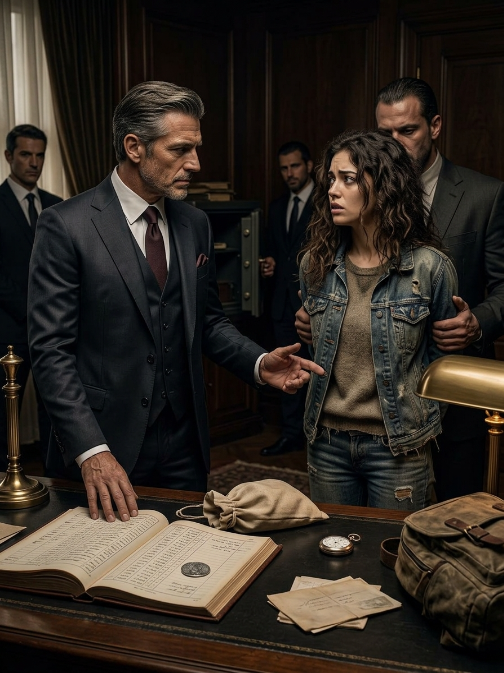
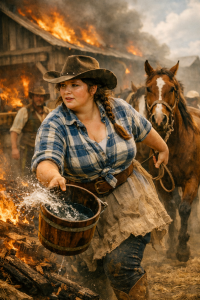
The Entire Town Laughed as a Cowboy Chose the “Fat Girl” — Then She Became the Only One Who Could Save His Ranch

—
## PART ONE
The stagecoach hit another rut, and Harper Lane’s head knocked against the wooden frame hard enough to rattle her teeth. She didn’t complain. Complaining had never gotten her anywhere worth going.
Through the dust-caked window, the landscape rolled past in shades of brown and gray — the kind of country that broke people quietly, without drama, just wore them down until they stopped trying. Harper had seen worse. The driver had given up on conversation an hour back, and now he just drove, spitting over the side and muttering about the road. She didn’t mind the quiet. Quiet was safe.
The trunk at her feet held everything she owned — two dresses, a spare pair of boots, a tin of needles and thread, a razor kept sharp enough to shave with, and a leather-bound notebook she’d never let anyone read. Not much to show for thirty-two years of living, but it was hers.
She’d left Harrisburg six weeks ago. Before that, St. Louis. Before that, a mining camp in Colorado she didn’t like to think about. The pattern was always the same: find work, keep your head down, stay until staying became more dangerous than leaving. She’d gotten good at reading the signs — when a man’s eyes lingered too long, when questions got too personal, when the safety of being invisible started to crack. Salvation Ridge wasn’t a destination. It was just the next stop.
The town came into view shimmering in the heat — a main street of packed dirt, maybe twenty gray weathered buildings, a saloon doing better business than anything else in sight. Men sat outside on a long bench, hats tilted low, watching the stagecoach roll in with the interest of people who had nothing better to do.
“Salvation Ridge,” the driver announced, like she might have forgotten. “You sure about this, ma’am?”
Harper stepped down, boots hitting dirt with a soft thud, the sun pressing on her shoulders like a physical weight. “I’m sure.”
“Ain’t much here for a woman alone.”
“There’s work.”
He hauled her trunk down and set it in the street, tipped his hat, still looking skeptical, and rolled away — leaving her standing there with her trunk and the weight of a dozen stares. The men outside the saloon didn’t try to be subtle.
“Well, look at that. Fresh meat.”
“Think she’s lost?”
“Nah, she’s got to be here for Big Eddie. Heard he sent for a mail-order bride.”
Laughter, meaner this time. Harper kept walking. The general store was ten yards away. She could make it ten yards.
“Hey, darling. Need help finding your way?”
She didn’t turn. Didn’t acknowledge them. Just kept putting one foot in front of the other, trunk handles digging into her palms, until she pushed through the store’s door and the noise from outside cut off behind her.
Inside, cooler air, the smell of flour and coffee and old wood settling around her like something familiar. A man behind the counter looked up from his ledger — late fifties, thinning hair, wire-rimmed glasses on a nose that had been broken at least once.
“Help you?”
“I’m looking for the Holt Ranch.”
His eyebrows went up. “You got business out there?”
“I was hired.”
That got his full attention. “Hired as what — cook?” He let out a low whistle. “Well, I’ll be damned. Grayson actually did it. We had a pool going on whether he’d find someone or just let the whole operation starve to death.” He stuck out his hand. “Name’s Porter. I run this place.”
“Harper Lane.”
“Pleasure, Miss Lane. Though I got to say — you sure you know what you’re getting into? That ranch has seen better decades. Grayson’s holding on by his fingernails, and the men he’s got are about as rough as they come.”
“I’ve worked rough before.”
“Fair enough.” He pulled a map from under the counter, marked a spot northwest of town. “Follow the creek bed north about three miles. Half-dead oak tree at the turnoff, property starts just beyond it.” He glanced at the clock. “Grayson usually sends someone in Fridays for supplies. You could wait, catch a ride.”
“I’d rather not wait.”
Porter considered this, then nodded slowly. “Got a wagon out back I use for deliveries. Loan it to you long as you bring it back next time you’re in town.” He patted the neck of a gray mare with kind eyes. “Her name’s Betsy. She’s old, but reliable. Treat her decent and she’ll get you where you need to go.”
They spent twenty minutes gathering supplies — flour, salt, lard, sugar, coffee, whatever vegetables weren’t half rotten — until the total came to eight dollars and forty cents, leaving Harper with less than three dollars to her name. Fine. She’d started over with less.
As they loaded the wagon, Porter lowered his voice. “Word of advice, Miss Lane. Don’t let those men out there push you around. Grayson’s fair, but he’s got a lot on his mind. And the hands — well, they ain’t used to having a woman around. They’ll test you.”
“They can test all they want.”
Porter grinned. “Yeah, I figured you’d say something like that. Good luck out there.”
As the wagon pulled away, Harper caught one last glimpse of the men outside the saloon, still grinning like they’d witnessed the setup to a joke. Let them laugh. She’d been underestimated before.
The ride out took just over an hour — empty land in every direction, poor fences, mediocre grazing, water sources too far apart for comfort. Not prime ranching country. The land you settled for when you couldn’t afford better. The half-dead oak appeared right where Porter said it would, and beyond it, the ranch emerged slowly from the landscape — a low sprawling house, a barn leaning slightly to one side, a bunkhouse that had seen better days.
A man stepped out onto the porch. Grayson Holt, tall, broad-shouldered, dark hair starting to gray at the temples, a face that had probably been handsome once before weather and worry carved lines into it. He didn’t smile.
“Miss Lane.”
“Mr. Holt. You made good time. Porter loaned me his wagon.”
Something flickered in his expression — approval, maybe, or just acknowledgment. “Fair enough. I’ll show you where you’ll be working.” He didn’t offer to help with her trunk, just turned and walked toward the house, expecting her to follow.
He led her through the kitchen a few minutes later, and Harper stopped in the doorway and took it in. Grease coated a cast-iron stove that hadn’t been properly cleaned in years. Dirty dishes cluttered the counter. Flour dust mixed with what looked like mouse droppings covered every surface.
“We’ve been making do,” Grayson said, defensive.
Harper ran her finger along the stove’s edge. It came away black. “I can see that.”
“My last cook left three months ago. Since then, the men have been taking turns. They try, but—” He gestured at the mess.
“When do they eat?”
“Breakfast at dawn. Lunch around noon, usually something they can take with them. Dinner after the work’s done. Around seven or eight.”
“How many?”
“Five. Six, with you.”
She opened the pantry — a few cans of beans, questionable dried beef, a nearly empty sack of flour.
“They’re not picky,” Grayson said, “but they eat a lot. And they’ll judge you on the first meal.”
“Everyone judges on the first meal.”
He checked his pocket watch. “That gives you about four hours to get something together.”
“I’ll manage.”
He turned to leave, then paused at the door. “I’ll send someone to help with the supplies.”
He left, his boots heavy on the floorboards. Harper stood alone in the kitchen, taking in the full scope of what she’d walked into. This wasn’t just neglect. This was a kitchen that had been slowly dying for months, maybe longer.
She rolled up her sleeves.
—
## PART TWO
The boy Grayson sent was Nate — maybe twenty, sandy hair, a sunburn that suggested he’d forgotten his hat more than once. He hauled water, six buckets and counting, and went a little pale when Harper told him she’d need three chickens plucked and cleaned instead of the salt pork the men had apparently been living on.
“You’re sitting on a cattle ranch,” she said, “and you’re eating salt pork?”
“Mr. Holt doesn’t like to cut into the herd unless he has to. Every head counts when you’re trying to make the drive.”
By the time the chickens simmered in a pot with onions and salt, and biscuits browned in the oven, and the kitchen had transformed from disaster site into something resembling order, the sun was dropping toward the horizon and men were coming in from the fields.
She served dinner at a rough table Nate had set up outside. Five men turned to look at her. Grayson at the head. Samuel, sixty-something and weathered, who reached for the ladle first, chewed slowly, and finally said, “Well, you’re better than any cook we’ve had in five years. Maybe longer.” Wes Dalton, younger, dark-haired, watching her with calculating interest. Charlie, nervous energy radiating off him. And Nate, trying not to look too eager.
“You got a name?” Wes asked.
“Harper Lane.”
“You always this quiet?”
“I talk when there’s something worth saying.”
Samuel snorted. “She got you there, Wes.”
Later, alone in her small room, Harper opened her notebook and wrote by lamplight: *Salvation Ridge, Holt Ranch, six people. Kitchen was worse than expected. One sweet — Nate. One suspicious — Wes. One solid — Samuel. Grayson Holt is harder to read. Property is struggling. This won’t be easy.*
She was elbow-deep in dishwater the next afternoon when her foot caught a loose board near the far wall. She knelt, pressed on it, felt more give than there should be, and worked her fingers under the edge. Underneath, a gap carved into the floor joists — and inside it, a leather-bound ledger, dusty and worn.
Harper pulled it out and opened it. Columns of numbers in neat handwriting, dates going back three years. Expenses. Income. Debts. Her stomach went cold as she read. Payments missed. Loans extended. The most recent entries showed amounts so far in the red she had to read them twice to be sure she wasn’t misunderstanding.
“What are you doing?”
Grayson stood in the doorway, his expression somewhere between angry and panicked.
She held up the ledger. “Found this under the floor.”
—
## PART THREE
“That’s private.”
“It was hidden in my kitchen.”
Grayson crossed the room in three strides and snatched the ledger from her hands. “You had no right.”
“I had every right. You expect me to work here? I need to know if you can actually pay me.”
“I’ll pay you with what?”
“According to those numbers, you can barely pay for the supplies I bought yesterday.”
His face went dark, but the anger burned itself out fast, replaced by something rawer. He sat down at the small kitchen table. “It’s bad.”
“How bad?”
“Bad enough I might lose everything by autumn if I can’t make the cattle drive work.” He stared at the ledger like the numbers might change if he looked hard enough. “My father left me debt I didn’t know about. Loans against the property. Promises to people who are now demanding payment.”
“Who’s the biggest creditor?”
“Woman named Evelyn Cross. Owns the ranch to the east. Controls most of the cattle routes through the valley. Been buying up land around here for years, squeezing out anyone who can’t keep up.”
“What does she want?”
“My land. The water rights that come with it. If she gets mine, she’ll own the whole valley’s cattle trade.”
“What’s your plan?”
“Make the drive. Get the cattle to market before she can strangle my access routes. Bring in enough money to pay down the worst of the debt.” He closed the ledger. “If I can’t make the drive, there won’t be a ranch to cook for.”
“I won’t tell anyone,” Harper said.
“Why not?”
“Because it’s not my story to tell. And because I’ve been in tight spots before. Sometimes the only way through is to keep your head down and work.”
Something shifted in his expression. Not quite trust. But the beginning of it. “Thank you.”
The smart thing would have been to leave — cut her losses, take what pay she could get, move on before everything collapsed. Harper had stopped doing the smart thing years ago.
—
Two weeks in, the kitchen gleamed, the men had started lingering after meals, and Harper understood exactly what was happening: they were starting to rely on her — not just for food, but for the stability she brought. It made her nervous.
She was in the pantry taking inventory when she heard Wes outside, talking to someone she didn’t recognize, his voice low and urgent.
“Told you I’m working on it.”
“Working on it isn’t good enough. She wants results.”
“It’s not that simple. Holt’s got his guard up. And that woman, the cook — what’s she got to do with anything?”
“I don’t know yet, but she notices things.”
“A few more weeks and this whole place will be hers anyway.”
“And my cut?”
“You’ll get paid. You always do.”
Harper pressed herself against the pantry wall until the footsteps faded, her heart racing. Wes was reporting to Evelyn Cross. Sabotaging Grayson from the inside. She needed proof before she said a word to anyone — accusations without proof were just words, and words could get you hurt, or fired, or worse.
She didn’t have to wait long for proof to arrive in the worst possible form. Nate burst into the kitchen a few evenings later, face white, collapsing before he could finish his sentence. “Fence broke. I fell. My leg—”
Harper caught him before his head hit the floor, lowered him carefully, already assessing. His leg was bent at an angle that turned her stomach. “Don’t move,” she said, calm despite the adrenaline. She grabbed a kitchen towel, folded it into a pad, straightened the leg over Nate’s sharp cry of pain, then splinted it with two wooden spoons bound in strips of torn apron.
“The fence,” Nate managed through tears. “Someone cut it, Miss Lane. The rail was sawed halfway through. I saw it before I fell.”
Samuel thundered onto the porch, took in the scene, and within twenty minutes had the wagon hitched and was driving Nate to town for the doctor. Charlie searched for Wes and came back empty-handed — his horse was gone.
Grayson pulled down a rifle in the tack room, checking the chamber with hands that meant he was about to do something stupid.
“Don’t,” Harper said.
“Someone just tried to kill one of my men.”
“I expect you to think. You go riding out looking for revenge, you give whoever did this exactly what they want — a reason to call you dangerous, unstable, someone who can’t be trusted with land or cattle.” She stepped closer. “You think Cross is behind this?”
“How do you know about Cross?”
“I hear things. And I know Wes has been meeting with someone asking about your operations.” She told him everything she’d overheard.
Grayson’s shoulders went tight with tension. “He’s been working for me two years. Ate at my table, took my pay. And the whole time he was selling me out.” He looked at her. “What are you going to do?”
“You let him think he walked away. Then you figure out exactly what he told Cross, and use it against her. Wes thinks you’re weak, that this place is falling apart. If he’s reporting that to Cross, she’s building her strategy on bad information. Let her keep thinking that.”
“While I do what?”
“Survive. Make the drive. Prove you’re stronger than she thinks.”
He studied her for a long moment. “You’re smarter than you let on.”
“Most people are. They just don’t get the chance to show it.”
—
Cross arrived herself the next morning — mid-forties, dark hair in a severe knot, a riding outfit more fashion than function, sitting a black horse worth more than everything Harper owned combined.
“I heard about your accident,” she said, voice carrying across the yard. “I wanted to express my concern.”
“Your concern isn’t needed,” Grayson said flatly.
“I came to make you an offer. A fair one. You’re struggling, Grayson. Everyone knows it. This ranch is bleeding money and you can’t possibly make enough on the drive to dig yourself out. But I can help. I’ll buy the property. Not for what it’s worth on paper — for what you actually owe. Clear your debts, give you enough to start fresh somewhere that isn’t killing you inch by inch.”
“No.”
“You’re making a mistake.”
“This is my father’s land. I’m not selling it to you or anyone else.”
Cross’s laugh was sharp. “Your father nearly destroyed this place. I control the northern routes. I have agreements with every major buyer between here and Kansas City. You think you’re going to waltz your herd to market without going through territory I manage?”
Harper stepped off the porch into Cross’s line of sight.
“And who’s this?” Cross asked, giving her one dismissive sweep. “The cook. Does she speak, or just stand there?”
“I speak when there’s something worth saying.”
“Charming. Tell me, do you always involve yourself in business that doesn’t concern you?”
“I work here. That makes it my concern.”
“You work here for now. But when this place fails — and it will fail — where will you go? Women like you are replaceable.”
Harper kept her face neutral. “Maybe. But men like Mr. Holt aren’t. Neither are ranches like this one. You can buy land, Mrs. Cross. You can’t buy what it means to the people who work it.”
Cross stared at her, then smiled — an unpleasant expression. “My offer stands for one week. After that, the terms get considerably less favorable.” She wheeled her horse and rode off, dust kicking up behind her.
“That woman’s poison,” Samuel spat.
“She’s also right,” Grayson said quietly. “She controls the routes. If she wants to, she can make the drive impossible.”
“Then we find another way,” Harper said. “What about Martin Keane?”
“Keane and I aren’t exactly friendly,” Grayson said. “Old dispute. His cattle got into my water supply a few years back. It didn’t end well.”
“Then rebuild it. Swallow your pride and ask.”
It took convincing, but the next morning Harper rode out with Samuel to Keane’s ranch — bigger than Grayson’s, better maintained, straight fences, a man who’d carved his territory out of nothing and held it through drought and recession. Keane listened to her case, weighed it against three years of grudge, and finally said, “I’ll help. But not because Grayson asked. Because you did. And because you’re right — if I don’t make a stand now, I’ll be making one later under worse circumstances.” He named his conditions: fence repairs, a written water-sharing agreement, and one honest answer.
“Why is a woman like you working for a failing ranch in the middle of nowhere?”
“I needed a job, and he needed a cook,” Harper said. “I’m staying because I’ve run from enough places. And this one feels like it might be worth staying for.”
Keane shook her hand. “Fair enough. You’ve got a deal.”
—
Cross didn’t take the alliance lying down. She rode in three days later flanked by six men who looked more like hired muscle than ranch hands.
“I heard the most interesting rumor,” she said. “Something about you and Martin Keane becoming friends again.”
“We settled our differences.”
“How convenient. I don’t just control the routes, Mr. Holt. I control the buyers. I’ve already spoken to the major cattle brokers in Kansas City. Mentioned there might be questions about the quality of Holt beef. Health concerns.” She adjusted her gloves, casual and cold. “You can make your drive if you insist. But when you get to market and no one will buy from you — don’t say I didn’t warn you.”
“That’s a lie.”
“Is it? Or is it prudent business practice to warn buyers about potential risks? In business, perception matters more than truth.” She gathered her reins. “You have one option left. Sell to me today. This is the last time I make the offer.”
She rode off, and Harper watched the hope that had been building over the past few days drain out of Grayson’s shoulders.
“It’s over,” he said. “She’s cut off the market.”
“It’s not over until you give up.”
“What do you want me to do, Harper? Magic up new buyers?”
“Tell me about the legal claim on the water rights. When did she file it? When did the survey get done?”
It took a moment for the question to land, but Harper’s instinct — sharpened by months spent working for a land surveyor in Colorado — told her Cross had rushed. Confident people got sloppy. They stopped double-checking because they were sure they couldn’t be wrong.
She and Samuel rode to the county clerk’s office the next morning, spent two hours going through filing records and public notices, and found exactly what Harper suspected: Cross had filed the claim without ever sending Grayson the legally required notice — or if she had, there was no record of it anywhere.
“We got her,” Samuel said, grinning.
Grayson hired a lawyer named Fletcher on Keane’s recommendation, and secured a loan from Keane himself — fifteen hundred dollars, enough to make a good-faith payment to the bank and buy breathing room. Fletcher reviewed Cross’s newest wave of claims, four of them filed within days of each other in retaliation, and found procedural problems in three. “She’s panicking,” Fletcher said. “These filings are aggressive but sloppy. My guess is she’s trying to overwhelm you with volume.”
They filed a motion documenting every violation and sent it to the newspaper. The headline ran two days later: *Local Rancher Challenges Cross Empire Claims.* The whole valley started talking.
Cross’s response came that evening — a letter demanding a private meeting. Harper insisted on coming along, over Grayson’s objection. “She won’t expect it. I’ve been watching her. I notice details.”
At the hotel dining room, flanked by two lawyers, Cross offered a settlement: withdraw the public motion, and she’d drop two of the four claims. Refuse, and she’d tie them up in litigation until long past the market window, then buy the ranch at bankruptcy auction for pennies on the dollar.
Fletcher started to respond. Harper spoke first.
“You’re scared.”
The room went still. “Excuse me?”
“That article rattled you. Not because of what it said about the violations — you could probably explain those away. Because it got people asking questions. Wondering what else you’ve been cutting corners on.” Harper leaned forward. “You filed four claims at once instead of spacing them out. You’re here offering to drop two immediately. That’s not strength. That’s desperation.”
“You’re making quite the accusation.”
“I’m making an observation. You look like someone who knows she made a mistake and is trying to fix it before anyone else notices.”
Cross’s face went hard as stone. She stood. “This meeting is over.”
“We’re not accepting your settlement,” Grayson said quietly. “We’re going to court. All four claims. And we’re going to document every single violation of procedure you’ve committed.”
“You’ll regret this.”
“Maybe. But at least I’ll regret it on my own terms.”
She left without another word.
“That was either brilliant,” Fletcher said, “or the stupidest thing I’ve ever witnessed.”
“Possibly both,” Harper admitted. “She was bluffing. Trying to look strong while offering to fold.”
—
The hearings went their way. Two of Cross’s claims were dismissed outright for procedural violations; a third sent back for more documentation; the original water claim allowed to proceed, but with real restrictions. Not a clean victory, but enough to shift the balance. Other ranchers started questioning their agreements with Cross. Buyers began demanding proof of her claims. The empire she’d built on confidence and control started showing cracks.
Then, the morning the drive was set to begin, Harper woke to shouting. The herd was gone — more than three hundred head vanished in the night, the fence cut clean through.
“Cross,” Grayson said, and something in him broke. “It’s over. She won.”
“No.” Harper’s mind was already racing through fragments — Wes’s warning about Cross’s legal strategy, his claim that he was done working for her. They found him in a boarding house two hours later, thinner, haunted. When Grayson told him what happened, Wes went pale.
“She didn’t tell me about this. I swear I’ve been out of it for weeks.” He hesitated, torn, then gave it up. “There’s a box canyon on her eastern property. Remote. She uses it for off-book transactions. Cattle that don’t officially exist. Three, four men guarding it. Not ranch hands — the kind who get paid not to ask questions.”
Keane agreed to help, bringing five armed men. They scouted the canyon at dusk and moved at dawn, when the guards would be least alert. It went wrong fast — a man spotted Samuel’s group before they were in position, warning shots turned into real ones, and the cattle stampeded through choking dust. Harper watched Samuel go down clutching his shoulder and ran to him without thinking, dragging him behind cover, pressing her hand against the wound while bullets and panicked hooves tore through the chaos around them.
The shooting stopped as fast as it started. Cross’s men surrendered or fled. The herd, scattered but mostly recoverable, was rounded up. They’d won — but the cost was written in Samuel’s blood on Harper’s hands.
He healed. The bullet had missed the bone. Charges were filed against Cross’s men for cattle theft; she claimed ignorance, but the newspaper ran the story, other ranchers came forward with their own suspicions, and the empire crumbled faster than anyone expected.
Three weeks later than planned, but still inside the market window, the drive finally happened — eleven days of dust and heat along routes that bypassed Cross’s territory entirely. The buyers in Kansas City had heard the stories. Some were skeptical. But the cattle were healthy, the price was fair, and deals were made. Not as much as they’d hoped. Enough to survive.
—
Cross sold her operation and moved east within the month. “Couldn’t handle the scrutiny,” the letter said.
“We won,” Grayson said, watching the sunset from the porch a few nights after they returned, land that was finally, entirely his.
“It worked out because a lot of people fought,” Harper said. “Samuel. Keane. Fletcher. Even Wes, in his own messed-up way.”
“Still. You were the one who held it together. Who saw possibilities when the rest of us just saw problems.” He was quiet for a moment. “I’m going to need a foreman who actually knows what they’re doing. Samuel’s not getting any younger.”
“I’m not qualified to run a ranch.”
“You weren’t qualified to negotiate with Keane either. Or dig through legal records. Or stare down Evelyn Cross. But you did all of it anyway.”
Harper didn’t know what to say to that. Six months ago she’d been a woman with a worn trunk and no prospects, looking for work that might last a few weeks. Now she was being offered a future.
“I’ll need to learn,” she said finally.
“We’ll all learn together. That’s what makes it interesting.”
That night, alone in the small room that had become hers, Harper opened her notebook one last time — pages filled with observations from dozens of places, survival strategies from a life spent in motion. She turned to a blank page.
*Salvation Ridge. Holt Ranch. Home. Not because it’s perfect, not because it’s easy, but because it’s where I chose to stop running and start building. Sometimes the bravest thing you can do is stay.*
She closed the notebook and lay down in the room that was hers, in the place that had become home. Through the window, stars filled the sky. Tomorrow would bring work, setbacks, the hundred small struggles of keeping a ranch alive.
But tonight, Harper Lane was exactly where she needed to be. And for the first time in longer than she could remember, that was enough.
**THE END**