The Mafia Boss Came to Collect My Father’s Debt—Then Took Me Instead of the Money

# PART 1
The ring arrived before the introduction.
That was the detail I kept returning to afterward — not the diamond, which was significant enough to be insulting on a table where my coffee had been paid for by someone else, not the man placing it there with the studied ease of someone performing generosity for an audience, but the sequence.
Ring first.
Name second.
Choice not at all.
—
My name is Sofia Reyes. I was twenty-three years old, finishing my last semester of urban design at Columbia while working thirty hours a week at a restaurant downtown to cover rent, student loan minimums, and the recurring cost of pretending my father’s situation was manageable.
It was not manageable.
Rafael Reyes had been building toward catastrophe with the dedication of a man who believed charm could outrun arithmetic. He bet on horses, on cards, on private games hosted by people who were not in the losing business. He borrowed from men who charged interest in compound misery. He borrowed more to pay the interest. He borrowed from my future to pay the compound misery and smiled at me over dinner like neither of us noticed.
I noticed.
I always noticed.
I had spent twelve years noticing, ever since my mother died and left the two of us and a mortgage and the peculiar silence of a house missing its structural center. I learned to read expenses the way other children learned to read bedtime stories. I learned to measure stability not in feelings but in load-bearing walls — what was actually holding things up versus what just looked like it was.
By the time Cristian Vasquez walked into my life, I was an expert in ruins that hadn’t fully fallen yet.
—
He came to our apartment on a Tuesday night in November.
I heard him before I saw him. Not his voice — the quality of quiet that precedes men who do not need to announce themselves. Then the knock, which was three measured beats, deliberate as punctuation.
My father answered. He made a sound I had not heard from him in years: pure, undiluted fear, the kind that bypasses pride entirely.
I came out of my room.
Four men. One door that had not been forced, which meant my father had opened it himself. A large man near the window, watching exits. Another near the hallway, watching me. And two in the center of the room — my father, standing with the specific posture of a man who knows he has run out of exits, and a man I did not recognize.
Cristian Vasquez was not the largest person there. He did not need to be.
He was somewhere in his mid-thirties, dark-suited, the kind of composed that comes not from calm but from certainty that the room would organize itself around him. His eyes moved to me with the even attention of someone reading a document.
Not desire.
Assessment.
That was somehow worse.
“Rafael,” he said. Just the name. The amount of information contained in two syllables was remarkable.
My father’s glass slipped. Whiskey and water spread across the linoleum, and in the sudden cold smell of it I understood: this was not the first time these men had come. It was the last.
They spoke for eleven minutes. I counted.
The number that emerged was one point eight million dollars. Not one debt — a structure. A whole improvised architecture of borrowing, each beam leaning against another until the whole thing required the building it occupied to not move.
My father looked at me.
Not like a parent who has made a terrible mistake.
Like a man hoping a problem will agree to become someone else’s.
Cristian Vasquez looked at me too.
Not with appetite. Not with cruelty.
With the even, dispassionate attention of a man filing away a fact.
He left without saying anything to me directly.
Two days later, my father told me I had a lunch meeting.
—
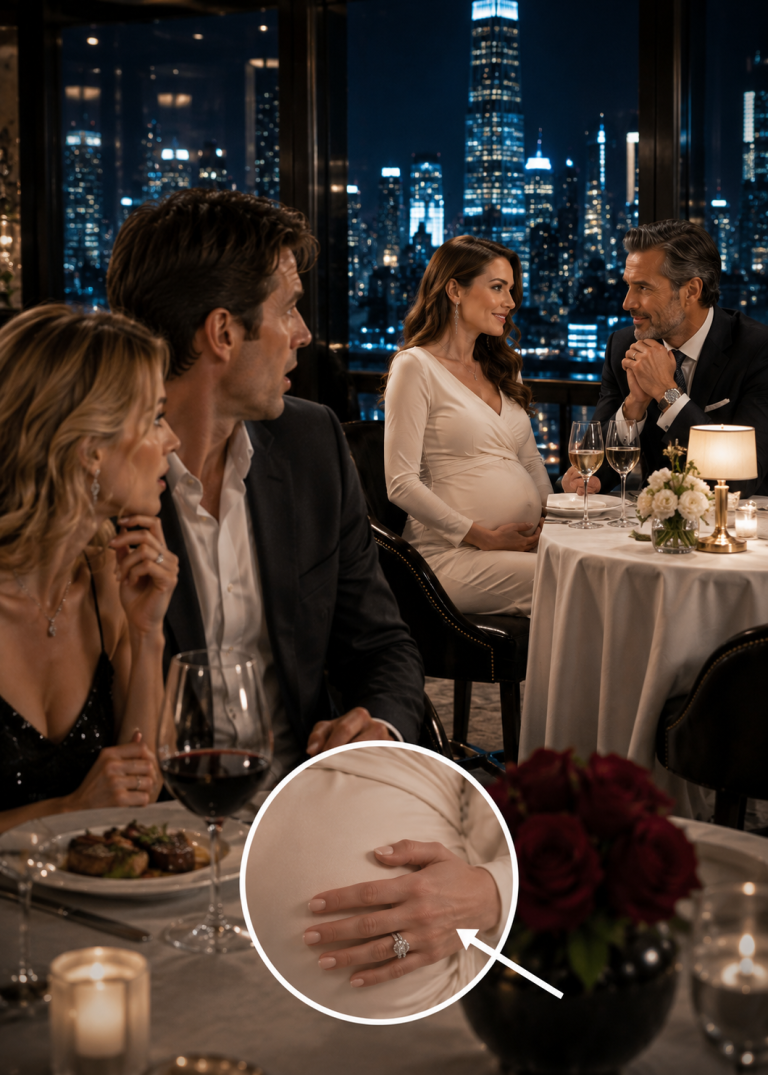
Restaurant Caterina seated twelve at any given time and pretended this was exclusivity rather than intimacy. The table had been arranged with the specific intention of framing the conversation: his position against the wall, mine with my back to the room, a diamond ring open in a velvet box where most people would place an appetizer.
Cristian Vasquez was already seated when I arrived.
He looked different in daylight. Less like a threat, more like a decision that had already been made and was waiting to be delivered.
“Sit down,” he said.
“I’d prefer to stand for the part where you explain what I’m doing here.”
A small silence.
“Sit down,” he said again, and it was not a command, exactly — it was the patience of a man who has learned that most situations resolve in his favor if he simply doesn’t rush them.
I sat. Primarily because I needed to look at the ring.
It was extraordinary. Three carats, possibly more. The kind of object that existed to communicate a size of wealth that has stopped needing to be practical. On a table where my bag was held together by a replacement strap and my coat had been relined with fabric from a different coat, it looked less like a gift and more like a translation problem.
“Your father owes one point eight million dollars,” Cristian said.
“I know.”
“He cannot pay it.”
“I know.”
“The people who hold the majority of that debt are not patient men.”
“And you are?”
He studied me.
“I have purchased most of the debt. The holders who remain are manageable.” He pushed the ring box one inch closer to me. “Marry me. The debt disappears. You finish your degree. You live safely.”
The restaurant continued its polite noise around us: silverware against china, the low music of money in conversation.
“What do you get?” I asked.
“You take my name. You appear at my side when the situation requires it. You understand the structure of my world and conduct yourself accordingly.”
“The structure of your world.”
“Yes.”
“I study buildings,” I said. “I know what it means when someone builds the structure before consulting the people who will live inside it.”
Something shifted in his expression.
Not surprise.
More like the specific attention of someone who has heard an expected answer and received a different one.
“You have time to consider,” he said.
“I won’t need it.”
He waited.
“You are not describing a marriage,” I said. “You are describing an acquisition framed in enough courtesy to make refusal seem ungrateful. And the fact that you said it quietly in a room full of witnesses who won’t repeat it doesn’t make it less of what it is.”
The waiter had stopped moving near the bar.
Cristian closed the ring box with one finger.
“You have twenty-four hours,” he said. “Think carefully about what your alternatives are.”
I stood. My bag caught the edge of the table; I righted it without looking away from him.
“I am not something my father can spend,” I said. “And I want you to sit with what it means that you thought he could.”
I left without touching the food.
Outside, rain had arrived without announcing itself. I walked two blocks before I felt my phone buzz.
Unknown number.
A photograph.
My father in a room I didn’t recognize, one eye swollen, seated in a way that made it clear he was not there by choice.
Below it: five words.
*The girl for the old man.*
And below that:
*Eighteen hours.*
—
# PART 2
Cristian’s car found me standing under the awning of a closed bookshop, phone still in my hand, the photograph already memorized.
The SUV pulled to the curb so smoothly it barely disturbed the puddle at the gutter’s edge. The rear door opened before I stepped forward.
Cristian was already inside.
I got in because my father’s swollen eye was inside my phone and fear, when attached to love, is not a weakness. It is a specific kind of clarity.
He did not pretend not to know about the photograph.
“The Caucasian Brotherhood,” he said. “They have been expanding into new markets. Your father’s debt network made him useful to them.”
“Useful how?”
“As leverage against me.”
I looked at him.
“They took my father to pressure you.”
“Yes.”
“Because they believe I matter to you.”
“Because I made it known you were under Vasquez protection,” he said. “Three months ago.”
I counted back.
Three months. Before Caterina. Before the ring. Before I knew his name.
“You were watching me.”
“I was protecting you.”
“Those are not the same thing.”
“No,” he said. “They are not.”
That admission, brief and level, unsettled me more than a defense would have. I had been prepared for justification. The absence of it left me recalibrating.
We drove to an industrial building near the waterfront. Inside, it was not abandoned. Security cameras in organized angles. Men who moved with the specific economy of people paid to be alert. Monitors showing streets I recognized: my university, my apartment, the restaurant where I worked Thursday shifts.
I stopped.
“That is my work.”
“Yes.”
“For how long?”
“Long enough to know you are not the variable your father is.”
I turned from the screens.
“A man convinced he is protecting someone can still be surveilling them,” I said. “The subject’s preference is relevant to whether it’s protection or control.”
His second-in-command — a man named Renzo, gray-templed, careful-eyed — made a sound that might have been a cough.
Cristian did not look at him.
He looked at me.
“You are correct,” he said.
That was the second moment I recalibrated.
Men who admit they are wrong in front of subordinates are either rare or strategically transparent. I did not yet know which he was.
What I knew was this: my father was alive for the moment, Cristian had resources I did not, and the notebook I had begun keeping under my mattress — dates, names, overheard numbers, the organizational structure I had been quietly mapping — was going to matter more than charm or anger.
“My father,” I said. “Tell me the plan.”
Cristian opened a folder on the steel table.
I read.
I began adding details I had not been given.
The shape of the problem, it turned out, required someone who understood how structures fail from the inside.
I happened to know something about that.
—
# PART 3
They located my father the following morning in a cold storage warehouse that the Brotherhood had been using as informal infrastructure for three months.
No shootout. No dramatic breach.
Cristian’s attorneys and two compliance investigators arrived with sealed documentation and made it clear that the Brotherhood’s use of the facility intersected with several ongoing regulatory reviews in ways that would become very expensive, very publicly, if the next thirty minutes unfolded incorrectly.
My father walked out.
Badly bruised. Smaller than I remembered. Wearing the face of a man who had finally arrived at the arithmetic he had been avoiding for years.
When he saw me, what crossed his face was not relief first.
It was shame.
Good.
I said three things to him:
“You offered me.”
He said, “I was desperate.”
I said, “Desperation explains the wound. It does not excuse the blade.”
He said nothing.
I said, “I hope you become someone who would rather run out of options entirely than spend another person’s life for more of them.”
He cried.
I let him.
The next eight weeks were complicated in ways I had not fully calculated.
I lived in Cristian’s house because the alternative — my apartment, which had been accessed once already — was known. This was not trust. It was geometry.
He gave me a room on the second floor with a window overlooking gardens maintained with the deliberate beauty of someone who has learned not to trust the natural world to be orderly. On the desk on the second morning: architecture monographs I had once ordered from the university library because buying them was outside my budget. Not new copies. Out-of-print editions, tracked down by someone who had taken the trouble to identify exactly which ones.
On the third day, he asked whether I preferred scaled models or technical drawings as primary thinking tools.
Not what I was working on.
How I thought.
That was when I started paying attention differently.
I kept the notebook. I expanded it. Dates and names became a record of the organizational structure I was mapping through observation: which companies appeared in documents I saw on desks in passing, which names appeared in multiple contexts, which of Cristian’s holdings were legal and which existed in the territory between law and intention.
I was not building a weapon.
I was building a door.
A woman can be grateful for safety and still keep her own keys.
Three weeks in, Cristian came to stand in the doorway of my room and said, “You are documenting my operations.”
I looked up from the structural drawings I had been using to think.
“I am documenting my situation,” I said. “Which overlaps with your operations in several places.”
He came in.
He placed a folder on the desk.
“What is this?”
“Legitimate business records. Tax compliance. Employment rosters. Construction contracts. Permits. The clean parts, accurately rendered.”
“Why give me this?”
“Because if you are going to make a decision, it should be based on accurate information rather than assumptions built from partial data.” He sat across from me. “I have used information asymmetry as a management tool for most of my professional life. I am trying to stop.”
I looked at the folder.
Then at him.
“Why?”
He was quiet for a moment.
“The first time I saw you,” he said, “was not the apartment. It was seven months ago. I was at Rosella’s with an attorney. You were working a triple shift. A man at a table snapped his fingers at you. You put down his coffee and said, ‘I respond better to names than to sounds.'”
I remembered that table.
“You watched me for seven months.”
“I had you investigated, yes. I know about your father’s debts, your mother’s absence, your degree program, your thesis project.” His voice stayed level. “I also know that on the night you had no subway fare after donating your shift tips to a coworker’s medical emergency, you walked forty-five minutes home in the rain and your shoes left wet marks on your design drawings and you redrew the damaged pages the next morning without mentioning it to anyone.”
My throat tightened.
“You should not know that,” I said.
“I know.”
“But you are telling me anyway.”
“Because there is a difference between being known and being seen. The first part, I did wrong. The second part, I am trying to earn.”
That sentence lived with me for a long time afterward.
—
Six weeks into my residence, I woke at three in the morning with a nausea that had nothing to do with anxiety.
I calculated backward.
Then I sat very still on the edge of the bed for a long time.
The pharmacy was two miles away and I needed to go alone. I told Renzo I needed personal items. He sent a driver. I directed the driver to a pharmacy four blocks from the one I used, paid cash, returned a different route.
The sedan following us appeared on the second turn.
Not Cristian’s.
I called him before I told Renzo.
His voice went carefully neutral.
“Do not stop. Take Meridian to Industrial. I will have cars in position.”
They intercepted the sedan before it could parallel my route. Four men removed from a vehicle, no injuries, and by the time we reached the warehouse compound Cristian had already arrived.
His hands moved over my shoulders, my face. Not romantic. Methodical. Checking.
“Are you hurt?”
“No.”
“The errand.”
I looked at my bag.
At the receipt inside it.
“Personal,” I said.
He studied me.
Renzo appeared. “Tracker on the vehicle. Minimum one week.”
One week. My routines. My exits. My pattern of small rebellions turned into useful geography for people with worse intentions.
“Someone inside,” Cristian said. Not a question.
“Yes,” Renzo said.
The silence that followed had a specific quality: the silence of a man discovering that the machinery closest to him has been turning against him.
By morning, Renzo had a name.
Viktor Solis. Five years with Cristian. Gambling debts, accumulated, ignored, then weaponized by the Brotherhood through a shell company layered enough to obscure until you traced the wire confirmations three steps back.
Viktor was gone by the time anyone looked for him.
He took personnel schedules, security protocols, and the movement records that had been building for a week.
I sat alone in the second-floor room and took the pregnancy test I had bought in a different pharmacy.
Two pink lines, immediate and indisputable.
I sat with that for a long time.
Then I called Cristian.
“There is something I found in the study,” I said. “And something else I need to tell you. Come up.”
He arrived in under a minute.
I showed him the safe photographs first.
“The safe was open,” I said. “Viktor’s name is on a file inside.”
He reached for the photographs.
“Bank transfers. Access logs. A communication script,” I said. “He was told to suggest to me that your father’s original debt was much lower. That you inflated it deliberately to manufacture a crisis. That you were using me while calling it protection.”
Cristian looked at the photographs.
“The script includes the phrase *gilded cage*,” I said. “Exactly as it appeared in a phone call I received yesterday. Which tells me Viktor wasn’t the only pipeline.”
He lowered the photographs.
“You already knew about the call.”
“I recorded it. The phrasing was too specific. Manipulation that uses your own doubts against you tends to use language you have already used privately.” I held his gaze. “I needed to see whether the documents would confirm the call was coordinated or whether the call was accurate.”
“And?”
“Viktor’s file tells me it was coordinated.” I reached into the folder and pulled out the last photograph. “Your father’s original debt records are also in there. The number is not fifty thousand. It is more than you told me.”
His jaw tightened.
“Yes.”
“Then Viktor’s caller lied about the amount to make me doubt you.”
“Yes.”
“But you still withheld the real number initially.”
“Yes.”
I placed all three photographs on the desk.
“I am not telling you what I found to praise you for being honest now,” I said. “I am telling you because we have a problem that requires coordinated response, and I am not able to coordinate with someone who is managing what I know.”
He looked at the photographs.
Then at me.
“What else did you want to tell me?”
I told him.
He went very still.
Not alarmed.
Something more complex than alarmed.
Then he said, “I will not make decisions about this without you.”
That was the first promise from him that I believed without needing to verify it.
—
The dismantling did not look like war.
It looked like a conference room at 6:00 a.m., a table of attorneys and compliance specialists and one federal liaison, and documents arranged by date and organizational connection.
I sat at the far end with my own folder.
Cristian’s lead attorney — a woman named Adriana, who wore reading glasses on a chain and had the specific energy of someone who had been waiting for this meeting for years — laid out the case.
Viktor Solis. The Brotherhood. The surveillance operation. The psychological pressure campaign. The tracker installation. The phone call script. The fake exit car staged at the service entrance.
She spoke without drama.
That made it devastating.
When she finished, Cristian stood at the window.
“What happens now?” he said.
“We do not respond privately,” Adriana said.
The room understood.
Adriana continued: accounts frozen, regulatory notifications through counsel, independent oversight of all legitimate holdings, compromised personnel removed through documented process, cooperation with financial crimes investigators in ways that protected employees who had not chosen these arrangements.
One of Cristian’s senior men shifted. “You want government in our house.”
“I want the house to stop functioning through the kind of darkness Viktor exploited,” I said.
The room turned.
“Darkness is not strength,” I continued. “It is a dependency. It means the people with the most proximity to you are also the most dangerous, because they are the only ones who know where the load-bearing walls actually are.”
Cristian looked at me from across the table.
“What else?” he said.
I placed a document in front of Adriana.
“My father’s debt — legally separated from me. Written confirmation that no debt of Rafael Reyes attaches to my name, my child, or my future. His treatment through court-appointed oversight, not private arrangement.”
I placed a second document.
“A trust, administered by outside counsel. My education, housing, medical care, and my child’s support guaranteed independently of any personal relationship between me and Cristian.” I looked at him directly. “Whether I stay or leave.”
The room went quiet.
“And?” Cristian said.
“And I finish my degree,” I said. “On my timeline. Without the program being notified of anything that would require explanation.”
Adriana said, “I can draft all of this.”
Cristian said, “Done.”
One of the older men at the table made a sound.
Cristian’s voice sharpened.
“Did I invite a comment?”
The sound stopped.
He looked at me.
“And between us?” he said.
I had not wanted to answer this in a room full of men who were calculating what my answer meant for their positions.
I had not wanted to answer it in private either, where tenderness could soften what needed to stay clear.
“There is nothing between us,” I said, “unless I can leave whenever I choose. Not as a theoretical freedom. As an actual door that opens from the inside and stays open.”
He nodded.
“Adriana will draft a separation agreement. Your residence, education, medical care, and security exist independent of whether you marry me. If you leave, no one follows without your consent.”
He turned to his men.
“Anyone who treats her as leverage forfeits their position and my protection. Anyone who misidentifies her role here loses access to my business and any benefit my name has carried for them.”
That was the first time I watched him use power correctly.
Not to acquire.
To release.
—
Viktor was arrested in a parking structure through a coordinated operation that used his own scheduled contact pickup. The evidence was bank records, access logs, the call script, and wire confirmations that led through four shell layers back to Brotherhood holding accounts.
The Brotherhood-linked companies were frozen through court orders. Three of Cristian’s executives resigned before the audits reached them. A law firm that had serviced both sides lost two partners after Adriana provided emails they had assumed were protected by a destroyed hard drive.
My father entered supervised treatment.
Not Cristian’s arrangement.
Not mine.
The court. Independent financial guardianship. Gambling debts moved into legal proceedings, some reduced under predatory lending challenges, none transferred to my name.
I visited him on a Tuesday afternoon. He was in a gray sweater. No performance. His hands had stopped shaking in the way of someone who had given up the thing making them shake.
“I offered you,” he said.
“Yes,” I said.
“I don’t—” He stopped. “I remember it. I remember choosing it. I don’t know how to explain it.”
“You don’t need to explain it,” I said. “I need you to understand that I will never be collateral. Not for debt. Not for anyone’s urgency. Not for love.”
He cried.
I sat with him for another hour.
Forgiveness is not the same as reinstating access.
Both things can be true.
—
I moved into my own apartment in March.
Three floors above street level. A drafting table by the north-facing window. A lock that responded only to my key. A pot of herbs on the windowsill that nobody had chosen for me.
It was the first space I had occupied in years that asked nothing of me except that I pay the rent, which I could now do.
Cristian visited on Saturdays. Always with a text first. Often with takeout I claimed not to be grateful for but ate entirely. My daughter arrived in August, and when he held her for the first time in the recovery room his face did the thing faces do when they encounter something that rearranges everything previously considered important.
“You wanted an heir,” I said.
“I wanted a future,” he said. “I did not yet know those were different words.”
My thesis project changed.
What had been a sleek public library became something else: a community resource center with integrated legal aid, childcare rooms, transitional housing, and financial counseling physically centered in the building rather than tucked into a basement where shame could quarantine it. A place designed around the principle that dignity should not require emergency before it is provided.
I called the project *Threshold.*
Not because thresholds are dramatic.
Because a threshold is the point where inside becomes outside and the direction of the door matters.
Cristian came to the presentation. He sat in the back row without announcing himself. Afterward, he waited by the campus gate.
“Load-bearing,” he said.
“That’s my advisor’s word for it.”
“She means it as a compliment.”
“I know.”
He was quiet for a moment.
Then he took a folded document from his coat pocket.
Not the ring.
“What is this?”
“Your trust documents. Already signed. Already lodged with the independent administrator. Irrevocable.” He held it out. “Read them before you believe them.”
I took the document.
It was denser than a ring box and weighed infinitely more.
“And what do you want?” I asked.
“To be considered,” he said. “After the choice is real. Not before.”
That was the second time he used power correctly.
He waited.
—
We married when my daughter was seven months old.
Not at Cristian’s estate. Not at Caterina, where a ring had been placed across from my cracked phone screen.
We married in the courtyard of the first *Threshold* center, which opened six weeks before the ceremony in a former industrial space two blocks from where my father had once been held.
I wore cream.
Not white.
My daughter slept through the vows in a chair that had been reupholstered and placed in the lobby as part of the permanent installation — objects whose original purpose has been changed. The sign beside it read: *Things That Held Power Over People Who Refused to Stay Held.*
Cristian read the sign and said nothing for a long time.
Then he said, “That is excellent.”
Adriana stood beside me as witness. My father sat in the third row, thirteen months sober, hands in his lap. My coworker from the restaurant sat beside him with her husband, both of them in the good clothes they reserved for events that mattered.
When Cristian placed the ring on my finger, it was not the one from Caterina. That ring had been returned to a vault because some objects carry the wrong beginning and deserve to remain historical.
The ring I wore was a band I had designed. Gold. Simple. Inside the band were four words engraved in small clean letters: *This door opens inward.*
Afterward, someone asked Cristian whether he was happy.
He looked at me.
“I am honest,” he said. “That’s where I’m starting.”
I thought that was the right answer.
—
Years later, people told the story the way people tend to tell stories about women who marry powerful men — they simplified the direction of rescue, flattened the negotiation, and erased the notebook.
They said: a young architect’s debt brought her to a dangerous man, who saw her value and gave her a better life.
That was not the story.
The story was that my father’s choices exposed a market where women could be offered as solutions to men’s problems.
The story was that I kept a notebook.
The story was that power offered me a cage and called it safety, and I learned to evaluate every room before accepting the terms — structural analysis as survival skill.
The story was that Viktor Solis was not dismantled by a gun or a threat or a man with more power than him.
He was dismantled by bank records, access logs, a call script, and a woman who photographed documents in a study at two in the morning before choosing to stay.
The story was that I stopped asking whether powerful men would protect me and started asking who benefited from my believing I needed their protection.
That question changed the room.
Not all at once.
Incrementally.
The way good buildings come together.
One load-bearing wall at a time.
—
At the fifth anniversary of *Threshold*, I stood in the lobby and watched a young woman sit across from a legal advocate. Her coat was insufficient for the weather. She had a bag against her hip with the weight of someone carrying everything important in one place, the way you do when you’re not sure where home is going to be that night.
But she was inside.
Warm.
Seen.
Not asked to spend herself for access.
My daughter, four years old and extremely confident in her own analysis of the world, tugged my sleeve.
“Mama, did you make this?”
I looked at the exposed structural beams we had left visible on purpose. The glass. The wide-open offices where help was not hidden in a basement. The waiting room full of people whose problem was not that they were weak but that the systems built around them assumed weakness was where they lived.
“Yes,” I said. “But not by myself.”
She thought about this.
“Is it strong?”
I looked at the threshold.
“It’s designed to be,” I said.
Across the lobby, Cristian stood with Adriana and two foundation directors, our son asleep against his shoulder, my daughter’s drawing of our building tucked into his coat pocket. He looked less like a man who had once owned rooms and more like a man who had learned to sit in them differently.
He looked up.
Still careful.
Still present.
Still mine by choice, which was the only version that counted.
I finally understood what I had not been able to see in that restaurant with the ring between us:
A woman’s future can be priced.
Her silence can be arranged.
Her fear can be mapped and used against her.
But she keeps the notebook.
She photographs the documents.
She asks whose interest is served by her uncertainty.
And then, one door at a time, she builds something the price could never capture.
—
*THE END*
—
—