He Paraded His Mistress Across the Gala Floor — Then His Wife’s Hidden Trillionaire Legacy Shocked Every Guest


—
## PART 1
The ring made a small, cheap sound landing in the crystal dish. That was the sound Amelia Sinclair Caldwell would remember for the rest of her life — not the door closing, not the car pulling away. Just that careless clink of gold against glass, like a man dropping a coin into a parking meter.
“You’re not wearing it?” she asked.
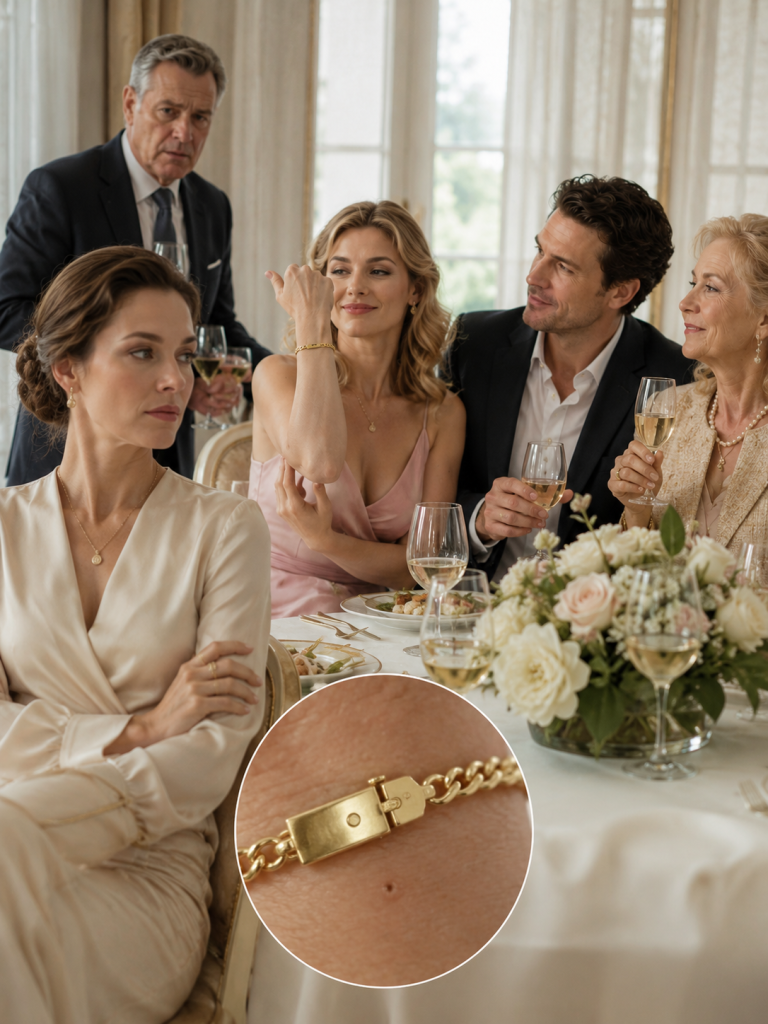
Ethan didn’t turn from the hallway mirror, still working his cufflinks, tilting his chin the way men do when rehearsing a version of themselves that doesn’t exist yet. “It’s a networking event, Amelia. There are people at this gala tonight who could change my entire life. I need them to see potential, not a guy with a wife in a sweater.”
She looked down at the gray sweater, worn thin at the elbows. “This was my dad’s,” she said quietly.
“I know. And that’s beautiful, truly. But nobody at the Manhattan Crown Hotel is going to care about your dead father’s sweater.”
The plate in her hands was still warm — short ribs, eight hours in the oven, a recipe she’d asked his mother for over the phone three years earlier, in a conversation she’d never told him about. “I made dinner,” she said. “I thought maybe we were going together.”
Ethan laughed. It wasn’t cruelty, exactly — cruelty requires a person to notice you and decide to hurt you. This was easier than that. This was amusement. He crossed the hall and took her face in both hands, the gesture that had worked on her for eight years. “Sweetheart, listen. I say this with love. You wouldn’t understand that world. What are you going to talk about — your tomatoes?” He kissed her forehead. “That’s why I married you. You’re simple. You’re good. That’s rare.”
*Simple.* He meant it as a compliment. That was the thing that finally cracked something open in Amelia’s chest — a hairline fracture in eight years of patience.
“And Vanessa understands that world?” she asked.
His hands dropped from her face. The tiny flicker — the half-second where a man’s whole architecture wobbles. “Vanessa is my assistant. She runs my calendar. It’s professional.”
“Then let me be bored too,” Amelia said. “Let me stand in the corner and hold your coat for three hours. I’ll say nothing. Just don’t make me hear about it from a photograph.”
The doorbell rang, and Ethan’s whole body changed — shoulders back, the hundred-watt smile switching on, the one Amelia had once found charming and now, standing three feet away in her dead father’s sweater, recognized for exactly what it was. A sales pitch.
Vanessa Reed was twenty-five, in a red dress that cost more than the mortgage payment, and she looked past Ethan’s shoulder directly at Amelia with an expression Amelia had never once in her life been on the receiving end of. Pity.
“Oh — hi, Mrs. Caldwell. Wow, are you okay? You look tired.”
Ethan laughed at that too. That was the exact moment. His wife standing there in a bathrobe of grief, and a twenty-five-year-old insulting her to her face, and he laughed like it was a joke they were all in on.
Amelia looked at him for a long moment. “Ethan,” she said. “Are you sure you know whose world you’re walking into tonight?”
He was already turning, already halfway gone. “I’m sure, sweetheart. Don’t wait up.”
The door closed. Amelia Sinclair Caldwell stood alone in the front hall of a nine-thousand-square-foot house she had quietly paid for through four layers of shell companies her husband had never once thought to look up, and listened to a car pull out of a driveway she owned, carrying a man toward a gala funded entirely by an empire that bore her family’s name.
“No,” she said to nobody, in a voice so calm it was almost gentle. “You’re not.”
She carried the plate to the kitchen and stood at the sink for eleven minutes without moving. She did not cry. That was somehow the most frightening part.
Amelia had been twenty-nine when her father died, standing in a hospital hallway in Zurich holding coffee she never drank, when a man in an expensive suit introduced himself as the acting chairman of Sinclair Global Holdings and told her she was now the majority shareholder of the third-largest private investment institution on Earth. Her father had been dead forty minutes.
Near the end, when the morphine made him honest, he’d told her the money wasn’t a gift. It was a wall. And the terrible thing about a wall was that you could never know what was on the other side of it — whether someone loved you, or loved the wall. *Find out first,* he’d said. *Whatever you do, find out first.*
So she had. She’d kept forty-nine percent of the voting shares in a trust, appointed a proxy chairman who’d never once met her in person, rented an apartment under her mother’s maiden name, and taken a forty-one-thousand-dollar-a-year job at a community garden nonprofit in Somerville — to wait, and find out if she was lovable.
A man had walked into that garden on a Tuesday in April with a clipboard and mud eventually on his knees, and said, “Teach me.” She’d married him fourteen months later in a courthouse, in a two-hundred-dollar dress, and thought, with a joy so violent it frightened her — *he doesn’t know, and he’s here anyway.* He chose the girl in the dirt.
Eight years later, she was starting to understand the most horrifying possibility of all. He hadn’t chosen the girl in the dirt. He’d chosen a woman he thought he could stand on.
—
## PART 2
The car smelled like Vanessa’s perfume. Ethan sat in the back with a folded cream envelope in his hand like a relic — a personal invitation to the Diamond Legacy Gala, an event Marcus Webb, a man with two billion under management, had been trying to get into for four years and couldn’t.
“They see what I am,” Ethan said.
In the front seat, Raymond Ortiz — fifty-eight, nineteen years driving for Sinclair Global’s executive fleet, personally selected for tonight’s route by a woman he’d never met — adjusted the mirror and said nothing at all.
The Manhattan Crown Hotel held two hundred and fourteen guests that night, every one of them worth more than four hundred million dollars, except one. Ethan walked in and the sound hit him like warm water — crystal laughter, a string quartet, the low hum of money that never has to raise its voice. He didn’t notice the coat girl skip asking his name. He didn’t notice, right away, the strange things that followed.
Gerald Whitlock, seventy-one, owner of a shipping empire, asked about his numbers, and when Ethan proudly recited fourteen consecutive quarters up thirty-one percent, Whitlock only said, “Well. Somebody’s been very good to you,” and walked away.
At the bar, reaching for his wallet out of habit, the bartender told him it was covered — Sinclair covers it every year. *Sinclair.* Ethan’s brain did what every brain does when a fact arrives that will destroy it. It filed the name as a coincidence. There were Sinclairs in the phone book. There was a Sinclair gas station on Route 9. His wife’s maiden name was Sinclair, but her father had been an accountant in Providence — he was almost certain that’s what she’d told him, once, over pasta, years ago, and he’d never asked a second question, because a man who asks a second question has to be ready to hear the second answer.
Then he found Marcus Webb, who grabbed his arm and demanded to know how a nobody like Ethan had gotten into this room. “There are two hundred and fourteen people here,” Webb said, “and every one of them is here because Sinclair Global has a position in something they touch. You’re not in the room because you’re impressive, Ethan. You’re in the room because they own a piece of you.” He listed Ethan’s own anchor investors — Meridian, Ridgeline, Copperfield — and traced every one of them back, in two or three hops, to the same balance sheet. “I thought you had a relationship,” Webb said. “I finally decided you must be sleeping with someone.”
The string quartet stopped. The lights dimmed. Two hundred and fourteen of the wealthiest people on the Eastern Seaboard went quiet at once, the particular quiet of a crowd watching something rehearsed.
“For thirty-one years,” the host said from the stage, “this evening has been hosted by a single family. For the last eight of those years, our host has attended in complete anonymity, at her own request. Tonight, for the first time, she has asked to be introduced.”
Ethan’s ears were ringing. Vanessa’s hand found his arm; he didn’t feel it.
“Please welcome,” the host said, “Amelia Sinclair Caldwell.”
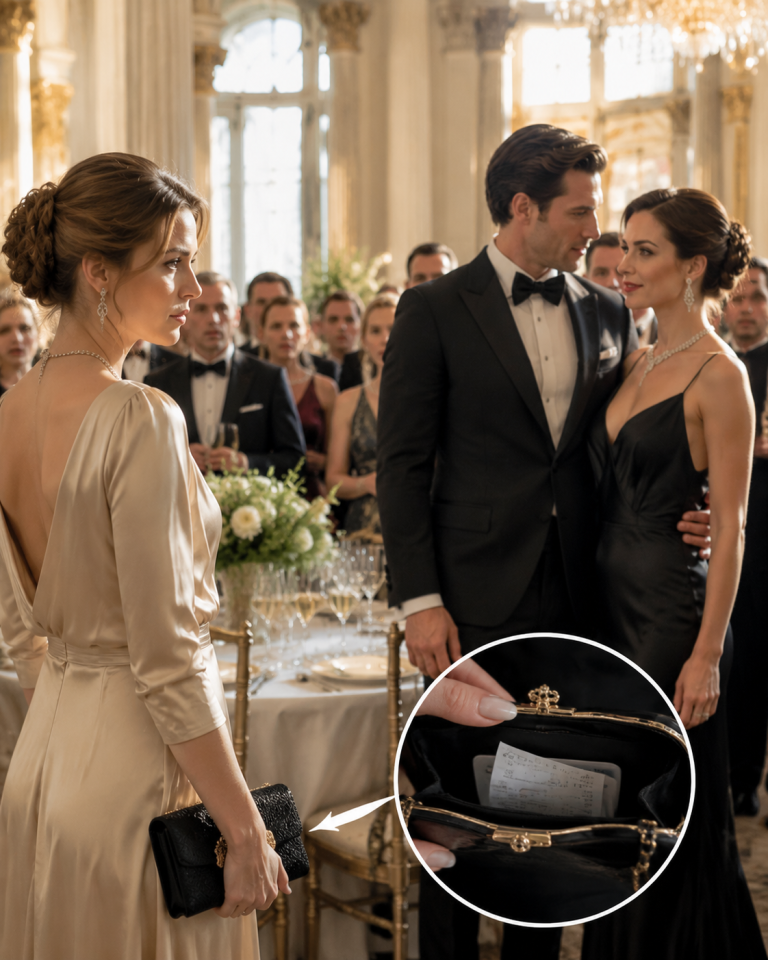
The champagne glass slipped from Ethan Caldwell’s hand and shattered on the marble floor. Nobody turned to look at him. Every eye in the ballroom was on the staircase, and on the woman coming down it — dressed in black, hair down, not smiling — and Ethan Caldwell, thirty-eight years old, the man who’d told his wife she wouldn’t understand this world, stood in a spreading pool of champagne and glass and could not make his lungs work.
—
## PART 3
Amelia reached the bottom of the staircase and crossed the ballroom floor toward exactly one person. Her face wasn’t angry. That was the thing that broke him — not that night, and not for years, but eventually, replaying it in the dark. She looked disappointed. The way you look at a student who’d had every chance.
She stopped four feet away, close enough to smell like their shower, like their house, like eight years. “You left your ring in the dish, Ethan,” she said quietly, so only he and Vanessa could hear it, and set it on the table beside him. “You should probably put it on. There are going to be photographs.”
His hands shook so badly he dropped it once. A woman in emerald retrieved it and handed it back without a word — Catherine Voss, who managed forty billion dollars, picking his wedding ring up off the floor like a coat check girl. “Thank you,” Ethan whispered. “Don’t thank me,” she said. “Thank her. Everyone here does.”
The ring didn’t fit right going back on, swollen knuckle catching, and he thought absurdly of the sound his wife’s hand had made an hour and a half earlier.
“Mrs. Caldwell — Sinclair,” Amelia said, turning to Vanessa for the first time. “The Caldwell part was a courtesy. I’m told courtesies expire.” She looked her over. “You look tired.” The first laugh of the night came from near the bar — one sharp bark — and then it spread, low and terrible, through two hundred people who had spent their whole lives learning exactly when to laugh at someone. Vanessa began to cry, and Ethan didn’t move to comfort her. Amelia watched him not move, and filed it away with everything else she kept.
“Take your seat at table four,” Amelia told him. “Your name’s been on it for three weeks. I invited you.” When he asked why, she said only, “Because I wanted to see who you’d bring,” and walked to the stage — leaving him to understand, for the first time in his adult life, that he had never once been the hunter.
She adjusted the microphone, too short for the podium built for men twice her size, and told the room the story they thought they already knew: a garden in Somerville, forty-one thousand dollars a year, a man with a clipboard who knelt in the dirt in an expensive suit and said, *teach me.* “I loved him completely,” she said. “I married him in a courthouse and I thought — he doesn’t know, and he’s here anyway. He chose the girl in the dirt.” She paused, looking directly at table four. “I was wrong. He didn’t choose the girl in the dirt. He chose a woman he thought he could stand on.”
She told them about the anchor investments they’d all quietly held in Caldwell Strategic without reading the fine print — Meridian, Ridgeline, Copperfield — every door that had opened for her husband because she’d made three phone calls. She told them his actual return, once you subtracted the capital she’d steered his way. Negative four percent. Over eight years. The room detonated — not with laughter, but with the low, collective murmur of two hundred professionals doing the same math and arriving at the same devastating number.
“That’s not illegal,” Amelia said. “A wife can invest in her husband. But at six-forty this evening, I received a call from my own general counsel. That call wasn’t about my marriage.” The screen behind her lit with a wire transfer record. Four million, one hundred eighty thousand dollars, moved through a Delaware entity into a personal account, in eleven transactions over nineteen months. “That’s not a bad marriage,” she said. “That’s a felony.”
Ethan was on his feet before he remembered standing, insisting it was management fees — until she cut the arithmetic in half in front of him, two percent of his assets under management being barely a fraction of what he’d taken. “You set me up,” he shouted, voice cracking off the crystal.
“I gave you capital,” Amelia said. “I didn’t tell you to steal it. You lied to me for eight years.”
“Yes,” she said. “I did. I lied to you at breakfast. I lied to you at your mother’s funeral, when I stroked your hair and thought, *I should tell him now,* and didn’t — because I was a coward, and because I still wanted to know.”
That was when Vanessa, unnoticed until she stood, screamed a question about a condominium in Miami she’d been told was corporate. Amelia turned to her, gently this time. “He didn’t leave me for you,” she said. “He wanted to be a man who could have you. There’s a difference. It’ll take you about four years to feel it.”
Ethan tried to turn the room against his wife — accused her of running an experiment on him for eight years, of watching him work himself sick while she held the one sentence that could have ended it. “Yes,” Amelia said. “I was. Until year two.” The room went silent in a different way. She told them about the Chicago job he’d turned down six years earlier — not, as he’d claimed, over culture, but because he hadn’t wanted to report to a woman. “That’s when I knew,” she said. “The test ended six years ago, Ethan. You failed it. I stayed anyway. So no — I wasn’t running an experiment on you. I was running one on myself. How long will a woman stay in a room with a man who’s already told her exactly who he is.” She let the number land. “Six years, apparently. And a hundred and nine days.”
She asked him, in front of the room, if he knew her father’s first name. He couldn’t produce it. Eight years, and he couldn’t produce it. She told them herself — Thomas Ray Sinclair, born in Fall River, a scar on his hand from a mill machine, dead on a Tuesday while Ethan had a deal closing. “He asked about you at the end,” she said. “He asked, is he good to you? I said yes.” Her voice finally broke all the way through. “I lied to my dying father for you.”
That was the sentence that would run in every publication, the one a stranger in Ohio would tape to her bathroom mirror.
Amelia announced Sinclair Global’s immediate redemption of its entire anchor position — enough to collapse the fund by Wednesday — and revealed that thirty-eight of Ethan’s forty employees had already accepted offer letters from Sinclair portfolio companies that same evening. Only two hadn’t: his head of compliance, who had a meeting with the SEC in the morning, and Vanessa, who hadn’t been offered anything at all. “Because you’re twenty-five,” Amelia told her. “And if I catch you now, you’ll never learn to land.”
Then Vanessa did something nobody expected. She apologized — publicly, brokenly — repeating back everything Ethan had told her: that his wife hadn’t touched him in two years, that she was dead inside, that he wasn’t going to spend his life in a mausoleum. Ethan’s fist came down on the table hard enough to send a glass over the edge, and two hundred of the wealthiest people in America saw, for one unguarded second, the man who had twisted a ring off his wife’s finger.
“There,” Amelia said from the stage. “There he is. Thank you. I was starting to think I’d have to describe it.”
She showed them one final image — a photograph of her own hand, swollen and split across the knuckle, timestamped two hours earlier. She let it hang on the screen for eleven long seconds. “I’ve been asked by four lawyers in the last two hours whether I intend to press charges,” she said. “I’m not. Not tonight. Because I want him to spend the next two years not knowing.” She looked at her husband. “That’s my gift to you. It’s the only one you’ve ever earned.”
The ovation lasted over four minutes. Ethan pushed through the crowd, unstopped, the way you let a man through when he’s carrying something contagious, and caught her at the doors, crying and begging, promising to fix everything, to go to the SEC himself, to start over somewhere small. She looked at him and asked one question. “What was I planting? The day you walked into the garden.”
He stood there for five long seconds before he answered. “Tomatoes.”
“Yes,” she said, and took her hand back.
—
She got twelve blocks before Warren Halloway called. He’d been acting chairman for eight years, since the day he’d walked up to a twenty-nine-year-old girl in a Zurich hospital hallway and said the word *succession* forty minutes after her father’s death.
He told her, smooth and unhurried, that she’d just made a public statement — under camera, before referral — that her husband had stolen from a co-mingled fund. And that every one of those eleven wire authorizations bore her signature as co-signer. Forged, badly, in the later transactions — but forged with her name. “A jury sees a very rich woman who signed eleven documents,” Warren said, “and then found out about a girl in a red dress.” There was a clause in her father’s trust, he told her — reputational impairment — that suspended a beneficial holder’s voting rights the moment she became the subject of a credible regulatory inquiry. He’d found the forgeries three weeks earlier and sat on them. He’d let her walk onto that stage anyway.
She reached the house to find Vanessa on the front steps, barefoot in the cold, nowhere else to go. Amelia brought her inside — not out of forgiveness, but because she needed her sober and thinking clearly, since in a few hours a lawyer was going to call and what Vanessa said would decide the rest of Amelia’s life.
It was there, going through Vanessa’s own calendar entries — the Cambridge meetings that were really Miami, the diligence trips that were really something else entirely — that Amelia understood her husband hadn’t been clever. He’d simply signed other people’s names because it was faster.
Ethan came home at ten to one in the morning and found his wife and his assistant in the kitchen together. Under pressure, in front of Raymond Ortiz standing silent in the hallway, he admitted the wires weren’t for a condo or a boat alone — two million of the four had gone somewhere else. Somewhere he’d never told a living soul about, in six years. Cleveland. A woman named Dana. A five-year-old son.
Vanessa’s stool went over backward like a gunshot when she understood there was a child. Amelia didn’t move. She asked how old. *Five.* She told him — voice steady until it wasn’t — about the four years of fertility treatments, the two miscarriages, the morning he’d told her *maybe it’s just not for us* while, unknown to her, his son had already been walking. That was the only time in the entire night Amelia Sinclair raised her voice.
“I would have loved him,” she said, once the shaking stopped. “I would have driven to Cleveland myself. You knew that about me for eight years, and you let me grieve a child you were already raising.”
Warren called again. He offered Ethan an affidavit — eleven words claiming Amelia had known about and approved the transfers — for a sum that climbed, in real time, from six million to twenty, tied to a full relocation and lifetime medical care for the boy. He laid out, with surgical cruelty, exactly how much easier this would be for everyone: Amelia would survive scandal fine, with a trillion dollars and a small library of lawyers; Dana Kesler, on thirty-eight thousand a year, would not survive being named a co-defendant in a federal fraud case with a sick five-year-old.
Ethan asked Amelia, in front of the open line, what would happen to her if he refused. She could have lied — four easy words, *I’d be ruined* — and won instantly. Instead she told him the truth. It would cost her a bad chapter. Nothing more.
That was what finally reached him — not the money, not even the boy, but watching his wife tell the truth when a lie would have cost her nothing. He refused Warren’s offer, and instead announced he would walk into the U.S. Attorney’s office that morning, alone, and confess to all eleven counts himself — naming Warren’s nineteen months of silent knowledge along with his own crimes.
Warren hung up laughing, softly, almost fondly — *your father would have loved this* — and self-reported the entire cover-up to the SEC before dawn, torching his own thirty-year career in the process. It was, Amelia understood later, the only way left for him to hand her the chairmanship without a fight: the reputational-impairment clause that had briefly suspended her rights applied just as cleanly to an acting chairman who’d just confessed to a federal cover-up.
Ethan asked her, before she left, to go to Cleveland — not for him, but for a boy whose mother made thirty-eight thousand dollars a year and was about to lose everything the moment he refused Warren’s deal. Amelia grabbed her keys. She took Vanessa with her — the only person in the house, she said, who knew how to make a phone call at four in the morning — and by the time they crossed into Pennsylvania, Vanessa had already found the best pediatric pulmonologist in the country and talked her way into a Thursday appointment.
—
They pulled up outside a rented Cleveland duplex a little before noon. Dana Kesler opened the door in scrubs, keys already in hand, and knew instantly who the woman in the black evening gown was. There was no confusion in her face. Only recognition, and six years of dread finally arriving.
“Is he in jail?” Dana asked.
“By tonight.”
“Okay,” Dana said, like a woman who’d been standing at the edge of exactly this for years.
Amelia told her the truth — that she’d become chairman that morning, that the payments Warren’s shell company had quietly funneled would now come directly from her, in her own name, starting Monday; that a doctor in Denver was already waiting on the boy’s records; that there was a house and a job if Dana wanted one, and nothing to sign, and nothing owed.
“Why?” Dana whispered.
“Because I’m not going to be the third person who decides that boy’s life is negotiable.”
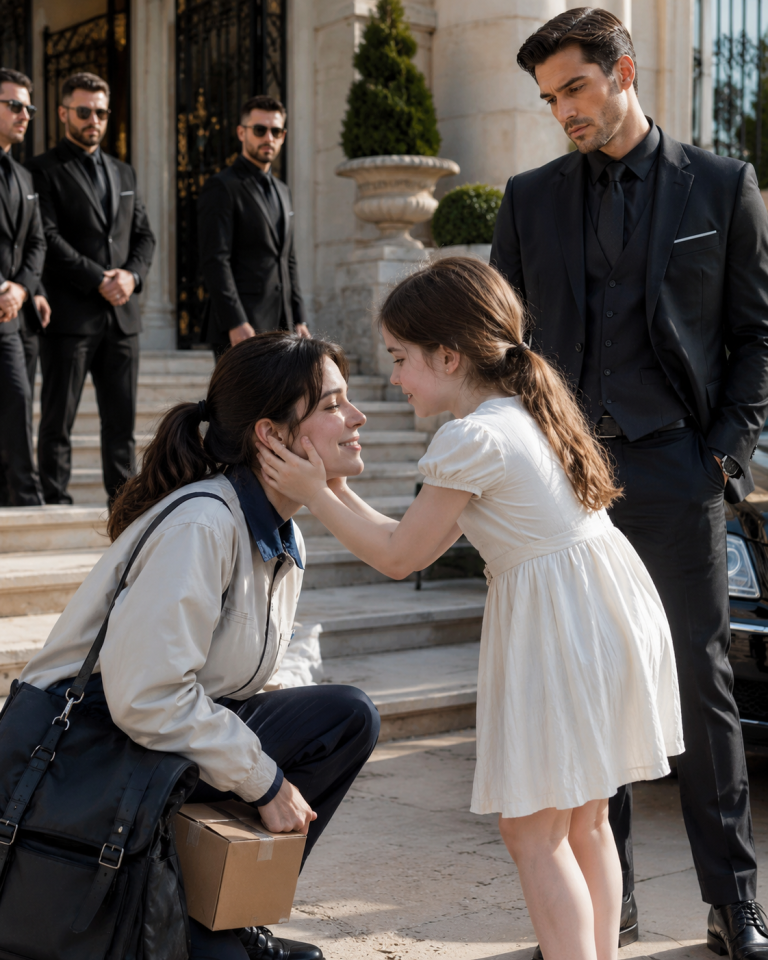
A five-year-old came to the door in blue pajama pants at noon, holding a plastic dump truck, and said, “Hi.” Amelia knelt on the concrete in a fifty-thousand-dollar dress, eye level with Ethan’s eyes and Ethan’s chin on a stranger’s face, and heard the thin, wet catch at the top of his breathing before he even spoke. He grinned, held his breath the way excited children do, and forgot to let it out — the exact detail his father had described in a kitchen hours earlier, breaking apart. “Breathe, baby,” Dana said automatically, and the boy breathed, and Amelia Sinclair put her hand over her mouth and made a sound she had never made in eight years of practiced composure.
Dana sat down beside her on the step, the wife and the mistress together, holding onto each other while a small boy ran a truck along the railing, because they had both been lied to by the same man, and only one of them had gotten anything good out of it.
—
Ethan Caldwell pled guilty to all eleven counts that afternoon before his court-appointed attorney had finished reading the file, waiving the recess he was offered. Asked if he understood what he was doing, he told the judge, “For the first time.” He was sentenced to fifty-one months and served thirty-eight.
Four years later, at the Diamond Legacy Gala, there were two seats near the front that no one was permitted to bid on. One belonged to Dana Kesler, who now ran the Sinclair Foundation’s pediatric access program out of Denver and had, in eighteen months, gotten nine thousand children into specialist care. The other sat empty every year, set deliberately with a plate and a glass that nobody questioned, because everyone already knew.
Amelia never spoke publicly about her marriage again beyond the same eleven words whenever a journalist reached for it: *that’s the only part of my life I still own privately.* Warren Halloway paid a four-million-dollar fine, never worked in finance again, and took her call every Thursday at six in the morning for the rest of his life, unpaid, as a friend — the best job, he said, he’d ever had. Vanessa Reed, twenty-nine now, ran Amelia’s office.
On a Tuesday in April, four years to the week, Vanessa told Amelia that Ethan was out — nine days, a room in Lowell, a job at a hardware store, thirteen-fifty an hour, a call to Dana every Sunday in which he never once asked for anything.
That same Tuesday, a man walked into the community garden in Somerville. He was forty-two, thirty pounds lighter, dirt already under his nails from four hours of work under his own name — a name nobody at that garden recognized, because nobody there read the financial press. He was kneeling at the far bed, planting tomatoes badly, spacing them wrong, crowding them the way he always had.
Amelia stood at the gate and watched him for four minutes. He never looked up. He never scanned the fence line for someone worth impressing — the thing he’d done every day of the eight years she’d known him. He just planted, badly, alone.
She understood, standing there with her hand on the latch, that she had one more test left in her, and that she would never stop having one more test in her, not really — that she could walk in, kneel beside him, tell him he had the spacing wrong, and know in the half-second before he could arrange his face whether there was anything left in him worth eight more years of finding out.
She took her hand off the latch.
She turned and walked back to the car. Raymond opened the door and didn’t ask. “The airport,” she said, and as they pulled away, she said, quietly, to no one — “I don’t need to know.”
That was the end of it. Not forgiveness — she said so, once, to a room full of women in Aspen who wanted a cleaner ending, and gave them the true one instead. “He took a ring off my hand in my own hallway, and let me grieve a child he was already raising. There’s no version of me that forgives that, and I’ve made peace with not being a good enough person to.” The story doesn’t end when you forgive someone, she told them. It ends when you stop needing the answer.
She held up her hand — the finger long healed, no mark left at all. “I asked one question for eight years,” she said. “Does he love me. I asked it with a garden, a fake name, a gala, two hundred witnesses. I got my answer. And four years later, at a gate in that same garden, I was ready to ask it one more time.” She lowered her hand. “And then I didn’t. That’s the whole thing. That’s eight years and a trillion dollars, right there in that one second at that gate. I didn’t need him to pass. I didn’t need him to fail. I just didn’t need.”
Her father had told her, dying, that money was a wall. She’d spent a decade proving him wrong. The money was never the wall. The question was — and the day she finally stopped asking it was the only day she was ever free of it.
She never went back to that gate. She never needed to. She already had everything Ethan Caldwell could never have given her, and everything he’d taken, and everything he’d been too small ever to see.
She was never the woman he married. She was the empire he never deserved.
THE END