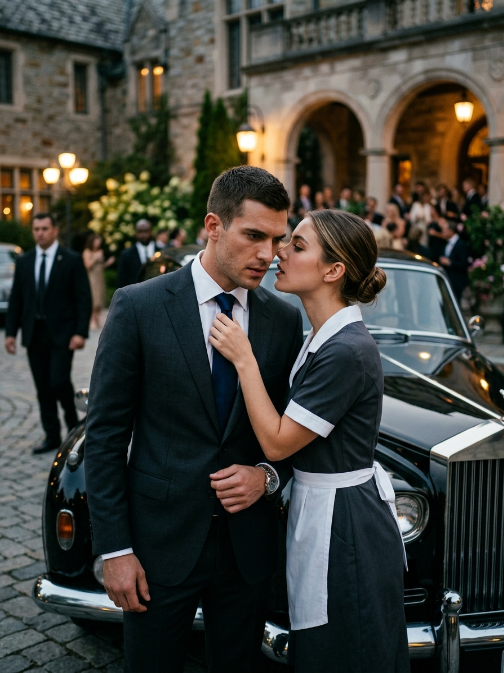
The delivery woman had already lost everything when the mafia boss turned his back on her—but then his daughter screamed, “Don’t take my mom away!” That single sentence froze everyone… because it exposed a secret someone had killed to keep buried.

## PART 1
Nora had done the math three times because the number was too clean to be real.
Two hundred dollars for a delivery in Lake Forest. Not a tip. Not in this economy, not with her credit report looking like a crime scene. The message sat on her phone’s screen while rain hammered the Honda’s windshield in a rhythm that matched her heartbeat—desperate and irregular.
The hospital called that morning. Not about her father. He was past calling for. The debt collector wanted to discuss his funeral bills one more time, suggesting, with genuine helpfulness, that she might consider liquidating assets. Her car was the only asset left. Twelve years old, coffee stain on the passenger seat, and the only thing her father’s hands had touched before the cancer did.
She accepted the order.
The restaurant hostess packed the food without meeting her eyes, like Nora was already contagious with bad luck. “Waverly Drive,” she said. “Big house. Don’t wander.”
Nora almost laughed. Wandering was a luxury for people with somewhere else to go.
The gates opened without resistance—that was the first wrong thing. No guard, no intercom, no security theater. Just iron doors swinging wide like an invitation. A fallen oak had taken part of the eastern fence, and in the controlled chaos of repairs, nobody noticed one 2012 Honda Civic slip through.
The mansion rose from the rain like something built to prove a point. All limestone and aggression, all those windows lit gold against the November dark. Nora found the greenhouse by accident, following what she hoped was a service entrance when wind destroyed her sense of direction. She was soaked through by the time the glass doors yielded.
Inside was another world. Warm. Breathing. Heavy with orchids and earth and something that smelled like survival.
“Hello?”
The child appeared like a ghost rising from water. Barefoot. Nightgown plastered to skin. Blond hair clung to her face in wet ropes, and her eyes—enormous, storm-gray, frozen with a particular kind of terror—locked onto Nora’s.
Nora recognized it because she’d seen it in mirrors after her father died.
“Hi,” Nora said, keeping her voice paper-thin. “I’m not supposed to be here, am I?”
The girl didn’t answer. Thunder cracked. The child flinched so hard the leaves around her trembled.
Nora set the food down slowly, then knelt on the cold stone, closing the distance the way you’d approach something wild and wounded. “When I was little, thunder sounded like God moving furniture because He had terrible taste in interior design. My dad used to say that. He wasn’t funny, but he tried.”
The girl’s eyes flickered.
“You don’t have to talk. You don’t have to move. But my hand is here if you need it. Until the sky stops screaming.”
Minutes dissolved. Then the child crawled from beneath the ferns and placed cold fingers in Nora’s palm like she’d found solid ground in a collapsing world.
Nora almost cried.
“You’re safe,” she whispered. “I’ve got you.”
The doors exploded open.
The man who entered brought the storm with him—tall, dark suit soaked nearly black, face carved in lines that suggested he’d spent years practicing cruelty. Three armed men flanked him, and for a moment, Nora couldn’t move because the arithmetic was suddenly very simple: a strange child, a poor woman holding her hand, and a man who looked like he could end both problems with one finger twitch.
The gun rose.
“Step away from my daughter.”
Nora’s hands went up but the child didn’t release her grip. Instead, Lily pressed herself against Nora’s side, her tiny body creating a barrier between the gun and the woman holding it like it was nothing.
“I’m a delivery driver,” Nora said, which was technically true. “The gate was open. I got lost. Please don’t shoot me.”
“Everyone says please when they’re lying.”
“Then I’m telling the truth twice.” She kept her voice steady because Lily was trembling. “If I planned to kidnap anyone, I wouldn’t use eggplant parmesan as my opener.”
One of the men made a sound that might have been a cough or laughter.
But the gun didn’t lower. The man’s finger tightened, and Nora realized with crystalline clarity that logic wasn’t going to save them. Fear wasn’t going to save them.
The child was going to.
Lily stepped between them.
“No,” Nora whispered, but Lily’s arms spread wide, and when she turned to look at the woman she’d just met, her mouth opened for the first time—not in fear, not in screaming, but in something that sounded like hope trapped in a five-year-old’s voice.
“Mommy.”
The gun fell.
It struck the floor with the sound of something final. The man went white, his face cracking like stone underwater. Around them, grown men stopped breathing.
Nora held Lily because the child was shaking, because no one else seemed capable of movement, and because her body had already made the decision her mind couldn’t quite accept.
“I’m not her mother,” Nora said to no one, to herself.
The man’s eyes lifted then—black, burning, and entirely focused on her like she’d just detonated a bomb in the center of his carefully controlled world.
“Then why,” he asked, and his voice was barely a whisper, “does she think you are?”
## PART 2
By dawn, Nora was drowning in cashmere and terror.
The woman who brought her clothes had looked at her like she was either blessed or doomed. Probably both. Lily had refused to sleep unless Nora sat beside the bed, so there she was, in a sweater that cost more than her rent, watching a child’s chest rise and fall in the predawn dark.
Now she sat across from the man in his study—all leather and old money and the kind of danger that didn’t need to announce itself. He knew everything. Her name. Her debt. Her dead father. The medical bills. The frozen nursing account. He knew because he’d asked, and asking, in his world, apparently meant getting answers.
“Seventy-three thousand dollars,” he said, reading from a file like it was poetry.
“How did you—”
“You’ll stay for one month. With Lily. No responsibilities except her.” He didn’t ask. “I’ll clear your father’s debt. I’ll clear your rent. In thirty days, if you want to leave, you leave with the money earned.”
Nora’s exhaustion had burned away into something sharp. “What’s the part you’re hiding?”
His eyes lifted. Darker than they’d been in the greenhouse, like something was prowling behind them. “You don’t discuss this house. You don’t search. You don’t listen at doors. And you accept that Lily’s memory is fragile.”
“Her memory of what?”
He didn’t answer.
Vincent—the gray-haired man from last night—appeared in the doorway like he’d been waiting for permission to exist. “Lily’s asking for her.”
The man’s jaw tightened. He stood, walked to the window where rain was still falling. When he spoke again, his voice had changed into something that sounded almost human.
“My wife was murdered two years ago. Lily was in the backseat. She hasn’t spoken since. Not to doctors. Not to me.” He paused. “Until you.”
Nora felt the weight of that settle across her shoulders like a coat made of glass. This wasn’t about money. This was about a man desperate enough to bargain with a stranger, and a child whose silence had become a cage.
“I won’t lie to her,” Nora said.
He turned. “What will you tell her?”
“That I’m Nora. That people leave sometimes and it still matters. That children don’t heal because adults make prettier lies—they heal when someone finally stops making them carry the truth alone.”
The silence stretched between them like a held breath.
Then he said, “One month,” and Nora realized with sick certainty that she’d just agreed to something much larger than money.
Upstairs, Lily sat by the window in her small nightgown, her rabbit tucked under one arm.
When Nora entered, the girl didn’t speak. But she reached out, and when Nora sat beside her, Lily placed her hand in Nora’s grip like they’d done this a thousand times before.
“Who is he?” Nora asked softly.
Lily’s voice came out fragile as bone. “Daddy.”
“And you love him.”
The child’s silence was answer enough.
But that night, while Nora was cleaning up Lily’s dinner, the girl whispered something that changed everything. “Mommy said… don’t tell Daddy.”
Nora’s hands stilled. “Don’t tell him what, sweetheart?”
Lily looked toward the door, then the window, like the words themselves were being hunted. Her voice dropped to nothing.
“Blue man.”
And before Nora could ask what that meant, before she could ask who or when or why, Lily’s face went blank—the kind of blank that came from deep trauma shutting every door at once.
Nora held her through the night, but the words wouldn’t come again.
In the study, the man was watching security footage on a loop. Nora and Lily baking cookies. Flour on the child’s nose. The moment she laughed for the first time.
When he finally noticed Nora in the doorway, he didn’t turn around.
“She said something tonight,” Nora told him. “Something she wasn’t supposed to say.”
His hand tightened on the desk.
“She said her mother told her not to tell you about a blue man.”
The room went colder than November had any right to make it.
## PART 3
The first two weeks were ordinary enough to hurt.
Lily whispered words by the kitchen island while Nora made cereal disasters that apparently were “exactly how cereal works.” By day six, she was saying Nora’s name like it was a prayer that had finally been answered. By day ten, she was giggling at Vincent’s suffering in a child-sized chair while wearing plastic tiaras.
Matteo—that was the man’s name, though Nora had learned it from a guard’s radio call, not from him—watched these moments with the intensity of someone witnessing a resurrection. He stood in doorways. He watched the security footage at night. He looked at his daughter like she was a miracle he’d already lost once and couldn’t quite believe was still breathing.
“She’s healing,” Vincent said one evening, appearing beside Nora as she cleaned up after dinner.
“She’s beginning to,” Nora corrected. “There’s still a lot of dark she’s not ready to touch.”
Vincent nodded. He was easier to read than Matteo—grief had worn paths through his face that were almost gentle now. “Sophia was his world.”
“I know.”
“He thinks her death was a business war. He’s been responding like it was an attack from the Russo family.”
Nora looked at him. “But it wasn’t.”
“No,” Vincent said quietly. “It wasn’t. But Matteo hasn’t figured out who it actually was. And if he doesn’t figure it out soon, he might lose her all over again.”
The hospital appointment fell on a Tuesday. Lily’s pediatric trauma specialist required paperwork review related to Sophia’s case. Matteo paced the foyer like a caged animal while Nora dressed Lily in a yellow coat that matched her new willingness to speak.
“I have a meeting first,” Matteo said, and Nora heard the lie underneath. “Then I’ll come straight there.”
Vincent drove them through November rain. Nora sat in the back with Lily, reading picture books, trying not to notice the way Vincent kept checking his mirrors.
Then his phone buzzed once.
His expression changed into something careful and controlled—the face of a man bracing for impact.
“Nora,” he said, calm in a way that made her skin crawl, “put Lily’s belt tighter.”
The highway became Lower Wacker Drive. The city’s basement, all concrete and echoes. A maintenance truck rolled sideways across their path.
Vincent braked hard.
Then gunfire split the air open.
Nora threw herself over Lily as the windshield fractured into white spiderwebs. Bullets came through the sides, and she pressed the child down, down, into the space between the seats, her body a shield that felt terrifyingly fragile.
“Rain,” Lily whimpered. “Just like rain.”
“Different rain,” Nora whispered back. “This rain isn’t forever. I’m here. Your dad is coming. Look at me—only at me.”
Vincent fired back with methodical precision, but there were too many. A window exploded. Glass carved across Nora’s shoulder and back, each shard a line of fire. She tasted blood and bit down so Lily wouldn’t hear her scream.
“Blue man,” Lily cried, and when Nora looked up, she saw him.
A man in a navy scarf stood behind the others, watching with the casual interest of someone observing a play. He lowered the scarf to take a phone call, and in that exposed moment, Lily began shaking like she was experiencing the night her mother died all over again.
The rear door jerked open. Nora grabbed the emergency kit and swung it, felt it connect with bone and cartilage. The man cursed and fell back.
Then the world erupted.
A black SUV came through the tunnel like an avenging angel and slammed into the maintenance truck hard enough to push it sideways. Matteo emerged before the doors fully opened, and the look on his face was pure animal ferocity—until he saw the backseat.
His expression cracked open.
He moved through the gunfire with the certainty of a man who’d already lost everything that mattered, and within minutes, the attackers who survived were fleeing. The man in the blue scarf vanished like he’d never been real.
Nora was bleeding heavily, still covering Lily.
“She’s okay,” she whispered. “She saw him. She saw the blue man.”
Then everything went dark.
—
She woke in a private medical room, her shoulder wrapped in gauze that smelled like antiseptic and expensive care. Lily was asleep in a chair beside her, one small hand resting on Nora’s wrist.
Matteo stood at the window with his back turned, looking like a man rebuilt from rubble.
“Your daughter saw the man from that night,” Nora said, because softness would break both of them. “The blue scarf man. He wasn’t Russo.”
“I know.”
Vincent appeared with an old canvas duffel, and everything else—Nora’s entire previous life—suddenly seemed to exist on a different timeline.
Her father. A paramedic at Sophia’s crash. He’d kept evidence. He’d recorded a confession that never made it to the police.
Nora read the letter through tears that came from a place deeper than grief.
*”If this has found you, do what I failed to do. Find the truth. Help the child speak.”*
The flash drive was damaged but the audio was crystalline. Sophia’s dying voice. A name.
Carlo.
The man who’d orchestrated everything. The financial architect. The quiet man who’d been in love with Sophia in a way that had nothing to do with love and everything to do with possession. When she’d refused his escape offer, he’d decided nobody else would have her either.
The video showed the blue scarf. The blue scarf showed the betrayal.
Matteo watched it without moving, without breathing, without anything except the white-knuckle grip of a man holding himself together by force of will alone. When Sophia’s final words came—*”Tell my baby, Mommy didn’t leave her”*—he dropped to his knees.
Lily woke and reached for him. She crawled into his arms, and for the first time since her mother died, she didn’t flinch when he held her.
“He hurt Mommy,” she whispered.
“Yes.”
“He said if I told, he’d put you in the car too.”
Matteo made a sound that wasn’t quite human, and Nora understood that some forms of rage were actually just love inverted—turned outward because it was too much to hold inside.
“You don’t have to protect me,” he told his daughter, his voice breaking. “You were a baby. You never had to carry that alone.”
By nightfall, Carlo Vescari was facing federal prosecutors with a file thick enough to bury him. Matteo didn’t kill him, which surprised everyone who knew Matteo well enough to expect the old response. He simply gave evidence. Names. Accounts. Routes. The entire empire dismantled not through violence but through exposure.
“She would have wanted that,” Nora said when Matteo explained it to her later.
He looked at her without anger, without hunger—with something quieter and more dangerous. Acknowledgment.
Winter came to Lake Forest, and the house began to breathe differently.
Fewer guards. Unlocked doors. Lily starting therapy in Evanston twice a week with a specialist who didn’t work for Matteo. Nora returning to nursing classes with a repayment agreement signed in her own stubborn handwriting—a symbolic debt that meant she would not be owned.
One snowy evening, Matteo found her in the kitchen at eleven at night, heating tea and thinking about fathers and promises.
“You are the most stubborn woman alive,” he said.
She smiled before she could stop herself. “That woman at the DMV could out-stubborn me with one eyebrow.”
He laughed—a real laugh, rusty and uncertain but genuine.
When he looked at her again, something in his expression had shifted. Not desire. Desire was simple. This was more dangerous: the beginning of trust.
“I don’t know how to be ordinary,” he said.
“Good. I don’t want you ordinary.”
“I will frighten you.”
“Probably. But I won’t run from the fear. I’ll just tell you when you’re being an asshole.”
He took her hand slowly, asking permission with that single movement. She let him keep it.
—
The greenhouse was decorated with white lights for Lily’s sixth birthday.
Children from her therapy group ran between the plants, shrieking with the particular wildness of safety. Vincent wore a party hat without complaint. Mrs. Alvarez cried twice and pretended both times that she wasn’t. Matteo stood near the orchids watching his daughter tell a story to three other children, her hands flying, her voice bright and loud and there.
Nora came beside him.
A photograph rested near the corner—Sophia in sunlight, holding baby Lily. Lily had chosen the spot.
“She said Mommy should be here,” Nora whispered. “Because this is where her voice came back.”
Matteo nodded, unable to speak because grief was softer now, less like a prison and more like a room with open windows.
Across the greenhouse, Lily shouted. “Nora! Daddy! Hurry!”
Matteo held out his hand. Nora looked at it, looked at him, saw the darkness that would always be part of his history and the man he was becoming despite it. She took his hand.
Together they walked toward the child who had once been silent and was now talking loud enough for every empty room to hear.
In the greenhouse, with snow falling beyond the glass and lights strung through the branches like captured stars, Lily DeLuca blew out six candles while the people who loved her sang imperfectly, beautifully, alive.
The blue man’s ghost had no power here anymore. Sophia’s memory lived in the sound of her daughter’s laughter. Nora’s sacrifice—her willingness to step into someone else’s wreckage and build something tender—had become the architecture that held them all.
When Lily opened her eyes from her birthday wish, she looked at the three of them together—her father, the woman who’d saved them both through nothing but stubborn courage—and she smiled.
“I wished that we would stay like this forever,” she whispered.
“We will,” Matteo said, and meant it.
Nora squeezed his hand.
And in that greenhouse filled with light and the sound of a child finally, finally speaking her truth, the family that had been broken into pieces by a man’s obsession began to heal into something stronger than either love or fear could touch.
THE END