HE PAID IN GOLD FOR A “BROKEN” GIRL NO ONE WANTED — THEN A BOUNTY POSTER PROVED SHE’D BEEN SAVED BY A WANTED MAN

PART 1
The whiskey glass shattered against the wall three feet from Callie Rourke’s head, and she didn’t flinch.
That was the trick. Five years of practice had taught her body to go stone-still no matter what flew, what shouted, what struck. Her father was loud tonight. Louder than usual. She catalogued the sound without letting her face show it — the wet slur in his words, the way his boot heel dragged when he stood, the particular pitch his voice hit right before his hand did something ugly.
She heard everything in Widow’s Hollow. Every whisper behind a raised cup, every lie dressed up as small talk, every secret men thought they were keeping.
Nobody else knew that.
To this town, Callie Rourke was broken furniture — the mute daughter of a drunk, deaf as the fence posts out back of the church, worth exactly as much as a mule and twice as quiet. She’d built that lie brick by brick the winter her mother died, the winter her father’s grief curdled into something that swung fists. Silence didn’t argue. Silence didn’t get hit near as often.
She sat on her stool in the corner of the Rusted Spur, hands folded, eyes down, while her father bled the family’s last coin into a card game he was too drunk to win.
“You’re cheatin’ me, Sal,” Cormac Rourke growled, swaying over the table.
The dealer, a broad-shouldered woman named Big Sal, didn’t even glance up from her cards. “Only thing cheatin’ you is that bottle in your fist, Cormac. Fold or walk.”
The piano stumbled to a stop. Talk thinned to nothing. Callie had heard this particular silence before — the kind that came right before something in the room broke permanently.
Then her father’s bloodshot eyes swung toward her, and her stomach dropped through the floor.
He crossed the room in three unsteady strides and closed his fingers around her arm hard enough to bruise. She didn’t cry out. Didn’t lift her eyes. He hauled her to the table like a sack of grain and shoved her forward into the lamplight.
“I’ll wager the girl,” he announced.
The room went colder than the night outside.
Big Sal’s jaw tightened. “This is a card table, Cormac, not a slave block. And everybody in this county knows she’s simple. Deaf. Dumb. What use is she to anybody?”
“She cooks. Cleans. Never talks back.” His grip twitched tighter on Callie’s arm. “Strong as any hired man.”
Callie’s whole body wanted to recoil from the pressure on her bones, and some traitorous muscle in her shoulder jerked before she could stop it.
“Get him out of my saloon,” Sal snapped at the bouncer.
That was when the voice came from the back corner — low, unhurried, carrying the weight of a boulder settling into a riverbed.
“I’ll take that wager.”
Every face in the room turned.
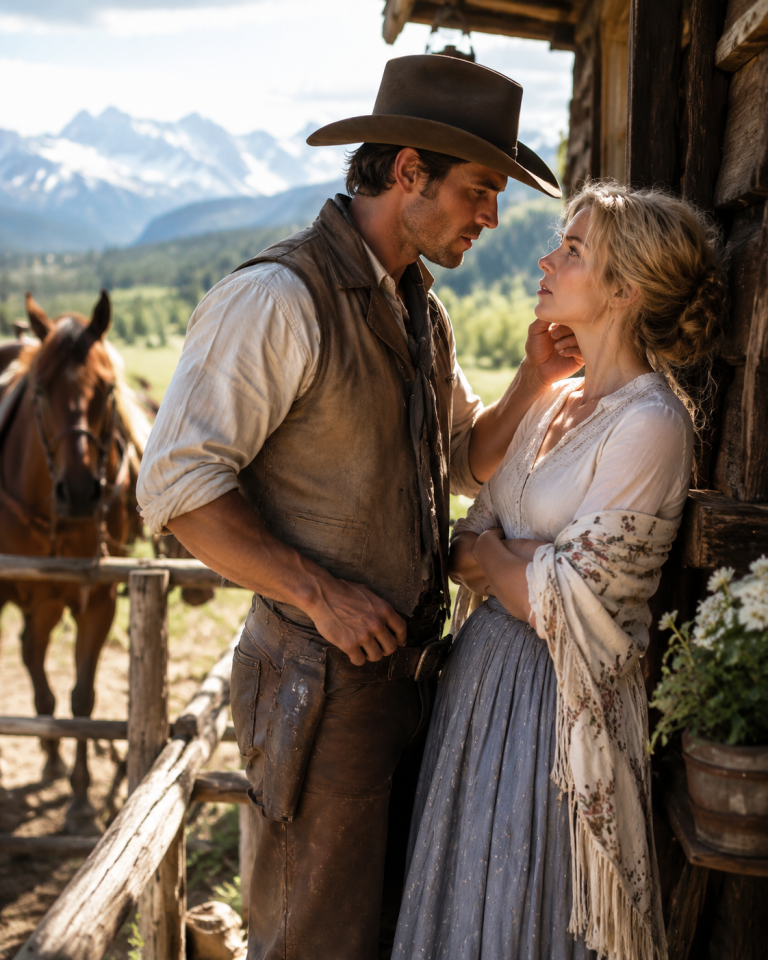
The man who rose from the shadows near the rear door seemed built from the mountains themselves — tall enough to duck under the door frame, shoulders wrapped in a heavy elk-hide coat still dusted with snow, a beard thick with frost-melt. But it was his eyes that stopped her breath. Pale blue, sharp as broken ice, fixed on nothing but her.
A trapper. The kind who came down from the high country once a season to trade pelts and vanish again before anyone learned his name.
He crossed to the table and dropped a leather pouch onto the wood. It landed heavy, full, unmistakable.
Gold. Raw nuggets, not coin.
“Not playing cards,” he said. “Buying outright.”
Whatever shame Cormac Rourke had left, greed swallowed it whole. He snatched the pouch before the words finished leaving the stranger’s mouth.
“Done. She’s yours.”
He didn’t spare his daughter a second look.
The trapper turned to Callie. “Get your things.”
She didn’t move. Couldn’t. If she reacted to a spoken order, five years of careful silence would crack open in front of the whole saloon.
Something in his expression shifted — understanding, not impatience. He didn’t grab her. He set one broad, steady hand against her shoulder and simply guided her toward the door, the way a man might guide a spooked animal.
“She’s deaf as a post,” her father called after them, already waving for another bottle. “Won’t cause you trouble.”
The night air hit her like a slap. Overhead, the sky had gone the color of a fresh bruise, orange bleeding into purple. The trapper lifted her onto his horse with a strength that made her weigh nothing at all, and for one dizzying second her cheek brushed the rough wool of his collar.
She braced for whatever came next.
Instead, he leaned close, his breath warm against her ear, and murmured four words that stopped her heart cold.
“You can hear me.”
It wasn’t a question.
“I’ve known since the saloon,” he said, quieter still. “You flinched at the right sound, Callie Rourke. Deaf girls don’t flinch at whispers.”
The horse lurched forward into the dark, carrying her away from everything she’d ever called home, and one truth settled over her like the cold — she hadn’t been sold.
She’d been caught.
PART 2
The mountain didn’t care who you were. It only asked whether you could survive it.
The trail narrowed to a ribbon of rock with a black drop on one side and stone on the other. Below them, Widow’s Hollow shrank to a smear of lamplight, then winked out entirely, swallowed by distance and dark pine. Wind sliced through Callie’s threadbare dress, and she sat rigid against the trapper’s chest, refusing to lean into him out of some stubborn scrap of pride.
He noticed anyway.
“You’re near frozen,” he said. Not a question. A fact, stated plain.
She said nothing. Speaking meant admitting the lie was over, and admitting that meant nothing would ever be simple again.
He exhaled, unbuttoned his coat one-handed, and folded half of it around her, drawing her firmly against his side. Warmth flooded her so fast it stung. He smelled of woodsmoke and cold iron.
“Paid good gold for you,” he muttered. “Not about to let you die of pride before we reach the cabin.”
A tear slipped free before she could stop it. She hated that her body kept betraying her tonight.
They climbed in silence for what felt like hours, snow thickening from patches to drifts, her fingers gone numb inside her sleeves. Somewhere far below, wind moaned through a canyon like something grieving.
“Open your eyes,” he said, gentle as a hand on a spooked colt. “Fear kills you faster than any fall will.”
She obeyed. Moonlight had turned the peaks to hammered silver, jagged and vast and beautiful enough to ache.
“Why,” she rasped. The word tore her throat raw — the first sound she’d let herself make in five years.
He went still behind her. “Why what.”
“Why buy me.”
The horse picked its way around a fallen pine before he answered.
“Didn’t buy you to cook. Or warm my bed.” A pause, weighted. “I need someone who actually listens. Truly listens.”
She let out a short, disbelieving breath. “I’m good at that.”
“We’ll see soon enough.”
That was when she caught it — not cabin lights, but something else. A shape breaking the treeline, low and careful, gone before she could be certain she’d seen it.
She went rigid against him.
“What,” he said instantly, every ounce of exhaustion vanishing from his voice.
“Something’s following us,” she whispered. “It’s been following us for miles.”
PART 3
The cabin rose out of the dark like something conjured — low, solid, a thread of smoke curling from its chimney. He called it home. A fortress of hand-hewn logs braced against the mountainside, and right now it looked like the only safe place left in the world.
He lifted her down; her legs buckled instantly, and he caught her without effort. For one breathless moment they stood chest to chest, moonlight carving the scars on his face into sharp relief. A hard man. Tired eyes. No cruelty in them at all.
“Inside,” he said. “Bar the door. Three knocks, a pause, then two — that’s me. Anything else, you don’t open it for God Himself.”
“Where are you going?”
His answer was the metallic click of a rifle hammer.
“We were followed.”
Her pulse slammed against her ribs. She fled inside, dropped the bar, pressed her ear flat to the wood.
Wind. Snow. Then —
A gunshot cracked the night in half.
She slid down the door with both hands clamped over her mouth, the silence afterward louder than any sound she’d ever known.
Minutes crawled by like hours.
Then — three knocks, a pause, two more.
She threw the door open. The trapper stumbled through, bleeding, snow-crusted, breathing.
Alive.
“You’re hurt,” she whispered.
“Grazed me. Had worse from a bad-tempered mule.” He knelt at the hearth, coaxing the fire back to life, and a folded paper slid from his coat onto the table. A charcoal likeness of his own face stared back at her. Beneath it, a number.
Five thousand dollars.
“You’re wanted,” she breathed.
“I’m a liability to certain men,” he corrected. “There’s a difference, if you look close enough.”
That night, between crackling logs and lowered voices, the truth came pouring out of him — slow at first, like a man testing ice before he trusted his full weight to it.
“Three years back, I worked the Larkspur mine,” he said, staring into the fire rather than at her. “Foreman by then. Good pay, good crew. My wife and boy lived in the camp with me — company let families stay if you’d put in enough years.” His jaw worked. “Owner started cutting timber supports to save money on lumber. I filed a complaint. Filed three, in fact. Nobody listened to a foreman crying wolf when the silver was still coming up fast.”
Callie sat very still, the way she’d learned to sit through her father’s worst nights, except this time the stillness wasn’t fear. It was something closer to reverence.
“Shaft collapsed on a Tuesday,” Ezra went on. “Forty-one men underground. My wife had walked down that morning with soup for the noon shift. My boy went with her because he liked the mules.” He rubbed a thumb slowly along the old scar cutting through his eyebrow. “I was topside when the mountain screamed. Never heard a sound like it before. Never want to again.”
“I’m sorry,” she whispered, and meant it with her whole chest.
“Owner paid off the marshal. Called it an act of God. I called it murder and said so in front of witnesses.” His mouth twisted, humorless. “Man doesn’t survive making an accusation like that against men with that much silver behind them. So I disappeared into the high country instead, and they papered every town from here to the territory line with my face and a price on it.”
“And your ears?”
“Blast took most of the hearing on my right side. Left one’s been failing slow ever since — comes and goes with the weather, with the altitude, with I-don’t-know-what. Doctor in Bitter Root told me I’d likely go fully deaf inside five years if I lived that long, which he seemed to doubt.” A ghost of dark humor crossed his face. “Hard thing, hunting men who mean to kill you, when you can’t always trust what you hear coming.”
“I bought you,” he said finally, turning to look at her directly for the first time since the fire had been lit, “because you hear what everyone else misses. Because for five years, before I ever set foot in that saloon, you’d already learned how to listen for danger better than any man on my payroll ever did.”
She stared at him, understanding landing like a physical blow.
The most feared man in the mountains was going deaf, and he had wagered his last gold on a girl the whole territory believed couldn’t hear a gunshot at ten paces.
“My mother used to say I heard the world wrong side out,” Callie said quietly, surprising herself with how easily the words came now. “Heard the truth under what people said instead of the words themselves. My father called it a curse most nights. Called me worse when he was drinking.”
“Wasn’t a curse,” Ezra said. “Man just never had the sense to see what he’d been given.”
“I need you alive, Callie,” he said, quieter still. “More than I’ve needed anything in a long while.”
The storm broke hard after midnight. She took the loft, shotgun heavy across her knees, and closed her eyes to listen the way she’d trained herself to listen for five long years.
Wind screaming. Snow hissing. Timber groaning.
Then — a sound that didn’t belong.
A crunch, deliberate, too rhythmic to be weather.
“Behind the cabin,” she whispered down into the dark.
Ezra moved like something poured from shadow. Metal scraped somewhere outside — a shutter being forced.
“Cover your ears,” he told her, and the world detonated a heartbeat later.
When the ringing stopped, screaming followed, and then nothing at all.
He returned bloodied, hands shaking around the rifle, one shoulder held wrong against his body.
“You heard them coming over that whole storm,” he said, something close to awe cutting through the pain in his voice.
“Told you,” she said, already reaching for the bandages he kept in a tin by the hearth. “I hear everything. Always have. Nobody just ever thought to ask.”
There were three of them, he told her once his breathing steadied — bounty men, professionals by the look of their kit, sent by whoever still wanted that charcoal sketch worth its weight paid out in full. Two wouldn’t be walking back down the mountain. The third had run, and running men talked, which meant more would follow before the season turned.
“How many more,” she asked, working a needle and thread through torn skin with hands steadier than she felt.
“However many it takes,” he said. “Men like the ones who own that mine don’t stop spending until the problem’s in the ground.”
Later, cleaning the new wound along his ribs by firelight, something between them shifted — quiet, but unmistakable. Not captor and captive anymore. Not even simply allies bound by a debt of gold.
His hand found hers once, briefly, when the needle bit and he flinched despite himself, and neither of them pulled away as fast as either would have liked to admit.
“Why’d you really stop in that saloon tonight,” she asked, tying off the last stitch. “Wasn’t looking to buy a wife or a maid. You said so yourself.”
“Wasn’t looking for anything,” he admitted. “Just needed supplies before the passes closed for winter. Heard a girl everybody called broken, and something about the way that saloon talked over you instead of to you — ” He shook his head. “Reminded me of my boy, some. How folks talk over a child like they’re furniture instead of listening.”
She didn’t have words for what that admission did to the hollow place in her chest, so she said nothing at all, and for once the silence between them felt like something shared rather than something hidden behind.
Outside, wolves began to howl, long and rolling across the ridgeline, and deep in her chest, Callie understood with sudden, cold certainty —
this war had only just begun.
Dawn didn’t arrive gently. It tore the night open like a wound.
The storm broke just before sunrise, leaving the peaks scrubbed raw and blinding white, snow glittering like scattered glass. The silence that followed was thick, wrong, the kind that made the hair rise on Callie’s arms.
Ezra stood outside cinching the saddle on his stallion, Ghost, his movements a half-beat slower than the day before. The wound along his ribs had stiffened overnight, and the ringing in his good ear hadn’t fully settled since the blast. He leaned into the horse’s flank longer than a man who wasn’t hurting had any reason to.
“We ride,” he said.
“Where,” Callie asked, steadying him with a hand at his forearm.
“Copper Flats. There’s a trading post — Amos runs it. Known him twenty years.” A pause, heavier than the words warranted. “If anyone in this territory can help us, it’s him.”
She studied the set of his jaw and decided, not for the first time, that she trusted this mountain more than she’d ever trusted a town. She trusted him. The road ahead, though — that was another matter entirely.
They rode east as the sun clawed its way over the ridgeline. This time Callie held the reins while Ezra surrendered to her ears, naming every sound she caught under her breath — wind through dead branches, an elk shifting somewhere below, ice cracking on a frozen creek, nothing, nothing, nothing. He rode with his eyes half shut, trusting her completely, and something in her chest warmed at the weight of that trust.
Around midday they stopped to water the horse at a half-frozen stream, and for a few minutes neither of them spoke of bounty hunters or dead mine owners or anything at all. Ezra showed her how to read a game trail from the snow — which prints belonged to elk, which to something hungrier. She showed him, in turn, how to tell a lie from the truth in the space between two heartbeats, a skill she’d never once been asked to teach anyone.
“Man could get used to this,” he said, watching her laugh — actually laugh, unguarded, for what she realized might be the first time in five years — at Ghost nosing hopefully at her coat pocket for a treat she didn’t have.
“Don’t,” she said, though there was no real warning in it. “Getting used to good things is how you end up grieving them.”
He looked at her a long moment, something unreadable moving behind those pale eyes. “Maybe. Or maybe it’s how you end up keeping them.”
Neither of them had an answer for that, so they rode on in a silence that had stopped feeling like armor for either one of them.
By midafternoon Copper Flats appeared below — a scatter of leaning shacks, hides curing on lines strung between posts, smoke that smelled like comfort wrapped around something rotten underneath. Amos burst from the trading post door with a grin stretched a shade too wide, a beat too fast.
“Ezra Kane! Figured the mountain finally took you.”
“Disappointed?” Ezra managed, forcing a smile that didn’t reach his eyes.
They were fed coffee, stew, blankets warmed by the fire — a hospitality that settled over the cabin like a second lie.
Callie felt it before she understood it. Not with her eyes. With the rhythm underneath everything else in the room.
A telegraph key clicking somewhere it shouldn’t be able to reach through storm-downed lines. A heartbeat spiking every time a certain syndicate’s name drifted into the conversation. A breath catching on guilt dressed up as friendliness.
“He’s lying,” she breathed once they were alone by the woodpile.
Ezra shut his eyes. “You hear traps in every shadow, Callie.”
“I hear this one closing around us right now.” She grabbed his sleeve, forcing him to look at her instead of the fire. “Something’s wrong with his hands, Ezra. They shake every time he pours coffee, but they were steady as stone when he loaded that shotgun by the door. A man doesn’t get nervous serving supper unless he’s got a reason to be nervous about what happens after.”
“Could be nothing. Could be an old man jumpy about bounty hunters passing through his territory.”
“Could be,” she agreed. “Or it could be that telegraph key I heard clicking not twenty minutes ago, in a building with lines the storm took down three days back. Somebody’s been sending word since before we ever rode in, and it wasn’t about the weather.”
He studied her face a long moment, weighing five years of a stranger’s instincts against twenty years of an old friend’s loyalty, and something in his expression told her he already knew which way that scale was tipping.
“Get your things together,” he said quietly. “Quiet as you can.”
It was already too late.
Hoofbeats answered before he could argue further — not one horse, but many, thundering up the frozen road.
The door slammed open.
Amos stood shaking in the frame, shotgun trembling in his grip, tears cutting tracks through the grime on his face. “They took my girl. They’ve had her since Tuesday. I had no choice, Ezra, I swear it —”
Behind him stepped a man in a tailored charcoal suit, boots polished to a mirror shine, eyes cut from broken flint. Civilization wearing a knife up its sleeve.
Julian Thorne.
“Take them both,” Thorne said, almost bored.
The fight that followed was short and brutal. Ezra broke one man’s nose with an elbow, drove another clean through a shelf of dry goods, and still went down hard under the butt of a rifle. Callie screamed his name as they dragged him out into the snow like a slaughtered deer.
Thorne caught her chin between two gloved fingers, tilting her face into the light. “Not mute after all. How disappointing for your father’s story.”
“Go to hell,” she spat.
“I own the deed to it,” he said, smiling like a man who’d never once been afraid. “And as of this afternoon, I own you as well.”
They took her to Devil’s Gate — steel gates, high stone walls, rifles watching from every tower, a silver mine that swallowed both light and sound. Thorne liked to talk, and he talked freely of veins and curses and leverage, certain a broken girl couldn’t repeat a word of it.
They locked her in a storage room off the assay office, and it was there, huddled against crates of blasting powder, that she found Amos’s daughter — a girl of maybe fourteen named Ruth, eyes swollen from crying, wrists rubbed raw from rope.
“They said my pa sold me out,” Ruth whispered. “Said he’d rather have Ezra Kane’s bounty than his own blood.”
“Your pa didn’t have a choice,” Callie said, and found she believed it. She’d seen enough men break under pressure to know the difference between betrayal and desperation, even if the end result looked the same from the outside. “Thorne’s men had you three days before Ezra ever rode into that trading post. Your father was trying to buy you back the only way he had left.”
Ruth didn’t look comforted, but she stopped crying, which Callie counted as a small victory in a place that seemed built to crush every other kind.
Callie listened. She mapped it all — footsteps, doorframes, the click of every lock, the drip of water two levels down that meant an old shaft ran beneath the compound, forgotten and unguarded because nobody at Devil’s Gate believed a captive girl capable of finding it. She counted guard rotations by the rhythm of boots on gravel. She learned which door hinges had gone dry and which had been oiled recently enough to open in silence. By the second night, she had the whole compound mapped inside her head clearer than any drawing could have shown it, and she’d begun teaching Ruth, in whispers, how to listen the way she’d taught herself to listen back in Widow’s Hollow — for the gaps between sounds, where the truth usually hid.
Ezra wasn’t dead. She knew it the way she knew weather before it broke, because far off on the wind she caught the unmistakable rhythm of Ghost’s gallop — furious, relentless, loyal past all sense. A scream followed, distant. Then another. The sound of a man who had decided, somewhere deep in his ruined ears, that he would not die today.
They marched her out onto the catwalk above the pit at dusk. Thorne sneered down at the black drop below. “No one survives that fall, little bird.”
A gunshot answered him from the smoke.
Ezra came through it like something carved out of pure wrath — bandaged, bloodied, burning with a fury that made even Thorne’s men step back. Two guards moved to block the catwalk entrance; he put one through the rail with a single blow and left the other choosing between the fight and the fifty-foot drop behind him. The second man chose the drop’s edge and ran.
Ruth’s voice rang out from somewhere below — she’d slipped her ropes exactly as Callie had shown her, and half the compound seemed to be shouting at once, guards scattering toward a fire someone had set in the powder store, drawing Thorne’s remaining men away from the pit at the worst possible moment for him and the best possible one for everyone else.
Thorne yanked Callie against him, a blade pressed flat to her throat. “Stay back, Kane, or I open her up right here.”
Ezra didn’t hear him. Couldn’t. His dead ear faced the wrong way, and he charged anyway, trusting momentum over sound for the first time in his life.
The catwalk shuddered under the impact. Thorne pitched over the rail, his hand snatching Callie’s ankle on the way down, dragging her half over the edge with him. The world tilted and hung there — Callie dangling above the black pit, Ezra flat on the grating with both hands locked around her wrist, Thorne screaming somewhere below in the dark.
Ezra’s arm shook under the strain. His breath tore ragged in his chest. He couldn’t hold them both much longer, and they both knew it.
Callie looked down into the pit.
Then up into his eyes.
“Hold on,” she said — clear, ringing, unafraid, the strongest her voice had ever sounded. “I’m not letting go and neither are you.”
She drove her free heel down into Thorne’s grasping hand.
His fingers tore loose.
The dark swallowed him whole, and silence rushed back in to fill the space where his screaming had been.
Ezra hauled her up and over the rail with a roar that seemed to shake the mountain’s bones loose. They collapsed together on the cold grating, chests heaving, snow drifting down around them like the world had decided to be gentle again.
“You shouted,” he said, stunned, something close to wonder breaking across his face. “I heard every word of it.”
“I’m here,” she sobbed into his shoulder. “I’m not going anywhere, Ezra. Not ever.”
Spring came late to the high country that year, but it came.
The cabin still stood, smoke curling steady from its chimney, bread rising warm on the hearth. Callie sang while she worked now — soft, imperfect, unashamed, a sound she’d spent five years burying. Ezra whittled cedar by the window, listening to the voice he’d come to love more than silence itself, his ruined ears finally, gladly, at peace.
The quiet between them had stopped being armor.
It had become, at long last, a home.
News came up from the territory that summer that the Larkspur mine’s new owners — men with cleaner hands and a conscience Thorne’s syndicate had never possessed — had reopened the investigation into the collapse that killed forty-one men. A year later, Ezra Kane’s name was cleared by territorial decree, the bounty poster burned in the marshal’s own stove, and for the first time in longer than he could easily remember, he rode down into a town without watching every rooftop for a rifle barrel.
Amos rode up into the high country himself that autumn, hat in hand, to thank them properly and to beg forgiveness he didn’t much need to beg for — Callie had long since stopped holding a frightened father’s worst night against him, having lived through enough of her own. He brought Ruth home to Copper Flats that same week, and the trading post reopened its doors with an honesty in its dealings it hadn’t carried in years.
Ruth stayed on with them two winters first, learning to shoot straight and read weather off the wind before her father finally coaxed her back down the mountain, and she never once forgot to send word each spring, always signed the same way: *still listening for the gaps, like you taught me.*
Years later, when their own daughter was born in that same cabin during a howling spring storm, Callie held her close to the fire and told her, the way her own mother never had the chance to, that hearing the truth under what people said wasn’t a curse at all.
It was a gift, passed down like her father’s steady hands and her mother’s stubborn heart — one that would carry through generations of that mountain family, long after the snow had buried every last trace of Widow’s Hollow and the men who’d once tried to sell her like livestock.
The girl grew up knowing the sound of every kind of danger the mountain could offer, because her mother taught her patiently, the same way Ezra had once taught Callie to read a game trail in fresh snow — and she grew up knowing, too, that some silences were worth keeping and some were worth breaking, and the wisdom to tell the difference was worth more than any gold a man could carry down from the high country.
The mountain that had once tested every stranger who dared its passes had, in its own hard way, given something back in return — a family built not from blood alone but from gold spent wisely, from trust earned slowly, from two broken people who’d found in each other exactly what the world had once told them they’d never deserve.
And in the wild, unforgiving heart of the mountains, that was more than enough for any of them.
THE END