NINE MAIL-ORDER BRIDES FLED THE SILENT RANCHER BEFORE HER — SHE WAS THE FIRST TO ASK WHY THEY REALLY LEFT

PART 1
Nobody in Grover’s Bluff counted the exact number of women who had come and gone from that high country ranch over the years.
But the postmaster, Gerald Finch, claimed he’d forwarded at least nine return letters on behalf of nine different women — all addressed back east, all written within the first week of arrival. He mentioned it without cruelty. The way a man mentions weather. Matter-of-fact. Inevitable.
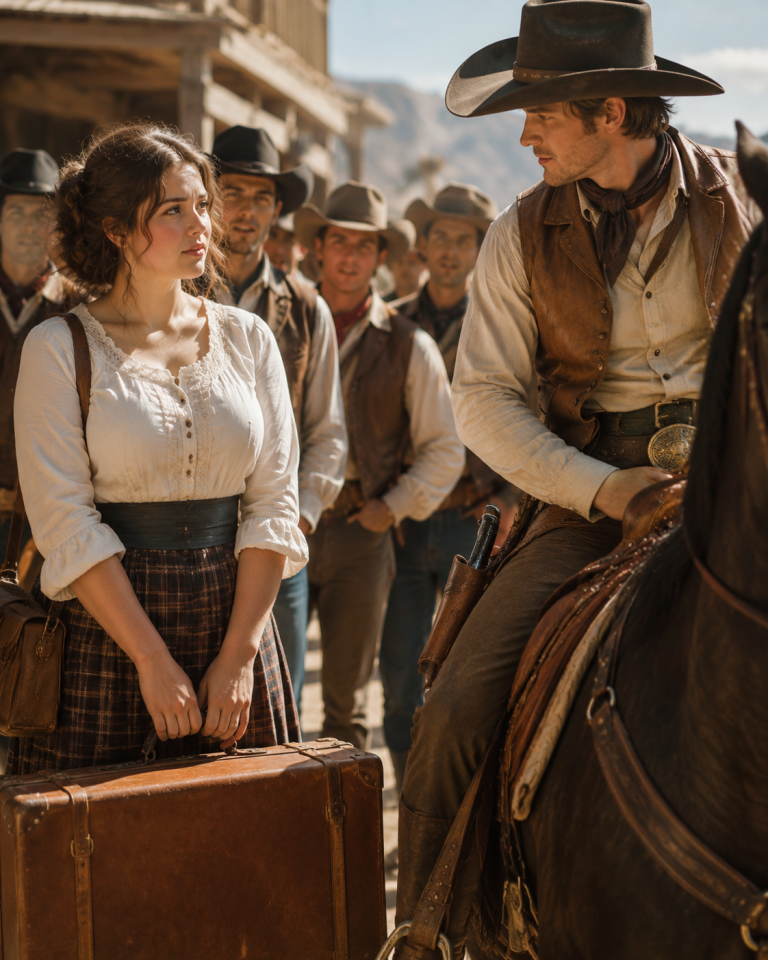
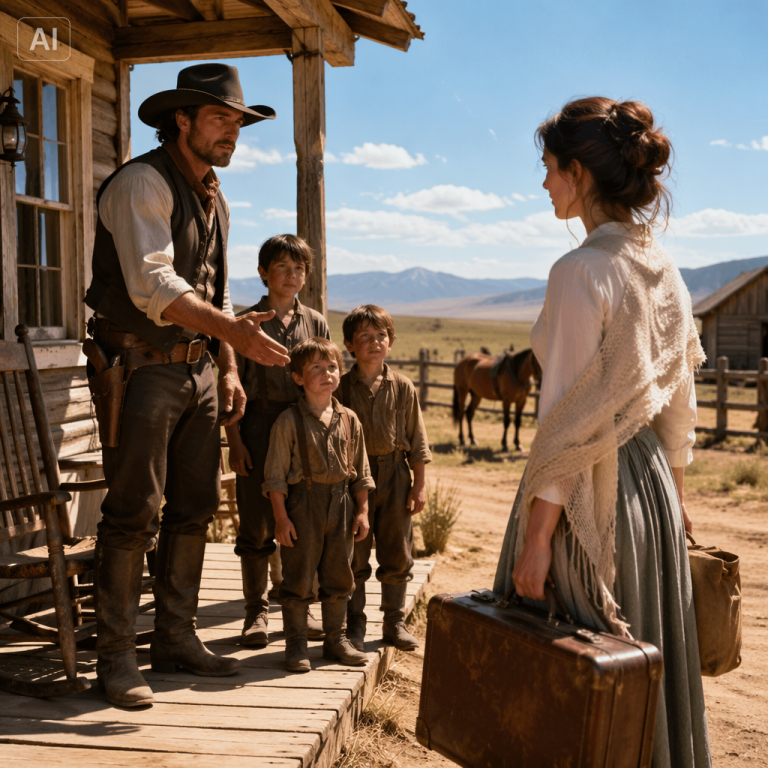
Viola Candace Moore didn’t know about Gerald Finch or his letters when she stepped off the stage in Grover’s Bluff on a gray October morning. She knew only what the correspondence had told her — that a man named Hezekiah Hawthorne owned four hundred acres above the treeline, ran cattle, kept to himself, and was in need of a wife.
The letter had been brief. Almost insultingly so. No flourishes, no promises, no flattery — just the facts of the land and the arrangement, signed at the bottom in tight, even handwriting. She’d read it four times on the journey west, not because it confused her, but because something in its bluntness had felt more honest than anything she’d received in years.
The man waiting at the edge of the road was not what she expected, though she couldn’t have said exactly what she’d expected. Tall. Lean through the shoulders. A jaw that looked cut from the same rock as the mountains behind him. He wore no expression she could identify as welcoming or unwelcoming. He simply stood there with his hat in one hand and looked at her the way a man looks at a fence line, calculating the cost of repairing it.
“Miss Moore.”
“Mr. Hawthorne.”
He picked up her trunk without asking and carried it to the wagon. He didn’t offer his hand to help her up. She didn’t wait for it.
They rode the better part of two hours without exchanging more than a dozen words, the trail climbing steadily, pines thickening on either side until the town below disappeared entirely. Viola watched the land and said nothing. She had learned some time ago that silence was not the same as emptiness, and that a person who rushed to fill it usually did so for their own comfort, not anyone else’s.
The ranch, when it finally appeared around a long bend, was not what the letter had described so much as what it had implied. Solid. Well-built. Stripped of anything decorative. No curtains in the windows she could see. No flower box. No wreath on the door. A working house, and every inch of it said so — a barn twice the size of the main structure, a smokehouse, a wood pile stacked with the kind of precision most men reserved for bookkeeping.
She stood in the yard a moment and took it all in.
“I’ll show you the inside,” Hez said, behind her.
The inside matched the outside. Functional. Clean in a sparse way. A table with two chairs. An iron stove, freshly polished. A shelf of supplies organized by size. A single framed piece on the wall that turned out, on closer look, not to be a painting at all — a hand-drawn map of the property lines.
There were no personal effects that she could see. No photographs. No letters. None of the small objects that accumulate in a home the way sediment accumulates in a riverbed — the quiet evidence of a life being lived. It looked, Viola thought, less like a home than a place someone was waiting in.
“Your room is there,” he said, nodding at a door off the main room. “Meals are five-thirty, noon, six in the evening. I work from first light. I don’t expect conversation during work hours. Sunday is rest, but the animals still need tending. There’s a list of household duties on the table.”
He said all of it the way another man might read from a ledger.
Viola picked up the list. Thorough. Written in the same tight, even hand as the letter. She read it fully without comment, set it back down.
“Any questions?” he asked.
“Just one.” She looked up at him. “Do you eat what you cook yourself, or have you been starving quietly up here?”
Something shifted in his face. Not a smile. But not nothing, either.
“I manage,” he said, and walked back outside.
She stood in that kitchen a moment after he left, looking again at the bare walls, the two chairs, the window facing the mountain without any softening frame around it. Then she set her bag on the table, opened it, and began to unpack.
The first woman, the stagecoach driver had told her without being asked, left after three days — said the man never spoke. The second lasted five, said he corrected the way she swept the porch. The driver had laughed telling it, like it was a long-running joke the whole county shared.
Viola had not laughed. She thought about it now as she moved through the kitchen, learning where everything was kept, running her fingers along the stove, cracking the window above the basin to let in the cold pine air. She was not here because she had no options.
She was here because she had made a choice, and she was not in the habit of walking away from choices because they turned out harder than expected.
Dinner that evening was quiet. She cooked a simple salt pork stew from the pantry stores. He came in at exactly six, washed his hands, sat down, and ate without complaint — finished every bite, pushed the bowl back with something that might have been, if you were watching closely, a fraction of relief.
She noticed. She also noticed, glancing toward the window mid-meal, that he watched her reflection in the glass for just a moment before looking back down at his bowl.
She said nothing about it. She cleared the dishes and began washing them.
He stood to leave, then stopped near the door.
“You didn’t ask about the others,” he said. His back was still to her.
Viola set a bowl on the drying cloth and picked up the next one. “No,” she said. “I didn’t.”
A long pause. “Most women ask by the second hour.”
“I’m not most women.” Not sharp. Just fact.
He was quiet another moment. Then he went outside, and she heard his boots cross the porch, then the barn door, then nothing but wind coming down off the mountain.
Viola finished the dishes, dried her hands, walked to her room, and sat on the edge of the bed in the lamplight a while. Not anxious. Not discouraged. Just thinking.
There was something underneath all that rigid silence. She’d seen it in the way he organized his supply shelf. In the hand-drawn map on the wall. In the way he’d finished every bite of a plain stew without a word of complaint or thanks — as though gratitude was a language he’d once spoken, and somewhere along the way decided was too costly to use.
She didn’t know yet what had made Hezekiah Hawthorne into a man who lived like a closed room. But she had a feeling she was going to find out.
She blew out the lamp. Outside, the mountain was dark and enormous and utterly indifferent, and somewhere in the barn, she could hear the faint sound of movement — steady, deliberate, rhythmic. A man who didn’t know how to stop working even when the day was done.
She pulled the blanket up and closed her eyes.
She was not going anywhere.
PART 2
By the third day, a shape had begun forming between them. Not warmth exactly — too early, too guarded for that — but something structural. Unspoken agreements. She cooked. He worked. She kept the house. He kept the land. At meals they sat across from each other, and the silence was less a wall now than a room they were both standing in, neither quite sure yet how to furnish it.
On the fourth evening, bringing in the last of the firewood near dusk, she heard a sound that didn’t belong to cattle or wind. She rounded the corner of the barn and found Hez crouched beside a young calf that had separated from the herd, trembling, eyes showing white at the edges — something had spooked it badly. He had one hand flat against its side and was speaking to it in a low, continuous murmur, his voice entirely different from the one he used with people. Patient. Gentle. Almost tender.
He didn’t hear her approach. She watched a moment — this rigid, wordless man, speaking softly to a frightened animal in the last of the evening light — and felt something tighten in her chest she didn’t immediately have a name for.
She stepped back quietly and went inside. At dinner, she didn’t mention it, but she looked at him differently now. Not the coldness on the surface. The shape of what lived underneath it.
“Did the calf settle?” she asked.
His fork stopped. “You saw that.”
“I came around the barn for the last of the wood.”
A long pause. “She’s fine,” he said. “She’ll be fine by morning.”
Viola nodded and let it be. She had no interest in pressing. She’d simply wanted him to know she’d seen it — that gentleness, quiet as groundwater — and that it hadn’t surprised her the way he might have expected.
The fifth day brought a hard storm, snow arriving sideways the way mountain snow does when it’s made up its mind. Hez came in early, stood by the stove with his hands out to the heat, face raw from wind. Viola handed him coffee without being asked. He looked at the cup, then at her, and something unguarded crossed his face for just a fraction of a second before his composure reassembled itself.
“Storm will hold through tomorrow,” he said.
“Then we stay in,” she said, easy, without complaint, and he looked at her like he wasn’t sure what to do with the absence of fear in it. Every other woman, she suspected, had treated the isolation as evidence something was wrong. Viola treated it like weather. Something you worked with, not against.
They spent the afternoon inside — him with his ledgers, her mending a set of forgotten curtains she’d found folded in a chest. By evening they were hung, and the room changed in a way that was hard to define. Less hollow. The lamp caught in them and made the space feel, for the first time, like somewhere a person intended to stay.
That night, after supper, he spoke more words in a single sitting than he had in five days combined.
“My father built this house,” he said, without preamble, without looking up. “Built it for my mother. She lasted three winters. Said the mountain was too quiet. Said she couldn’t hear herself think up here.” He turned his cup slowly. “I was seven.”
Viola went still. She understood, in that moment, the precise architecture of what she was looking at — the bare walls, the folded curtains, the two-chair table. A man who had turned silence from a wound into a way of life, because silence was all the mountain had offered him after his mother left, and all his father had ever modeled afterward.
She did not rush to fix it with words.
“How old was he when she left?” she asked instead. “Your father.”
“Thirty-one.”
“Did he ever say much about it?”
“No,” Hez said. “He just worked.”
“Sounds familiar,” she said — and something moved across his face. Recognition. The particular discomfort of being seen clearly by someone who isn’t trying to wound you.
He stood, took his cup to the basin, paused with his back to her.
“You haven’t asked me why the others left,” he said.
“No.”
“You’re not curious?”
She considered that honestly. “I think I already know,” she said. “And I don’t think it’s the reason you believe it is.”
He stood very still. Then, without another word, he went to his room. But he left his lamp burning longer than usual, and through the thin wall, she could hear him — not moving, not working. Just awake. The way a man is awake when something he set down a long time ago has just been quietly handed back to him, and he isn’t sure yet whether he’s ready to carry it.
PART 3
The storm broke on the sixth morning. Viola knew it before she opened her eyes — the quality of the silence had changed overnight, gone from the dense, pressurized quiet of heavy snowfall to something cleaner, stiller. The kind of silence that follows the way a held breath follows a long exhale.
She dressed, came into the kitchen, and found the stove already lit. He’d beaten her to it. Coffee was already brewed, sitting in the pot with a cloth folded over the handle to keep it warm.
She stood and looked at it a moment. Then poured herself a cup and said nothing about it. She understood by now that remarking on things made him retreat, so she simply drank it and let it mean what it meant.
He came in an hour later, snow on his shoulders. They ate. The silence between them that morning had a texture neither of them commented on — softer. Less guarded.
“Fence line on the north pasture took damage,” he said, midway through the meal. “I’ll need most of the day on it.”
“I’ll bring lunch out,” she said.
He looked up. “You don’t have to do that.”
“I know.” She returned to her breakfast.
He left without arguing, and without telling her which part of the north pasture — as though he expected her to find him. Or perhaps hadn’t quite decided yet whether he wanted her to.
She found him anyway. Followed the fence line east from the barn until she heard the steady rhythm of a hammer against a post, then saw him — coat dark against the white ground, working with that same concentrated precision he brought to everything. She set the lunch pail on a flat rock nearby. He drove two more nails before he stopped and turned, looked at the pail, then at her, then at the distance she’d covered through the snow.
“It’s a long walk,” he said.
“Yes,” she agreed pleasantly.
He sat on the rock and opened the pail. She stood a few feet away, looking out across the north pasture — white ground broken only by dark fence posts and the treeline beyond, the sky above it so blue it almost hurt to look at.
“It’s beautiful up here,” she said. Not to fill silence. Just because it was true.
He chewed slowly, looking at the same view. “Most women say it’s lonely.”
“Most women aren’t wrong,” she said. “It’s both.”
He glanced at her sideways. Something in the line of his shoulder shifted — not dramatically, just the way a door shifts when a latch releases. Not yet open. But no longer held shut by force.
They stayed like that a while. The cold was sharp but not cruel. The mountain was enormous around them, entirely indifferent, and somehow that indifference made the small, warm fact of two people sitting near each other feel more significant than it might have anywhere else.
He finished eating, closed the pail, handed it back.
“Thank you,” he said.
The first time he’d said those words since she’d arrived.
She took the pail and turned to go. He went back to his fence posts. Neither of them said anything else. But she was smiling by the time she rounded the treeline, and she didn’t bother trying to stop it.
—
The days that followed were not dramatic. No grand declarations, no sudden transformation, no morning when Hezekiah Hawthorne woke up a different man. That was not how it worked with a man like him. She’d understood that from nearly the beginning.
What happened instead was smaller. Slower. And considerably more real.
He began leaving the stove lit every morning. He stopped disappearing to the barn immediately after supper, staying instead a few minutes longer each evening — not talking much, but present in a way he hadn’t been that first week. Once, when she mentioned the supply room shelf nearest the door had developed a lean, he fixed it that same afternoon without being asked again. She caught him one evening standing in the doorway of the main room, just looking at the curtains she’d hung, the lamplight moving in them gently, the room slowly becoming a home again.
She said nothing. She let him look.
Then, one afternoon in the third week, the postman’s wagon came up the trail — Gerald Finch himself, red-faced from the cold, with a small parcel of mail and the undisguised curiosity of a man who’d forwarded nine return letters and was quietly astonished to find no tenth one in his bag. He stayed for coffee and talked more than both of them combined, which wasn’t difficult.
“I’ll be honest, Miss Moore,” he said at one point, with the frankness of a man who’d simply stopped pretending people don’t talk. “The whole town had bets on you by Thursday.”
Viola raised an eyebrow. “What kind of bets?”
“On when you’d be coming back down.” He had the grace to look slightly abashed.
She set her cup down. “And what do they say now?”
Gerald glanced at Hez, sitting with his coffee, looking at the table with the particular expression of a man who would very much like to be elsewhere. Then he looked back at Viola, and a slow grin crossed his weathered face.
“Now,” he said, “they don’t quite know what to say.”
After he left, the yard fell quiet again. Hez stood on the porch and watched the wagon descend the trail. She stood beside him, not quite touching, both of them looking out at the valley below.
“Does it bother you?” he asked. “That they talk.”
“People talk about what they don’t understand,” she said. “It means nothing.”
He was quiet a moment. “It used to bother me,” he said slowly, examining the words as he produced them. “After the second woman left, the whole county had an opinion about why. After the third, they stopped bothering to hide it.” He paused. “I stopped going into town much after that.”
Viola looked at his profile — the hard jaw, the careful eyes, the way he held himself like a man permanently braced for impact.
“What do you think it was?” she asked quietly. “Why they left?”
He was still for a long time.
“I think I forgot how to make room for another person,” he said finally. “My father never learned it after my mother left. I watched him close down inch by inch, year by year, until there was nothing left but the work.” His jaw tightened. “I told myself I wouldn’t be like that. And then I was exactly like that. By the time I noticed, I couldn’t find the way back.”
It was the most she had ever heard him say. She didn’t fill the moment with reassurance, didn’t rush to tell him he was wrong about himself. She simply stood beside him and let the words exist in the cold air between them — solid, honest, long overdue.
“You noticed,” she said at last. “That’s not nothing.”
He turned and looked at her directly. Really looked, in a way that was different from every guarded sideways glance of the past weeks, as though he’d finally decided the looking was worth the risk.
“Why did you stay?” he asked. “The real reason.”
She held his gaze. “Because I’ve met men who were unkind and called it strength,” she said. “You’re not unkind. You’re just unfinished.” A pause. “And I’ve never seen the sense in walking away from something unfinished.”
Something broke open in his expression then — not dramatically, not with the spectacle of a man falling apart, but quietly, the way ice at the edge of a river gives way in early spring. Not all at once. Steadily. Inevitably. Because the season has simply made holding together no longer necessary.
He looked away after a moment, cleared his throat. “I fixed the floorboard by the door,” he said roughly. “The soft one.”
She blinked. Then, very slowly, she smiled.
“I noticed,” she said.
—
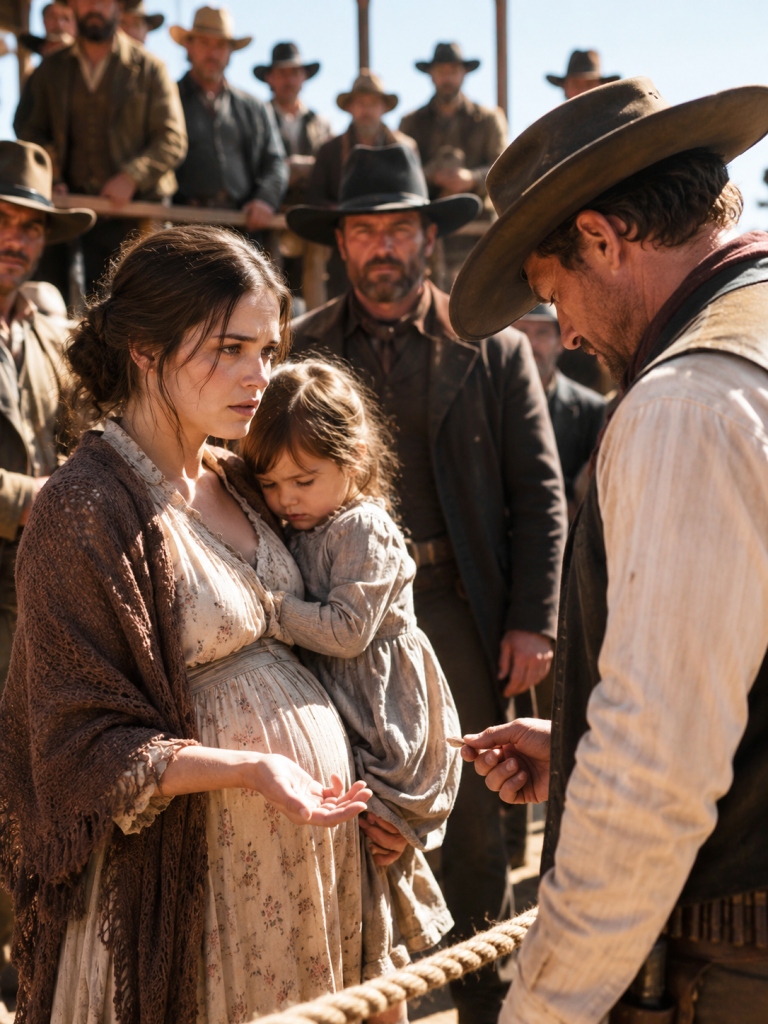
They were married in the Grover’s Bluff church on a Saturday in late February, six weeks after Viola Moore had stepped off the stage into the cold October morning. A small ceremony — the reverend, Gerald Finch, and three ranching families who’d come partly out of warmth and partly out of the irresistible pull of witnessing something the town had quietly decided was impossible.
Hez stood at the front of the church in a clean dark coat, watching her walk up the aisle with the expression of a man trying very hard to maintain his composure and not quite managing it. His jaw was set, his hands were still, but his eyes were entirely undone.
She reached him, and quietly, so only she could hear, he said, “You could have left.”
“I know,” she said simply.
He nodded once, as though that settled something that had been unsettled in him for a very long time.
The reverend spoke. They answered when required. Hez’s voice, when he made his promises, was low and even and without the slightest hesitation — the voice of a man who had waited a long time to mean something completely, and wasn’t going to waste the occasion.
When it was done and they stepped out into the February cold, Gerald Finch shook Hez’s hand with considerable enthusiasm and told Viola she was the most sensible woman he had ever encountered, which she accepted graciously.
On the ride back up the mountain, they sat close on the wagon bench — closer than necessary, closer than the cold alone required — and the valley fell away beneath them, and the ranch appeared around the long bend, solid and waiting, changed somehow, the way a place changes when it’s finally been decided upon.
He helped her down from the wagon and held her hand a moment longer than the task required.
“I’m going to plant something by the front porch in the spring,” she said, looking up at him in the last of the afternoon light. “Something that comes back every year.”
He looked at her a long moment. Then the corner of his mouth moved — not a large thing, just small and private and utterly genuine, the shift she recognized by now as the closest he came to joy expressed without restraint.
“All right,” he said.
She squeezed his hand once and went inside. He stood on the porch a moment longer in the cold, looking out at the mountain, at the land his father had built and closed himself away inside, at the fence lines he’d mended alone for so many winters.
And for the first time in longer than he could honestly remember, Hezekiah Hawthorne did not feel like a man waiting for something.
He felt like a man who had finally, quietly, come home.
He went inside and closed the door behind him. The mountain stood as it always had — enormous, indifferent, beautiful. But the light in the window was warm.
And this time, it stayed on.
By the following winter, there were curtains on every window, and a child’s laughter in the house Hezekiah Hawthorne had built his walls inside of for so many years. Viola had planted climbing roses by the front porch as promised, and though they slept now beneath the snow, she had assured him they would come back in April.
He believed her.
He had learned by then to believe her about most things.
THE END.