SHE SOLD EVERYTHING SHE OWNED TO MARRY A STRANGER IN COLORADO — THEN THE MAN WAITING AT THE TRAIN STATION SAID FOUR WORDS THAT ENDED HER PLAN BEFORE IT BEGAN

—
PART 1
Annabelle Porter had sold her mother’s jewelry, every book she’d ever loved, and the last scraps of her dignity to buy a train ticket to a man she had never met.
Three days on hard wooden benches, coal smoke bleeding through the windows, and the whole time she kept telling herself the same thing, the way you recite a prayer you’re no longer sure you believe. *This is the right decision. This is the only decision.*
She was twenty-eight. A widow for two years, four months, and eleven days — she’d counted every single one. Her husband Thomas had been a careful, good man who had somehow, without her knowledge, left behind a mountain of debt that swallowed her house, her furniture, and finally her position in Boston society within six months of his funeral.
The advertisement had been plain and businesslike: *Gerald Harrington, landowner, Silver Creek, Colorado. Seeking an educated, capable woman of good character for the purpose of marriage. No prior acquaintance necessary.* Four letters exchanged over six months. Practical. Formal. Neither of them had mentioned love, and that had felt honest to Annabelle — like a contract she could actually understand.
She sold everything else, packed two trunks, and boarded the train.
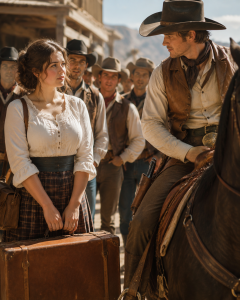
The platform in Silver Creek was loud with the ordinary chaos of arrival. Annabelle stepped down, chin level, scanning faces for a man who looked like he was expecting someone.
She found him almost immediately — medium height, fair-haired, arms crossed, watching the train with a businesslike expression that matched everything she’d imagined.
She took one step toward him.
“Miss Porter.”
The voice came from her left. Not a question. A statement.
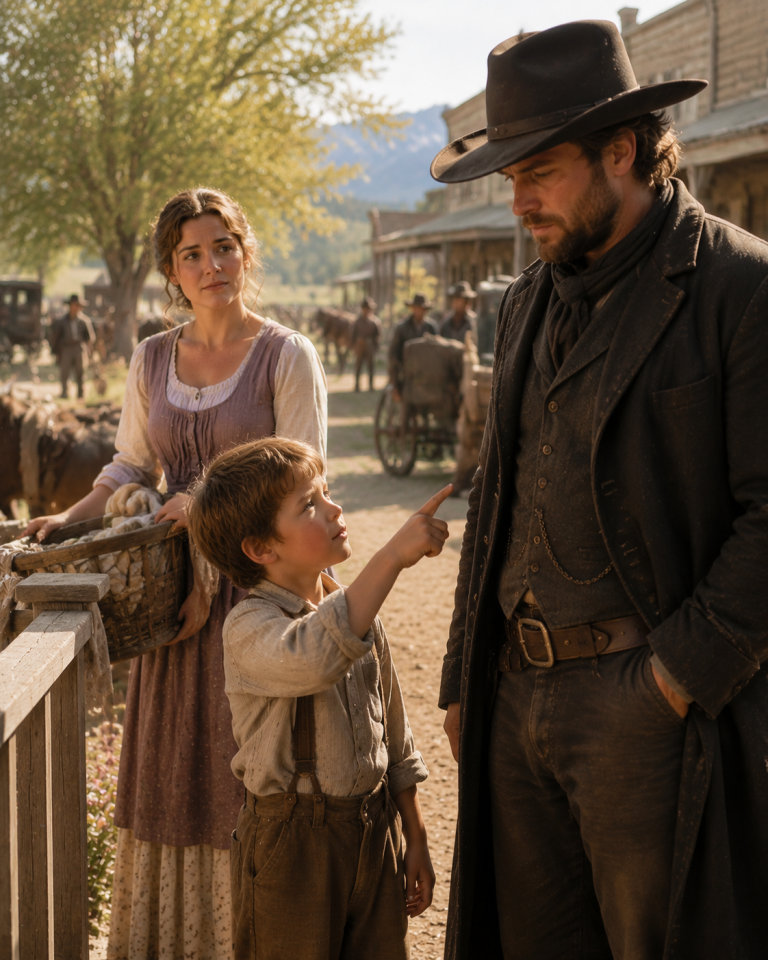
She turned, and the man standing there was nothing like the picture she’d built in her mind. Tall — genuinely tall, the kind of height that didn’t announce itself, simply existed the way a mountain exists. Dark hair a little long under a worn hat. Eyes the gray-green color of river water in late afternoon, difficult to read.
“I’m Miss Porter,” she said. “And you are not Mr. Harrington.”
“No,” he said. “I’m not.”
The silence that followed was small, but it was enough to send the first thread of unease through her chest.
“Is Mr. Harrington here?”
The tall man’s gaze flicked briefly toward the fair-haired man across the platform, then came back to her, his expression shifting into something careful, deliberate — a man choosing his words the way you choose your footing on uncertain ground.
“He is,” the man said. “But there’s something you need to know before you go over there, Miss Porter. Something he should have written to you himself and didn’t.”
Her hand tightened on her traveling bag. “Tell me.”
“His sister arrived from Philadelphia two weeks ago. Recently widowed herself, two children with her. Gerald decided he doesn’t need a wife anymore. He’s got family to run the household now.”
A pause.
*”He doesn’t want you.”*
Four words. Clean and flat as a blade.
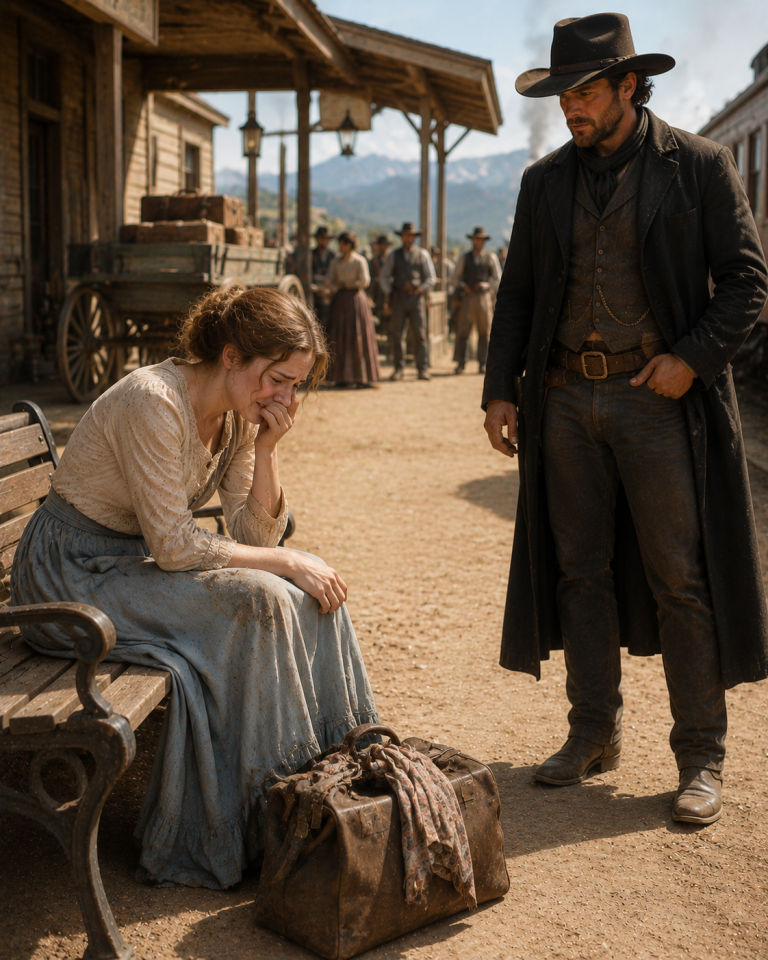
Annabelle heard them. She absorbed them. She felt the blood leave her face and come back very hot — and she stood perfectly still through all of it, because she’d learned a long time ago that the worst thing you can do in the moment of a blow is let it show.
“I see,” she said.
“He should have written,” the man said again — not an apology, since this wasn’t his to apologize for, but something rougher than that. An acknowledgment that a wrong had been done.
“Yes,” Annabelle said. “He should have.”
Across the platform, Gerald Harrington still stood with his arms crossed, waiting for the unpleasant task to resolve itself without his direct involvement. He hadn’t walked over. He’d sent a stranger to do it for him.
The anger that moved through Annabelle in that moment was quiet, hot, and total.
“You still haven’t told me your name,” she said.
“Kieran Knox. I own the ranch neighboring Harrington’s land.”
“And why did Gerald Harrington send you to tell me this instead of coming himself?”
“He didn’t send me,” Kieran said. “I came on my own. I was at the station picking up supplies when I saw the train come in. I knew you were arriving today.” A pause. “I thought you deserved to hear it from someone who’d at least have the decency to look you in the eye.”
She studied him for a long moment. She was good at reading people — a skill sharpened by years navigating Boston society, where half of everything said was designed to obscure the other half. Kieran Knox did not appear to be a man who spent much energy on concealment.
“Thank you,” she said quietly, and meant it.
Then she turned and walked across the platform toward Gerald Harrington, who unfolded his arms and extended his hand as she approached, his expression the soft, comfortable look of a man who had lived well and intended to keep doing so.
“Miss Porter, I trust you had a pleasant journey.”
“I trust,” she said, not taking his hand, “that you will return to me the full cost of my travel expenses, as your advertisement promised. Today.”
His expression flickered. And Annabelle Porter — twenty-eight years old, widowed, with two trunks, a broken plan, and exactly enough money left for perhaps a week — stood on that platform and discovered, in real time, that she had not traveled three days across the country to be quietly humiliated.
What she didn’t yet know was that the tall stranger with the gray-green eyes was still standing a few feet away, watching Gerald Harrington’s retreating back with an expression she couldn’t quite name — and that he was about to make her an offer that would change the entire shape of her life.
—
PART 2
“You handled that well,” Kieran said.
He hadn’t left. Annabelle turned to find him watching Harrington’s retreat with something unreadable in his face.
“Thank you,” she said again. Then, because there was no point pretending otherwise: “I’m in a difficult position.”
“I know.” He looked at her directly. “Is there a reputable boarding house in town?”
“There is. But a boarding house will eat through whatever Harrington gives you inside a week, and then you’ll be looking at the train back east.”
“Is that a fact,” she said, “or a prelude to something?”
The corner of his mouth moved. Not quite a smile. “A prelude. I have a proposition for you, Miss Porter, and I want to be clear it’s entirely your choice to refuse it.”
He laid it out plainly. His housekeeper had married and left the previous spring. He needed someone who could manage a household — cook, accounts, supply orders. Harrington had mentioned, in passing, that she had experience with exactly that kind of work.
“Six months,” he said. “Or less, if you want to leave sooner. Fair wage, your own room, your own privacy. If it’s not what I’ve described, you leave, and I’ll pay your train fare back east. My word on it.”
She should have taken time to think it over. That was what a sensible person would do. But the bank draft Harrington had returned to her, tight-lipped and avoiding her eyes, was not going to last long, and the train back east would deposit her in Boston with nothing but the same closed doors she’d left behind.
“All right,” she said. “Six months, and I want it in writing.”
Something close to respect moved across his face. “I’ll have it written up today. You can read every word before you sign it.”
He loaded her trunks without being asked, without ceremony, and drove her out of Silver Creek in an efficient, quiet way that told her nothing about himself and everything about how he moved through the world.
The Knox ranch was larger than she’d expected — solid, well-built, put up by someone who intended it to last. Four full-time hands kept to the bunk house. She’d have the west wing, a door that locked from the inside. He showed her the account ledger, kept in his own precise hand.
“You keep your own books,” she said.
“I keep my own everything.” Not pride. Just fact.
That night, she signed the agreement after reading it twice. It contained no hidden conditions. Over a supper she’d assembled from a nearly bare pantry, he told her the practical routine of the ranch and nothing about himself. She didn’t ask.
But lying awake in the unfamiliar west-wing bedroom, she found herself cataloguing what she’d already learned about Kieran Knox in a single extraordinary day. He was a man of his word. He’d come to a train station for no reason except that it was right, and offered a stranger genuine options at a moment when she had almost none.
She wasn’t accustomed to trusting that easily. Life had burned the tendency out of her. But she was honest enough, in the dark, to admit she was already paying attention to him in a way that had nothing to do with business.
She turned onto her side and told herself firmly that six months was six months, and that the particular quality of a man’s voice saying her name was not a sound a sensible widow should spend time thinking about.
She thought about it anyway.
Across the wall, in the east wing, a light burned late. She didn’t know that Kieran Knox sat at his desk reading their agreement a second time, a third time, his jaw set in the way it got when he was holding something at a careful distance — a distance he’d maintained, with considerable discipline, for six years, for reasons that had, for the first time in a very long while, started to feel less convincing than they had the day before.
What neither of them knew yet was that a man named Wade Voss, who owned the ranch to the north and had spent four years trying to take Kieran’s water rights by every means short of honest, was about to notice the new woman managing the Knox household — and decide she was either an obstacle or a target. He hadn’t yet worked out which.
—
PART 3
The first morning told Annabelle everything she needed to know about what she’d walked into.
She was up before dawn — not summoned, just unable to bear her own thoughts lying still in an unfamiliar bed — and found the pantry in worse shape than she’d assessed the night before. Flour, salt pork, dried beans, coffee, and very little else. Whoever had been managing meals held the philosophy that food existed for survival and nothing more.
By the time boots hit the floorboards in the east wing, she had coffee on and cornbread frying. Kieran stopped in the kitchen doorway, hat in hand, and something moved across his face that he controlled almost immediately.
“You didn’t have to start this early,” he said.
“I was awake. Sit down. Coffee’s ready.”
He sat, wrapped both hands around the mug, and looked at her with that careful, measuring expression she was already learning to recognize — not unfriendly, but not quite open either.
“Annabelle,” he said, when she offered her first name without quite planning to. “This is more than I’ve eaten for breakfast in six months.”
“That explains a great deal,” she said.
The corner of his mouth moved — not quite a smile, but close. Cody, a round-faced ranch hand who couldn’t have been more than twenty, burst through the back door with the energy of a young man who’d forgotten other people existed, stopped dead at the sight of Annabelle, yanked off his hat, and then caught sight of the cornbread. His whole face changed.
“Is that cornbread?”
“It is,” Annabelle said. “Sit down.”
He sat so fast the chair scraped. Three more hands filtered in over the next ten minutes — Pete, Darnell, and a weathered older man named Swede, who’d been with the Knox ranch eleven years and regarded the whole enterprise with the quiet authority of a man who’d outlasted every problem it had ever produced. He looked at the food, looked at Annabelle, looked at Kieran.
“About time,” he said, and sat down.
Kieran caught Annabelle’s eye across the table, and this time the corner of his mouth went all the way. The first time she’d seen him close to smiling. She turned back to the stove before it could mean anything.
By noon, she’d found three double-paid invoices sitting uncollected in the ledger — thirty dollars owed back to the ranch. Kieran stared at the papers, then at her.
“You found those in one morning.”
“The ledger wasn’t difficult to read. It just needed someone to read it.”
He looked at her with the measuring quality intensified, as though she’d passed a test she hadn’t known she was taking.
The first real trouble arrived that afternoon. Raised voices in the yard pulled Annabelle to the window, where Cody stood facing three riders she didn’t recognize — an older, thick-chested man on horseback with the easy authority of someone who’d spent his whole life in the saddle, and two men behind him who had not come to discuss anything pleasantly.
“Mr. Voss,” Cody was saying, “the boss said the water rights on that creek are settled by deed. There’s nothing to discuss.”
*Voss.* The name landed in Annabelle’s chest with a cold weight she couldn’t yet explain.
“Boy,” Voss said, in a voice like gravel rolling in a tin, “you go tell your boss that settled by deed and settled by fact are two different things out here.”
Annabelle walked out onto the porch. All three men looked at her. Cody’s face flashed relief and alarm at once.
“I’m afraid Mr. Knox isn’t on the property at the moment,” she said pleasantly, meeting Voss’s flat, pale-weather eyes directly. “If you’d like to leave your name and the nature of your business, I’ll make sure he receives the message when he returns. Your name, sir?”
The pause that followed had edges on it. Voss looked at this composed, unmoving woman on the porch and found nowhere to go.
“Wade Voss,” he said finally. “I own the Double V ranch to the north. Tell Knox I’ll be back.”
“I’ll tell him,” she said. “Good afternoon, Mr. Voss.”
He rode out. Cody let out a breath stored somewhere in his boots. “Ma’am, that was — Mr. Voss doesn’t usually — most people don’t look at him like that.”
“Like what?”
“Like he’s not particularly impressive.”
“He’s not,” she said, and went back inside.
—
**THE FENCE AND THE DOOR**
When Kieran came home that evening, she relayed the encounter in the same flat tone she might have used to report the weather. His reaction told her more than his words did.
“You went out to the porch,” he said. “Cody is twenty and Voss was pushing him. He could have been dangerous.”
“He was. He just decided not to be.” She looked up. “Is this water rights dispute something I should know more about?”
The shift in his expression was subtle but total — a door closing quietly, deliberately. But when she pressed, he told her plainly: Voss had been trying to acquire land in the valley for four years, buying out smaller ranches, and Garrison Creek — the water that fed Kieran’s northern pastures in summer — cut through his land on its way to Voss’s property. Without it, Voss’s own pastures went dry by August. The deed was clear. But Voss had a lawyer in Denver and a judge in the county seat who drank at his table regularly.
“My last housekeeper left,” Kieran admitted, “partly because her husband didn’t want her working for someone who might have a legal fight coming.”
“You didn’t mention that when you offered me the position.”
“No. I didn’t.”
“Why are you telling me now?”
“Because you went out to that porch this afternoon,” he said. “And you deserve to know what you’re in the middle of.”
It was, she thought, the most honest thing a man had said to her in years.
“Where are the original deed papers?” she asked.
He stared at her a moment, then went and retrieved a leather folder. They worked side by side at the kitchen table until the light went from gold to gray, and what struck Annabelle most was how natural it felt. Kieran answered her questions without impatience, tracked the conversation with a quick intelligence he wore lightly. She kept recalibrating her estimate of him upward, again and again.
He was not what she had expected. He was something more specific, and considerably more inconvenient. He was interesting.
She drove that thought firmly from her mind and focused on the deed.
—
**CLARA WESTON**
Four days passed. Annabelle transformed the pantry in a single trip to town, navigating Harland’s dry goods with the focused efficiency of a woman who’d once managed a household budget under real pressure. In the street outside, a striking dark-haired woman in a good wool riding habit caught Annabelle’s eye and held it a beat too long before turning away.
“Who is that?” Annabelle asked quietly.
“Clara Weston,” Kieran said, his jaw tightening by a degree. “Her father owns the lumber operation east of town.”
There was a flatness in how he said it — the particular flatness of a subject deliberately compressed.
“She looked at you,” Annabelle observed.
“People look,” he said, and lifted another crate onto the wagon.
Clara Weston came to the ranch the next morning, framed in the doorway in a riding habit that fit her extremely well, her eyes moving from Kieran to Annabelle and back with a warmth that didn’t quite reach them.
“I heard you had a new housekeeping arrangement,” she said, then to Annabelle: “You must be Miss Porter.”
They shook hands with the focused precision of two women who understood that politeness was currently doing a great deal of work. Clara had come, ostensibly, about the water board meeting — her father thought Kieran should have representation, since Voss was bringing his lawyer.
“It would be good to see you,” Clara said to Kieran, nothing overtly stated — but the statement under the statement was perfectly clear.
After she left, the kitchen was very quiet.
“She’s in love with you,” Annabelle said, in the tone she might have used to observe that the weather looked like rain.
“That’s—” Kieran stopped.
“She’s been in love with you for some time. And she came here to see what I am.”
He was quiet a moment. “Clara and I have known each other for years.”
“That’s not what I said.”
“No,” he admitted. “It’s not.” He looked at her directly. “Is that a problem for you?”
It wasn’t the question she’d expected — not a deflection, but something aimed straight at her.
“No,” she said, equally directly. “Is it a problem for you?”
The silence that followed had the stillness of air before a storm.
“I need to get back to the south pasture,” he said, and left.
She stood in the kitchen and was honest with herself, for exactly fifteen seconds, about what was happening in her chest. Then she put it away and went back to the deed folder. She was here for six months. She was here to work. She repeated it until she almost believed it.
Outside, Kieran walked to the barn with his jaw set, aware that the fence he’d built so carefully over six years had, in five days, developed a door it had never had before.
—
**THE LETTER IN THE FOLDER**
The fourth morning, going through the deed folder again, Annabelle found a letter that stopped her cold — folded twice, no envelope, tucked in the back. It unfolded before she could stop herself, and the first line was already visible.
*Kieran, by the time you read this, I will be gone. I need you to know that leaving had nothing to do with you and everything to do with me. You deserved better than what I was able to give. I’m sorry.*
She folded it immediately, put it back exactly where she’d found it, and sat with her hands still, her mind very quiet. She understood now, with sudden clarity, the quality she’d been trying to name in him since the first day — that particular combination of self-sufficiency and sealed-off stillness. Someone had left him, and he had built the whole architecture of his solitude around that fact.
She said nothing. But the knowledge sat inside her chest, quiet and careful, changing the shape of everything she thought she understood.
That evening, she asked him plainly whether he’d been married.
“Engaged,” he said. “Seven years ago. She left about four months before the wedding. Said the ranch was too hard, that she hadn’t understood what the life actually meant until she was standing inside it.” A pause. “She wasn’t wrong. I don’t hold it against her. But it changed you,” Annabelle said.
“That particular thing changed me a specific way.”
“I understand that completely,” she said, and told him about Thomas — a good man who’d kept his debts and his failing practice from her because he was afraid of looking like a failure, not to be cruel.
“Men sometimes confuse protecting someone with being honest with them,” she said.
“Yes,” Kieran said. “They do.”
Later, in a quieter register: “You should know I didn’t offer you this position because I needed a housekeeper. I mean — I did need one. That was true. But when I saw you step off that train, and Harrington’s man hadn’t even come to meet you, I was angry. For you specifically. I wanted to give you an option that wasn’t humiliation.”
“And now?” she asked.
“Now I’m glad you’re here. For reasons that have nothing to do with the accounts or the pantry.”
“It’s not the whole of it from my side either,” she admitted. “And that scares me considerably.”
“Me too,” he said.
They sat with that — the mutual, honest admission of fear, a far more intimate thing than most declarations of feeling — until Cody’s shout from outside brought them both to their feet.
—
**FIRE ON THE NORTH RIDGE**
An orange glow lit the ridgeline where there was no business for one to be. “Grass fire,” Swede said, appearing half-booted from the bunk house. “Wind’s coming from the west.”
Kieran moved instantly, directing the hands to barrels and wet sacks. Annabelle ran for the water pump without being told and did not stop moving for two hours. By one in the morning, the line was out — the barn untouched, the men blackened and exhausted but standing.
Kieran found her afterward, noticed the burn on her wrist where a spark had caught her, and took her hand in both of his to look at it in the lantern light. His expression, in that moment, was one she’d remember for a long time — a man holding something carefully because he was afraid of what he might do if he wasn’t.
“That fire didn’t start itself,” he said, quiet enough that only she could hear. “Grass doesn’t catch like that on a still night in October unless someone helps it.”
“Voss,” she said.
“I can’t prove it. Not yet.”
“Then we get proof.”
Something in him — held in careful suspension for six years behind a fence built with intention and grief — shifted. Not broke. Simply moved, the way a door moves when someone finally turns the handle.
“Yeah,” he said. “We do.”
He didn’t let go of her hand right away. That small fact — the not immediately — was the thing she carried with her into the next morning.
—
**THE COMPETING CLAIM**
Kieran rode to the county seat at dawn with the deed, survey record, and a written account of the fire dated and signed. He returned that evening with worse news: Voss’s lawyer had filed an adverse possession claim, arguing ten years of continuous water usage, backed by signed statements from three of Voss’s own men. The hearing was six days out.
“You need a lawyer,” Annabelle said. “Today.”
The only lawyer in Silver Creek played cards with Voss every Thursday. But Kieran knew a man in the county seat — Robert Fletcher, honest, expensive, and the one who’d handled the original deed registration.
“Send a rider tonight,” Annabelle said. “If Voss’s lawyer is moving this fast, every hour matters.”
Cody left within the hour. That night, Swede reported that two more survey stakes had been found — not removed, but relocated eight inches, enough to shift the apparent boundary. He’d marked the original positions with cairns of stone before reporting in, which Annabelle thought was exactly the right instinct.
She had Cody draw the positions precisely, dated and witnessed by Swede. Then she and Kieran built a written timeline — every incident since Voss’s first visit, every date, every witness — which she’d already been recording in the account book as it happened.
“How do you remember all of this?” Kieran asked.
“I had a feeling records would matter,” she said.
Robert Fletcher arrived that night, having ridden four hours rather than wait for morning. He read everything — the deed, the survey, the timeline, Cody’s drawing — and delivered his verdict: a strong case, weakened only by the fact that the presiding judge, Carver, drank at Voss’s table.
“Who wrote this?” he asked, holding up the timeline.
“I did,” Annabelle said.
He looked at her with the evaluating stare of a lawyer assessing a witness, and nodded. “You may be the most useful person in this room, Miss Porter. She testifies.”
—
**HERBERT WESTON’S CHOICE**
Four days before the hearing, a rider from the Weston ranch arrived after dark with news that changed everything: Voss had offered Herbert Weston a lucrative lumber contract in exchange for testifying that he’d witnessed Voss’s cattle at Garrison Creek for a decade. Weston hadn’t given his answer yet. Clara had sent the warning herself.
“If Weston testifies for Voss,” Annabelle said, “what does that do to the case?”
“It shifts the balance,” Kieran said. His face was controlled, but barely.
“Then we need to talk to Clara Weston,” Annabelle said, when Kieran doubted Clara would go against her father. “She already did. She sent that rider when she didn’t have to. She’s already made her choice. We just need to give her a reason to act on it.”
They rode to the Weston ranch at first light — together, a word that had begun to carry more weight than its surface meaning. Clara met them before they reached the door, and something disciplined moved across her face, the courage of a person choosing right over comfortable.
“He’s inside,” she said. “He’s expecting you. He was not pleased that I sent the rider.” She looked at Annabelle directly, without performance for the first time. “He responds to logic more than feeling. Lead with the practical consequences, not the moral ones.”
Herbert Weston, sixty-five and used to being the most important man in any room, did not offer them seats. Annabelle laid it out with surgical precision — Voss’s adverse possession claim was weak, the survey tampering was documented, Judge Carver’s conflict of interest would move the case to a circuit judge with no connection to Voss, and criminal charges for destroying registered boundary markers were a real possibility.
“The lumber contract Voss offered you is worth a great deal today,” she said. “It is worth considerably less if the man offering it is under criminal investigation. And a signed testimony given in support of a fraudulent claim by a man of your standing in this valley is the kind of thing that follows a reputation for a very long time.”
Herbert Weston stared at her a long moment, then turned to the window, his back to them.
“I haven’t given Voss my answer yet,” he said finally.
“I know.”
“Tell Fletcher I’ll speak to him before the hearing,” he said. “In private.” He looked at his daughter. “About what I know. About Voss.” A heaviness crossed his face — the look of a man releasing something held too long. “Not everything that man has done in this valley has involved Knox’s land. I have stayed out of it because the cost of getting involved was high.” He looked at Annabelle. “You made the cost of not getting involved higher.”
Riding home, Kieran pulled his horse to a stop. “That was extraordinary.”
“It was just logic,” she said.
“I have never met anyone like you,” he said.
“You have to stop saying things like that. We have a hearing in four days.”
“I’ll stop after the hearing.”
“You won’t.”
“No,” he agreed. “I won’t.”
—
**THE HEARING**
The morning of the hearing, Voss made his first mistake — loudly, in the street outside the courthouse, in front of witnesses. “Knox, you brought your housekeeper to speak for you. That’s what it’s come to.”
Annabelle didn’t break stride. “Mr. Fletcher, make note of the time and the statement for the record. We may find it useful to establish Mr. Voss’s regard for the testimony of women before the hearing begins.”
“Already done,” Fletcher said pleasantly, without looking up from his notebook.
Judge Carver’s conflict-of-interest motion had been granted before dawn; Circuit Judge Harold Marsh, seventy-two and famously impervious to theater, presided instead. The hearing ran four hours. Fletcher entered the deed, the survey record, the timeline, Cody’s drawing, the buried stakes themselves.
Annabelle testified with the clear, even voice of a woman telling the exact truth and knowing it. Voss’s lawyer tried three times to rattle her — her position at the ranch, her relationship to the defendant, the suggestion her records had been compiled after the fact to support a legal position. Each time, she answered with dates, specifics, and the calm authority of someone who had written things down as they happened and could prove it.
Herbert Weston testified next, describing in careful, weighted language three separate occasions on which Voss had pressured neighboring landowners, and the explicit connection Voss had drawn between the lumber contract and Herbert’s testimony. He was describing bribery, in open court, under his own name. The silence that followed had texture.
Swede testified for eleven minutes in his flat, unhurried cadence, describing the night he’d watched Voss’s man bury the survey stakes, marking the site because it seemed like something a person ought to mark.
“You’re a careful man,” Judge Marsh told him.
“Try to be,” said Swede.
The judge deliberated forty-five minutes. Annabelle sat beside Kieran, their arms touching shoulder to elbow, neither of them moving away from the contact.
The ruling, when it came, was complete and unambiguous: Knox’s deed and survey rights upheld. Voss’s claim dismissed. The destruction of boundary markers referred to the sheriff for criminal investigation. Judge Carver’s conduct referred to the territorial oversight committee.
Wade Voss, who had spent four years believing every door in the valley was already bought, walked out of the courthouse without speaking.
Fletcher held Annabelle’s hand a moment longer than necessary as he shook it. “In forty years of practice, I have had perhaps six clients who understood instinctively what documentation was worth. You are one of them.”
Outside, Clara Weston was waiting. “My father did the right thing,” she said.
“It took courage,” Kieran said.
“It took Annabelle,” Clara said, looking at her honestly, the clear-eyed regard of a woman who had made her peace with something and meant to honor it. “She’s good for this valley. And she’s good for you.” A pause. “Don’t be slow about it.”
She rode off before Kieran could answer.
“She’s right,” he said.
“About which part?”
“All of it.”
—
**THE QUESTION ON THE ROAD HOME**
They rode home together in the long golden light of a Colorado autumn, the hands giving them space without making a performance of it.
“I want to ask you something,” Kieran said, pulling his horse to a stop. “You came here on a six-month agreement. That agreement was about work, about an arrangement that gave you options. I don’t want to ask you to stay for the same reasons I hired you. What I want to ask is bigger than that, and it has nothing to do with the kitchen accounts or anything practical at all.”
She waited.
“Annabelle Porter,” he said. “Will you stay here? Not as my housekeeper. Not as a practical arrangement. As my partner in this land and this life — because I am a better version of myself when you are in it, and because I do not want to go back to the man I was before you stepped off that train.”
The horses stood patient in the afternoon light. She thought about Boston, about the closed doors and the cold room and the borrowed periodical with the advertisement tucked in the back pages. She thought about a stranger who’d come to a train platform because it was the right thing to do, who had offered her a real choice when she had almost none, who had built his fence carefully over six years and then, against every instinct of self-protection, let her find the door.
“Yes,” she said. One word, clean and whole and without qualification.
He took her hand and held it the way he had that night after the fire — carefully, as something of specific and serious value — and this time he didn’t let go when the moment passed.
They rode home together in the last of the light, and the Knox ranch came up over the rise the way it always did — solid, functional, real. Swede was already at the barn. Cody was unsaddling his horse. It was the ordinary end of an extraordinary day, and it was exactly what a life looked like when two people had finally stopped running from it.
That evening, on the porch in the cold, clear dark, he did not let go of her hand, and she did not pull it away.
“We should probably tell Mrs. Callaway in town,” Annabelle said, “before she hears it from someone else.”
“Probably,” he said.
“And the supply order needs to go out by Thursday.”
“It does.”
“And the south fence—”
“Annabelle.”
“What?”
“Let the south fence wait.”
She was quiet a moment. “All right,” she said. “The south fence can wait.”
She leaned her head against his shoulder. He rested his cheek against her hair. The night was very still, very cold, and completely theirs.
Some people spend their whole lives waiting for the thing they are owed — the easy path, the uncomplicated love, the future that arrives without cost. Annabelle Porter had never been one of those people. She had learned early that the things worth having were the things you chose in the hard moment, when every practical reason said turn back, and something deeper and more honest said go forward anyway.
She had come to Colorado with almost nothing. She had found something that could not be advertised for and could not be arranged. She had found a man who meant what he said and said what he meant, who had been waiting, without knowing it, for someone who would do the same.
And Kieran Knox, who had guarded his solitude for six long years, had learned that the right person doesn’t breach a fence. They simply make you understand, slowly and irrevocably, that you built it in the wrong place.
They had not started as a love story. They had started as a practical arrangement in a frontier town in 1878, between two people who had been hurt by the world and had decided, against considerable evidence, to trust it one more time.
That was exactly what made it true.
THE END