The Waitress Said Yes to a Child’s Joke—Not Knowing He Was the Mafia Boss’s Son… Until Everything Changed

## PART 1
In the dark of the storage room, with her back against a cold metal shelf of flour sacks and tomato cans, Lina Brooks had finally understood exactly what she was worth.
Fifty thousand dollars.
That was the number her stepmother had put on her body, her breath, her whole life — the price Sondra Brooks had agreed to after gambling away everything else, then selling the only thing left to bargain with: her dead husband’s daughter. For three months Lina had been waiting tables under a fake last name at Vignola, a small Italian place in Brooklyn, and now the past had kicked the door open.
“You can hide all night if you want,” Sondra snarled through the thin door. “Bruno’s men are already outside. You think I’m losing fifty thousand because you suddenly grew a spine?”
Lina’s fingers tightened around the handle of a dented frying pan.
Then a small voice came from behind the flour sacks.
“Will you marry me, Miss Lina?”
She nearly screamed. She spun, pan raised — and a little boy stepped out of the dark. Six, maybe seven, glossy black hair, round serious eyes, superhero pajamas peeking out beneath a wool coat far too expensive to be his own. He looked too polished for this nightmare.
“Please don’t hit me,” he whispered. “I’m not one of the bad guys.”
She lowered the pan an inch. “Who are you?”
“My name is Enzo,” he said, puffing out his chest like a tiny general. “I’m hiding from my dad. He wants to take me to the doctor tomorrow.” He made a face. “Doctors are terrible. They poke you with needles and tell grown-ups things that make them stop smiling.”
Despite the terror in her throat, a painful little smile pulled at Lina’s mouth. “Then we’re both hiding. I’m hiding from bad people too.”
His eyes went wide. “Like a witch?”
“Something like that.”
A fist struck the door. “Lina! Come out before I let Bruno’s men drag you out by your hair!”
She flinched. Enzo’s gaze went from the door to her bruised wrist and back to her face, and something fierce settled under the softness. “In fairy tales,” he said, “when a witch chases a princess, a knight saves her.”
She laughed once, broken. “I don’t see many knights in Brooklyn.”
He stepped closer, chin lifted. “Me.” He nodded as though it were already decided. “My dad has lots of money. And lots of men. Everyone is scared of him. So if you marry me, the witch has to go away.” Then, with deep concern for etiquette, “Would you agree to marry me, ma’am?”
The sweetness of it nearly broke her. For one second, in the worst hour of her life, Lina forgot the men outside, the debt, the word *merchandise.* She knelt and brushed the hair off his forehead. “If I marry you, can you really protect me from the witch?”
“One hundred percent,” he said gravely. “Pinky promise.”
She hooked her smallest finger around his. “I promise. I’ll marry you.”
His whole face lit up — and then the storage-room door slammed open.
Lina threw herself in front of the boy. But it wasn’t Sondra, and it wasn’t Bruno’s men.
A tall man in a black suit filled the doorway, and the air changed. Broad-shouldered, coldly handsome, dark hair swept back, gray eyes that looked as if they had never once asked the world for mercy. Two men stood behind him, jackets cut to hide weapons, faces empty enough to frighten anyone with sense.
Lina knew that face. Everyone in New York who watched the news or listened to backroom whispers knew it.
Adriano Falco. The most feared boss on the East Coast.
His gaze swept over her, paused on the blood at her lip and the bruises ringing her wrist, then moved to the boy behind her.
“Enzo,” he said, his voice quiet and lethal. “What did I tell you about running off?”
Enzo peeked around her, and smiled. “Dad, this is Lina. She’s my fiancée. A witch is trying to sell her, so I proposed. You have to help me chase the witch away.”
The silence that followed felt almost alive. Adriano looked at his son, then at Lina, then at their linked pinkies. Something almost like amusement touched the corner of his mouth.
“My son’s fiancée,” he said slowly. “Interesting.”
And Lina knew, with a cold certainty that sank into her bones, that her life had just stepped off a cliff.
## PART 2
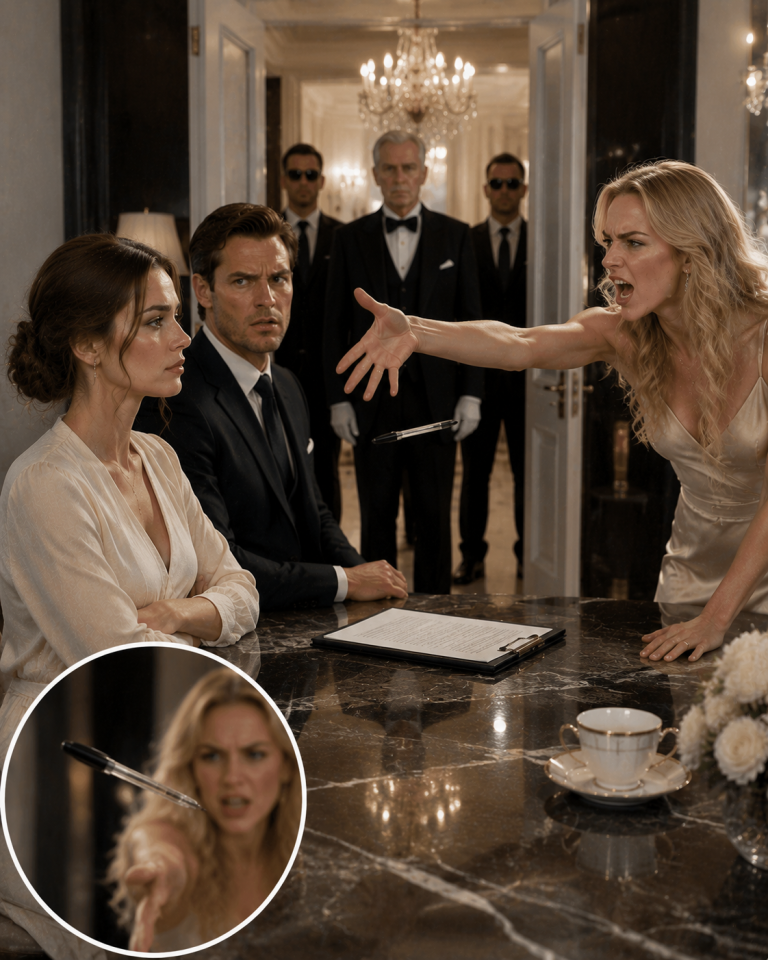
Adriano said nothing else. He walked into the dining room, and Lina found her legs following because fear had emptied her of options. Sondra stood near the bar, red-faced, her stepsister Chelsea leaning against a booth with a smile poisonous enough to curdle milk. “There you are,” Chelsea said. “Bruno says if you behave, he’ll be gentle.”
Then Adriano moved between them, and the restaurant seemed to shrink. He didn’t shout. He didn’t touch a weapon. He simply stood there. Sondra recognized him, and the color drained from her face.
“She belongs to my house now,” Adriano said quietly.
“Mr. Falco — this is a family matter.”
“No. It was a family matter before you sold her to Vittorio Severino.” The name landed like a gunshot. “If I see you near her again — if one man connected to you breathes in her direction — I will treat it as an insult to my family.” He looked at Chelsea. “Take your mother and leave.” They didn’t walk. They ran.
He turned back to Lina. “Are you hurt?”
“No,” she lied.
His eyes dropped to her split lip. “You lie badly.” He took a black card from his jacket — silver numbers, no name. “If they come back, call.”
“I don’t need a mafia boss saving me,” she said, because pride was the only weapon she had left.
“Everyone needs something eventually.” She hated the truth of it, and took the card.
She didn’t call. That night, in her Bronx apartment, a chair wedged under the doorknob, her phone buzzed. *You embarrassed me. Bruno’s coming. Nobody saves trash twice.* Sondra. At two in the morning, the door splintered. Lina went out the window onto the rusted fire escape, palms slicing open, dropped into an alley, and ran — until a hand caught her hair and a scarred man spun her around. “Bruno likes fighters. Says they’re worth more.” She clawed his face; he hit her hard enough to burst light behind her eyes.
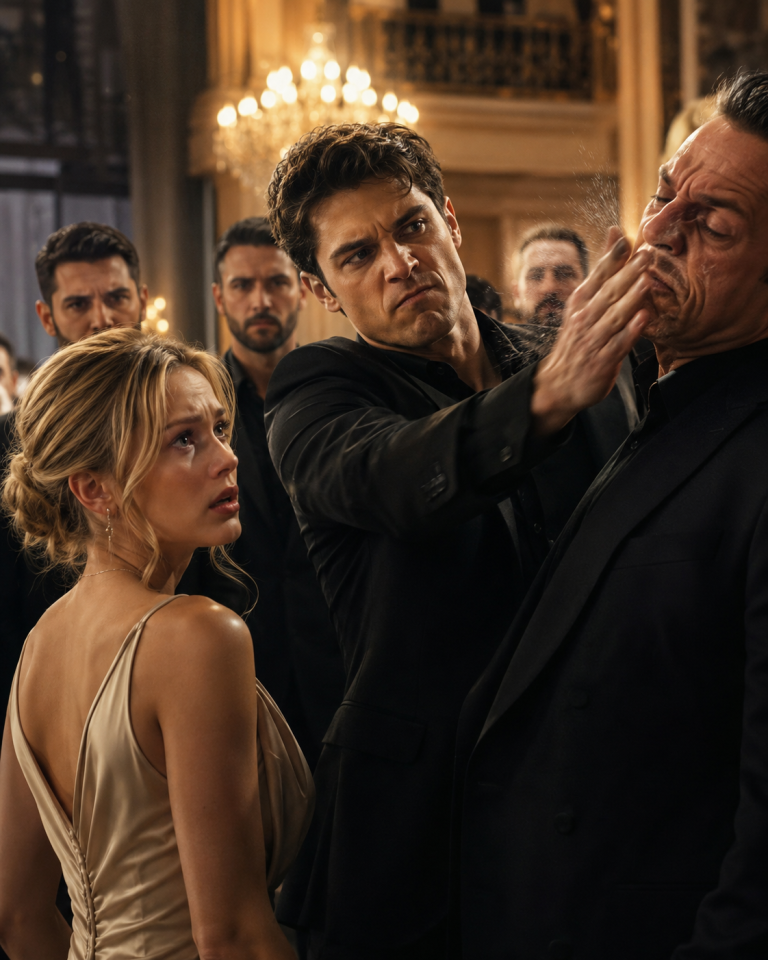
Then headlights flooded the alley. A black SUV tore in; two figures moved; she heard fists, a body hitting brick, the wet crack of a nose. Within seconds both men were down, and Adriano Falco stepped into the light, sleeves rolled, gray eyes moving over her bleeding lip and bare feet.
“I told you to call.”
“This isn’t your city,” she rasped.
“Tonight it is.” He wrapped his coat around her shoulders. “Get in the car.”
She looked at the men on the ground, the broken fire escape, the phone still glowing with Sondra’s threat — and climbed in. And somewhere on the road to the Falco estate, he told her the thing that turned the debt into something far worse: Vittorio Severino was his oldest enemy. “Now he’ll want you,” Adriano said, “because losing you made him look weak.”
## PART 3
The Falco estate stood in Alpine, New Jersey, behind iron gates and walls built by men who expected betrayal — white columns under moonlight, silent guards, a fountain whispering in the cold. Before Lina was fully out of the SUV, the front doors flew open and Enzo barreled down the steps in his superhero pajamas and crashed into her knees. “I knew Dad would save you! I told him the witch was coming.” She knelt and hugged him, and the child’s small arms nearly cracked something open in her chest. When he saw her bruised cheek his face crumpled. “She hurt you.” He spun on his father. “Dad. Handle it more.” A bodyguard coughed into his hand, and for the first time Lina saw the faintest warmth move across Adriano’s face.
The mansion was magnificent and cold — marble, chandeliers, oil paintings of stern men in dark suits, and no laughter anywhere in it. Enzo refused to sleep unless Lina stayed; he pulled her into a room painted with castles and dragons, clutched her sleeve, and demanded a song. She hummed a wordless, broken tune until his breathing evened out. When she stepped into the hall, Adriano was waiting.
In his study — leather, old books, a portrait of an older man with eyes like Adriano’s but crueler — he told her the rest. Severino ran trafficking through New York, Newark, the ports. Women. Children. Organs when he could get them. Their fathers had fought for thirty years and died bloody. Adriano’s brother had died because of him. “I’m just a waitress,” she whispered. “No. You’re a woman Severino paid for and I took away in public. Now he’ll want you to prove he wasn’t weak.”
“So you saved me and made me a target.”
“I saved you because my son asked me to.”
“Don’t make that sound noble.” When he offered terms — *stay, care for Enzo, I protect you, I remove Sondra and Chelsea from your life* — she refused to be a prisoner with silk sheets or a charity case. “I want a contract. Wages. My own bank account. I don’t owe men for saving me.” For a long moment he only looked at her. Then the corner of his mouth moved. “Good. Never owe men like me.”
The next morning she learned why Enzo hated doctors. Seven medicine bottles lined his nightstand, color-coded, arranged by hour. “My heart,” he whispered, pressing a small hand to his chest. “It doesn’t work right. The doctors said I need a new one. I’ve been waiting ten months.” His voice dropped. “My mom left because I’m broken.” The sentence cut deeper than anything Sondra had ever thrown at her. “No,” Lina said firmly, though she knew nothing about his mother. “Children don’t make mothers leave. Adults make their own choices.” “Will *you* leave?” She thought of her whole life — people leaving, using, selling, abandoning — and held out her pinky. “I won’t leave you alone with needles. That I can promise.” He hooked his finger around hers, and that promise changed everything.
Days became weeks. She learned the rhythms of the house: breakfast at seven because the medicine needed food, therapy twice a week, cardiology every Thursday, security briefings she wasn’t meant to overhear and always did. She learned that Adriano Falco drank his coffee black, slept little, never raised his voice at his son, could make grown men sweat with one sentence — and would sit on the floor building castles for an hour without checking his phone. She learned he didn’t trust easily. Neither did she. Their conversations began as negotiations. “Enzo needs to go outside,” she told him one gray afternoon. “He’s a child, not a porcelain statue.” “He gets tired.” “Then we bring a chair.” “He could collapse.” She stepped closer. “And if he spends his whole childhood behind bulletproof glass waiting to collapse, what exactly are you saving?” The next morning a heated greenhouse appeared on the garden schedule. Enzo called it his jungle. Lina called it a compromise. Adriano called it temporary — but he came every afternoon, standing by the lemon trees while Enzo drew dragons and Lina read fairy tales in funny voices. Slowly, dangerously, she began to see the man under the title. Not innocent. Never innocent. But not empty.
One night, after Enzo fell asleep against her arm, she found Adriano at a window over the frozen garden. “You love him,” she said. “He’s my son.” “That isn’t the same thing.” For once the steel in his eyes looked tired. “My wife, Sofia, left two years after he was born. She said she couldn’t watch him die in a house guarded by killers.” “Enzo thinks she left because of him.” “I know.” “Then tell him the truth.” His hand curled against the frame. “The truth is worse. She sent one letter. She wrote that love wasn’t enough — that she wanted a life without hospitals and blood. Enzo found it last year.” Lina closed her eyes. *That’s why he thinks he’s broken.* For a moment she hated Sofia Falco, a woman she’d never met. But life had taught her that the stories told by abandoned people were rarely complete.
The first warning came three weeks later — a dead rat at the gate, a note pinned to it: *Pretty waitress. Sick boy. Strong father. Everyone has a price.* Adriano read it once and burned it. The second came at the hospital, while Lina held Enzo’s hand through bloodwork. In the reflection of the glass door she saw a man in a gray coat, a scar near his mouth, watching them. She stood so fast her chair scraped back; he was gone; the search turned up nothing. But she knew what she’d seen.
That night Adriano’s control cracked. “You go nowhere without Dom or Vince. You do not leave the secured wing. You do not open doors. You do not—”
“I am not one of your soldiers,” she snapped. “Don’t bark orders because you’re scared.”
“My fear has kept my son alive.”
“And it’s taught him the world is only danger.”
“It is.”
“No. *Your* world is. There’s a difference.” His eyes darkened. “I know what it means to be hunted,” she went on, voice trembling but steady. “To wedge a chair under a door and sleep in my shoes. But I also know this — if fear makes every decision, the bad people still own your life. They don’t even need chains. They just need you to build the cage yourself.” He turned away. “My brother believed that.” Her anger drained. “What happened to him?” “Severino shot him outside a church.” There was nothing to say to that but the truth: “I’m sorry.” “So am I.” After that, something shifted — not trust, not yet, but recognition. Two wounded people can sometimes identify each other by the shape of the silence they carry.
The twist began with a necklace. Lina had worn the small silver locket since she was thirteen — her mother’s. Inside was a faded photo of Margaret Brooks and a scrap of paper with a line Lina had never understood: *When wolves wear halos, look beneath Saint Cecilia.* Margaret had been a hospital nurse who wrote grocery lists on napkins and prayers on the backs of receipts, so Lina had always assumed it was one of her strange poetic notes.
One afternoon, painting a wooden birdhouse, Enzo noticed the locket. “Is that your treasure? Can I see?” She opened it. He studied the photo. “She looks like the lady in Dad’s locked room. The one in the picture with my mom.” Lina’s smile vanished.
She found Adriano in the study. “What locked room?” His face closed. “No.” “Enzo says my mother is in a picture with Sofia.” That broke through. He took a key and led her down a private corridor to a room that smelled of dust and old perfume — covered paintings, sealed boxes, the things that had been Sofia’s. He pulled a cloth off a framed photograph and Lina stopped breathing. Her mother stood beside Sofia Falco outside what looked like a charity event, younger, smiling nervously, Sofia’s arm around her shoulders, a banner behind them: *St. Cecilia’s Children’s Cardiac Foundation.*
“When wolves wear halos,” Lina whispered, and showed him the paper. The blood left his face.
St. Cecilia’s hadn’t just been a hospital. It had been a charity funded by wealthy families — the Falcos among them — to help children awaiting transplants. Sofia had worked with it after Enzo’s diagnosis. Adriano opened old files and Lina read beside him until the words blurred. Irregular donor lists. Children missing from foster homes. Emergency transplant approvals signed under false names. Shell charities tied to Severino. And one name appearing again and again as a whistleblower contact: *Margaret Brooks, RN.*
Lina’s mother had not died in a random car accident. She had found evidence that Vittorio Severino was using St. Cecilia’s as a front to traffic the desperate and harvest organs. Sofia had helped her; together they had hidden the proof. Then Margaret died, Sofia disappeared, and Adriano — grieving and furious — had believed his wife abandoned him.
“Sondra knew,” Lina said. Adriano’s face hardened into something terrifying. “She didn’t sell you only for the debt. She sold you because Severino realized who your mother was.” Lina gripped the desk. All those years of running, all the cruelty — not random. She had been hunted because her mother had left behind a key. “What’s beneath St. Cecilia’s?” His eyes met hers. “The old chapel.”
The chapel had been sealed a decade ago when the foundation collapsed; his men found it two nights later beneath a decaying wing of the old hospital complex in Queens. Lina insisted on going. Adriano said no. “It’s my mother,” she said. He said no again. She looked him in the eye. “You told me never to owe men like you. I don’t. But I owe *her.*” So he took her.
The chapel smelled of mold and old incense, broken pews leaning in the dark, a cracked statue of St. Cecilia near the altar with her stone hands folded. Beneath the statue, behind a loose marble tile, they found a metal box: a flash drive, a ledger, and a letter wrapped in plastic. Lina knew her mother’s handwriting at once.
*My darling Lina. If you’re reading this, I didn’t come home. I’m sorry. I thought exposing monsters would be enough. Monsters buy judges, priests, doctors, and grieving mothers. Sofia Falco is not your enemy. She is trying to save her son without becoming what these men want her to be. If she vanishes, do not believe the first story told about her. Sondra has seen too much; I fear she’ll choose money over mercy. Run if you must. But one day, when you’re strong enough, let the truth out.* It ended with four words: *You were my courage.*
Lina pressed the page to her chest and broke down. Adriano stood beside her, silent, then placed one hand on her shoulder. “I believed Sofia left because she was weak.” “Maybe she left,” Lina said, “because staying would have gotten Enzo killed.”
Then gunfire shattered the chapel windows. Adriano shoved her behind the altar; his men returned fire; stone exploded, dust filled the air. A voice echoed through the ruin. “Adriano Falco. Still hiding behind women and ghosts?” Vittorio Severino stepped through the broken doorway — older than she’d expected, silver-haired, elegant in a camel coat, a face that might have looked kind if not for the deadness behind the eyes. Sondra stood beside him. Chelsea hovered behind, pale and shaking, refusing to meet Lina’s eyes.
“Lina Brooks,” Severino said. “Your mother caused me great inconvenience.”
“You killed her.”
“I corrected a problem.”
“You came in person,” Adriano said through the dust. “That was stupid.”
“Necessary. The girl has what’s mine.” His eyes moved to Lina’s chest. “Do you know why your stepmother kept you alive all these years? Your blood markers were in your mother’s old hospital file. Rare tissue profile. Useful compatibility. Not perfect — but interesting. Especially after the Falco boy got sick.” Adriano’s face turned deadly. “Grief makes men generous,” Severino went on. “If I couldn’t kill Adriano Falco, I could sell him hope. A donor here. A miracle there. A heart when the waiting list failed his son.” He lifted a hand as the bodyguards tensed. “Careful. Kill me and certain files vanish. Certain doctors vanish. Certain opportunities vanish.”
And Lina understood. He had planned to use her — leverage, tissue, blood, whatever language monsters used to make murder sound medical. Adriano understood too. “You thought I’d buy a heart from you.”
“I thought you’d buy anything for your son.”
The words struck Adriano where no armor reached, and for one awful second Lina saw the temptation — not because he was evil, but because he was a father drowning in terror. Severino saw it too. “There it is. Men like us are moral only until the child starts dying.”
Lina stood. “Stay down,” Adriano hissed. But she stepped out from behind the altar with her mother’s ledger in her hands. “No. You don’t get to call murder hope. You don’t get to put a price on a child’s heartbeat and call yourself merciful. Enzo needs a heart — yes. But he needs to grow up in a world where his father didn’t become *you* to save him.” Adriano looked at her, and something broke open in his face.
Then sirens rose outside, and Severino’s smile faltered. Lina lifted her phone. “I called someone too.” She looked at Sondra. “You always said nobody listens to poor girls. So I sent the files to people who listen to federal crimes.” The FBI poured into the chapel within minutes. Adriano’s men lowered their weapons first. Severino tried to run; Dom caught him at the side entrance and put him on the ground. Sondra screamed that it was all a misunderstanding. Chelsea cried. Lina watched without pity. When an agent took the ledger from her hands, he asked, “Are you willing to testify?” She looked at Adriano, whose gray eyes held hers and, for once, did not command or decide. He waited. “Yes,” she said. “I am.”
The trial became national news. St. Cecilia’s Children’s Cardiac Foundation was exposed as a trafficking network — donors, doctors, shell companies, protected men. Vittorio Severino went down with judges, surgeons, accountants, and politicians attached to his money. Sondra took a plea deal, then lost it for lying under oath. Chelsea testified against her mother and vanished into witness protection with regret that came years too late. Adriano Falco himself was questioned for weeks; his own empire was dragged into the light, some of his men arrested, some turned state’s evidence.
Lina expected him to hate her for it. Instead, one evening after a brutal day of testimony, he found her outside the courthouse in Manhattan, snow falling over the steps. “You could have warned me.”
“You’d have stopped me.”
“Yes.”
“That’s why I didn’t.” He looked out at the reporters behind the barricades. “My father built our name with blood. I told myself I was different because I had rules.” She said nothing. He turned to her. “Rules aren’t redemption.” “No,” she said softly. “They’re only the start of restraint.” His mouth curved faintly. “You talk like someone who’s survived bad men.” “I have.” “And what do surviving women do after they win?” She thought of her mother’s letter, of Enzo’s small hand, of the storage room where a child had offered protection because the adults of the world had failed so completely. “They build something safer.”
Six months later, Adriano Falco dissolved three companies, sold two clubs, and surrendered enough records to burn half the underworld in New York. People called it strategy, fear, a power shift. Lina knew better. It was a man pulling his son’s future out of the mud, one filthy root at a time.
Enzo got weaker before he got better. There were nights Lina sat by his hospital bed while machines beeped and Adriano stood at the window with his hands clasped behind his back like a king watching for his kingdom to fall. Then one rainy morning the call came — a donor heart. Legal. Verified. A child from another state whose grieving parents had chosen mercy in the worst hour of their lives. When the coordinator entered, Adriano arrived two minutes later, breathless for the first time Lina had ever seen. Enzo looked from one adult face to the other. “Is it here?” Adriano took his hand. “Yes.” Enzo’s eyes filled. “Will it hurt?” “Yes,” Adriano said, his voice breaking. “But you won’t be alone.” Enzo turned to Lina. “Pinky promise?” She hooked her finger around his. “Pinky promise.”
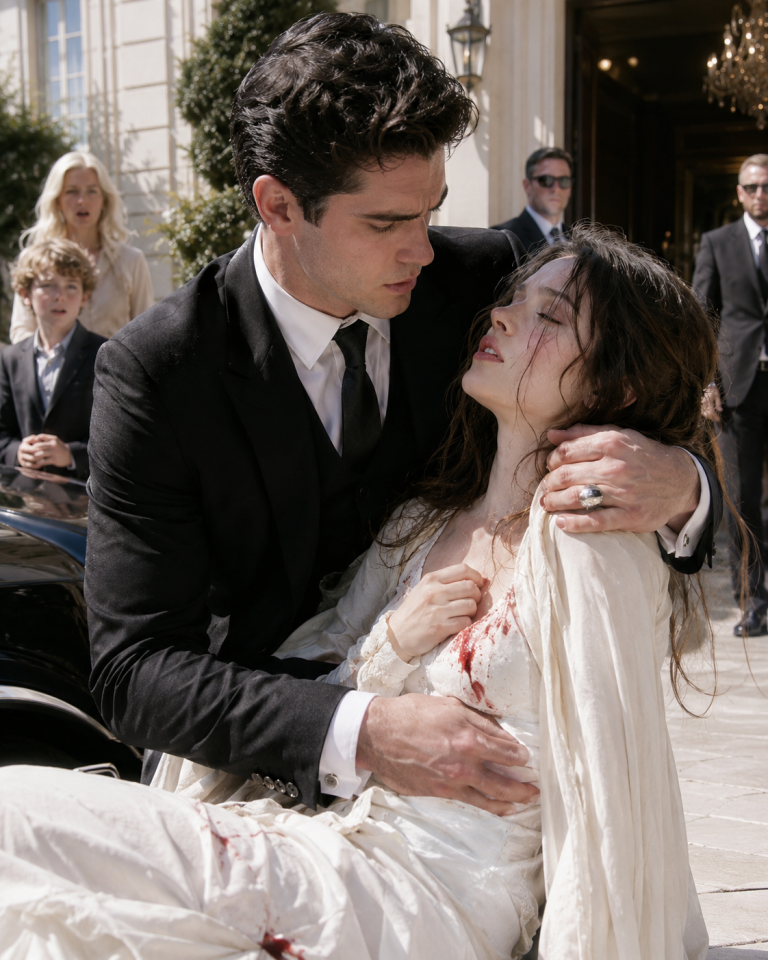
The surgery lasted nine hours. Adriano did not sit. Lina did not sleep. When the surgeon finally came out, mask hanging loose, exhaustion carved into his face, Adriano looked as if he might stop breathing. “The heart is beating,” the surgeon said. “He made it.” Adriano turned away, and Lina saw his shoulders shake once. Only once. She stepped beside him, and this time he didn’t hide from her. He took her hand.
A year later, Vignola reopened under a new name. Lina bought it with money from a victims’ compensation fund, her wages, and an investment Adriano insisted wasn’t charity — because she made him sign repayment terms so strict his lawyer laughed for ten minutes. She called it *Margaret’s Table:* a place where women leaving shelters could work without questions, where tips were pooled fairly, where the back office kept emergency cash, legal contacts, and a list of safe apartments.
On opening night, Enzo — healthier, round-cheeked — stood on a chair and tapped a spoon against a glass. “Attention. I have something important.” Adriano groaned. “Enzo.” Lina smiled. “Let him speak.” The boy looked very serious in his tiny suit. “A long time ago, I asked Miss Lina to marry me because a witch was chasing her.” The room laughed gently. “But I was little then, so it didn’t count legally.” More laughter. He turned to his father. “So now I think Dad should ask her.” The room went silent. Lina froze. Adriano looked at his son. “We discussed subtlety.” “You said be honest.” “I said that privately.” Enzo shrugged. “I’m helping.”
Adriano stood. He didn’t kneel right away — that would have been too simple for a man like him, and too easy for a woman who had fought too hard to belong to herself. He came to her slowly. “I have owned many things I should not have owned,” he said, low enough that only the nearest tables heard. “Territory. Loyalty. Fear. Silence. For a long time I thought protection meant possession.” Her eyes burned. “You taught my son courage. You taught me the difference between guarding a house and building a home. So I’m not asking you to belong to me.” He took a small velvet box from his pocket. “I’m asking if you’d let me belong beside you.”
“Say yes,” Enzo whispered, loudly. Lina laughed, crying now. She looked at the boy who had once found her in the dark and called himself her knight, then at the man a city had feared who had learned to set power down for love. “Yes,” she said. Enzo cheered so loudly half the restaurant startled. Adriano slid the ring onto her finger and kissed her hand with a reverence that made her remember every night she had believed she was worth nothing.
She was not merchandise. Not a debt. Not a poor girl hiding behind a shelf. She was Margaret Brooks’s courage. She was Enzo Falco’s safe place. She was the woman who had walked into a mafia king’s fortress and taught it how to become a home.
And years later, when people asked how Lina Brooks survived being sold to monsters, she would smile and tell them the truth. “A little boy proposed to me in a storage room,” she would say. “I thought it was a joke.” Then she’d look across the room — at her husband, at her son, at a restaurant full of women learning to breathe again. “But sometimes the first door into your new life is hidden inside the most impossible sentence you’ve ever heard.”