An Angry Rancher Bought Four Sisters Sold by Their Cruel Uncle — Then Turned Their Broken Lives Into a Legendary Legacy

—
## PART 1
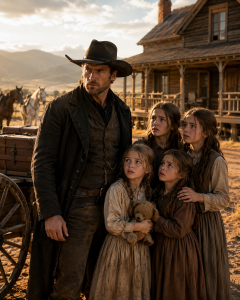
The morning of September 14th, 1887 dawned gray over Clearwater, Kansas, as if the sky itself disapproved of what was about to unfold. A crowd gathered in the town square, not for celebration, but for the cruelest kind of commerce. On a hastily built wooden platform stood four girls, ages six to fifteen, huddled together like sparrows before a storm — dresses clean but threadbare, hair braided with desperate precision, a final act of dignity before being stripped of everything else.
Fifteen-year-old Sarah Henderson stood at the front, spine rigid with a pride poverty and tragedy hadn’t managed to break. Behind her, twelve-year-old Emma’s musical fingers trembled against her sleeve. Ten-year-old Kate’s sharp eyes darted around the square, calculating, always calculating. And pressed against Sarah’s side, six-year-old Lucy clutched a carved wooden horse, the last gift from their father, and tried very hard not to cry.
Their parents, James and Margaret Henderson — a schoolteacher and a seamstress, respected people in this very town — had died within a week of each other in the scarlet fever epidemic of 1886. Sarah had nursed them both, had heard her father’s final words: *Keep your sisters together, Sarah. Promise me.* She’d promised.
But their uncle, Silas Crane, had other plans. A gambler and a drinker, he’d spent eleven months selling off everything their parents had left — the sewing machine, the books, their grandfather’s furniture — into poker games at the Lucky Silver Saloon. When three men in black suits arrived demanding $1,500 in gambling debts, Silas had looked at his four nieces with eyes that made Sarah’s blood run cold. “You’re going to market,” he’d said flatly. “All of you should fetch enough to clear my debts.”
“Lot 17,” barked the auctioneer, Marcus Blackwood. “Four healthy girls. Starting bid twenty dollars a piece, or seventy for the lot.”
Silence fell like a shroud. Even for 1887 Kansas, this crossed lines. When a farmer named Dutch Henderson — no relation, known for working hired help near to death — bid twenty-five dollars for “just the oldest,” the implication in his voice made several women turn away.
“Going twice, fifty,” a voice called from the back — deep and rough as gravel, carrying a weight that made people step aside.
Sarah’s eyes found him: a man in his late thirties, tall, broad-shouldered, a rancher’s coat and flat-brimmed hat shadowing a face carved from granite, steel-gray eyes fixed on the platform with startling intensity.
“Fifty for the eldest?” Blackwood asked, perking up.
“No,” the man said, stepping through the parting crowd. “Fifty for the eldest. A hundred for all four together.”
A murmur rippled through the square — more than most families earned in three months. Silas scrambled forward, piggy eyes gleaming. “A hundred for all four? You got that kind of money, mister?”
The stranger pulled out a leather wallet and counted bills onto the platform. “Right here. Cash. Grant Ashford, Twin Pines Ranch, five miles west.”
Recognition flickered through the crowd. Twin Pines was one of the largest cattle operations in three counties. Grant Ashford had lost his wife to pneumonia three years back and hadn’t been the same since.
“A hundred, going three times. Sold to Mr. Grant Ashford.” The gavel cracked like a gunshot.
Sarah felt the world tilt. Sold. As Silas scrambled to collect his money, Grant grabbed him by the collar, his voice dropping to a growl only Sarah could hear: “If I ever see you in this town again, if I ever hear you’ve laid a hand on another child, I will find you, and what I do to you will make you wish you’d never been born. Are we clear?”
Silas nodded frantically and stumbled back. Grant released him and turned to the platform. “Come down from there. All of you.”
Sarah’s legs felt like wood as she guided her sisters down. When they stood before him, Grant looked them over with the same assessing gaze Dutch Henderson had used — but there was no hunger in his eyes. No cruelty. Just evaluation, like a man trying to figure out what he’d gotten himself into.
“Names,” he said curtly.
“Sarah Henderson. This is Emma, Kate, and Lucy. Ages fifteen, twelve, ten, and six.”
He turned to a kindly-looking woman nearby. “Mrs. Hartwell, I need a favor. Take these girls to Morrison’s restaurant, order them whatever they want, put it on my account. Then take them to Schultz’s general store for proper clothing. Don’t stint.” He looked back at the girls. “You hungry?”
Four heads nodded in unison.
“Then go eat.” He started to turn, then paused. “And Sarah — stop calling me sir. My name is Grant. We’ll figure out the rest later.”
Then he was gone, striding toward the land office, leaving Sarah with a thousand questions and the first stirrings, however cautious, of something that wasn’t quite despair.
—
## PART 2
“Why did you buy us?” Kate asked bluntly once they were settled in Mrs. Hartwell’s care, over plates of chicken and apple pie. “It doesn’t make economic sense. Four orphans represent significant investment with uncertain return.”
Mrs. Hartwell smiled at the ten-year-old with surprise. “My, you’re a sharp one. Truth is, I don’t fully know. Three years ago, Grant’s wife Mary died. She always wanted children, and before she passed, she made him promise that if he ever had the chance to help a child in need, he wouldn’t turn away. I think he saw you four up there and remembered that promise.”
On the wagon ride to Twin Pines, Sarah pressed Grant directly. “Why us specifically?”
“I went to that auction to buy a breeding bull,” Grant said after a long silence. “I had no intention of getting involved in that spectacle. But when I saw you four up there, when I heard that auctioneer talking about you like livestock — my Mary always said good people have an obligation to act when they witness injustice. I failed to act when I should have, many times in my life. I wasn’t going to fail again.”
“So you spent a hundred dollars out of guilt?” Kate asked.
“I spent a hundred dollars because it was the right thing to do.” He was blunt about the rest, too: he hadn’t thought it through. “Here’s what I’m proposing. You work for your keep, help Mrs. Chen with the house. Learn what you can about ranch management. Get educated. In return: food, shelter, safety, and the chance to decide your own future when you’re old enough.”
“We’re not slaves,” Sarah said.
“No. Which is why I’m giving you a choice right now. I can turn this wagon around, find you a church or charitable institution in Clearwater. It won’t be comfortable and you’ll probably be separated. Or you come to Twin Pines and build something better. Your choice.”
Sarah looked at her sisters — Emma pleading for safety, Kate calculating odds, Lucy simply trusting her to decide. “We’ll come to Twin Pines,” Sarah said. “But I need your promise. You won’t split us up.”
“You have my word,” Grant said. “Whatever else I am, I keep my promises.”
Twin Pines materialized from the twilight — a two-story ranch house grander than anything Sarah had ever seen, if showing sixteen months of neglect since a woman’s hand had last tended it. Mrs. Chen, the ranch’s housekeeper and cook, emerged wiping her hands on her apron, took one look at the wagon full of girls, and declared she’d raised six children in Canton before America — “four skinny girls, this is nothing” — before shepherding them inside to warm beds, hot baths, and the first uncomplicated kindness Sarah had felt in eleven months.
That first night, lying in a clean bed with her sisters safe nearby, Sarah allowed herself to believe, just barely, that maybe their auction hadn’t been an ending after all. Maybe, impossibly, it had been a beginning — though neither she nor Grant yet knew that the hardest fight for that beginning was still three weeks away, waiting in the form of a government inspector with papers and a grudge.
—
## PART 3
The weeks that followed became a rhythm of quiet transformation. Mornings began before dawn, Sarah learning the choreography of ranch breakfasts under Mrs. Chen’s brisk instruction. Grant taught Sarah bookkeeping in his office two hours daily — ledgers, market reports, profit margins — treating her mind with a respect she’d rarely been shown. “Most people think women can’t understand business,” he told her. “Most people are fools. My Mary ran half this ranch, and did it better than most men could.”
Emma discovered Mary’s untouched piano in the library and began to play again for the first time since her mother’s death, filling the silent house with Chopin. Kate attached herself to ranch operations with the precision of a scientist, proposing “algorithms” for cattle rotation that left ranch hand Tommy quietly terrified and secretly impressed. And Lucy found her gift with horses — insisting to old Hector that the ranch’s meanest stallion, Thunder, “wasn’t mean, he’s scared,” and being proven right.
At dinner one night, when Mrs. Chen chided Grant for working himself into a grieving ghost, he snapped at her to stop — and she shot back without flinching, “Someone must. He need to hear truth sometimes.” The tension in the house was real, but underneath it, something long frozen in Grant Ashford was beginning, cautiously, to thaw.
“Your father would be proud of you,” Grant told Sarah one evening on the porch. “The way you protect your sisters, the way you’re learning, the way you’re not giving up.” Later, Mrs. Chen filled in what he wouldn’t say himself: Grant had been poor as a boy, had lost a brother, Thomas, to a factory accident after men had come to “buy” him and his siblings as child laborers — an old wound the auction block had torn open again. “So we’re not just girls to him,” Sarah realized. “We’re a second chance.”
—
The trouble arrived on a crisp October morning, three weeks after the auction — two men on horseback, one in a city suit, the other wearing a sheriff’s badge. Inspector Lawrence Vale, of the Kansas Bureau of Child Welfare, unfolded a formal complaint: Silas Crane alleged the sale had been coerced under threat of violence, conducted while he was intoxicated, and therefore illegal. Vale was authorized to remove the children to state institutional care pending investigation.
“Silas is lying,” Sarah said, her voice shaking. “He sold us willingly. He wanted your money to pay his gambling debts.”
But Vale had already found the auctioneer conveniently out of state and the general store owner conveniently forgetful. “As far as my investigation shows,” he said smoothly, “this was a private transaction conducted under questionable circumstances.” When Mrs. Chen protested that she provided proper supervision, Vale added, with cold condescension, that given “her race and her accent,” he questioned whether she was an appropriate moral influence at all. The silence that followed was arctic.
Grant took one step toward him; Vale’s hand moved toward his coat. “Careful, Mr. Ashford. Threatening a government official is a federal offense.”
“I’m not threatening,” Grant said. “I’m promising. You’re not taking those girls.”
Sheriff Morrison, caught between duty and conscience, stepped between them. “If you resist, he can have you arrested. Then what happens to the girls? They go to that institution anyway, and you’re in jail.”
Grant asked for time. Vale, with theatrical reluctance, gave him three hours — “I’ll return at noon with a wagon.”
What followed was a desperate, brilliant scramble. Kate proposed the plan: prove with hard evidence that the girls were thriving, not being exploited. Sarah compiled financial records showing over $300 already invested in the girls’ care in three weeks. Mrs. Chen produced detailed teaching logs. The town doctor, summoned urgently, wrote a medical statement documenting dramatic improvements in the girls’ health since arrival — “in my medical opinion, these children are thriving under Mr. Ashford’s care. Removing them would constitute harm.”
By eleven-thirty, half the town had ridden out to testify on the girls’ behalf — Mr. Schultz from the general store, Mrs. Hartwell, even Dutch Henderson, the man who’d first bid on Sarah, who growled, “I might be a hard man, but I ain’t dishonest. What Ashford did — keeping all four together, actually caring what happens to them — that’s something I never would have thought of.”
At noon, facing an assembled crowd instead of compliant surrender, Vale found himself outmatched. Sarah presented the ledgers. Doc Henderson read his statement. Emma played a Beethoven sonata she’d only learned two weeks prior on a piano dragged onto the porch, and told Vale plainly: “Three weeks ago I couldn’t touch a piano. My mother died and the music died with her. Grant gave it back to me. You want to take that away?” Kate cited Census Bureau mortality statistics for state orphan institutions — twelve percent annually, she said, versus the “significantly higher probability of our survival and success” here. And Lucy simply walked to Vale’s own nervous horse, laid a hand on its neck, and calmed it instantly. “Your horse has a stone bruise on his right front hoof. That’s why he’s agitated. Grant taught me how to see when animals are hurting. Before I came here, I couldn’t help anything. Now I can. Are you going to take that away from me?”
Sheriff Morrison finally spoke up in their favor. Vale, cornered by optics he couldn’t control, suspended the removal order pending a formal judicial hearing the following week.
—
Judge Thaddeus Blackwell’s courtroom, a week later, was packed. Silas Crane, dressed in clothes bought with Grant’s hundred dollars, testified with theatrical wounded dignity about coercion and impaired consent — until Grant, cross-examining directly, asked how much of that hundred dollars was left. “Maybe ten,” Silas admitted, cornered, having spent the rest at the Lucky Silver Saloon.
Mrs. Chen testified with quiet, devastating dignity about what family meant: “Family is not just blood. Family is people who choose each other, who protect each other, who want each other to succeed. Grant choose these girls. Girls choose him back. That is family.”
Kate stood and demolished the state’s case with statistics on institutional overcrowding and mortality that left even skeptical committee-minded men nodding. Sarah delivered the closing argument herself: “Grant Ashford didn’t save us because he’s a saint. He saved us because he was angry at a system that allows this to happen. And then he did something harder than saving us. He kept us.”
Judge Blackwell ruled the transfer of guardianship legal and in the children’s best interest. The complaint was dismissed. As Silas was escorted furiously from the building, the judge told Grant quietly: “Those girls are now legally your responsibility. If they’re harmed, you’ll answer to me personally… because they’re right. Sometimes the right thing and the legal thing aren’t the same. Someone has to have the courage to choose right over easy.”
That night, Twin Pines celebrated with the whole town in attendance, music and dancing filling a house silent since Mary Ashford’s death. “Thank you,” Grant told Sarah quietly, “for reminding me why I did this.”
“We’re not your obligation anymore,” Sarah said. “We’re your family. And families fight for each other.”
—
But Sarah couldn’t let it rest there. “Other children are still being auctioned,” she told Grant. “We saved ourselves. What about them?” And so began the harder, longer fight — Grant writing to the Kansas State Legislature proposing the abolition of guardianship sales in favor of a supervised foster system; Sarah drafting arguments; Kate compiling cost comparisons showing that proper foster stipends cost the state a third of institutional care while producing far better outcomes; Emma composing a piece she called the *Auction Block Symphony* that reduced grown men to tears; Lucy quietly proving, daily, that a child given a real chance would exceed every low expectation set for her.
Four months after the courthouse victory, the Kansas State Legislature agreed to hear their testimony in Topeka. Before the Committee on Public Welfare, Grant told their story plainly. Sarah presented the proposed reform. Kate dismantled every fiscal objection with research pulled straight from the state’s own public budget records — to the open astonishment of skeptical legislators. Emma’s melody, accompanied by a moved legislative clerk’s violin, left the chamber in tears. And six-year-old Lucy, standing barely visible behind the witness table, said simply: “Horses remember how you treat them. People are like that too. Right now Kansas treats orphans like we don’t matter. I think you can do better.”
Inspector Vale himself, expected to argue against them, instead stood and admitted he’d been wrong — that somewhere along the way he’d started protecting the system instead of the children, and that these girls had reminded him of the difference.
The Orphan Welfare Reform Act passed the Kansas legislature on March 15th, 1888, 58 to 42. Within a year, child mortality in state care dropped by thirty percent. Twin Pines Ranch itself became a model for ranch-based fostering, and Grant went on to take in three more children over the following years.
—
The decades that followed carried Sarah, Emma, Kate, and Lucy — legally adopted as Ashfords — into lives that would have been unthinkable on that auction platform. Sarah studied law and social work at the University of Kansas, becoming one of the architects of child welfare reform across the country. Emma became a music professor in Boston, her symphony performed in concert halls from Chicago to New York, keeping the memory of reform alive through art. Kate became one of the first female civil engineers in Kansas, applying the same rigor that had once dismantled a state’s fiscal objections to problems of water management and rural poverty. Lucy became the first female veterinarian in Kansas, naming her practice after the ranch that had saved her.
Mrs. Chen remained the household’s beating heart until her death at seventy-eight, her funeral drawing hundreds of former orphans who’d found refuge at Twin Pines over the years.
In 1912, twenty-five years after the auction, Dr. Sarah Ashford stood before the United States Congress to argue for federal child welfare protections — the Child Empowerment Act, which would prohibit the sale or exploitation of minors nationwide and guarantee education and oversight for orphaned children everywhere. She told them about a rancher who’d bid a hundred dollars out of fury at an injustice he refused to look away from, and who had died the year before at seventy-two believing that buying four sisters at an auction had been the best decision of his life — “not because we became successful, but because we became family.” The bill passed with overwhelming majorities and was signed into law at the White House, with Sarah standing beside the President as the pen moved across the page.
That evening, on the steps of the Lincoln Memorial, the four sisters — now grown women with families and legacies of their own — stood together as the sun set gold over Washington.
“Do you think he knows?” Emma asked. “Grant, I mean. Wherever he is. Do you think he knows what we accomplished?”
“Mary’s probably already told him,” Sarah said, smiling. “I like to think they’re arguing right now about who gets the credit. Mary will say it was her promise that started everything. Grant will say it was his anger. And they’ll both be right.”
The auction block in Clearwater, Kansas, was gone by then, torn down and replaced with a memorial garden. Its plaque read: *In memory of all children sold as property, and in honor of those who fought to ensure it would never happen again.*
Four sisters had once stood on that platform believing their lives were over. Instead, an angry rancher’s single act of defiance had rippled outward for twenty-five years, until it reached the halls of Congress and changed, for good, how a nation treated its most vulnerable children.
**THE END**