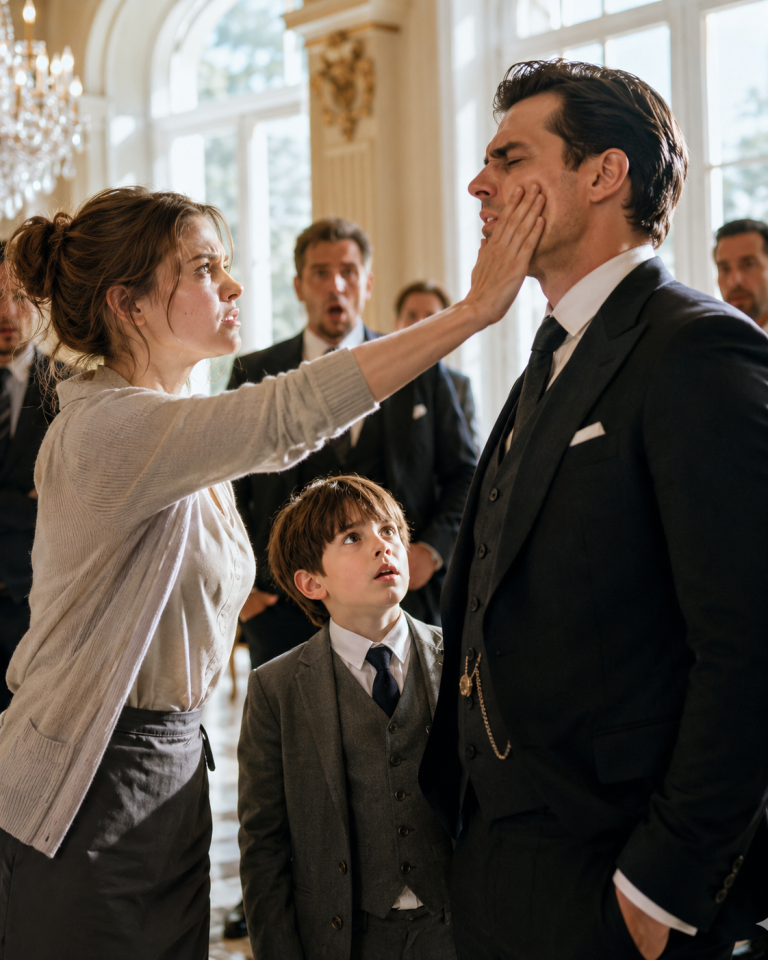
The Whole Town Laughed at the Plus-Size Woman They Called “Too Big to Love” — Then a Mountain Man Chose Her as His Bride

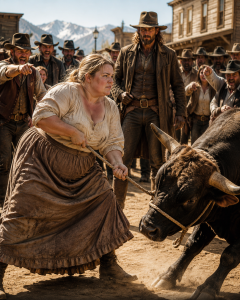
—
## PART ONE
The train’s brakes screamed like something dying, and Clara felt it in her chest — metal grinding against metal, the whole car shuddering as Red Hollow’s excuse for a station rolled into view. Through the dust-smeared window she could already see them gathering. A dozen faces, maybe more. Waiting.
“You getting off here, miss?” The conductor stood in the aisle, hat in hand, not quite hiding the curiosity in his eyes. He’d been stealing glances at her the whole ride from Omaha — at her size, at the worn state of her luggage, at the way she sat alone while other passengers clustered in chattering groups.
“Yes.” Her voice came out smaller than she wanted. “Yes, I am.”
“Well.” He shifted his weight. “Good luck to you.”
The way he said it made her stomach drop.
Clara stood. Her legs felt like water. She’d practiced this moment a hundred times during the three-day journey — stepping off with her chin up, her shoulders back, looking like a woman who belonged somewhere. Her reflection caught in the glass as she moved toward the door. Round face. Arms that strained against her sleeves. Hair that never did what it was told, even pinned tight under her bonnet. Twenty-four years old, already carrying the weight of a lifetime of being looked at the wrong way.
The conductor opened the door. Heat slammed into her — dry, choking, tasting of alkali and horse dung. The crowd’s chatter died the instant she appeared. Silence hit harder than any insult ever had.
She gripped the handrail and descended. One step. Two. Three. Her boot heels clicked against the wooden platform, loud as gunshots in that terrible quiet.
Then someone laughed. Low, from the back of the crowd. It spread — a woman’s high giggle, a man’s guffaw — until the whole platform was alive with it.
“Jesus, look at the size of her.”
“That’s what he ordered?”
“Man must’ve been desperate, taking a pig like that.”
The voices crashed over her in waves. Clara’s vision blurred at the edges, her chest too tight to breathe right. *Don’t cry. Don’t you dare cry.* She forced herself to look up. A rough semicircle of dusty workclothes and faded calico, faces ranging from openly mocking to merely curious. A few children pushed to the front with the brutal honesty of the young.
“Where’s the groom?” someone called. “Boon, you seeing this?”
Her eyes swept the crowd, searching for Ezekiel Boon — the man whose letters had been her lifeline these past four months. *I need a wife who can work, who won’t break,* he’d written. *The frontier doesn’t care what you look like, only what you’re made of.* She’d believed every word. But standing here while this town laughed at her like a sad traveling attraction, doubt sank its teeth in deep. What if it had all been a cruel joke?
“That’s enough.”
The word cut through the noise like a blade. The laughter sputtered out in awkward patches as the crowd turned. A man stepped forward — tall, lean in a way that spoke of hard work rather than hunger, maybe thirty-five, the frontier aging people in ways that defied counting. Dusty brown trousers, a collarless shirt with the sleeves rolled to his elbows, a hat weathered nearly past recognition. His face was hard angles and sun-dark skin. But it was his eyes that stopped her breath — dark, steady, looking right at *her*. Not at the parts of her that inspired whispers.
He stopped three feet away, close enough that she could see the scar cutting through his left eyebrow, the calluses on his hands.
“Clara Lynwood.” His voice matched his face — rough, spare, offering nothing extra.
“Yes.” She managed to get the word out without her voice breaking. “Mr. Boon.”
He nodded once. Then he did something she didn’t expect. He removed his hat.
“Sorry about the welcome,” he said, loud enough for the crowd to hear. “Red Hollow’s got some people in it who forgot what manners look like.” He scanned the faces around them, and when he spoke again his voice carried a warning. “We done here, or do some of you need more to stare at?”
The crowd began to disperse, slowly at first, then faster as his gaze landed on specific people. Within a minute the platform had mostly cleared.
But not everyone left.
A man emerged from the shadows of the station house — younger than Ezekiel, maybe twenty-eight, and where Ezekiel was rough-cut and weathered, this one looked polished. Pressed trousers, clean white shirt, hair slicked back with pomade. His smile showed teeth.
“Brother.” The word dripped something that wasn’t quite affection. “You didn’t mention your bride was arriving today.”
Ezekiel’s jaw tightened. “Didn’t know it was your business, Victor.”
*Victor.* Clara remembered that name from the letters — Ezekiel’s younger brother, gone east for schooling, come back with big ideas. *Ambitious in ways that make me nervous,* he’d written.
Victor’s eyes slid over Clara, up and down, taking inventory. She felt it like hands on her skin. “Miss Lynwood.” He swept his hat off with a flourish that made Ezekiel’s simple gesture look crude. “Victor Boon. A pleasure.” He took her hand and held it a beat too long. “Quite the journey you must have had. All the way from Philadelphia.” His smile widened. “And here I thought Ezekiel’s advertisements reached only as far as Chicago. He must have cast quite the wide net to land such an unexpected catch.”
The insult was there, wrapped in courtesy. Clara pulled her hand free.
Ezekiel stepped between them. “We’re leaving.”
“Of course, of course.” Victor backed up, hands raised in mock surrender. “I’m sure you two have much to discuss. The ranch, the arrangements, the—” his smile turned sharp — “well, all of it.” He replaced his hat, tipped it to Clara. “Welcome to Red Hollow, Miss Lynwood. I’m certain you’ll find it *educational*.”
He strode toward a buggy hitched near the station, and then it was just the two of them, standing in a silence Clara had no idea how to fill.
—
## PART TWO
Ezekiel retrieved her trunk from the baggage car without a word — everything she owned in one piece of brown leather, two dresses, her mother’s Bible, four months of letters tied with string. He carried it to a plain buckboard wagon, working animals, no show ponies.
“Can you manage the step?”
She climbed up. The wagon groaned under her weight, and she saw him glance at the axle, saw him notice. Her face burned. He climbed up beside her without comment and took the reins.
They rode through Red Hollow’s single rutted street, past a saloon and a general store and a building that might have been a church, people watching from doorways as they passed. Clara kept her eyes forward, but she could feel the stares.
“About what happened back there.” Ezekiel spoke without looking at her. “I won’t tolerate it. People running their mouths about my wife.”
*My wife.* They weren’t married yet. She’d assumed there’d be a ceremony first.
“We’re not—”
“We will be. Soon as we get you settled. Judge comes through next week.” He glanced at her, then back to the road. “Unless you’ve changed your mind. You’re within your rights.”
“Have you?”
“No.” Simple, definite, like everything about him.
They rode in silence for a while before he pulled the wagon to a stop in the middle of nowhere — just grass and sky and the far outline of mountains. He turned to face her properly for the first time.
“I’m going to tell you something, and I need you to hear it. I didn’t write those letters looking for pretty. Pretty doesn’t feed cattle or mend fence or survive a winter that’ll freeze you dead if you’re not careful. I wrote looking for someone strong enough to build a life out here. You answered. You came. That took more courage than most people in that town will ever have.”
Clara’s throat tightened.
“So no, I haven’t changed my mind. Question is whether you have. Once we’re married, you’re stuck with me, with the ranch, with all of this.” He gestured at the empty land around them. “It’s not romantic. Most days it’s just hard work and going to bed too tired to think.”
“I’m not afraid of hard work.”
Something that might have been a smile flickered and vanished. “Knowing something and living it are different things.” He released the brake. “We’ll try it. See how it goes. You don’t like it, I’ll put you on the train back east. No questions, no shame.”
“I don’t want to go back.” The words came out harder than she’d intended. But they were true.
They crested a hill, and the ranch came into view — a one-story house with a sagging porch, a barn that had seen better days but still stood square, a corral holding two dozen cattle. Rough, weathered, real.
“Home,” Ezekiel said simply.
A woman emerged from a cabin near the barn — fifty, maybe older, built like a fence post. “So you did bring her,” she called across the yard. “Sarah,” Ezekiel said, climbing down, offering Clara his hand.
Sarah looked Clara up and down with the same assessing gaze as everyone else, but there was something different in it. Not mockery. Evaluation.
“You cook?”
“Yes, ma’am.”
“Ride?”
“I’ve been on a horse once.”
“She’ll learn,” Ezekiel said, already carrying the trunk toward the house.
That night, after a meal and a house tour and exhaustion that pulled her under fast, Clara woke to voices outside — low, urgent, coming from near the barn. In the moonlight she made out two figures. Ezekiel. And someone else, gesturing sharply, moonlight catching a watch chain, vest buttons.
Victor.
Even from the window she could see the tension in Ezekiel’s shoulders, the way he stood like a man holding himself back from violence. The argument went on for minutes before Victor stalked to his horse and rode for town. Ezekiel stood alone in the yard a long time before he turned back toward the house.
Clara stepped away from the window before he could see her watching, heart hammering. What had they been fighting about? The ranch? Money?
Her?
—
## PART THREE
Morning came with roosters screaming and a cold stove that needed starting from scratch. By the time Ezekiel came in, dirt on his clothes from hours of work already done, biscuits were pulled from the oven and he ate without ceremony.
“I heard voices last night,” Clara said finally. “You and someone.”
His jaw tightened. “Victor. Nothing you need to worry about. Family business.” The dismissal stung, but she let it go. He grabbed his hat and was gone before she could ask anything else.
The first week passed in a blur of work that made her previous life look like a vacation — dishes, laundry, water hauled until her shoulders screamed, chickens mean as snakes, a garden that yielded just enough. Sarah helped, and Sarah judged. “You call that kneaded?” she said on the third morning, poking at Clara’s dough. “Looks like you gave up halfway through.” Clara bit back a response and worked the dough until her arms shook.
Slowly, things began to click. By the eighth morning, Ezekiel looked up from a plate of eggs and bacon.
“This is good.” Two words, landing like a compliment from a king.
“Thank you.”
He looked at her properly then. “You’re managing all right?”
“Yes.”
“Sarah’s not riding you too hard?”
“She’s teaching me.”
Something like approval crossed his face. “That’s how she does it. Hard at first. Eases up once she sees you’re not going to quit.” He stood to leave, and Clara found herself asking something that surprised her.
“Can I come with you sometime, when you ride out?”
He paused, hat halfway to his head. “You want to?”
“You said I’d need to learn to ride. Seems like I should start.”
“Tomorrow, then. But I’m warning you, it’s not like riding schools back east. You’re going to fall.”
“I’m not afraid of falling.”
His mouth twitched, almost a smile. “No, I don’t suppose you are.”
—
She was hanging laundry when Victor came, riding up the path like he was posing for a portrait, dressed like he was going to church despite the heat.
“Mrs. Boon.” He swept off his hat. “Or should I still say Miss Lynwood? I confess I’m unclear on whether the vows have been spoken.”
“Ezekiel’s not here.”
“I know. I came to see *you*.” Warning bells went off in her head. “I must say, I had hoped my brother would hire help for such tasks. A woman of your obvious quality shouldn’t be reduced to manual labor.”
The insult was wrapped so prettily she almost missed it. “I don’t mind the work.”
“How gracious.” He leaned against the porch rail, making himself comfortable. “Tell me — how are you finding Red Hollow? Have the people been welcoming?”
Clara’s hands twisted in the wet fabric. “As welcoming as can be expected.”
“Ah. Small towns can be provincial. They fear what they don’t understand.” His smile never wavered. “Ezekiel showed me your letters, you know, before he sent for you. Wanted my opinion on whether he was making a mistake.”
Her breath caught. “And what did you tell him?”
“That a man gets lonely out here. That loneliness makes us see what we want to see rather than what’s really there.” He pushed off from the rail. “I confess I do have a concern. It’s about the ranch’s situation. We’re not doing well, Clara. May I call you Clara? Last winter was brutal. We lost a quarter of the herd. And Ezekiel, stubborn as he is, refuses to modernize.”
Clara’s mind raced. Ezekiel had never mentioned money troubles. “If things are so bad, why did he send for a wife?”
“Pride.” Victor said it like it explained everything. “He’s trying to prove he can build something lasting. But pride doesn’t pay debts.” He stepped closer, close enough that she could smell whiskey on his breath. “I tell you this because you deserve to know what you’ve walked into.”
The door to Sarah’s cabin banged open.
“Victor.” Sarah’s voice cut across the yard like a whip crack. “What are you doing here?”
“Just visiting.”
“It’s a visit when Ezekiel’s not around and you’re bothering his wife.” Sarah crossed the yard fast for a woman her age, positioning herself between Victor and Clara. “You’ve said your peace. Now get on your horse.”
Something cold showed through Victor’s smile. “Careful, old woman. Your position here isn’t as secure as you think.”
“My position’s fine. Yours is the one that’s shaky. Ezekiel knows what you’re trying to do. We all do.”
“And what am I trying to do?”
“Undermine him. Make him look weak so you can swoop in and take what’s his.”
He recovered his smile from wherever he’d dropped it. “I can see I’m not wanted.” He mounted and rode off without another word.
“That bastard,” Sarah muttered, watching him go. “Their father died five years ago,” she told Clara later, as they finished the laundry. “Left the ranch to Ezekiel. All of it. Victor got money — a decent sum — but he wanted the land. Contested the will, lost every time. Came back with big plans, wanted to be partners, but his help always seemed to benefit him more than anyone. They fought. He’s been circling ever since, waiting for Ezekiel to fail so he can step in and claim what he thinks is his.”
“And now I’m here.”
“And now you’re here, and Victor sees that as either a weakness he can exploit or a threat he needs to eliminate. Be smart. Don’t trust him. And don’t repeat anything he says to you — he’s a collector. Gathers information like other men gather coins.”
That night, over venison stew, Clara told Ezekiel everything Victor had said.
His face went hard. “He said that?”
“Yes. And you believed him?” “I don’t know what to believe. I’ve been here eight days. I don’t know anything about ranching or finances or whether we’re drowning or thriving.”
Ezekiel walked to the window, looked out at nothing for a long moment. “We’re not rich. Never claimed to be. Last winter was hard — Victor’s right about that much. But we recovered. We always recover.” He turned to face her. “He wanted to bring in investors, run this like a factory back east. I said no. I’ve seen what happens when city money comes to the frontier. It squeezes everything dry and leaves.”
“He also said you keep things from me. That you don’t share your worries.”
“You want my worries?” His voice hardened. “Fine. I worry we won’t have enough feed for winter. I worry about disease in the herd, about fence lines, whether the creek runs dry in August. Everything that can go wrong out here eventually does.” He leaned on the table with both hands. “But I don’t dump that on you because you’ve got enough to carry learning how to survive here. Once you’re settled, we’ll talk about money and planning.”
“And what if I want to help now? What if I want to be treated like a partner instead of a child?”
Something flickered in his expression — surprise, maybe. Respect. “All right,” he said slowly. “Tomorrow, after I teach you to ride, we’ll go over the books.”
“Thank you.”
“But next time Victor comes around when I’m not here — don’t be alone with him. Don’t listen to his poison.”
“Sarah already told me the same thing.”
“Good. Then you’re learning.”
—
He kept his word. The next morning he taught her to ride on a patient old mare named Birdie, and that afternoon he spread the ranch’s ledgers across the kitchen table.
“We’re not drowning,” he said, running his finger down a column of numbers. “But we’re not exactly swimming either.”
Clara studied the figures — she’d kept her father’s household accounts back in Philadelphia. “You could sell some of the north pasture. The section that’s mostly rock. It’s not good grazing anyway.”
Ezekiel looked at her sharp. “You’ve been paying attention.”
“You said the north fence line needed checking. That means it’s not used much.”
He stared at her a long moment, then laughed — actually laughed. “Sarah’s right. You’ve got spine.”
The weeks rolled on. Clara’s riding improved. Her bread stopped coming out like rocks. She and Ezekiel found a rhythm — quiet mornings, small conversations that grew less awkward. On the thirteenth day, the judge came in a dusty buggy.
“You both understand what you’re agreeing to?” he asked. “Marriage in the territory is binding. No easy divorces out here.”
“We understand,” Ezekiel said.
“And you, Miss Lynwood — entering this marriage of your own free will? No coercion?”
“None.”
The ceremony lasted five minutes. *I do. I do. Sign here.* And just like that, Clara Lynwood became Clara Boon.
That night was the most uncomfortable of her life — Ezekiel moving his few belongings into the bedroom, both of them changing for bed in painful silence, lying in the dark with a careful foot of space between them.
“You don’t have to be nervous,” he said eventually.
“I’m not nervous.”
“You’re breathing like you’re about to bolt.”
She forced herself to breathe slower. “I don’t know what I’m supposed to do.”
“Neither do I.” He shifted. “We’ll figure it out. Same as everything else.”
“Is that what marriage is? Just figuring things out?”
“I think so. At least out here.” The honesty in his voice steadied her. He was just as lost as she was. “Thank you,” she said quietly, “for being patient.”
“Get some sleep, Clara. Morning comes early.”
—
October came. Clara was riding the eastern fence line alone for the first time, feeling competent for the first time since arriving, when Sam reared at a snake in the brush and threw her. The impact knocked the air from her lungs; pain exploded through her leg, bent at an angle that made her stomach lurch.
She lay there gasping, half a mile from the house, alone. By the time Ezekiel found her — hoofbeats, his voice calling her name, the ridge, the run — the sun had moved and the pain had settled into something constant.
“What happened?”
“Snake. Sam spooked. I fell.”
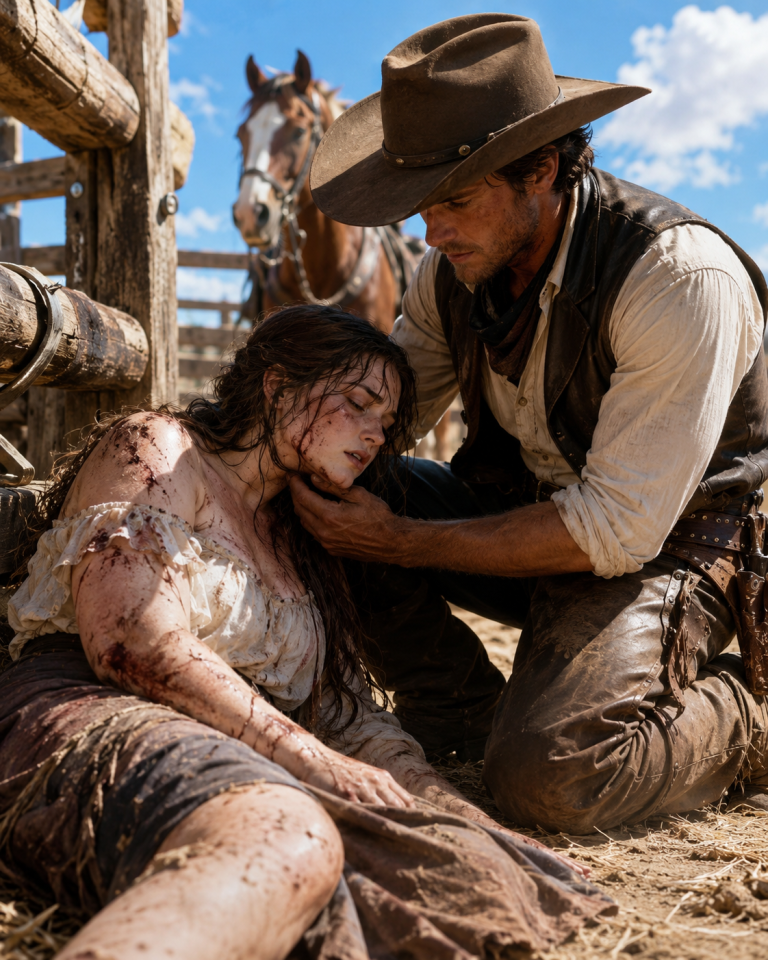
His hands moved over her carefully. When he touched her leg, she screamed.
“All right. All right. I’ve got you.” His face was white. He pulled a knife from his belt. “I need to cut this fabric away from the injury. Need to immobilize the leg before I move you. You understand?”
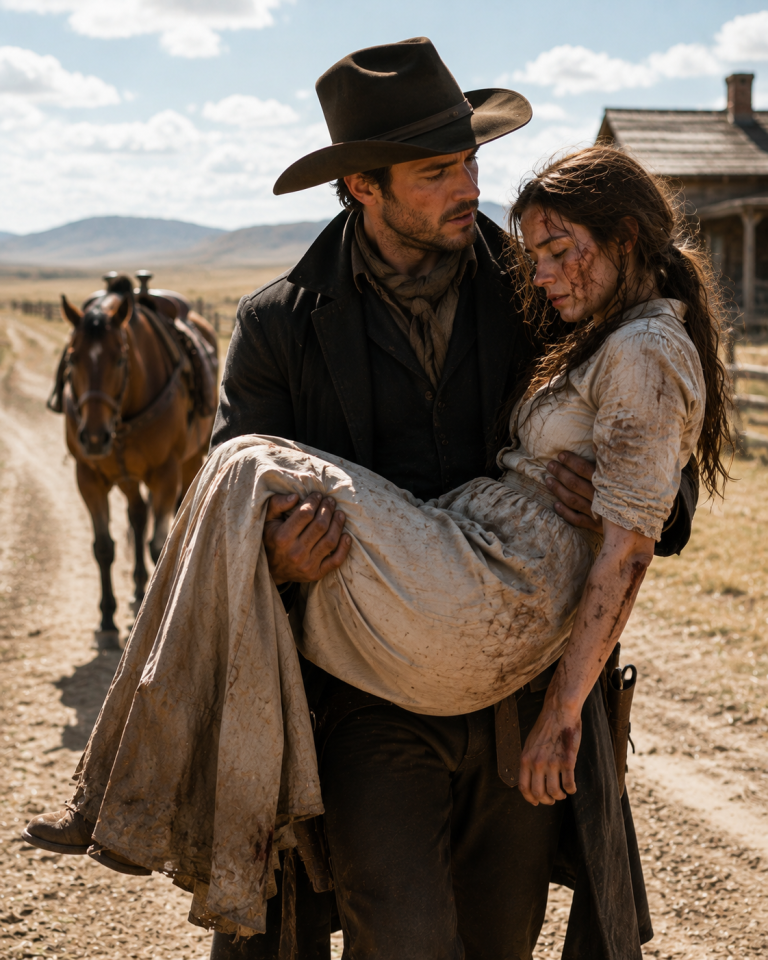
She nodded, teeth gritted. He worked fast — fashioning a splint from his belt and fence-post pieces, securing it with a care that belied his rough hands. “Definitely broken,” he said. “But the bone hasn’t broken skin. That’s good.” He lifted her, carried her to his horse despite her crying out, and rode back with one arm locked around her waist.
“This is my fault,” he said as Sarah took over, sending the hand for the doctor. “I shouldn’t have let you go alone.”
“Wasn’t your fault. Was a snake.”
The doctor set the bone that night while she bit down on a leather strap. *Clean break,* he pronounced. *Could be worse. Six weeks off it minimum, or she’ll limp the rest of her life.* Ezekiel sat beside the bed until dawn, and when Sarah finally sent him out to do something useful, Clara felt something had shifted — that the accident had cracked more than her leg.
—
Three days later, Sarah came back from town with her face like carved granite.
“We need to talk.”
“What happened?”
“The whole damn town is talking. About you, about Ezekiel, about what they think happened out there when you fell.” Sarah’s jaw worked. “Someone saw him bring you back — your dress torn, your leg exposed, him carrying you. They’re saying he dishonored you.”
The words didn’t make sense at first. “That’s insane. He was helping me. My leg was broken.”
“I know that. You know that. Red Hollow doesn’t care about the truth when a lie is more interesting.”
“Who’s saying these things?”
Sarah’s expression went dark. “Take a guess.”
Victor. Of course it was Victor — buying drinks at the saloon, expressing concern for his poor brother’s unfortunate situation, and by morning half the town had heard the worst possible version of events.
When Ezekiel came storming in from the south pasture and heard it, his face went from confusion to fury in seconds. He punched the doorframe hard enough to split his knuckles.
“That son of a bitch.”
“He’s playing a long game,” Sarah said quietly. “This isn’t just about embarrassing you. He’s making people question whether you’re fit to run this ranch. And if the whole territory thinks you’re some kind of deviant, good luck getting fair prices for your cattle. Good luck getting help when you need it.”
“We could leave,” Clara said suddenly. “Go somewhere else. Start over.”
“And let Victor win.” Ezekiel’s voice was hard. “This is our land. I’m not running.”
“Then what?”
“We fight back. A public meeting. We call them out. Make them face us instead of whispering behind our backs.”
Sheriff Carson confirmed it the next morning — a town meeting, called by the mayor, to address “concerns about moral conduct.” Clara caught the flicker of disgust the sheriff himself couldn’t hide.
“Between you and me,” he admitted, “I think this is horseshit. But the mayor felt obligated.”
“The mayor being Victor’s drinking buddy,” Sarah said from the doorway.
Carson didn’t deny it.
—
That night, Clara couldn’t sleep, and neither could Ezekiel. She found him in the main room, pacing.
“Come here,” she said. He crossed to sit on the edge of the bed, exhaustion etched into his face.
“This isn’t your fault,” she told him.
“Feels like it is.”
“Victor would have found some way to attack you regardless. If it wasn’t this, it would’ve been something else.” She reached for his hand; he let her take it. “He’s jealous. Bitter. That’s all this is.”
“Doesn’t make it hurt less.”
“No. But it means we can’t let him win.” She squeezed his hand. “If we’re doing this meeting, we need to be smart about it. Strategic.”
“You sound like you have a plan.”
“Maybe I need to think it through.” Her mind was already working, pieces falling into place. “Whatever happens, we face it together. That’s what partnership means.”
Something shifted in his expression. “You’re stronger than I gave you credit for.”
“I’m stronger than anyone gave me credit for. Including myself.”
—
The night of the meeting, the hall was packed, every seat taken, people standing along the walls. Victor stood near the front, dressed impeccably, his expression one of practiced concern. When he saw them enter — Clara on a crutch Ezekiel had fashioned from a branch, refusing to be carried — something flickered across his face. Surprise. He hadn’t expected them to show.
*Good,* Clara thought. *Let him sweat.*
Mayor Hutchkins banged his gavel. “We’re here tonight to address some serious concerns brought to the council’s attention. Concerns about moral conduct.” He looked around the room. “Victor Boon has brought forward some troubling allegations regarding his brother. Victor, would you like to speak?”
Victor stood with apparent reluctance. “Thank you, Mayor. This pains me deeply — Ezekiel is my brother, my blood — but I have a moral obligation to this community. Three days ago, Mrs. Boon suffered an accident while riding alone. When Ezekiel brought her back, her clothing was severely damaged, her leg exposed in a manner no decent woman would allow unless something improper had occurred. And this happened in a remote location. No witnesses. Only my brother’s word.” He paused, letting it sink in. “I desperately want to believe he acted honorably. But the appearance of the situation raises questions.”
“That’s enough.” Ezekiel stood, and the room went silent. “You want to accuse me of something, Victor? Then say it plain. Stop hiding behind concern.”
“I’m not accusing you of anything, brother. I’m simply asking for clarity, for Mrs. Boon’s sake.”
“Her reputation.” Ezekiel’s laugh was harsh. “You’ve been working to destroy her reputation since the moment she arrived. Don’t pretend this is about protecting her.”
“That’s a serious accusation.”
“Because I remember you visiting our ranch when I wasn’t home. Filling her head with lies about our finances. Watching us like a hawk, waiting for anything you could twist into scandal.” Ezekiel turned to address the room. “My brother wants this ranch. He’s wanted it since our father died and left it to me. Everything he’s done since — the legal challenges, the rumors, this meeting — it’s all been about taking what he thinks he’s owed.”
“That’s a lie.” Victor’s composure cracked. “I’ve built my own life. I don’t need your failing ranch.”
“Then why are you here?” Clara’s voice rang out clear and strong. She got to her feet, leaning hard on the crutch. “If you don’t care about the ranch, why dedicate so much energy to destroying us?”
“Mrs. Boon,” the mayor started. “Perhaps you should sit.”
“I’ll stand.” Her legs trembled, but she locked her knees. “You want to know what happened three days ago? I’ll tell you every detail.” She described it all — the fall, the crack of bone, lying alone and terrified. “My husband found me. He assessed the situation and realized my leg was broken badly enough that moving me without stabilizing it could cause permanent damage. So he did what any competent man would do — he used what was at hand. That meant cutting my dress to reach the injury. Was it improper by the standards of a Philadelphia drawing room? Yes. We are not in Philadelphia. We’re on the frontier, where sometimes survival matters more than modesty. My husband saved my leg. Possibly my life, if infection had set in during a longer delay. And for that, you want to hang him.”
“No one’s talking about hanging anyone,” Hutchkins said quickly.
“Aren’t you? You’ve called this meeting, put us on trial, based on the word of a man with demonstrable bias against my husband.” Clara turned to Victor. “Tell them. Tell them about visiting me when Ezekiel was gone. About how you’ve been trying to drive a wedge between us since day one.”
“I was trying to help you.”
“Liar.” The word came out flat and cold. “You saw me as a weakness — a way to get to Ezekiel. Thought a desperate woman from back east would be easy to manipulate. And when I didn’t leave, you needed a new strategy.” She took a painful step forward. “I’m starting to wonder if maybe you had something to do with my accident.”
The room erupted. Hutchkins banged his gavel. Victor went white with fury. “That’s slander.”
“Is it? You were very interested in my riding schedule. And my horse spooked at something in the brush I never actually saw.” Clara was improvising now, working on instinct — she had no proof, only the doubt creeping into faces around the room. “Ask him about Catherine Mills.”
Victor went rigid. “Don’t.”
“Who’s Catherine Mills?” someone called out.
“A woman Victor courted two years ago,” Clara said, trusting her gut. “Before he came back to Red Hollow. Ask him what happened to her.”
Sheriff Carson spoke up from the back. “I recall hearing something about that. Trouble in Denver.”
“He promised her marriage,” an older man near the front said slowly, “took money from her father for a business venture, then disappeared when it failed. Left her ruined.”
The crowd’s mood shifted like a change in air pressure. “That’s not — I never—” Victor looked around wildly, seeing his support crumble. “This is a distraction from the matter at hand.”
“About how you’ve been playing this town like a fiddle,” Sarah said, standing now too, “feeding them stories designed to make Ezekiel look bad so you could swoop in and take over.”
Sheriff Carson moved to the front. “I’ve been thinking, since yesterday, about who benefits from all this scandal. Who’s been buying drinks, stoking the fires.” He looked at Victor. “It all comes back to you.”
“You’re all fools.” Victor’s carefully built facade shattered completely. “Ezekiel’s failing. This ranch is dying. I could have saved it — modernized it, made it profitable — but he’s too stubborn to accept help from anyone.”
“There it is.” Ezekiel’s voice was quiet, but it carried. “The truth. You don’t care about my wife’s honor. You want my land.”
“I deserve that land!” Victor was shouting now, all control gone. “I’m the one who went to school, learned business, brought back knowledge — but Father left everything to you because you stayed and played cowboy!”
“You left. Chose to chase your ambitions. I stayed and worked myself half to death keeping the ranch alive.” Ezekiel’s hands were fists at his sides. “I earned what Father left me by being there. By showing up. By caring about something other than myself.”
“You’re not special, Ezekiel. You’re just stubborn, and now you’ve tied yourself to this—” Victor turned to Clara, mask completely gone. “This desperate, pathetic creature who latched onto my brother because no one else would have her.”
The silence that followed was absolute.
Then Clara smiled.
“Thank you.”
“For what?”
“For finally showing everyone who you really are.” She looked around the room. “You all heard it. The concern, the worry for my welfare — all lies. He doesn’t care about honor. He just hates that I exist. Hates that Ezekiel chose to build something instead of wallowing in the loneliness he was counting on.”
Mayor Hutchkins cleared his throat. “I believe we’ve heard enough.”
“I agree,” Sheriff Carson said. “Mrs. Boon, Mr. Boon — I believe your account of what happened. I’m sorry this got as far as it did.” He turned to Victor. “Go home. Or better yet, go back to Denver. I don’t think Red Hollow’s going to be very welcoming to you from here on out.”
“This isn’t over,” Victor said, but there was no power left in it.
“Yes, it is.” Ezekiel’s voice was final. “Stay away from my wife. Stay away from my ranch.”
Victor straightened his vest with shaking hands, trying to recover some dignity he no longer had, and walked out with his back rigid. Clara knew, watching him go, they’d never see him as a real threat again.
—
The adrenaline drained away on the ride home, leaving her shaking. Ezekiel caught her when she swayed.
“We did it,” she whispered.
“You did it. That was all you.”
She slept fourteen hours straight. When she woke, sunlight streamed through the window, and Ezekiel sat beside the bed watching her.
“You were extraordinary last night. I was terrified.”
“Didn’t show. You faced that whole room like you owned it.”
“I was mostly making things up as I went. The part about Catherine Mills — I didn’t actually know anything. But your face when I said Denver told me I’d hit something, so I pushed.”
He laughed — actually laughed, a sound she’d almost never heard. “You’re dangerous.”
“Only when I need to be.” She sobered. “Victor’s leaving?”
“Heard from the sheriff. Packing up, heading back east. Several people made it clear he’s not welcome here anymore.”
“Good.”
“Good,” he echoed, then went quiet a moment. “I’m sorry you had to defend yourself, defend us, in front of that mob.”
“They weren’t all a mob. Some listened. Changed their minds.”
“Because you made them.” He leaned forward. “Clara, I know this hasn’t been easy. Wasn’t what you expected when you answered my letters. But I want you to know — I’m glad you’re here. Glad you stayed. Glad you’re my wife.”
The words landed somewhere deep in her chest. “I’m glad too. Even with the broken leg and the scandal and all of it.”
“Even with all of it.”
She reached for his hand. “This is where I belong. With you. Building something real.”
He raised her hand to his lips and kissed it — a gesture so unexpected it made her breath catch. “Then let’s build it,” he said. “Together.”
—
Recovery was slow. Clara hated her own helplessness those first weeks, watching Ezekiel do the work of two people, watching Sarah manage the kitchen while she sat propped in bed useless. But the north pasture sold to the Hendersons for a fair price — more than fair, Ezekiel suspected, out of quiet guilt over the town meeting — and the cushion it gave them let him breathe easier through winter.
“You were right about that land,” he told her one morning. “About a lot of things.”
“We’re partners. That’s what partners do.”
By December she could walk short distances without the crutch, the bone healing straight, though the doctor warned her of a permanent limp. She accepted it. Vanity seemed pointless out here — what mattered was function, and her body had already proven it could carry her through worse.
Winter deepened. Ezekiel talked more now, told her small things about his day, asked her opinions and actually listened. One night in mid-December she woke to find him by the window, unable to sleep, thinking about Victor — whether he was really gone or just waiting.
“Maybe there is no other shoe,” Clara said. “Maybe we won.”
“Doesn’t feel like winning.”
“What would winning feel like?”
“I don’t know.” He turned to look at her. “Not this. Not constantly waiting for the next disaster.”
“That’s not Victor. That’s just life out here.” She crossed to sit beside him. “Every day something could go wrong. We can’t control it. Can only deal with it when it comes.”
“Aren’t you scared?”
“Terrified. Every day. But being scared doesn’t change anything. So I do what needs doing anyway.”
He studied her in the moonlight, then, hesitantly, reached for her hand — the first time he’d initiated touch since their wedding night. “Thank you,” he said quietly, “for staying. For fighting. For being here.”
“Where else would I be? Philadelphia didn’t want me. Red Hollow didn’t want me. But you did.” She squeezed his hand. “That matters more than easy.”
That night the space between them narrowed. Not gone — they still had miles to cross — but narrower.
By February, that space had closed almost completely. “This marriage started as a transaction,” Clara told him one morning, watching him wake. “But it doesn’t have to stay that way. I care about you. About this life. And I think — I hope — you feel something similar.”
The silence stretched so long she thought she’d miscalculated badly.
Then he reached for her hand. “I’m not good with words. Never have been. But yeah. I feel it. Have for a while. Just didn’t know how to say it.”
“You don’t have to say it. Just don’t hide from it.”
He kissed her that night for the first time — clumsy, both of them out of practice, but real. They took their time after that. No rushing. Slow exploration of what it meant to be partners in every sense, and gradually, carefully, they became something neither of them had expected to find out here.
In March, Clara discovered she was pregnant.
“I’m pregnant,” she told him over supper, and Ezekiel froze with his coffee cup halfway to his mouth.
“You sure?”
“Pretty sure.”
“How do you feel about it?”
“Terrified. Excited. Sick to my stomach most mornings.” She searched his face. “How do you feel about it?”
“Same. All of it.” He crossed to kneel beside her chair, touched her face. “A baby.”
“You’re going to be a father.”
“I don’t know how to be a father.”
“Good thing babies don’t know how to be babies. We’ll figure it out together.”
The news spread through town, and the response surprised her — women she’d never spoken to stopping her at the general store to offer advice, the doctor riding out to check on her and refusing payment, a cradle left on their porch with a note that just said *Congratulations.* Not universal acceptance. Some still whispered. But the hostility had faded to something closer to wary tolerance, and after everything, tolerance felt like enough.
She felt the baby move for the first time in June — a flutter, then something stronger, strong enough that Ezekiel came running from the barn when she called him, pressed his hand to her stomach, and felt it too.
“That’s our child,” he said, wonder cracking his voice. “That’s our child.”
On the fifth of October, just after midnight, Clara woke to pain that made her gasp. The hours that followed blurred into something worse than breaking her leg had ever been — her body tearing itself open to make way for new life, Sarah’s calm instructions, Ezekiel’s hand gripped so hard she probably bruised his fingers, his voice steady through her cursing him for doing this to her, staying despite Sarah trying twice to order him out.
Dawn light was creeping through the window when the baby finally came — a sound unlike anything else, high and outraged.
“It’s a girl,” Sarah announced.
Clara collapsed back against the pillows, shaking, weeping and laughing at once. Sarah placed the baby in her arms — small, red, furious at the world. Perfect.
“She’s beautiful,” Ezekiel whispered. She wasn’t, not really, not yet. But she was theirs.
“What should we name her?”
They’d discussed names and never decided. Now, looking at that tiny scowling face, Clara knew.
“Hope,” she said. “Her name is Hope.”
Ezekiel touched one finger to the baby’s fist. She grabbed it, grip surprisingly strong.
“Hope Boon.” He said it softly, like a promise. “Welcome to Montana.”
—
Years later, when Hope was old enough to ask, Clara would tell her the whole story — the train, the laughing crowd, the man who took off his hat when no one else showed her a single kindness. She’d tell her about the brother who tried to burn it all down, and the town meeting where the truth finally won. And when Hope asked why she hadn’t just gone back east where it would have been easier, Clara always gave the same answer.
“Because Philadelphia decided who I was before I ever opened my mouth. And out here, for the first time in my life, I got to decide for myself.”
She never forgot the girl who’d stepped off that train believing she was worthless. But she stopped being her the day a scarred, quiet stranger looked past everything the world had trained her to be ashamed of and saw, instead, someone worth defending.
That winter, with Hope asleep in the cradle a stranger had left on their porch, Clara stood at the window watching snow fall over land that was finally, entirely, hers — not because anyone had given it to her, but because she’d stayed and fought and built until it couldn’t belong to anyone else.
Ezekiel came up behind her, wrapped his arms around her, and for a long moment neither of them said anything at all. They didn’t need to.
Outside, the mountains stood white and silent, keeping watch over a family that had been made, not born — out of stubbornness, out of choice, out of two broken people who had decided, one letter at a time, to become whole together.
**THE END**