HIS GIRLFRIEND SENT OUT FUNERAL INVITATIONS FOR MY MOTHER BEFORE SHE HAD EVEN DIED — THE VISITOR LOG SHOWED EXACTLY WHY

# Part 1: The Invitation Sent Too Soon
My cousin Josephine was the one who put the phone in my hands.
Not after the doctor pulled me into the pale hallway and lowered his voice. Not after the hospice nurse folded my mother’s fingers over the quilt she had stitched herself back in the seventies. Not after the chaplain came by with his soft leather Bible and asked if there was anyone my mother wanted called before the end.
Before all of that.
While my mother was still breathing.
While her chest still rose, faint as a held breath, beneath the pale gray blanket at Cormorant Point Hospice in Newport, Rhode Island. While her hand, thin and cold as something washed ashore, still found mine every time I whispered, *I’m here, Mom.*
“Margot,” Josephine said, barely above a whisper, stepping into the doorway of Room 12. “You need to see this.”
The screen showed a cream digital invitation edged in gold foil.
*A Celebration of the Life of Rosalind Kane. Hosted with love by Weston and Bianca. Saturday, two o’clock. Trinity Church. Reception to follow at Kane Hall.*
My mother’s name sat there in careful calligraphy.
My husband’s name sat beneath it.
And beside his, as though she had always belonged there, was Bianca’s.
Bianca Sorrell. The woman half of Newport pretended was only Weston’s “brand consultant.” The woman who wore ivory to my thirty-ninth birthday and called it neutral. The woman who touched Weston’s sleeve when she laughed, then glanced at me to make sure I’d noticed.
I stared at the screen until the letters blurred into one another.
Behind me, my mother took a long, ragged breath.
Alive. Still alive.
Weston walked in ten minutes later carrying two coffees, both for himself. His mother, Constance, trailed him in a strand of pearls that had probably cost more than my first car.
I held up Josephine’s phone. “What is this?”
Weston glanced at it once and looked away. “Margot,” he said, the way you’d address a child making a scene in a restaurant, “Bianca’s just helping. You’re overwhelmed.”
Constance sighed. “Honestly, dear, you should be grateful someone’s organized. Rosalind would hate chaos.”
Something in me went very still. I didn’t yell. I didn’t cry. I didn’t ask why the woman sleeping with my husband was planning my mother’s funeral while my mother’s heart was still, technically, beating in the room behind me.
I just looked at Weston, then at Constance, then down at my mother’s hand resting in mine.
At 5:17 that afternoon, the hospice nurse handed me the visitor log. Bianca Sorrell had signed in at 8:42 that morning. Under “relationship to patient,” she’d written *family.*
Beside the nurse’s note from earlier that day were eight words that turned the air in my lungs to ice: *Visitor asked how much longer the patient has.*
—
My mother had always hated being early. “Being early is just another way of saying you didn’t trust the moment to arrive on its own,” she used to tell me, standing in the kitchen at Kane Hall while coffee brewed and morning light came in sideways over the old hardwood.
Kane Hall wasn’t a mansion in the loud sense. It didn’t announce itself with iron gates or stone lions. It sat back from the harbor behind a low stone wall and a hundred-year-old copper beech, its shingles silvered by salt wind, its porch deep enough to hold whole conversations no one outside the family ever heard.
My mother inherited the house from her father, but she built the fortune that kept it standing. Rosalind Kane had been a widow at thirty-one with a six-year-old daughter and a folder of unpaid bills. By fifty, she owned Kane Maritime Holdings, two historic inns, and a third of the commercial waterfront. People said she could end a man’s confidence with one sentence delivered at half volume. They weren’t wrong.
Cancer did, eventually, what no man in a boardroom ever managed. It made her small.
For five months I split my life between our house in Middletown and a chair beside her hospice bed. I learned the rhythm of the oxygen machine. I stopped wearing mascara after the third time I cried it straight into my coffee.
Weston told people I was “not myself.” That explained everything to him. If I forgot to eat, I wasn’t myself. If I asked why he came home smelling faintly of Bianca’s perfume, I wasn’t myself. If I noticed charges from the yacht club on nights he claimed to be working late, I wasn’t myself.
By then I already knew about Bianca. Not because he’d confessed — men like Weston don’t confess, they reposition the truth until you feel guilty for finding it. I knew because I had eyes. Because her texts lit up his phone at midnight with no subject line and too many hearts. Because Constance once told me over brunch, “A man with Weston’s responsibilities needs softness in his life, Margot. You’ve become so heavy lately.” *Heavy.* That was her word for grief.
I had gone heavy while my mother was dying. Bianca, apparently, was light.
The invitation arrived on a Thursday morning in early October. My mother had been unconscious most of the day, but when I rubbed lotion into her hands, her fingers tightened weakly around mine.
“I’m here,” I whispered.
Her eyelids fluttered. I leaned in close.
“Don’t let them take the house,” she breathed.
I froze. “Mom?”
Her mouth moved again, but no sound came. The nurse said it was common near the end — patients drift between memory and fear. But my mother had never been afraid of dying. She was afraid of Weston. I knew that with the certainty of a daughter who’d spent her whole life reading what her mother chose not to say aloud.
That afternoon, after Josephine showed me the invitation, I walked into the hallway and called Weston.
He answered on the fourth ring. “Margot, I’m in a meeting.”
“Why is Bianca sending funeral invitations?”
A pause, then a sigh. “She has contacts. The church needed the details. Your mother’s passing is imminent.”
“Imminent isn’t dead.”
“Don’t be dramatic.”
Through the window I watched my mother’s lips part, struggling for air.
“You put your mistress’s name on my mother’s funeral invitation.”
Another silence. Colder this time. “Watch your tone,” he said.
There it was. Not the photos, not the galas, not the Christmas cards printed on heavy stock. Just those three words. The real marriage, finally visible.
When Weston arrived that evening, Bianca was with him, wearing black. Not navy. Not charcoal. Black. She carried a folder against her chest and offered me the gentle pity of a woman rehearsing widowhood on someone else’s mother.
“Margot,” she said softly. “I am so sorry.”
I looked at the dress. She glanced down as if surprised by her own choice. “I came from a donor lunch. I didn’t think—”
“You didn’t think my mother would still be alive.”
Her smile flickered.
Weston stepped between us. “Enough.”
Constance touched my shoulder, and I resisted the urge to shake it off. “Dear, grief makes people unkind,” she said, looking at Bianca instead of me.
Bianca gave a small, brave nod, as if she’d been wounded and had simply chosen grace. That was her real talent — turning other people’s knives into her own halo.
My mother’s breathing changed behind us. A wet rattle filled the room. For one long second, everyone stopped pretending.
The nurse came in, checked the monitor, and looked only at me. “Talk to her,” she said. “She can still hear you.”
I sat beside my mother and took her hand. Weston stood near the door, visibly irritated by death’s poor timing. Bianca studied the room like she was arranging flowers in her head. Constance murmured, “The lilies should be white.”
I leaned close to my mother’s ear. “Mom, I’m here. I’m not leaving.”
Her eyes opened. Cloudy, distant, but focused. She looked past me — at Weston, at Bianca, at Constance — then back at me. Her fingers tapped weakly against my palm. Three times. A habit from my childhood, back when a nightmare or a skinned knee sent me running to her. *I. Love. You.*
I tapped back.
She exhaled, and the room held its breath.
But she didn’t die. Not then. Not for three more days — three more days in which Bianca revised the flower order twice.
# Part 2: The Table Set for a Hostess Who Wasn’t Family
The dinner was Constance’s idea. “People will be arriving,” she announced Friday morning in the hospice lounge, as though she owned the vending machines. “We cannot behave like scavengers once Rosalind finally passes. Plans must be made.”
“When she dies,” I said. “Not finally passes. You make it sound like a delayed flight.”
Weston’s jaw tightened. “Margot.”
That warning again.
Bianca pressed her folder to her chest. “I really can handle the details. It might be easier for everyone.”
“Everyone,” I said, “or you?”
She lowered her eyes. Constance inhaled sharply. “This is exactly what I mean. Bianca offers support and you attack her. Rosalind would be embarrassed.”
The old Margot would have defended herself, listed every night beside that hospice bed, every medication schedule memorized, every bill quietly paid from her own account while Weston murmured about liquidity being “temporarily tight.” But that Margot had burned away somewhere between the invitation and the visitor log.
So I said nothing. Silence, I was learning, makes cruel people generous. They fill it with evidence.
Dinner happened at Kane Hall two nights later, at a table set beneath the copper beech with my mother’s silver, my mother’s china, my mother’s monogrammed linen — while my mother lay dying four miles away and Josephine sat with her so I wouldn’t have to leave the vigil unattended.
When I arrived, soaked from the drive, Bianca was already seated at the far end of the table.
In my mother’s chair.
# Part 3: What My Mother Left Under the Quilt
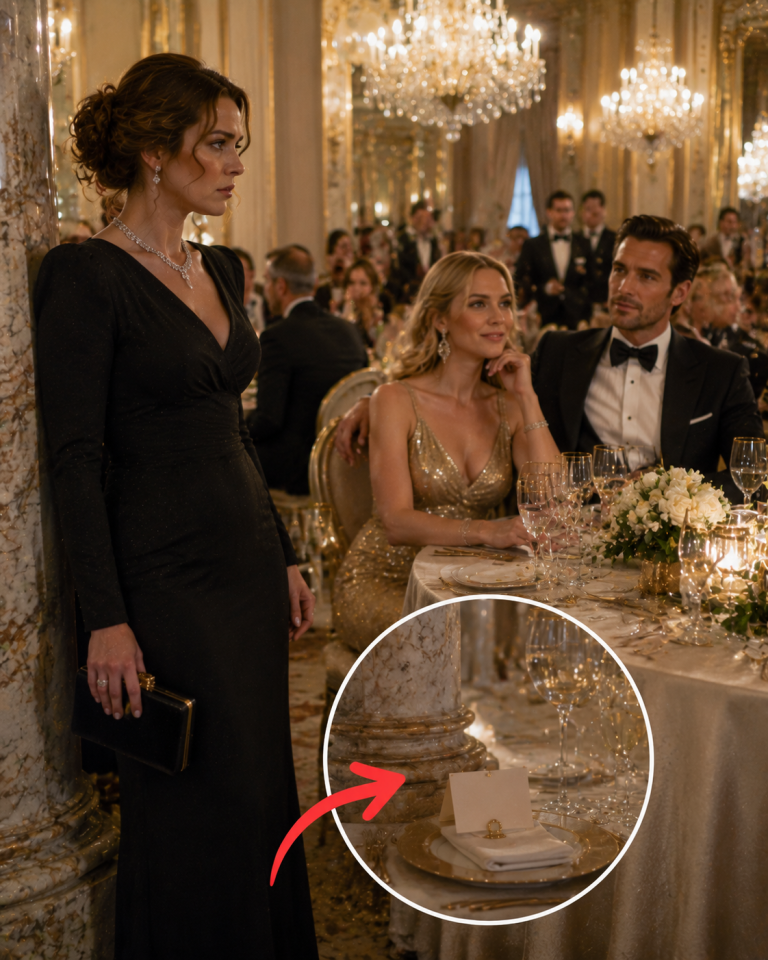
I stood on the brick path a long moment before anyone noticed me. Candlelight caught in Bianca’s hair as she laughed at something Constance said. She’d changed into a softer black dress, one shoulder bare, the whole picture of a hostess in mourning for a woman who hadn’t died yet.
Weston saw me first. “You’re late,” he said, nodding at the one empty setting — not beside him, not at the head of the table, but halfway down, wedged between Constance’s sister and a cousin I barely knew.
“Traffic,” I said. It was the only lie I told that night.
Dinner was lobster rolls and white wine from my mother’s own cellar, served on the china she’d bought for her fiftieth. Bianca opened with the church. “Trinity can do Saturday at two,” she said, flipping her folder open. “Reverend Cole agreed the timing felt right.”
“Timing feels right,” I repeated.
“My mother hated white lilies,” I added, when Bianca mentioned the choir hymn she’d chosen. “She said they smelled like hospitals pretending to be gardens.”
Constance waved a hand. “Everyone hates something. Funerals are for the living.”
Then Bianca slid a page toward me — a draft tribute for the program. The first line read: *Rosalind Kane lived a life of grace, made complete by the loving family she leaves behind, including her devoted son-in-law Weston Cole and his dear friend Bianca Sorrell, whose support brought comfort during Rosalind’s final season.*
*Dear friend.*
Something in me turned to glass. I set the page down. “No.”
The garden went quiet. Weston set down his fork. “You’ve been unstable for months,” he said. “Bianca stepped up when you couldn’t.”
There it was — the sentence he’d clearly been rehearsing. He reached into his jacket and produced an envelope. Divorce papers, laid gently beside my untouched wine, at my dying mother’s own table, with the candlelight making it all look almost gentle.
“I think it’s best we begin the separation now,” he said, soft enough for the whole table to admire his composure. “After the funeral, we can handle the property quietly.”
“You mean Kane Hall.”
“It became our marital residence.”
“For eleven months.”
“I invested in it.”
“You replaced a boiler.”
Constance’s eyes flashed. “Weston has carried you for years.”
That nearly made me laugh. My mother had loaned Weston capital to save his firm after two overleveraged waterfront projects went bad. She’d paid off a credit line through a holding company he thought I didn’t understand. She’d given him introductions, respectability, a seat at every table that mattered in three counties. Weston hadn’t carried me anywhere. He’d been carried, quietly, by my mother’s name.
I picked up his pen. He smiled slightly, certain I was broken enough to sign. Instead I wrote a single line across the front of the envelope, folded it, and set it back beside his plate without a word. Then I stood and walked back through the house, past my mother’s portrait at thirty-five in a navy suit, looking like she’d already guessed exactly how this would end.
My phone rang in the front hall. Josephine, crying. “Margot. Come back now.”
—
My mother died at 11:46 that night. Not at the garden table where they’d tried to divide her life before it was over. Not under Bianca’s white lilies. She died with my forehead against her hand and Josephine at the foot of the bed and the night nurse humming something low and old.
There are sounds grief makes that no one warns you about — the click of a machine switched off, the quiet zip of a bag of personal effects, the soft, practiced apology of a nurse who has done this a hundred times and still means it every time.
When Josephine drove me home, Kane Hall was already lit for company. Weston’s car in the driveway. Constance’s beside it. Bianca’s white sedan at the curb. They hadn’t waited. Inside, my mother’s good bourbon had been opened. Bianca stood near the fireplace, hand resting lightly on Weston’s sleeve, murmuring condolences to the minister as though she’d hosted the whole evening herself.
“We should present a united front tomorrow,” Weston told me, before I’d even taken off my coat. My mother had been gone less than an hour.
I went upstairs alone. My mother’s room smelled faintly of lavender and old paper. On the bed lay the quilt she’d stitched decades earlier, returned from hospice in a plastic bag. A corner had come loose, and tucked beneath the backing was a small white envelope with my name on it in her slanted hand.
*Margot.*
I sat on the edge of the bed and opened it with shaking fingers.
*My dearest girl — if you’re reading this, I’m gone, and I need you to remember what I taught you when you were seven and that terrible boy pushed you into the harbor off the club dock. Do not swing first. Let them speak. Let them show everyone exactly who they are. Then hand the truth to the right person.*
*I know about Weston. I know about Bianca. I know Constance has been telling people you’re unstable. I know he’s been pressuring you to sign papers. I know he believes Kane Hall is vulnerable because he convinced you to move back in here with him.*
*It is not. Nothing he wants is his. Everything he thinks he’s taken has already been moved beyond his reach.*
*Call Nathaniel Bright in the morning. Do not tell Weston. Wear the navy dress.*
*I love you three times, and then forever. — Mom*
I cried then — not the loud kind, the kind Weston could later call unstable, but quiet, private, daughter-shaped tears that belong only to the newly dead.
At seven the next morning I called Nathaniel Bright, my mother’s attorney of nearly thirty years. “I’ve been expecting you,” he said. “Your mother amended her trust six weeks ago. She also left me a sealed packet to deliver at the reception, not before.”
“Why the reception?”
“Because she believed Weston would use the funeral as a stage,” Nathaniel said. “She wanted the stage turned around.”
I closed my eyes. Even dying, my mother had understood him better than I ever had.
The invitation said black attire requested. I wore navy — my mother’s favorite.
—
Trinity Church was full by quarter to two. Old Newport families in dark suits, developers with polished shoes and guilty faces, charity women with casseroles and waterproof mascara. At the front, my mother’s casket sat beneath an arrangement of white lilies — Bianca’s lilies, the very flower my mother despised. I laid a single branch of beach roses across the casket instead and almost smiled.
Weston stood beside me at the front pew. Bianca stood beside him. Not behind him — beside. A ripple moved through the church, small but unmistakable.
When it was my turn to speak, I stepped to the lectern and unfolded one page. “My mother taught me three things,” I said. “Never mistake manners for weakness. Never let a man explain your own life back to you. And never bring white lilies to a Kane woman unless you want her haunting you.”
A ripple of soft laughter moved through the pews. Bianca’s face tightened.
“She was brave, but quietly,” I went on. “She never needed to announce her strength, because the people who depended on it already knew it was there. She also believed silence could be useful — that if you let people talk long enough, they’ll eventually hand you the very knife they used.” I folded the page. “She did not leave this world unprotected. She left it prepared.”
Weston’s eyes narrowed. I returned to my seat.
At the reception back at Kane Hall, Bianca had arranged everything exactly as she’d planned it days earlier — champagne in the garden, white roses in silver bowls, framed photographs of my mother arranged like a museum exhibit, herself stationed near the entrance saying “thank you for coming” as if the house had always belonged to her.
At 4:12, Nathaniel arrived through the side door in a charcoal suit, carrying a leather case. Behind him came a hospice nurse I recognized, and two men in plain suits I didn’t. Weston stiffened. “Why is he here?”
“Mom invited him,” I said.
Nathaniel walked to the center of the parlor, cleared his throat, and the room quieted in uneven layers.
“Ladies and gentlemen, my apologies for the interruption. Rosalind Kane left instructions that a statement be read at this reception.”
Constance stood. “This is hardly appropriate.”
“Mrs. Cole,” Nathaniel said over his glasses, “I assure you Rosalind considered that possibility.”
He opened a sealed envelope, notarized weeks before her death in the presence of witnesses and her own physician.
*To my friends, family, and anyone currently standing in my house pretending affection for social advantage —*
A gasp moved through the parlor. Nathaniel read on: that Weston had pressured his wife to sign marital documents while she cared for her dying mother; that he had represented to lenders that Kane Hall and certain Kane Maritime assets would soon fall under his control. That they would not — that as of midnight following her death, the house, its grounds, and its accounts had transferred fully into the Rosalind Kane Family Trust, with Margot as sole trustee and beneficiary. That Weston’s personal lines of credit through Kane Maritime were terminated, with all obligations due immediately.
Weston’s phone began buzzing. Then Constance’s. Then Bianca’s, all at once, like insects trapped in glass.
Nathaniel turned the last page. “Regarding Miss Bianca Sorrell.” Bianca flinched visibly at *Miss.* “It has come to my attention that Miss Sorrell visited me at Cormorant Point Hospice on the morning of October the ninth and asked staff how much longer I had to live. She later circulated invitations naming herself as host of my funeral before I had died.”
A woman near the back whispered, “My God.” The hospice nurse stepped forward with a signed statement. Nathaniel pressed a small recorder, and Bianca’s own voice filled my mother’s parlor, brisk and impatient: *”I understand, but realistically — are we talking hours or days? Weston needs to know when we can move forward with the church and the house.”*
Her champagne glass slipped from her hand and shattered on the floor.
For a moment nobody spoke. Then everyone did. Constance stood, sat, stood again. Weston stared at Bianca as though she’d betrayed him simply by being caught. “Weston told me you couldn’t handle any of this,” Bianca said to me, voice rising. “He said the house was practically his already.”
“Shut up, Bianca,” Weston snapped — and there it was, the beautiful partnership rotting in daylight.
Constance tried one last time. “Rosalind would be ashamed of you,” she said to me.
For years that sentence would have flattened me. But my mother wasn’t there to be used against me anymore — and somehow, because she was gone, she was suddenly everywhere: in the beach roses on the casket, in the navy dress against my skin, in the envelope in Nathaniel’s hand, in the house that had refused to become anyone’s prize.
“No,” I said. “She’d be proud I finally learned.”
I told Weston to leave. He laughed once. “This is still my home.” Nathaniel corrected him gently — his permission to occupy the property had already been formally revoked, effective midnight. One of the plain-suited men, private security my mother had quietly hired weeks in advance, stepped forward and showed identification.
Even in death, she had been thorough.
Bianca paused beside me on her way out. “You think this makes you better than me?”
“No,” I said. “It makes me done.”
Car doors slammed outside. Inside, the house exhaled.
—
The scandal burned hot through Newport for two weeks. Bianca resigned from every board she’d joined in my mother’s orbit. Weston’s firm folded into lawsuits within the month. Constance sent one email hoping I would “choose dignity over vengeance.” I never answered — dignity, I’d learned, isn’t the same as silence. Sometimes dignity is changing the locks.
I opened my mother’s final letter on a quiet Sunday, sunlight moving across the kitchen where she’d once taught me to make biscuits.
*My dearest Margot — if the room went the way I suspect, you’re probably exhausted. Drink water. Eat something with butter in it. I’m sorry I couldn’t stand between you and every sharp thing in this world; life doesn’t allow that. So I did the next best thing. I left you proof. I left you the house. I left you enough to make choices no one can corner you into. Most of all, I hope I left you the memory of your own spine. You were never weak. You were loyal — the world just confuses the two, because loyal women are useful to selfish people. Don’t become cruel. That would make them too important. Become free. And when you’re ready, open the east garden again. Plant something that doesn’t apologize for blooming. I love you three times, and then forever. — Mom.*
I spent that whole morning pulling weeds in my navy dress, hands in the dirt, hair coming loose, looking like nothing Bianca could ever have replaced and nothing Weston could ever have shrunk. I looked, finally, like my mother’s daughter.
The divorce became final the following spring. Weston fought until fighting cost him more than losing. Constance never apologized — some people are too proud to recognize the shape of their own defeat.
On the anniversary of my mother’s death, I hosted a small dinner under the copper beech. No champagne, no lilies, no performances — just lobster rolls, cornbread, and people who had loved my mother without needing her name attached to anything.
At sunset I walked to the beech tree and pressed my palm against the bark. Three taps. *I. Love. You.* The wind moved through the leaves, and for the first time in a year, I didn’t feel haunted.
I felt held.
Bianca had planned the funeral before the death.
My mother had planned my whole life after it.