He Gave My Reserved Seat To His Mistress At Our Own Award Dinner — Then They Called My Name For The Award

—
**PART 1**
The Grand Meridian Hotel was built for people who like to believe money is a form of morality. Gold-veined marble. White orchids taller than children. Waiters gliding between tables with champagne that cost more per bottle than my first month’s rent in Brooklyn, back when I still counted rent in months instead of headlines.
I found out about the seat the way you find out about most betrayals — from someone too junior to lie to me well.
“Mrs. Whitmore?” A hostess, headset crooked, seating chart clutched like it might detonate. “I’m so sorry. There was a last-minute adjustment.”
*Adjustment.* Her voice cracked on the word like it already knew better.
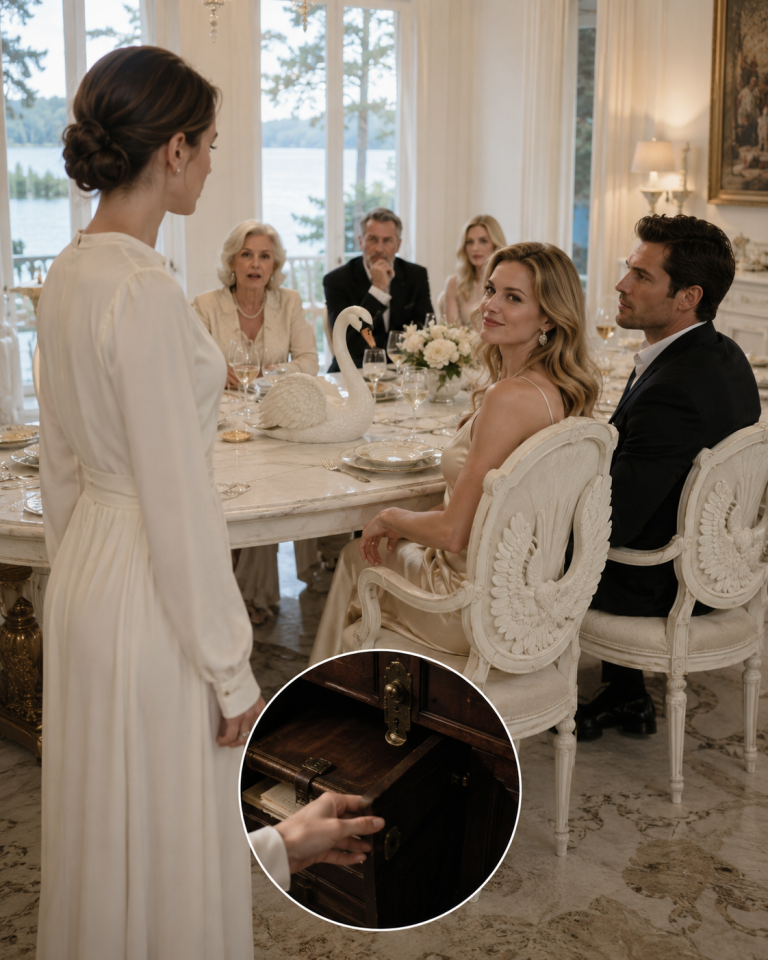
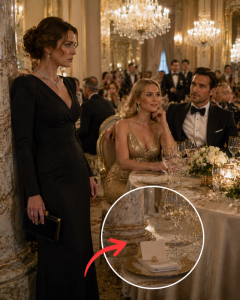
She pointed toward the far end of Table One. Behind the pillar. The one seat in the entire ballroom where a person could appear in every photograph and disappear from every one of them at the same time. A shoulder. A sliver of profile. Enough for my husband to say I’d been honored. Not enough for anyone to actually see my face.
It was, I’ll admit, almost artistic.
“Leave it exactly as it is,” I told her.
She looked relieved and terrified in the same breath, which is how most people look when they realize they’re standing next to a woman who has decided not to make a scene.
I walked across that ballroom in my mother’s black silk gown — the one she wore once, in 1989, to a Boston benefit with borrowed pearls and a confidence she said changed her life — and I let every donor, every board member, every photographer near the step-and-repeat see exactly what had been done to me.
My husband’s name is Preston Whitmore. Golden-haired, easy-smiling, the kind of charming that ages into entitlement if nobody stops it in time. Nobody had stopped it in fourteen years. I hadn’t stopped it. I’d married it in a stone chapel in Connecticut while rain tapped the windows, and I’d spent over a decade telling myself that quiet partnership was its own kind of power.
In my seat sat Celeste Monroe. Twenty-nine, maybe thirty. Honey-blonde, ivory satin, the soft expensive glow of a woman who has recently discovered Pilates and men who pay for it. Her fingers rested on Preston’s sleeve with the light possessiveness of someone who has already decided she belongs there.
“Evelyn,” she said, like we were old friends at a garden party instead of what we actually were. “You look stunning.”
“Thank you,” I said. “So do you.”
Preston half-rose from his chair — the coward’s version of manners.
“Evie,” he said. He only calls me Evie in public now. In private, he calls me *unreasonable.*
“There was a mix-up,” he said, smoothing his lapel. “Celeste is here representing Monroe Media. Important sponsor. You understand.”
I looked down at the place setting in front of her. My charger. My menu. A handwritten note from the gala chair that read *With deepest gratitude for everything you have built.*
Celeste’s hand rested an inch from it.
“I understand perfectly,” I said, and I meant it in a way none of them were prepared for.
His mother, Lillian, leaned forward, diamonds trembling at her throat like they were nervous on her behalf. “Darling,” she said, “you know these events are all about optics.”
Lillian once told me I was “surprisingly presentable for a scholarship girl from Queens.” That was three months before my family’s trust quietly paid off the Whitmores’ tax liens. I have a very long memory for math.
“Yes,” I said. “I do know that.”
I walked to the folding chair beside the pillar and sat down. And here is the part nobody in that room understood yet — the part that made the next fifty-one minutes the most dangerous of Preston Whitmore’s life, though he wouldn’t have believed it if you’d shouted it in his ear.
I wasn’t devastated.
I was *calm.*
Not the calm of a woman who has given up. The calm of a woman who has already made every phone call, signed every document, moved every asset she needed to move, and is now simply waiting for the room to catch up to what has already happened without them.
For forty minutes I watched the theater. Preston’s hand on the back of Celeste’s chair. Celeste’s laugh, loud and full-bodied, angled just enough for me to feel it from across the table. Lillian introducing her to museum trustees with a warmth she had never once given me.
And beneath all of it, something cold and clean settled into my chest. Not rage. Rage is hot and wasteful. This was clarity — the kind that arrives exactly once in a life, usually disguised as the worst night you’ve ever had.
I had given Preston fourteen years. I had edited his speeches, repaired his scandals, softened his cruelty before it ever reached a reporter. I had built the machine and watched him stand in front of it, taking bows for the engine.
Tonight, he had given away my seat.
That was his mistake. Not the affair. Not the lies. His mistake was believing the seat had power.
It never did.
I did.
Because in exactly fifty-one minutes, they were going to call my name for the National Arts Alliance’s Lifetime Achievement Award — an award tied to a foundation whose finances I had quietly audited for three months, whose board I had quietly turned one vote at a time, and whose controlling assets I had, as of five o’clock that very evening, moved somewhere Preston Whitmore would never be able to reach again.
He still thought the best seat in the room was beside him.
He was about to learn it never had been.
—
**PART 2**
By 8:47, Preston had brushed a strand of hair off Celeste’s cheek. Small gesture. Tender. Fatal. A photographer caught the flash of it, and Celeste’s eyes flicked toward me and away, fast, the way people move when they still think old-money rooms gasp instead of record.
They don’t gasp. They remember.
The first course cleared. The lights dropped to amber. Onstage, a jazz trio eased into a slow, cruelly on-the-nose version of an old standard, and I sat behind my pillar and did the math one more time, out of habit more than doubt.
Vivian Sterling stepped to the podium. Seventy years old, silver-haired, richer than every man in the room who’d ever tried to talk down to her. She looked directly at me. Not at Preston. At me.
Something in my chest tightened.
“Tonight we celebrate legacy,” Vivian said. “Not the kind printed on buildings. The kind built quietly, at great personal cost.”
Preston clapped politely. He did not hear the blade enter the room.
“Because of our next honoree’s work, abandoned theaters have reopened in Detroit. Youth orchestras have been funded in Atlanta. More than eight thousand students have received scholarships, instruments, mentorship.” Vivian turned a page. Celeste checked her lipstick in a compact. Preston adjusted his cufflinks. “Many of you know the Whitmore Cultural Foundation. Tonight, it is my privilege to honor the woman who built its heart, its mission, and, quite frankly, its spine.”
Preston froze mid-motion, cufflink still between two fingers.
“The Marguerite Caldwell Lifetime Achievement Award goes to Evelyn Hart Whitmore.”
For one full second, nobody in that ballroom moved.
Then it broke open — chairs scraping, applause rising toward the ceiling like weather, every camera swinging away from my husband and his mistress so fast that Celeste actually flinched from the motion of it.
Preston looked at me like I’d stepped out of a portrait he thought he owned.
I rose from behind the pillar. That detail mattered more than anything I would say in the next ten minutes — the room *saw* where I had been sitting. They saw the distance between the woman being honored and the man who’d put her there.
I walked toward the stage. Every step felt like crossing a border I could not uncross.
Vivian met me at the podium, embraced me, and whispered, close enough that only I could hear it: “You ready?”
“I was ready the moment he moved the card,” I said.
She laughed, soft, and pressed the glass award into my hands. It was heavier than I expected — shaped like an open door.
I looked out at the ballroom. At the donors, the trustees, the society wives pretending not to enjoy themselves. At the young artists at the back tables in borrowed tuxedos, watching with the kind of hunger only people who’ve never been given anything can have. At Lillian, pale under her diamonds. At Celeste, gripping her napkin like a life raft. At Preston, whose smile had turned, in real time, into a wound.
I leaned into the microphone.
“Thank you,” I said. “I confess — when I arrived tonight, I wasn’t sure I’d have a clear view of the stage.”
A murmur moved through the room like wind through wheat.
I let it breathe.
“But perhaps that was appropriate,” I said. “Much of my life’s work has been done from obstructed views.”
Preston’s jaw tightened, one small muscle giving him away.
Behind me, unseen by anyone yet, a technician waited at a laptop for a signal only I knew was coming — a slide, queued and ready, that would replace the Whitmore Cultural Foundation’s silver logo with something else entirely, the instant I said four specific words into that microphone.
I hadn’t said them yet.
I was about to.
—
**PART 3**
“And I want to correct the record.”
Those were the four words. I felt the room lean toward me before I even finished speaking them, the way a held breath leans toward its own release.
Preston’s face changed. Not dramatically — he was too practiced a performer for drama, even now, even here. But I saw fear arrive in him, quiet and total, entering through the eyes the way it always does with men who have spent their whole lives being told their faces were their best asset.
“For fourteen years,” I said, “the public has known the Whitmore Cultural Foundation as my husband’s vision. The truth is more complicated. It was funded originally through the Hart family trust, designed by my office, and sustained by a network of women and working artists who were often thanked last, if at all.”
A few heads turned toward Preston. I didn’t raise my voice. I have learned, in fourteen years of rooms exactly like this one, that a whisper travels farther than a shout when everyone in the building is desperate to hear it.
“As of five o’clock this evening, following a unanimous emergency vote by the board, the foundation has been formally restructured. Its assets, its programs, and its endowments will continue under a new name.”
Behind me, the screen changed.
The Whitmore crest dissolved into black, and in its place bloomed a simple mark — a door, opening into gold light. Beneath it, six words.
HART HOUSE ARTS INITIATIVE.
The gasp that moved through the ballroom was not metaphorical. It was audible, physical, a wave of silk and breath.
It was, I will admit, one of the more beautiful sounds I have ever heard.
Preston rose halfway out of his seat. “Evelyn.” The microphone caught just enough of it to carry.
I smiled at him — the specific, terrible smile of a woman who has waited a very long time to be allowed to smile that way in public.
“Please sit, Preston,” I said. “You’ve always enjoyed a good performance.”
Somewhere near the back, a stunned laugh broke loose. Then another. Then the whole room shifted forward in their seats with the helpless, hungry attention of people watching a dynasty crack open in real time, live, with no rewind.
I kept going, because stopping now would have been a mercy I didn’t owe him.
“Hart House Holdings has also acquired the controlling interest in Whitmore Capital’s outstanding debt. That acquisition prevents the liquidation of several community properties tied to our grant programs.” I paused, just long enough to let the cameras find my profile. “It also means that, for the first time in its history, the Whitmore family business is majority-controlled by a woman named Hart.”
Lillian set down her champagne flute with the exaggerated care of someone whose hands have begun, very slightly, to shake.
Celeste leaned toward Preston and whispered something urgent. He didn’t answer her. He couldn’t. He was still staring at me the way a man stares at a bridge he’s just watched collapse behind him — understanding, too late, that he’d already crossed it and there was no going back to check his math.
I had one more thing to say, and I had debated for three days whether to say it at all.
“An independent audit has also identified improper foundation expenditures, including luxury travel, personal gifts, and consulting fees billed through Monroe Media.”
Every drop of color left Celeste’s face at once. I did not look at her when I said it. That would have been too small a thing to do at a moment this large.
“Those findings have been referred to counsel,” I said. “I won’t discuss them further tonight. The work this foundation does is bigger than the people who tried to profit from it, and the families we serve deserve protection from spectacle.”
That, I think, is the difference between revenge and power. Revenge wants blood on the floor where everyone can see it. Power knows exactly when to put the knife down and walk away with clean hands.
I let the silence sit for one more breath.
“I came here tonight and found my reserved seat had been given away,” I said. “At first, I thought it was a humiliation. Now I understand it was a gift. It showed me — and perhaps some of you — the exact shape of the life I’m leaving behind.”
I found Preston’s eyes and held them, for the last time, as his wife.
“Funny,” I said. “The best seat in the room was never actually beside him.”
The applause hit the ceiling like thunder rolling downhill. I stepped back from the podium with the glass door still warm in my hands, and somewhere in that noise, I felt fourteen years finally, quietly, exhale.
**THE COLD AFTER THE CHANDELIER**
By midnight, the internet had already picked its headline. It wasn’t quite accurate — viral stories rarely are — but it was close enough to sting, and it spread the way fire spreads through dry paper: fast, indiscriminate, impossible to take back once it starts.
I didn’t see any of it right away. After the speech I was swallowed by hands and cameras and faces I’d known for a decade, suddenly rearranged into admiration they’d never once offered me before.
Vivian squeezed my arm as I came off the stage. “That was cleaner than he deserved.”
“I wasn’t doing it for him.”
“I know,” she said. “That’s exactly why it worked.”
Across the ballroom, Preston stood trapped without a single locked door around him. The exits were open. But socially, he was pinned beneath every glittering eye in that room — men who’d laughed at his jokes over cocktails an hour earlier now studying their phones with sudden, urgent interest. Women who had tolerated him for the sake of Lillian’s committees now watched me with the sweet, ferocious warmth of people finally seeing an old wrong get corrected in real time.
Celeste stood a step behind him, no longer glowing. Ivory satin, I’ve since learned, does not survive public judgment well.
Lillian reached me first. Of course she did.
“Evelyn,” she said, posture perfect, mouth thinned to a pale line. “Surely this could have been handled privately.”
I thought of every dinner where those diamonds had flashed while she corrected my table settings, my vowels, my ambitions.
“It was handled privately,” I said. “For fourteen years.”
Something flickered behind her eyes. “Think carefully,” she said, low. “Divorce is ugly at this level.”
“No, Lillian.” I buttoned my coat, though I hadn’t put it on yet — my hands just needed something to do. “Marriage was ugly at this level. Divorce is just paperwork.”
She stepped back like I’d slapped her, which, in a way, I suppose I had.
Preston came next. He didn’t storm — men like Preston believe grace can disguise panic, right up until it can’t. Two attorneys trailed him at a careful distance, phones already lit.
“Evelyn,” he said, soft, reasonable, the voice he uses when he wants a room to think he’s the calm one. “You’re emotional.”
The word landed between us like something dead.
“Still?” I said.
His mask cracked, just at the corner. “Do you have any idea what you’ve done?”
“Yes.”
“You humiliated me.”
“No, Preston. I described you accurately in public. You’re feeling the difference for the first time in your life.”
His eyes hardened, and for one unguarded second I saw the man underneath the charm — not wounded, not sorry, *offended.* As if I had stolen something that belonged to him by simply refusing to stay stolen myself.
“You think they respect you now?” he said. “They’re entertained. That’s all. By tomorrow they’ll have moved on to someone else’s disaster.”
“Maybe.”
“You’ll be alone.”
I looked past him, toward the archway of white orchids near the exit, where a tall man in a black tuxedo stood reading nothing in particular, giving me room. Adrian Vale. Attorney. Former prosecutor. The first person in years who had asked me, over coffee in a windowless conference room, *what do you want your life to feel like when this is over* — not look like, *feel* like — and waited, actually waited, for the answer.
“Alone isn’t the threat you think it is,” I told Preston.
Celeste stepped up beside him, her composure returning in uneven pieces. “Evelyn, I never wanted to hurt you.”
That is the sentence mistresses say when they enjoyed the hurting very much right up until the witnesses showed up.
“You sat in my chair,” I said.
“For God’s sake,” Preston snapped, “it was a chair.”
“No,” I said. “It was a message.”
Celeste’s eyes glistened, and for one moment I almost believed the shine was real. “He told me you two were separated.”
“We live in the same house.”
“He said it was for appearances.”
“It was.”
She flinched, actually flinched, and something in me — not forgiveness, nothing so generous — softened by half a degree. Perhaps she hadn’t been evil. Perhaps she’d simply been hungry, and hunger is easy to mistake for love when a rich man is the one feeding it.
I reached into my clutch and drew out a cream envelope.
“This is for you,” I said.
“Evelyn, don’t,” Preston said, too fast.
I handed it to her anyway. Inside was a copy of the audit summary, the sections involving Monroe Media highlighted in careful yellow, and a business card for an attorney with no connection to either of us.
“You should have independent counsel,” I said. “Not his. Not mine.”
Her lips parted. And that was the moment I watched the second twist land on her — the one she hadn’t seen coming, the one Preston had never told her about. She had believed she was the prize in all of this. She was starting to understand, in real time, in front of two hundred witnesses, that she might only ever have been the shield.
He had placed her publicly in my seat not just to humiliate me, but to bind her to him before the audit ever surfaced — if she looked like his partner socially, perhaps she could be made to look like his partner legally too. Men like Preston don’t love women. They *position* them.
“What is this?” Celeste whispered to him.
“Nothing,” he said, too sharp, too fast.
She took a step away from him. The cameras caught that too.
I felt tired then, all at once — not the weak kind of tired, the marrow-deep kind that comes from carrying a man for fourteen years who mistook being carried for standing tall on his own.
“I’m not destroying you,” I told Preston, quietly, so only the three of us could hear it. “I’m returning you to yourself.”
“And what about us?” he asked.
*Us.* The smallest word. The largest lie I’d let myself live inside.
I looked at his wedding ring, platinum, engraved on the inside with a line of poetry he’d never once understood: *We are what we choose to keep.*
“I kept enough,” I said. “Now I’m choosing differently.”
I walked away before he could answer, because there wasn’t going to be an answer worth hearing.
Adrian met me at the archway. He didn’t touch me right away, and I appreciated that more than I could have explained — men are often too quick to put a hand on a woman stepping out of fire, as if survival is something that needs to be claimed by somebody else.
“You were magnificent,” he said.
“I was precise.”
“That too.”
Behind us, the ballroom had turned into a hive — phones glowing, voices rising, the chandelier still glittering overhead though it looked colder now, less like celebration, more like evidence photographed at a scene.
Adrian offered his arm. “Your car’s waiting.”
I looked back once. Not at Preston. At the pillar.
My seat beside it sat empty. My name card remained on the linen, small and white, forgotten. I almost went back for it.
Then I didn’t. Some things are only powerful until the moment you decide to leave them behind.
**WHAT FOURTEEN YEARS COST**
I want to be honest about something, because the viral version of this story never has room for it: I did not wake up one morning and decide to destroy my husband. Betrayal, when it’s done well — when it’s done by someone as practiced as Preston Whitmore — doesn’t announce itself. It arrives disguised as vulnerability.
I met him at a charity auction in Palm Beach when he was thirty-six and I was thirty-two, newly appointed director of a small arts nonprofit in Brooklyn, still surprised when wealthy people bothered to remember my name. He bought a painting that night for fifty thousand dollars, charged to a card that was already, I’d learn much later, overdue. But under the warm Florida lights he looked like a man built out of good intentions, and he asked me why I cared so much about abandoned theaters and underfunded art programs.
“Beauty saves people who don’t know how to ask for help,” I told him.
He looked at me like I’d said something holy. “I want to learn to see the world the way you do,” he said.
It took years to understand he never wanted to see the world the way I did. He wanted the world to see *him* standing beside me while I did the seeing for both of us.
We married eighteen months later, in a stone chapel in Connecticut, rain against the glass. My mother, already sick, squeezed my hand at the reception and said, “Make sure he loves your light, and not just the way it shines on him.”
She died the following spring. Grief makes people generous in dangerous ways, and I was no exception.
Preston’s father had left behind a collapsing investment firm and three open lawsuits. Preston confessed this to me one night, standing at our townhouse window with a drink in his hand and shame arranged very attractively on his face. “I didn’t want you to know,” he said. “I wanted to be worthy of you.”
I believed him. That’s the embarrassing truth about betrayal — before it becomes obvious, it usually looks exactly like honesty.
So I helped. My mother had left me Hart House — a portfolio of real estate and private holdings built by my grandfather, who repaired elevators in Queens and quietly bought up buildings nobody else wanted, decades before the city grew up around them and made him right. I used part of that inheritance to stabilize the Whitmore family business. Quietly. No headlines, no announcement, no Whitmore men forced to admit a woman had saved them from ruin.
In exchange, Preston promised to help me build something of my own — a foundation funding arts education, restoration, and grants for young creators from working-class communities exactly like the one I’d grown up in.
The Whitmore Cultural Foundation was born a year later.
He became the face of it. I became the hands.
For a while, I told myself that was a fair division of labor. I told myself good work doesn’t need applause. I told myself marriage is a kind of partnership where sometimes one person stands in the light and the other holds the ladder steady underneath them.
But Preston didn’t stand in the light. He blocked it. He started saying “my foundation” in interviews. He accepted awards for programs I had designed line by line. When donors praised my work directly, he’d interrupt with an anecdote that made him sound visionary. When journalists asked about my role, he’d smile and say, “Evelyn prefers privacy.”
I did prefer privacy. Until privacy hardened into erasure, and I couldn’t tell the difference anymore between being modest and being deleted.
The first time I smelled another woman’s perfume on his collar, I said nothing. The second time, I asked, and he kissed my forehead and told me I was tired. By the third time, I knew her name.
Celeste Monroe. Former lifestyle influencer, founder of a boutique branding firm hired to “modernize” the foundation’s image. Within six months his public profile looked like a presidential campaign, and Celeste was sitting in on private donor meetings wearing dresses that cost more than our first gala budget combined.
I watched. I listened. I collected — not for revenge at first, but because I needed proof that I wasn’t losing my mind. Receipts. Calendar invites. A hotel charge in Napa during a weekend he swore he’d spent in Boston. A Cartier bracelet billed to a foundation account under “donor relations.”
Then came the call that changed the shape of everything.
Three months before the gala, a forensic accountant named Maribel Santos phoned me from Chicago. “Mrs. Whitmore,” she said, “you asked me to review administrative expenses. I found something larger.”
“How large?”
A pause I still remember the exact length of. “Large enough that your husband shouldn’t be chairing anything with the word *charitable* in its name.”
Standing in my kitchen while rain slid down the windows, I listened to Maribel walk me through a web of shell vendors, inflated consulting fees, and private travel filed as outreach. Not all of it was criminal — Preston was too careful for that. But it was rotten in the quiet, tailored way that never makes headlines until someone decides it should. And at the center of it, every time, sat Celeste’s company.
That same night, Preston came home with white roses. White roses always meant he’d done something expensive.
“You’ve been distant,” he said.
“I’ve been busy.”
“With what?”
“Seeing clearly.”
He laughed. “That sounds ominous.”
“It should.”
For the first time in years, I watched uncertainty cross his face. Then his phone lit up on the counter. *Celeste.* Not a number saved under someone else’s name — just her name, plainly, sitting there between us.
He saw me see it. And he smiled anyway.
That was the moment I finally understood the true depth of his arrogance. He wasn’t hiding because he thought I’d leave. He thought my own dignity was a cage strong enough to hold me. He believed I’d never risk a scandal, because women like me are trained our whole lives to protect the table, even after we’ve realized the table is built out of our own bones.
So I stopped protecting it.
I hired attorneys in New York and Delaware. I activated clauses in agreements Preston had signed without reading, because reading things carefully had never been a skill he valued. I met with board members one at a time and showed them facts instead of tears. I secured votes. I moved assets. Through Hart House Holdings, I quietly purchased the distressed majority stake in Whitmore Capital before Preston even knew the anonymous buyer existed.
Two weeks before the gala, the National Arts Alliance called to tell me I’d won the Marguerite Caldwell Lifetime Achievement Award.
I laughed once, softly, when I hung up the phone. Not because it was funny. Because timing, when it finally decides to turn in your favor after years of turning against you, has an almost cruel sense of humor.
**ELEVEN MONTHS**
The divorce took eleven months. Preston fought everything — the townhouse, the foundation’s name, the narrative, even a set of silver candlesticks he’d once called “provincial” until he learned they’d belonged to my mother.
He gave interviews through unnamed sources. Friends of Preston Whitmore described him as devastated. Friends of Evelyn Hart Whitmore described me as calculating. A society columnist wrote that my speech at the gala had been “effective but perhaps unbecoming.”
I sent her a donation receipt — Hart House Arts Initiative funding twelve girls from the Bronx to attend a summer film program — with a short note attached: *May they all become unbecoming.*
Someone screenshotted it. It went further than the speech had.
By then I’d stopped pretending not to notice any of it. Viral fame isn’t warmth. It’s weather — it comes in fast, floods everything in its path, and leaves debris behind whether you asked for the rain or not. Strangers called me a queen, a legend, a warning, a gold digger, a genius, a bitter wife, an ice sculpture, an inspiration, and a handful of other words I wouldn’t repeat in front of my mother’s portrait.
None of that healed anything.
The work did.
Hart House Arts Initiative moved into an old limestone building in Chelsea, once a piano factory. We restored the windows, kept the scuffed maple floors exactly as they were, and turned the old freight elevator into a vertical gallery for student work. On the first morning we opened, a ten-year-old boy from Newark stood in the lobby staring at a wall of donated violins and whispered, “You mean we can *touch* them?”
That healed something. Not everything. Something.
Celeste cooperated with investigators. Her company didn’t survive the audit, and neither did her arrangement with Preston, which ended not long after she discovered the apartment he’d promised her was leased through a business entity now quietly controlled by Hart House Holdings.
Six months after the gala, she sent me a letter. Not an email — an actual letter, thick paper, blue ink. She didn’t ask for forgiveness, and I respected that more than almost anything else she could have written, because people who ask for forgiveness too quickly are usually just asking to skip past the consequences.
*I thought taking your seat meant I had won,* she wrote. *I understand now that he had trained both of us to compete for a place at a table he never actually built.*
I kept the letter in a drawer. Not as friendship. As evidence that some women, eventually, do wake up.
Preston’s fall was quieter than people expected, and far less cinematic than the gala had been. No courthouse collapse, no perp-walk, nothing the tabloids could really sink their teeth into. Just resignations, settlements, legal fees stacking up, invitations that slowly stopped arriving, and the long social death of a man whose charm had finally stopped generating profit for anyone but himself.
His mother moved permanently to Palm Beach. Preston moved into a glass apartment downtown with rented furniture and a view of buildings he no longer owned any part of.
The last time I saw him was outside the Manhattan Supreme Court, the day the divorce was finalized. He looked thinner — still handsome, in the specific way expensive flowers stay handsome for exactly three days after nobody remembers to change their water.
“You got what you wanted,” he said.
I buttoned my coat against the wind coming off the river. “No,” I said. “I got what I earned.”
He looked at me for a long time, longer than I expected. Then, for the first and only time in fourteen years, he said, “I did love you.”
I believe that he believed it when he said it. That has never once been the same thing as it being true.
“You loved being near what I built,” I told him. “That’s a different thing entirely.”
He didn’t have an answer for that. I walked down the courthouse steps alone, and for the first time in longer than I could measure, alone didn’t feel like a punishment.
**BLUE, NOT BLACK**
At the bottom of the steps, Adrian Vale stood beside a black town car, reading a folded newspaper the way men from another century used to. Snow moved through the air, soft, taking the hard edges off the whole city for a few minutes.
He looked up. “Free woman,” he said.
“Expensive woman,” I corrected him.
His smile came slow. “Accurate.”
Adrian and I didn’t fall into each other’s arms — life is rarely that simple, and I had no interest in turning another man into a destination. But over the months that followed, he became part of the quiet architecture of my new life. He came to gallery openings and stood at the back so students could have the front row. He sent books instead of flowers. He never once called me *brave* when I was simply tired; he brought soup instead. He didn’t ask me to soften any of my edges. I think he understood, in a way almost no one else had bothered to, that some edges aren’t damage. They’re design.
One evening in late spring, Hart House hosted its first public gala under its new name. Not at the Grand Meridian — I refused, and nobody argued with me about it. We held it in the restored Chelsea piano factory instead, under exposed beams and strings of warm lights, with food catered from a Queens restaurant my mother used to love. Billionaires stood shoulder to shoulder with public school teachers. Broadway actors talked shop with teenagers from Detroit. A senator spilled sauce down the front of his tuxedo, and for once, nobody in the room treated it like a crisis.
There was no Table One. That was my rule, and it was non-negotiable.
The seating chart was circular. Artists sat with donors. Students sat with trustees. No wives placed behind pillars. No mistresses displayed like trophies under a chandelier. No one arranged as decoration for somebody else’s importance.
At the entrance, we hung a small framed card that read: *A seat is not power. Access is.*
People photographed it all night.
Near the end of the evening, a young composer named Maya Reynolds performed a piece she’d written for strings and piano. She was seventeen, from Baltimore, and had once practiced on a keyboard missing three keys. That night she stood beneath the old factory windows and filled the room with something aching and bright enough to make grown men set down their drinks.
I sat in the front row. Not because it was the best seat in the house.
Because Maya had saved it for me.
When the last note faded and the room came to its feet, she found me in the crowd before she found anyone else. I touched my hand to my heart. She did the same, mirrored, across all that noise.
That, I’ve come to understand, is what legacy actually looks like. Not a logo. Not a marriage. Not a chandelier dripping crystal over a ballroom built for people who confuse money with morality.
A door held open long enough for someone else to walk through it on their own two feet.
After the applause, I stepped out onto the terrace for air. The city glittered below the railing, restless the way it always is, full of people telling their own versions of their own worst nights. Somewhere downtown, Preston was probably telling someone a version of this story in which he’d been misunderstood. Somewhere in Palm Beach, Lillian was probably correcting a florist about the wrong shade of white. Somewhere online, strangers were still arguing about whether I’d gone too far, as if there’s a formula for exactly how far a woman is allowed to go after fourteen years of disappearing in plain sight.
The night smelled like rain and lilacs from the planters along the brick wall. Adrian joined me with two glasses of sparkling water.
“No champagne?” I asked.
“You once told me champagne is for people trying to make bad decisions look festive.”
“I say a lot of wise things.”
“You do.”
We stood together in a silence that didn’t need filling. Below us, Manhattan moved like a river made of light.
After a while, he asked, “Are you happy?”
I actually considered it, instead of reaching for the easy answer. Happiness had once felt like a room I needed someone else’s permission to walk into. Then it turned into a rumor. Then a luxury I’d stopped expecting. Now, standing on that terrace with the city breathing below us, it felt quieter than I’d braced for.
It felt like breathing without asking anyone’s permission first.
“I’m getting there,” I said.
Adrian nodded, like the answer deserved exactly that much respect and no more performance than that.
Inside, laughter rose again. Music started back up. Someone opened the terrace door and warm light spilled out across the stone, touching the hem of my dress.
I wore blue that night. Not the black silk armor I’d worn to the Grand Meridian. Blue, like morning breaking over water. Blue, like a life picking itself back up after the storm has finally finished doing its worst and moved on to someone else’s weather.
Adrian offered his hand — not to lead me anywhere, just to ask.
I took it.
**A WARM LIGHT AFTER THE STORM**
Years later, people would still ask me about that night at the Grand Meridian. They wanted the glamorous version — the betrayed wife, the mistress in ivory, the cruel husband, the speech that traveled across the internet faster than the truth usually manages to move. They wanted to know if I’d planned every single second of it.
I always told them the same true thing.
I had planned the documents. The board vote. The legal protections. The new foundation’s name. The exact timing of the announcement. I had planned everything necessary to protect fourteen years of work from one man’s collapse.
I had not planned the chair.
That part was entirely Preston’s contribution — one final, perfect symbol from a man who understood status down to the decimal point and never once understood value. He believed placing me behind a pillar would make me smaller in front of everyone who mattered.
Instead, it gave the whole room an unobstructed view of exactly what he was.
And it left me with one last lesson on my way out the door: never confuse proximity with being cherished. Never mistake being chosen for being seen. Never spend your one life orbiting someone else’s table when you have the strength, the vision, and the plain right to build a room of your own.
The headlines faded, the way headlines always do. The viral clips became things people rediscovered every few months with a caption and a flame emoji, already half-forgotten by the time the algorithm moved them along.
But Hart House stayed. The scholarships kept growing. The theaters stayed lit. The children kept touching the violins. The murals kept climbing brick walls in neighborhoods that had spent generations being told beauty wasn’t meant for them. Women who’d been interrupted, erased, underestimated, and quietly seated behind their own pillars wrote to me from every corner of the country, and I answered as many of those letters as I could — not with advice about revenge, but with reminders about worth.
Because the sweetest part of any of it was never watching Preston lose his place at that table.
It was no longer needing a seat beside him at all.
It was waking up every morning in a home full of books and flowers I’d bought for myself. It was hearing music drift down the hall from a rehearsal room. It was laughing without checking anyone else’s mood first. It was learning, finally, at forty-six years old, that real love does not move your name card to make room for another woman.
Real love saves you a seat where you can be fully, completely seen.
And if it can’t find one, it stands beside you until you build a better table yourself.
THE END