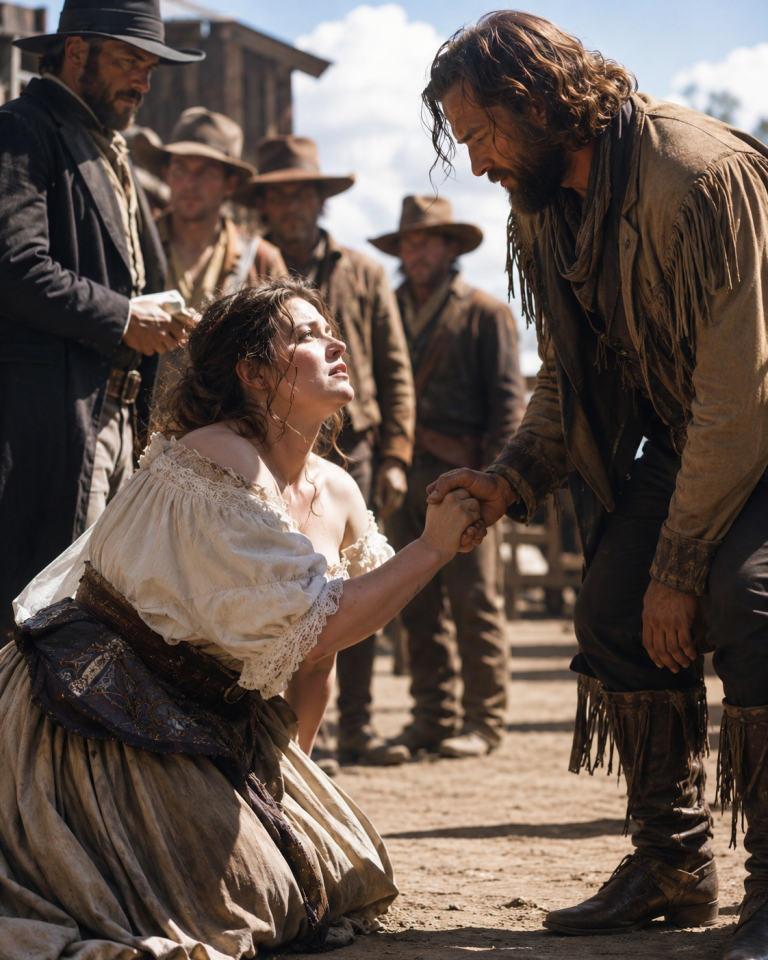
She Accidentally Texted “He Broke My Ribs” to a Stranger—The Mafia Boss Showed Up First

## PART 1
I want to tell you what the floor felt like.
Not what happened — what it felt like, the specific material truth of lying on linoleum in a third-floor apartment in the Pilsen neighborhood with blood in my mouth and one hand pressed flat against my left side where Kyle’s boot had connected twice. The neon sign from the liquor store across the street pulsed through the cheap blinds in a rhythm I’d learned to count by. Red. Three seconds. Black. Three seconds. Red. I had been timing it since I stopped being able to stand.
From the bedroom, Kyle’s snoring came through the wall in slow even waves.
That was the worst part. Not the ribs — two of them, I was almost certain, crackling in a way that made each breath a separate decision. Not the blood from my lip where my tooth had gone through. The snoring. The absolute ordinary peace of a man who had hurt me and gone to sleep the way you sleep after yard work.
My phone was under the television stand.
Getting to it took most of what I had left.
I dragged myself across the carpet with my right elbow, which left a smear I would not be able to clean because I would not be here in the morning, because I had decided, for the first time in twenty-six months of deciding otherwise, that morning was going to be different.
When my fingers found the phone, the screen was cracked from last Tuesday when Kyle threw it against the wall to stop me calling anyone, and it showed 4% battery, and I pressed my forehead against the linoleum for exactly five seconds and then I started typing.
My brother Danny’s number was not saved. Kyle checked my contacts every evening like a man checking inventory. Danny’s number lived in my memory the way emergency numbers live — urgent and unreliable, prone to slipping when needed most.
773-555-0291.
Danny was a paramedic. Danny had told me six months ago, outside a diner in November rain, that he wasn’t going to watch me do this anymore. “You want someone to pull you out,” he had said, “call me when you decide to stay out.” But Danny knew how to tape ribs and Danny had outstanding warrants of his own and Danny would not call the police.
I typed with my thumb moving wrong from the blood.
Kyle went too far. Ribs broken. Can’t breathe right. Please come. Mara.
Battery at 3%.
I hit send.
Waited.
The snoring in the next room shifted rhythm.
My phone buzzed.
I turned it over expecting Danny’s voice in text, something rough and warm and familiar.
What I found instead was: *Well. And who is this?*
The tone of it was wrong.
Not Danny.
Not close to Danny.
I looked at what I had dialed.
773-555-0292.
One digit.
One digit and I had sent my desperate bleeding emergency to a stranger at two in the morning.
Shame moved through me, hot and useless. I moved my thumb toward the notification to dismiss it, to block the number, to stop humiliating myself before the battery died entirely.
Then: *Not Danny. But I’m on my way. Share your location.*
I stared at those words for a long time.
Battery: 2%.
The smart thing was to assume it was a joke. Someone up late with too much time and a cruel imagination, having fun with a woman stupid enough to text the wrong number in a crisis.
But the pain in my ribs made smart irrelevant.
I pressed the location icon.
The reply came before the screen had fully loaded the confirmation.
*Stay on the floor. Don’t move. Eleven minutes.*
Then my phone died.
I lay in the red-black pulse of the neon sign and understood what I had just done.
I had invited an unknown person into an apartment where a man was sleeping off the damage he had done to me. I had given my address to a stranger who did not ask questions, did not offer to call 911, did not say who he was.
Only that he was coming.
Kyle’s snoring stopped.
The particular silence of a sleeping body shifting toward waking.
The bed creaked.
I pressed my face against the carpet and tried to make myself smaller than I was, which I had been doing, in various ways, for twenty-six months.
“Still on the floor?”
His voice was rough with sleep. He shuffled into the doorway in sweatpants, scratching his chest, looking at me the way you look at a spill you’re going to have to clean up. That was the thing about Kyle that I had spent two years trying not to see clearly: it was never fury. Never passion. Always maintenance. I had stepped out of line and been corrected and now he wanted coffee.
“Get up,” he said. “I need coffee. My head hurts.”
I did not move because I could not move.
He stepped toward me.
The deadbolt on the front door snapped.
Kyle turned.
The door came inward with controlled force — not kicked, driven, the frame splitting cleanly along the jamb. It hit the interior wall and stayed there, and the man who stepped through it was not what I expected from the message I had sent.
He wore a charcoal suit. His shirt was open at the collar. He was tall, dark-haired, with a face that looked like it had been arranged by someone who understood that intimidation could be architectural. His eyes moved across the room — one sweep, complete and unhurried — and stopped on me.
“Mara,” he said.
Not a question.
Behind him, two men in dark leather filled the doorway.
Kyle made the noise men like Kyle make when they’re trying to reclaim a room they’ve already lost.
“Who the hell are—”
The man in the suit didn’t look at him. He didn’t speak to him. He simply tilted his head a fraction of an inch, and the two men behind him moved.
What happened next was brief.
Not the fight from any movie I had seen.
One of them hit Kyle across the side of the knee with something leather-wrapped. The sound it made was specific and final. Kyle went down, and the second man put him into the floor before he could get the scream out.
Footsteps approached me.
The man in the suit crouched down.
Up close I could see the lines of exhaustion under his eyes, light scars at his knuckles, a scar through one eyebrow that had healed badly on purpose or by accident.
“Which side?” he asked.
“Left,” I said.
His hands moved along my ribs with the impersonal precision of someone who had done this before and was not here to be gentle, only accurate.
Pain erupted where he pressed.
“Two,” he said. “Maybe three.” He looked over his shoulder at the sound of Kyle trying to drag himself across the kitchen. “Bag him. Docks. I’ll be there after the clinic.”
“Yes, Mr. Vane.”
The name meant nothing to me.
Docks did.
*After* did.
He slid one arm beneath my knees and the other behind my back.
“This is going to hurt,” he said. Not an apology. A fact.
Then he lifted me.
The pain was catastrophic. My vision went white at the edges and I pressed my face into his chest, fine wool and expensive cologne and underneath both of those something older and harder that I couldn’t name.
“Breathe,” he said, carrying me out through the broken door and into the wet Chicago street. “Just breathe. I’ve got you.”
I understood, even then, that I was not saved.
I had traded one kind of captivity for another.
But for the first time in twenty-six months, I was breathing — really breathing, through the pain, toward something — and I couldn’t make myself be sorry about what I had done.
—
## PART 2
The clinic smelled of iodine, bleach, and the particular antiseptic quiet of a place that treated injuries that couldn’t be reported.
When I woke, the ceiling was white acoustic tile. Clean. No stains. No sound of Kyle moving in the next room.
A tube ran into my arm.
“Three fractures,” a voice said. “Hairline, fortunately. No lung involvement. You got fluids and medication. The doctor estimates six weeks, assuming you don’t do anything stupid.”
Callum Vane was sitting near the door in a plastic chair, jacket removed, sleeves rolled to his forearms. He was looking at a phone so matte black it seemed to absorb the light around it.
“Where am I?”
“A private facility,” he said. “Below a veterinary supply warehouse in Bridgeport.”
He finally lowered the phone.
“You texted my private encrypted line. It has six active users in this city. Tell me how you got it.”
The cracked screen came back. The blood on my thumb. The single digit.
“I didn’t get it,” I said. “I was trying to reach my brother. His number ends in 91.”
Callum Vane looked at me.
Three seconds.
Then he exhaled, long and quiet.
“A wrong number,” he said.
“Yes.”
“Your thumb slipped and you accidentally contacted me instead.”
“Yes.”
He stood and walked to the window — there was no window, just a gray cinder block wall, but he turned toward it anyway the way people turn toward where light should be when they need a moment.
“Your boyfriend ran product for the Cordero crew,” he said. “He also owed me eighty thousand dollars and had been avoiding contact for three weeks. My people had the neighborhood triangulated but not the specific address.”
I waited.
“When his burner phone went active tonight, we had a four-minute window and a block-level fix.” He turned back. “Then your text came through my personal line with his address embedded in your location.”
I felt the shape of it.
“Kyle was the target.”
“Kyle was a debt that needed closing.” He sat back down. “Tonight he also became a conversation about where my eighty thousand went, and that conversation has concluded.”
The monitor on my arm tracked my heart rate climbing.
“He’s dead.”
“Yes.”
He said it the way weather forecasters say rain.
“Listen to me,” Callum said, moving to the bed rail. “Kyle is gone. But the people he worked for are not. When the Cordero crew realizes he’s missing, they’ll locate the woman who lived with him. They’ll assume you know where their forty thousand is.”
“I don’t know anything about their money. I work at a diner. I split the electric bill.”
“I know that,” he said. “They won’t. They use methods of inquiry that don’t allow for nuance.”
He leaned closer.
“Kyle gave you to me when you texted my number. He led me to himself and you were beside him. That makes you a thread in my ledger until this board is clear.”
I looked at the door.
He wasn’t standing between me and it.
He didn’t have to.
Broken ribs. No clothes. No phone. No money. My apartment was a crime scene and my brother had told me six months ago not to call.
“What happens to me?” I asked.
“You disappear for thirty days. My man Rex drives you to a secure location. You heal. You don’t contact anyone. You don’t go back to the diner or the apartment or your brother. In thirty days, when the Cordero situation is resolved, you surface somewhere new with documentation and enough money to start over.”
“Am I a prisoner?”
“You’re a liability I’ve chosen to protect,” he said. “There’s a distinction. The cost of the night, including medical care, runs approximately twenty thousand. I’ve paid it. I do not extend that kind of expenditure to people I intend to harm.”
He stood.
“But I dictate the terms while the threat exists. If you walk out of this building tonight, you are visible. By noon, someone has a photo. By sunset, someone has a question.”
I stared at the white acoustic tile above me.
I had spent twenty-six months telling myself the familiar danger was safer than the unknown one.
Tonight I had learned what that calculation had cost me.
“Okay,” I said.
His expression didn’t change.
But he nodded once.
And something in the room — something specific, something I wouldn’t have words for until later — shifted.
“Rex brings the car in twenty minutes,” he said. “Rest until then.”
He left.
I lay in the white quiet of the veterinary-supply clinic and understood that I had entered a new kind of story, and that unlike the last one, in this one I was permitted to notice what was happening to me.
That was something.
—
## PART 3
The penthouse on the thirty-fourth floor of a downtown high-rise was not the kind of place people lived.
It was the kind of place people stored themselves between other places. Floor-to-ceiling windows showing the rain-slicked city below. Marble counters. Furniture so minimal and expensive it seemed untouched by any human history. No photographs. No books. No mail accumulated near the door. Nothing that indicated preference or attachment.
I stood in the middle of it wrapped in an oversized hoodie that smelled of cigar smoke and clean laundry, and I understood that Callum Vane used this apartment the way some men used hotel rooms — efficiently, without sentiment.
“Master bedroom is at the end of the hall,” he said, setting down the matte black phone. “The en suite shower works. Don’t take a bath. You won’t be able to get out of the tub with those ribs without help, and you would hate needing help for that.”
He knew me in about thirty seconds, I thought.
“Does anyone actually live here?” I asked.
“I use it when the south office runs late.” He moved to the kitchen and poured himself something amber and brief. “The door locks electromagnetically. Rex and I are the only biometric access. Windows are sealed.”
“You’re telling me I’m locked in.”
“I’m telling you the building lobby has cameras, and the lobby feeds to a service the Cordero crew monitors. You walk out tonight, they have you by morning. I am containing the variable until the variable is no longer dangerous.”
He stepped closer.
“You eat what Rex brings. You sleep. You don’t use the landline. You don’t try to contact your brother, because your brother becomes a pressure point the moment his name surfaces.”
I met his eyes without stepping back.
I had survived Kyle.
I was not going to flinch at a man in a better suit.
“I understand the rules,” I said. “I want to understand why you’re bothering.”
He studied me for a moment.
“Because I don’t produce collateral damage,” he said. “I’m a violent and unforgiving man, Clara — Mara. But I don’t leave civilians on floors to die for the convenience of a clean exit.”
“So I’m a principle.”
“You’re a complication.” The corner of his mouth moved — almost. “One I’ve chosen to manage.”
He poured a second glass and slid it down the counter toward me.
I took it.
For a while, neither of us spoke.
“Get some sleep,” he said eventually. “Tomorrow we discuss the next thirty days.”
He moved toward the hallway.
“Callum,” I said.
He stopped.
It was the first time I had used his name and we both noticed it.
“Thank you,” I said.
He looked at me in the way of someone deciding whether to answer.
Then: “Don’t thank me yet.”
He was gone before I could work out what that meant.
Morning came through motorized blinds.
The wrong ceiling, the wrong smell, the wrong size — too large, too clean, too silent. I lay in the king-sized bed for several minutes reacquainting myself with the specific absence of Kyle’s weight in the room. Not grief. Not relief, exactly. Something simpler: the recognition of negative space where a constant threat used to live.
The bathroom mirror was accurate and unkind.
I looked at what the past three years had produced on the surface of my body — the bruise across my cheekbone now deep purple, the split lip, the medical tape the clinic doctor had wrapped around my torso — and I waited for the feeling of shame I had trained myself to associate with being seen this way.
It didn’t come.
Only the clean fact of what had happened, and the equally clean fact that it was done.
I showered with Callum’s soap because it was the only soap there. Cedar and black pepper, masculine and expensive, and oddly useful as a sensory marker between what I was leaving behind and whatever came next. When I came out, Rex was in the kitchen.
He was built like a structural element rather than a person, quiet in the way of large things that have learned the economy of silence.
“There are clothes,” he said, pointing to shopping bags on the couch.
Inside: soft cotton, thick cardigans, sweatpants, practical things chosen for someone who was healing rather than performing. Somebody’s assistant had made careful choices.
“Kyle’s apartment?” I asked.
Rex cracked eggs. “Cordero crew was there at six. Kicked the door. Found the mess. Tore the walls looking for the stash.” He paused. “You weren’t there.”
“My brother,” I said. “Ben — Danny. Did they—”
“He came by. Saw the emergency vehicles. Spoke to a uniform. Left.” Rex’s voice was flat but not cruel. “They didn’t touch him.”
The relief hit hard enough that I had to sit down.
Rex put a plate of eggs in front of me.
I ate because my body demanded it and because I had learned, somewhere in the last three years, that eating was a form of commitment to the next hour.
That evening, the lock disengaged.
I was standing at the window watching the city below with the lights off the way Callum had told me to, and I heard the front door and turned expecting Rex.
Callum came through the door and two steps into the room and went to his knees.
His white shirt was soaked red along his right side.
Not seeping. Flowing.
“Callum—”
“Bathroom cabinet,” he said. “Black case. Bring it to me.”
His voice was controlled and his face was the color of new concrete and I did not waste time because I had learned in three years of emergency that panic was the most expensive response available.
I found the case and brought it back.
It was not a first aid kit.
It was what someone carried when hospitals weren’t an option.
“Glass,” he said. “Car window. Ramirez — Cordero. They sent people to the sit-down.”
“You need—”
“No hospital. Clinic’s compromised.”
“How do you know?”
“Because they knew where the sit-down was, which meant they knew my route, which means someone accessed my operations contact. The clinic is in that contact.”
He pressed his hand to his side and looked up at me.
“Gloves. Pour iodine over the wound. Wipe it. Staple it.”
I put the gloves on.
“I’m not a doctor,” I said.
“I know that. You’re the person here.”
I poured iodine.
He slammed his free hand against the floor. The sound that came out of him was low and guttural and private, and I filed it away because even then, in the middle of it, I was still the kind of person who noticed what people revealed when they forgot to manage their pain.
“Wipe it,” he said through his teeth.
I wiped.
The wound was deep and ragged, glass-edged, still bleeding at the depth.
“Staple.”
The first one made me close my eyes for exactly one second.
Then I opened them and kept going.
Seven.
When I sealed it with the heavy gauze, my arms were trembling and I was sweating through the borrowed cardigan.
Callum stared at the ceiling and breathed with the focused concentration of someone managing a body that had filed a significant complaint.
I poured two glasses of scotch.
He didn’t say anything when I handed him one.
I didn’t say anything when I took mine.
We sat with the city glowing below the dark windows and the medical case open on the floor between us.
“How many came?” I asked.
“Enough.” His jaw set. “Two of my people didn’t make it out of the car.”
I watched his face.
The anger was there — flat and dense, not the explosive kind but the stored kind, the kind that became fuel rather than display.
“Kyle was your maintenance project,” I said. “What am I?”
He looked at me.
“A complication I keep encountering.”
“You said that yesterday.”
“Yesterday I meant it professionally.” He paused. “Today I’m not sure.”
I didn’t ask him to explain.
I had spent three years with a man who explained himself constantly and never told the truth once.
Callum’s phone vibrated.
He was already different when he answered it — all the exhaustion gone, replaced by something clinical.
He listened.
“How many.” Not a question. “Don’t use the main elevators. Cut the grid. Freight shaft.”
He ended the call and looked at me.
“They’ve bypassed building security,” he said. “They’re in the stairwell.”
He pulled a matte black pistol from the back of his waistband and stood, ignoring the wound in a way I didn’t entirely believe.
“Get your shoes. We’re leaving now.”
He hit a panel in the wall. The penthouse went dark.
I found the sneakers Rex had bought and laced them in the dark by feel, and I followed Callum into the service corridor without asking questions because there was not time for questions and because I had decided, sometime in the last hour, to trust the instinct that had sent me running toward this rather than away from it.
The freight elevator was slow.
Concrete dust and machine oil and old grease. Somewhere above us, through the ceiling, the sound of the penthouse being entered by people who had not knocked.
Callum stood in front of me, blocking the view from wherever the doors would open.
The elevator shuddered.
Stopped.
Not sub-basement.
Parking level one.
He said, “If someone fires—”
“I drop and cover,” I said. “You told me.”
He looked back at me once.
The doors opened.
Gunfire was nothing like the flat distant sound of television. It was physical — it pressurized the air, it knocked breath from lungs, it bounced off concrete and came from every direction at once. I hit the floor before I had decided to, hands over my head, the pain from my ribs arriving half a second after impact.
Three shots from Callum, measured and close together.
Then Rex’s voice from the far side of the garage: “Clear!”
I opened my eyes.
The parking garage smelled of gunpowder and tire rubber. Fifteen feet away, a man in tactical gear lay on the concrete, a dark pool spreading from beneath his head. Rex stood near a gray sedan with a sawed-off shotgun pointed at the floor like a piece of equipment he’d set down.
“Two scouts,” Rex said. “More upstairs. Three minutes before police.”
Callum pulled me to my feet by my arm — firm but not rough — and pushed me toward the car.
I got into the back seat.
He got into the front.
“Drive,” he said.
Rex drove.
The sedan cleared the garage at speed and turned into the rain. Through the back window, the lights of the high-rise fell away. Through the side windows, the city strobed past in wet red and gold.
My apartment was gone.
Kyle was gone.
The diner, the electric bill, the cracked phone, the three years of learning to make myself small enough to be safe in one man’s company — all of it was gone, burned or broken or irrecoverable.
I curled against the back door and pressed my arm against my ribs and watched the city blur.
This is not a rescue, I thought. I know what rescues look like and this is not one. This is a different kind of story and I am in the middle of it.
But here is what I also knew, lying in the back seat with nothing left: I had been standing on a floor in a Pilsen apartment at 2 a.m., bleeding and choosing, and I had chosen to send the message. One wrong digit and one stubborn decision to share my location instead of blocking the stranger who answered.
I had chosen.
Not the best choice. Not a safe choice. Not the choice any sensible person would defend.
But mine.
And Mara, who had spent twenty-six months making herself invisible in a man’s apartment because she had decided the familiar monster was safer than the unknown one, was done with that particular calculation.
The gray sedan moved through rain and red light and I watched the city receive us without comment, the way cities receive everything — without judgment, without mercy, as one more thing moving through it in the dark.
I was bruised.
I was hunted.
I had nothing.
I had never in my life felt so completely, undeniably, stubbornly myself.
That, I thought, was something worth being afraid of.
And something worth being.