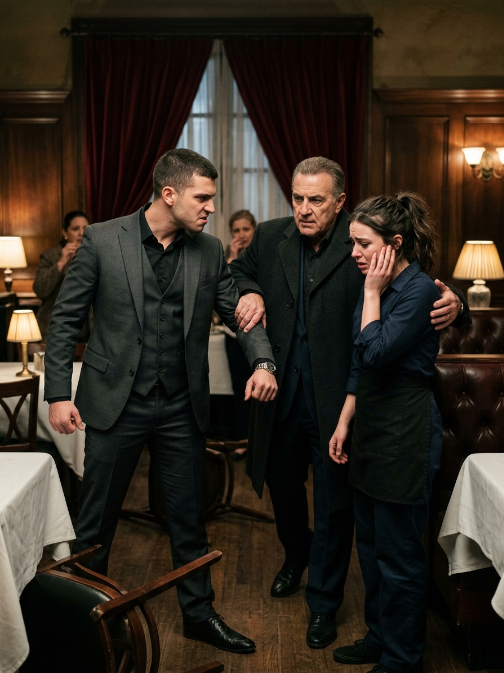
Her Sick Son Was in Danger—Until the Mafia Boss They Feared Stepped In

## PART 1:
They didn’t start with her.
That was what she would remember later — that they started with Milo.
“Kids that age,” the man called Dex said, in the tone of someone making casual conversation, “they’re fragile. You know how it is. One bad day in a hospital and everything changes.”
The night went quiet around those words.
Not silent. The street was never silent — distant traffic, the groan of a freight elevator from the warehouse across the block, rain collecting in the gutters of the Garment District’s indifferent buildings. But the noise fell away from Dex’s voice the way noise falls away from something that matters, and what Elena Vasquez heard in its place was her son’s name, unspoken, hanging between them like a blade.
Milo. Seven years old. Leukemia, diagnosed fourteen months ago. Currently in Room 4 of the pediatric oncology ward at St. Benedikt’s, three miles from where Elena was standing in the rain in her hospital scrubs — teal, the ones with the small bleach stain on the left cuff she hadn’t been able to get out — holding an envelope that contained every liquid dollar she had on earth.
Four thousand, two hundred dollars.
Against a debt of fifty-one thousand.
She had gone to Harlan Voss — no relation to any Voss with a conscience — eight months ago, when the insurance gap had become impossible to ignore. Experimental protocol. Two words that meant *maybe your son lives* and also *not covered, not negotiable, here is a number with more digits than your bank account has ever contained.*
She had gone to every legitimate option first. She was not naive. She was a pediatric oncology nurse — she knew, better than most people, what desperation looked like from the outside, and she had always believed she would never be the person who made the decisions desperation makes.
Then she sat in the parking structure of St. Benedikt’s at midnight and looked at the number the billing department had given her, and thought about Milo asking that morning whether the medicine was going to work, and whether it would hurt, and whether she would stay in the room while it happened.
*Yes to all three*, she had told him.
She had been right about two.
Harlan Voss’s operation ran out of a legitimate-looking financial services office on West 38th with a receptionist and a plant and paperwork that almost looked like paperwork. The interest rate was in the fine print. The terms were in smaller fine print beneath that. Elena had read every word, which meant she had no one to blame but her own desperation, which understood the terms and signed anyway because the alternative was explaining to a seven-year-old why *maybe* had become *no*.
Eight months later, the principal had somehow grown. The monthly payments had consumed her second job — she was working thirty hours a week as a home health aide on top of her hospital shifts. She hadn’t slept more than five hours consecutively since March.
She had come tonight with everything she had.
She had known it wouldn’t be enough.
She had come anyway.
Harlan Voss stood under the scaffolding of a building on 39th that had been under renovation for as long as anyone could remember. Fifties, soft around the middle, with the particular confidence of a man who had never had to be physically threatening because he had always had Dex for that.
Dex was not soft anywhere.
Elena held out the envelope.
Voss looked at it without taking it.
“Four thousand,” he said.
“Four thousand, two hundred.”
“Against fifty-one.”
“I know what it’s against.” She kept her voice level. She had learned, over fourteen months of clinical work with families in crisis, that level voices get further than breaking ones. “I’m asking for an extension. Sixty days. I have a second position being posted at the hospital — senior staff, fifteen percent pay increase. I’ve applied. I have a strong chance.”
“You had a strong chance last time.”
“I didn’t get that one. I’m telling you about this one so you understand I’m not asking you to accept risk without basis.”
Voss tilted his head slightly. “You talk like someone who went to school.”
“I did.”
“Lot of good it’s doing you.”
Elena said nothing.
Dex shifted to her left, and she tracked the movement without turning her head — another thing fourteen months of pediatric oncology teaches you: how to monitor the room without appearing to. Parents learn it too, that constant peripheral surveillance, checking every door and every face for information about what’s coming.
“Here’s what I think,” Voss said pleasantly. “I think you’re going to go back to that hospital tonight. And I think you’re going to think very carefully about creative solutions. Because my patience has a shape, Elena, and you’ve reached the edges of it.”
“I’ve brought you money every month—”
“You’ve brought me fractions.”
“It’s everything I have.”
“Then find more.”
The rain picked up. Elena’s scrubs were soaked through at the shoulders now. She thought about Milo asking her this morning, in the half-awake way he had before the morning medication, whether she had slept. She had told him yes. He had looked at her with seven-year-old accuracy and said *you don’t look like you slept.* She had laughed and called him her little doctor.
“Tommy,” Voss said, with the ease of someone who’d said it a hundred times, “remind Ms. Vasquez about our policy on accounts that plateau.”
The man behind Voss’s left shoulder moved forward.
He didn’t touch her. He didn’t have to.
“Kids in hospitals,” Tommy said conversationally. “Scary places. So many people coming and going. Hard to keep track of everyone.”
The envelope crumpled in Elena’s fist.
“He’s in a secure ward,” she said. Her voice came out flat.
“Sure,” Tommy agreed.
The single syllable of a man who knows something you don’t.
Elena looked at Voss.
Voss looked back with the expression of someone who has made a calculation and found it satisfying.
“Sixty days,” Elena said. “That’s all I’m asking.”
“And I’m asking for creative solutions,” Voss said. “Tonight. Before the shift change at St. Benedikt’s.” He let that land. “You understand what I mean by before.”
She understood.
She also understood — with the cold, complete clarity that comes when someone threatens your child and something animal and implacable rises up through the exhaustion and the debt and the wet scrubs and the four-thousand-two-hundred dollars that wasn’t enough — that she was not going to find fifty-one thousand dollars before shift change.
She was not going to find it at all.
She was out of exits.
Except one, and she’d been avoiding it for eight months because it frightened her in a different way than Harlan Voss frightened her. Voss was petty and cruel and motivated by money. The other option was something more complicated.
Elena put the envelope back in her pocket.
“I need to make a call,” she said.
Voss smiled. “I’ll wait.”
She walked to the edge of the scaffolding, just outside the rain’s reach, and called the number she had memorized eight months ago and never used.
It rang twice.
“Who is this.”
Low. Controlled. The voice of a man who doesn’t ask questions he doesn’t already know the shape of.
“My name is Elena Vasquez,” she said quietly. “You treated my son at St. Benedikt’s two years ago. Bay 7, pediatric oncology. He was the one who told you your watch was the wrong color for your jacket.”
A pause.
“I remember him.” Something shifted in the voice. “Is he alright?”
“He’s fighting.” She kept her back to Voss. “I need help. I know what you are and I know what asking means. I’m asking anyway.”
Silence.
Then: “Where are you.”
She told him.
Another silence, shorter.
“Do not move. Do not engage them further. Four minutes.”
The line went dead.
Elena turned back to Harlan Voss with the envelope still in her pocket and her hands steady for the first time all evening.
Voss read something in her face and frowned. “Who did you call?”
“Someone who knows creative solutions,” Elena said.
It took three minutes and forty seconds.
She knew because she counted.
The black car didn’t announce itself — no sirens, no acceleration. It simply appeared at the end of the block the way weather appears: present before you registered its arrival. Two men got out first. Then a third.
Then him.
She recognized him immediately, though he looked different outside a hospital — no paper gown, no IV line, none of the deliberately rendered vulnerability of patienthood. He wore a dark overcoat and moved with the unhurried confidence of a man who has never once in his life needed to rush because things wait for him, not the other way around.
He had been Bed 12 for eleven days. He had been polite to every nurse on the ward and given her son a handshake on the day he was discharged, very seriously, man to man, which Milo had talked about for a week.
His name was Raphael Drăgan, and Harlan Voss had gone the color of old chalk.
He didn’t look at Voss first.
He looked at Elena.
Took in the wet scrubs, the envelope she was holding, the precise expression on her face of someone who has spent fourteen months not breaking and is very tired of the effort.
Then he turned to Voss.
“Her debt,” he said, “is settled.”
Voss opened his mouth.
Raphael looked at him, and Voss closed it.
“The documentation—”
“Will be provided to you tomorrow,” Raphael said, “along with a conversation you will not enjoy but will benefit from remembering.” He paused. “The comment about the hospital ward.”
Voss said nothing.
“Dex,” Raphael said, without looking at him, “you specifically.”
Dex had developed a sudden interest in the scaffolding above him.
Raphael turned back to Elena.
“My car will take you back to St. Benedikt’s.” His voice had changed register — not soft exactly, but the formal edge was gone. “Your son is fine. I had someone check twenty minutes ago.”
Elena stared at him. “Twenty minutes ago you didn’t know I was going to call you.”
Something crossed his face.
“No,” he said. “But I knew about the debt three weeks ago. I was waiting to see what you’d do.”
The rain fell between them.
“Why?” she asked.
He looked at her for a moment with an expression she couldn’t read — layered, and careful, and carrying something she didn’t have the context to interpret yet.
“Because the last person who asked me for help,” he said quietly, “asked for themselves.” He glanced toward the car, where the door was being held open. “You never once mentioned yourself tonight.”
Elena Vasquez stood in the rain in her bleach-stained scrubs with four thousand, two hundred dollars in her pocket and a debt that had just, impossibly, been settled.
She thought about Milo. About shift change. About the morning medication she needed to be there to explain.
She walked to the car.
She didn’t know yet what Raphael Drăgan had been doing three weeks ago when he first found out about her debt.
Or why a man like him had been watching a pediatric oncology nurse from a distance for twenty-one days.
Or what the document he’d mentioned to Voss actually contained.
But she knew — with the same instinct that told her when a patient was turning a corner, when the numbers were starting to go the right way — that the conversation she’d just stepped into was not finished.
It had, somehow, just begun.
—
## PART 2:
He sent her back to St. Benedikt’s alone.
She’d half-expected him to come with her — to make something of the evening, to extend what had just happened into something she’d have to navigate. He didn’t. He closed the car door, said *my driver will wait as long as you need*, and walked back toward Voss with the particular walk of a man who considers the conversation with her complete for now and the conversation with Voss just beginning.
She was back at the hospital by midnight.
Milo was asleep, which she had known he would be, but she stood in the doorway of Room 4 for two full minutes watching his chest rise and fall before she went to the nurses’ station to check the medication log. He was fine. His numbers from the afternoon were better than last week. He had apparently told the night nurse that his mother was the best nurse on the whole floor, and the night nurse had written it in the communication log with a small star next to it.
Elena sat in the family lounge with a cup of machine coffee and looked at the star for a while.
She went home at two. She slept five hours. She woke up and went back.
Raphael called on Tuesday afternoon, while she was charting in the supply room.
“I want to meet,” he said. “There’s something I need to explain to you. In person.”
“The document,” she said. “The one you mentioned to Voss.”
A pause. “Yes.”
“You said it would be provided to him tomorrow. That was Sunday. Today is Tuesday.”
“I delayed it.”
“Why.”
Another pause. Longer than the first.
“Because I needed to decide something first,” he said. “About whether to tell you what it contained.”
Elena set down her pen.
In her experience, people who needed to *decide* whether to tell you something had usually already decided not to and were looking for a reason to change their mind. She had learned to give them the room to find it themselves.
“Thursday,” she said. “After my morning shift. There’s a coffee place on Amsterdam Avenue, north of 168th. I’ll be there at two.”
“All right,” he said.
He was there when she arrived. Same overcoat, different shirt, the same quality of stillness she’d noticed under the scaffolding — controlled, precise, the stillness of someone who has been in rooms where stillness mattered and made it a habit.
He stood when she came in.
She sat down across from him and said: “Tell me what was in the document.”
He sat.
He did not reach for the coffee in front of him. He put both hands flat on the table instead, which she recognized as the gesture of a person about to say something they have fully committed to saying.
“A patient died at St. Benedikt’s fourteen months ago,” he said. “Her name was Dorota Mach. She was sixty-three. She came in with a cardiac event and was placed in the step-down unit. She died on her third day.”
Elena knew the name. Not intimately — she hadn’t been the primary nurse, and the step-down unit was a different floor. But she remembered the family. A daughter who had asked very specific questions. A son-in-law who had been very quiet in the way that sometimes means grief and sometimes means something else.
“The family hired me,” Raphael said. “Not immediately. Six months later, when they had gone through the hospital’s internal process and found the outcome unsatisfying.” He held her gaze. “They believed the death was not properly handled. They wanted an independent investigation.”
“Into the hospital.”
“Into specific staff.” He paused. “You were one of four names they gave me.”
The coffee shop noise continued around them — the milk steamer, the door bell, a man across the room laughing at something on his phone.
“I wasn’t in the step-down unit,” Elena said.
“I know. I established that within the first week.” He looked at her steadily. “You had been Dorota Mach’s primary nurse during an outpatient procedure six months before her death. A routine follow-up. The family believed — incorrectly — that something from that visit had been documented improperly.”
“And?”
“Your documentation was thorough. Accurate. Timed correctly. Every notation exactly as it should have been.” He paused. “Better than most of what I’ve seen in fourteen months of looking at medical records.”
Elena looked at her hands.
Fourteen months. The same length of time Milo had been sick. She had started working double shifts fourteen months ago. She had taken the home health aide position fourteen months ago. She had been, for fourteen months, visibly stretched in ways that showed in parking structures at midnight and envelopes that weren’t enough and scrubs with bleach stains she hadn’t had time to replace.
“You were investigating me,” she said, “while I was borrowing money to keep my son alive.”
“Yes.”
“For six months.”
“The investigation took three weeks,” he said. “Three weeks to establish that the family’s suspicion about you was unfounded. I cleared your name from the inquiry entirely.” He held her gaze. “I found out about Voss three weeks ago — not through the investigation but through a separate information network. I had someone look at your financial situation to understand whether you were a person susceptible to improper payments.” He stopped. “What they found instead was Milo.”
The sentence landed quietly.
“You were looking for evidence that I could be bribed,” Elena said. “And what you found was that I was in debt because my son has cancer.”
“Yes.”
She sat with that for a moment. The specific, cold, complete shape of it.
“The document you mentioned to Voss,” she said.
“Is the settlement confirmation. Proof of debt clearance.” He paused. “It contains nothing about the investigation. Your name is not in it except as the debt holder.”
“But you withheld it for two days.”
“Yes.”
“Because you were deciding whether to tell me this.”
“Yes.”
“You were deciding,” she said slowly, “whether I would ever need to know that you came into my life as someone investigating me. Whether you could settle the debt and walk away and the reason you’d originally found out about me would simply — not matter.”
Raphael said nothing.
Because she was right, and they both knew it, and he had apparently decided that pretending otherwise was not something he was willing to do.
Elena looked at the table.
She thought about fourteen months of not breaking. About the thing she had said to herself in the parking structure at midnight when she signed Voss’s paperwork: *you understand what you’re doing. Do it anyway.* The specific self-awareness of desperation, which doesn’t stop you but at least doesn’t lie to you.
She thought about a man who had three weeks ago found out her child was dying and had watched her for twenty-one days before she called him.
“Why twenty-one days,” she said. “If you’d cleared my name in three weeks — if you knew about Voss — why watch me for three weeks before I called.”
Raphael looked at her directly.
“Because I didn’t know how to approach you,” he said. “I knew what I’d been sent to find. I knew what I’d actually found. I didn’t know what someone does with that.”
“So you waited to see what I would do.”
“Yes.”
“And what I did was run out of money.”
“What you did,” he said quietly, “was carry everything alone for fourteen months without asking anyone for anything, and then stand in the rain and ask for help for your son and still not mention yourself once.”
The coffee shop. The milk steamer. The door bell ringing for someone else.
Elena thought about Milo this morning, asking if she’d eaten breakfast. She had said yes. He had looked at her with seven-year-old accuracy, the same accuracy as always, and said *the good kind of breakfast or the coffee-counts kind.*
She had laughed.
He always made her laugh. Even now. Even in Room 4 with the numbers and the medication log and the morning shift she had to get back to.
“The family,” she said. “The Mach family. Did they find what they were looking for?”
“Not in the way they hoped.” Raphael’s voice was even. “The investigation found documentation issues — not from your records, from a different staff member. Minor, but real. The family chose to accept the hospital’s revised response.” He paused. “The outcome for them was not what they expected when they hired me. It rarely is.”
“That’s true of a lot of things,” Elena said.
He looked at her.
She picked up her coffee. It was still warm. She drank from it and set it down and looked at the man across the table from her — who had come into her life as an investigator and stayed in it as something she didn’t have a name for yet, which was accurate, because she hadn’t decided what it was.
“The document,” she said. “Send it to Voss today.”
“All right.”
“And I want a copy.”
“Of course.”
She picked up her jacket from the back of the chair.
“I have a question,” she said.
He waited.
—
PART 3:
She didn’t ask it then.
She put on her jacket, picked up her bag, and said she had to get back for the afternoon check on Milo’s numbers. She walked to the door. She said she’d be in touch. She went back to the hospital and checked the numbers, which were holding steady in the way that on a good week felt like a gift and on a careful week felt like information not yet complete.
Milo was awake. He was working on a drawing of what he informed her was a rocket ship, though it looked, to her clinical eye, more like a very optimistic potato.
“It’s a rocket,” he said, with the certainty of someone who does not require external validation of his artistic vision.
“I can see that now,” she said.
He showed her the window he’d added for the astronaut. Then he asked if Raphael was going to come visit again.
She looked at him.
“What do you know about Raphael,” she said carefully.
“He was in Bay 7 when I was little.” Milo said it the way seven-year-olds say *when I was little*, which means eighteen months ago. “He had the wrong watch. I told him.”
“You did tell him.”
“He shook my hand when he left.” Milo considered the rocket. “Like I was a real person.”
“You are a real person.”
“I know. But some grown-ups don’t shake hands with kids. They shake hands with the *parents* and just like—” He made a vague wave in the direction of hypothetical children. “So.”
Elena looked at her son drawing his rocket ship and thought about a man who had shaken his hand seriously, man to man, and then two years later appeared in her life through a path she was still understanding the shape of.
“I don’t know if he’ll come,” she said honestly.
“You could ask him,” Milo said. “You have his number.”
“I do have his number.”
“Then.” He added a flame to the rocket’s base. “Easy.”
She went back to her shift.
She thought about the question all the way through her afternoon patients, through the medication log, through the family meeting in the consultation room at five where she sat across from a mother and father who were two months into a diagnosis and needed someone to tell them the truth about what came next without making it impossible to breathe.
She was good at that. She knew how to hold the truth and the person at the same time.
She thought about whether Raphael Drăgan had anyone who did that for him.
On Friday she texted him: *Same coffee place. Saturday morning, ten o’clock, if you’re available.*
He responded in four minutes: *I’ll be there.*
She was there first this time. She ordered for both of them — she knew how he took his coffee, she’d noticed on Thursday, the specific attention she gave to people she was trying to understand — and she was sitting with both cups when he came in.
He stopped when he saw two cups.
Then he sat down.
“The question,” he said.
“Yes.”
He waited. Hands flat on the table again, the same way, the gesture of someone fully committing to what’s about to happen.
Elena looked at him across the table. She had spent a week with the question, and she knew it was the right one, not because it was gentle or because it would make things easier but because it was accurate. In fourteen months of pediatric oncology she had learned that the right questions were usually the ones nobody asked first because they were afraid of the answer.
She was not afraid of answers. Answers were information. Information was what you used.
“When you decided to tell me the truth on Tuesday,” she said, “instead of letting me believe you’d simply done a good thing for a stranger — what were you hoping would happen?”
Raphael looked at her.
Not the controlled look she’d seen under the scaffolding. Not the formal look from Thursday when he’d laid out the facts in order. Something more unguarded than either of those — the look of a person who has been asked a question they’ve been asking themselves and haven’t finished answering.
“I don’t know,” he said.
She believed him.
“That’s honest,” she said.
“I thought—” He stopped. Started again. “The investigation was over. Your debt was settled. I could have sent the document and had no further reason to be in contact.” He looked at the table. “I made a decision to tell you instead of letting it be over. I haven’t been entirely sure why.”
“I think you know why,” she said. “You’re just not sure whether it’s a reason that makes sense for someone like you.”
He looked at her.
“Someone like me,” he repeated.
“You shook my son’s hand when he was five years old,” she said. “Like he was a real person.” She held his gaze. “I don’t think you do that by accident. I think you’re someone who decides what things mean and then acts accordingly, and you shook his hand because it meant something, and now you’re sitting here because that means something too, and you’re trying to decide if that’s reasonable.”
Raphael Drăgan was quiet for a moment.
“Is it?” he said.
It was not the question she’d expected. She had expected deflection, or precision, or the careful management of a man who managed everything carefully.
She hadn’t expected him to ask her.
She thought about it honestly.
She thought about a man who had watched her for twenty-one days and moved a timeline forward because she was standing in the rain in bleach-stained scrubs. She thought about an investigation that had cleared her name and a document that had been delayed because someone needed to decide what honesty required. She thought about her son’s rocket ship and the word *easy* and fourteen months of doing things that weren’t easy and not having anyone to tell that they weren’t.
“I think,” she said carefully, “that it’s complicated. And I think complicated things are worth doing slowly, and I think you already know that, and I think that’s probably why you waited twenty-one days before you called.”
He looked at her with something she’d been seeing in glimpses for a week and could now see clearly: the expression of a man who is not used to being understood correctly and is very still with the surprise of it.
“Milo wants to know if you’ll come visit,” she said.
He blinked. Just once.
“He said you shook his hand like he was a real person,” she said. “He remembers.”
“He was five,” Raphael said.
“He has a very good memory.” She picked up her coffee. “He’s going to want to show you the rocket ship. I should tell you honestly that it looks like a potato, but he’s committed to it being a rocket, so.”
Something moved in Raphael Drăgan’s face.
It was not the controlled stillness. It was not the formal edge. It was not any of the things she’d been cataloguing and reading and trying to understand.
It was simple.
It was, she thought, what he looked like when something surprised him into not managing his expression at all.
“Saturday afternoon,” he said. “If he’s up for visitors.”
“I’ll ask him.”
She texted Milo from the table, right there, which she almost never did during what was supposed to be her own time. Milo had a tablet in Room 4 for exactly this kind of communication. The response came in forty seconds, which was fast even for Milo.
*YES TELL HIM ABOUT THE ROCKET*
She showed Raphael the screen.
He read it. Something in his face did a thing she didn’t have a word for yet but recognized the shape of — the way a person’s face changes when something they’d decided not to want becomes, without permission, something they want.
She would learn to recognize that expression well, in the months that followed. She would see it the first time he sat in Room 4 and listened to Milo explain the rocket ship’s fuel system with complete seriousness. She would see it in a hospital corridor on a Tuesday in February when the numbers came back better than expected and she came out of the consultation room and he was there because she had, without quite deciding to, told him when to be there. She would see it on the day in March when Milo’s doctor said the phrase *responding well*, and Raphael, who had been standing in the doorway of Room 4 not wanting to intrude, heard it from the hallway and had to look at the wall for a moment before he could look at anything else.
But that was later.
Right now there was coffee, and a text from a seven-year-old with a rocket ship, and a man across a table who had come into her life as the wrong thing and stayed as something she was still naming.
Elena Vasquez put her phone in her pocket.
“Saturday at three,” she said. “He naps at one. He’ll fight you on that but he does.”
“I’ll come at three,” Raphael said.
She finished her coffee.
He finished his.
Outside, the November morning was doing its ordinary things — traffic, wind, a man arguing with a parking meter, a woman pushing a cart of laundry with the focused efficiency of someone who has a long list and enough energy for exactly the list.
She had a list too. She had always had a list.
For the first time in fourteen months, someone else knew what was on it.
She didn’t know yet what to do with that. But she was a person who had learned that not knowing what to do with something was different from not having it, and that having it was, for now, enough.
She went back to the hospital.
Milo was adding a flag to the top of the rocket when she walked in.
“Did you tell him?” he said, without looking up.
“He’s coming Saturday at three.”
“Good.” He added a star to the flag. “He should see it before it launches.”
“When is it launching?”
“When I get better,” he said. Simply. With the certainty of a child who has not yet been given a reason not to be certain.
Elena sat down in the chair beside his bed.
She looked at her son and his rocket ship.
She did not say anything, because some things don’t need to be said, and she had learned — in fourteen months of sitting with families in the specific geography of hope and fear and the strange way those two things coexist in a pediatric ward — that silence is sometimes the most accurate response.
She sat with him until his eyes got heavy and the marker dropped a little in his hand.
Then she took it from him gently, capped it, and set it on the tray table.
The rocket waited on the bed beside him, complete except for the stars she could see he’d planned for the body and hadn’t gotten to yet.
There was time.
There was, she told herself, with every careful and specific and hard-won thing she had, still time.
—
**THE END**