SHE WAS LEFT FOR DEAD IN THE MUD FOR STEALING BREAD — THEN THE MAN WHO SAVED HER HELPED HER TAKE DOWN THE MAN WHO KILLED HER FATHER

PART 1
“This ain’t your business, Yates,” Donovan shouted over the wind.
“She stole from my establishment. And you nearly beat her to death for it,” the stranger replied, steady even with the storm howling around him. “I’d say that settles the debt.”
Harriet tried to speak, to explain, to defend herself against a charge that was, in fact, entirely true — but all that came out was a weak, wracking cough. The stranger knelt beside her, holstered his gun, and turned her over with a gentleness that felt almost impossible given what she’d just watched him threaten to do.
His face came into focus through the rain — weathered by sun and wind, a strong jaw shadowed with stubble, eyes so blue they seemed to hold their own light even in the dark.
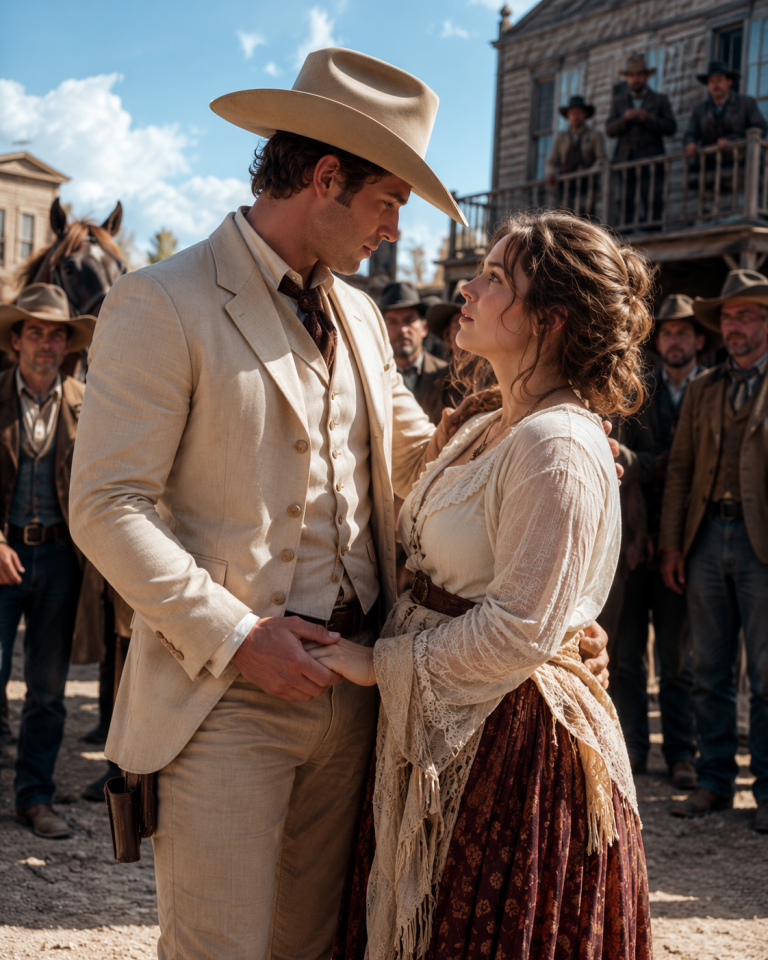
“You’re safe now, sweetheart,” he said softly, lifting her from the mud like she weighed nothing at all. “I’ve got you.”
She didn’t remember the ride. She only remembered waking hours later in a small, clean room, sunlight filtering through cotton curtains, the smell of coffee and bacon drifting in from somewhere close. She tried to sit up and winced at a sharp stab through her ribs.
“Easy.” The same deep voice, from a chair beside the bed. The stranger sat with his hat resting on his knee, watching her with the careful attention of a man used to tending wounded things. “Doc Miller says you’ve got two cracked ribs and more bruises than he cared to count.”
Harriet pulled the blanket higher, suddenly aware she wore a nightgown that wasn’t hers. “Who are you?”
“Samuel Yates. Most folks call me Sam.” He tilted his head. “And you’re in my home, about a mile outside of town.”
“Harriet James,” she managed, after a hesitation that surprised even her. “Though I don’t see why you’d care to know.”
The corner of his mouth lifted. “Well, Miss James, when a man carries a half-drowned woman through a thunderstorm, it seems only polite to learn her name.”
She looked away, gratitude and humiliation warring in her chest in equal measure. “Thank you for intervening. But I should be on my way as soon as possible.”
“Doc says you need at least a week of rest.” He stood, hanging his hat by the door. “Besides — Donovan and his boys might still be looking for you. Best to lie low for a spell.”
She wanted to argue. Her body, throbbing with every shallow breath, wouldn’t let her.
“Why help me?” she asked quietly.
“You don’t know me.” He paused at the doorway. “Let’s just say I’ve got a particular dislike for men who beat women. Regardless of the reason.”
He told her there was fresh water for washing, clothes lent by a neighbor named Mrs. Wilkins, and breakfast waiting on the stove, and left before she could form a reply.
It took her nearly an hour to dress, every movement slow and deliberate against the ache in her ribs. When she finally made her way out, she found a modest, well-kept cabin — a fire in the stone hearth, breakfast steaming on the stove, and through the window, Sam working a chestnut mare on a long lead in the corral. His movements were confident and unhurried, and the horse leaned into his direction like it trusted him completely.
Harriet ate — realizing only when the first bite touched her lips how hungry she truly was — and watched him through the glass, turning her circumstances over in her mind.
She had come west three months earlier, following her father’s death, hoping to claim the land he’d described so lovingly in his letters. What she’d found instead was his grave and a deed contested by the local cattle baron. With no money and no proof beyond her father’s own words, she’d taken work at the hotel — until the owner’s son made advances she refused, and she was dismissed without pay. Stealing bread had been the last resort of a woman with nowhere else to turn.
Sam came in from the corral, hanging his hat by the door. “You’re up. How are you feeling?”
“Like I’ve been trampled by a herd of cattle.” She managed something close to a smile. “But I’ll manage.”
“Doc Miller will be by tomorrow to check on you. In the meantime, you’re welcome to stay as long as you need.”
“I can’t impose.”
“It’s no imposition.” His voice was gentle but firm. “The spare room’s been empty since my brother moved to Denver last year.”
She studied him, searching for the angle men usually hid behind offers like this. As if reading the thought directly off her face, he added, “There’s no strings attached to my offer, Miss James. Just a safe place to recover.”
“Why would you do this for a stranger?”
He took a long sip of coffee before answering. “I came west after the war with nothing but nightmares and a horse. A family took me in when they had no reason to. Gave me work. Gave me purpose.” He gestured around the cabin. “Everything I have is because someone once showed me kindness when I needed it most.”
His honesty disarmed her more completely than any reassurance could have.
“Thank you,” she said simply.
The week that followed passed slowly as her body mended. Sam spent his days with cattle and horses — breaking and training them, she learned, for ranchers and the cavalry alike — while Harriet insisted on earning her keep, taking over the cooking, mending his clothes, filling the small cabin with a warmth it had clearly been missing.
In the evenings, over shared meals, she learned he’d fought for the Union, had a rare gift for calming skittish horses, and read voraciously despite little formal schooling. He listened, in turn, as she told him about her father’s dream of a life along Beaver Creek — and it was one particular evening, watching the sunset bleed gold across the mountains, that the ground beneath both their feet quietly began to shift.
“Where was this land your father claimed?”
“North of town, along Beaver Creek.” Her voice went soft with memory. “He wrote it had the sweetest water and richest grass he’d ever seen.”
Sam went very still.
“That would put it,” he said slowly, “on the edge of Blackwell’s range.”
—
PART 2
“Victor Blackwell.” Harriet’s voice hardened around the name. “The man who claims my father never properly filed the deed.”
“Blackwell’s not a man to cross,” Sam said carefully. “He’s got the sheriff in his pocket, and he doesn’t hesitate to use force when it suits him.”
“So I’ve discovered.” Harriet’s hand went unconsciously to her healing ribs. “The men who beat me work for him. Donovan may own the saloon, but everyone in this territory knows Blackwell owns Donovan.”
Sam’s jaw tightened. “You never mentioned that part.”
“Would it have made a difference?”
“No,” he admitted. “But it explains why they were so intent on punishing you over a few loaves of bread.” He leaned forward, elbows on his knees, something calculating settling into his expression that hadn’t been there a moment earlier. “What proof do you have of your father’s claim?”
She withdrew a folded paper from her pocket — his letters, a hand-drawn map of the land’s boundaries. “He wrote that the official deed was filed with the land office in Cheyenne.”
Sam studied the crude sketch a long moment. “Your father had a good eye. This is prime grazing land.”
“Which is why Blackwell wants it,” Harriet said bitterly. “He wrote that he’d built a cabin, started fencing the property. When I finally went there, all I found were charred remains. The locals told me it was a tragic accident. A fire that took his life.”
“You don’t believe that.”
“No.” She met his eyes. “I don’t.”
The following morning, Sam rode into town alone, insisting it was safer for her to remain at the cabin until he’d assessed how much danger still followed her name through Silverage. He returned by midafternoon, expression grim.
“Blackwell’s men are still looking for you,” he reported, unsaddling his horse with hands that had gone tense despite his even tone. “And there’s more. The land office in town has mysteriously lost all records of claims filed in this area before 1873.”
“Convenient,” Harriet said, bitterness sharpening every syllable. “Without those records, I have nothing.”
“Not necessarily.” Sam led the horse into the barn, Harriet following close behind, hanging on every word now with something that felt dangerously close to hope. “The land agent, Jenkins, is Blackwell’s man through and through. But I spoke with Elijah Monroe at the telegraph office. He’s been sending copies of every land transaction in this county to the territorial capital for years. If your father’s claim was legitimate, there should be a record in Cheyenne.”
Something loosened in her chest for the first time in months. “How long would that take?”
“Under normal circumstances, weeks.” He finished stripping the horse’s tack, then turned to face her fully. “But Monroe’s son works in the land office in Cheyenne. He’s agreed to look into it immediately and telegraph the results.”
“Why would he help me?”
Sam’s smile was small, but it carried an edge she hadn’t seen in him before — something closer to quiet vengeance than kindness. “Monroe lost his best grazing land to Blackwell two years ago, in a remarkably similar misunderstanding about property boundaries. He’s not the only man in these parts who’d like to see Blackwell taken down a peg.”
Harriet felt the weight of three months’ grief and fear shift, just slightly, on her shoulders.
“Thank you, Sam. I don’t know how I’ll ever repay you for all this.”
“No need,” he said simply — though something in the way he looked at her when he said it made her pulse quicken in a way that had nothing to do with Blackwell, Donovan, or the land she’d nearly died defending.
She had come to Sam’s cabin as a stranger with a stolen loaf of bread on her conscience.
She was beginning to understand she might be leaving it as something else entirely — if Blackwell’s men didn’t find a way to end that possibility first.
—
PART 3
Three days later, Sam returned from town with a triumphant look on his face and a telegram in hand. Harriet’s father had indeed filed a legal claim to one hundred and sixty acres along Beaver Creek — properly recorded in Cheyenne, complete with survey and witnesses.
“This changes everything,” Harriet said, reading it a third time, her hands unsteady. “With this proof, I can challenge Blackwell’s claim.”
“It won’t be easy.” Sam’s caution didn’t diminish the fire in his eyes. “Blackwell won’t give up without a fight, and he’s got most of the town intimidated.”
“I’m not afraid of him.”
“Maybe you should be.” His voice was serious now, all humor gone. “Men like Blackwell don’t hesitate to use violence to get what they want.”
“All the more reason I can’t back down.” Her chin lifted. “This land is all I have left of my father.”
Sam studied her — the set of her jaw, the steel that had replaced the trembling woman he’d carried out of the mud two weeks earlier — and something in his expression shifted into resolve.
“You’re not alone in this fight anymore, Harriet. I want you to know that.”
The intensity in his eyes made her breath catch. Over two weeks, something had changed between them — what began as gratitude on her part and obligation on his had deepened into something neither had yet found the courage to name.
“Thank you,” she said softly. “That means more than I can say.”
They rode into town together the next morning, Harriet in her borrowed dress with her head held high, the telegram folded safely in her pocket. Sam rode beside her, rifle visible in its scabbard — a silent message to anyone inclined to test the matter further.
Sheriff Taylor’s office smelled of stale tobacco and worry. The man himself, thin and perpetually anxious, deliberately avoided Harriet’s eyes when they entered.
“Mr. Yates,” he acknowledged. “What can I do for you?”
“Miss James has some business regarding her property,” Sam said evenly.
Recognition and unease crossed the sheriff’s face when he finally looked at Harriet. “You’re the woman who assaulted Donovan’s men and stole from his establishment.”
“That’s not quite how I remember it.” Harriet placed the telegram on his desk without flinching. “I’m here about my father’s land claim, which Mr. Blackwell has illegally occupied.”
The sheriff barely glanced at the paper. “Property disputes aren’t my jurisdiction. You’ll need to take this to the circuit judge when he comes through next month.”
“In the meantime,” Sam interjected, “Miss James will be taking up residence on her rightful property. We thought you should know, in case Mr. Blackwell mistakenly reports trespassers.”
The sheriff’s eyes narrowed. “You’re making a mistake crossing Blackwell. Both of you.”
“The mistake,” Harriet said, “was thinking I’d abandon my father’s land. Good day, Sheriff.”
Outside, Sam helped her back onto her horse. “That went about as well as expected.”
“He’ll warn Blackwell immediately.”
“Counting on it.” Sam’s smile was grim. “Now we visit the land office.”
Word spread through Silverage by noon — Harriet James was challenging Victor Blackwell’s claim, and Sam Yates was standing behind her. As they rode out of town, Harriet felt eyes tracking them from every window along the street.
“We’ve stirred the hornet’s nest,” she observed.
“That we have. Blackwell will make his move soon. We need to be prepared.”
Instead of returning to Sam’s cabin, they rode north toward Beaver Creek. After an hour, they crested a rise, and Harriet caught her breath at the valley spread below them — a clear, winding creek, knee-high spring grass, wildflowers scattered across it like something out of her father’s most vivid letters.
“It’s exactly as my father described it,” she whispered.
“Some of the finest grazing land in the territory.” Sam’s voice softened. “No wonder he staked his claim here.”
They followed the creek down into the valley until they reached a clearing marked by charred timber — the remains of a cabin — and beside it, a small grave with a wooden cross. Harriet dismounted and knelt in the grass beside it, running her fingers over the carved letters: *Henry James, 1874.*
“I’m sorry I wasn’t here when you needed me, Papa.” Her hand pressed flat against the earth. “But I’m here now. And I promise I won’t let your dream die.”
Sam kept his distance until she stood, wiping her eyes, and then approached leading both horses.
“We can rebuild,” he said. “Not today. But soon.”
“First,” Harriet said, straightening her shoulders, “we need to deal with Blackwell.”
They spent the rest of the day surveying the property using her father’s map, discovering — to Harriet’s fury — that Blackwell had already been grazing his own cattle across the northern section for months.
“Probably started as soon as your father died,” Sam observed grimly, examining the trampled grass and cow paths.
They made camp by the creek as the sun set, and Harriet found herself sitting closer to Sam than propriety strictly allowed, the evening air cool between them.
“What happens tomorrow?”
“We start rebuilding. I’ve got lumber back at my place. It won’t be much, but it’ll establish your presence on the land.” He hesitated. “And when Blackwell’s men come — and they will — we won’t be alone. I’ve sent word to a few friends. Men who’ve had their own troubles with Blackwell over the years. They’ll be here tomorrow to help.”
Harriet stared into the fire. “I’ve dragged you into my fight, Sam. That wasn’t fair of me.”
“You didn’t drag me anywhere I wasn’t willing to go.” His voice went quiet. “These past weeks, having you at my cabin — it’s the first time in years the place has felt like a home.”
Her heart quickened.
“Sam, you don’t have to—”
“I just wanted you to know,” he said, faster now, before he could think better of it, “that I’m here because I want to be. Because I care about what happens to you.”
In the firelight, his eyes reflected the flames and something else entirely — something that made her brave enough to reach out and take his hand.
“I care about you too,” she admitted. “More than I should, perhaps.”
His fingers tightened around hers. “There’s no *should* out here, Harriet. Just what is.”
He leaned forward slowly, giving her every chance to pull away. She met him halfway instead, and the kiss that followed carried weeks of unspoken longing finally allowed to surface. When they parted, he rested his forehead against hers.
“I’ve been wanting to do that since the day you first made breakfast in my kitchen.”
She laughed softly. “Even with my face still bruised and swollen?”
“Even then.” He brushed a strand of hair from her cheek. “You’re the strongest woman I’ve ever met, Harriet James.”
They slept under the stars that night, close but proper, both aware that whatever had shifted between them was too new and too precious to rush.
—
Morning brought five ranchers and farmers from across the county, each with his own grievance against Blackwell, arriving with tools, lumber, and a shared, quiet determination. By noon, the foundation of a new cabin had been laid, the first logs going up under practiced hands while Harriet moved among the workers with water and encouragement.
“Your father was a good man,” one of the older ranchers, Peterson, told her during a rest. “Helped me dig my well when nobody else would spare the time. It’s about time somebody stood up to Blackwell and his bunch.”
The sound of approaching hooves cut the moment short.
A dozen riders appeared on the northern ridge, Victor Blackwell at their head — a large man with a thick mustache and eyes as cold as the creek water. He reined to a stop twenty yards off, surveying the half-built cabin with open contempt.
“Yates,” he called, ignoring Harriet entirely. “You’re trespassing on my property.”
Sam stepped forward, positioning himself slightly ahead of her. “This land legally belongs to Miss James, Blackwell. We’ve got documentation from Cheyenne confirming it.”
Blackwell sneered. “Papers can be forged. This land’s been part of the Double B range for years.”
“Since exactly one week after my father died,” Harriet said, stepping up beside Sam, chin lifted. “After someone burned his cabin — with him inside.”
A dangerous silence fell. None of Blackwell’s men would meet her eyes.
“That’s a serious accusation, Miss James.” Blackwell’s voice went deceptively soft. “One that could get you hurt.”
“Is that a threat?” Sam’s hand drifted toward his holster.
“A friendly warning.” Blackwell’s eyes flicked toward the charred remains of the original cabin. “Accidents happen out here. Terrible accidents.”
Harriet felt a chill despite the warm sun. “I’m not leaving my land, Mr. Blackwell.”
“We’ll see about that.” Blackwell nodded to his men. “Remove these trespassers.”
Both sides reached for their weapons in the same breath — and before a single shot could ring out, a new voice cut across the clearing.
“That’ll be enough, Victor.”
Sheriff Taylor rode in with three other men, one of them wearing a badge Harriet had never expected to see this far from a courthouse.
“Marshal Davis,” Blackwell said, visibly thrown.
“This is a local matter,” the sheriff started.
“Not anymore.” The marshal’s tone left no room for argument. “I’ve got a warrant for the arrest of Donovan on charges of assault and attempted murder — and I’m investigating reports of land fraud and intimidation across this county.”
The sheriff shifted uncomfortably as the marshal continued. “Miss James’s telegram to the governor caught considerable attention in Cheyenne. Seems there’s been a pattern of questionable land acquisitions in this area.”
Blackwell’s face darkened. “This is absurd. I’ve broken no laws.”
“Then you have nothing to worry about.” The marshal’s calm was its own kind of threat. “In the meantime, this land is legally registered to Harriet James. You and your men will vacate it immediately.”
For a long moment, Harriet thought Blackwell might order his men to fight regardless of the odds. Then, after a tense standoff, he wheeled his horse around.
“This isn’t over,” he growled, glaring at both of them. “Not by a long shot.”
As Blackwell and his men rode off, Marshal Davis approached. “Miss James. The governor was most interested in your situation. Seems you’re not the only one who’s had trouble with Mr. Blackwell’s expansion plans.”
“Thank you for coming.”
“Don’t thank me yet.” His expression stayed measured. “Men like Blackwell don’t give up easily. But with enough evidence, we can ensure he faces justice.”
By evening, Donovan had been arrested, and Blackwell’s activities were under formal territorial scrutiny — his empire, built on fear and forged deeds, beginning at last to come apart at the seams.
—
Work on the cabin continued for three more days, the structure rising with remarkable speed thanks to the many willing hands. Harriet worked alongside Sam from dawn until dusk, their shared purpose drawing them closer with every log set into place.
On the fourth day, as they fitted the door to the nearly finished cabin, Sam suddenly took her hand.
“I’ve been thinking,” he said, uncharacteristically hesitant. “My place is too big for just one person. And this cabin’s going to be awfully small.”
Her heart skipped. “What are you suggesting, Mr. Yates?”
“I’m suggesting that maybe neither of us needs to live alone.” He took a breath. “I know it’s fast. Maybe I’m being presumptuous. But these past weeks have been the happiest I can remember, and I think — I hope — you feel the same.”
“I do.” She squeezed his hand. “But are you really proposing what I think you’re proposing?”
The uncertainty left his eyes all at once. “I am. Marry me, Harriet. We can combine our lands. Build something lasting together.”
She pretended to consider it, though her heart had already answered. “Well — you did save my life. And you’re not a terrible cook.”
Sam laughed, pulling her into his arms. “Is that a yes?”
“Yes.” She rose on her toes to kiss him. “I’ll marry you, Samuel Yates.”
—
Two months later, they stood together on the porch of their newly expanded cabin, watching the sun sink low over the land that had nearly cost both of them everything. The investigation into Blackwell’s affairs had revealed a pattern of intimidation, fraud, and violence stretching back years — his grip on the territory finally broken, though the courts would take their time settling the rest. Their wedding, a month prior, had been a simple affair attended by every friend who’d stood beside them against him, officiated by the circuit judge on his monthly rounds.
“Do you ever think about that night in the rain?” Harriet asked, leaning into Sam’s solid presence, his arm settled around her waist. “When you found me in the mud?”
He pulled her closer. “Sometimes. Mostly I think about how lucky I am I happened to be in town that evening.”
“I don’t think it was luck.” Her voice went soft. “My father used to say that some things are meant to be, even when the path to them is difficult.”
“Your father was a wise man.” Sam pressed a kiss to her temple.
She smiled, placing her hand over his where it rested against her still-flat stomach. “He would have liked you. And I think he’d be happy to know his grandchild will be born on the land he loved.”
Sam went very still, her meaning arriving a beat behind her words. “Harriet — are you saying—”
“Yes.” She laughed at the astonishment breaking across his face. “Doc Miller confirmed it yesterday. We’re going to have a baby, Sam.”
The joy that spread across his features was everything she could have hoped for. He lifted her clean off her feet, spinning her once before setting her down and kissing her with a tenderness that brought tears to her eyes.
“You’ve given me everything I never knew I wanted,” he whispered against her lips. “A home. A purpose. A family.”
“We’ve given those things to each other,” she corrected, cradling his face in her hands.
As the sun disappeared behind the mountains, painting the sky in brilliant orange and violet, they stood together on the land that had once brought them both sorrow, and now carried nothing but promise. What had begun with a beaten woman in the mud and a stranger’s steady revolver had become, against every likelihood the world had offered either of them, a home, a legacy, a future neither had dared imagine before the storm that first threw them together.
The last light faded from the ridge. The first stars broke through above them.
Whatever tomorrow asked of them, they would face it exactly as they’d faced Blackwell and everything before him — together, and unafraid.
THE END