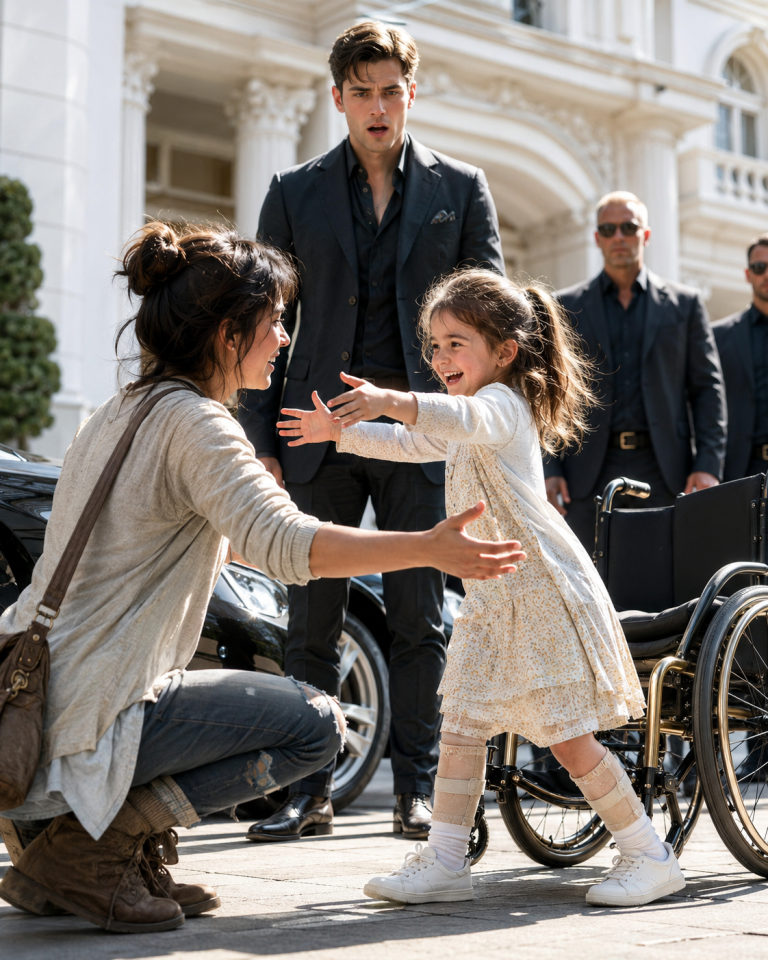
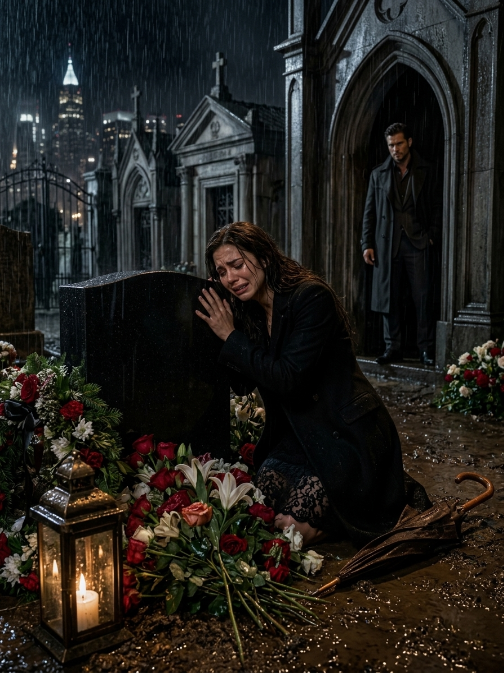
She Thought the Mafia Boss Saw Her as Family — Until Another Man Touched Her Waist… and the Truth He Revealed Changed Everything

PART 1
She was not supposed to be in the garage.
That was the first thing Dara Mitchell thought, afterward, when she had the luxury of thinking in straight lines again — she was not supposed to be in that parking structure at eleven forty-seven on a Thursday night because her shift had ended at eleven-thirty and she should have been two blocks away by now, in the warm cab she couldn’t really afford, on her way back to the apartment where her daughter was sleeping with a stuffed fox under her chin.
But she had gone back for her jacket.
The jacket was seven years old and faded at the cuffs and she had left it on the hook in the break room and it was the only jacket she owned that was warm enough for a Chicago November. So she had gone back for it, and then she had taken the parking structure stairs instead of the elevator because the elevator was slow and she was cold and tired, and the stairwell door had opened into the second level and she had heard the voices before she processed what kind of voices they were.
Too late to go backward.
Three men in a pool of fluorescent light.
One of them on the concrete.
The man on the floor was breathing in the specific way that breathing became audible — not dramatically, not like the movies, but with the wet, effortful quality of someone working hard just to keep their chest moving. His hands were secured behind him. Dark stain spreading from his left shoulder.
He looked at her.
“Please,” he said.
His voice was barely there.
The two standing men turned.
The taller of the two — not the tallest in the group, but the one the others watched before they moved, before they spoke, before they breathed — looked at her with dark eyes that registered her name badge, her scrubs, the jacket folded over her arm, all of it, in the span of about a second and a half.
“Well,” he said quietly. “That’s complicated.”
Dara did not run.
She should have run.
She was thirty-one years old and an emergency room nurse and she had been surviving on thirty-seven-hour weeks and a prayer and the specific stubbornness of women who have no one to hand the difficult things off to. She did not run because the man on the floor was breathing the way patients breathed when they were running out of time, and her body understood that before her fear did.
“He needs help,” she said.
The tall man looked at her.
“Yes,” he said.
That was all.
Just yes. As though the situation had already sorted itself and he was simply confirming the outcome he had assessed.
“My kit is in my car,” she said. “Parking level three.”
He looked at the man beside him.
“Get it.”
She gave her keys without being asked. Something in the architecture of the situation had removed certain categories of choice from her, and she understood that fighting them in this moment would cost more than she could afford.
She worked.
She had done this in ER bays and ambulances and once in the stairwell of a building where someone had collapsed, and the body’s knowledge took over the mind’s terror the way it always did — efficiently, gratefully. She cut fabric, packed gauze, assessed airway, put her fingers to a pulse and counted.
Alive. Staying that way, if she moved fast.
The tall man crouched across from her.
He watched her hands without speaking.
After a few minutes she said, without looking up: “He needs more than I can do here.”
“He’ll get it.”
“A hospital—”
“No hospital.”
She looked up then. “Then why are you letting me help him?”
“Because he has value worth preserving.”
The words were delivered without inflection, which made them land worse.
“Value,” she repeated.
“In my world, useful lives longer than innocent.”
She looked at him steadily. “Your world sounds exhausting.”
He studied her with an expression she could not read. Then he said, quietly: “It is.”
There was a quality to those two words that she did not expect — not self-pity, nothing performed. Just a tired acknowledgment, the kind that lived in a person who had been something for long enough that they could see it clearly without being able to change the view.
She finished what she could do.
When two men arrived and moved the injured man into a vehicle that materialized from somewhere, she stood on unsteady legs and did not fall, which she considered an accomplishment.
The tall man picked up her kit and held it out.
“Your name,” he said.
“It’s on the badge.”
“I want to hear it.”
She looked at him. “Dara Mitchell.”
“Dara,” he said. The name in his mouth had a quality she couldn’t categorize. “You did well.”
“I did my job.”
“Under circumstances that would have made most people useless with fear. That’s more than your job.”
She took the kit from him. “Can I go?”
“Yes.”
She walked toward the stairwell.
“Dara.”
She stopped. Not because she wanted to. Because something in the register of it was not a command and not a request and landed somewhere between the two where she didn’t have an automatic response.
He held out a card. Black matte, no logo.
“I won’t need that,” she said.
“You might.”
“I won’t.”
He held it another second. Then he put it in the pocket of her jacket — the one she’d come back for, the one she was still carrying — without asking permission.
“Go home,” he said. “Get some sleep. Forget tonight.”
“Who are you?”
A pause.
“Nolan Gray.”
The name meant nothing to her. She would learn what it meant later. Right now she was running on a sleep deficit and adrenaline and the muscle memory of helping people, and she went home to her apartment in Bridgeport and checked the locks and stood in her daughter’s doorway until her breathing normalized.
Wren was four years old and asleep in a way that only children slept — completely, without reservation, one arm thrown over the edge of the mattress. She had leftover something on her cheek. A crayon mark, maybe. A smear of the afternoon.
Dara did not fall apart.
She went to bed.
She woke at five-fifteen to Wren climbing onto her chest and saying: “Mama, I dreamed about a horse.”
“What kind of horse?”
“Purple.”
“A good purple or a bad purple?”
Wren considered this with the seriousness it deserved. “Good purple.”
Dara put her arms around her daughter and held on.
The card was in her jacket pocket. She did not throw it away. She told herself she would and she didn’t.
Three days later her car wouldn’t start.
Four days after that, the daycare sent a notice.
Five days after that, she used the card.
—
Nolan Gray became, over the following six months, a problem she did not have a category for.
He paid too much. She argued about it and lost. He called at late hours from an unknown number, addressed her with an economy of words that should have felt cold but didn’t, and sent her to locations that were never what they looked like from the outside — a back office behind a dry cleaner, a private room above a restaurant, a disused clinic in a part of the city where she had never been and did not mention to anyone.
She stitched cuts and wrapped ribs and, twice, removed things that had no business being inside a human body. After the second time she went into the alley behind the building and put her back against the brick wall and breathed in the deliberate pattern she had learned from a meditation app she no longer had a subscription to.
She heard him come out behind her.
He didn’t speak. He just stood nearby with his back to the wall too, which was, she thought, his way of saying he understood.
When she was ready she went back inside.
She never asked him to stop calling.
She told herself it was for the money, which was real and necessary and transformed Wren’s winter into a season with proper boots and a coat that fit, and transformed their refrigerator into something that wasn’t a source of anxiety every time she opened it. She told herself it was temporary. She told herself a lot of things.
In the meantime, she noticed things.
She noticed that when one of his men made a comment about a woman walking past and Nolan looked at him, the man did not make that kind of comment again. She noticed that he tracked what she said — not in the way of someone gathering ammunition, but in the way of someone for whom information was the primary mode of engagement with the world, so everything was information. She noticed that he had offered her a substantial amount of money to stay quiet about a man she had helped and then never once leveraged that arrangement.
She noticed, too, the way his men spoke around her.
*She’s under Roman’s protection.*
Roman. They called him that — a version of his name she hadn’t been given. She filed it.
*She’s like family to him.*
*Like his little sister.*
She filed that too.
Once, three months in, he said it himself. One of his men had made a joke — edged, testing — and Nolan said, without looking up from what he was reading: “Watch yourself. She’s family.”
The word settled over her like something she had been cold without noticing.
Her own family had been a series of absences — her mother dead when she was twenty, her father remarried and managed at a comfortable distance, Wren’s father three years gone with the specific finality of men who leave before they have to be asked. Family was a word she had stopped applying to herself.
Nolan Gray gave it back to her like it was his to give.
She told herself it was gratitude. Professional loyalty. The particular bond of people who worked in high-stakes proximity.
His men called her the little sister.
She let herself believe them.
It was easier than the alternative.
—
The surgeon appeared in April.
His name was Dr. Cameron Wells, and he arrived at St. Catherine’s from a fellowship in Boston with an easy manner and a talent for making people feel immediately comfortable, which Dara recognized as a skill because she had it too and knew how much work went into making a skill look effortless.
He was kind, which made her careful.
He remembered Wren’s name after hearing it once, which made her more careful.
He made her coffee when she looked tired and told her once — simply, without expectation — that she was the best nurse he’d worked with and he meant it. She believed him, which was the problem. She was out of practice trusting simple things.
Three weeks in, he asked her to the hospital’s annual charity gala.
“Just as colleagues,” he said, which she thought was probably not true but appreciated the framing.
She bought a dress from the consignment shop on Archer Avenue. Black. She had not owned a dress in two years. It fit in the way that things fit when they’re made for a different body and happen to accommodate yours — imperfectly, but well enough.
Mrs. Ortega downstairs watched Wren.
Cameron picked her up in his car and said she looked beautiful and she believed he meant that too, which continued to be the problem.
The gala was in a ballroom above the river that turned everything gold. She had not been in a room like this in years — maybe ever, in this particular configuration. She stood with champagne she barely touched and felt the specific strangeness of being in a beautiful place after years of survival-mode functioning, like a language she had forgotten was hers.
Cameron’s hand found the small of her back.
Polite. Guiding. Warm.
She looked up.
And found Nolan Gray across the room.
—
PART 2
He was in a tuxedo and conversation with someone important, and neither of those things were what registered first.
What registered first was that he saw her.
Not saw her in the way of a room that was aware of him and therefore tracked everything near him. Saw her specifically — her face, the dress, the way she was standing — and went very still in a way she had learned to read as meaningful because very still, with Nolan, was the opposite of neutral.
Then his eyes moved to Cameron’s hand.
Something shifted in his face.
She knew him well enough now to see what moved when other people would have called his expression blank. The particular tightening around the jaw. The quality of attention redirected from the room to a single point.
Cameron leaned close. “That’s the man who’s been watching you for the last ten minutes.”
She said: “He’s a donor.”
Cameron’s hand remained where it was.
Nolan crossed the room.
The crowd parted in the way crowds parted around certain people — not because anyone decided to, but because it happened anyway, the body’s older instincts recognizing something before the mind named it.
“Dara,” he said.
Not kid. Not little nurse. Her name.
She felt it differently than she expected.
“Nolan,” she said.
Cameron extended his hand with the smooth confidence of a man who had been in rooms like this all his life. “Cameron Wells.”
Nolan looked at the hand.
Did not take it.
“I know,” he said.
Cameron smiled. “Should I be concerned?”
“Yes,” Nolan said.
“Nolan,” Dara said.
His eyes moved to Cameron’s hand at her waist.
“Take your hand off her,” he said. Quiet. Conversational.
The air changed.
Cameron lifted his hand slowly, palms up, a gesture of easy compliance that didn’t reach his eyes. “I didn’t realize Dara came with restrictions.”
“She doesn’t,” Nolan said. “This is something else.”
She stepped between them — not to protect Cameron, she understood somewhere below the level of thought, but because she was the only person in this particular configuration who was actually angry, and she had been angry for a while now, and the anger had finally found its shape.
“You don’t get to do this,” she said to Nolan.
He looked at her.
“Six months,” she said. Her voice was steady. She was proud of that. “Six months of *kid* and *little nurse* and *she’s family* and everyone in your orbit believing we are something that we are not, and now another man pays attention to me and suddenly you’re across a ballroom making problems. You don’t get to have both.”
The room around them had the quality of a room trying not to listen.
Nolan said nothing.
“Which is it?” she said. “Because I need to know which I’m living in.”
He looked at her for a long moment.
Then he said: “I call you kid because if I called you what I want to call you, I wouldn’t stop there. I said family because it was the only word that made my men stop looking at you the way men look at things they think they can take. I kept distance because every part of me that still knows how to want things wants to close it, and I didn’t have the right.” His voice had not risen. If anything it had dropped. “If you have been living inside a story about what you are to me, that’s my failure. Not yours.”
The ballroom went away.
There was only the specific quality of his eyes in the chandelier light — tired, and something underneath the tired that she had never quite been able to name, and was now naming whether she was ready to or not.
Cameron’s voice, from beside her: “Claire, maybe we should get some air.”
Nolan’s gaze moved to Cameron.
Something in it changed.
Not jealousy this time.
Something older. The quality of a man who has spent decades tracking variables that other people couldn’t see and had just seen one.
“Who sent you?” he said.
Cameron’s expression shifted by a fraction that Dara caught only because she had spent months learning the distance between his face and his meaning.
Then the lights went out.
—
PART 3
The ballroom noise collapsed into itself — champagne glasses going over, a woman’s scream cutting through before it was absorbed by the general sound of two hundred people losing their orientation at once. Emergency lighting bloomed red along the baseboards.
Dara felt a hand on her wrist that was not Nolan’s.
She knew it wasn’t his because she knew his hands now — she had worked alongside them, bandaged them, accepted things from them in the specific transaction of their arrangement — and this grip had a different quality to it. Purposeful in a different direction.
“Cameron—”
“Move,” he said.
Not a suggestion.
She fought him.
She had not planned to fight him. It happened in the body’s older layer, below decision, before thought. He yanked. She resisted. He had significantly more physical leverage and used it, pulling her through the crowd toward a side corridor that smelled like service access and cold concrete.
“Stop,” she said.
He shoved a door open with his shoulder and the ballroom noise cut off.
Service hallway. Dim. The sound of the city filtering in from somewhere ahead.
He pressed her against the wall and she felt, in the specific economy of the contact, that the man who had brought her coffee and remembered her daughter’s name had been a thing he was doing and not a thing he was.
“I need you to understand something,” he said.
“Let go of me.”
“I’m not going to hurt you.”
“I’ve heard that in this hallway configuration before and it was wrong that time too.”
Something moved in his expression. Surprise, maybe.
“You’re not scared,” he said.
“I’m furious,” she said. “That’s different. Who are you?”
He didn’t answer.
From his jacket he took a gun with the practiced ease of someone who had done it many times, and the sight of it moved her from furious to a different register that had space for both things.
“Walk,” he said.
She walked.
The corridor ended at a loading dock door, and he pushed it open, and the Chicago November came in cold and exact, and Nolan was standing on the other side.
Alone.
No men. No coat — he’d left it inside. In the emergency lighting spillage from the open door he was in his tuxedo shirt, hands at his sides, the specific stillness she recognized as his most alert state dressed in its most controlled clothing.
He looked at her first.
The check — her face, her posture, visible injury — took maybe two seconds. Then he looked at Cameron.
“Let her walk to me,” he said.
“She stays here until we’re done.”
“We can be done without her.”
“That’s not how this works.”
“It is now.” His voice was even. “Who are you?”
Cameron’s arm remained at her back, the gun low but present. “My name’s not Wells.”
“I know that.”
“Then you know who my father was.”
A pause.
“Harmon,” Nolan said.
The name landed in the air with weight she didn’t have the context for yet.
“Daniel Harmon,” the man said. “My father.”
“Your father ran a trafficking operation for eleven years and was protected by politicians until he wasn’t,” Nolan said. “He was not a good man.”
“He was my father.”
“I understand that those can both be true.”
The grip on her arm shifted. She measured the shift the way she measured vital signs — for what it indicated about what was coming next.
“I’ve spent three years building a story about you,” the man said. “The people you’ve hurt. The things you’ve taken. I was going to put a bullet in you and call it justice.” He paused. “Then I saw her.”
“Dara.”
“She had no idea what she was standing next to.”
“No,” Nolan said. “She knows exactly what she’s standing next to.”
Dara said: “He’s right, actually.”
Both men looked at her.
“I’ve known what he is since the parking garage,” she said. “I made decisions about how to proceed with that information. They were my decisions.” She held the man’s gaze. “Whatever you think you’re doing for my benefit, stop. I don’t need anyone to save me from a situation I chose.”
“You chose to work for him?”
“I chose to use the skills I have in exchange for compensation that helped my daughter have a stable life. Yes.”
“And the rest of it?”
She didn’t answer that.
The man looked at Nolan. “She’s going to get hurt.”
“Not by me,” Nolan said.
“By the life. By the people who come for you. By the next Harmon, the next Blake, the next whoever decides your vulnerabilities are their opportunities.”
“I know that,” Nolan said quietly. “That’s the argument I make to myself every night.”
“Then why—”
“Because she’s already in it.” His voice dropped. “She was in it the second she walked into that garage and made a decision no one asked her to make. She could have stepped over a bleeding man and gone home. She didn’t. That’s not because of me. That’s who she is.” A pause. “I’ve been trying to keep her safe from a world she already understood better than I expected. That’s its own kind of condescension.”
The loading dock was cold.
Somewhere above them the city was moving through its business.
The man’s grip on Dara’s arm had loosened without his seeming to notice.
“She got to you,” he said.
“Yes.”
“My father would say that’s your weakness.”
“Your father would say a lot of things,” Nolan said. “Most of them self-serving.” He held the man’s gaze. “You came here for justice. What you planned isn’t justice. It’s repetition.”
“What would you know about justice?”
“Less than I should,” Nolan said. “More than I used to.” He took one step forward. “Let her come to me. Then we can talk about what you actually want.”
Silence.
The arm at Dara’s back dropped.
She walked the six feet to Nolan.
He did not reach for her immediately. He waited until she was beside him and then his hand settled at the back of her arm — not possessive, not claiming, just there, in the specific way that there meant *I have you*.
“Talk,” he said to the man.
“You killed my father.”
“Your father’s operation was dismantled by a federal investigation that I provided information to,” Nolan said. “He died in custody of complications from a pre-existing condition. I did not put the bullet in him.”
“You put him there.”
“Yes.”
“You don’t even deny it.”
“What would be the purpose?”
The man’s gun hand dropped another degree. Not lowered — but the intention behind it was changing, she could see it, the quality of a person whose body was ahead of their mind in arriving at something.
“I spent three years planning this,” he said.
“I know.”
“And now what? You talk me out of it?”
“No,” Nolan said. “You talk yourself out of it. I just have to not make it worse.” He paused. “Your father did damage. I know that because I’ve spent a decade trying to catalog it accurately. The women who went through his operation. The families. I won’t tell you that stopping him wasn’t worth what it cost. But I can tell you that what you’re planning doesn’t end anything. It extends it.”
“Into what?”
“Into whatever comes after. Another son. Another generation of the same argument.” A pause. “Or something else.”
The gun lowered.
Not all the way. But enough.
“I don’t trust you,” the man said.
“That’s reasonable,” Nolan said. “Trust me anyway.”
Dara thought: this is the most honest thing she had ever heard him say.
—
He was shot thirty seconds later.
Not by the man he’d been talking to — a second figure she hadn’t seen, positioned at the dock entrance, who had apparently decided the conversation had gone on too long. The sound was enormous and specific in the enclosed space.
Nolan went down and she went down with him because her hands were already moving, already in the assessment she had done a hundred times in a hundred contexts, her body’s knowledge arriving before her fear.
“Stop talking,” she said.
“I’m not—”
“Nolan.”
He went quiet.
The next several minutes were the controlled chaos she had learned to function inside — Nolan’s men arriving from positions she hadn’t known they occupied, the second shooter handled in a way she didn’t watch, the man from the hallway sitting with his back against the dock wall and his gun on the ground between his feet, watching her work with an expression she didn’t have time to interpret.
Nolan’s side. Not his chest. She ran the assessment fast and built the picture: bad, not unsurvivable, needs real intervention, has minutes not seconds.
“We’re moving you,” she said.
“I can—”
“You cannot walk. You’re going to let four people carry you and you’re going to stop trying to direct this situation.”
He looked at her.
“Yes, ma’am,” he said.
He lost consciousness twice in the vehicle.
She worked both times with the focused absence of self that emergency medicine required, and when the second time his eyes came back she said: “There you are,” in the same voice she used with Wren when Wren woke up disoriented, and she didn’t analyze that choice later.
The private facility was forty minutes out. She had been there once before. The team was competent and had learned, in her months of parallel employment, not to ask her questions she couldn’t answer.
She was on her third cup of bad coffee when Nolan’s second-in-command appeared beside her.
“He’s stable,” Matteo said.
She already knew that. She had gotten the update twenty minutes ago.
“The other man,” she said.
“Secure.”
“He needs to talk to someone. Police, or—”
“Nolan already made a call,” Matteo said. “Certain people are interested in the network the man can testify about. There’s an arrangement being arranged.”
“He won’t be hurt.”
“No.”
She looked at her coffee.
“Matteo,” she said. “He was changing.”
“The boss?” He looked at the wall. “He’s been changing. We’ve all been watching it happen.”
“What changed?”
“You started arguing with him,” Matteo said simply. “Nobody argues with him. It turns out he responds well to it.”
She almost laughed.
She sat for a while in the specific stillness of a waiting room after crisis, when the immediate thing has resolved and the larger shape of the situation becomes visible.
She thought about what Nolan had said in the ballroom — *if you have been living inside a story about what you are to me, that’s my failure*. She thought about six months of kid and little nurse and the clean, deliberate line he had maintained, and what it had cost him to maintain it, and how she had known and told herself she didn’t know.
She was honest with herself, eventually.
She had known.
She had let herself believe the little-sister story because it was safer than the alternative, and because she had not been sure what she wanted, and because wanting something from a man like Nolan Gray seemed like the kind of decision that required more certainty than she had.
Wren was four years old and needed a stable mother.
The stable mother was sitting in a waiting room outside a private medical facility having the most emotionally complicated night of her adult life.
She thought: these things can both be true.
—
He woke on the fourth day.
She was there because she had arranged her shifts around being there, which was a decision she made without extensive deliberation and which told her something about where she actually was.
His eyes opened, found the ceiling, then found her.
“Dara,” he said.
“You were shot,” she said. “In case you’re unclear on how we got here.”
“I remember.”
“You lost consciousness twice.”
“I remember that too.”
“The second time was worse.”
“I know.”
She put down the chart. “How do you feel?”
“Like I was shot.”
“Accurate.” She moved to the side of the bed. Clinical check — pupils, pulse, the incision, the drain. All of it appropriate. “Are you in pain?”
“Some.”
“On a scale—”
“I don’t want to talk about the scale.” His eyes tracked her. “The man.”
“Being processed by federal contacts of yours. Matteo handled it.”
“He’ll be—”
“Safe. Yes. I told Matteo that was non-negotiable.”
Something in Nolan’s face settled.
“Thank you,” he said.
“Don’t thank me yet. I have opinions about what comes next.”
“I expected that.”
She sat in the chair beside the bed. Outside the window, afternoon light was doing something ordinary and entirely incongruous with the room.
“The things you said in the ballroom,” she said.
He was quiet.
“Were they true?”
“Yes.”
“All of it.”
“Yes.”
She looked at her hands. “I knew,” she said. “I want to be honest with you. I knew and I let myself believe the other story because it was easier, and because I was scared, and because I had Wren to think about and bringing complicated things into her life felt irresponsible.”
“It wasn’t irresponsible,” he said. “It was accurate.”
“It was also a little bit cowardly.”
“No—”
“I’m allowed to be honest about my own decisions, Nolan.”
He stopped.
“I was a little bit cowardly,” she said. “I’m telling you because I think we both need to not have more cowardice between us than we’ve already had.”
His hand, resting on the blanket, moved slightly toward her. Not reaching. Just present.
She put her hand over his.
“I don’t know what this looks like,” she said. “I have a daughter who needs stability. I have a job and a life and a sleep schedule I care deeply about. I need to know what I’m actually in, not what the comfortable version of it is.”
“Yes,” he said.
“What does yes mean?”
“It means I want to show you what it actually is. Not the version I built to protect you from it. The real one.” He turned his hand under hers. “That will take time.”
“I know.”
“Some of it will be difficult.”
“I’ve had difficult.”
“This is a different category of difficult.”
“I can handle different categories,” she said. “I’ve been handling things that didn’t come with instructions my entire adult life. I don’t need easy. I need honest.”
He was quiet for a moment.
“I can do honest,” he said.
“Start now,” she said. “Tell me something true.”
He looked at her.
“I’ve been listening to everything you said for six months,” he said. “The things you argued about. The opinions you gave me that I didn’t ask for. You talked once about a program at your hospital for uninsured pediatric patients and how it kept losing funding, and the next week it didn’t lose funding. You said once that hungry people shouldn’t be punished like criminals and I looked at three collection operations differently after that.” He paused. “I don’t know if that’s the right kind of change. I don’t know if it’s enough. But you should know it happened.”
She looked at him.
“That’s not nothing,” she said.
“No,” he said. “It’s not.”
—
Three months later she brought Wren to the aquarium.
This had not been planned as a meeting — it had been planned as a Saturday, a thing to do with a four-year-old who had been asking about sharks since she watched something on television that Dara could not in good conscience describe as educational but had resulted in an obsession with marine biology.
Nolan was there.
Not by accident. She had told him where they’d be, which was not quite the same as inviting him and both of them knew it, which was why he had arrived separately and was standing near the penguin exhibit when they came through.
Wren saw him before Dara could prepare anything.
Wren had the observational instincts of a small person who had learned that adults were more interesting than they usually admitted to being, and she looked at him with the directness that children deployed before they learned to be tactical about it.
“You’re tall,” she said.
“Yes,” he said.
“Are you Mama’s friend?”
He looked at Dara briefly. “Working on it.”
Wren considered this. “Do you like sharks?”
“I’ve never thought about it.”
“Today you’re going to learn to like sharks,” Wren said, with the authority of someone establishing the terms of engagement. “Come on.”
She reached up and took his hand.
Dara watched it happen — the absolute confidence of it, the four-year-old’s complete absence of strategy — and she watched Nolan look down at Wren’s hand in his and then look up at Dara with an expression she had never seen from him.
Unguarded.
Just unguarded. All the way down.
She had learned, over six months, to read what lived beneath his expressions. She had catalogued the controlled, the calculated, the careful. She had seen frightened, which he hid well, and tired, which he hid less well, and something that might have been grief when she had accidentally learned about a sister named Elise who had died in someone else’s war.
She had not seen unguarded.
She thought: there it is. There he is.
She caught up with them at the shark tank.
Wren was narrating something about the differences between hammerhead and great white, which she had memorized with an accuracy that Dara had verified against actual research and found alarming for a child of her age. Nolan was listening with the specific quality of attention he gave to things he found genuinely interesting, which was not different, she was learning, from the quality of attention he gave to his daughter.
“She knows a lot about sharks,” he said, when Wren had moved to press her face against the glass.
“She’s like this about everything,” Dara said. “Full commitment or nothing.”
He glanced at her.
She knew what he was not saying.
“Yes,” she said. “She takes after me.”
They watched Wren track a shark along the glass with the focused attention of a small scientist documenting a phenomenon.
“I’ve been making changes,” Nolan said. It was quiet, not a declaration.
“I know.”
“Not fast enough.”
“No,” she agreed. “But some things can only go at the speed they go.”
He was quiet.
“I want to ask you something,” he said.
“Ask.”
“What does this look like? Not theoretically. Practically. With her, with your life, with what I am.”
She thought about it honestly.
“It looks like you come to the aquarium on Saturdays sometimes,” she said. “And it looks like you tell me the truth when I ask you questions, even when the truth is that you don’t know yet. And it looks like she decides what she thinks of you based on who you are to her, not on who you are out there.” She paused. “And it looks like you’re patient. Because I’m going to need patience. And so is she.”
He was quiet for a moment.
“I’ve built things that required patience,” he said.
“This is different.”
“Yes,” he said. “I know.”
Wren appeared between them and looked up at both of their faces with the assessing expression of a four-year-old who had decided something.
“You can come to the jellyfish,” she said to Nolan. “But you have to actually look at them. Not at your phone.”
“I don’t have my phone,” he said.
Wren inspected him.
“Good,” she said.
She took both their hands and walked them toward the jellyfish.
Dara did not let herself make it into anything more than what it was: a Saturday, a child who had decided to include someone in her afternoon, a man who was learning what it was to be somewhere he hadn’t planned to be.
But she thought, walking between them through the light-diffused water of the jellyfish exhibit while Wren narrated something about bioluminescence that she had definitely gotten from a book she was too young for:
Her life had a shape now that it hadn’t had before the parking garage. Not the shape she would have designed. Not the shape that made sense from the outside or that she could explain to her coworkers or that arrived without cost and complication and the specific weight of things that were true.
But a shape.
Something she was building in real time, with real materials, with a four-year-old and a man who was learning to mean what he said and an understanding that safety was not the same as simple.
She could work with that.
She had been working with what she had her whole life.
She was very good at it.