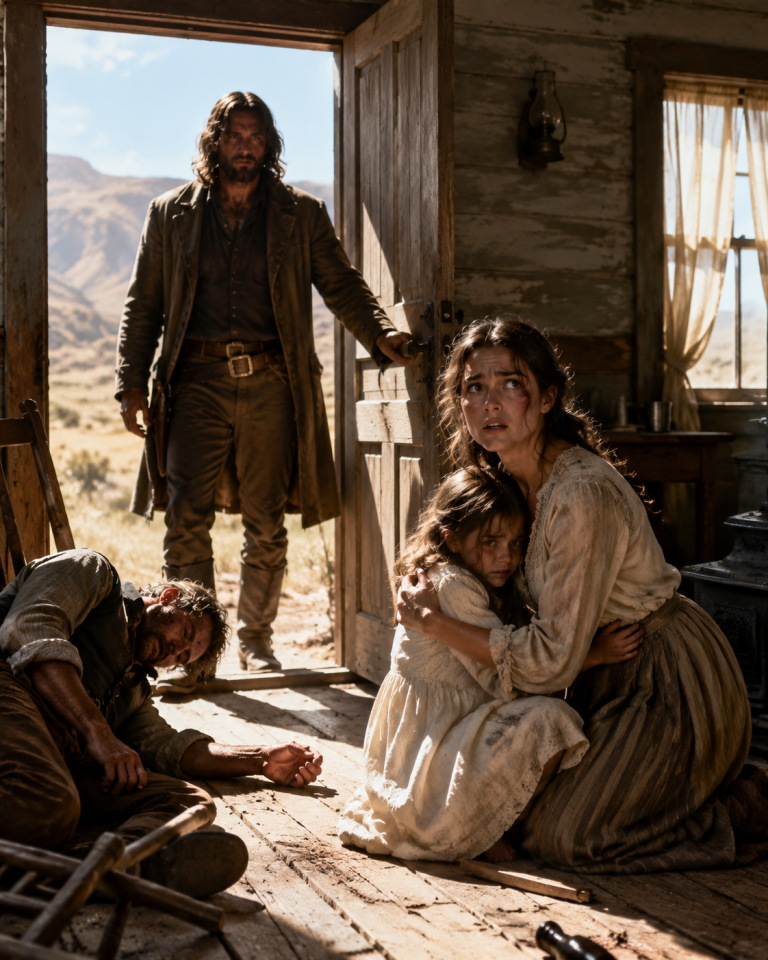
She Sobbed at the Mafia Boss’s Grave—Unaware He Was Alive, Watching From the Shadows

## PART 1
The thing no one tells you about grief is that it has a smell.
Not metaphorically. Literally. The specific combination of candle wax, cut flowers going soft, and the particular chemical quality of condolence food left too long in a refrigerator. I had learned this the hard way in the weeks after Salvatore Conti was declared dead, when my apartment in the North End became a place people arrived at quietly, spoke in, and left without quite making eye contact, as though sadness were something you could catch if you stayed too long near the source of it.
Seven months later, I still sometimes caught that smell in rooms where there was no source for it.
Old grief learning new hiding places.
I was thinking about this — about the way loss settled into the architecture of your life rather than leaving — when I arrived at the cemetery on a Wednesday evening in October and realized I was not alone.
The visit itself was routine by now. Wednesdays after my shift at Bellini’s. The number sixteen bus. The walk from the gates through the older section where the headstones stood closer together and the trees had grown into each other overhead. His stone was black marble, chosen by someone other than me, with his name and years carved into it with the geometric certainty of people who had no doubts about what they were recording.
*Salvatore Marco Conti, 1991–2025.*
I had stood here dozens of times.
Tonight something was different.
The air held it before I could name it — a specific quality of presence, the way a room felt occupied even when you couldn’t see anyone. Cedar. Something dark and expensive underneath, the kind of scent that belonged to cold weather and good wool and a particular man I had spent the last seven months trying to remember how to not think about.
My hands went still on the stone.
I told myself it was grief doing what grief did: constructing ghosts from sensory data.
Behind me, leaves moved in a wind that was not quite strong enough to account for the sound.
I turned.
The cemetery was empty in every direction I could see.
I turned back.
Pressed my fingertips to his name.
“I know you’re not here,” I whispered. “But I keep coming anyway.”
Somewhere behind me and to the left, barely audible: a footstep.
Then another.
The sound of someone who had stopped trying to be quiet.
I did not turn around this time. My heart was beating too fast. My hands had gone cold in a way that had nothing to do with October.
I said: “Salvatore.”
The wind moved through the cemetery.
No one answered.
I was still standing there when headlights swept the entrance gates and a black car rolled slowly down the access road. The window came down. A man I recognized — broad, watchful, never more than two steps from a man I had thought was dead — looked at me with an expression that carried far too many things.
“Ms. Conti,” he said. Which was wrong, because I was not a Conti, had never been a Conti, had only been a woman who loved one.
“Get in the car,” Marco Falco said.
“Why?”
“Because Mr. Conti sent me.”
I stood in the October cemetery and looked at the black marble headstone with a dead man’s name on it.
“Which Mr. Conti?” I said.
Marco’s face answered before his mouth did.
—
I had met Salvatore the way most people met men they weren’t supposed to love: at the exact moment when the guard was down.
I had been working at Bellini’s for four months, a fine-dining restaurant in Boston’s North End where the wine list started at three figures and the clientele divided neatly into people with old money and people with money that didn’t have a history anyone wanted to document. I was twenty-seven and tired in the specific way of people who are tired of being invisible, which is different from regular tired and much harder to sleep off.
He came in on a Thursday with two men who stood too still and watched the room in a particular way. He was tall, and the suit was dark, and the way the room adjusted around his presence — conversations dropping half a volume, the manager appearing without being summoned — told me everything I needed to know about what kind of man had just sat down in my section.
I almost requested a swap.
Instead I brought the menu.
He looked up.
Dark eyes. The kind that didn’t soften when he smiled, which made the smile more honest rather than less. A jaw that looked like it was accustomed to being set.
“What’s good?” he asked.
“The fish,” I said. “Don’t order the lamb. They’re not doing it well right now.”
He looked at me for a beat.
“Why are you telling me that?”
“Because you’ll be disappointed otherwise and I’d rather not spend the rest of the evening managing your disappointment.”
His expression moved in a way I couldn’t categorize.
“That’s very honest.”
“It saves time.”
He ordered the fish.
He also, at the end of the evening, left a card with his number written on the back beside a tip that was not obscene but was generous in the way people were generous when they wanted to communicate something other than simple gratitude.
I looked at the number for three days.
Then I called.
That was the beginning of a year that I had spent seven months trying to understand how to survive the ending of.
—
Now I was sitting in the back of a car that smelled of leather and cigar smoke while Marco drove us out of the cemetery and through the streets of a city that had no idea one of its most feared men was apparently not dead.
“How long?” I asked.
“Ms. Ferraro—”
“How long has he been alive, Marco?”
Marco’s hands tightened on the wheel.
“From the beginning,” he said.
The words settled over me with the specific weight of things that rearranged everything you thought you understood.
From the beginning.
Seven months.
The death certificate. The burned watch I had been given in a velvet box. The check I had never cashed. The days I had spent in an apartment that smelled of condolence food while people spoke in lowered voices and didn’t make eye contact.
All of it.
While Salvatore Conti was somewhere alive.
“Take me to him,” I said.
“He wants to explain—”
“Marco.” My voice came out steadier than I expected. “Take me to him now.”
Marco was quiet for a moment.
Then he drove east, toward the harbor, where the water was dark and the lights of the city reflected up from below like something drowned.
The building was a warehouse that had been converted into something that was only technically not a residence. Brick. Loading dock. A door that opened without a knock because someone inside had seen us coming.
Up two flights.
A long room with high windows showing the harbor.
And Salvatore Conti standing at the far end of it, facing away from me, looking out at the water.
He turned.
Seven months of grief.
Seven months of a black marble headstone.
Seven months of weekly visits to a cemetery to talk to an empty grave.
I looked at him for a long moment.
Then I walked across the room and hit him so hard my hand hurt.
The sound of it filled the warehouse.
He did not step back.
He turned his face back toward me slowly.
There was a red mark where my palm had connected with his cheek.
He looked at it, then at me.
“You had the right,” he said.
“I had more than that,” I said. “I had seven months. Seven months of thinking you were dead.”
“I know.”
“Don’t say you know. You were there. I wasn’t.”
Something moved behind his eyes.
“I was there,” he said quietly. “That part is true.”
The cemetery. The scent. The footstep on the gravel.
“You watched me,” I said.
“Yes.”
“At the grave.”
“Every week.”
I looked at him for a long, very still moment.
Then I said: “Why.”
Not a question. A demand.
He looked toward the harbor windows.
“There is a ledger,” he said. “Names. People with everything to lose. When they believed I was dead, they stopped looking for it. They stopped looking for you.”
“You used me as a decoy.”
“I kept you safe by making you irrelevant.”
“I was grieving you. You watched me grieve a lie.”
“Yes.”
The word landed simply, without excuse or decoration, which was somehow worse than if he’d tried to justify it.
“Who are you hiding from?” I said.
Salvatore’s jaw worked.
“Ferrante,” he said. “Giancarlo Ferrante.”
I knew the name the way you knew names that appeared in certain conversations just before people changed the subject.
“He had your father killed,” I said.
The temperature in the room changed.
Salvatore looked at me very carefully.
“How do you know that?”
“Because your father’s name is in the ledger,” I said. “And because I found it.”
The silence that followed was the loudest thing I had ever heard.
Salvatore went completely still.
“What did you say?”
“Three weeks after you died,” I said, “I found a key in the lining of your coat. The one you left at my apartment in February. I didn’t throw it away. I couldn’t throw anything away.” I reached into my jacket. “And last month I finally looked up what it opened.”
I held up a thumb drive.
Salvatore’s expression was something I had never seen on his face in the year I had known him.
Fear.
Not for himself.
For me.
“You should not have that,” he said.
“No,” I agreed. “But I do.”
Before he could respond, Marco appeared in the doorway.
His face was wrong.
“Boss,” he said. “Ferrante’s people are outside.”
—
## PART 2
The word moved through the room like a temperature drop.
*Outside.*
Salvatore was already moving — not running, but the controlled fast motion of someone who had rehearsed this possibility and was now executing the plan without wasting time on the fact that it had arrived.
“How many?” he said to Marco.
“Six. Maybe eight. They came from the harbor side.”
“They followed the car.”
“I swept for tags—”
“They followed you visually. Old method.” Salvatore looked at me. “Give me the drive.”
“No.”
His expression sharpened. “Sofia.”
“After you explain,” I said. “All of it.”
A sound from below — something impacting the loading dock door.
Marco moved toward the stairs.
Salvatore stopped him with a look and came toward me instead. His voice dropped.
“The ledger contains the names of every person Ferrante controls. Politicians. Judges. Federal agents. And yes — my father’s name, because my father found out what Ferrante was doing and Ferrante had him killed before he could use it. I’ve spent three years building toward the moment I could take Ferrante down with evidence clean enough to stick.”
“And me?”
“You were the safest place for the key. No one connected to Ferrante’s world had any reason to look at you.” His eyes held mine. “Until now.”
“Until I showed up at a warehouse with the drive.”
“Yes.”
Something crashed below.
“The drive goes to a federal contact,” he said. “Not to Ferrante. Not to anyone in my organization. Clean hands. Clean evidence. That was the plan before tonight changed it.”
“And your father?”
The question landed differently than the others.
Salvatore looked at me for a moment that contained seven months of absence and whatever he had seen in those months from a distance.
“My father was trying to do the right thing,” he said. “He deserves to have it matter.”
I looked at the drive in my hand.
Then at him.
“Who is the federal contact?”
“A woman named Reyes. Department of Justice. She has been building a parallel case for two years. This completes it.”
Another impact from below, closer.
“How do I know you’re telling me the truth?” I said. “You lied about being dead.”
“I lied to keep you alive.” He didn’t flinch from it. “That was the only lie.”
I looked at him for three more seconds.
Then I held out the drive.
He took it.
And then the window behind him shattered inward, glass across the floor, and a man came through it with a weapon already raised.
Salvatore moved in front of me before I understood what was happening.
The shot went wide.
Marco came up the stairs firing.
The warehouse erupted.
And in the chaos, through the smoke and the breaking glass and the sounds of men who had found the man they thought was dead, Salvatore grabbed my hand and pulled me toward the door at the back of the room.
“Don’t let go,” he said.
“You either,” I said.
—
## PART 3
The door at the back of the warehouse opened onto a fire escape that had been retrofitted — recently, based on the new bolts — as an exit route. Salvatore had clearly planned for this. Of course he had. He had planned for most things.
He had not, I suspected, planned for me to show up with the drive.
We went down two flights in the dark with gunfire audible above us and the smell of the harbor rising cold and salt-sharp from below. At the bottom, a car was parked at the edge of the dock. Marco appeared from somewhere behind us — I had stopped tracking him — and got behind the wheel.
We moved.
The car turned onto a street I didn’t know and then another and we drove for twenty minutes in silence before Salvatore said anything.
“Are you hurt?”
“No.”
“Your hands are shaking.”
“My hands have been shaking for seven months,” I said. “This is just a different reason.”
He looked at me.
I looked at the city going past outside the window.
“Tell me about your father,” I said.
He was quiet for a moment.
“He was careful,” he said finally. “Methodical. He built the organization with rules about what we would and would not do — lines that seemed arbitrary from the outside but weren’t. He was the reason I knew the difference between making people afraid and making them disappear.”
“And he found Ferrante’s network.”
“He had been watching it for two years. He kept the evidence himself. He didn’t tell me until three weeks before he died, and even then he didn’t give me everything. He said he wanted to be certain I would use it correctly.”
“Correctly meaning?”
“Through channels that could actually prosecute. Not through the methods available to me.”
I thought about that.
“He was trying to do it clean.”
“Yes.” A pause. “He died clean. That mattered to him.”
“And to you.”
Salvatore looked out his window.
“He was the first person who made me understand that what you do with the power you have is not separate from who you are. It is who you are.”
We drove.
The harbor disappeared behind us and the city thinned into neighborhoods I knew better — the streets that looked like streets rather than like wealth, the diners with neon signs and the corner stores with their awnings folded against the cold.
“Where are we going?” I said.
“Somewhere that Ferrante won’t look.”
“Which is?”
Marco said: “Your apartment.”
I looked at him in the rearview mirror.
“My apartment is not a safe house.”
“No,” Salvatore said. “But Ferrante’s people will assume that’s the last place we’d go. Which makes it the right place.” He paused. “For a few hours.”
My apartment in the North End was small and familiar and still, if I was being honest with myself, haunted by the particular smell of seven months of grief. I had not redecorated. I had not moved anything. The photograph on the windowsill — Salvatore in the early summer, squinting into the sun outside a restaurant in the South End — had stayed where he’d left it the last time he’d been here.
Before he died.
Before he didn’t die.
I sat at the kitchen table.
Salvatore stood near the window, looking out at the street with the practiced vigilance of someone who had been doing this a long time.
“Sit down,” I said.
He looked at me.
“Please,” I said. “I have questions and I need you in one place to ask them.”
He sat across from me.
Up close, in the familiar light of my kitchen, he looked like himself. That was the hardest part. He looked exactly like himself. Not like a ghost or a stranger but like the man who had eaten at this table and disagreed with me about whether the windows needed replacing and fallen asleep on my couch once during a film neither of us had been watching.
“The ledger,” I said. “What’s actually in it?”
He told me.
It was extensive. Names I recognized from newspapers and names I recognized from the kinds of conversations that happened at the edges of his world, where powerful people talked to each other using language that had nothing to do with what they were actually saying. Politicians who had received money through foundations that didn’t exist. Judges whose decisions in certain cases bore a suspicious correlation to the outcomes Ferrante preferred. Federal agents who had been helpful at critical moments. A network that had been built over twenty years to make one man essentially untouchable.
“Reyes has pieces of it,” Salvatore said. “She built her case from the outside. The ledger is the center — it’s the proof that the network exists as a coordinated structure rather than a series of coincidences.”
“What happens when it goes public?”
“A great deal of disruption,” he said. “A great deal of people suddenly becoming very cooperative with prosecutors. Ferrante’s entire operation depends on the people in that ledger remaining in place. Remove the protection and the foundation is gone.”
“And Ferrante himself?”
“He goes to trial. Or he runs.” Salvatore’s expression suggested he found one of these outcomes more likely. “He’s old. He’s been insulated from consequences for so long that he has probably forgotten how to run.”
I thought about Salvatore’s father.
A careful man who had kept his evidence and his rules and his lines, and who had died before he could use them correctly.
“Your father would want the trial,” I said.
“Yes.”
“He’d want the record to show what Ferrante did.”
“Yes.”
“So would I,” I said.
Salvatore looked at me.
“The drive goes to Reyes,” I said. “Tonight. Before anything else happens.”
“I intended—”
“I know what you intended. I’m saying I agree with it. I’m saying I want to be there when it happens.” I held his gaze. “I am not a variable in your plan, Salvatore. I am a person. A person who spent seven months at a cemetery talking to a headstone.” I kept my voice even. “If you want any chance of being in my life in any form, you will start treating me like someone who gets to know what is happening.”
He was quiet for a long moment.
“I was afraid,” he said.
“Of Ferrante.”
“Of you being used against me.” He said it plainly, without the protective distance his control usually provided. “When I look at you, I make mistakes. I made the mistake of letting you see me the way I am — not the way I need people to see me. That made you a weakness.”
“I’m not a weakness.”
“No,” he said. “But loving you made me one. And I didn’t know how to keep you safe from that without lying.”
I sat with that.
“You could have told me,” I said.
“You would have tried to help.”
“Yes.”
“You would have been in more danger.”
“Possibly.” I looked at him. “But I would have been a person making an informed choice instead of a person being managed.”
He looked at the table.
“Yes,” he said. “I know that now.”
—
The call to Reyes happened from my kitchen table at two in the morning.
She was awake. She had the quality of a person who was always awake when things moved. She listened to what Salvatore told her and then she asked three questions, two of which were about chain of custody and one of which was about me.
“Who is the third party who found the drive?” she said.
“Sofia Ferraro,” Salvatore said. “She’s the one who has been holding it.”
“Does she understand what she’s holding?”
“She’s the one who insisted we call you tonight,” he said. “So yes.”
A brief silence.
“I need both of you at a location I’ll text you within the hour,” Reyes said. “And I need the original drive, not a copy.”
“Understood.”
“Mr. Conti.”
“Yes.”
“I’ve been building this case for two years,” she said. “Don’t be late.”
We were not late.
The handoff happened in a parking structure near Faneuil Hall at three-thirty in the morning, with Reyes and two colleagues whose names I wasn’t given and whose expressions communicated the specific alertness of people who understood that what they were receiving was significant.
Reyes took the drive from Salvatore.
Then she looked at me.
“You found this,” she said.
“In the lining of a coat.”
“And you held onto it.”
“I couldn’t throw anything away,” I said. “I was grieving.”
Something passed through her expression — not sympathy exactly, something more professional and more real at once.
“Good,” she said.
She turned to Salvatore.
“I’ll be in touch,” she said. “Stay reachable.”
She left.
We stood in the empty parking structure as her car’s taillights disappeared up the ramp.
Salvatore exhaled slowly.
I looked at him.
“Is it over?” I said.
“The hard part is beginning,” he said. “The legal part. The part that takes time.”
“But Ferrante doesn’t have the ledger.”
“No.”
“And Reyes does.”
“Yes.”
I thought about Salvatore’s father — careful, methodical, building his evidence, keeping his rules, dying before the right moment arrived. And then the evidence passing, through a series of coincidences that were not quite coincidences, into the hands of a woman who had been building the parallel case for two years and only needed the center piece.
Things moved when they were ready to move.
“Your father’s name will come out in the trial,” I said.
“Yes.”
“People will know what he found. What he tried to do.”
“Yes.”
“Does that matter to you?”
Salvatore looked at the ceiling of the parking structure, at the concrete and the fluorescent lights and the ordinary architecture of a place that would never appear in anyone’s record of what had happened here tonight.
“It’s the only thing that mattered,” he said. “The rest of it — the organization, the territory, the things men like me spend our lives protecting — none of it outlasts us. What outlasts us is the record of whether we tried to do right by the people we were responsible for.”
He looked at me.
“My father tried. He didn’t get to finish.”
“You finished it for him.”
“We finished it.”
I looked at him for a long moment.
He was not a safe person to love. He never had been, and he was not going to become one simply because he had done a right thing tonight. The organization still existed. The world he moved through still moved the way it always had, with gravity that pulled toward damage regardless of intention.
And I had spent seven months grieving him.
That was not nothing.
“I need time,” I said.
“I know.”
“I’m not saying no. I’m saying I need time.”
“Yes.”
“And I need you to not manage information about my life for my own protection. If we have a conversation, we have it. If there’s a threat, you tell me.”
“Yes.”
“And I need you to accept that I’m going to go back to work at Bellini’s tomorrow and live my life in the normal ways I live it, and you are not going to have people standing outside the building.”
He paused on that one.
“One person,” he said. “Indoors. Lobby only.”
“Lobby only,” I agreed.
“For three months.”
“Two.”
He considered.
“Two,” he said.
—
Six months later, Boston felt like itself again.
The trial had begun, which meant it was in the news, which meant it was in conversations at Bellini’s and on the bus and in the particular ambient awareness of a city that was processing something large. Ferrante’s name appeared in headlines beside words that had not accompanied it before: *alleged*, *indicted*, *cooperating witnesses*. The names in the ledger appeared more gradually, some of them before anyone was ready.
I read the coverage the way I read most things — carefully and with the specific attention of someone who understood that the story on the page was not the same as the story that had taken place.
Salvatore and I had dinner on Thursdays.
Not every Thursday. Most Thursdays. In a restaurant that was not Bellini’s — that felt like too much overlap, too much of two worlds sitting in the same seat — but in a smaller place in the South End where the tables were close and no one appeared to recognize him.
We did not have a name for what we were.
We talked about his father, and about the organization’s slow contraction — legitimate businesses expanding, other operations being quietly wound down over a timeline that he was honest with me about and that I found, mostly, acceptable. We talked about the cases Reyes was building, which advanced slowly in the way legal proceedings advanced, which was to say not slowly at all compared to the way these things usually went. We talked about my students, because I had gone back to teaching — community college, writing and composition — and the classes had a texture and a schedule that gave shape to days that might otherwise have blurred.
We talked about his mother.
That happened once, in the middle of a Thursday dinner, when something I said connected to something he had not yet said out loud, and he looked at his wine glass and said, quietly, that he had been nine years old when she died and that he had spent the following years learning to act as though nothing were missing, which was not the same as the missing not being there.
I listened.
I did not try to fix it.
He looked up after a while and said: “You’re very good at that.”
“At what?”
“Letting things be what they are.”
I thought about seven months of weekly visits to a black marble headstone.
“I had practice,” I said.
He smiled.
The small one, the real one, the one that was rare enough to be worth something.
—
On a November evening exactly one year after the cemetery — after the footstep on the gravel and the scent that should not have been there and the black car rolling toward me with its window down — I stood at the harbor.
The same harbor where the warehouse had been.
The building had been sold, which I knew because Salvatore had mentioned it in passing, the matter-of-fact way he mentioned the gradual dismantling of the old architecture of his life.
He appeared at seven, as agreed.
No car behind him. No second person at a careful distance.
He stood beside me and we looked at the water.
“Do you know what I thought about,” I said, “in all those months?”
“Tell me.”
“I thought about the fish.”
He looked at me.
“The night we met,” I said. “You ordered what I recommended. Most people in that restaurant didn’t notice what I said. They were going to order whatever they’d decided before they walked in. But you actually listened.”
A pause.
“I ordered the fish because you were right,” he said.
“I know. That’s what I thought about.” I looked at the water. “That you listened. That’s the thing I kept coming back to. Not the dangerous parts, not the complicated parts. Just that you listened.”
He was quiet.
“I would like to keep listening,” he said. “If that’s something you’ll allow.”
I looked at him.
In the November light, with the harbor behind him and the year between us and all the complicated machinery of what we were and what his world contained and what it would require to navigate — all of that present, none of it pretended away.
I reached over and took his hand.
Not a declaration.
Not a conclusion.
Just the beginning of the next thing, whatever it was, built on something more honest than the thing before it.
“Start,” I said.
And he did.
—
*Not all love survives being tested by the truth.*
*Some of it doesn’t deserve to.*
*But sometimes two people emerge from the same wreckage, look at each other clearly, and decide that what remains is worth building on.*
*Not perfect.*
*Not safe.*
*Just honest enough to be real.*