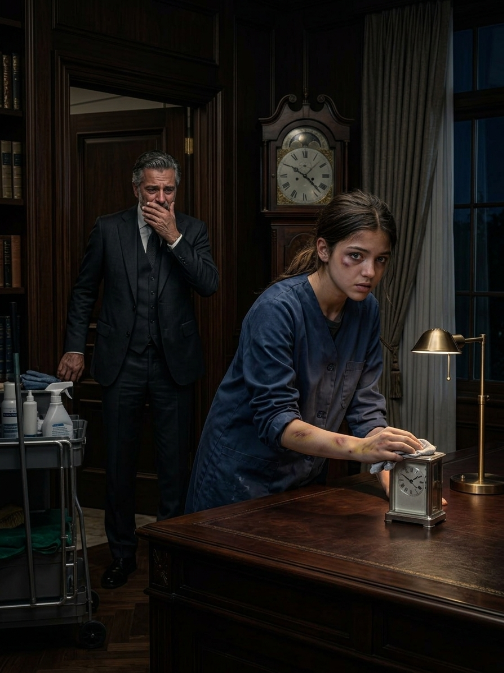
The Mafia Boss Slapped the Shy Waitress and Called Her a Thief—Then Her Father Revealed She Was Hiding a Deadly Empire

## PART 1
She had been good at disappearing for so long that even she sometimes forgot there was something underneath to find.
Mara Sutton had worked the floor at Sinclair’s for nine months. She arrived early, left late, smiled precisely as much as the job required, and gave the kind of service that made rich men feel attended to without making rich women feel threatened. She had learned that trick the way she had learned most things: from the outside, watching, cataloguing what kept her safe.
Noah Briggs noticed her the way you notice weather changing — gradually, then all at once.
He had been behind the bar at Sinclair’s for three years. He had seen ambitious girls and tired girls and girls running from things they never named. Mara was different. She was running from something, yes, but she ran with an economy of motion that suggested she had chosen her direction carefully.
He noticed the coffee first.
Every morning she left one on the corner of his station — black, exactly right, without comment. As if she had simply observed what he needed and decided to provide it. When he thanked her the first time, she had shrugged as if gratitude embarrassed her more than invisibility.
He noticed the rest slowly. The way she memorized every face in a room before committing to crossing it. The way she positioned herself near exits during high-volume nights. The way she hummed — old standards, barely audible, like a frequency only she could hear — when she was polishing glassware and thought nobody was watching.
He had been watching.
Tonight, Vincent Carra sat at table seven with four men whose suits cost more than Noah earned in three months. Carra ran the south Manhattan territories. He was thirty-three, attractive in a way that had clearly worked for him his entire life, and currently furious about a watch.
A platinum Patek Philippe. Missing since he arrived.
Noah was polishing a highball glass when Carra stood and pointed at Mara.
“You.”
She turned. Her expression did not change.
“Come here.”
She came. She carried a water pitcher and maintained the careful neutrality of someone who has been told her whole life that having a face was dangerous.
“My watch,” Carra said.
“I don’t have your watch.”
“No?”
“No.”
Carra’s hand moved faster than anyone in the room expected. The sound was catastrophic — not because it was the loudest thing Noah had heard, but because the silence that followed it was absolute. Crystal chandeliers. White linen. The scent of expensive food going cold on plates as every person in the room stopped breathing.
Mara went down. Her water pitcher shattered on the marble. She came up on one knee among the shards, one hand pressed to her face, and looked up at Vincent Carra with an expression Noah had never seen on her before.
He had seen her frightened. He had seen her tired. He had seen her hold herself together through things that would have unraveled most people.
This was not fear.
This was the expression of someone who had been waiting.
He was moving before he could reason himself out of it.
“Don’t.”
The word came from his mouth but it landed in the room like something much larger. Carra’s men turned. The other diners pressed back in their chairs like water finding the edges of a container.
Carra looked at Noah with the mild curiosity of a man who found inconvenient things in his path. “Barman has an opinion.”
“I have one opinion. Don’t put your hands on her again.”
“Noah.” Mara’s voice was low. His name in her mouth carried a warning he felt in his chest. “Don’t.”
Not because she didn’t want him. He understood that immediately, with a clarity that hurt. Because she was afraid of what Carra’s men would do to him for trying.
That was when he realized she knew exactly how dangerous this was — and had calculated it in the first second.
Domenic Cross, Carra’s second, moved toward the restaurant’s entrance and locked the doors. Rain was running hard down the tall windows. Outside, the city continued. Inside, everyone understood they were in a different kind of room now.
Baptiste, the manager, appeared from the kitchen looking like a man choosing between cowardice and employment.
“Mr. Carra, I’m certain there’s been a misunderstanding—”
“Search her.”
“She doesn’t have it,” Noah said.
“Then let her prove it.”
Mara rose from the floor without accepting anyone’s hand. Glass dust sparkled on her dark uniform. Her lip was cut. Her posture, when she straightened, was wrong for a waitress. It was too composed. Too deliberate. The kind of posture that lived in the body of someone who had been trained, once, to stand in rooms where weakness cost you.
Noah had never seen it before.
Or he had seen it, and had not let himself ask why.
“Search me,” Mara said. “You won’t find it.”
“I’m not done with you if you’re clean,” Carra said. “I want to know who took it.”
“So do I.” Her voice carried no tremor. “But threatening to take me apart won’t produce the watch.”
Carra stepped closer.
Noah moved.
One of the guards intercepted him — an arm across the chest, professional, impersonal, a wall made of man.
Mara looked at him again.
Her eyes, for a moment, said everything she had never said in nine months of quiet proximity. Coffee left without comment. A small “you okay” on days he looked like he wasn’t. The afternoon three weeks ago when the kitchen power cut out and she had stood close enough for him to feel the warmth of her arm, and neither of them had moved away.
She was afraid he would die for her.
He was afraid she would vanish trying to protect him.
Carra pulled his phone out and pushed it against her chest. “Your apartment, your accounts, your whole small life. I want compensation. Right now. And if you can’t pay—”
“I can’t.”
“—then you can explain that in detail to some people I know on Washington Street.”
The threat was specific. It was meant to be specific. Carra made sure she understood what Washington Street meant for girls who caused him inconvenience.
Noah watched Mara’s face.
She did not look at Carra when he said it.
She looked at Noah.
And in that look he saw the thing she had been holding for nine months — the thing she had been careful not to let him see, because letting him see it would have meant letting him in, and letting him in would have meant risking this particular kind of moment, where his safety became the price of hers.
“Give me your phone,” she said to Carra.
He laughed.
So did his men, and some of the guests, desperate to align themselves with power before the night resolved.
Noah did not laugh.
He watched Mara take the phone when Carra handed it over, goading. He watched her thumb enter a number from pure memory — long, complex, international, the kind of number that didn’t live in contact lists.
She placed it on a cleared table.
It rang.
Twice.
The third ring died in the middle.
The line opened without greeting. Without static. Just the quality of deep silence that exists on the other side of absolute authority.
Then a man’s voice — British, unhurried, cold enough to make the room contract — came through the speaker.
“Mara. You were told this number was for the end of the world.”
She lifted her chin.
“It ended about three minutes ago, Dad.”
The word landed like a structural failure. Noah felt it travel through the room. He felt it travel through himself.
Carra’s smile dissolved.
—
## PART 2
The voice on the phone did not raise itself.
It had no need to.
“Describe the situation.”
Mara kept her gaze on Carra. “A patron named Vincent Carra misplaced his watch and decided I was responsible. He struck me across the face. He’s locked the doors. He’s threatened Washington Street.”
The silence that followed was not empty. It was the silence of a calculation being completed.
Noah heard it and understood, the way he had understood things on certain nights in certain places, that the danger in the room had just changed direction.
Carra found his voice. He leaned toward the phone with the bravado of a man who had not yet processed what was happening. “Listen. My name is Vincent Carra. I don’t know who you are, but your daughter—”
“I know exactly who you are.” The voice was almost gentle. “Your father sat across from me in a hotel in this city twelve years ago and agreed to terms he was grateful to be offered. You inherited his operations and none of his sense.”
Carra’s color changed.
Domenic Cross took a half-step backward without seeming to decide to do it.
Noah looked at Mara.
He had built a version of her in his mind over nine months. The version that arrived early and left late. The version that survived on staff meals and thrift-store coats and a quiet smile that never asked for more than it was given. The version that had once told him, during a slow Tuesday, “Some people think a cage isn’t a cage if it’s beautiful enough. I’ve never found that argument convincing.”
He was looking at the real version now.
And the real version was someone whose father’s name made armed men go quiet.
“What is your father’s name?” he heard himself ask.
She didn’t answer. She didn’t need to.
Because Noah had heard the name once, in a different country, from a man who ran weapons and feared almost nothing, and who had said it in a whisper because some names carried weight even when you were far from the people attached to them.
Graham Sutton.
The name didn’t belong to the newspapers. Graham Sutton had spent decades ensuring it didn’t. But it belonged to the infrastructure underneath the world Noah had once moved through in uniform — the invisible financial architecture of criminal enterprise, the man who decided what moved through which ports and at what cost.
The waitress at Sinclair’s who left coffee at his station every morning.
She was his daughter.
On the phone, Graham’s voice dropped further. “You put your hand on my daughter.”
Carra swallowed. He looked like a man who had realized very late that the drop was much further than he’d estimated. “I can compensate—”
“Your assets began transferring fifteen minutes ago,” Graham said. “A formality I arranged while you were explaining yourself.”
Carra made a sound that didn’t belong in his expensive suit.
“The question,” Graham continued, “is what happens to you.”
Carra’s knees buckled. He caught the edge of table seven and held on.
Mara looked at Noah then — just briefly, just for a second — and what he saw in her face was the thing she had been most afraid of. Not Carra. Not danger.
This.
Him knowing.
Him seeing the empire she had fled, rising up through the floor of the ordinary life she had built herself, swallowing it whole.
Then the windows at the front of the restaurant shuddered under an impact that wasn’t wind.
The doors came off their hinges.
—
## PART 3
Six men entered with the controlled efficiency of people who had done this before.
They wore dark coats, moved without hurry, and spread through the room in a pattern that covered all exits before anyone had processed that the doors were gone. Outside, rain was sheeting down Greenwich Street, turning the parked cars into dark shapes and the streetlights into halos.
The man who followed them in was not large.
This was the first thing Noah registered, because it surprised him. Everything about Graham Sutton’s name suggested mass, presence, the physical weight of power. The man who entered Sinclair’s was lean and silver-haired and carried an old-world stillness that made the room very quiet without him demanding it. He closed an umbrella, handed it off, and looked at the restaurant the way you look at something you’ve been watching for a long time from outside.
His gaze found his daughter immediately.
The bruise on her face.
Something moved behind Graham Sutton’s eyes.
“Dad,” Mara said.
He crossed the room. His men adjusted around him. Carra and his guards had already been gathered, disarmed, arranged near the far wall with the professional absence of fuss that suggested this was an unremarkable Tuesday for the people doing it.
Graham stopped in front of Mara.
He lifted one hand and very carefully touched the edge of the bruising at her jaw.
Mara went still.
Not with fear. With the particular held-breath quality of someone waiting to be claimed.
Then Graham turned to look at Noah.
Noah did not move aside.
He had not planned this. There was no plan here — just the understanding that he was standing beside Mara and intended to keep standing there until she asked him not to.
Graham studied him. “You’re the bartender.”
“Yes.”
“You moved toward my daughter when Carra struck her.”
“Yes.”
“They stopped you.”
“They did.”
“You tried anyway.”
It was not quite a question. Noah answered it anyway. “Yes.”
Something shifted in Graham’s assessment. Not warmly. But with a precision that suggested the calculation had been updated.
Mara said, quietly, “His name is Noah. And nobody in this room touches him.”
The instruction was aimed at her father’s men. The tone was not a request. The men heard it, and one of them — older, grey at the temples, clearly senior — gave the faintest nod.
Graham looked at his daughter with an expression Noah couldn’t fully read. Complicated, whatever it was. The expression of a man who had wanted one thing and been presented with evidence for a different one.
“The car is outside,” Graham said.
“I know.”
“You’ll come back with me.”
“I won’t.”
The room tightened.
Carra was on his knees near the wall, bargaining in fragments with anyone who would listen. Domenic Cross sat on the floor with his hands folded behind his head, looking at the middle distance with the expression of a man mentally revising his career choices. The guests had retreated, some beneath tables, some pressed against the far wall, all of them doing the math on how much the story they told later would cost them.
Baptiste was praying in French.
Graham looked at his daughter for a long moment. “It isn’t safe.”
“Your version of safe wasn’t safe either,” Mara said. “It was just a different kind of danger.”
Graham’s jaw tightened.
“You watched me,” she said. “All nine months. Cameras, men, contacts — I know, Dad. I know you’ve known where I was since the third week.” She looked at the older man near the door, the one who had nodded. “Hello, Remy.”
Remy looked at Graham.
Graham looked at the floor for one brief second.
It was the smallest concession Noah had ever watched a man make, and it carried more weight than Carra’s entire pleading monologue.
“You watched me waitress,” Mara continued. “You watched me clean up other people’s messes and take home a salary that wouldn’t cover one of your dinners. And you let me. Because you understood, somewhere, that I needed it.”
Graham’s voice came out quieter. “I let you because I thought you’d come back.”
“I know.”
“I thought you’d remember what I built and understand it was for you.”
“I know that too.” Her voice didn’t soften, but it did something else — it opened slightly, the way a window opens, not invitation but air. “You built it the way you loved Mom. By surrounding her with things that couldn’t hurt her from the outside, and not noticing the damage from within.”
The older man by the door looked at his shoes.
Graham was very still.
“She didn’t die because you failed to protect her,” Mara said. “She died because she couldn’t breathe. Because she wanted one afternoon where she was just Catherine, not your asset to be kept safe. And when she had that afternoon — when she finally just went out alone, just once — the accident happened, and you turned what was left of love into a prison and called it grief.”
The room was entirely silent except for rain.
Noah watched Graham Sutton absorb this.
The Ghost of Wall Street. The invisible hand. The man who had held his daughter at such careful distance from danger that he had pushed her across an ocean and into a nine-month performance of invisibility just to feel ordinary.
He looked, in this moment, like a man holding a wound no armor had ever reached.
“You think he can carry what our name brings,” Graham said finally.
Mara glanced at Noah. Then back at her father.
“I think I can carry it,” she said. “I think that’s the part you keep forgetting.”
Graham looked at Noah. “And you. What do you think you’re doing here?”
Noah considered the question seriously.
“I’m standing next to her,” he said. “Same as I’ve been doing for nine months, just usually without the armed men.”
Something almost crossed Graham’s face.
“I read your file.”
“I assumed you would.”
“Two tours. Sangin. The burning vehicle.”
Noah saw Mara turn toward him in his peripheral vision. He had not told her. He had not told many people, because it was not the kind of thing that abbreviated well.
“You understand violence,” Graham said.
“Enough to hate it when I see it used on people who don’t deserve it.”
“My world is full of it.”
“I know. Her world was too. She left anyway. That should tell you something.”
Graham was quiet for what felt like a long time.
Carra made a sound from across the room — a bargaining sound, a please-don’t sound. Graham’s eyes moved to him without apparent urgency.
“Vincent Carra,” he said, with the mildness of a man settling an account. “You struck my daughter over a watch that was in your lieutenant’s pocket.”
The temperature dropped.
Everyone looked at Carra.
Carra looked at his lieutenant.
His lieutenant — thick-necked, standing with Remy’s hand on his shoulder — had the frozen expression of a man who had been hoping this particular detail wouldn’t surface tonight.
“Show him,” Remy said.
The man didn’t move.
Remy showed him.
The watch came out of an interior pocket. Platinum. Engraved. It caught the light from the chandeliers and looked small and ridiculous in the context of everything it had caused.
Carra’s face went through several stages.
Shock. Comprehension. A brief attempt at outrage directed at his lieutenant. Then the complete collapse of a man who understood, all at once, that he had struck the wrong woman over a theft his own man committed, in front of the wrong father.
“I didn’t know,” he said. To Graham. To Mara. To the room.
Mara looked at him.
“You decided before you asked,” she said. “You hit me before you questioned anyone else. Because I was easiest to blame, and blaming me cost you nothing.” A pause. “It usually doesn’t. For men like you.”
Carra opened his mouth.
Graham said, “Remy.”
That was all.
Carra was removed. His lieutenant followed. Domenic Cross was escorted out with the professional detachment of men handling furniture.
The watch was placed on a table.
Nobody wanted it now.
Graham stood in the cleared space and looked at his daughter for a long moment.
“What do you want?” he asked.
It was a simple question. It sounded simple. Noah suspected it had cost the man something to ask it.
Mara breathed.
“I want to build something,” she said. “Here. My own. Not under your companies, not run by your contacts. A restaurant where people who need a real meal and a safe place can have both. Women coming out of shelters. People who’ve been told they’re invisible. The kind of place—” She paused. “The kind of place where nobody gets hit for dropping a tray.”
Graham looked around Sinclair’s. At the white linen. The crystal. The carefully constructed architecture of exclusion.
“That isn’t profitable.”
“I know.”
“I won’t fund it.”
“I didn’t ask.”
“I won’t protect it publicly.”
“I know that too.”
He looked at her.
“The Salvatore family won’t interfere,” he said finally. “The Volkov operation won’t interfere. Anyone who decides your project looks like an opportunity will find they’ve misread the situation.”
Mara exhaled.
“Is that a blessing or a warning?”
“For men like me,” Graham said, “they’re the same thing.”
She crossed the room and kissed his cheek.
He went still, the way he had gone still when Remy looked at his shoes — the stillness of a man unready for softness, encountering it anyway.
“I love you,” she said quietly. “But I’m not coming back.”
Graham closed his eyes for one second.
“No,” he said. “I know.”
Remy drove them to the door.
At the threshold, he stopped beside Noah and looked at him with the measured attention of a man who had spent a career reading people.
“She’s not helpless,” Remy said.
“I know.”
“Don’t come at this trying to save her.”
“I wouldn’t know how to,” Noah said honestly. “She’s better at keeping herself alive than anyone I’ve met.”
Remy gave the smallest smile. It rearranged his face into something almost warm.
“Her mother would have liked you,” he said. “It would have irritated Mr. Sutton considerably.”
Then he held the door.
—
Outside, rain was still falling.
Mara stood on the steps of Sinclair’s with her ruined uniform and her bruised face and her hands in her pockets, looking at the street the way you look at something you’ve survived.
Noah stood beside her.
“Nine months,” he said.
“Yes.”
“You left coffee at my station every morning.”
“You always looked like you needed it.”
He turned to face her. “Why didn’t you tell me?”
She looked at him. The question was fair and they both knew the answer was complicated and she gave it to him anyway. “Because I wanted to be Mara. Just Mara. Not Sutton’s daughter. Not anyone’s legacy or threat or protected asset. And whenever I let someone know—” She stopped. “They stopped seeing me.”
“I saw you.”
“I know.” Her voice broke slightly on the second word. “That’s why I left the coffee.”
Noah reached out and brushed a fragment of glass from her sleeve.
She watched his hand.
“You have nowhere to be tonight,” he said.
“No.”
“Neither do I.”
A pause.
“That’s a very careful way of saying something,” she said.
“I’m a careful person.”
She almost smiled. “You stepped out from behind a bar at Vincent Carra.”
“I’m careful about some things.”
The rain came down. Somewhere on Greenwich Street, a car passed, its headlights dragging brief shadows across the wet pavement.
“I need to find a place to sleep,” Mara said. “My apartment isn’t safe until my father’s people have swept it.”
“I have a couch.”
“That’s also a very careful way of saying something.”
“I meant the couch.”
She looked at him for a moment. Then she nodded.
They walked two blocks through the rain, and she did not flinch when he put a hand briefly between her shoulder blades to guide her around a deep puddle, and he did not pretend he hadn’t done it.
—
Six months later, the sign above the new storefront read *Catherine’s* in small brass letters the color of old gold.
Her mother’s name. No empire behind it. No hidden ownership. Just a word on a door that opened at seven in the morning for nurses coming off overnight shifts, opened again at noon for the lunch crowd who came because the food was honest and the staff were paid properly, and opened a third time in the evenings for the women from the shelter two blocks over who were learning to run a kitchen professionally.
Mara ran the floor.
Noah ran the line.
He had, it turned out, cooked for two hundred men in difficult conditions and never mentioned it, the same way he had never mentioned Sangin, the same way he had apparently filed away every detail of what she needed before either of them had words for it.
He taught knife skills on Tuesday afternoons. He made the new hires feel like people. He moved through the kitchen with the calm of someone who had been in genuinely dangerous places and understood that a busy service was not one of them.
On the first Tuesday of every month, a dark car parked across the street and stayed for nine minutes. The man inside drank tea — she knew it was tea because Remy had told her, almost fondly — and watched through the window.
Graham Sutton did not come in.
Not yet.
But one Thursday evening, after close, Mara found a box at the hostess stand. No card. White flowers, simply arranged, the kind her mother had kept on the kitchen table of the house Mara could only half-remember.
She stood holding the box for a long time.
Noah came out of the kitchen drying his hands and found her there.
“From him?”
“Yes.”
He looked at the flowers. “You okay?”
She thought about it.
Nine months of hiding. One phone call. A bruised jaw and a broken tray and a man in a bar who had stepped forward when stepping forward cost him something. A father who had learned, slowly, at the cost of everything, that love was not protection.
A restaurant with her mother’s name. A door that was open.
“I think I am,” she said.
Noah set down the towel. He crossed the space between them and touched the bracelet on her wrist — a simple silver chain, his mother’s, given without ceremony and without claim — and she turned into him the way she turned into a room she already knew well.
“Tomorrow?” she asked.
He kissed the top of her head. “I’ll introduce myself when I get there.”
Outside, the rain had stopped.
Manhattan was doing what it always did after rain — washing clean, briefly, before the next day’s dirt. The streetlights made the wet pavement luminous. Through the window of *Catherine’s*, anyone passing could see two people standing close in the after-close quiet, and white flowers on the hostess stand, and the lights still on at an hour when most of the block was dark.
Not rescue.
Not empire.
Just this: a woman who had stopped running long enough to arrive somewhere, and a man who had been waiting, without quite knowing it, for exactly her to show up.
—
*THE END*