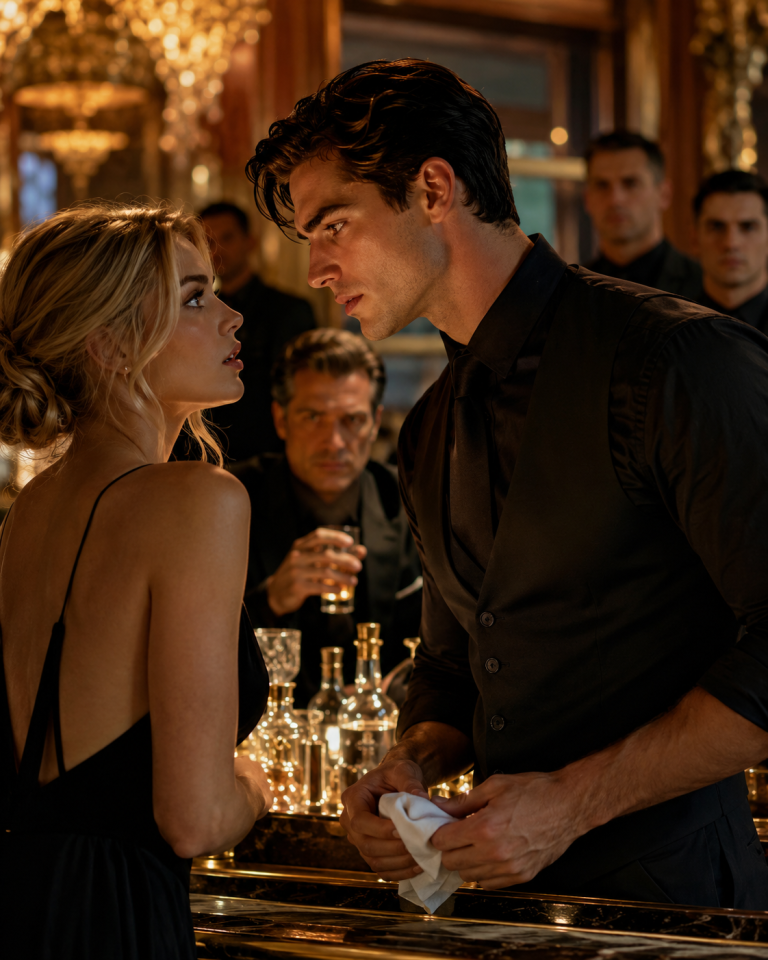
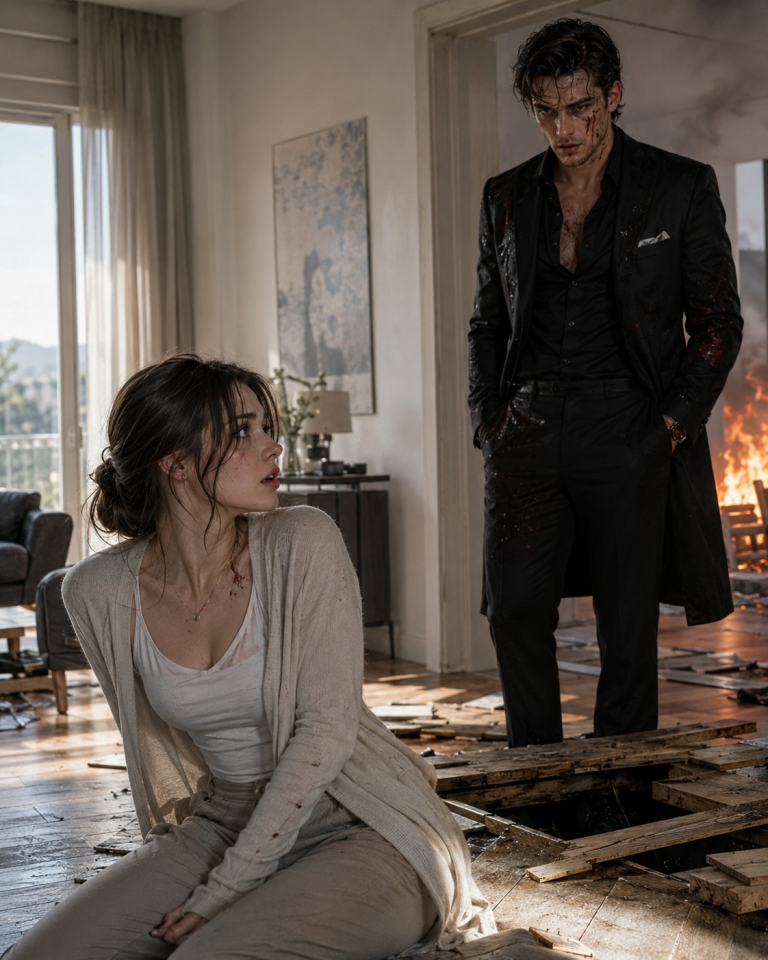
She Said “Don’t Touch Me”—Then the Mafia Boss Saw the Bruises and Unleashed Chaos

## PART 1
I had been trained to smile through worse than a wedding.
That was the thought moving through me as the cathedral doors opened and the organ swelled and three hundred people rose to their feet — not for me, never for me, but for the occasion of me, for what the Alderton name transferred to the Malone family on this particular morning and what the exchange would cost each side in influence and debt and continued silence.
My name is Cecily Alderton. I am twenty-three years old. I have a degree I was not permitted to use, a room in my father’s house that had a lock on the outside, and bruises across my left shoulder that the tailor had been paid to ignore.
I had never met Ronan Malone before today.
I knew what he was. Everyone in Chicago knew what the Malones were — three generations of men who moved money and men and fear through this city with the efficiency of infrastructure. Not loud about it. Not theatrical. The Malones did not need to perform power. They simply held it, the way old buildings hold water damage: silently, until the weight became visible.
Ronan had taken the seat at the head of that table eighteen months ago, after his father’s heart attack. He was thirty-four. He had a reputation that circulated in the specific circles my father moved in — controlled, precise, willing to make decisions that quieter men avoided. The city feared him the way it feared weather: not personally, but with respect for what he was capable of.
My father had arranged this marriage over two dinners and one round of golf.
I had not been consulted.
This was not surprising.
I walked down the aisle on my father’s arm. He held me firmly, the way you hold something you are delivering rather than accompanying. I kept my eyes on the altar, on the priest, on the candles — anything but the faces turning toward me in the pews, cataloguing my dress, my posture, my expression for whatever story they were already building about this alliance.
At the altar, my father released my arm.
Ronan Malone stood before me.
He was taller than I had expected. Broad through the shoulders, in a dark suit that looked like it had been made for a funeral and worn to a wedding by decision rather than accident. His face was angular, closely shaved, carrying the particular quality of a man who spent a great deal of time not showing what he was thinking. His eyes were gray and watchful, and when they found me, they did not move away.
He looked at me the way I was not used to being looked at.
Not through me. Not past me. Not at the dress or the Alderton name or the calculation of what this marriage bought him.
At me.
I did not know what to do with that.
The ceremony moved in the way ceremonies do when the participants are performing for an audience rather than each other. Vows spoken clearly. Rings exchanged with steady hands. The priest smiled throughout. My father stood in the front pew with his hands clasped and the expression of a man completing a transaction.
Then came the moment I had been dreading since the morning.
Ronan reached for my veil.
My body reacted before my mind could prevent it.
The flinch was small. A tightening across my shoulders, a fractional backward lean, the kind of involuntary movement that belongs to a body that has learned, over a long time, to anticipate impact.
He saw it.
His hands slowed.
Did not stop — stopping would have been visible, would have required explanation, and Ronan Malone was clearly a man who did not invite explanation — but slowed, made the gesture deliberate, lifted the veil back with the careful precision of someone handling something that could break.
He looked at my face.
And in the silence between the vow and the kiss, in the space where only he could hear me, I said the thing I had not planned to say: “I’ll do whatever you need me to do. I just — please don’t hurt me.”
Something crossed his face.
Fast. Controlled. Gone before anyone behind him could read it.
He kissed my forehead instead of my mouth. A small deviation. The kind that a hundred guests would interpret as tenderness.
Only I understood it as something else.
A decision.
The reception moved around me like weather I was standing inside. I ate nothing. I smiled the way I had been taught to smile — fully, warmly, holding the expression long enough to photograph well. My mother adjusted my hair twice and told me I looked lovely. My father shook hands with Ronan’s associates and laughed at things they said. The city’s power moved through that room the way blood moved through a body, and I was simply the mechanism that had facilitated the flow.
By eight o’clock we were in the car.
By nine we were inside the Malone estate.
I stood at the window of a bedroom I had never seen before, watching fog move across a lawn that did not belong to me yet, wearing a dress that cost more than I had ever chosen to spend on myself, and I waited for footsteps in the hall.
They came at ten-fifteen.
—
## PART 2
He did not open the door the way I expected.
No sharp movement. No announcement of his presence by the authority of it. He knocked once, which was already more than I had been given in a long time, and waited two full seconds before the handle turned.
Ronan entered the room with his jacket gone and his sleeves rolled to the forearm. There was a fresh cut across his right hand that had not been there during the ceremony. He looked at me standing rigid at the window and stopped several feet away.
“You didn’t eat anything tonight,” he said.
I turned from the window. “I apologize. I should have—”
“I wasn’t criticizing.”
The correction landed quietly. I wasn’t criticizing. The distinction between observation and judgment, stated simply, as if it were the most natural thing in the world.
I did not know what to do with that either.
“We should establish what this marriage is,” he said. “I don’t require affection. I don’t require performances. What I do require is honesty, which is a different thing than what your family trained you to give.”
“I’ll be a good wife,” I said.
“That’s not what I asked for.”
He stepped closer. Far enough away to be non-threatening, close enough that I could see the gray of his eyes and the deliberate quality of his stillness. He moved like a man who had learned long ago that his physical presence carried weight, and had decided to be responsible about it.
“You flinched in the church,” he said. “You flinch now, before I’ve done anything. And you’ve been standing at that window since we arrived like you’re calculating exits.”
My throat tightened.
“I’m not—”
“Who hurt you?”
The question arrived without preamble, without softening, and it hit me the way direct questions always hit people who have been answering indirect ones for years.
“Nobody,” I said. Too fast.
Ronan looked at me for a long moment.
“Okay,” he said.
Not satisfied. Not convinced. Just: okay. As if he understood that trust was not a thing you could demand from someone in the first hour of a forced marriage, and he was willing to wait.
“The bedroom is yours,” he said. “I’ll use the adjoining room. The doors aren’t locked from the outside. There’s food downstairs if you need it at any hour.”
He turned toward the door.
“Ronan.”
He stopped.
“Why are you—” I didn’t know how to finish the sentence. *Being kind* felt presumptuous. *Doing this* was too vague.
“Because someone taught you that kindness comes attached to a cost,” he said quietly, without turning around. “I’m not interested in teaching you the same lesson.”
He left.
I stood in the center of the room for a long time afterward, trying to locate the trap in what he had just said.
I could not find one.
That was the most frightening thing that had happened all day.
—
## PART 3
I woke at three in the morning to the sound of a man crying.
Not loudly — controlled, suppressed, the specific sound of someone trying very hard to contain something that was escaping anyway. It came from below, muffled by floors and walls and the general thickness of a house built for privacy.
I sat in the dark and listened.
Then I heard a second sound: a low voice, male, asking a question. Then a higher voice answering — strained, desperate. Then a crash that I felt in my sternum before I heard it.
I was out of the bedroom before I had decided to move.
The hallway was lit by wall sconces turned low. The staircase curved down into the entrance hall, and from there a door stood partly open toward the back of the house. Light came through it, and sound.
I stopped in the doorway.
Two men stood flanking a third who sat in a chair — zip-tied, not with rope, which told me something about the organization of this. The man in the chair had been crying. I could see it in the redness around his eyes, in the wet that had tracked down his face and dried there. He was middle-aged, well-dressed in a suit now ruined at the knees and lapels.
Ronan stood in front of him.
Jacket off. Hands at his sides. Completely still.
“You’ve had six months,” Ronan said.
“I know, I know, I—”
“And you’ve stolen from me for four of them.”
“It wasn’t — I needed to — my son is sick, my wife—”
“I know about your son,” Ronan said. “I know about the hospital bills.”
The man blinked through his panic.
“I’ve known for three months,” Ronan continued. “I was waiting to see whether you’d come to me.”
Silence.
“Why didn’t you come to me?”
“Because I was afraid—”
“Of what?”
The tied man looked at the floor.
Ronan crouched to his level. Not threatening — equalizing. “I put men in the ground for betrayal. You know that.”
“Yes.”
“What I don’t do is execute fathers of dying children without first asking why they made the choice they made.” He stood. “So tell me. Exactly what you took, exactly how much, and exactly what you needed it for. All of it.”
The next twenty minutes were quiet and methodical and nothing like what I had been imagining behind the door. The man told him everything. Ronan listened without interrupting. One of the men flanking him took notes. At the end, Ronan was quiet for a moment.
“The debt is forgiven,” he said. “Your son’s bills for the next six months come out of my account — separately, with no obligation attached. You will return to work Monday, and you will tell no one about this conversation.”
The tied man stared at him.
“In exchange,” Ronan said, “when you’re ready, you’ll come to me with the things you should have come to me with before. That’s all.”
I stepped backward from the doorway before he could see me.
But I was not fast enough.
His gaze found the shadows in the hall.
“Cecily.”
I stopped.
“Come in or go back to bed,” he said quietly. “Standing in doorways is its own kind of exposure.”
I stepped into the light.
The tied man looked at me with the wide, wet eyes of someone who had just survived something and was still processing whether it was a trap.
“You’ll excuse us,” Ronan said to his men.
They began moving without complaint.
“What were you going to do to him?” I asked.
Ronan looked at me steadily. “What I said.”
“Before tonight. If he hadn’t had a reason.”
“Something considerably less forgiving.”
I absorbed this.
“Why does the reason matter to you?”
He seemed to consider the question genuinely. “Because men make bad decisions for reasons. The reasons determine whether the problem is character or circumstance.” He looked at the man still in the chair, now being helped free by one of the remaining guards. “Character problems I don’t fix. Circumstances I sometimes can.”
I watched the tied man stand, unsteady, and be guided toward a side door.
“That’s not what I expected from this house,” I said.
“No. I imagine not.”
He looked at me with the same quality of attention from the church — direct, unhurried, reading something he was not yet ready to say aloud.
“Go back to sleep,” he said. “We’ll talk properly tomorrow.”
I went back upstairs.
I did not sleep for a long time.
—
The morning came gray and cold and arrived with a meal left outside my door — hot tea, toast, fruit, left by someone who had understood not to knock, just to leave it where I would find it when I was ready.
I ate alone at the window and watched the estate wake up.
Ronan found me mid-morning in the library, which was the room I had drifted toward instinctively — floor-to-ceiling shelves, morning light coming through tall windows, the particular quiet of a space full of books that had actually been read.
He stopped in the doorway.
“You’ve made yourself at home,” he said. Not critical. Noting.
“I hope that’s all right.”
“It’s your home.”
The word landed strangely. Home. I had not lived somewhere that felt like that in years. My room at my father’s house had been comfortable and controlled and fundamentally not mine in any way that mattered.
“I want to ask you something,” I said.
He came to sit in the opposite chair. Close enough for conversation, far enough to give me room.
“Ask.”
“Last night. The man in the chair. Did you know before the wedding that I would see that? Or was it coincidental?”
He looked at me with something like respect moving through his expression. “You’re asking whether it was staged to create an impression.”
“Yes.”
“It wasn’t. He arrived at eleven. I handled it when it needed handling.” He paused. “But I’m not surprised you wondered.”
“Why?”
“Because someone taught you to look for manipulation behind kindness.” He held my gaze. “I want to be honest with you about what this house is and what I am. I’m not interested in building something on a foundation you’ll eventually discover was false.”
I looked at him carefully.
He had gray eyes, this man my father had sold me to. They were the clearest thing about a face that was otherwise difficult to read. In them I could see something I had not anticipated encountering in this marriage: a person who was genuinely trying to do something right, in a world where right was complicated and he had never claimed otherwise.
“I had a fiancé before this,” I said.
Ronan went still.
“My father arranged it. Before the Malones.” I pressed my hands flat on my knees to keep them steady. “His name was Garrett Holloway. Old family. Good name. My father liked him.”
“What happened?”
“The alliance became less favorable. My father negotiated a better arrangement.” I paused. “By then Garrett had been — engaged to me — for fourteen months.”
“He hurt you.”
It was not a question. He had read the space between my words with the same attention he applied to everything else.
“He had a specific quality of anger,” I said. “The kind that doesn’t announce itself. The kind that waits for a closed door.”
The room was very quiet.
“Does your father know?”
“My father arranged the introduction, managed the engagement, and collected two substantial gifts from Garrett’s family during the fourteen months.” I felt the words come out flat and certain, the way things come out when you have examined them so many times they’ve lost their capacity to hurt you in the immediate sense. “He knew what Garrett was.”
Ronan stood.
Not fast. But with the particular quality of a man who has arrived at a decision.
“I need to make some calls,” he said.
I looked up at him. “What are you going to do?”
“Handle something that should have been handled before your father turned it into a business arrangement.”
“Ronan—”
He turned.
“You should understand something,” I said carefully. “Garrett has lawyers. Friends in the DA’s office. He has survived three previous complaints from women whose families had significantly more resources than mine.”
Ronan’s expression did not change.
“I know,” he said.
“Then you know he’s insulated.”
“He’s insulated from the things those women had access to.” He held my gaze with the steady certainty of a man who understood exactly what he was and had made peace with it. “He’s not insulated from me.”
He walked out.
I sat in the library with the morning light moving across the shelves and thought about what it meant that the most dangerous man in Chicago had just told me, with complete calm, that the person who had hurt me was his problem now.
I did not know whether to be frightened or relieved.
I decided it could be both.
—
I found out at noon what Ronan’s calls had set in motion.
Not from him — from the television in the small sitting room off the kitchen, where I had gone for a second cup of tea and found one of the household staff watching the news with the focused attention of someone following a developing story.
Garrett Holloway’s financial services company was under federal investigation. A tip had arrived at the FBI’s Chicago field office in the early morning hours, accompanied by documentation that had apparently been compiled over a significant period of time — records of offshore accounts, fabricated valuations, a client fraud scheme spanning four years.
By one in the afternoon, three of Garrett’s business partners had retained separate counsel.
By three, two city officials had stopped returning his calls.
Ronan returned to the house at five, and he came straight to the library where I had spent most of the afternoon, and he sat down across from me without preamble.
“The financial fraud case will hold him for years,” he said. “The women who filed the previous complaints have been contacted by a federal victims’ advocate. If any of them choose to refile with the existing financial investigation as context, the DA’s insulation becomes a liability rather than protection.”
I stared at him.
“What about my father?”
A pause.
“Your father is a more complicated problem.”
“He knew,” I said. “About Garrett. About what he was.”
“I know.”
“He—” My throat tightened. “He received gifts during the engagement. While it was happening. He collected gifts while it was happening.”
Ronan’s jaw tightened. One degree. Barely visible.
“I know,” he said again. More quietly.
“What are you going to do about him?”
“I’m going to give you the choice about that.”
That surprised me more than anything he had said yet.
“What?”
“He’s your father. Whatever I do will affect your life, not just his. I’m not going to make that decision without you.”
I looked at him for a long moment.
“Tell me the options.”
He told me.
The options were not gentle. They were calibrated — specific consequences for specific actions, the kind of precision that came from a man who had spent years thinking about power as a tool rather than a performance. Some options were financial. Some were structural. One option involved federal investigators and documents that Ronan had apparently been sitting on for longer than tonight.
“This last one,” I said. “The federal documents. How long have you had them?”
“Eight months.”
“You had them before the wedding.”
“Yes.”
“Before my father agreed to this marriage.”
He was quiet.
“So you knew what my father was before you agreed to this arrangement,” I said slowly, “and you came into it anyway.”
“I came into it because your father needed to believe he was the one controlling the terms,” Ronan said. “Men like him make mistakes when they believe they’re in control.”
I sat with that for a long moment.
“You used the wedding.”
“I used the negotiation. The wedding was incidental.”
“And me?”
He looked at me directly. “You were never part of the calculation. When I understood what the arrangement would mean for you specifically — not for the Alderton name, but for you — I made decisions about what I was willing to do and what I wasn’t.”
“What weren’t you willing to do?”
“Collect you like property and treat you accordingly.”
The simple honesty of it sat in the room between us.
“What is it you actually want from this marriage?” I asked.
He was quiet for a moment.
“A partner,” he said finally. “Not in the organizational sense. Someone who is actually here. Who understands this world and chooses to navigate it alongside me rather than someone I’ve placed inside a gilded problem.” He paused. “That may not be what you want. I understand that.”
“You’ve known me for less than a day.”
“Yes.”
“You can’t know what you want from someone you’ve known for less than a day.”
“No,” he agreed. “But I can know what I don’t want. And I don’t want what my father had. A wife who disappeared into this house and became invisible and died at sixty having given everything and received nothing.”
The afternoon light had gone flat and gray.
“My father’s case,” I said. “I want the federal option.”
Ronan looked at me.
“I want it documented. In court. Public.” I met his gaze steadily. “I want there to be a record that says what he did. Not just a private ruin — a record.”
Something crossed Ronan’s expression.
“All right,” he said.
“And Garrett. I want to know when the women who filed before are contacted. I want to know what they decide.”
“I’ll make sure you hear it directly.”
I nodded.
“One more thing.”
“Name it.”
“I’m not going to be afraid of you,” I said. “Not because you’ve been kind to me today, because one day is not enough to build on. But because I’ve spent three years afraid and I’m done choosing it. Whatever happens in this house, I’m done choosing it.”
Ronan’s expression shifted. Something quiet and real moving through it.
“Good,” he said.
—
The investigation moved quickly.
Ronan’s people were thorough in ways that federal investigators were not, not because they operated differently in method, but because they had been gathering material for longer and with a precision that left very little room for evasion. My father’s lawyers spent the first week issuing statements. By the second week, they were negotiating separately from him. By the third, two of them had withdrawn from his representation entirely.
Garrett Holloway’s case consolidated with the new victim statements into something substantial enough that the DA’s friends stopped being useful. His lawyers were excellent. His conviction was not certain. But the insulation he had believed in — the names, the favors, the powerful people who had found it more convenient to look away — that insulation dissolved in the specific way that self-interest dissolves when the cost changes.
I learned all of this slowly, in pieces, from Ronan in the evenings.
He had a habit of finding me after dinner — in the library, or in the garden when the weather allowed, or once in the kitchen at eleven at night where I had gone for tea and found him already there with a book he was not reading. He sat across from me and told me what had happened that day, not the full strategic picture, but the things I had asked to know. He always asked what I wanted to know before assuming.
That was the part I could not stop noticing.
He always asked.
Six weeks into the marriage, he found me in the library with my shoulder against the window frame, watching rain.
“What are you thinking about?” he asked.
“My mother.”
He sat down.
I had not talked about my mother. I had thought about her often — the specific texture of her complicity, the way she had adjusted my sleeves and looked away, the things she must have known and had chosen not to intervene in. I had been carrying the weight of that complicated grief for years, the particular grief of realizing that someone you needed protection from was also someone you had needed protection from within.
“She knew,” I said. “She knew what Garrett was doing. She saw the bruises. She told me not to upset him.”
Ronan said nothing.
“I used to think she was weak,” I said. “Now I think it’s more complicated than that. I think she was afraid too. I think she’d been afraid for so long it became the whole architecture of her life and she didn’t know how to dismantle it without dismantling herself.”
“That doesn’t make it forgivable,” Ronan said carefully.
“No. But it makes it understandable.” I turned from the window. “There’s a difference between the two.”
He looked at me with an expression I was beginning to recognize — the one that appeared when I said something he had not expected and was taking seriously.
“What are you going to do about her?” he asked. It was the same question he had asked about my father. Not what should I do. What are you going to do.
“I don’t know yet,” I said. “I think I need to talk to her.”
“Do you want to do that here or somewhere else?”
I thought about it.
“Here,” I said. “I want to do it on ground where I can leave the room if I need to.”
He nodded. “I’ll arrange it.”
“I don’t need you present.”
“I know. I’ll arrange it and stay out of it.”
I looked at him.
“Why do you keep doing that?” I asked.
“Doing what?”
“Offering things and then removing yourself from them. Making space.”
He was quiet for a moment.
“Because you’ve spent a long time in rooms where all the space belonged to someone else,” he said. “You need to learn what it feels like to have your own.”
I did not have a response for that.
I looked out at the rain instead, which was moving in sheets across the garden, and I thought about the question I had been circling for weeks — whether this man was what he appeared to be, or whether I was simply learning to mistake a different kind of control for safety.
I thought about the employee from the first night. The way Ronan had listened before deciding. The way he had asked why instead of only responding to what.
I thought about the way he had slowed before lifting my veil.
“Ronan,” I said.
“Yes.”
“I’m not ready to trust you.”
“I know.”
“But I’m less afraid of you than I was six weeks ago.”
He looked at me steadily. “That’s enough for now.”
“It might take a long time.”
“I have time.”
Outside, the rain was easing into something lighter, the sheets becoming scattered and then intermittent, the gray of the afternoon starting to thin at its edges.
“Tell me something true,” I said. “Not about the cases or the investigation. Something about you.”
He was quiet for a moment.
“My father used fear the way other men used money,” he said. “It was currency. You bought loyalty with it, bought silence with it, bought compliance. He was very good at it.” A pause. “I understood from a young age that the things he bought with fear were not actually loyalty, or silence, or compliance. They were performances. The real things were somewhere else, and fear kept you from reaching them.”
“So you decided not to use it.”
“I decided not to use it the way he did. I still use it. I’m not naive about what this world requires.” He looked at me directly. “But I try to reserve it for people who’ve earned it.”
“How do you decide who’s earned it?”
“By what they choose to do with power when they have it.”
I sat with that for a long moment.
“And me?” I asked.
“You’ve been given no power your whole life,” he said. “That’s not a thing you choose. It’s a thing that’s done to you.”
“And now?”
He leaned forward slightly.
“Now you’re in a house that belongs to both of us. With access to resources I haven’t restricted. With the full picture of your father’s case and Garrett’s case as they develop.” He held my gaze. “If you decide at any point that leaving is the right decision, you have enough information to leave safely. I’ve made sure of that.”
I stared at him.
“You’ve made it possible for me to leave?”
“I’ve made it so the decision to stay or go is actually yours.” He sat back. “That’s not a thing that’s been true for you before.”
The rain had stopped entirely. The garden was wet and still, everything darkened and clarified by the water, the last daylight coming through at a low, honest angle.
I had spent three years learning to read danger in the spaces between words. I had learned what men looked like when they were performing safety as a technique. I had learned the specific quality of a room right before it became dangerous.
This room was not that.
“I’m going to stay,” I said.
Ronan did not look relieved. He did not look triumphant. He looked like a man receiving information that he would think about carefully before drawing conclusions from.
“For now,” I said. “I’m staying for now.”
“That’s enough,” he said.
—
Spring arrived in Chicago the way it always did — late, grudging, finally making good on weeks of false promises. The estate’s garden came back slowly, the hedges greening before the flowers, the lawn recovering its color in uneven patches.
I learned the house room by room.
The kitchen, which had a cook who tolerated my presence with progressive warmth when she understood I was not inspecting but curious. The east study, where Ronan worked in the mornings and where I was welcome if I needed something and silent if I didn’t. The garden in the evenings, which we had fallen into the habit of walking after dinner when the weather allowed — not always talking, often just moving through the same space in the same direction, which was its own kind of language.
My mother came in February.
The conversation lasted two hours and left me exhausted and unresolved in the specific way of conversations that go to the truth and find something complicated there. She cried. She explained. She did not excuse herself, which surprised me. She said things I had not known she was capable of saying: that she had been afraid, that she had told herself it was manageable, that she had believed her silence was protecting me from something worse rather than contributing to the thing itself.
I did not forgive her that day. I am not sure forgiveness is the right word for what I am working toward. But I stopped carrying the story I had told myself about her — the one where she was purely complicit rather than a person who had been broken in her own right and had broken others as a result.
That felt like something.
My father’s case reached a federal grand jury in March. Garrett Holloway’s trial date was set. Two of the previous complainants had refiled. A third came forward who had never filed at all.
Ronan told me each development directly, in the evenings, and asked each time what I wanted to do with the information.
I was present at nothing. I testified to nothing. What I gave to the process was the documentation I produced for the federal advocate — my own account, written carefully over three weeks, with dates and specifics, in the clear language of someone who had spent months deciding what words to use. Whether it would be needed, I did not know. Whether it would change anything for the women who came after, I did not know either.
I knew that I had said the true thing in writing and it existed now, outside my own memory.
That was something.
—
One evening in April, I found Ronan standing at the garden’s edge watching the city lights begin to emerge against the darkening sky. He heard me coming and did not turn until I was beside him.
“You’re outside,” he said.
“It seemed like a good night for it.”
We stood together for a moment.
“Ronan.”
“Yes.”
“When I asked you, months ago, what you wanted from this marriage — you said a partner.”
“I remember.”
“I want to ask you what that means to you. Specifically.”
He turned to look at me.
“Someone who tells me the truth,” he said. “Even when the truth is that they’re uncertain, or angry, or not ready. Someone who holds this world with me rather than being held inside it.”
“You said you didn’t want what your father had.”
“No.”
“But you are your father’s son. You do what he did, in the ways this city requires.”
“Yes.”
“Is that — are you at peace with that?”
He was quiet for a moment, genuinely quiet, the silence of a man thinking rather than formulating.
“I think about it,” he said. “I don’t think peace is the right word. I think there are things I’m responsible for and I try to be responsible for them clearly, without pretending they’re different from what they are.”
“That’s not quite an answer.”
“No. It’s as close as I can get honestly.”
I looked out at the city — that restless, hungry, enormous thing that this man understood and moved through and had helped build in ways I was still learning.
“I want to learn how it works,” I said. “Not to manage it. Not to be managed by it. I want to understand the thing I’m living inside.”
He looked at me.
“What parts?”
“All of it, eventually. Starting with the parts you’re willing to explain.”
“That might take years.”
“I have time,” I said, using his own words back at him.
Something shifted in his expression — brief, warm, quickly settled into something quieter.
“There are things in it I’ll need you to accept without full explanation,” he said. “Not to deceive you. Because the full explanation carries costs I can’t ask you to carry.”
“I’ll tell you when I’ve hit a limit.”
“All right.”
“And when I’ve hit a limit, I expect you to take that seriously.”
“I always have.”
I turned to face him.
The man my father had sold me to, who had slowed before lifting my veil because he had seen me flinch, who had left meals outside my door and given me access to exits I hadn’t asked for and asked before touching and listened before deciding and told me, consistently and without drama, the true thing rather than the comfortable one.
“I’m still not sure I trust you,” I said.
“I know.”
“But I think I want to try.”
He was quiet for a long moment.
“That’s more than I hoped for,” he said.
Outside, Chicago shimmered and hummed and went about its dangerous beautiful business.
Inside the estate garden, for the first time in longer than I could accurately count, I was not performing composure or enduring a situation or waiting for the other shoe. I was standing in my own life, making a decision that was actually mine, with a man who had understood — without being told — that the most important thing he could offer me was the reality of the choice.
I reached for his hand.
He did not move. Waited.
I placed my hand in his.
After a moment, his fingers closed around mine. Carefully. Without pressure.
The city moved on below us.
Fear, I was learning, could end.
Not all at once. Not cleanly. Not without the work of learning a different way to stand in a room.
But it could end.
That turned out to be the most important thing anyone had ever told me.
Even if I had to learn it by discovering it was true.
—
**THE END**